As a result of the announcement, BTIG increased its target price on Forty Seven from $40 per share to $95.50, the price Gilead will pay for the company, which amounts to about $4.9 billion. This reflects “a material premium over even our prior $60.48 takeout valuation, likely reflecting a very competitive process,” Hazlett commented.
The California-based biopharmaceutical firm is developing anti-CD47 antibodies that will stimulate the immune system and that could be used in various cancers.
Gilead reportedly pursued Forty Seven for three key reasons, Hazlett indicated. The company’s margrolimab (5F9) is at an advanced stage in the clinic, its myelodysplastic syndrome (MDS) and acute myelogenous leukemia (AML) programs combining margrolimab and azacitidine are progressing and potential exists for rapid U.S. Food and Drug Administration approval of the antibody. Thus, Hazlett deduced, the Phase 1b updates on the MDS and AML programs, to be provided at the American Society of Clinical Oncology’s annual meeting from May 29 to June 2, 2020, are expected to be favorable.
Hazlett noted the two catalysts for Forty Seven in Q1/20. One, the biopharma plans to start a single-arm, 100-patient trial of 5F9 in diffuse large B-cell lymphoma to evaluate overall response rate and durability. Interim data from this trial are expected in H2/20.
Two, the company will announce results from the Phase 1b ovarian cancer trial evaluating combination therapy, 5F9 and avelumab, likely the first clinical data available for 5F9 plus an anti-PD-L1. “Positive safety and efficacy data could support broader discussions for collaborations in ovarian and other cancers,” noted Hazlett.
Disclosure: 1) Doresa Banning compiled this article for Streetwise Reports LLC and provides services to Streetwise Reports as an independent contractor. She or members of her household own securities of the following companies mentioned in the article: None. She or members of her household are paid by the following companies mentioned in this article: None. 2) The following companies mentioned in this article are billboard sponsors of Streetwise Reports: None. Click here for important disclosures about sponsor fees. 3) Comments and opinions expressed are those of the specific experts and not of Streetwise Reports or its officers. The information provided above is for informational purposes only and is not a recommendation to buy or sell any security. 4) The article does not constitute investment advice. Each reader is encouraged to consult with his or her individual financial professional and any action a reader takes as a result of information presented here is his or her own responsibility. By opening this page, each reader accepts and agrees to Streetwise Reports’ terms of use and full legal disclaimer. This article is not a solicitation for investment. Streetwise Reports does not render general or specific investment advice and the information on Streetwise Reports should not be considered a recommendation to buy or sell any security. Streetwise Reports does not endorse or recommend the business, products, services or securities of any company mentioned on Streetwise Reports. 5) From time to time, Streetwise Reports LLC and its directors, officers, employees or members of their families, as well as persons interviewed for articles and interviews on the site, may have a long or short position in securities mentioned. Directors, officers, employees or members of their immediate families are prohibited from making purchases and/or sales of those securities in the open market or otherwise from the time of the interview or the decision to write an article until three business days after the publication of the interview or article. The foregoing prohibition does not apply to articles that in substance only restate previously published company releases. 6) This article does not constitute medical advice. Officers, employees and contributors to Streetwise Reports are not licensed medical professionals. Readers should always contact their healthcare professionals for medical advice.
Disclosures from BTIG, Forty Seven Inc., March 2, 2020
Analyst Certification I, Robert C. Hazlett, hereby certify that the views about the companies and securities discussed in this report are accurately expressed and that I have not received and will not receive direct or indirect compensation in exchange for expressing specific recommendations or views in this report. I, James Colby, hereby certify that the views about the companies and securities discussed in this report are accurately expressed and that I have not received and will not receive direct or indirect compensation in exchange for expressing specific recommendations or views in this report.
The research analyst(s) responsible for the preparation of this report receives compensation based upon a variety of factors, including the quality and accuracy of research, internal/client feedback, and overall Firm revenues.
CompanySpecific Regulatory Disclosures
BTIG LLC expects to receive or intends to seek compensation for investment banking services in the next 3 months from: Forty Seven, Inc. (FTSV)
BTIG LLC has received compensation for investment banking services in the past 12 months from: Forty Seven, Inc. (FTSV)
BTIG LLC had an investment banking services client relationship during the past 12 months with: Forty Seven, Inc. (FTSV)
Welcome to this week’s Market Wrap Podcast, I’m Mike Gleason.
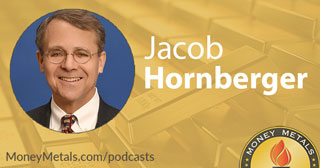
Coming up we’ll hear from a first-time guest Jacob Hornberger, founder and president of The Future of Freedom Foundation, author of the book My Passion for Liberty and also the winner of all three of this week’s Presidential primaries for the Libertarian party.
Jacob tells us how both the major political parties in America have been engaged in socialism, why he believes the Federal Reserve needs to be abolished, and how gold and silver can help to restore our broken monetary system. So, don’t miss a fascinating interview with one of the leaders of the modern-day libertarian movement, Jacob Hornberger, coming up after this week’s market update.
Another tumultuous week in equity and interest rate markets has helped fuel a big pop in safe-haven demand for gold and silver.
The major market moving event was, of course, the Federal Reserve’s emergency rate cut on Tuesday. The Fed slashed its overnight funds rate by 50 basis points. But even before the Fed acted, the bond market had already forced its hand as yields on the 10-year Treasury note plunged to record low levels.
By Friday morning, the 10-year treasury yielded less than a paltry 0.90%. That represents almost no reward in exchange for the risk involved. Bond buyers are apparently willing to make a decade-long bet on U.S. government finances remaining solid and inflation remaining extremely low.
It’s still possible for bonds to experience capital appreciation if rates ultimately head to zero or below – as they have already done in other parts of the world. The Fed is almost certain to cut rates again. There is a good chance at least some portion of the yield curve will be at zero later in the year.
As central bankers act furiously to devalue cash assets, the U.S. dollar is likely to come under downside pressure. If for no other reason than the Fed still has room to cut rates further while much of the rest of the developed world has already run out of conventional tools to depreciate their currencies.
There has been a lot of talk of “coordinated action” among world central banks. Perhaps they will all get together and roll out some sort of global quantitative easing or other unconventional forms of stimulus. Since zero and even negative interest rates haven’t had the desired effect, maybe they will just try dropping cash out of helicopters – or whatever the digital equivalent may be.
Gold is emerging as the strongest currency in the world since the outbreak of the coronavirus. Although the monetary metal got hammered in futures markets in last Friday’s trading, it has quickly recouped those losses. Gold is posting a healthy 5.0% gain this week to bring spot prices to $1,668 per ounce.
Gold is showing tremendous relative strength versus the stock market, which continues to swing wildly on a daily basis. The Dow Jones Industrial Average has so far suffered just a sharp correction in the big picture. It was just a month ago that the blue-chip average was hitting new record highs.
But when measured in terms of gold, the Dow is in a major bear market. In fact, the Dow:gold ratio dropped this week to a 3-year low of 15.6:1.
Another ratio we monitor closely is the gold:silver ratio. It is now trading at an extreme high of just over 96:1. You’d have to go all the way back to 1991 to find gold selling at a more elevated premium to silver – and then only briefly.
If coronavirus fears continue to drive markets, then gold could potentially spike to 100 times the silver price. But we suspect that when markets finally calm down and prospects for the global economy improve, silver will begin playing catch-up to gold. And it has a long way to go to get back to a more historically typical relationship with its more prestigious counterpart.
Silver prices currently check in at $17.26 an ounce and are a posting a 2.6% gain this week.
We are also seeing a big surge in demand for silver bullion products. The U.S. Mint reported that it sold 675,000 Silver Eagles in just the first three days of March. By comparison, it supplied dealers with just 650,000 Silver Eagles for the entire month of February.
Coming off of three years of subpar demand for physical precious metals – the downturn really began after the election of Donald Trump in November 2016 – this year could see a significant rebound.
Although fears of a debilitating global pandemic may fade – and we certainly hope they do – other drivers of bullion buying are likely to persist.
The Fed’s return to zero interest rate policy makes hard money look like an increasingly attractive place to hold wealth. Plus, we could see rising political uncertainties and worries heading into this fall’s election – especially if investors fear the outcome could be bad for Wall Street.
The threat of an overt socialist becoming president seems to have subsided with Bernie Sanders losing several key states to Joe Biden on Super Tuesday. But Sanders is still winning the youth vote overwhelmingly. That large and growing cohort of radical leftists could propel more AOC types into Congress and into powerful positions at the state and local level.
Both Joe Biden and President Trump will talk a lot about unifying the country on the campaign trail. But the reality is that the U.S. is likely to remain as politically polarized as ever. There are no bipartisan solutions in sight for chronic problems such as trillion-dollar budget deficits.
All our big fiscal and economic issues are being handed off to the Fed to handle. The only strategy it has to deal with them is to paper over everything with more fiat dollars.
Well now, without further delay, let’s get right to this week’s exclusive interview.
Mike Gleason: It is my privilege now to welcome Jacob Hornberger, founder and president of the Future of Freedom Foundation, a non-profit educational foundation with a mission to present the principled case for the libertarian philosophy. Mr. Hornberger is a native of Texas, served a number of years in the U.S. Army Reserves and authored a book titled My Passion for Liberty with introductions by Ron Paul and Richard Ebeling, the latter having been a one-time guest on our podcast, as a matter of fact.
He also served as one of the essay judges for the 2019 Money Metals Exchange Scholarship, the first gold back scholarship of the modern era. And perhaps most notably and at the risk of bearing the lead in his impressive bio, last fall Jacob announced his candidacy for president as a member of the Libertarian party and is currently campaigning as he seeks his party’s nomination.
It’s a tremendous honor to have him on with us today. Jacob, thank you so much for the time and welcome, sir.
Jacob Hornberger: Well, thank you, Mike. It’s nice to be here with y’all.
Mike Gleason: Well, let’s begin by having you introduce yourself a little bit more for our listeners, above and beyond the bio I just read, for people that may not be familiar with your candidacy so they can get a sense of what Jacob Hornberger is all about as a person and as a candidate. Let’s begin there.
Jacob Hornberger: Okay. Well, I grew up in Laredo, Texas on a farm on the Rio Grande, just outside the city limits. And I had always wanted to be a lawyer when I was a kid because my dad was a lawyer, I’d always go to court with him. So after college, I went to college of Virginia Military Institute and I got a degree in economics. And then I went to law school at the University of Texas and then started practicing law in Laredo, in partnership with my dad.
And then after about, three years or so, I discovered libertarianism, which just totally changed the course of my life. I started seeping myself in libertarian books, studying everything I could get my hands on and ultimately decided to leave the practice of law, and go to work for a libertarian foundation – the first libertarian educational foundation in the country called the Foundation for Economic Education, which was based in New York.
So, I stayed there a couple of years and then decided I wanted to start my own foundation, non-profit educational foundation that, as you pointed out, presents a very principled and compromising case for the libertarian philosophy and how it’s the only practical approach to the many crises that afflict our land… healthcare, immigration, foreign policy, and so forth.
So, I started FFF in 1989 and I should emphasize that the foundation does not endorse my political candidacy, but I’ve been doing that now for 30 years in the educational arena. And so I finally decided I’d come to a point in my life where I wanted to take on these people who have destroyed our freedom in this country, both Democrats and Republicans in a more direct way. And so I decided I would do that by thinking the Libertarian party presidential nomination. And that’s what I’ve been doing since 2nd of November is campaigning actively tried to win this nomination.
Mike Gleason: Well, excellent. We’ll get more into the inner workings of the Libertarian party and how they go about selecting their nominee for president as it may be. It’s a little bit different than the two major parties, which of course everybody seems to know full well about. And on that front, there’s been some strife within Libertarian party ranks. Some Libertarians think leadership there has not done a great job when it comes to consistency in principles. Gary Johnson and Bill Weld headed the party’s ticket in 2016, but did so without universal support from a good number of people both inside and outside the party. Weld in particular seemed to many like a garden variety RINO Republican rather than a true champion for limited government.
In fact, he joined the Republican party and he’s challenging Trump in the primary. You are on the other hand, the real deal in our opinion and then the timing seems good. It looks to us like there is an opportunity this year, the roster of Democrat candidates is weak and Trump isn’t exactly the most beloved figure in political history. And there will be voters looking for alternatives. The trick will be getting their attention, though.
Do you think you can unite libertarians, Jacob, and how about reaching disaffected voters in the other major parties? Because obviously it’s a real uphill battle given the corporate media isn’t going to be helping much.
Jacob Hornberger: Well, I think that the basic question that everyone in America has to answer for themselves is do you like the direction in which America’s headed? This is a direction of socialism. We can see that reflected by the ascendancy of Bernie Sanders as well as the Democratic party in general, but also with the Republican party. The Republican party claims that they favor a free market system, but they support social security, Medicare, Medicaid. These are the crown jewels of America’s socialist system in terms of the welfare state. And it doesn’t stop there.
There are education grants, farm subsidies, foreign aid, corporate bailouts, the whole realm of welfare state programs. So, if you liked this direction where you’ve got death and suffering, like with the war on immigrants, the foreign wars that are going on, all the foreign interventionism, the coups, the assassinations. If you like this direction, you can vote for either Trump or Biden or Sanders, any of them. It doesn’t matter which one you vote for. Because you’re going to get the same direction. Donald Trump has turned out to be nothing more than a continuation of Barack Obama and George W. Bush.
But if you want a new direction, a different direction, a direction that goes genuinely in the direction of freedom, economic liberty, free markets, private property, and a limited government Republic, then come and join us. Join me. This is my campaign. And when I first started thinking about running, I wasn’t sure of the reaction that I would get from LP members, because the Libertarian party is or is composed of many, many reform-minded type of Libertarians… the ones that are willing to settle for reform of the welfare warfare state, serfdom under which we live.
So, they come up with plans like school vouchers and state health savings accounts and all these did keep the system intact. While I wasn’t sure where I would land in this and how people would respond to a principled message of liberty that entails the dismantling of these programs, including Social Security, Medicare, the Federal Reserve, a free market, monetary system, immigration controls, open borders, free trade and open immigration. And it’s been very gratifying, Mike, because the message is resonating really powerfully within this party. So far, we won three primaries yesterday on Super Tuesday, the three primaries that the LP was in. I won all three of those in Massachusetts, California and North Carolina.
I’ve won straw polls in California, Florida, Arkansas. I won the Iowa caucuses; I won the Minnesota caucasus. This is telling me that that LP members are responding positively to what I’m calling a campaign of principle for the party of principle. The Libertarian party calls itself the party of principle. And ever since I served three terms on the platform committee in the 90s for the national party, I’ve always believed, and I believe more strongly now than ever that are our principles in the Libertarian party are our greatest assets. Not only because they lead to liberty, but also because they are the only practical solution to the crises the Democrats and Republicans have forced it upon our land with their socialism, interventionism regulation and an overall statism.
Mike Gleason: Yeah, very well put. One thing you mentioned there, the Federal Reserve and I want to key on that for a moment. Ron Paul made the case to the American public about the corrupt and anti-free market nature of the Federal Reserve. He is the only candidate in recent memory to make serious political hay with his criticism of the central bank. He got remarkable traction, particularly with young people, but ending the Fed pretty much died as a political issue when Ron Paul left government. The Fed once again operates with impunity, blowing bubbles and distorting the economy. When the bubble pops next time officials there will probably dodge the blame once again. In fact, they will most likely trot out even more extreme policy measures with great cheers from Wall Street of course.
It’s amazing that they keep getting away with this. After all, many of the president’s supporters are fixed income retirees. Trump is leaning hard on the Fed to cut interest rates even further, but people don’t seem worried about what lower rates are already doing to people who rely on interest for income.
So, what will it take for citizens to wake up and start holding the central bank and politicians accountable here, Jacob?
Jacob Hornberger: I think during exactly what Ron Paul did is just speaking the truth. And I think that’s why Ron Paul was so successful and even one of my real life heroes. I mean, it was a real honor when he agreed to write the introduction to my book and it turned out to be a very nice introduction – my book, My Passion for Liberty. Ron spoke the truth and I think that’s what resonated in people and that’s exactly the truth I’m going to speak. The Federal Reserve is really nothing more than a socialist institution.
It’s socialism in the sense that they are involved in central planning, central government planning, which is a core feature of socialism. So, you have a government board that is planning the monetary affair of countless people, hundreds of millions of people. It simply cannot be done as Friedrich Hayek, the Nobel Prize winning Libertarian economist pointed out, this is the pretense of knowledge, what he called the fatal conceit. That people think they can, that government thinks they can plan economic activity, and all they do is create crises and chaos. Ludwig von Mises called it planned chaos.
Well, look what they’ve done since the Fed was established in 1913. They ended up destroying the finest monetary system in history, that our system was founded on gold coins and silver coins. Anybody who reads the Constitution can see that. The Constitution even says, “No state shall make anything but gold coins and silver coins, legal tender.” And the Fed by over-printing the debt instruments, the promise is to pay gold and silver inflated the money supply so much that that’s what ended up leading to the stock market crash in 1929, which of course they blame on the free enterprise system. When it was a direct result of monetary manipulation by the Fed and that’s been documented by economists like Milton Friedman.
Anther Libertarian who won a Nobel prize, Murray Rothbard, the Austrian School of Economics. So, you look at the decade after decade after decade and you’re right, they just print the money to finance ever-growing expenditures of the welfare-warfare state, all their foreign escapades, all their welfare state escapade here and they just debased the value of people’s money. And who paid the biggest price for this? It’s the people at the bottom of the economic ladder like you pointed out, people on fixed income.
And the advantage of this kind of system is that the average person doesn’t realize why prices are rising across society. So, he starts blame it on rapacious businessmen and profiteers and speculators and the Fed just smiles and laughs because they know they’re the ones responsible for it. So, what’s the solution? Yes, in the Fed abolish it, dismantle it and instead of returning to a gold coin, silver coin standard that the federal government manages, which is the second-best alternative; the best alternative is a free market monetary system.
This was pointed out by Friedrich Hayek and in an essay called the Denationalization of Money where you just leave money to the free market. If the free market chooses gold coins, silver coins, American Express bank notes, bitcoins as the money that’s being used or a combination of all the things… the free market produces the best of everything. We’ve learned that both theoretically and practically. So, that’s what I’m calling for is dismantling this whole central planning agency and having a free market monetary system.
Mike Gleason: Do you think sound money has a real chance of revival in the current political climate? Obviously, we heard Trump talk about that on the 2016 campaign trail, haven’t heard much about it since. But where do you think that’s headed? Is it basically going to take a crisis of the currency, a hyperinflationary type of event for people to sort of find religion when it comes to gold and silver as the only true money?
Jacob Hornberger: Well, I hope not because at that time when there’s a big crisis, you don’t necessarily get freedom. Sometimes you get tyranny. I mean, that’s what happened in the Great Depression. The Fed caused the stock market crash. And instead of abolishing the Fed at that point, people turned to Roosevelt and his New Deal, which was just an autocratic authoritarian control over economic activity. And that’s what ushered in social security, which had originated among German socialists. And you had the National Industrial Recovery Act, which was straight out of Benito Mussolini fascist book out of Italy.
So, I would like to think that it can be done before that happens and that’s just the power of ideas. Throughout history, there’s been times when people respond to principles and ideals. This is how we get things like freedom of speech and freedom of religion, and freedom of the press, the right to keep and bear arms, due process of law, the right to be free from unreasonable searches and seizures. It’s because people at that time in history, rose above their daily problems in life and said, “Let’s go for this grand shift in how a society operates by enshrining these basic liberties into law.” And I think that if we happen to hit that kind of period, and I think the time was right, I think people are looking at the Republicans and just shaking their heads. They’re looking at the Democrats and shaking their head.
I think we Libertarians have a tremendous opportunity right now to lift people’s vision and say, “Let’s go for something big.” Let’s lead the world out of this statist mirage, out of the socialism, the intervention is the imperialism, the central planning and lead the world to the highest reaches of freedom that mankind’s ever seen. Now that takes vision, it takes foresight, it takes wisdom. But I think the American people might be ready for something like that.
Mike Gleason: Yeah, certainly takes education as well. And I’m glad there’s people out there like yourself that are trying to move forward that cause and get more people educated. Because that is what it takes. Now, the gold standard has made some rounds in the news again after Judy Shelton’s Fed confirmation hearing. Would you support Dr. Shelton’s confirmation, Jacob?
Jacob Hornberger: Well, it’s not really so much supporting her. I don’t get involved in that because to me, getting better people to run this system is not the solution. You could staff the Fed with nothing but Austrian economics Libertarian professors and it wouldn’t make any difference because nobody is able to manage this system. We already see what the Fed’s doing in response to this coronavirus. I mean, what are they doing? Lowering interest rates. I mean, they are just so weird. What are they saying? “Oh, we’re going to stimulate the economy.” Well, we’ve gone through this bubble bursting syndrome before.
They inflate the bubble with these artificially low interest rates. They encourage businesses to go out and invest in new production because people are buying things now because of these artificial interest rates, and then all of a sudden the bubble burst like it did in 2008 and you have all these people going broke and bankrupt and all because of Fed manipulation. So, I prefer to think in terms not so much in how do we get better people in the Fed, whether it’s Judy Shelton or anybody else. How do we get a better monetary system? And that necessarily means getting rid of the Fed rather than getting better people into the Fed.
Mike Gleason: Yeah, well put. Couldn’t agree more on that. Well, as we begin to wrap up here, Jacob, tell us a little bit about how the Libertarian party selects its nominee for the November general election. Obviously, we had Super Tuesday this week. The libertarian party had a few primaries this past Tuesday. Talk about the process there and how your party goes about selecting a nominee for a November.
Jacob Hornberger: Yeah, it’s really totally different from the Democrats and Republicans. Our nominee is selected 100% by the delegates at the National Nominating Convention, which will be held in Austin, Texas in the latter part of May. Now, how are those delegates selected? Well, each state Libertarian party has a convention, a state convention, where they elect the delegates to the national convention. And I’ve been to around 10 or so state conventions this year already. And in every state convention, there have been more people running for delegate slots than slots available, which is phenomenal.
I don’t know if that’s ever happened before, but it shows the excitement in this party. And I can feel the electricity when I go into these state conventions and participate with speeches or debates and so forth. Now, at the same time, the Libertarian party has been very successful in various states, which has earned them the right of being called major party status. And that entitles them to participate in the primary and caucus system of many states.
So yesterday, we were on the primary ballot in Massachusetts, California and North Carolina. And next week we’re going to be on the Missouri ballot or I’m going to be on the Missouri ballot. I’m the only LP candidate that qualified for that. And then we had caucuses in Iowa and Minnesota, but none of those are binding on the delegates. They just ways to say, “Hey, look, I could win these things. I can campaign. Make me your nominee because this is what I can do.” And so there’s what in classic political parties are called beauty contests. They don’t bind the delegates, but they give some guidance to the delegates that end up at the national convention as to who they want to select to be their nominee.
Mike Gleason: Yeah, we’ll be following it closely for sure. Just one last question before we go. You mentioned Ron Paul obviously being one of your heroes or people you’ve looked up to. Any others throughout history that you’ve taken lots of guidance from or had great respect for?
Jacob Hornberger: Yeah. The man that really changed the course of my life was a man named Leonard E. Read who was the person who founded the Foundation for Economic Education and he published some books in the 50s, or the foundation did, which I discovered in the late 70s and that’s what changed the course of my life. I later wrote an essay for The Freeman, which is published by FEE as it’s called FEE called Leonard Read Changed My Life. And then there’s Ludwig von Mises who I consider, I think most Libertarians consider the greatest economist who’ve ever lived. He’s played a major role in my intellectual development.
Ayn Rand’s Atlas Shrugged and the Fountainhead were major books for me when I was first discovering libertarianism. And then there’s Hayek and Milton Friedman and lots of others… Frédéric Bastiat, Henry Hazlitt. These are not common names in America. I’d like to make common names if I am courted the honor of winning this nomination, because I think every American should know about Frédéric Bastiat and his little book The Law, and Henry Hazlitt’s famous book in libertarian circles called Economics in One Lesson. Any college student who reads Hazlitt’s Economics in One Lesson will know more economics than most of the colleges professors in the country. So I think those are the majors that have had a big role in my life.
Mike Gleason: Well, great stuff. Thanks Jacob, take care and we certainly appreciate you coming on and wish you good luck on the upcoming election. And more importantly, we wish you success in educating the people out there about the importance of liberty and a free society, the harm of government overreach and overregulation and we wish you all the best there. We really appreciate the time. And before we let you go, please tell people how they can learn more about your campaign or anything else they should know.
Jacob Hornberger: Yeah. Well, to learn more about libertarianism, come to my foundation website, which again does not endorse my candidacy, but that’s at fff.org. For people just Google the Future of Freedom Foundation. And then if they want to learn more about my campaign and hopefully maybe support me with a donation come JacobForLiberty.com you can read off my blog that I update regularly.
I have upcoming appearances where people can keep track, the media announcements that are mentioning me and interviews that I do and so those two sites, fff.org and JacobForLiberty.com. And thank you very much, Mike. I’m really appreciative for this nice interview. A big honor for me.
Mike Gleason: Well, absolutely. It’s an honor for us as well and thank you again. Take care. Hope we can speak to you again down the road and a good look on the campaign trail and have a great weekend, Jacob.
Jacob Hornberger: Thank you. You too Mike. Thank you. Bye-bye.
Mike Gleason: Well, that will do it for this week. Thanks again to Jacob Hornberger, founder and president of the Future of Freedom Foundation, found at fff.org and now a candidate for president in 2020. And you can find all the information about his noble efforts there along with ways you can support his candidacy at JacobForLiberty.com.
Well, be sure to check back here next Friday for our next Weekly Market Wrap Podcast. Until then, this has been Mike Gleason with Money Metals Exchange. Thanks for listening and have a great weekend, everybody.
The Money Metals News Service provides market news and crisp commentary for investors following the precious metals markets.
Two weeks ago, we got the preliminary reading of Japan’s Q4 GDP which widely disappointed economist expectations.
The market, however, barely budged. The precipitous drop in Japan’s economic growth was baked into the cake and was easy to explain: taxes.
Despite government protestations that the sales tax hike would have minimal effect on the economy, most analysts blamed Japan’s dismal performance on the October tax hike.
Early on Monday, we get the final reading. Expectations are for this to ratify the already reported -1.6% Q4 (lack of) growth. That means a total cumulative GDP of -0.4% for the year.
This result just manages to technically not fall into the definition of a recession. Q3 growth was just 0.1%, meaning that Japan was only 2 decimals away from falling into recession last year. And unless the economy stages a massive recovery in the next couple of weeks, it’s likely Japan is already in a technical recession.
It’s All About the BOJ
As macro figures have worsened over the last several months, analysts have been constantly asking when the BOJ will step in. Although to be fair, the BOJ has been one of the most accommodative in the world for the longest time.
In fact, many doubt that further rate cuts of increased asset purchases will do anything to help. Some even argue it will make things worse.
In any case, potential action from the central bank is likely to be the longer-term guide for the JPY. At first, there was the potential for coordinated action among central banks, but that didn’t materialize.
In the end, the Fed initiated an unscheduled cut on their own, putting pressure on other central banks. This has pushed speculation that the BOJ may cut the rate further into negative territory when they meet on March 17-18 next.
So, Why the JPY Strength?
As the outbreak of coronavirus has worsened and Japan’s economy has floundered, the JPY has grown weaker.
This opened the question as to whether the JPY was still seen as a safe haven currency, given the unique situation of Japan in the current economic climate. However, as risk appetite diminished significantly, the currency turned around, reasserting its role as a safe haven.
Some are pointing to Kuroda’s recent comments about how the bank might react to the economic fallout from COVID-19. He has insisted on further asset purchases and didn’t even mention rate cuts.
At the same time, he also showed that the bank was more flexible on inflation goals, prioritizing growing the economy over trying to spur inflation. On Feb 21, many traders saw alarming signs of a lack of liquidity among US equities and corporate debt, prompting a rush to safety, and supporting the yen.
Will it Continue?
Japan is most likely already in a technical recession, considering the economic impact that the measures to deal with the COVID-19 outbreak will have on this quarter’s growth.
Even before the virus, Japan’s economy registered negative growth. And with their largest trade partner unable to receive goods due to port closures, it’s hard for the export-oriented country to show growth.
However, now that China is showing signs of reactivation after the number of new coronavirus cases have been dropping steadily, trade and industry might be about to start reactivating in Asia. Too late perhaps for the first quarter… But, maybe by the second quarter, the demand for the safe-haven might finally slow down.
We just closed out our TLT position, which opened up 20.07% from our entry price, amazing. Who said bonds are dull and boring? haha
Only three times since 2008 have I seen bonds rally more than 20% from a new swing trade entry. Each time the move was short-lived, and the price collapsed after it within a few weeks. My goal is not to try and time tops and bottoms for the best entry and exit level. That is a gambler/losing strategy. Sure it pays big if you luck out and nail the timing, but they are few and far between, and the losses from trying will eat up any previous gain.
What I do is follow the price using my proven technical trading experience and tools, which I have acquired since 1997 and then apply position management to limit risk. I then use my trading systems for statistical analysis, so I know the odds for trade are favorable to win and also to pinpoint profit taking levels just like today’s TLT position closure.
Sure, TLT could pop and rally another 5-10%, but its highly unlikely, and it’s fear/volatility driven, so any spike higher from here is likely to drop straight back down shortly after. We got the low-risk easy money portion of the trade, and we are back in cash while everyone today is freaking out and losing money and piling into bonds because of fear, which is likely a top for the price of bonds for a while.
The bottom line, we avoided the stock market crash. We will not be trading inverse ETFs on the stock market until we enter a bear market. Until then, we avoid market corrections by moving to cash, then into bonds just like we have done with TLT. The SP500 is down 14% from the high a few weeks ago, and our TLT bond position is up 20% as of today.
We also made some good money on GDXJ for those who follow our trading strategy and position management. The last couple of weeks has been a tremendous learning experience, in my opinion. The recent price action amplifies how critical position management is (targets, stops) are for our long term trading success. No one knows where the price will ultimately move to or reverse, but through the use of technical analysis and our trading systems, we can consistently pull money out of the market each year.
Yes, we will have small losing trades from time to time like SSO, and UNG but when we do take a loss, they don’t cause much damage to our overall account because of our position sizing and stop levels. I was once told by my trading mentor in 2001 that you should be proud of yourself for taking a loss.
Taking a loss (closing a losing trade) means you are following rules, managing risk, and that you can accept your timing for the trade was wrong. That has stuck with me and pops into my head every time I have to bite the bullet and close out a losing trade.
The stock market is down 9.5% for the year as of today, our account is positive and making money, not many can say that right now. The Power of Technical Analysis!
Remember, successful trading is not about having a bunch of positions you have open, and thinking you always need to own something. It’s about limiting/avoided risk when the odds are unfavorable, and getting back into the market when they do become favorable. Cash is a position and sometimes its the best and only position to be in like right now.
Thanks, everyone, for the kind and uplifting emails, it really is amazing to navigate the market like this with all of you.
Happy Members Making Money!
Hi Chris, Many thanks for your sterling work. The beauty of your work is that you cover all asset classes to identify setups. One key lesson we learnt is to trust the bond market more than the equities market when the trend between the two asset classes diverges. Regards, Yusuf
Hi Chris, I just wanted to send a quick note to tell you how impressed I am with your service and your trading system. I’ve followed/subscribed to several folks over the past several years and have never seen anything like what you provide. Your timely and accurate technical analysis of the major markets is incredible and perfectly aligns with my preferred swing trading approach. My favorite part of the day is watching (and learning from) your morning videos. And to know that my account is steadily increasing in the face of utter market panic is invaluable. Thanks so much for all you do! Ryan M.
If you want to become part of an exquisite trading newsletter where you can learn to reach the charts, spot trades, profit targets, stops, and be force-fed winning trades like this TLT trade, and our GDXJ trade then join my Wealth Building Trading Newsletter Today!
Recent German economic data after the Destatis statistics office reported slower annual growth in fourth quarter of 2019 were mixed: activities in private sector slowed expansion in February, consumer sentiment weakened in March. At the same time data showed retail sales growth ticked up in January, followed by continued rise in construction PMI in February pointing to continued expansion in construction activity. Markit’s Composite PMI declined to 50.7 from 51.2 in January, with the contraction in manufacturing sector continuing while the services sector expansion slowed. Meanwhile the GfK consumer sentiment indicator edged down to 9.8 heading into March 2020 from an eight-month high of 9.9 in February as income expectations and willingness to buy fell on the back of concerns over the impact of the coronavirus outbreak on export oriented German economy. And as the authorities in every single nation endeavor to protect their economies from the toll of the expanding spread of coronavirus infection, worsening disruptions to global business from the coronavirus beyond China are bearish for German stock market index.
By Orbex – Standard and Inverse Head & Shoulders are two sides of the same coin and are the exact opposite of each other. That said, both signal the end of a directional move and hint at a reversal.
A standard Head & Shoulders is always formed at the top of the chart and, upon successful completion, signals a bearish reversal.
An inverse Head & Shoulders is the exact opposite. It is always formed at the bottom of the chart and signals a bullish reversal.
Why Do Reversals Occur?
In hindsight, price reversal occurs when the trend in any one direction is about to end. That is to say, a trend is about to change, either in the short or long term.
The latter usually occurs when fundamentals stop supporting the direction of the ongoing trend due to a drastic shift in economic factors. It could either be that economic data starts to print weaker numbers or, alternatively, better than expected economic activity starts to point to a stronger recovery.
These fundamental factors could very from a shift in monetary policy or, in rare cases, external unforeseeable factors like war or a virus outbreak.
When a reversal is impending, price tends to correct in the opposite direction. Before it corrects, however, it usually goes into a consolidation mode, moving in a zig-zag fashion. Thus, it puts in a pattern that becomes recognizable.
Standard and Inverse Head and Shoulders Patterns
There are many reversal patterns to choose from, but we will discuss the most prominent one.
Head & Shoulders
This is one of the most reliable and prominent reversal patterns a trader can see on a chart.
It is always formed at the top of the trend. When prices trend higher and an H&S pattern appears, it signals an end to the trend and hints at a bearish reversal.
The H&S pattern has three visual characteristic stages to complete:
The price is trending higher; it forms a peak and declines back to its initial base where the price has lifted off from. Price is basically forming the Left Shoulder of the pattern
The price surges up again taking out the previous peak high and forming a newer one. It then declines back to the previous base support. This new peak high is the Head.
The price surges yet again from around the base support. However, the upside is sustained to or around the peak formed initially by the Left Shoulder. Then, the price ends up reversing once again and moves back to the base support. This is basically forming a Right Shoulder and consequently the Head & Shoulders.
The base support of the Shoulders (Left & Right) along with the Head is called the neckline. And when and if a bearish break occurs upon the completion of the Right Shoulder, it only then is called the Neckline break.
Inverse Head & Shoulders
This is the exact opposite of Head & Shoulders. It obeys the same rules but in the opposite direction.
How to Trade Standard & Inverse Head & Shoulders Patterns?
One can opt to trade them aggressively or trade them conservatively. An aggressive way is to buy the break of the Neckline. A trader can get into the trade while the break of the Neckline is in progress. Note that, at times, (more often than not) we have false breakouts and trades can be easily stopped out.
A conservative way to trade the H&S pattern is to wait for a valid breakout of the neckline. Once, the breakout is confirmed, a trade could be opened in the same direction as the Neckline breakout. More conservative traders, however, will usually wait for a retracement before getting into the trade.
On USDCAD, the final part of the cycle degree wave x seems to be currently forming. It consists of the primary sub-waves Ⓐ-Ⓑ-Ⓒ.
Wave Ⓐ is a completed bullish zigzag, wave Ⓑ is a double zigzag, and wave Ⓒ, a bullish 5-wave impulse consisting of intermediate sub-waves (1)-(2)-(3)-(4)-(5).
Given that the minor wave 5 is currently under development, the trend could continue to the 1.35 area. This target would respect the tenancy of 5-wave impulses (3) and (5) being equal.
Taking into account the current proportions of the intermediate waves, the completion of the bullish trend in the area of the specified level is very likely.
An alternative scenario indicates that the intermediate wave (4), which is part of the primary impulse Ⓒ, might not be completed just yet.
With such structure in mind, wave (4) can take the form of a minor horizontal triangle A-B-C-D-E.
If this hypothesis is correct, we can expect to see a sideways movement, as indicated on the chart.
After the completion of wave (4), the trend will likely continue in wave (5). This could end near or above the 1.35 area, as triangle breakouts usually come with strong momentum.
King Dollar remained in the dumps on Friday afternoon despite non-farm payrolls for February smashing market expectations.
The United States added a whopping 227,000 jobs to its economy last month, its largest gain since May 2018 as employment held up before the coronavirus outbreak intensified. The unemployment rate edged down to 50-year low at 3.5% while average earnings picked up to 0.3% month-to-month but remained unchanged at 3% year-on-year.
Overall, the data is quite solid and illustrates the resilience of the US labour markets in the face of coronavirus outbreak. However, this is unlikely to derail the Federal Reserve from cutting interest rates again this month and such continues to be reflected in the Dollar’s valuation.
For what it’s worth, today’s report may act as a benchmark to compare with once the impacts of the coronavirus are felt across the the US labour markets and economy.
Taking a look at the technical picture, the Dollar Index is trading around 95.80 as of writing. A breakdown above 95.80 should open a path towards 95.50.
Disclaimer: The content in this article comprises personal opinions and should not be construed as containing personal and/or other investment advice and/or an offer of and/or solicitation for any transactions in financial instruments and/or a guarantee and/or prediction of future performance. ForexTime (FXTM), its affiliates, agents, directors, officers or employees do not guarantee the accuracy, validity, timeliness or completeness, of any information or data made available and assume no liability as to any loss arising from any investment based on the same.
The US dollar has been lower again today, extending the week’s declines as the market continues to digest the Fed’s surprise rate cut earlier in the week. The US dollar has been heavily sold over the week and is now testing the 96.04 support. Later today, the market receives the latest labor market report from the US. And, in the wake of the surprise rate cut this week, any further weakness in data will weigh heavily on USD.
Traders Brace for ECB Next Week
EURUSD has been higher again today, benefiting from the drop in USD. EURUSD has now broken above the 1.1239 resistance level to trade up to its highest level since early 2019. The rally in EUR has seen price making its largest weekly gain since summer 2018 and is now testing the bearish trend line from 2017 highs.
GBPUSD has benefited strongly from the drop in USD this week. Price has now recovered firmly from the 1.2769 level and is now testing the bearish trend line from December 2019 highs. Despite protest from Gina Miller’s True & Fair Campaign, Andrew Bailey was approved as the new BOE governor this week. The market is now expecting the BOE to cut rates this month in line with the response seen from global central banks.
SPX500 Falls Back
Risk markets have fallen lower again today. Following some initial upside earlier in the week in response to the Fed’s surprise rate cut, equities prices have now fallen back as concerns over the continuing coronavirus outbreak continue to weigh on sentiment. The SPX500 has now fallen back below the 3025.25 level, having traded highs above 3130 earlier in the week.
JPY & Gold Rally Against USD
Safe havens have ended the week in the green with both JPY and gold trading higher against USD. USDJPY has fallen back to 105.77 last from highs last month above 112, reflecting the strong risk-off tone to recent trading. XAUUSD trades 1677.40, well on its way to retesting the current 2020 highs at 1689.39.
Crude Cascades Despite Increased OPEC Production Cuts
Oil prices have been lower again today also with price heading back down towards the week’s lows in the wake of yesterday’s OPEC meeting. OPEC announced that it will cut production by a further 1.5 million barrels per day through to the end of Q2 2020. However, with Russia and other non-OPEC members yet to agree to the deal, there are doubts over the prospect of the fresh cuts being fully implemented and fully effective. Crude trades 45.23 last.
Loonie Lower on Week
USDCAD has been a little weaker over the final trading of the day of the week so far. Despite a firm rally over the last three days, the loonie is ending the week in the red currently. The breakdown in oil prices has weighed heavily on CAD, which has also come under pressure this week from a .5% rate cut from the BOC.
Aussie Tests Resistance
The Australian dollar has been higher today benefiting from the ongoing weakness in USD as a result of the Fed’s surprise rate cut. The RBA cut rates earlier in the week ahead of the Fed’s surprise rate cut. However, in light of the heavy sell-off in the dollar, the Aussie has ended the week in the green. AUDUSD is testing the .6645 level resistance as of writing.
The optimism in the markets following the IMF pledging $50 billion in aid to fight the coronavirus outbreak was short-lived.
After the state of California declared an emergency, equity markets continued to fall.
So far, the sell-off in the equity markets has been one of the worst since the 2008 financial crisis. The volatility index from CBOE rose to 34.54 points mid-day.
The deputy minister said that his government is considering increasing its spending to fight the epidemic to 5 billion euros from 3.6 billion previously. This comes as Italy already stands as one of the most highly indebted countries in the eurozone.
EURUSD Struggling Near Resistance
The common currency’s momentum is somewhat slowing. It trades at the resistance level of 1.1177 and the 1.1200 region. However, as the Stochastics oscillator remains firmly in balance, we anticipate price to eventually breakout higher. A daily close above this level, including some momentum, could keep the bullish trend alive.
OPEC Cuts Oil Production, Awaits Russia to Get on Board
OPEC member nations agreed in Vienna on Thursday to curb oil production by 1.5 million barrels per day in the second quarter of 2020. The move comes despite Russia staying non-committal to the production cuts. The move comes as OPEC nations attempt to keep oil prices stable in the aftermath of the virus outbreak.
WTI Crude Oil Slips Back to Support
WTI crude oil prices gave up the modest gains made earlier in the week. Prices are now testing the support area of 46.50. This level could prove to be crucial. A downside breakout will trigger declines to the 45.20 region. Alternatively, if the support holds, we expect the gains to see a push-through to the 50.00 resistance.
Gold Prices Rise on Fear
With many publicly listed companies providing weaker forward guidance and questions of whether the Fed’s rate cut will be able to do anything, gold prices are riding high. The precious metal is up over 1.50% on the day as equities take a tumble and risk aversion remains high.
XAUUSD Next Target: Feb 24th Highs
After consolidating within the 1655 and 1631 levels, gold prices broke out to the upside. The breakout above 1655 will now see the precious metal challenging February 24th highs of 1682. This is possible if the current momentum remains in play. To the downside, the price level of 1655 could support the price declines in the short term.