Author Archive for InvestMacro – Page 583

Forex Technical Analysis & Forecast 14.03.2017 (EUR/USD, GBP/USD, USD/CHF, USD/JPY, AUD/USD, USD/RUB, GOLD, BRENT)

Article By RoboForex.com

EUR USD, “Euro vs US Dollar”

The EUR/USD pair is falling towards 1.0620 and then may try to grow to reach 1.0660. After that, the instrument may continue falling inside the downtrend with the target at 1.0500. An alternative scenario implies that the market rebound from 1.0620 and then form one more ascending structure with the target at 1.0700.


GBP USD, “Great Britain Pound vs US Dollar”

The GBP/USD pair is consolidating again. Possibly, today the price may fall towards 1.2125 and then start another correction to reach 1.2300. Later, in our opinion, the market may continue moving downwards with the target at 1.2040.


USD CHF, “US Dollar vs Swiss Franc”

The USD/CHF pair is forming the first ascending impulse. Possibly, today the price may be corrected to reach 1.0072. After that, the instrument may grow towards 1.0112.


USD JPY, “US Dollar vs Japanese Yen”

The USD/JPY pair is forming another ascending structure to reach 115.64. Later, in our opinion, the market may fall with the target at 114.00.


AUD USD, “Australian Dollar vs US Dollar”

The AUD/USD pair has broken the ascending channel. Possibly, today the price may continue falling inside the downtrend and form the fifth wave towards 0.7474.


USD RUB, “US Dollar vs Russian Ruble”

Being under pressure, the USD/RUB pair is falling. Possibly, the price may fall to reach 58.26 and then start growing with the target at 60.69.


XAU USD, “Gold vs US Dollar”

Gold is moving downwards to reach 1196.48. After that, the instrument may grow to reach 1220.00 and then fall towards 1200.00.


BRENT

Brent is trading above the broken consolidation range. Possibly, the price may reach a new low at 50.79. Later, in our opinion, the market may move upwards with the target at 54.45.


RoboForex Analytical Department

Article By RoboForex.com

Attention!
Forecasts presented in this section only reflect the author’s private opinion and should not be considered as guidance for trading. RoboForex LP bears no responsibility for trading results based on trading recommendations described in these analytical reviews.

EUR/USD: a pin bar formation has recently appeared

By Gabriel Ojimadu, Alpari

Previous:

Trading on the euro on Monday closed down. The EUR/USD rate fell from a maximum of 1.0714 to 1.0651 (-63 pips). The economic calendar was empty and the euro underwent a correction across the market after Friday’s rally.

Market expectations:

On Tuesday, the FOMC’s two-day meeting begins. On Wednesday, the Federal Reserve will announce its interest rate decision. Most are expecting a 0.25% hike in federal interest rates. The likelihood of a rate hike currently stands at 93%. The meeting will be followed by a press conference with the Chair of the Board of Governors, Janet Yellen.

The EUR/USD instrument is currently trading at 1.0653. I’m forecasting a drop to 1.0630. As it happens, there is still time for the euro to correct and take a wait-and-see stance before the Fed announces its decision.

Day’s news (GMT+3):

  • 10:00 Germany: CPI (Feb);
  • 13:00 Germany: ZEW survey – economic sentiment (Mar);
  • 13:00 USA: NFIB business optimism index (Feb);
  • 13:00 Eurozone: industrial production (Jan);
  • 13:00 Eurozone: ZEW survey – economic sentiment (Mar);
  • 14:00 Germany: monthly Bundesbank report;
  • 15:30 USA: PPI (Feb);
  • 23:30 USA: API weekly crude oil stock.

EURUSD on the hourly. Source: TradingView

Intraday forecast: low: 1.0630, high: 1.0659 (current in Asia), close: 1.0645.

Monday v Friday worked out as expected. The EUR/USD fell from a maximum of 1.0714 to 1.0651. In Asia, the minimum renewed at 1.0645.

The hourly trend line has been broken through, and a pin bar formation has recently appeared. The Stochastic has been crossed downwards. I’m forecasting a slide to 1.0630. I must warn you, though, that judging by patterns, the situation is 50/50. The euro could just as easily return to 1.0714, making a cup formation. I’ve decided to follow the cycles and go for a weakening of the euro today, followed by growth on Wednesday and Thursday.

Positives for the euro (+):

Fundamental:

(+) US president Donald Trump favours a weaker dollar;

(+) The threshold for acceptable US government debt of 20.1 trillion USD may be reached by March this year. This will create headaches for new US president Donald Trump. A new law on the debt ceiling will come into force on the 16th of March 2017;

(+) The Greek government has made some progress in its talks with international creditors on the second stage of their reform program;

(+) Head of the ECB, Mario Draghi, has hinted that the central bank may not need to provide any further stimulus to revitalise Europe’s economy. From April to December 2017, the ECB will reduce their monthly assets purchases to 80 to 60 billion EUR;

(+) ECB bosses have discussed the possibility of raising interest rates before the QE program comes to an end;

Technical (short-term):

(+) Long/short ratio according to myfxbook as of 7:30 EET: 55%/44%, lots: 21002/16534 (previous day: 24102/10020), positions: 54808/42583 (previous day: 57118/22205)

(+) EURGBP (W):  the CCI (20), AO, AC and the Stochastic (5,3,3) are moving upwards;

(+) EURGBP (D): the AO is moving upwards. The trend line has been broken through;

(+) EURUSD (M): the Stochastic (5,3,3) is moving upwards;

(+) EURUSD (W): The Stochastic (5,3,3), AO, AC, and CCI (20) have reversed upwards;

(+) EURUSD (D): the Stochastic (5,3,3), AC, and AO indicators are moving upwards. The CCI (20) is in the zone above +100. The trend line has been broken through;

Negatives for the euro (-):

Fundamental:

(-) According to CME Group’s FedWatch Tool, as of Monday the 13th of March, the probability of a rate hike in March has grown from 88.6% to 93.0%, in May from 89.6% to 93.5%, and in June from 95.4% to 97.1%;

(-) Political uncertainty in Europe (French elections and Brexit). Ex-Prime Minister Alain Juppe has ruled himself out of participation in the French presidential elections;

Technical factors (short-term):

(-) According to data from 07/03/17, large speculators on the Chicago Exchange have increased their long and decreased their short positions. Long positions have fallen by 5,404 to 137,358 contracts, while short positions have grown by 8,820 to 196,124 contracts. Net short positions have grown from 44,542 to 58,766 contracts.

(-) German 10-year bond yields: 0.471% (down 2.68% from 13/03/17);

(-) US 10-year bond yields have risen to 2.607% (up 0.96% from 13/03/17). In Asia, US 10Y bond yields have grown by 0.30% to 2.615%;

(-) EURUSD (M): the AO and AC indicators are moving downwards;

(-) EURGBP (D): the AC, CCI (20), and Stochastic (5,3,3) indicators are moving downwards;

Built into the price:

(-) President of the Philadelphia Fed, Patrick Harker, has hinted at a rate hike in March;

(-) President of the Dallas Fed, Kaplan, says that it’s better to raise rates sooner rather than later;

(-) President of the San Francisco Fed, John Williams, says that March is a good time for the FOMC to seriously consider a rate hike;

(-) FOMC member Lael Brainard says that the US economy is growing and that a rate hike would soon be appropriate;

(-) Head of the FOMC, Janet Yellen, has said that interest rates might be raised in March;

(-) Head of the Fed in Richmond, Lacker, has said that losing control over inflation could prove very costly;

(-) Vice-president of the Federal Reserve, Stanley Fischer, echoes his colleagues’ comments about rate hikes;

(+) François Bayrou, leader of the “Democratic Movement” party, has ruled out running for the presidency and thrown his weight behind independent candidate Emmanuel Macron;

(+) Marine Le Pen has had her EU parliamentary immunity from prosecution lifted for political reasons;

(-) US federal interest rates to be raised by 0.25%.

The ultimate song playlist for traders

By Adinah Brown

With a nod to the folks who produced mid 90’s infomercials offering soundtracks for everything from washing dishes to polka dot conventions, and a big wave to Ryan Stiles and Colin Mockerie of “Whose line is it?” fame, here is the compilation of songs to get you in the mood to trade. So sit back, turn down the audio sqwark and get your fibbonacci shoes on as we go through the four greatest songs for traders.

“I need a dollar” by Alex Blacc

With an opening line of “I need a Dollar, Dollar. Dollar is what I need…”, you know that this blues influenced track by the smooth jazz of Blacc is the ideal way to get started.

A powerful and poignant ballad of a man down on his luck, it provides the perfect fodder to inspire you to keep following your dreams of wealth, so that you don’t  ever need to say “Please mister boss man I need this job more than you know”.

“Money for nothing” by Dire straits

The first single aired on MTV Europe, probably due to the frequent references to MTV and the product placement like “I want my MTV”, it perfectly captures the daring entrepreneurial spirit of trading. A song describing the “wealth” available to musicians, it is the ultimate life hack single for traders looking to remind themselves of the possibilities of trading.

Let this song remind you that it’s all about money for nothing, and “pips” for free!

“It’s the end of the world as we know it” by REM

For those bears who can’t get enough of the idea that the world is on the precipice and short everything except gold, this is your jam.

“It’s the end of the world as we know it….. and I feel fine”, takes you on a speed singing course through the ultimate disaster and how to profit from any gloominess. Contrarians and survivalists know how true this song is, they welcome the opportunities that everyone else dreads. The secondary chorus of “It’s time I had some time alone” rings truer for everyone a bit overwhelmed by life and in need of a little bit of simplicity.

“The fear” by Lily Allen

From the opening line “I want to be rich and I want lots of money, I don’t care about clever, I don’t care about funny”, this tongue in cheek homage to materialism will get you smiling as you focus harder on the things you can buy with all you extra wealth.

Whilst veering into cringe worthy satire and laugh out loud funny lyrics (“life’s about film stars and less about mothers, it’s all about fast cars and cussing each other” and “Now everything is cool as long as I’m getting thinner”), the soul of the song describes the fear and confusion that shallow values engender, giving pause to every trader on the impact of getting the things you want in life.

A song for those traders who are close to wealth and getting ready to transition into financially independent status, it is both a serious caution and a satirical look at money, fame and values.

Honourable mentions – but not selected because the lyrics are too explicit.

“Gold digger” by Kanye west

“Straight Outtaa Compton” by NWA

“I’m on a boat” by The lonely island

“No such thing” by John Mayer

About the Author:

Adinah Brown is a professional writer who has worked in a wide range of industry settings, including corporate industry, government and non-government organizations. Within many of these positions, Adinah has provided skilled marketing and advertising services and is currently the Content Manager at Leverate.


Jack Chan’s Weekly Gold and Silver Market Update: Bear Market Return?

Source: Jack Chan for The Gold Report   03/11/2017

View Original Article: https://www.streetwisereports.com/pub/na/jack-chan-s-weekly-gold-and-silver-market-update-bear-market-return

Technical analyst Jack Chan sets forth data that signals the potential return of a bear market in the precious metals.

chancover3-11

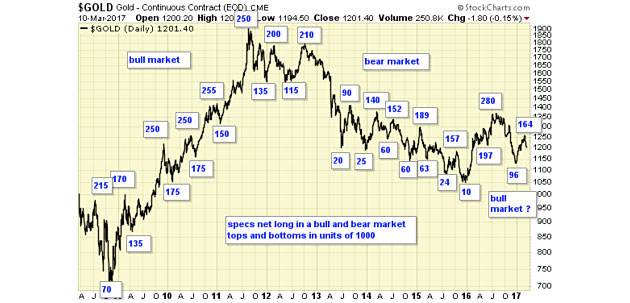
A follow up to our last week’s special update: COT data has been instrumental in guiding us and helping us navigate market conditions during a bull and bear market. The latest COT data is quite alarming, and has our full attention going forward.

Long-time readers are familiar with the chart above, and it is self-explanatory. But for newcomers, here is a detailed breakdown:

• A bull market attracts speculators and the net long positions at both tops and bottoms are significantly higher of those in a bear market. Common sense.

• The price spike in 2016 attracted a record crowd with 280k net long positions at the 2016 summer top, giving us hope that a new bull market was in progress.

• However, the sharp sell-off into December reduced the net long positions to 96k, which was much lower than average bull market value at bottoms.

• Since December, prices have recovered about half, while net long positions only reached 164k, which is a bear market value.

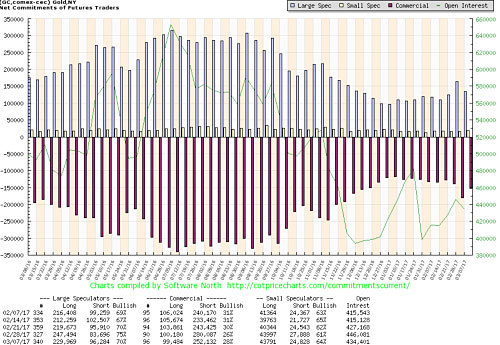
chanspec3-11
COT data this week shows a sharp pull back, confirming a peak in speculation, with the peak at bear market value.

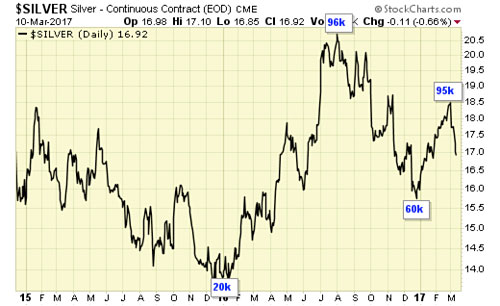
chansilver3-11
The speculation in silver is even more alarming. Net long positions reached 95k this week, barely lower than the recovery peak of last summer, and yet the price of silver is 10% below that peak.

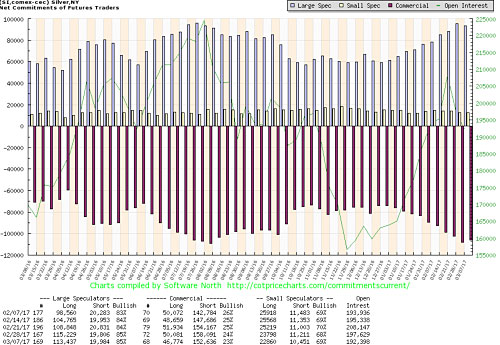
chansilverspec3-11
Speculators in silver also retreated this week, confirming the previous week as a speculative peak.

Summary
We have been monitoring COT data for the past seventeen years, and by observing speculative activities, it has helped us to identify the speculative values of a bull and bear market. The latest data has alerted us to the potential return to a bear market. Caution is advised.

Jack Chan is the editor of simply profits at www.simplyprofits.org, established in 2006. Chan bought his first mining stock, Hoko Exploration, in 1979, and has been active in the markets for the past 37 years. Technical analysis has helped him filter out the noise and focus on the when, and leave the why to the fundamental analysts. His proprietary trading models have enabled him to identify the NASDAQ top in 2000, the new gold bull market in 2001, the stock market top in 2007, and the U.S. dollar bottom in 2011.

Want to read more Gold Report articles like this? Sign up for our free e-newsletter, and you’ll learn when new articles have been published. To see a list of recent articles and interviews with industry analysts and commentators, visit our Streetwise Interviews page.

Disclosure:
1) Statements and opinions expressed are the opinions of Jack Chan and not of Streetwise Reports or its officers. Jack Chan is wholly responsible for the validity of the statements. Streetwise Reports was not involved in any aspect of the article preparation or editing so the author could speak independently about the sector. The author was not paid by Streetwise Reports LLC for this article. Streetwise Reports was not paid by the author to publish or syndicate this article.
2) Jack Chan: We do not offer predictions or forecasts for the markets. What you see here is our simple trading model, which provides us the signals and set-ups to be either long, short, or in cash at any given time. Entry points and stops are provided in real time to subscribers, therefore, this update may not reflect our current positions in the markets. Trade at your own discretion. We also provide coverage to the major indexes and oil sector.
3) This article does not constitute investment advice. Each reader is encouraged to consult with his or her individual financial professional and any action a reader takes as a result of information presented here is his or her own responsibility. By opening this page, each reader accepts and agrees to Streetwise Reports’ terms of use and full legal disclaimer. This article is not a solicitation for investment. Streetwise Reports does not render general or specific investment advice and the information on Streetwise Reports should not be considered a recommendation to buy or sell any security. Streetwise Reports does not endorse or recommend the business, products, services or securities of any company mentioned on Streetwise Reports.

Charts courtesy of Jack Chan

Le Pen-ization of France

Europe’s Changing Landscape

Dan Steinbock, Paris

In France, President Hollande’s utter failure to foster broad consensus for structural reforms has paved the way for the most contested election in decades. While public debate focuses on the 2nd round winner, the real story is that Marine Le Pen’s agenda has already shifted the French political landscape.

In recent polls, the French presidential rivalry involves 3-4 viable candidates, which together account for 85-90 percent of the total vote. Until recently, the leader of the Front National, Marine Le Pen, and the centrist Emmanuel Macron, have each garnered about 25 percent in the polls. The two are followed by the center-right François Fillon, who has about 20 percent, and the socialist Benoît Hamon, with 15 percent.

While Le Pen may win the first round, she is not likely to win the second round, in which her popular triumph would be likely contained by a coalition of her adversaries. Yet, the future belongs to Le Pen’s agenda which the next president must coopt to win – and coopt to sustain victory.

Who’s afraid of Marine Le Pen

The French presidential election will take place in late April, but the real winner will be chosen in the second round in early May. Even if Le Pen won the first round, the consensus is that a centrist or a center-right candidate will win the second round.

Marine Le Pen (49) is the youngest daughter of the veteran FN leader Jean-Marie Le Pen, a French far-right politician who supported euro-skepticism, opposed immigration and pushed for law and order, traditional culture and values. As long as he led the FN, it was a marginal far-right, anti-Semitic party with politically incorrect neo-Nazi associations. In the past decade, Marine Le Pen has successfully “mainstreamed” FN away from the margins and extremism. Nevertheless, she has had difficulties funding her campaign because of the opposition of every French bank to her political platform.

In her campaign, Le Pen continues to support traditional values, law and order, while opposing immigration and the EU. As her campaign kicked off, Le Pen pledged a fight against “two totalitarianisms, globalization and Islamism” that seek to “subjugate France.” Running in the name of the French people, she reaffirmed the FN’s anti-immigration, protectionist and anti-EU stance. “The divide is not between the left and right anymore, but between patriots and globalists,” she said. “Financial globalization and Islamist globalization are supporting each other. Those two ideologies want to bring France to its knees.”

Le Pen wants to pull out of the Euro and a return to French franc, a referendum on EU membership within 6 months, and taxes on imports and the employment of foreigners in France. Building on Gaullist legacies, she is a critic of and wants to pull France out of the NATO. She would like to revise French relations with the U.S. and has denounced French bandwagoning toward Washington. Her France needs greater independence, believes in a multipolar world and neo-gaullist geopolitics.

The three anti-Pen musketeers

Emmanuel Macron (40) is a self-proclaimed proponent of a “third way” and the product of the elitist École nationale d’administration (ENA). After a stint as an investment banker at Rotschild & Cie Banque, he served in Hollande’s socialist governments, where he advocated business-friendly reforms that were a poor fit with Hollande’s socialist constituencies. Like Blair and the Clintons, Macron tends to support whatever is expedient at the time, whether it has been Rotschild’s neoliberal profits or Hollande’s bureaucratic socialism.

Married with his 24 year older high school teacher he first met at 15, Macron’s personal life and policy stances remain ambiguous. Last November, he declared that he would launch a social liberal bid under the banner of En Marche!. In public, this was legitimized as a new Clintonesque-Blairian ideology; in practice, it was necessary because Macron had alienated socialists while failing to gain enough support among conservatives; he lacked a party platform.

Of the key candidates, Macron is the ultimate Europhile and federalist, although he sees himself as EU-agnostic. He supports integration and structural reforms. In controversies about immigration, secularism, security and terrorism, Macron has favored a balancing act, which accounts for the perception that he avoids taking any stances. Ironically, that makes him valuable to neoliberal business, Brussels and Washington.

Born into privilege, François Fillon (63) became nationally known as President Sarkozy’s Prime Minister. Already years ago, he undertook controversial reforms of the labor code and the retirement system. He represents conservative Republicans (previously Sarkozy’s Union for a Popular Movement, UPM), France’s largest center-right party. Last fall, Fillon still seemed to appeal to the conservative “silent majority” in France, but that was before a widening embezzlement investigation following charges that he had paid his wife and children almost 1 million euros from the public payroll for little or no work. Rather than resign, Fillon attributed all blame to a “smear campaign” and has stayed in the game.

Just as Fillon thought he could get on with his presidential campaign, he was recently hit by more claims of financial irregularities as Canard Enchaine disclosed that he has also received an interest-free, undeclared loan of 50,000 euros from a French billionaire tycoon in 2013. If Fillon can remain afloat, he could prove a minority kingmaker in the second round – unless centrist forces can agree on a unifying candidate.

Known as an “Anglophile,” Fillon is a French Thatcherite. He would like to balance the budget and abolish the wealth tax. He would raise retirement age to 65 and reduce the public sector by cutting half a million civil-service jobs. He holds tough views about immigration, Islamic radicalism and terrorism. As a believer in realpolitik, he has called for dialogue with al-Assad’s Syria and Putin. “In a Trump era,” he says, “Europe must spend more on military.” While he stands for the West, he sees the expansion of NATO to Russia’s borders in the 1990s as a provocation that was bound to alienate Moscow and foster redundant friction.

The last viable candidate is Benoît Hamon (49), a French socialist (PS) who defeated the centrist and business-friendly Manuel Valls in the party primaries. While he is portrayed as a new figure, he is a veteran party bureaucrat and has served in the European Parliament (2004-9), Hollande’s Junior Minister for the Social Economy (2012-4) and Minister of National Education (2014).

Hamon supports a basic income to all French citizens, a 35-hour workweek, legalization of cannabis and euthanasia, and huge investments in renewable energy. Unlike recent socialist leaders who have managed to widen the gap between business-friendly and pro-NATO social democratic leadership and the socialist and NATO-skeptical grassroots constituencies, Hamon represents the left wing of the PS and is an admirer of US Democrat Bernie Sanders. He is critical of neoliberal myths and the NATO.

In contrast, the more leftist Jean-Luc Mélenchon, who heads the new “Unsubmissive France,” would like France to leave both the euro and NATO. While Mélenchon has barely 10%+ support in France, the two might align to achieve a unified left position in May. Nevertheless, after years of Hollande’s failed policies and plunging ratings, all socialist candidates face a steep uphill.

Coming shifts in French policy stance

Whether Le Pen wins the elections or not may not be the question. The real story is that the winning agenda that the next French president has been re-defined by the rise of Marine Le Pen. Domestically, the new president will push for (subdued) structural economic reforms with or without the consent of the unions, while taking a stricter view of immigration and a tougher stance against Islamic fundamentalism.

France will have a more critical stance toward further EU integration, and the euro. As even Hollande recently acknowledged, “for a long time, the idea of a differentiated Europe, with different speeds and distinct paces to progress, has provoked a lot of resistance. But today this idea is necessary. Otherwise, Europe will explode.” If Le Pen wins, Paris will also start a process that could ultimately result in a ‘Frexit.’

In foreign policy, the new president will be more cooperative with Russia and President Putin, from the Middle East to Ukraine and energy issues. While France may actually invest more in defense spending, the return of Gaullisme is predicated on greater skepticism toward the NATO and harder push for French national priorities. While Macron’s team has already suggested that Russia may be intervening in the French election, France is not as vulnerable to Russo phobia as the United States.

Furthermore, recent Wikileaks disclosures prove that it is not so much Moscow that Paris should be concerned about. In the 2012 French presidential election – as classified CIA “tasking orders” indicate – the agency engaged in a spying campaign ahead of the election. The documents reveal that all major French political parties were targeted for infiltration by the CIA’s human and electronic spies in the seven months leading up to France’s 2012 presidential election. According to the most recent WikiLeaks documents, televisions, smartphones and even anti-virus software are all vulnerable to CIA hacking, which makes any effort to shape the outcome of the impending elections and referendums in Europe relatively easy. Washington and Pentagon favor pro-NATO candidates and will walk the talk.

Even more important will be the net effect of the new economic policies. In Brussels, the greatest fear involves Le Pen’s quest to unilaterally take France out of the Euro in just 6 months, which would be followed by the effective redenomination of €1.7 trillion of French public debt into francs (80% of this debt is not under international law and thus FN would have the right to change the currency). Unsurprisingly, the ratings agencies have already warned that the net effect would be the largest sovereign default on record, nearly 10 times larger than the €200bn Greek debt restructuring in 2012. Like biblical prophets, Le Pen’s adversaries have warned that her victory would mean a French Armageddon, the plunge of euro, and chaos to the world financial system.

In contrast, the FN argues that reintroducing a national currency that would fall in value against the euro would lower France’s total debt burden and thus allow Paris to begin competitive devaluation.

Domestic dead-end, international spillovers

The struggle for France is the direct result of half a decade of policy failures, which climaxed last summer in a failed effort to reform the French labor code. It was not the first time. Years ago, huge strikes forced President Chirac to back down from proposed changes in the pension system, just as they led to fierce union opposition when President Sarkozy raised the retirement age. However, under Hollande, a Socialist government has been pitted against unions and the ultra-left, which has fostered apprehension, disappointment and fragmentation on the left.

When the socialist Hollande replaced the conservative Sarkozy as the French president in May 2012, the latter’s ratings had plunged but Hollande’s popularity hovered at around 58 percent. By late 2016, his ratings had plunged to less than 5 percent. So his decision not to seek a second term was hardly a surprise. While France cannot avoid the overhaul of its labor legislation in the future, a socialist president cannot drive a neoliberal labor agenda; and that’s what Hollande tried to do.

After half a decade of near-stagnation, French economy has been benefiting from a cyclical rebound, thanks to a more accommodative external environment, especially lower oil prices, a depreciated euro, record low interest rates and the European Central Bank’s quantitative easing. Nevertheless, these shifts cannot compensate for France’s longstanding internal rigidities, which overshadow the economy’s medium-term potential. In the 1980s and 90s, French growth still exceeded 2.2 percent; in the 2000s, it hovered around 1.8 percent; now it is around 1.1 percent and likely to decelerate to less than 1% by early 2020s. In the past decade, French competitiveness, as reflected by the country’s share in world export markets, has declined significantly as well.

What’s worse, French real wage growth has been solid, despite declining productivity growth. The equation is unsustainable; it means that French economy is penalizing future generations for its current distortions. If the external environment grows still more adverse, while reform progress is hardly evident, French banks, given their size and interconnectedness, could generate adverse effects not just domestically but through spillovers, especially in Italy and emerging Europe.

France remains the world’s sixth largest economy. If it begins to shake, Italy cannot avoid a quake and ailing Eastern European economies could take multiple hits. That, in turn, would have adverse implications across the Eurozone and globally.

About the Author         

Dr. Dan Steinbock is an internationally recognized expert of the nascent multipolar world. In 2010, he predicted that Brussels opted for misguided policies to overcome the European sovereign debt crisis, which would prolong rather than resolve the challenges. In spring 2016, he forecast the UK Brexit and the outcome of the Italian referendum.

Dr Steinbock is the founder of DifferenceGroup. He has served as Research Director of International Business at India China and America Institute (USA) and Visiting Fellow at Shanghai Institutes for International Studies (China) and the EU Center (Singapore). For more, see www.differencegroup.net 


The original, full commentary was published by The World Financial Review on March 9, 2017


Wave Analysis 13.03.2017 (EUR/USD, GBP/USD, USD/JPY, AUD/USD)

Article By RoboForex.com

EUR USD, “Euro vs US Dollar”

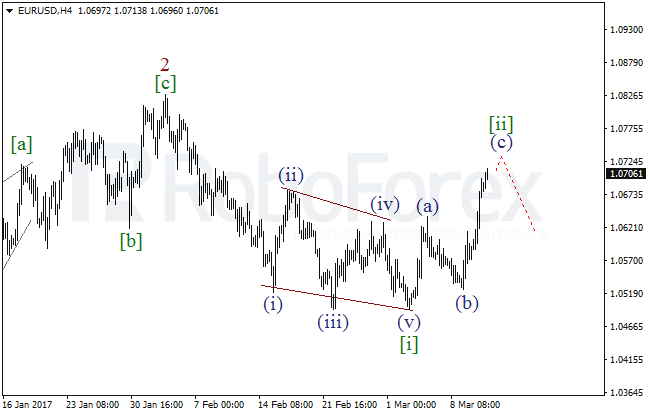
It looks like the EUR/USD pair is about to complete the wave [ii], which is taking the form of the zigzag. Later, after finishing the wave (c), the market may resume falling.

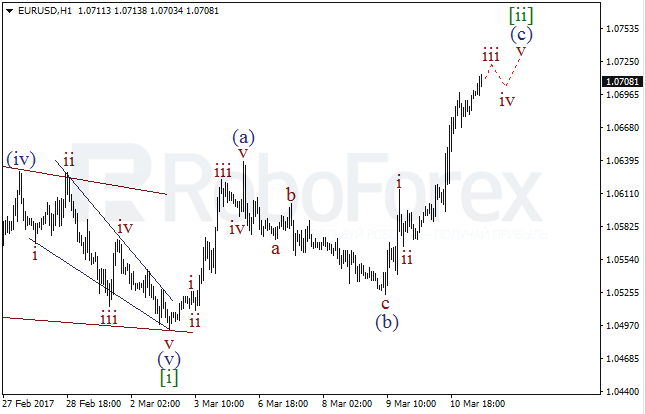
More detailed structure is shown on the H1 chart. After finishing the zigzag in the eave (b), the pair started forming the ascending impulse in the wave (c) of [ii]. On Monday, the price may continue growing, but after completing the wave v of (c), the market is expected to resume moving downwards.


GBP USD, “Great Britain Pound vs US Dollar”

After finishing the horizontal triangle in the wave (iv), the GBP/USD pair completed the descending impulse in the wave i. Consequently, after finishing the local correction, the market may start another decline in the wave iii of (v).

As we can see at the H1 chart, last Friday completed the wave [5] of i and started an ascending correction. As a result, during the day the market may continue growing in the wave ii of (v).


USD JPY, “US Dollar vs Japanese Yen”

Possibly, the USD/JPY pair is extending the wave (iii) of [iii]. Earlier, the price completed the bullish impulse in the wave (i) and the correctional wave [ii] in the form of the zigzag. Consequently, in the nearest future the market may resume growing and break the local high.

More detailed structure is shown on the H1 chart. Probably, the pair is completing the zigzag in the wave ii. It’s highly likely that in the nearest future the market may resume moving upwards while forming the wave iii of (iii).


AUD USD, “Australian Dollar vs US Dollar”

After finishing the zigzag in the wave [e] of 4, the AUD/USD pair completed the descending impulse in the wave (i). Consequently, after finishing the wave (ii), the price may start a new bearish impulse in the wave (iii).

As we can see at the H1 chart, the pair completed the wave v of (i) and right now is being corrected to the upside. Possibly, the wave (ii) may take the form of the zigzag. If this assumption is correct, then after finishing the local correction, the pair start a short-term growth in the wave c of (ii).


RoboForex Analytical Department

Article By RoboForex.com

Attention!
Forecasts presented in this section only reflect the author’s private opinion and should not be considered as guidance for trading. RoboForex LP bears no responsibility for trading results based on trading recommendations described in these analytical reviews.

Short-term trading idea FX EUR/USD – a bull’s game: strengthening of the euro expected by way of correction

By Gabriel Ojimadu, Alpari

Trading opportunities for the currency pair:Movement on the EUR/USD pair continues to correlate with that of 2005. According to historical patterns, a large downwards correction is due to take place after the 15th of April. Despite this, the rate may still deviate significantly upwards.

After Friday’s payrolls, the price came out of the 1.0494 – 1.0626 range. As it breaks 1.0715, growth will accelerate to 1.0780. This is where the euro will stop growing and a symmetrical triangle will form. If a rebound doesn’t follow from this, and the rate breaks the 1.0829 support, we could see the price restore all the way to 1.1021. Should the daily candlestick close below the 2 copy line, then we can forget about this potential surge. We’re working towards 1.1021 with an eye on the 1 copy and 2 copy lines. The euro should reach the TR1 trend line by the 10th of April.

Background:

The previous idea for the EUR/USD currency pair was published on the 19th of December 2016. At the time of publication, the pair was trading at 1.0451. In my review, I proposed various possible scenarios for the pair’s development based on historical patterns. My model was based on the price pattern from 2005, which had a 90% correlation with price movements at the time. Back then, I was expecting a rebound from the lower boundary of the A channel to 1.0672 by the end of the year.
What actually happened is that the euro rebounded from the lower boundary of the A-A channel on the 20th of December 2016. On the 30th of December, the euro restored to 1.0654. Due to a slide from 1.0451 to 1.0352, the euro missed its target by 18 pips. The first few days of the new year were very volatile. In the space of two days, buyers receded by 314 pips. Despite this, on the 2nd of February, the price restored to 1.0828.

Current situation:

From a maximum of 1.0828, the euro fell back to 1.0453. The correction came to 61.8% of the upwards movement from 1.0340 to 1.0828. From the 22nd of February, the pair got stuck in a sideways trend for 10 days. The price came out of this trend on Friday as the US jobs report was published.

The number of new nonfarm jobs in the US in February grew by 235,00, with a forecast of 200,000. The figure for December was revised from 157,000 to 155,000, and January’s was upgraded from 227,000 to 238,000. The aggregate revision across the two months comes to +9,000.

In response to such strong figures, the euro fell to 1.0594, which was followed immediately by a phase of growth as demand for euros on all the crosses rose. Remember that on Thursday the 9th of March, at the ECB press conference, traders were given the impression that the regulator may not need to take any further measures to stimulate the European economy. By the end of the day, the euro index has risen from 100.03 to 100.81, and the EUR/USD rate had risen from 1.0582 to 1.0671.

Traders ignored the US statistics given that the market has already prepared itself for a rate hike on the 15th of March. The Non-Farm Payrolls is the final dataset that the Fed will take into account before making their decision.

The EUR/USD rate has risen by over 100 pips. After the NFP’s release, the euro strengthened across the whole market following Bloomberg’s report that during the ECB’s meeting on Thursday, the governing members discussed the idea of a rate hike before the QE program expires. According to Bloomberg, members of the governing council didn’t make any official decisions or set any deadlines, but simply exchanged their opinions on the matter.

Daily chart. Source: TradingView

The vertical line imposed at 19/12/16 represents when the previous idea on this currency pair was published. The grey bars represent the period from 22/11/04 to 04/07/05. It has a 90% correlation with the period from 03/05/16 to 16/12/16 (163 trading days). From the chart, we can see how the price changed over a period of 58 trading days. With the most recent quote, this has extended from 163 to 221 days to cover the period from 22/11/04 to 29/09/05, and the correlation is now 93%.

After the ECB’s meeting, there was a change in trader sentiment on the market. If we look at historical patterns, then after a 23 day flat (until the 17th of April), the rate should start to fall again.

The correlation between the two periods is likely to remain high, although we may see some sharp surges in the rate during this time. Now let’s take a look at the weekly chart.

Weekly chart. Source: TradingView

The price has rebounded from the lower boundary of the A-A channel to the support at 1.0829. Now, I’ve drawn two trend lines from the minima of 1.0462 and 1.0517 (1), and now I’ve attached a copy of this to the minimum at 1.0340. From here I’ve drawn a channel that projects some bullish movement to 1.1021, which is on the TR1 trend line. From here, I’m envisaging the formation of a W-model. 1.0965 is at 50% of the downwards movement from1.1616 to 1.0340.

If buyers are unable to break through 1.0778, then my prediction for growth may not come off. In such a case, I expect a flat before April, followed my some downwards movement. To understand why I’m forecasting a W-model, see below.

Daily chart. Source: TradingView

Here, the weekly values are showed on the daily chart. The daily timeframe gives us a detailed picture. On Friday, the rate came out of the 1.0494 – 1.0626 range. As the price breaks 1.0715, growth will accelerate. Bulls are unlikely to stay at this level. They will more likely apply the brakes around 1.0780 given that many traders can see a symmetrical triangle forming. If the price doesn’t rebound from here, I’m expecting it to restore to 1.1021. Should the daily candlestick close below the 2 copy line, we can forget about the scenario for growth. The bulls still have time for a correction before the 10th of April, when the French presidential elections will start to weigh heavily on the market.

Murrey Math Lines 13.03.2017 (EUR/USD, CAD/JPY)

Article By RoboForex.com

EUR USD, “Euro vs US Dollar”

Super Trends formed “bullish cross”, which means that the ascending correction may yet continue. The closest target is at the 8/8 level. If later the price rebounds from this level, the market may try to resume its decline.

At the H1 chart, the h1 Super Trends is a support level. On Monday, the pair may continue growing towards the 8/8level, which may provide resistance. To confirm a new descending correction, later the market has to fix below the 7/8 level.


CAD JPY “Canadian Dollar vs Japanese Yen”

The CAD/JPY pair rebounded from the daily Super Trend and then fixed below the 3/8 level. As a result, in the nearest future the market may resume moving downwards. The closest target for bears is the -2/8 level. If the price breaks this level, the lines at the chart will be redrawn.

At the H1 chart, the pair failed to stay above the 7/8 level and plummeted towards the 4/8 one. If later the price fixes below the 4/8 level, the market will continue falling towards the 1/8 one.


RoboForex Analytical Department

Article By RoboForex.com

Attention!
Forecasts presented in this section only reflect the author’s private opinion and should not be considered as guidance for trading. RoboForex LP bears no responsibility for trading results based on trading recommendations described in these analytical reviews.

EUR/USD: Monday v Friday

By Gabriel Ojimadu, Alpari

Previous:

The euro closed up after trading on Friday. The single currency managed to reach the D3 line after the publication of the US jobs report. The number of new nonfarm jobs in the states in February grew by 235,000 after a forecast of only 200,000. The figure for December was revised from 157,000 to 155,000 and for January from 227,000 to 238,000. The aggregate change for these two months comes to +9,000.

The labour force participation rate grew from 62.9% to 63%. Unemployment has fallen to 4.7% (forecasted: 4.7%, previous figure: 4.8%). Average hourly earnings in the US rose by 0.2% (forecasted: 0.3%, previous figure revised from 0.1% to 0.2%).

The euro’s initial reaction to all this data was a slide to 1.0594. The pair then started a phase of growth as traders started to buy euros on all the crosses. By the end of the day, the exchange rate has risen from 1.0582 to 1.0671.

The euro rose across the board after it was reported by Bloomberg that during their meeting, the ECB bosses had discussed the possibility of raising interest rates as the QE program reaches its final stage. They reported that the governing council didn’t make any concrete plans or set any deadlines, but that council members simply exchanged opinions on the matter.

Market expectations:

In Asia, the euro has risen to 1.0700 on the back of a slide in US bond yields and some growth on the euro index. Given that the euro grew throughout Friday and closed up, today (Monday), I’m expecting to see movement against Friday’s. In this regard, I’m setting a target of 1.0658. If buyers start to lock in their profits from the growth of the last two trading days, then we could see a price correction to 1.0632.

Day’s news (GMT+3):

  • ECB member Lautenschläger’s speech;
  • ECB member Draghi’s speech;
  • ECB member Constâncio’s speech;
  • ECB member Praet’s speech.

EURUSD rate on the hourly. Source: TradingView

Intraday forecast: low: 1.0658, high: 1.0705, close: 1.0670.

The euro rate has restored from a low of 1.0525 to the 157th degree. Given that trading on the euro closed up on Friday, today I’m expecting it to fall to around 1.0658. If it starts to fall ahead of schedule, we can revise our target to 1.0632.

If the trend line gets broken through, pressure on the euro will increase. In this case, the rate will continue to decline through to Wednesday. Once the Fed officially announces its interest rate decision, the euro will strengthen once again.

Positives for the euro (+):

Fundamental:

(+) US president Donald Trump favours a weaker dollar;

(+) The threshold for acceptable US government debt of 20.1 trillion USD may be reached by March this year. This will create headaches for new US president Donald Trump. A new law on the debt ceiling will come into force on the 16th of March 2017;

(+) The Greek government has made some progress in its talks with international creditors on the second stage of their reform program;

(+) Head of the ECB, Mario Draghi, has hinted that the central bank may not need to provide any further stimulus to revitalise Europe’s economy. From April to December 2017, the ECB will reduce their monthly assets purchases to 80 to 60 billion EUR;

(+) ECB bosses have discussed the possibility of raising interest rates before the QE program comes to an end;

Technical (short-term):

(+) Long/short ratio according to myfxbook as of 7:30 EET: 70%/29%, lots: 24102/10020 (previous day: 15330/17193), positions: 57118/22205 (previous day: 42399/38840)

(+) German 10-year bond yields: 0.483% (up 13.64% from 10/03/17);

(+) In Asia, US 10Y bond yields have fallen by 0.15% to 2.578%;

(+) EURGBP (W):  the CCI (20), AC and the Stochastic (5,3,3) are moving upwards;

(+) EURGBP (D): the AO and Stochastic (5,3,3) are moving upwards. The trend line has been broken through;

(+) EURUSD (M): the Stochastic (5,3,3) is moving upwards;

(+) EURUSD (W): The Stochastic (5,3,3), AO, AC, and CCI (20) have reversed upwards;

(+) EURUSD (D): the Stochastic (5,3,3), AC, and AO indicators are moving upwards. The CCI (20) is in the zone above +100. The trend line has been broken through;

Negatives for the euro (-):

Fundamental:

(-) According to CME Group’s FedWatch Tool, as of Friday the 10th of March, the probability of a rate hike in March has fallen from 90.8% to 88.6%, in May from 91.8% to 89.6%, and in June from 95.9% to 95.4%;

(-) Political uncertainty in Europe (French elections and Brexit). Ex-Prime Minister Alain Juppe has ruled himself out of participation in the French presidential elections;

(-) strong NFP report;

Technical factors (short-term):

(-) According to data from 07/03/17, large speculators on the Chicago Exchange have increased their long and decreased their short positions. Long positions have fallen by 5,404 to 137,358 contracts, while short positions have grown by 8,820 to 196,124 contracts. Net short positions have grown from 44,542 to 58,766 contracts.

(-) US 10-year bond yields have risen to 2.582% (up 0.27% from 10/03/17);

(-) EURUSD (M): the AO and AC indicators are moving downwards;

(-) EURGBP (D): the AC and CCI (20) indicators are moving downwards;

Built into the price:

(-) President of the Philadelphia Fed, Patrick Harker, has hinted at a rate hike in March;

(-) President of the Dallas Fed, Kaplan, says that it’s better to raise rates sooner rather than later;

(-) President of the San Francisco Fed, John Williams, says that March is a good time for the FOMC to seriously consider a rate hike;

(-) FOMC member Lael Brainard says that the US economy is growing, and that a rate hike would soon be appropriate;

(-) Head of the FOMC, Janet Yellen, has said that interest rates might be raised in March;

(-) Head of the Fed in Richmond, Lacker, has said that losing control over inflation could prove very costly;

(-) Vice-president of the Federal Reserve, Stanley Fischer, echoes his colleagues’ comments about rate hikes;

(+) François Bayrou, leader of the “Democratic Movement” party, has ruled out running for the presidency and thrown his weight behind independent candidate Emmanuel Macron;

(+) Marine Le Pen has had her EU parliamentary immunity from prosecution lifted for political reasons.

Time for African Economic Miracle

By Dan Steinbock

In the 20th century, Africa gained political independence but fell behind economic boom. In the 21st century, it is Africa’s turn – but not without stronger state and new external push.

After struggle against corruption, lawlessness and terror, President Buhari’s administration has outlined an economic recovery plan targeting 7 percent GDP growth rate from 2017 to 2020. While many African economies are hoping for takeoff in the coming years, Nigeria represents the region’s greatest economic potential.

For longer than a century, Africa’s economic miracle has been a pipedream. But things are changing.

Stronger state, different external actors

In the mid-2000s, after decades in the slow lane, African economies hit the accelerator. But what lies ahead for the continent is not an open highway, says Justin Yifu Lin, World Bank’s former chief economist, with co-author Andrea Goldstein. “If Africa is to achieve its potential as the next emerging-market engine of global economic growth,” the two write, “it will have to industrialize.”

But the devil is in the details.

Ever since Britain’s first Industrial Revolution, the rise of labor-intensive light manufacturing (textiles, garments, shoes, and associated tools and machinery) has played a major role in pushing up national incomes. However, as Africa has not managed to participate fully in industrialization since the 1970s, it has lagged behind the rest of the developing world.

Lin and Goldstein advocate a new catalyst role for government. They emphasize that an effective industrial policy must cover not just manufacturing but the kind of economic activities that support it. This means vital role for external actors, particularly for large emerging economies, such as China, that are able and willing to participate in African growth.

After three decades of economic stagnation and income polarization in the name of freedom and democracy, Lin and Goldstein are right to stress a different, more inclusive view of economic development.

And yet, despite Africa’s great long-term potential, the future may prove more challenging than anticipated. The fact that Africa fell behind globalization and associated catch-up growth after the 1970s should not be associated with domestic economic choices only.

Historically, external geopolitical constraints have weighed heavily on Africa’s economic promise.

Legacies of colonialism and decolonization

During colonialism, the largest colonizers – the British Empire and its European counterparts – did contribute to the building of infrastructure in some African nations. Yet, the latter was geared to serve the colonizer’s economic and strategic needs, not

those of the colonized. In Africa, the colonial efforts focused on raw materials and commodities that were most needed for the colonizers’ industrialization during and after the ‘scramble for Africa’ in the late 19th century.

The great irony should not be discarded. Historically, Western Europe’s Belle Époque (1870-1914) – an era of great optimism, regional peace and stability, rapid industrialization and technology innovation – went hand in hand with the “Scramble for Africa”; that is the devastating invasion, occupation, division, colonization and annexation of African territory by European powers during the period of ‘new imperialism.’

Moreover, the end of colonialism did not translate to rapid growth either. In the postwar Africa, political independence came often with great destabilization, which virtually ensured that nascent efforts at industrialization would fail, remain partial, or stall.

As the Nigerian story attests, political independence was followed with strife and fragmentation, civil wars, and sectarian divisions, which were further exploited by major powers and multinational giants during the Cold War. And yet, industrialization requires stability, not destabilization.

Illicit financial outflows, lawlessness and corruption

After the Cold War, interventionism by external powers has shifted toward economic exploits. Between 2004 and 2013 alone, developing and emerging economies lost $7.8 trillion in illicit financial flows (Global Financial Integrity), which averaged at 6.5 percent per year; that is, nearly twice as fast as global GDP.

Typically, Sub-Saharan African economies, despite very low prosperity levels, have a key role among those that have suffered the most outflows, including South Africa ($20.9 billion in average illicit financial flows 2004-13), Nigeria ($17.8 billion), Zambia ($2.9 billion), Ethiopia ($2.6 billion), Cote d’Ivoire ($2.3 billion), and so on.

Economic stability also requires appropriate institutions. Yet, according to the Rule of Law Index (World Justice Project), many African economies have low scores, including Cameroon, Zimbabwe, Ethiopia, Uganda, Kenya, Nigeria, Sierra Leone, Liberia and so on. Even the best – South Africa, Ghana, Botswana and Senegal – do not make it to the top-40 list.

The same goes for corruption. According to Transparency International, corruption perceptions are greatest among African nations, including Somalia, South Sudan, Sudan, Guinea-Bissau, Chad, Central African Republic and Burundi. Even the best performer – Botswana – is not in the top-30 league. Nigeria’s rank is 136, along with those of Myanmar, Guinea and Mauritania.

The lesson is that if illicit financial flows are allowed to prevail, if the rule of law cannot be sustained and if corruption grows pervasive, even rapid industrialization or modest success at sustained economic growth will not contribute to economic modernization and rising living standards.

What African economies need is a series of industrial takeoffs across the entire region. That is a viable project, but not without stronger state catalyst and external actors’ participation, particularly large emerging economies such as China which have more in common with African nations than the slow-growing, rich Western economies.

Toward the Big Push

While nascent takeoffs have been evolving for a long while, they need a ‘Big Push.’ Developing economies require large amounts of investments to embark on the path of economic development.

As in other developing regions, structural change in sub-Saharan Africa has been characterized by a significant decline in the share of the labor force engaged in agriculture. In a sense, this is progress; agriculture has been the least productive sector in African economies. But the bad news is that, unlike other developing regions, structural change in Africa has not yet been accompanied by a significant expansion in the share of the labor force employed in manufacturing.

Yet, the potential between the two regions is not that different. Between 2000 and 2010, overall labor productivity growth in Africa was second only to Asia, where structural change continued to play a vital positive role. The real difference is that, in emerging Asia, the share of employment in manufacturing is more than double the share of employment in manufacturing in low-income African countries.

Asian economies have been able and willing to industrialize; African countries have been willing, but not able to industrialize.

In the postwar era, development economist Gunnar Myrdal showed that the strong state and associated public institutions ensured sustained economic growth in advanced economies. In contrast, the ‘soft state’ virtually ensured stagnation in Asia and other developing regions. Until recently, neoliberal policies have further contributed to arrested modernization in Africa, while keeping soft states in power.

In the early 21st century, the global landscape is finally shifting, but not because of initiatives in the advanced West. Rather, it is the rise of the large emerging economies in the past two decades that can finally offer a new and more realistic view of a strong state and the required push for industrialization.

What Africa needs is industrialization and inclusive growth for the many, not exploitation and exclusive growth for the few.

About the Author:

Dan Steinbock is the founder of Difference Group and has served as research director of international business at the India China and America Institute (US) and a visiting fellow at the Shanghai Institutes for International Studies (China) and the EU Centre (Singapore). For more, see http://www.differencegroup.net 

The original commentary was released by BusinessDay, Nigeria’s leading business daily, on March 2, 2017