Author Archive for InvestMacro – Page 506

10-Year Note Speculators cut back on bullish net positions this week

By CountingPips.comReceive our weekly COT Reports by Email
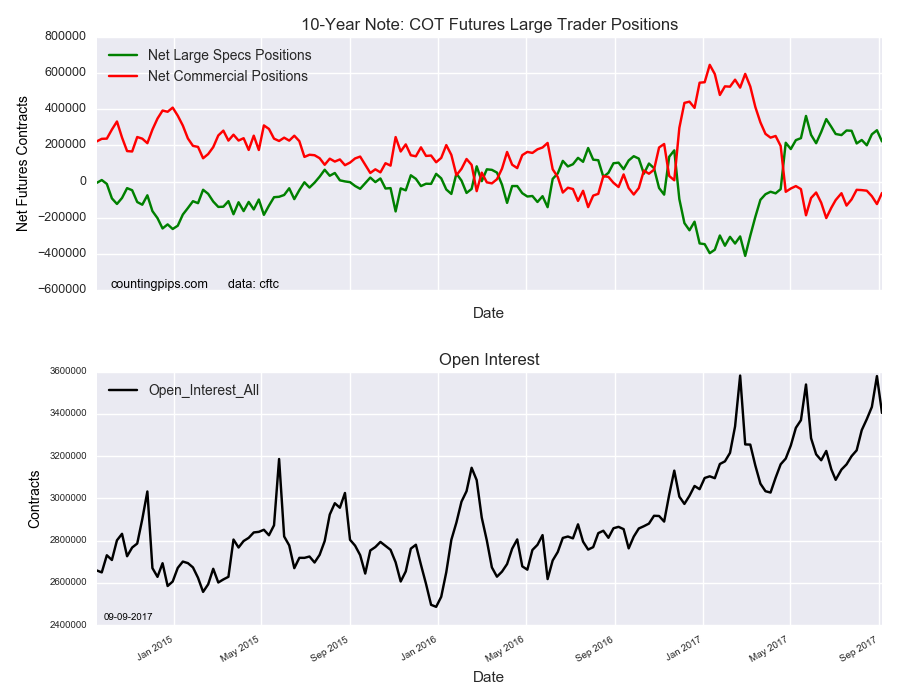
10-Year Note Non-Commercial Speculator Positions:

Large speculators decreased their bullish net positions in the 10-Year Note futures markets this week following two weeks of bullish gains, according to the latest Commitment of Traders (COT) data released by the Commodity Futures Trading Commission (CFTC) on Friday.

The non-commercial futures contracts of 10-Year Note futures, traded by large speculators and hedge funds, totaled a net position of 221,806 contracts in the data reported through Tuesday September 5th. This was a weekly lowering by -61,913 contracts from the previous week which had a total of 283,719 net contracts.

Speculative positions fell sharply this week (following two weeks of rises) and brought the bullish bets back under the +250,000 contract level for the first time in three weeks. The speculator positions have been going mostly sideways after surging above +300,000 net bullish contracts in both May and June.

10-Year Note Commercial Positions:

The commercial traders position, categorized by the CFTC as hedgers or traders engaged in buying and selling for business purposes, totaled a net position of -62,634 contracts on the week. This was a weekly uptick of 61,067 contracts from the total net of -123,701 contracts reported the previous week.

IEF ETF:

Over the same weekly reporting time-frame, from Tuesday to Tuesday, the 7-10 Year Treasury Bond ETF (IEF) closed at approximately $108.51 which was an uptick of $0.51 from the previous close of $108.0, according to unofficial market data.

*COT Report: The COT data, released weekly to the public each Friday, is updated through the most recent Tuesday (data is 3 days old) and shows a quick view of how large speculators or non-commercials (for-profit traders) as well as the commercial traders (hedgers & traders for business purposes) were positioned in the futures markets. The CFTC categorizes trader positions according to commercial hedgers (traders who use futures contracts for hedging as part of the business), non-commercials (large traders who speculate to realize trading profits) and nonreportable traders (usually small traders/speculators). Find CFTC criteria here: (http://www.cftc.gov/MarketReports/CommitmentsofTraders/ExplanatoryNotes/index.htm).

Article by CountingPips.comWeekly COT Report


Gold Speculators continued to sharply raise bullish positions this week

By CountingPips.comReceive our weekly COT Reports by Email

Gold Non-Commercial Speculator Positions:

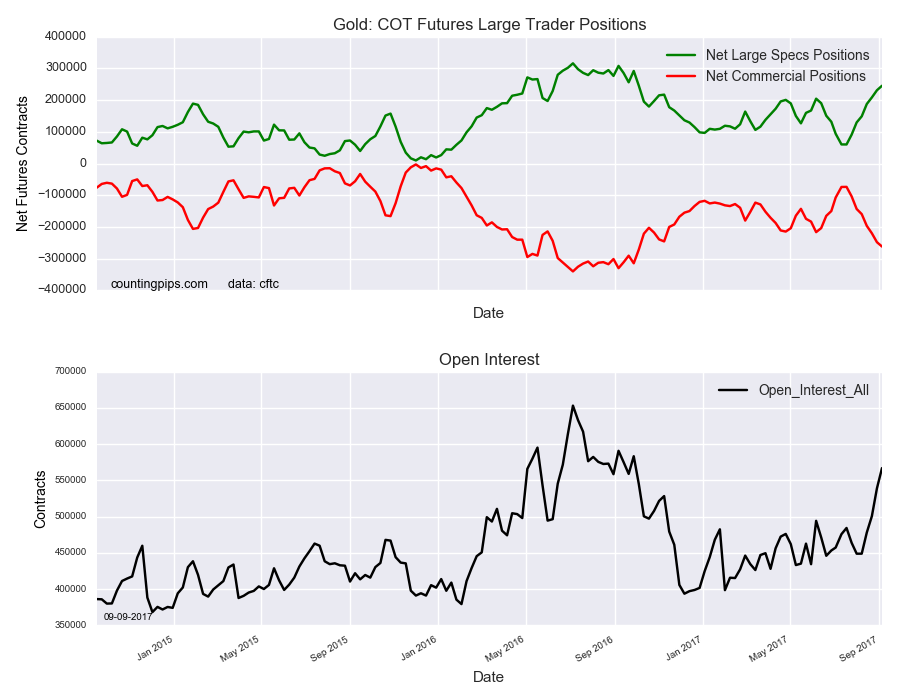
Large speculators continued to sharply raise their bullish net positions in the Gold futures markets this week, according to the latest Commitment of Traders (COT) data released by the Commodity Futures Trading Commission (CFTC) on Friday.

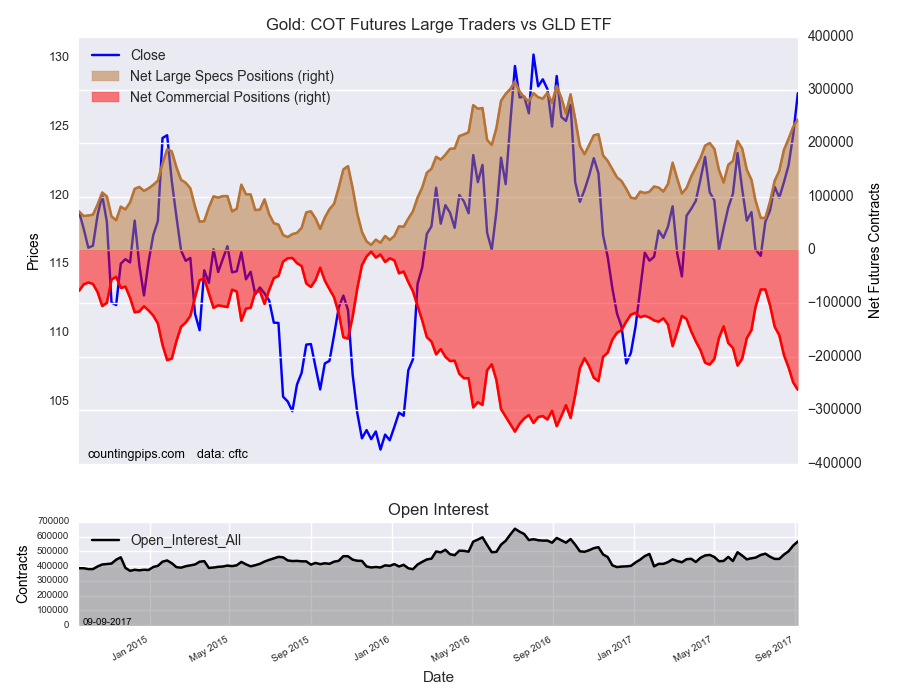
The non-commercial futures contracts of Gold futures, traded by large speculators and hedge funds, totaled a net position of 245,298 contracts in the data reported through Tuesday September 5th. This was a weekly jump of 14,251 contracts from the previous week which had a total of 231,047 net contracts.

Speculative positions are higher for a seventh straight week with net positions rising by at least +10,000 bullish contracts in each of those weeks. The bullish level is now at the highest threshold since October 4th 2016 when the net positions totaled +245,508 contracts.

Gold Commercial Positions:

The commercial traders position, categorized by the CFTC as hedgers or traders engaged in buying and selling for business purposes, totaled a net position of -261,807 contracts on the week. This was a weekly decrease of -13,778 contracts from the total net of -248,029 contracts reported the previous week.

GLD ETF:

Over the same weekly reporting time-frame, from Tuesday to Tuesday, the GLD ETF, which tracks the price of gold, closed at approximately $127.46 which was a rise of $3.04 from the previous close of $124.42, according to unofficial market data.

*COT Report: The COT data, released weekly to the public each Friday, is updated through the most recent Tuesday (data is 3 days old) and shows a quick view of how large speculators or non-commercials (for-profit traders) as well as the commercial traders (hedgers & traders for business purposes) were positioned in the futures markets. The CFTC categorizes trader positions according to commercial hedgers (traders who use futures contracts for hedging as part of the business), non-commercials (large traders who speculate to realize trading profits) and nonreportable traders (usually small traders/speculators). Find CFTC criteria here: (http://www.cftc.gov/MarketReports/CommitmentsofTraders/ExplanatoryNotes/index.htm).

Article by CountingPips.comWeekly COT Report


S&P500 Speculators edged their bearish net positions higher

By CountingPips.comReceive our weekly COT Reports by Email

S&P500 Non-Commercial Speculator Positions:

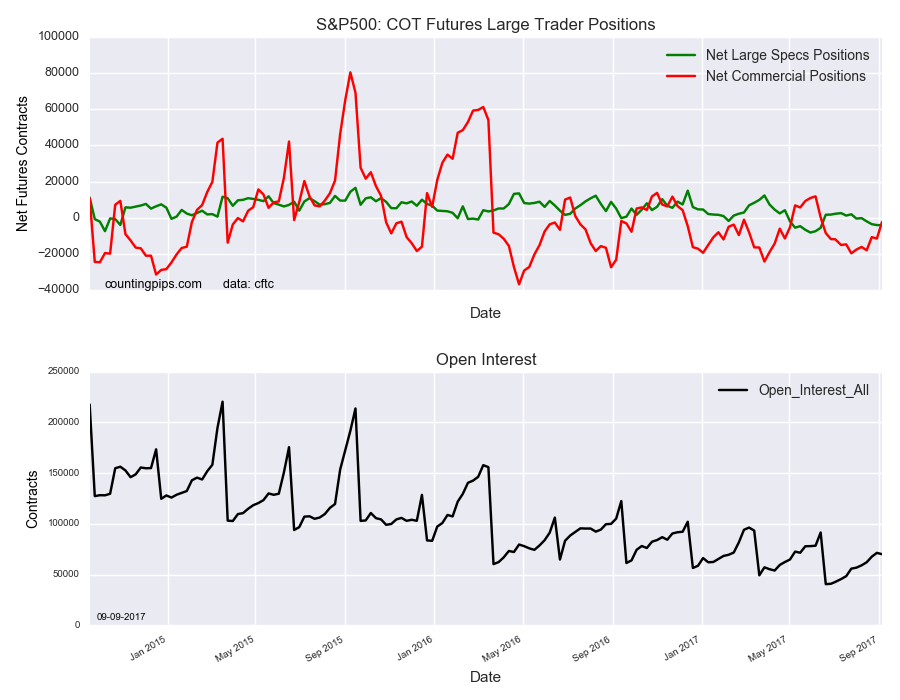
Large stock market speculators slightly added to their bearish net positions in the S&P500 futures markets this week, according to the latest Commitment of Traders (COT) data released by the Commodity Futures Trading Commission (CFTC) on Friday.

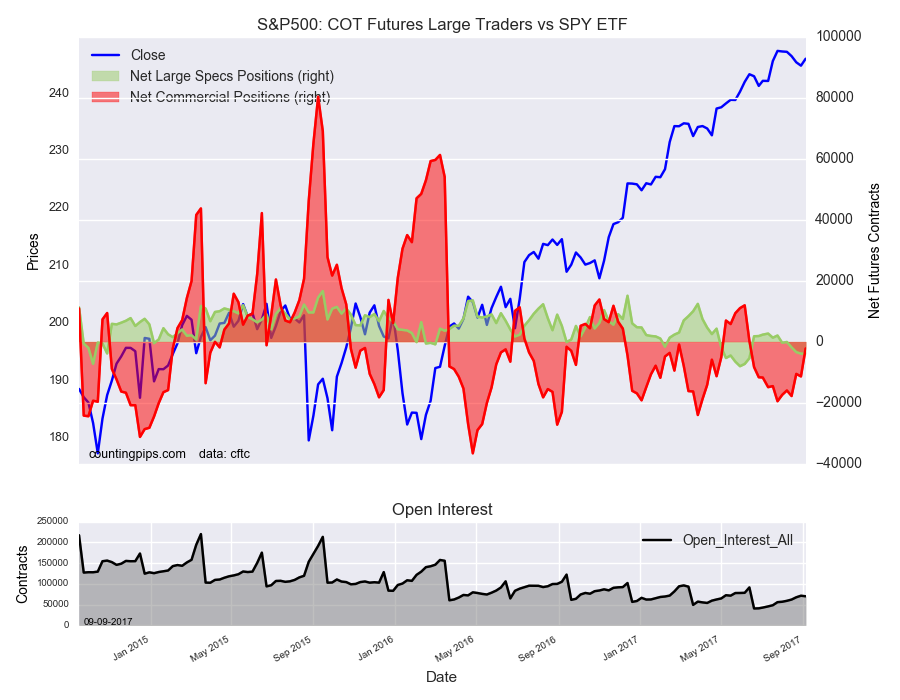
The non-commercial futures contracts of S&P500 futures, traded by large speculators and hedge funds, totaled a net position of -4,028 contracts in the data reported through Tuesday September 5th. This was a weekly decline of -73 contracts from the previous week which had a total of -3,955 net contracts.

Large SP500 speculator positions have now seen increasing bearish bets for four straight weeks and the overall bearish level is the highest since June 13th when net positions totaled -5,466 contracts.

S&P500 Commercial Positions:

The commercial traders position, categorized by the CFTC as hedgers or traders engaged in buying and selling for business purposes, totaled a net position of -2,267 contracts on the week. This was a weekly increase of 9,163 contracts from the total net of -11,430 contracts reported the previous week.

SPY ETF:

Over the same weekly reporting time-frame, from Tuesday to Tuesday, the SPY ETF, which tracks the price of S&P500 Index, closed at approximately $246.06 which was an advance of $1.21 from the previous close of $244.85, according to unofficial market data.

*COT Report: The COT data, released weekly to the public each Friday, is updated through the most recent Tuesday (data is 3 days old) and shows a quick view of how large speculators or non-commercials (for-profit traders) as well as the commercial traders (hedgers & traders for business purposes) were positioned in the futures markets. The CFTC categorizes trader positions according to commercial hedgers (traders who use futures contracts for hedging as part of the business), non-commercials (large traders who speculate to realize trading profits) and nonreportable traders (usually small traders/speculators). Find CFTC criteria here: (http://www.cftc.gov/MarketReports/CommitmentsofTraders/ExplanatoryNotes/index.htm).

Article by CountingPips.comWeekly COT Report


Silver Speculators sharply boosted bullish net positions, up for 7th week

By CountingPips.comReceive our weekly COT Reports by Email

Silver Non-Commercial Speculator Positions:

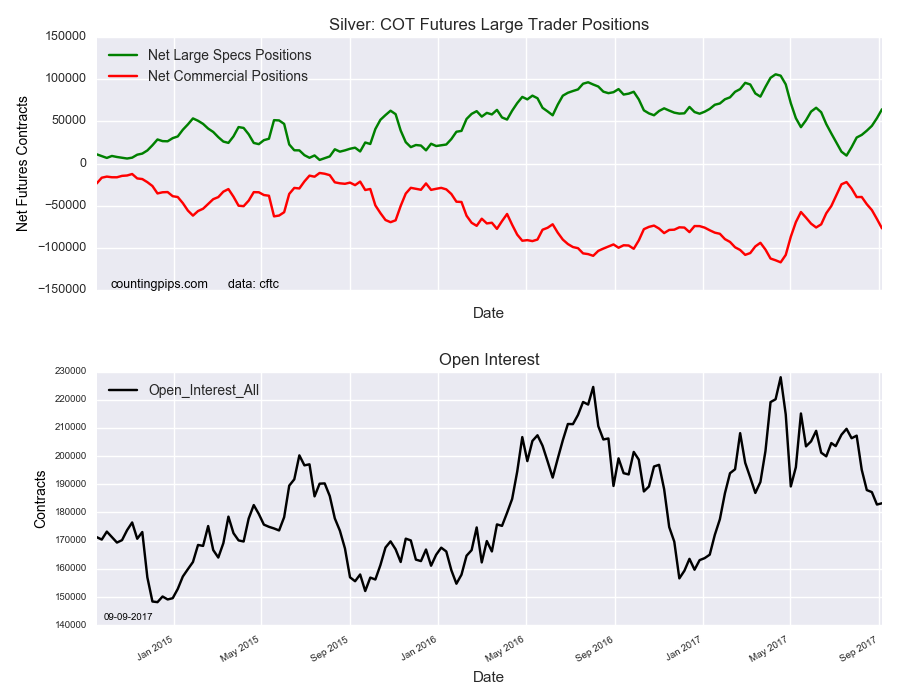
Large speculators continued to push their bullish net positions higher in the Silver futures markets this week, according to the latest Commitment of Traders (COT) data released by the Commodity Futures Trading Commission (CFTC) on Friday.

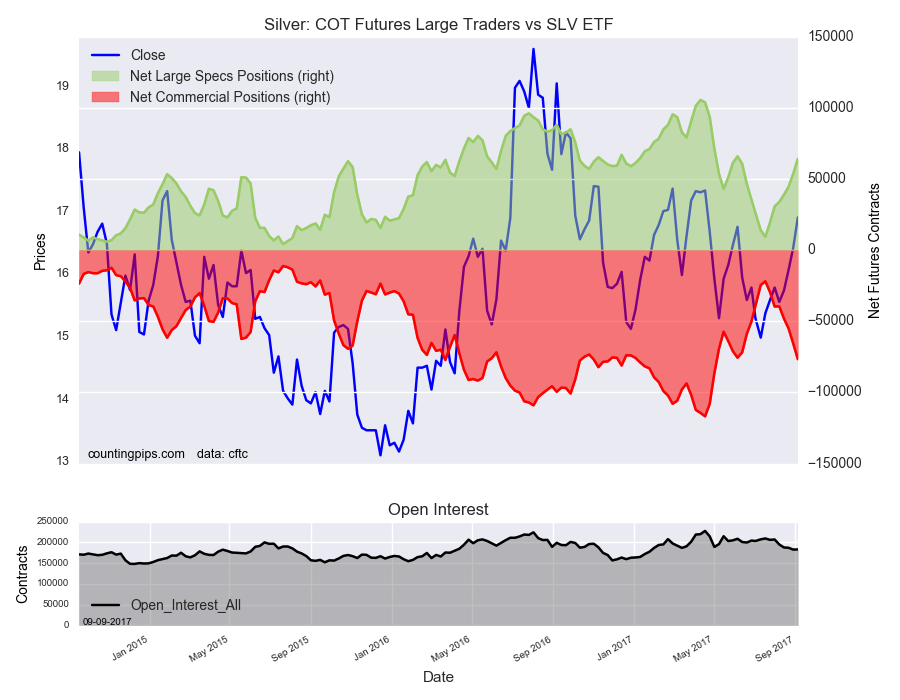
The non-commercial futures contracts of Silver futures, traded by large speculators and hedge funds, totaled a net position of 64,171 contracts in the data reported through Tuesday September 5th. This was a weekly increase of 10,526 contracts from the previous week which had a total of 53,645 net contracts.

Silver speculative positions have gained for seven consecutive weeks (a total rise of +54,795 net contracts over the seven weeks) which has leveled spec positions at the highest standing since June 6th when net positions totaled +65,941 contracts.

Silver Commercial Positions:

The commercial traders position, categorized by the CFTC as hedgers or traders engaged in buying and selling for business purposes, totaled a net position of -76,688 contracts on the week. This was a weekly decline of -11,100 contracts from the total net of -65,588 contracts reported the previous week.

SLV ETF:

Over the same weekly reporting time-frame, from Tuesday to Tuesday, the SLV ishares ETF, which tracks the price of silver, closed at approximately $16.91 which was a gain of $0.49 from the previous close of $16.42, according to unofficial market data.

*COT Report: The COT data, released weekly to the public each Friday, is updated through the most recent Tuesday (data is 3 days old) and shows a quick view of how large speculators or non-commercials (for-profit traders) as well as the commercial traders (hedgers & traders for business purposes) were positioned in the futures markets. The CFTC categorizes trader positions according to commercial hedgers (traders who use futures contracts for hedging as part of the business), non-commercials (large traders who speculate to realize trading profits) and nonreportable traders (usually small traders/speculators). Find CFTC criteria here: (http://www.cftc.gov/MarketReports/CommitmentsofTraders/ExplanatoryNotes/index.htm).

Article by CountingPips.comWeekly COT Report

Copper Speculators pushed bullish net positions higher for 8th week

By CountingPips.comReceive our weekly COT Reports by Email

Copper Non-Commercial Speculator Positions:

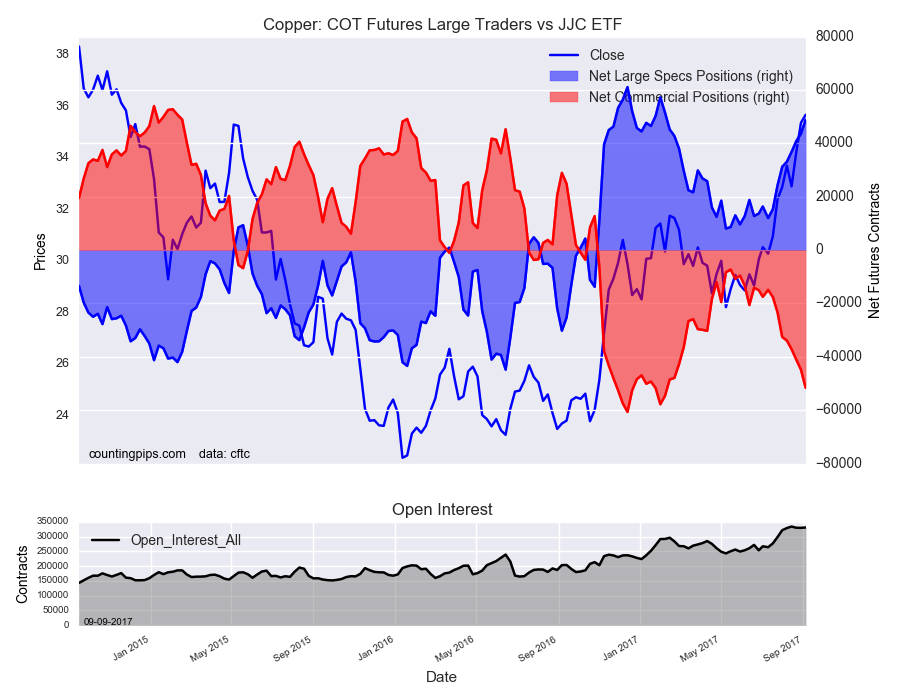
Large speculators continued to lift their net positions in the Copper futures markets this week to the highest level in about six months, according to the latest Commitment of Traders (COT) data released by the Commodity Futures Trading Commission (CFTC) on Friday.

The non-commercial futures contracts of Copper futures, traded by large speculators and hedge funds, totaled a net position of 48,865 contracts in the data reported through Tuesday September 5th. This was a weekly lift of 5,213 contracts from the previous week which had a total of 43,652 net contracts.

Speculative positions have now risen for eight straight weeks and by a total of +36,859 net contracts over that time-frame to level at the best standing since February 7th when net positions totaled +51,559 contracts.

Copper Commercial Positions:

The commercial traders position, categorized by the CFTC as hedgers or traders engaged in buying and selling for business purposes, totaled a net position of -51,639 contracts on the week. This was a weekly loss of -6,813 contracts from the total net of -44,826 contracts reported the previous week.

JJC ETF:

Over the same weekly reporting time-frame, from Tuesday to Tuesday, the JJC iPath Bloomber Copper ETN, which tracks the price of copper, closed at approximately $35.69 which was an increase of $0.31 from the previous close of $35.38, according to unofficial market data.

*COT Report: The COT data, released weekly to the public each Friday, is updated through the most recent Tuesday (data is 3 days old) and shows a quick view of how large speculators or non-commercials (for-profit traders) as well as the commercial traders (hedgers & traders for business purposes) were positioned in the futures markets. The CFTC categorizes trader positions according to commercial hedgers (traders who use futures contracts for hedging as part of the business), non-commercials (large traders who speculate to realize trading profits) and nonreportable traders (usually small traders/speculators). Find CFTC criteria here: (http://www.cftc.gov/MarketReports/CommitmentsofTraders/ExplanatoryNotes/index.htm).

Article by CountingPips.comWeekly COT Report


Business Cash Flow: Ways to Manage Cash Resources

“If I had to run a company on three measures, those measures would be customer satisfaction, employee satisfaction and cash flow.” – Jack Welch

The ancient adage that “cash is king” is of particular relevance to the ongoing growth and success of any business. Therefore, it goes without saying that cash flow control and management are one of the critical elements of running a successful small- to medium-sized business. Without money, you cannot pay your suppliers and employees, buy stock, as well as pay for the various other monthly costs.

Unfortunately, despite understanding the importance of ensuring a strong and healthy cash flow, most business owners do not take the time to manage their finances appropriately. Thereby, increasing the likelihood that the company will die an untimely death.

Amy E. Knaup in her research article titled “Survival and longevity in the Business Employment Dynamics Data” noted that “it is not surprising that most of the new [businesses] disappeared within the first 2 years after their birth, and then only a smaller percentage disappeared in the subsequent 2 years.”

Why?

One of the fundamental grounds for these horrifying statistics is that one of the primary reasons why the small and medium business die a horrible death is an inadequate capital coupled with the misallocation of available funds to purchasing of non-priority assets. Therefore, the need to have a healthy cash flow in your business cannot be emphasized enough.

What is cash flow

Before we look at ways to ensure that your business has liquid cash resources at all time, let’s look at what a formal definition of cash flow is:

Cash flow is the movement of financial resources in and out of your business. There are typically two types of cash flow: Positive and negative cash flow.

Simply stated, positive cash flow occurs when the money coming into your business from sales and other income streams is more than the amount of the cash exiting your business via monthly expenses, etc. On the other hand, negative cash flow happens when the funds leaving your company are greater than the money coming in.

Tips to manage business cash flow

Now that the importance of the need for proper cash flow management has been established, let’s look at a few ways to help you manage your business cash flow:

Take charge of your cash flow

It is vital to track every cent that flows in and out of your business on a real-time basis. This can be done using a simple spreadsheet that records income and expenditure. Additionally, it is important to analyze your income and expenses on a daily, weekly, and monthly basis.

There should be a have a list of fixed monthly expenses such as wages, office rent, water and lights, and telecommunications, etc., which will help you plan and budget for these costs. As money comes into your business via sales and other income streams, you will be able to meet these expenses.

Cultivate a positive cash flow

It stands to reason that a negative cash flow is bad for your company. Therefore, it is important to develop a business model and practical strategies that will convert your negative cash flow into a positive cash flow.

Maximize your profit

It is vital to make your capital work for you! A senior investment manager from Stern Options explains that by “investing your excess cash in low-risk investment vehicles such as fixed deposit accounts, and government bills or bonds will earn you returns that will help you counter the depreciating factor on the value of your idle cash that is caused by rising inflation.” Furthermore, this cash will be readily available should you need quick access to the funds.

Final Thoughts

The ultimate word on the cash flow conundrum is that without cash in the bank, even a profitable business on paper cannot function and runs the risk of ending up being liquidated because the cash-in and cash-out figures do not balance. Cash is indeed king. Without money, your business cannot function. Therefore, as explained above, it is absolutely critical to ensure that your company has healthy liquidity levels.

Article by Taylor Wilman


This Indicators’ 30-Year Track Record is Flashing Red for Stocks

By Elliott Wave International


3 Videos + 8 Charts = Opportunities You Need to See.

Join this free event hosted by Elliott Wave International and you’ll get a clear picture of what’s next in a variety of U.S. markets. After seeing these videos and charts you will be ready to jump on opportunities and sidestep risks in some major markets. This free report (a $29 value) will present a unique outlook and give you a new perspective on the markets you won’t get anywhere else.

Get your FREE report now – for a limited time >>

This article was syndicated by Elliott Wave International and was originally published under the headline This Indicators’ 30-Year Track Record is Flashing Red for Stocks. EWI is the world’s largest market forecasting firm. Its staff of full-time analysts led by Chartered Market Technician Robert Prechter provides 24-hour-a-day market analysis to institutional and private investors around the world.

Murrey Math Lines 08.09.2017 (USD/CHF, EUR/CHF)

Article By RoboForex.com

USD CHF, “US Dollar vs Swiss Franc”

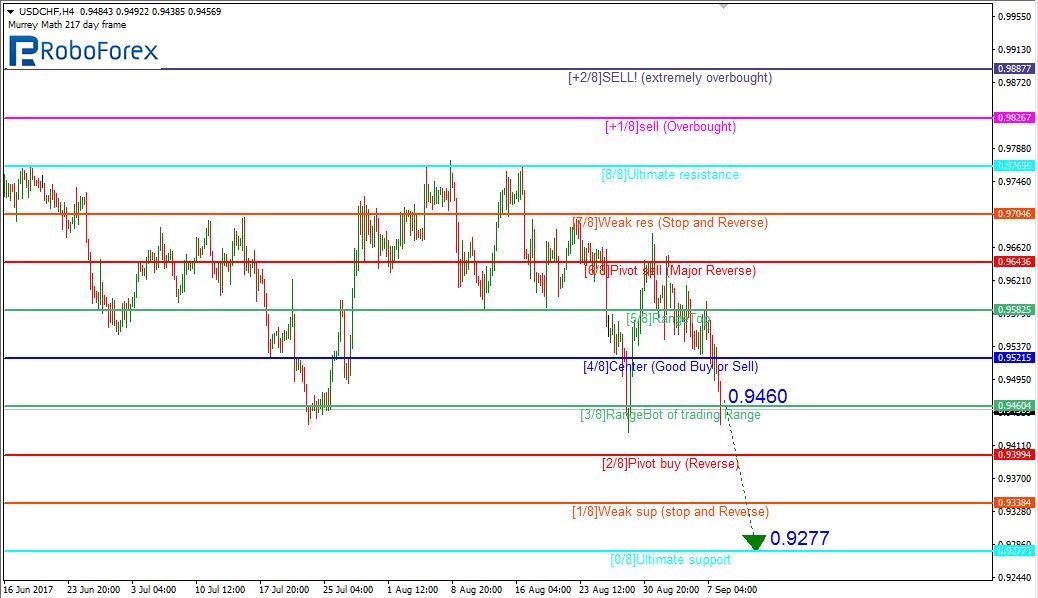
At the H4 chart, the USD/CHF pair is trading at the 3/8 level at 0.9460. The price is expected to break this level and then continue moving downwards to reach the 0/8 one at 0.9277.

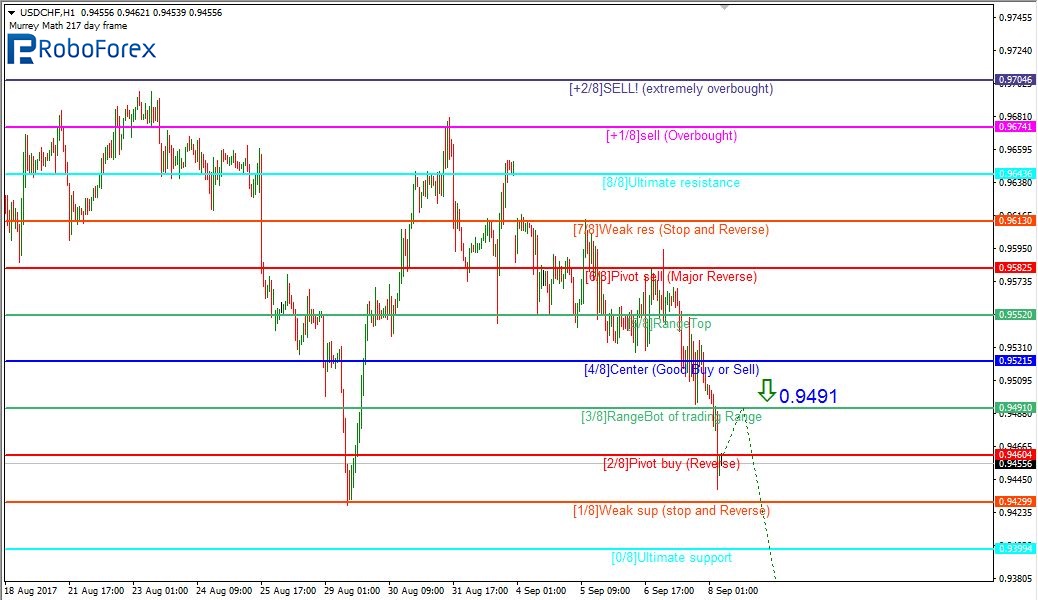
At the H1 chart, the pair is expected to test the 3/8 level at 0.9491. The price may rebound from it and then continue falling towards 0.9277.


EUR CHF, “Euro vs Swiss Franc”

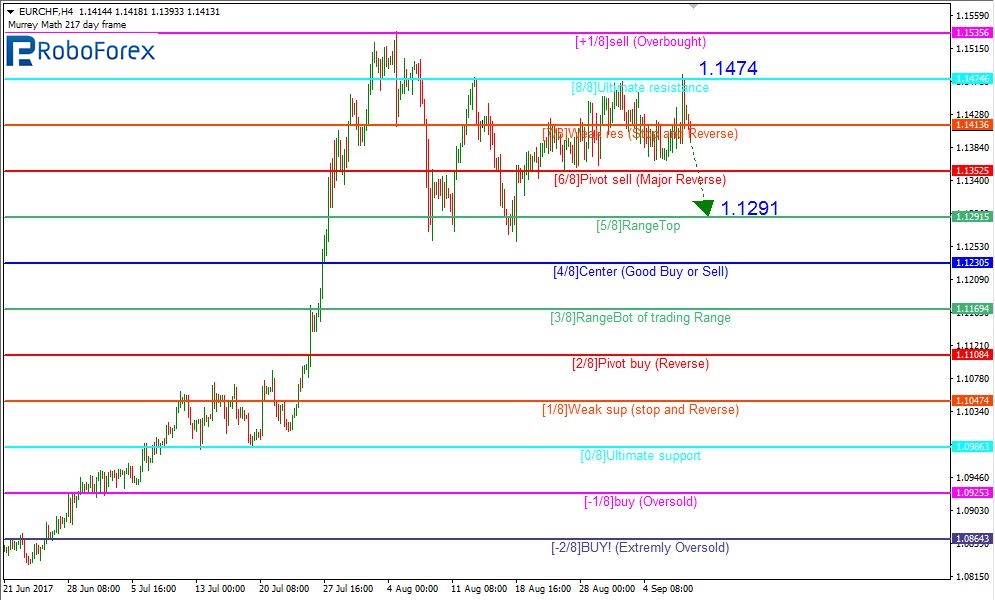
As we can see at the H4 chart, the EUR/CHF pair has rebounded from the resistance at the 8/8 level at 1.1474. Later, the price is expected to fall towards the 5/8 level at 1.1291.

At the H1 chart, the pair may test the 5/8 level at 1.1428, rebound from it, and then resume falling to reach 1.1291.

At the M15 chart, the pair has broken the downside line of the VoltyChannel indicator, which means that it may continue moving downwards.


RoboForex Analytical Department

Article By RoboForex.com

Attention!
Forecasts presented in this section only reflect the author’s private opinion and should not be considered as guidance for trading. RoboForex LP bears no responsibility for trading results based on trading recommendations described in these analytical reviews.

Forex Technical Analysis & Forecast 08.09.2017 (EUR/USD, GBP/USD, USD/CHF, USD/JPY, AUD/USD, USD/RUB, GOLD, BRENT)

Article By RoboForex.com

EUR USD, “Euro vs US Dollar”

The EUR/USD pair is still trading upwards and consolidating above 1.2070. If later the instrument breaks this consolidation range to the upside, the market may grow towards 1.2121; if to the downside – fall with the target at 1.2020.


GBP USD, “Great Britain Pound vs US Dollar”

The GBP/USD pair is still moving upwards; it has extended the wave towards 13130. We think, today the price may consolidate and form a reversal pattern. The market is expected to start a new descending correction with the target is at 1.3024.


USD CHF, “US Dollar vs Swiss Franc”

Being under pressure, the USD/CHF pair is moving downwards. The downside target is at 0.9404. Later, in our opinion, the market may grow towards 0.9550.


USD JPY, “US Dollar vs Japanese Yen”

The USD/JPY pair is still falling. The target of the fifth wave is at 106.50. We think, today the price may reach 107.00. After that, the instrument may be corrected towards 108.70 and continue falling inside the downtrend to reach the above-mentioned target.


AUD USD, “Australian Dollar vs US Dollar”

The AUD/USD pair has broken its consolidation range upwards; it has extended the fifth wave and reached the target. Possibly, today the price may start another correction to reach 0.7984.


USD RUB, “US Dollar vs Russian Ruble”

The USD/RUB pair has reached the target of the third descending wave. We think, today the price may form another consolidation range near the lows. Possibly, the instrument may fall towards 56.50 and then grow to test 58.60 from below. Later, in our opinion, the market may continue falling inside the downtrend.


XAU USD, “Gold vs US Dollar”

Gold has broken its consolidation range upwards and reached 1357. Possibly, today the price may be corrected towards 1329. After that, the instrument may form another ascending structure to reach 1381. Later, in our opinion, the market may be corrected towards 1258.


BRENT

Being under pressure, Brent is still growing. Possibly, the price may reach 55.15 and complete the third ascending wave. After that, the instrument may start another correction towards 51.00 and then resume growing with the target at 57.00.


RoboForex Analytical Department

Article By RoboForex.com

Attention!
Forecasts presented in this section only reflect the author’s private opinion and should not be considered as guidance for trading. RoboForex LP bears no responsibility for trading results based on trading recommendations described in these analytical reviews.

EURUSD: expect a rebound from the 135th degree and U3 line

By Gabriel Ojimadu, Alpari

Previous:

On Thursday the 7th of September, trading on the euro closed up. Mario Draghi’s press conference was the key event of the day, and volatility on the market surged as he was speaking. Everyone heard what they wanted to hear, but the bulls overpowered the bears.

Draghi didn’t say anything new. He remained silent on the strength of the euro; although he did say that volatility on the euro is a source of uncertainty in the Eurozone and that the ECB was closely monitoring its fluctuations. Draghi also announced that most of the decisions regarding the reversal of the QE program would be made in October. The bank’s economists upgraded their GDP forecast for 2017 from 1.9% to 2.2%.

On Draghi’s comments, the euro jumped to 1.2060 compared to 1.1917 when trading closed in New York on Wednesday.

Day’s news (GMT+3):

  • 09:00 Germany: trade balance (Jul).
  • 11:30 Australia: RBA Governor Lowe’s speech.
  • 11:30 UK: industrial production (Jul), trade balance (Jul), manufacturing production (Jul), consumer inflation expectations.
  • 15:00 UK: NIESR GDP estimate (Aug).
  • 15:30 Canada: net change in employment (Aug), unemployment rate (Aug), capacity utilisation (Q2).
  • 15:45 USA: FOMC member Harker’s speech.
  • 17:00 USA: wholesale inventories (Jul).
  • 22:00 USA: consumer credit change (Jul).

EURUSD rate on the hourly. Source: TradingView

The daily price range on the 7th of September’s candlestick was 146 pips. Buyers met with resistance at around the 180th degree and the U3 moving averages line. If the price didn’t break through this line during Draghi’s speech, it’s very unlikely to happen today.

So, how can we make sense of current affairs? First of all, the first thing that comes to mind is the formation of a triple top beneath the U3 line. If you have an MA line on your chart, take a look at the price dynamics from the 25th to 29th of August.

Another possibility is that in the case of a lack of news and a lack of will from buyers to take profit on their long positions, we could see a correction to the 45th degree at 1.2038. I’m forecasting a rebound from this level, but we need to keep an eye on trading volume. If volume is low, the downwards correction should continue to the LB balance line, to around 1.2010.

Could the euro/dollar go up? It’s possible. The price could climb without volume to 1.2130 to form a bearish divergence. The euro is rising against the US dollar, the pound, and the Canadian dollar, while falling against the franc, yen, and the Aussie and Kiwi dollars.