Author Archive for InvestMacro – Page 505

Ichimoku Cloud Analysis 11.09.2017 (AUD/USD, NZD/USD, USD/CAD)

Article By RoboForex.com

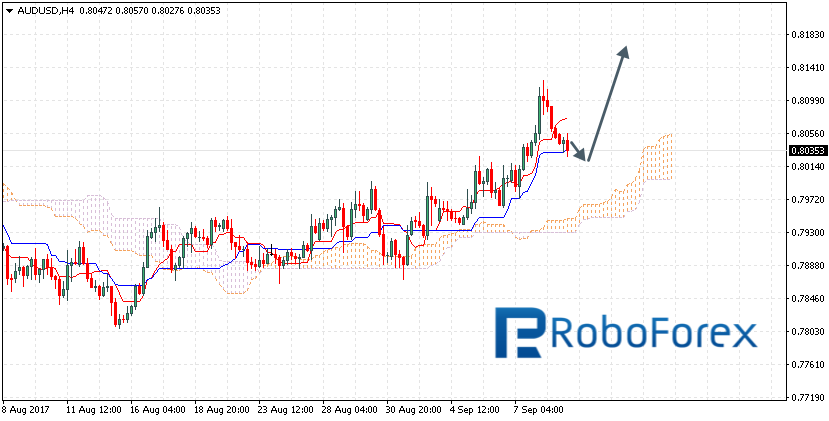
AUD USD, “Australian Dollar vs US Dollar”

The AUD/USD pair is trading at 0.8035; the instrument is still moving above Ichimoku Cloud, which means that it may continue growing. We should expect the price to test Tenkan-Sen and Kijun-Sen at 0.8025 and then continue moving upwards above 0.8155. However, this scenario may be cancelled if the price breaks the downside border of the cloud and fixes below 0.7975. In this case, the pair may continue falling towards 0.7830.


NZD/USD, “New Zealand Dollar vs US Dollar”

The NZD/USD pair is trading at 0.7251; the instrument is still moving above Ichimoku Cloud, which means that the it may continue growing. We should expect the price to test the upside border of the cloud at 0.7240 and then continue moving upwards to reach 0.7350. However, the scenario that implies further growth may be cancelled if the price breaks the downside border of the cloud and fixes below 0.7190. In this case, the pair may continue falling towards 0.7085.


USD/CAD, “US Dollar vs Canadian Dollar”

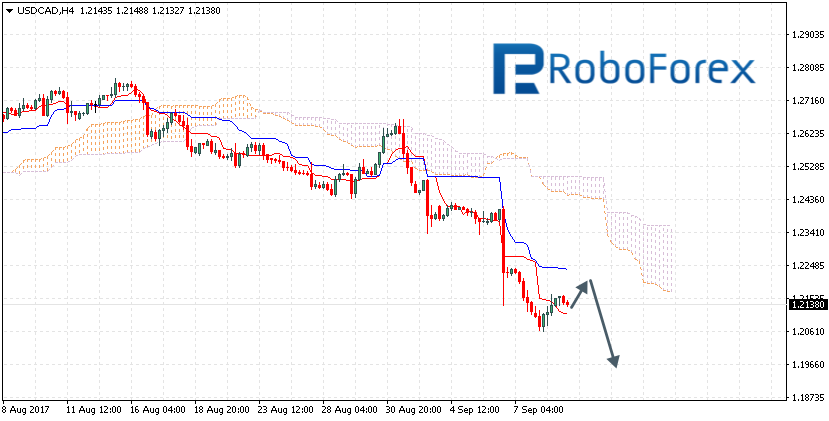
The USD/CAD pair is trading at 1.2138; the instrument is still moving below Ichimoku Cloud, which means that it may continue falling. We should expect the price to test Tenkan-Sen and Kijun-Sen at 1.2195 and then continue moving downwards below 1.1970. However, this scenario may be cancelled if the price breaks the upside border of the cloud and fixes above 1.2365. In this case, the pair may continue growing towards 1.2510.


RoboForex Analytical Department

Article By RoboForex.com

Attention!
Forecasts presented in this section only reflect the author’s private opinion and should not be considered as guidance for trading. RoboForex LP bears no responsibility for trading results based on trading recommendations described in these analytical reviews.

Back to School: What to expect from the markets this September

By Adinah Brown

Cryptocurrency – This past Monday China’s financial regulators banned virtual coin fundraising schemes that have exploded over the course of this year and is expected to follow up with further rules to tighten up the entire industry of virtual currencies. According to Yicai, a nationally based publication site, China has banned the practice of raising funds through initial coin offerings (ICO) that issue token based digital funds. According to the report, a source close to the China Securities Regulatory Commission has advised that this is merely the start of further more aggressive regulation on virtual currencies.

Undoubtedly, the regulators are reacting to the surge of funds that has been put into ICOs, of the $2.32 billion dollars that has been raised, $2.16 billion of that, was raised just within 2017 alone. As a result of this development, Bitcoin, which cracked the $5,000 glass ceiling over the previous weekend subsequently dropped 20% on Monday and then continued to fall, albeit less dramatically, over the course of the week.

European Central Bank Policy Meeting – Held in the first week of September the ECB met to address the unwinding of its massive quantitative easing program. A senior European Central bank supervisor called for subjecting private investors to market discipline in order to share the burden of a bank rescue. According to the report, responsibility to share the burden must fall on them as “this is a non-negotiable prerequisite prior to public funds being touched”. Even still the ECB upgraded its growth outlook and reduced inflation slightly. The ECB announced the selection of a technical committee that will be tasked with crafting policy options, an important step towards scaling back stimulus programs.

Weak inflation rates in the US – With inflation rates over the summer falling well short of the target rate set by the Federal Reserve, Fed Govenor Lael Brainard, cautioned the US central bank on pushing interest rates any further, at least until it is confident that it is able to push prices above the 2 percent target. Brainard, a permanent voter on monetary policy, said that inflation needs to be on target, before the Fed can consider a change in tightening its monetary policy.

In other parts of the country, the economic impact of hurricane Harvey is still being surveyed. However according to Enki Holdings who have conducted studies on the economic impact of natural disasters, the cost of the flooding on the economy is likely to be around $30 billion. While a third of Houston’s economy is directly tied to oil and gas production, the region is also home to small manufacturers and large corporations such as KBR, food production and waste management companies. In the wake of the storms many of these companies will have closed down, as have hospitals, airports and sea ports. According to an expert at Enki “Houston, the fifth largest economy in the United States has been sitting at a standstill for over four days, the reverberations of the impact are going to be felt widely”.

Britain struggling to find their exit – According to a senior source from within the trade department, Britain simply does not have the capacity to strike a new trade deal with every partner of the European Union, leaving it in a position where the best approach appears to be of “copy pasting” existing EU deals. Late August Britain and Japan agreed that the EU-Japan trade agreement would become the basis of their own trading arrangement once Britain leaves the bloc. However, Japan is just one of forty FTAs (Free Trade Agreements) that still need to be negotiated, and Britain remains limited in its capacity to achieve bilateral deals across the board.

About the Author:

Adinah Brown is a professional writer who has worked in a wide range of industry settings, including corporate industry, government and non-government organizations. Within many of these positions, Adinah has provided skilled marketing and advertising services and is currently the Content Manager at Leverate.


5 Reasons Why You Should Start Trading on the Global Financial Markets

“The tendency is to think if you are a professional woman, it’s because you’ve turned your back on the traditional side. The tendency is not to recognize that we can excel as professionals without giving up our identity of being mother, wife, and homemaker.” – Lucille Roybal-Allard

There are many reasons to open a small startup (or work part-time) from home while you are a homemaker. As Lucille Roybal-Allard notes in her quotation mentioned above, as a wife and mother, you do not need to give up your professional career.  It is possible and doable for you to start a part-time gig as well as be at home for your family.

Micha Kaufman in his 2014 article “Glass Ceiling Smashed by Freelancing Moms” cited the Bureau of Labour Statistics which showed that “women are making more money than men in part-time jobs. Female part-timers earned $10 more in median weekly salaries than their male counterparts.”

What are the global financial markets?

Before we look at the reasons why you should consider investing on the world’s capital markets, let’s have a look at what the world’s financial markets are:

Succinctly stated, a financial market is a “market in which people trade financial securities, commodities, and other fungible items of value at low transaction costs and at prices that reflect supply and demand.”

There are different markets or stock exchanges that are housed in a physical location such as the New York Stock Exchange and the London Stock Exchange. Other markets like the foreign exchange markets are a virtual network of global financial houses that facilitate the buying and selling of the world’s currencies.

Financial market trading: Reasons to open your own startup

There are many justifications for the need to open up your own part-time business. Some of these reasons range from personal fulfillment to the need to generate extra money to save for a vacation or other large purchase. However, the point of this article is not to determine whether you should or shouldn’t work as a freelancer, it is to say that financial market trading is a good option to consider when looking at what part-time business you should look at.

Therefore, here are a list of reasons why you should consider trading on the global financial markets as a viable means of earning a part-time (or full-time) income:

Advancements in financial technology

The financial and technological know-how that underpins the different online trading platforms has advanced to such an extent that it is now a simple matter of sitting down in front of your computer and getting on with the task of placing successful trades. In real terms, it is slightly more complicated as you need to sign up with an online trading broker, work through their exhaustive educational documents, utilizing the demo platform to practice placing successful trades, and then getting on with the business of making successful trades.  The good news is that you can trade 24/5, any time of the day or night. As a result, online financial market trading is something that you can do when you sit down after putting the kids to bed at night or when they are at school.

Reach your investment goals

You and your family will have financial goals such as pay off study loans, buy your own home, or go on an extended vacation. Or your goal might simply be to earn enough money to meet your monthly budget. The importance of reaching your savings goals, or even just adding to the monthly pot to be able to meet your budget cannot be underestimated.

Reduce the risk to your savings by adding a mix of investments

According to a financial market analyst from Stern Options, “the way to reduce the risk of your investments losing value due to inflationary pressures, etc., it is wise to diversify your investment portfolio into high-risk, high-reward, short-term investments and low-risk, low-reward, long-term investments.”

One of the best strategies to implement when you are investing in short-term, high-risk investments is to make sure that you open and close your trading position before the end of every trading day. It is not a good idea to keep high-risk trades overnight because of the current financial market instability and volatility.

Final words

Online share trading in all its different guises is a perfect solution to the challenge of being a wife, mother, as well as an income-earning professional.

By Taylor Wilman


Fibonacci Retracements Analysis 11.09.2017 (GOLD, USD/CHF)

Article By RoboForex.com

XAU USD, “Gold vs US Dollar”

At the H4 chart of the XAU/USD pair, the price is forming the divergence, which may indicate a possible correction or a reverse. The closet targets of this descending correction are the retracement of 38.2%, 50.0%, and 61.8% at 1321.49, 1299.22, and 1281.20 respectively. The resistance for the current movement is close to the local high at 1357.46.

At the H1 chart, the situation pretty the same. The pair is also forming the divergence, thus indicating a possible correction. By now, the price has been corrected by 23.6%. The next targets of the correction may be the retracements of 38.2%, 50.0%, and 61.8% at 1326.05, 1316.45, and 1306.58 respectively.


USD CHF, “US Dollar vs Swiss Franc”

As we can see at the H4 chart, the pair has once again tested the support area at 0.9427. If the price breaks this level, it may move towards the post-correctional extension area between the retracements of 138.2% and 161.8% at 0.9315 and 0.9235 respectively. The resistance for the current movement is at 0.9772.

At the H1 chart, the pair is forming an ascending correction within the downtrend. The targets of the correction may be the retracements of 38.2%, 50.0%, and 61.8% at 0.9517, 0.9549, and 0.9578 respectively.


RoboForex Analytical Department

Article By RoboForex.com

Attention!
Forecasts presented in this section only reflect the author’s private opinion and should not be considered as guidance for trading. RoboForex LP bears no responsibility for trading results based on trading recommendations described in these analytical reviews.

So far the US Dollar is handling the pressure

By RoboForex

The US national debt topic is getting “hotter” day after day for a good reason. It’s already September, and the US Congress has to consider the increase of the maximum possible amount of the national debt until the end of the month. It will be a difficult task, which may require more time than the politicians really have.

Right after the Labor Day, the US Congress went back to work after legislative recess. Its highest priority is the 2018 budget agreement and acceptance along with the national debt issue. Earlier, Steven Mnuchin, the US Secretary of the Treasury, warned that the national debt “ceiling” should have been considered as early as in spring.

Right now, the US national debt is a bit shy of 20 trillion USD. This number is more than the country’s GDP, but it’s okay for developed economies. If the debt is serviced in due time, there won’t be any problems with it. However, in the USA, there is a legislatively accepted “ceiling” of the national debt. This year, members of the Congress have to revise it until September 29th.

There always is a chance that they won’t make it in time. On several occasions in the past, there was a real drama about it and the decision was made just several hours before the “H-hour” while the stock and currency markets were swinging. The major political difference is that the Republicans are always in favor of decreasing the load on budget expenditures while the Democrats are against. Both parties fight for every cent, but eventually come to a consensus.

By the way, the latest news says that the members of the Congress have time: Trump asked the Congress for three more months, so now the deadline is December the 5th.

Discussions about the national debt “ceiling” increase are a very delicate topic for the US Dollar. While they are discussing the topic, the demand for “safe haven” assets may increase and the USD may come under even more pressure than now.

The technical picture of the EUR/USD pair shows a stable uptrend, which indicates that the loser here is the USD. The situation is evolving the favor of the Euro. Still, the situation may change in the short-term if the price doesn’t break the high at 1.2070 reached on August 29th. However, if “bulls” succeed, the closest target will be at 1.2250, which is close to the upside border of the ascending channel. But again, if the above-mentioned high provides resistance, it may stop the impulse and start the Flat pattern with the support at the downside border of the current range. After the price finishes this pattern and breaking 1.2070 upwards, the upside target may change to 1.24. Also, one shouldn’t ignore another scenario, which implies that the pair may beak the range downwards. In this case, the support level will be at 1.19. If the price breaks this level and fixes below it, investors may close their positions, all or partially. As a result, the instrument may continue falling towards 1.1550.

Author: Dmitriy Gurkovskiy, senior analyst at RoboForex

Attention!

Forecasts presented in this section only reflect the author’s private opinion and should not be considered as guidance for trading. RoboForex bears no responsibility for trading results based on trading recommendations described in these analytical reviews.


EURUSD: price sitting on the balance line

By Gabriel Ojimadu, Alpari

Previous:

On Friday the 8th of September, trading on the euro/dollar pair closed down. After hitting a new high of 1.2092 in Asia, buyers started cashing in on their long positions during the European session. The rate first fell to 1.2036 (-56 pips). During the second wave of euro selling, it fell against the dollar to 1.2015 (-21 pips).

The US dollar index closed up. It strengthened after a speech from FOMC member Dudley and after Congress’ decision to temporarily raise the government’s debt ceiling. Dudley stated that restoration works after hurricanes tend to lead to a rise in economic activity in the long term. US 10Y bond yields have increased.

Day’s news (GMT+3):

  • 09:00 Japan: machine tool orders (Aug).
  • 15:15 Canada: housing starts (Aug).

Fig 1. EURUSD rate on the hourly. Source: TradingView

On Monday the 11th of September, as trading on the currency market got underway, the euro opened down. The opening price was brought about by investors abandoning the safe havens given that the weekend passed without any trouble. In celebrating North Korea’s founding day on the 9th of September, Supreme Leader Kim Jong-un stopped short of marking the occasion with a missile launch. The Japanese yen, Swiss franc, and gold are all trading down.

In Asia, US 10Y bond yields have risen sharply, while the euro rate against the dollar has retreated to the LB balance line. Now let’s look again at the dynamics from the 29-30th of August. The price first corrected to the balance line, and then the drop continued to the D3 line. The economic calendar for Monday is empty, so I’m predicting a rise to 1.2035, followed by a drop to 1.1955. Over the last few days, a candlestick with a long wick has formed. The bearish signal could be extinguished, but in any case, be careful with buying.

US Dollar Index Speculators added to bearish net positions for 2nd week

By CountingPips.comReceive our weekly COT Reports by Email

US Dollar Index Non-Commercial Speculator Positions:

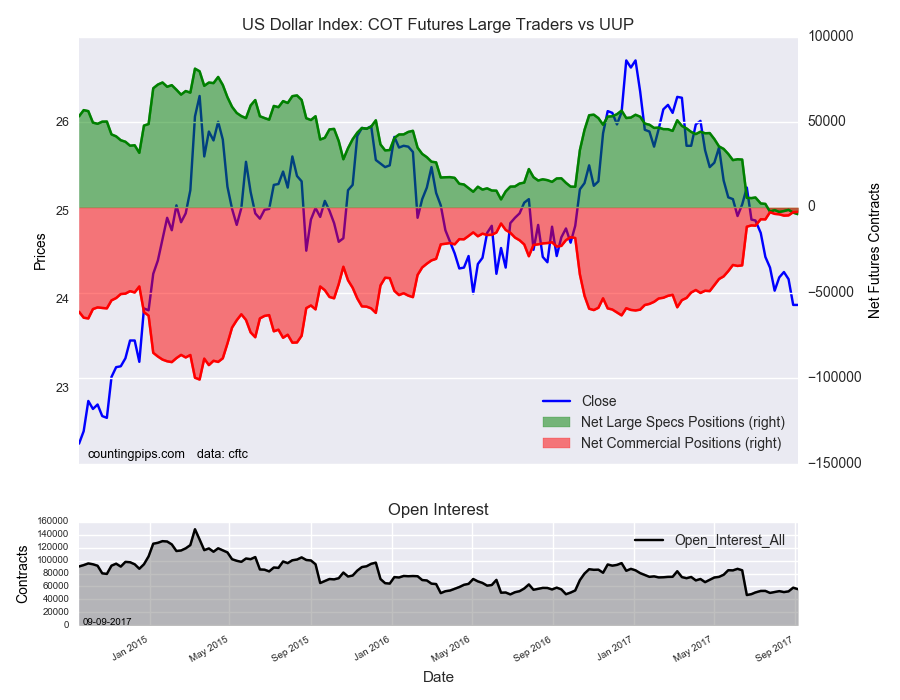
Large speculators raised their bearish net positions in the US Dollar Index futures markets this week, according to the latest Commitment of Traders (COT) data released by the Commodity Futures Trading Commission (CFTC) on Friday.

The non-commercial futures contracts of US Dollar Index futures, traded by large speculators and hedge funds, totaled a net position of -3,944 contracts in the data reported through Tuesday September 5th. This was a weekly lowering of -890 contracts from the previous week which had a total of -3,054 net contracts.

US dollar index speculator positions have now been in short territory for seven straight weeks after turning from bullish to bearish on July 25th. The spec position is now at the most bearish level since April 1st 2014 when net positions totaled -10,053 contracts.

US Dollar Index Commercial Positions:

The commercial traders position, categorized by the CFTC as hedgers or traders engaged in buying and selling for business purposes, totaled a net position of -2,653 contracts on the week. This was a weekly edge higher of 141 contracts from the total net of -2,794 contracts reported the previous week.

UUP:

Over the same weekly reporting time-frame, from Tuesday to Tuesday, the UUP ETF, which tracks the price of US Dollar Index, closed at approximately $23.95 which was virtually no change from the previous close, according to unofficial market data.

*COT Report: The COT data, released weekly to the public each Friday, is updated through the most recent Tuesday (data is 3 days old) and shows a quick view of how large speculators or non-commercials (for-profit traders) as well as the commercial traders (hedgers & traders for business purposes) were positioned in the futures markets. The CFTC categorizes trader positions according to commercial hedgers (traders who use futures contracts for hedging as part of the business), non-commercials (large traders who speculate to realize trading profits) and nonreportable traders (usually small traders/speculators). Find CFTC criteria here: (http://www.cftc.gov/MarketReports/CommitmentsofTraders/ExplanatoryNotes/index.htm).

Article by CountingPips.comWeekly COT Report


COT Report: Gold, Silver, Copper bets surge higher. USD more bearish. Crude bets gain

By CountingPips.com

Here is a short summary and this week’s links (below) to the latest Commitment of Traders changes.

– US Dollar Speculators add to USD bearish bets, USD has been down 10 out of 11 weeks

– WTI Crude Oil Speculator bets rebounded after 4 down weeks

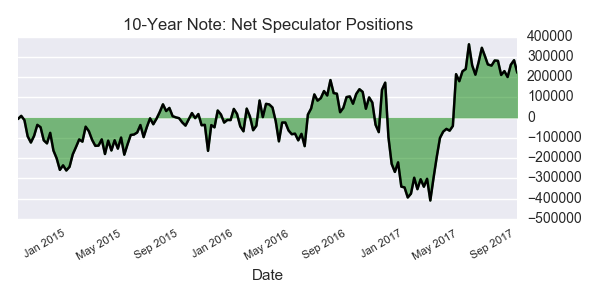
– 10-Year Note Speculators bullish bets fell after 2 weeks of gains, back under +250,000 level

– Gold bets go sharply higher for 7th straight week

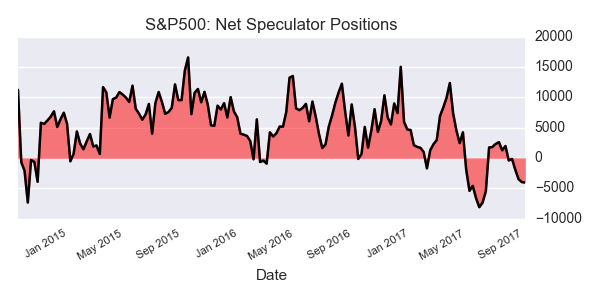
– Large S&P500 Speculators pushed bearish bets higher for 4th week

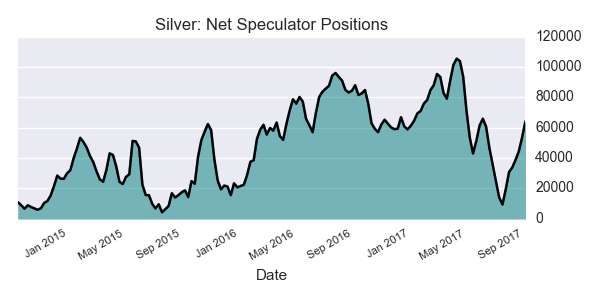
– Silver Speculator bets rise for 7th consecutive week, continue strong bullishness

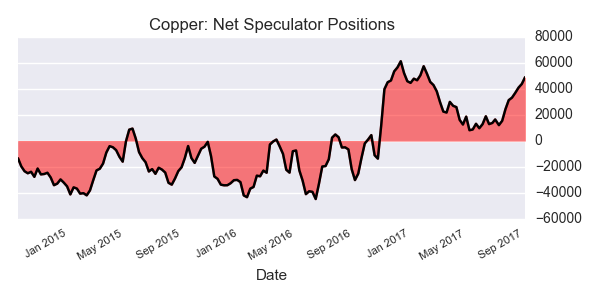
– Copper bets gained for 8th week in a row


FX Speculators added to US Dollar bearish bets again this week

US Dollar net speculator positions leveled at $-10.89 billion as of Tuesday

The latest data for the weekly Commitment of Traders (COT) report, released by the Commodity Futures Trading Commission (CFTC) on Friday, showed that large traders and currency speculators added to their bearish bets for the US dollar this week for a third straight week. See full article


WTI Crude Oil Speculator bets bounce back after 4 down weeks

The non-commercial contracts of WTI crude futures totaled a net position of 382,113 contracts, according to data from last week. This was a lift of 16,248 contracts from the previous weekly total. See full article


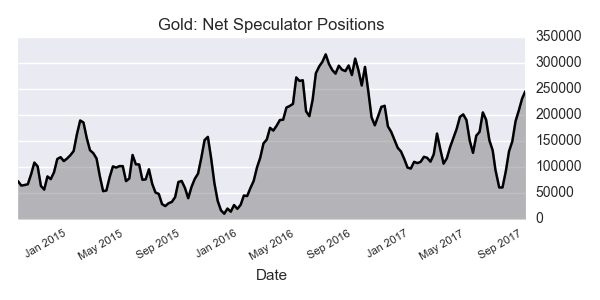
Gold Speculators continued to sharply raise bullish positions this week

The large speculator contracts of gold futures totaled a net position of 245,298 contracts. This was a weekly advance of 14,251 contracts from the previous week. See full article


10-Year Note Speculators cut back on bullish net positions this week

The large speculator contracts of 10-year treasury note futures totaled a net position of 221,806 contracts. This was a weekly reduction of -61,913 contracts from the previous week. See full article


S&P500 Speculators edged their bearish net positions higher

The large speculator contracts of S&P 500 futures totaled a net position of -4,028 contracts. This was a decrease of -73 contracts from the reported data of the previous week. See full article


Silver Speculators their positions last week

The non-commercial contracts of silver futures totaled a net position of 64,171 contracts, according to data from last week. This was a weekly gain of 10,526 contracts from the previous totals. See full article


Copper Speculators pushed bullish net positions higher for 8th week

The large speculator contracts of copper futures totaled a net position of 48,865 contracts. This was a weekly boost of 5,213 contracts from the data of the previous week. See full article


Article by CountingPips.com

The Commitment of Traders report data is published in raw form every Friday by the Commodity Futures Trading Commission (CFTC) and shows the futures positions of market participants as of the previous Tuesday (data is reported 3 days behind).

To learn more about this data please visit the CFTC website at http://www.cftc.gov/MarketReports/CommitmentsofTraders/index.htm


FX Speculators added to US Dollar bearish bets again this week

By CountingPips.comGet our weekly COT Reports by Email

US Dollar net speculator positions declined to $-10.89 billion this week

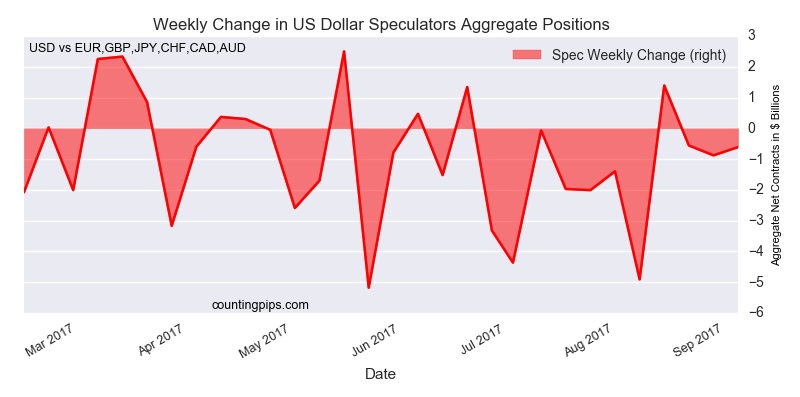
The latest data for the weekly Commitment of Traders (COT) report, released by the Commodity Futures Trading Commission (CFTC) on Friday, showed that large traders and currency speculators added to their bearish bets for the US dollar this week for a third straight week.

Non-commercial large futures traders, including hedge funds and large speculators, had an overall US dollar position totaling $-10.89 billion as of Tuesday September 5th, according to the latest data from the CFTC and dollar amount calculations by Reuters. This was a weekly decline of $-0.61 billion from the $-10.28 billion total short position that was registered the previous week, according to the Reuters calculation (totals of the US dollar contracts against the combined contracts of the euro, British pound, Japanese yen, Australian dollar, Canadian dollar and the Swiss franc).

The aggregate US dollar position has now fallen ten out of the past eleven weeks and to a new lowest level since 2013. Despite the consistent fall, the latest declines have been relatively small with under a $-1.0 billion decrease taking place each of the past three weeks.


Weekly Speculator Contract Changes:

The individual major currencies saw only one weekly change above the (+ or -) 10,000 contract mark this week in the speculators category.

  • Mexican peso bets jumped by over +16,000 contracts this week after a small decline the previous week. The MXN speculator standing is now back over the +100,000 net contract level and at the most bullish point since May 28th 2013 when net positions totaled +120,864 contracts.

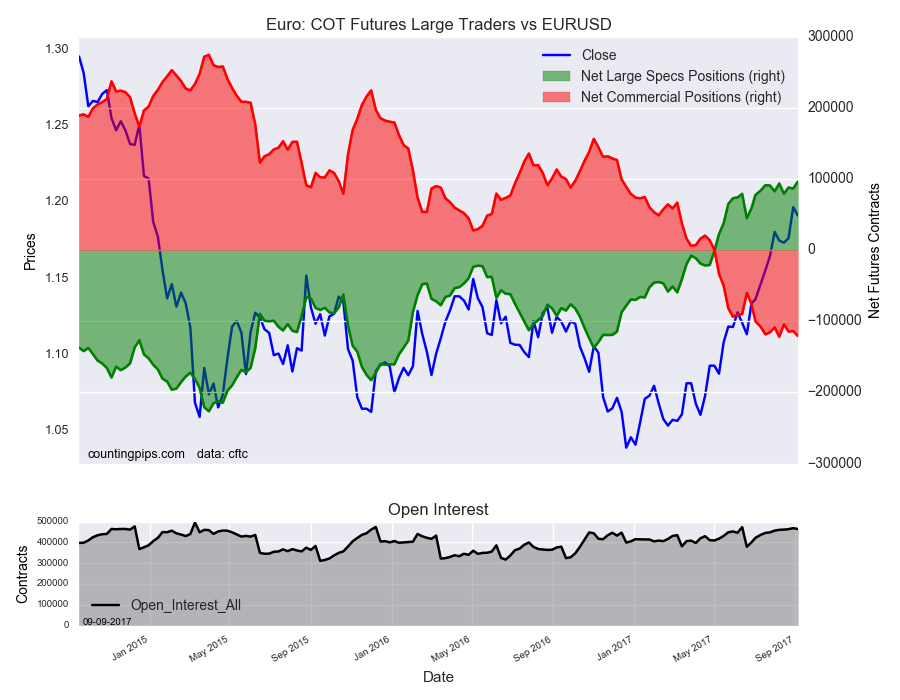
Overall, the major currencies that improved against the US dollar last week were the euro (9,790 weekly change in contracts),  Canadian dollar (477 contracts) and the Mexican peso (16,602 contracts).

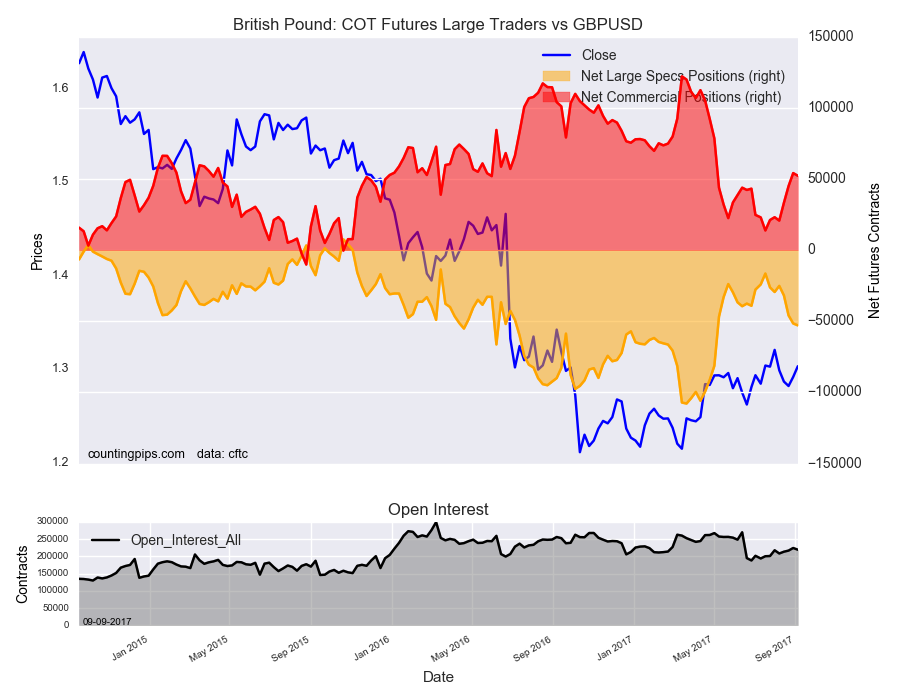
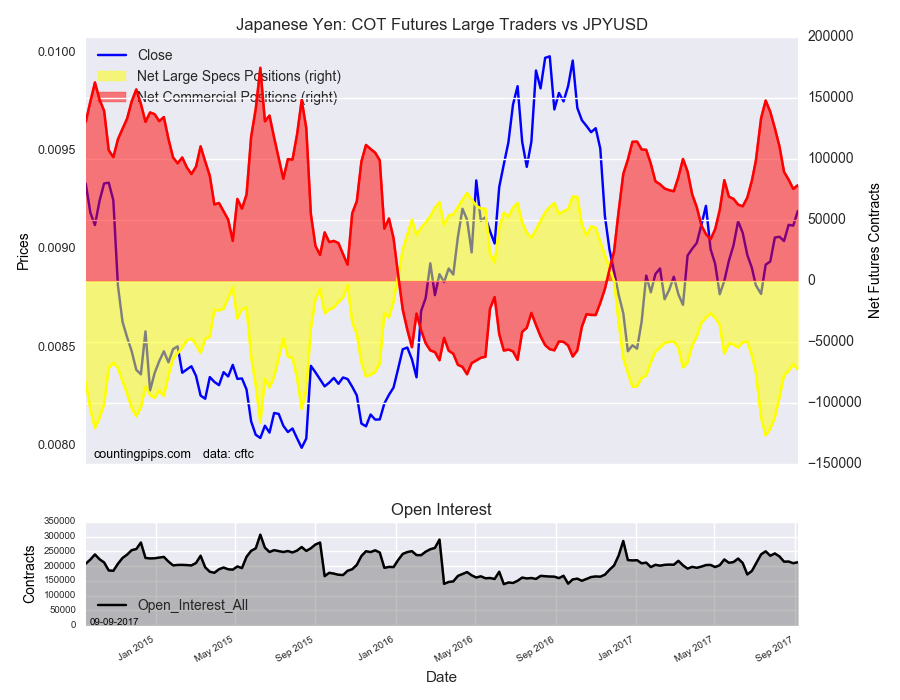
The currencies whose speculative bets dropped declined last week versus the dollar were the British pound sterling (-1,372 weekly change in contracts), Japanese yen (-4,421 contracts), Swiss franc (-393 contracts), Australian dollar (-1,623 contracts) and the New Zealand dollar (-4,081 contracts).


Table of Weekly Commercial Traders and Speculators Levels & Changes:

CurrencyNet CommercialsComms Weekly ChgNet SpeculatorsSpecs Weekly Chg
EuroFx-120,668-6,90896,3099,790
GBP52,245-1,896-52,927-1,372
JPY78,2323,028-72,945-4,421
CHF5,7072,004-2,171-393
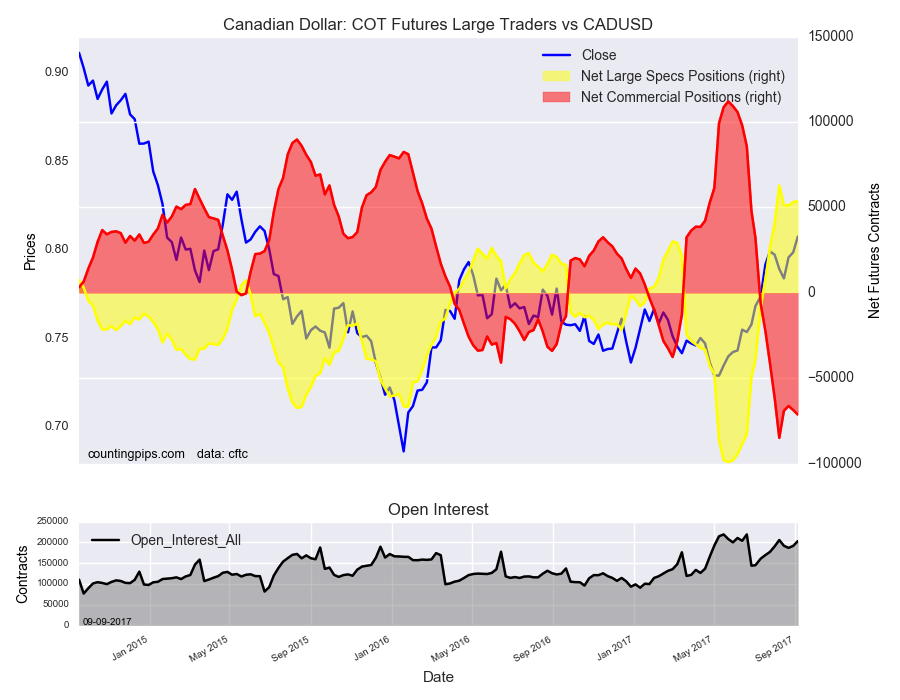
CAD-71,350-2,67453,644477
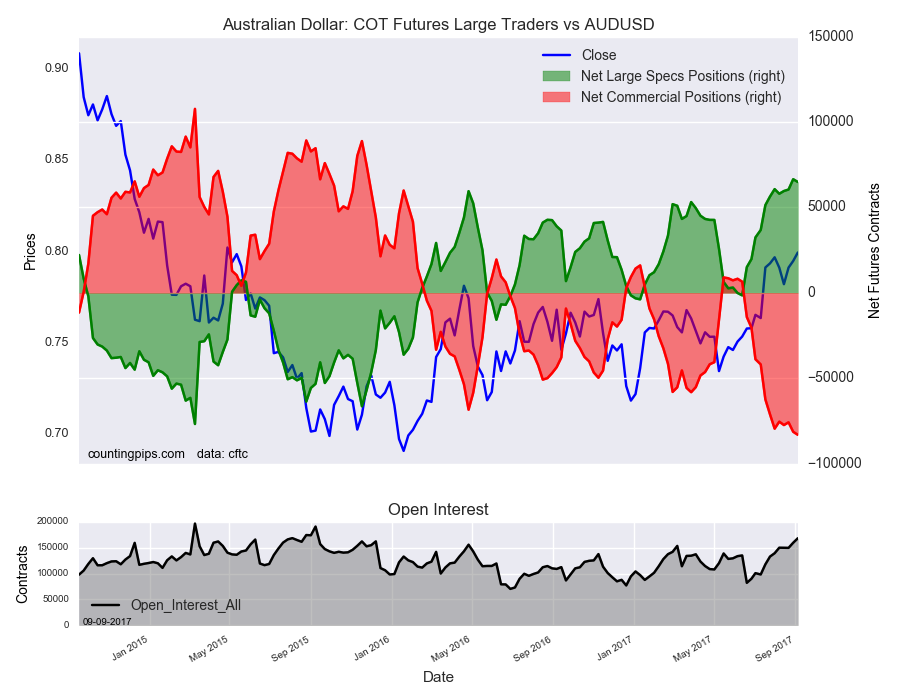
AUD-83,189-1,77564,904-1,623
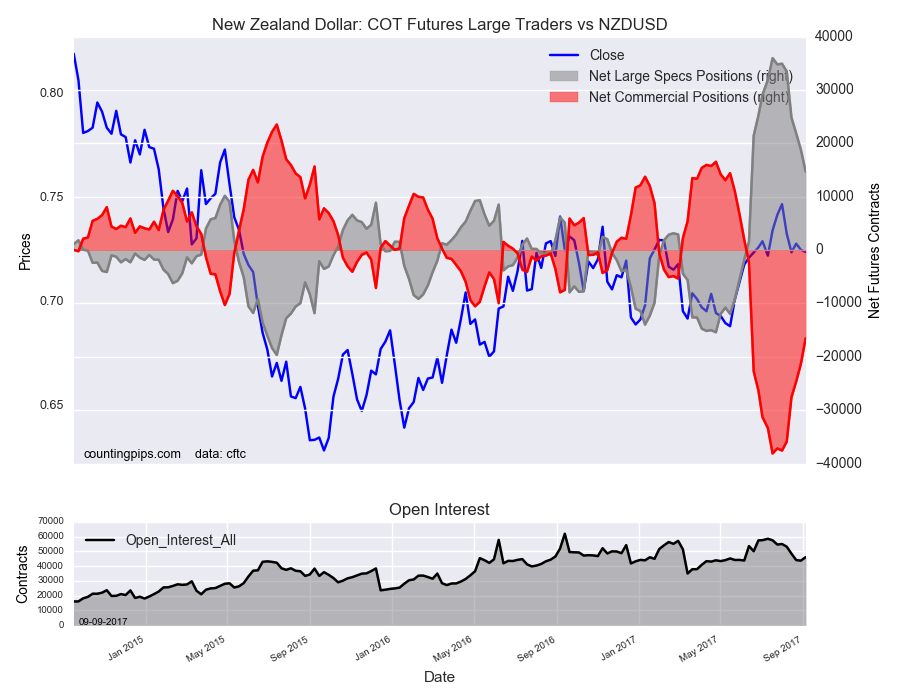
NZD-16,5244,78014,723-4,081
MXN-119,359-17,332113,61216,602


This latest COT data is through Tuesday and shows a quick view of how large speculators or non-commercials (for-profit traders) as well as the commercial traders (hedgers & traders for business purposes) were positioned in the futures markets. All currency positions are in direct relation to the US dollar where, for example, a bet for the euro is a bet that the euro will rise versus the dollar while a bet against the euro will be a bet that the dollar will gain versus the euro.


Weekly Charts: Large Trader Weekly Positions vs Price

EuroFX:


British Pound Sterling:


Japanese Yen:


Swiss Franc:


Canadian Dollar:


Australian Dollar:


New Zealand Dollar:


Mexican Peso:

*COT Report: The weekly commitment of traders report summarizes the total trader positions for open contracts in the futures trading markets. The CFTC categorizes trader positions according to commercial hedgers (traders who use futures contracts for hedging as part of the business), non-commercials (large traders who speculate to realize trading profits) and nonreportable traders (usually small traders/speculators). Find CFTC criteria here: (http://www.cftc.gov/MarketReports/CommitmentsofTraders/ExplanatoryNotes/index.htm).

The Commitment of Traders report is published every Friday by the Commodity Futures Trading Commission (CFTC) and shows futures positions data that was reported as of the previous Tuesday (3 days behind).

Each currency contract is a quote for that currency directly against the U.S. dollar, a net short amount of contracts means that more speculators are betting that currency to fall against the dollar and a net long position expect that currency to rise versus the dollar.

(The charts overlay the forex closing price of each Tuesday when COT trader positions are reported for each corresponding spot currency pair.) See more information and explanation on the weekly COT report from the CFTC website.

Article by CountingPips.com


WTI Crude Oil Speculator bets bounce back after 4 down weeks

By CountingPips.comReceive our weekly COT Reports by Email

WTI Crude Oil Non-Commercial Speculator Positions:

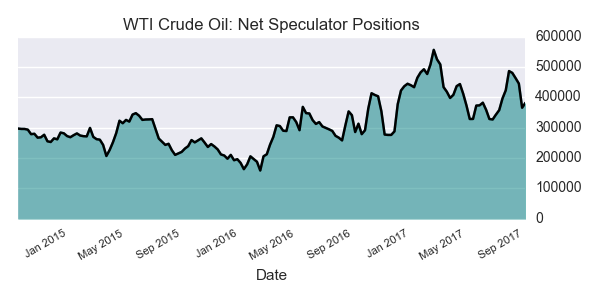
Large oil speculators raised their bullish net positions in the WTI Crude Oil futures markets this week after a month of decline, according to the latest Commitment of Traders (COT) data released by the Commodity Futures Trading Commission (CFTC) on Friday.

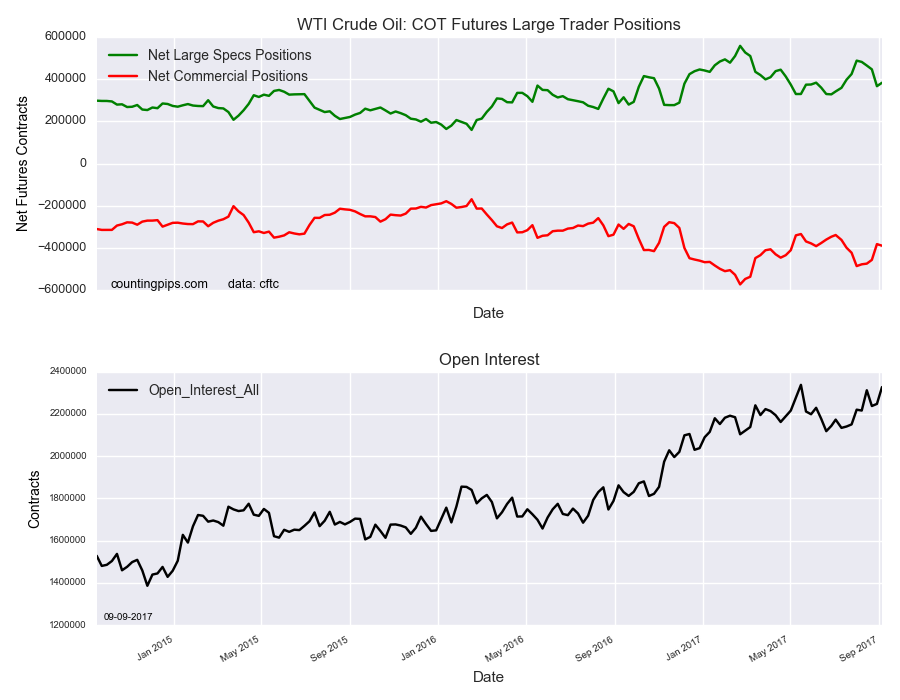
The non-commercial futures contracts of WTI Crude Oil futures, traded by large speculators and hedge funds, totaled a net position of 382,113 contracts in the data reported through Tuesday September 5th. This was a weekly gain of 16,248 contracts from the previous week which had a total of 365,865 net contracts.

WTI crude speculators had previously decreased their bullish bets in the prior four weeks by a total of -120,900 contracts. Despite this week’s increase, the net bullish level is under the +400,000 contract level for a second consecutive week.

WTI Crude Oil Commercial Positions:

The commercial traders position, categorized by the CFTC as hedgers or traders engaged in buying and selling for business purposes, totaled a net position of -388,729 contracts on the week. This was a weekly fall of -7,549 contracts from the total net of -381,180 contracts reported the previous week.

USO:

Over the same weekly reporting time-frame, from Tuesday to Tuesday, the USO Crude Oil ETF, which tracks the price of WTI crude oil, closed at approximately $9.92 which was a gain of $0.46 from the previous close of $9.46, according to unofficial market data.

*COT Report: The COT data, released weekly to the public each Friday, is updated through the most recent Tuesday (data is 3 days old) and shows a quick view of how large speculators or non-commercials (for-profit traders) as well as the commercial traders (hedgers & traders for business purposes) were positioned in the futures markets. The CFTC categorizes trader positions according to commercial hedgers (traders who use futures contracts for hedging as part of the business), non-commercials (large traders who speculate to realize trading profits) and nonreportable traders (usually small traders/speculators). Find CFTC criteria here: (http://www.cftc.gov/MarketReports/CommitmentsofTraders/ExplanatoryNotes/index.htm).

Article by CountingPips.comWeekly COT Report