Author Archive for InvestMacro – Page 504

Forex Technical Analysis & Forecast 14.09.2017 (EUR/USD, GBP/USD, USD/CHF, USD/JPY, AUD/USD, USD/RUB, GOLD, BRENT)

Article By RoboForex.com

EUR USD, “Euro vs US Dollar”

The EUR/USD pair has broken 1.1928 to the downside and reached the local target at 1.1867. Possibly, today the price may be corrected to return to 1.1928 and the form another descending wave with the target at 1.1765.


GBP USD, “Great Britain Pound vs US Dollar”

The GBP/USD pair has broken the ascending channel and right now is moving downwards. We think, today the price may consolidate and then continue falling inside the downtrend to reach the first target at 1.3040.


USD CHF, “US Dollar vs Swiss Franc”

The USD/CHF pair has extended the ascending wave and finished it. Possibly, today the price may form another consolidation range near the highs. After that, the instrument may be corrected to the downside to reach 0.9525.


USD JPY, “US Dollar vs Japanese Yen”

The USD/JPY pair has reached the target of the correction. We think, today the price may start falling towards 109.01 and then grow to reach 109.90. Later, in our opinion, the market may resume moving downwards with the target at 108.65.


AUD USD, “Australian Dollar vs US Dollar”

The AUD/USD pair has reached the predicted downside target. Possibly, the price may form another descending structure towards 0.7966. After that, the instrument may grow to reach 0.8280 and then fall with the target at 0.7928.


USD RUB, “US Dollar vs Russian Ruble”

The USD/RUB pair is still consolidating. Possibly, the price may grow towards 58.42. Later, in our opinion, the market may continue falling inside the downtrend with the target at 56.40.


XAU USD, “Gold vs US Dollar”

Gold is still falling. We think, today the price may reach 1305. After that, the instrument may grow towards 1331 and then start forming the third descending wave with the target at 1285.


BRENT

Brent is trading above 54.60. Possibly, the price may move upwards and reach the local target at 55.15. Later, in our opinion, the market may be corrected to the downside towards 51.00 and then continue growing to reach 57.00.


RoboForex Analytical Department

Article By RoboForex.com

Attention!
Forecasts presented in this section only reflect the author’s private opinion and should not be considered as guidance for trading. RoboForex LP bears no responsibility for trading results based on trading recommendations described in these analytical reviews.

Murrey Math Lines 14.09.2017 (EUR/USD, XAU/USD)

Article By RoboForex.com

EUR USD, “Euro vs. US Dollar”

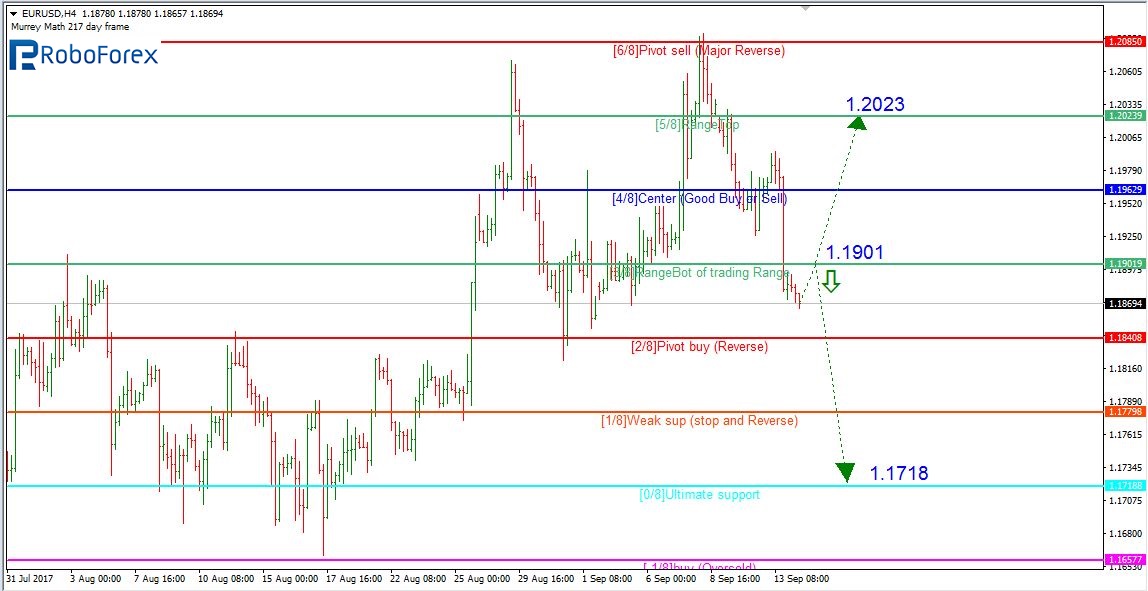
As we can see at the H4 chart, the EUR/USD pair has broken the 3/8 level at 1.1901 to the downside and left the consolidation channel. In this case, the most probable scenario implies that the price may fall towards the support at the 0/8 level at 1.1718. However, this scenario may be cancelled if the pair breaks the 3/8 level to the upside. In this case, the instrument may grow to reach first target at the 5/8 level at 1.2023.

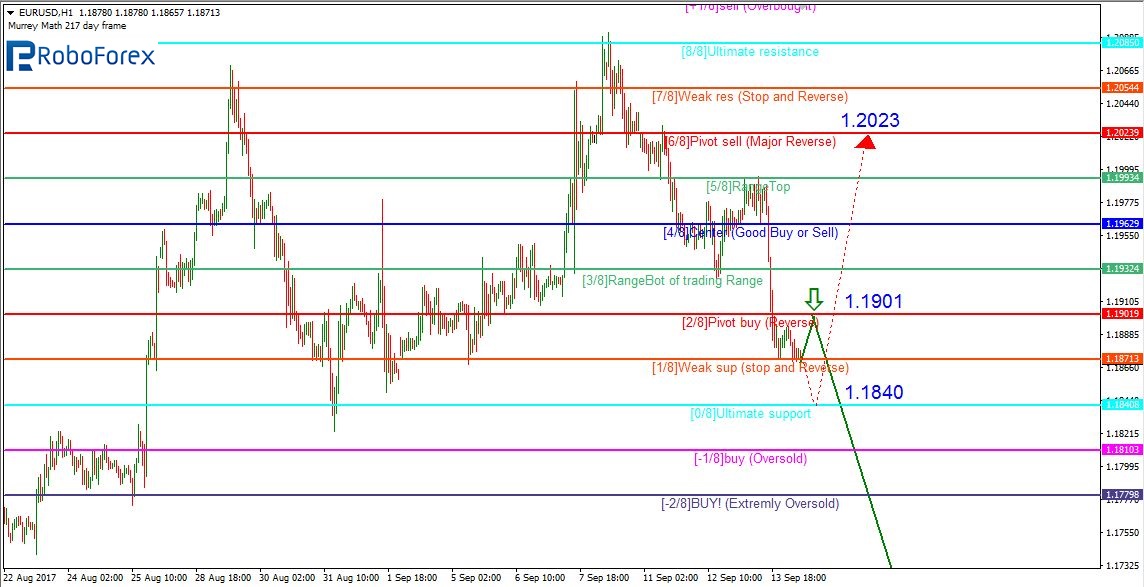
At the H1 chart, the pair may rebound from the 2/8 at 1.1901 and continue falling towards 1.1718. However, the current descending movement may face a serious resistance at the 0/8 level at 1.1840. If the pair rebounds from the 0/8 level, the instrument may resume growing to reach 1.2085.


XAU USD, “Gold vs US Dollar”

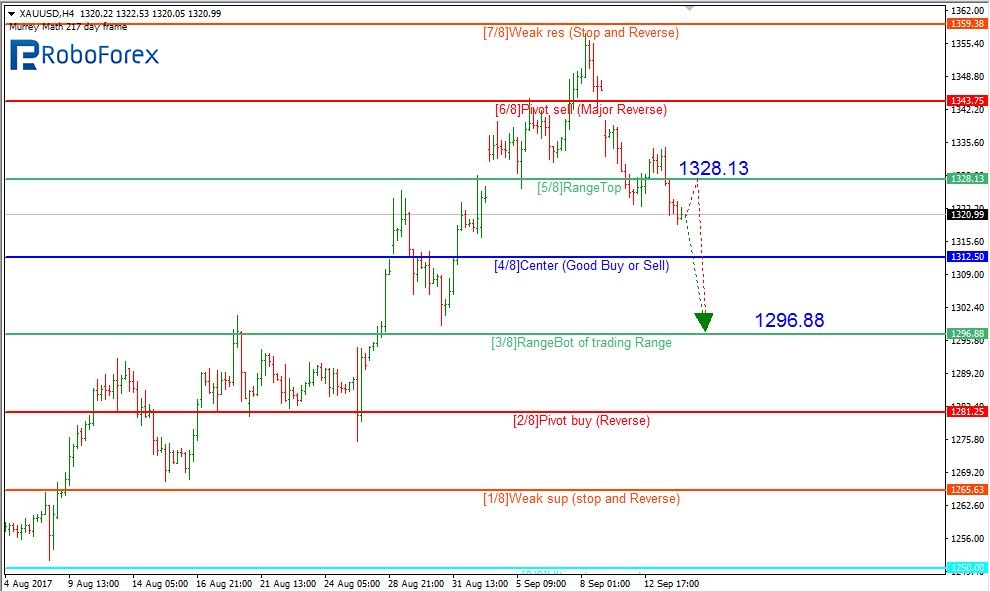
As we can see at the H4 chart, the XAU/USD pair is still trading to the downside to reach the target at the 3/8 level at 1296.88.

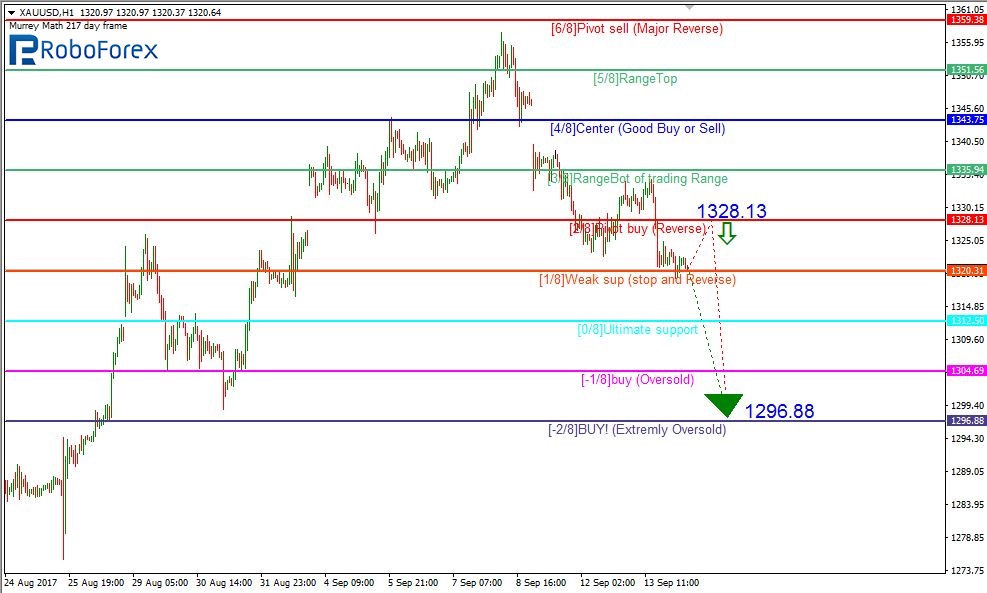
At the H1 chart, the price may be corrected towards the 2/8 level at 1328.13. in case the price reaches this level, one should wait until it rebounds and open a position only after that. If the price breaks the 1/8 level at 1320.31, the instrument may continue falling without testing the 2/8 one at 1328.13.


RoboForex Analytical Department

Article By RoboForex.com

Attention!
Forecasts presented in this section only reflect the author’s private opinion and should not be considered as guidance for trading. RoboForex LP bears no responsibility for trading results based on trading recommendations described in these analytical reviews.

EURUSD: correction to the LB line in the works

By Gabriel Ojimadu, Alpari

Previous:

On Wednesday the 13th of September, the euro/dollar rate closed down. The euro lost more than 100 pips of ground against the dollar over the course of the day, falling to 1.1873. It was revealed that Donald Trump is set to announce the details of his proposed tax reform legislation next week. According to a statement on the budget by the speaker of the House of Representatives, the new legislation could come into force by the end of the year.

The British pound has collapsed against the dollar, shedding 145 pips. This drop began in Europe after the publication of employment data in the UK. Buyers were disappointed by the average earnings index, which performed worse than expected. Because of this, the euro has gained some temporary support against the dollar through the cross.

Day’s news (GMT+3):

  • 10:30 Switzerland: SNB interest rate decision.
  • 14:00 UK: BoE interest rate decision, BoE asset purchase facility.
  • 15:30 Canada: new housing price index (Jul).
  • 15:30 USA: CPI (Aug), initial jobless claims (8 Sep).
  • 18:30 Germany: German Buba president Weidmann’s speech.

EURUSD rate on the hourly. Source: TradingView

The price is currently moving along the D2 MA line. I think that the price will continue in its current direction until 1.1858. From the 112th degree and the lower boundary of the downwards channel, we can start to think about upwards movement towards the LB balance line. At the moment, the 45th degree is projected from the 1.1870 low. If the euro rate falls as far as 1.1858, the 45th degree will shift to 1.1913.

Be warned, you shouldn’t act on the basis of my forecast alone. It doesn’t take fundamental factors into account such as the BoE’s meeting and US inflation data. Statistics are more important than technical analysis, so you should always make an assessment of the risks involved in a trade and set stop levels accordingly. Fundamentals can break any strong reversal model. The smaller the upwards rebound, the higher the probability of dropping to 1.1780 on Friday.

Murrey Math Lines 13.09.2017 (NZD/USD, XAU/USD)

Article By RoboForex.com

NZD USD, “New Zealand Dollar vs US Dollar”

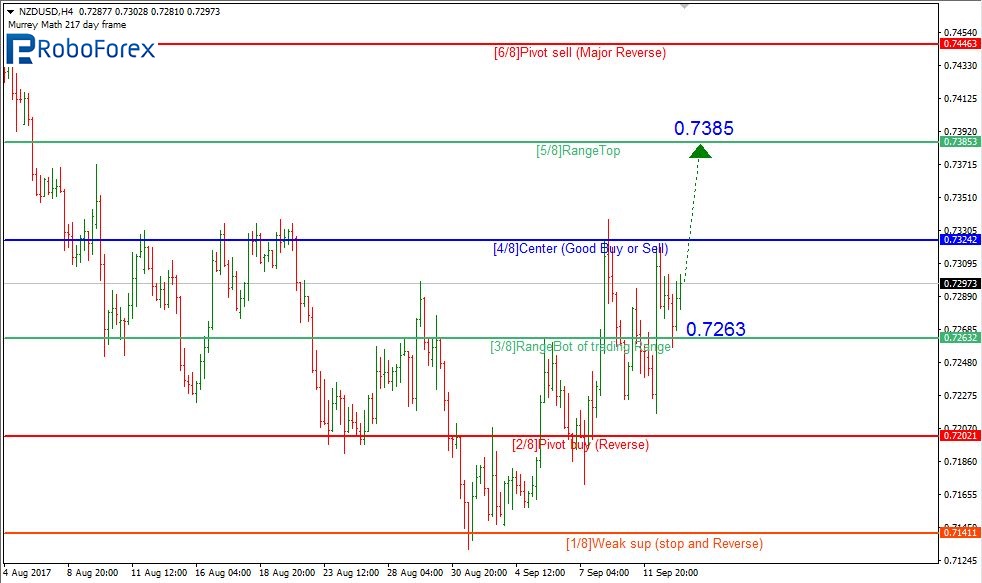
As we can see at the H4 chart, the NZD/USD pair has fixed below the 3/8 level at 0.7263. Later, the price is expected to continue growing to reach the 5/8 level at 0.7385.

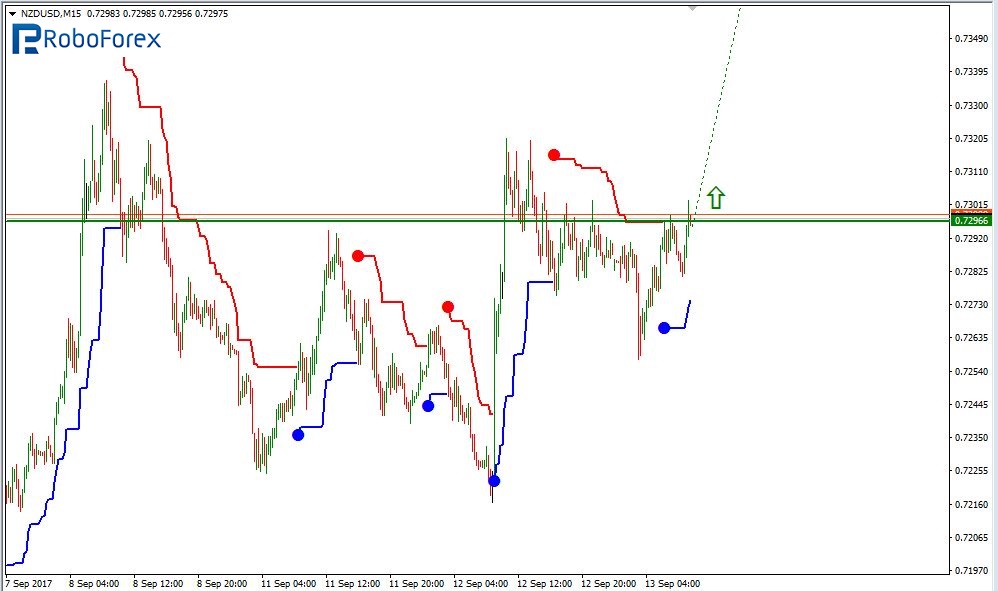
At the M15 chart, the price has broken the upside line of the VoltyChannel indicator. In this case, the pair may continue moving upwards to reach 0.7385.


XAU USD, “Gold vs US Dollar”

At the H4 chart, the XAU/USD pair is trading above the 5/8 level at 1328.13. The price is expected to break it and then continue falling towards the downside border of the consolidation channel at the 3/8 level at 1296.08.

As we can see at the H1 chart, the price has broken the 3/8 level at 1335.94 and left the consolidation range between the above-mentioned level and the 5/8 one. In this case, the pair may continue falling to reach 1296.08.

At the M15 chart, the price may break the downside line of the VoltyChannel indicator and, as a result, continue moving downwards to reach 1296.08.


RoboForex Analytical Department

Article By RoboForex.com

Attention!
Forecasts presented in this section only reflect the author’s private opinion and should not be considered as guidance for trading. RoboForex LP bears no responsibility for trading results based on trading recommendations described in these analytical reviews.

Ichimoku Cloud Analysis 13.09.2017 (AUD/USD, NZD/USD, USD/CAD)

Article By RoboForex.com

AUD USD, “Australian Dollar vs US Dollar”

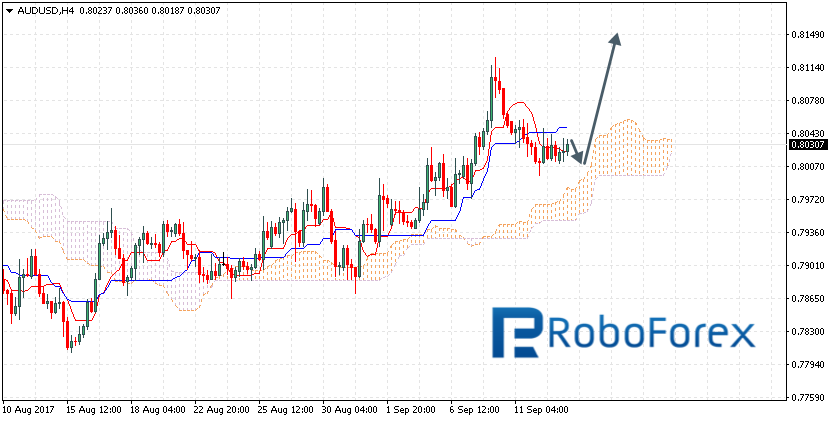
The AUD/USD pair is trading at 0.8030; the instrument is still moving above Ichimoku Cloud, which means that it may continue growing. We should expect the price to test the upside border of the cloud at 0.8010 and then continue moving upwards above 0.8150. However, this scenario may be cancelled if the price breaks the downside border of the cloud and fixes below 0.7990. In this case, the pair may continue falling towards 0.7865.


NZD/USD, “New Zealand Dollar vs US Dollar”

The NZD/USD pair is trading at 0.7297; the instrument is still moving above Ichimoku Cloud, which means that it may continue growing. We should expect the price to test Tenkan-Sen and Kijun-Sen at 0.7270 and then continue moving upwards to reach 0.7400. However, the scenario that implies further growth may be cancelled if the price breaks the downside border of the cloud and fixes below 0.7205. In this case, the pair may continue falling towards 0.7140.


USD/CAD, “US Dollar vs Canadian Dollar”

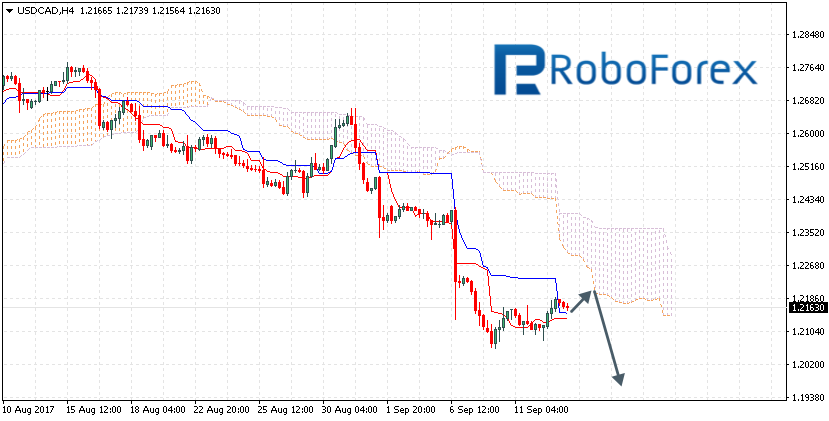
The USD/CAD pair is trading at 1.2163; the instrument is still moving below Ichimoku Cloud, which means that it may continue falling. We should expect the price to test the downside border of the cloud at 1.2175 and then continue moving downwards below 1.1970. However, this scenario may be cancelled if the price breaks the upside border of the cloud and fixes above 1.2365. In this case, the pair may continue growing towards 1.2610.


RoboForex Analytical Department

Article By RoboForex.com

Attention!
Forecasts presented in this section only reflect the author’s private opinion and should not be considered as guidance for trading. RoboForex LP bears no responsibility for trading results based on trading recommendations described in these analytical reviews.

Fibonacci Retracements Analysis 12.09.2017 (EUR/USD, USD/JPY)

Article By RoboForex.com

EUR USD, “Euro vs US Dollar”

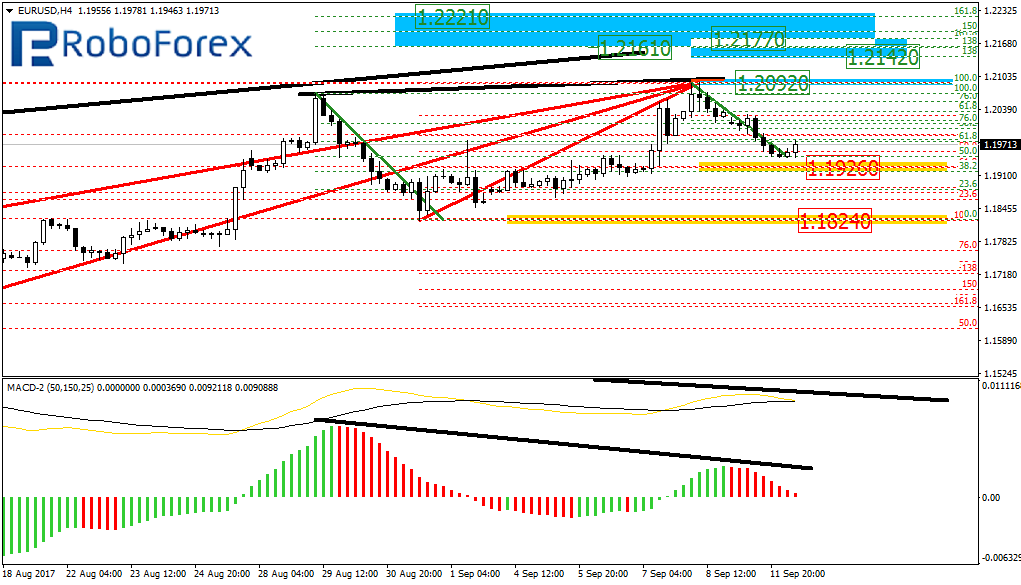
As we can see at the H4 chart, the EUR/USD pair has formed two ascending impulses along with corrections, and this structure means that the impulses along with the corrections are the parts of another bigger impulse. The price is forming the divergence, which indicates a new descending correction. However, this may be just a correction of the previous ascending impulse. By now, the pair has been already corrected by 50.0%. Later, the instrument may continue growing, but only after breaking the local high at 1.2092. The main target may be the post-correctional extension area between the retracements of 138.2% and 161.8% at 1.2161 and 1.2211 respectively.

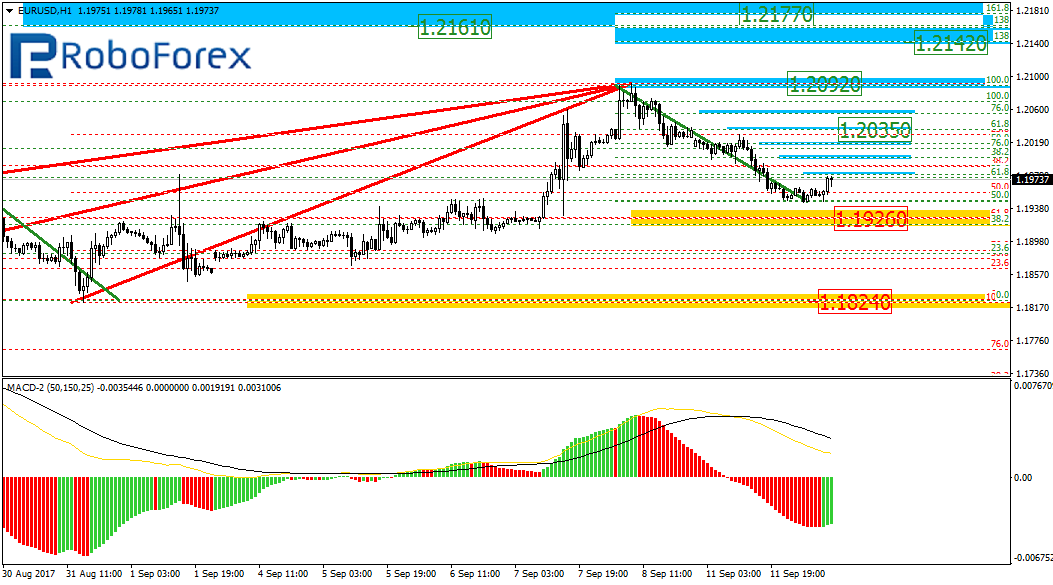
At the H1 chart, the situation is similar, but shows more detailed structure. In case the previous downtrend may be considered as completed, then right now the pair is being corrected to the upside. The main target of this correction is the retracement of 61.8% at 1.2035. After breaking 1.2092, the price may grow towards the post-correctional extension area between the retracements of 138.2% and 161.8% at 1.2142 and 1.2177 respectively.


USD JPY, “US Dollar vs. Japanese Yen”

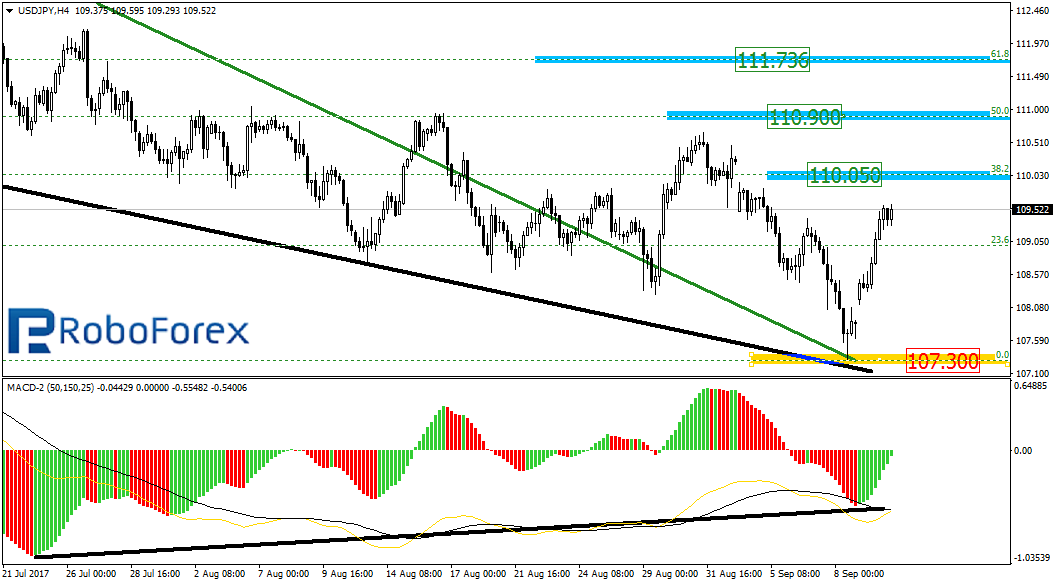
At the H4 chart, after reaching this year’s lows, the USD/JPY pair formed the convergence, which indicated a possible correction to the upside. At the moment, the price trading to reach the retracement of 38.2% at 110.05. The next upside targets may be the retracements of 50.0% and 61.8% at 110.90 and 111.736 respectively.

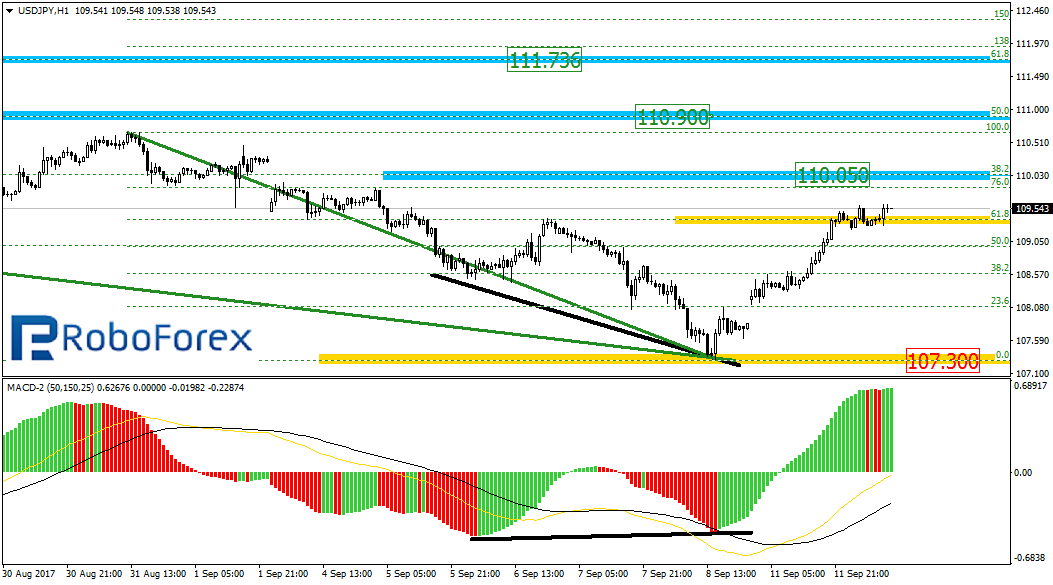
As we can see at the H1 chart, the previous downtrend has been corrected by 61.8%. the next target of the correction is the retracement of 76.0%.


RoboForex Analytical Department

Article By RoboForex.com

Attention!
Forecasts presented in this section only reflect the author’s private opinion and should not be considered as guidance for trading. RoboForex LP bears no responsibility for trading results based on trading recommendations described in these analytical reviews.

Forex Technical Analysis & Forecast 12.09.2017 (EUR/USD, GBP/USD, USD/CHF, USD/JPY, AUD/USD, USD/RUB, GOLD, BRENT)

Article By RoboForex.com

EUR USD, “Euro vs US Dollar”

The EUR/USD pair has reached the predicted target of the descending structure and right now is consolidating near the lows. If later the instrument breaks this consolidation range to the downside, the market may extend this wave twice and reach 1.1850; if to the upside – grow with the target at 1.2018.


GBP USD, “Great Britain Pound vs US Dollar”

The GBP/USD pair is still falling towards 1.3117. Later, in our opinion, the market may grow to reach 1.3171 and then start another decline with the target is at 1.3037.


USD CHF, “US Dollar vs Swiss Franc”

The USD/CHF pair has reached the predicted target of the ascending structure. Possibly, today the price may continue consolidating at the top of this wave. If later the instrument breaks this consolidation range to the upside, the market may continue growing towards 0.9614; if to the downside – start another correction with the target at 0.9526.


USD JPY, “US Dollar vs Japanese Yen”

The USD/JPY pair has reached the predicted target of the ascending structure. We think, today the price may start falling towards 108.35 and then grow to reach 109.02, thus forming another consolidation channel. If later the instrument breaks this channel to the upside, the market may grow towards 110.47; if to the downside – fall with the target at 107.00.


AUD USD, “Australian Dollar vs US Dollar”

The AUD/USD pair is trading downwards to reach 0.7984. After that, the instrument may grow towards 0.8050 and form another consolidation range. If later the instrument breaks this range to the downside, the market may continue the correction to reach 0.7860; if to the upside – grow with the target at 0.8130.


USD RUB, “US Dollar vs Russian Ruble”

The USD/RUB pair is being corrected towards the target at 57.38. Possibly, the price may form another ascending structure to reach the target. Later, in our opinion, the market may continue falling inside the downtrend with the target at 56.40.


XAU USD, “Gold vs US Dollar”

Gold has broken the ascending channel. Possibly, today the price may test 1331.95 from below. After that, the instrument may fall towards 1305.00 and then start another correction with the target at 1332.00.


BRENT

Brent is trading upwards with the target at 54.10. Possibly, the price may form another descending structure to reach 52.85 and then continue growing towards 55.15.


RoboForex Analytical Department

Article By RoboForex.com

Attention!
Forecasts presented in this section only reflect the author’s private opinion and should not be considered as guidance for trading. RoboForex LP bears no responsibility for trading results based on trading recommendations described in these analytical reviews.

EURUSD: unclear situation around the trend line

By Gabriel Ojimadu, Alpari

Previous:

On Monday the 11th of September, the euro/dollar rate closed down. The US dollar strengthened across the board thanks to a rise in US bond yields. Due to correctional movements and an empty economic calendar, buyers were beaten back to 1.1950. Now let’s look at Tuesday’s technical picture.

Day’s news (GMT+3):

  • 04:30 Australia: NAB business conditions (Aug).
  • 11:30 UK: CPI (Aug), PPI core output (Aug), retail price index (Aug).
  • 13:00 USA: NFIB business optimism index (Aug).
  • 17:00 USA: JOLTS job openings (Jul).

Fig 1. EURUSD rate on the hourly. Source: TradingView

My predictions for yesterday were all correct. The euro/dollar rate slid to the 112th degree at 1.1955. The area from the 112th to 135th degree is a reversal zone. What’s more, the trend line runs through this area, which takes its starting point from the low of 1.1823 set on the 31st of August. The requirements for an upwards correction are all there. This isn’t a key line, however. The main line runs through 1.1900. I was expecting the euro to fall to this level.

The situation is unclear to me. It’s not easy to make a decision here. Cyclical analysis indicates a strengthening of the euro to 1.2000, while the pattern from October 2005 as well as the dynamics of the euro/pound cross point towards a slide. I went against the cycles and it seems this was a mistake. The euro rate has jumped to 1.1969. The UN has tightened sanctions against North Korea. Investors may once again retreat to the safe havens. In this regard, the situation is fairly simple. Should the price exit the downwards channel, my scenario for a slide won’t play out. Since there isn’t a bullish divergence between the price and the AO indicator, I’m expecting a new low today.

Let’s Get Practical: Is the S&P 500 Over or Under Valued?

By Elliott Wave International


3 Videos + 8 Charts = Opportunities You Need to See.

Join this free event hosted by Elliott Wave International and you’ll get a clear picture of what’s next in a variety of U.S. markets. After seeing these videos and charts you will be ready to jump on opportunities and sidestep risks in some major markets. This free report (a $29 value) will present a unique outlook and give you a new perspective on the markets you won’t get anywhere else.

Get your FREE report now – for a limited time >>

This article was syndicated by Elliott Wave International and was originally published under the headline Let’s Get Practical: Is the S&P 500 Over or Under Valued?. EWI is the world’s largest market forecasting firm. Its staff of full-time analysts led by Chartered Market Technician Robert Prechter provides 24-hour-a-day market analysis to institutional and private investors around the world.

If America exits the Paris Accord, climate risks will intensify for emerging Asia

By Dan Steinbock    

Even before Irma and its successors, Typhoon Hato and Hurricane Harvey caused massive devastation from the US to Asia. If America will withdraw from the Paris climate agreement, emerging Asia will pay the highest price.

As I left Manila, tropical storm Isang passed the Batanes area in northern Philippines. When I flew to Guangzhou, the low-pressure area morphed into a tropical depression southeast to Taiwan and then into a typhoon in the South China Sea. On August 23, Hato’s eye was directly over Hong Kong as rapid intensification turned it into a category 3-equivalent typhoon. Days later, Hato had left behind 26 people killed, and damages amounting to $1.9 billion in mainland China.

Almost at the same time, Harvey was still classified as a tropical storm before entering the Caribbean, until it nearly dissipated. Thanks to warm sea surface temperatures and low windshear, it strengthened rapidly  into a category 4 hurricane within 24 hours before hitting the shoreline of Texas on August 26.

After biblical rain and historical flooding, 30,000 displaced people and more than 50 confirmed deaths, recovery is likely to take “many years.” Exposed stock with damage to floods is calculated at $267 billion. That’s more than the effect of the 2011 Tōhoku earthquake and tsunami, the 2008 Sichuan earthquake, or the 2005 Hurricane Katrina and 2012 Sandy combined.

After Hato in China and Harvey in Texas, Irma has strengthened into the strongest Hurricane on record in the Caribbean and the Gulf of Mexico. After Puerto Rico, it wil cast a shadow over Florida. The threat of natural disasters has substantial economic implications. In Texas alone, state and local debt exceeds $370 billion (25% of state GDP). As Puerto Rico has prepared for the “catastrophic system,” its fiscal crisis is about to play out in court, with some $125 billion in debt and pension obligations (nearly 130% of GDP, about the same as in Italy).

In all these cases, extreme weather proved far more destructive than initially anticipated, navigated across several country boundaries, and left behind huge economic devastation that typically deepened income polarization. In each case, too, scientists see less the effect of a natural disaster and more the forces of human-induced climate change.

Ironically, as extreme weather phenomena are intensifying, international efforts to contain collateral damage may be failing.

Trump’s planned exit from Paris Accord

During his campaign, President Trump pledged to withdraw America from the Paris Climate Accord, which seeks to reduce the effects of climate change by maintaining global temperatures “well below 2°C above pre-industrial levels.” The pact was negotiated by almost 200 parties and adopted by consensus in December 2015.

During his campaign, Trump called the pact a “bad deal” for the U.S. and framed withdrawal as a key piece of the “America First” platform.

The White House initiated the exit path from the climate agreement already in March, when Trump signed an executive order to begin the formal process of repealing President Obama’s unilateral climate agenda, including ending carbon rules for power plants which is seen as the key to achieve the Paris goal.

On June 1, Trump announced America would withdraw from the Paris Climate Agreement. Yet, legal questions linger as to how the Trump White House can execute the withdrawal and what role the US can play in future international climate meetings.

If Trump ultimately will implement the withdrawal, the global economy will be held hostage by the greatest polluting nation – as measured on a per capita basis – and, more precisely, by a conservative minority of about a fifth of American voters and wealthy financiers whose continued fortunes are predicated on worsening global climate change.

Collateral damage in China and Asia

While Trump has expressed skepticism about the scientific basis of climate change, he has portrayed the concern over extreme weather as an obstacle to US competitiveness. These misguided views seem to go back to in November 2012, when he famously tweeted that “the concept of global warming was created by and for the Chinese in order to make U.S. manufacturing non-competitive.”

Thanks to its great growth performance, China has soared into the world’s second-largest economy while overtaking the U.S. and the EU as the world’s largest emitter, with CO2 emissions from fossil fuels tripling over the past 30 years. Nevertheless, China is estimated to account for “only” 10-12 percent of total greenhouse gases in the atmosphere. That figure that has remained fairly steady over the industrial period.

Since climate change is not just cumulative but accumulative, current greenhouse gases and aerosols have been collected in the atmosphere over the entire industrial era. By this measure, the U.K. remains the largest single cause of climate change, followed by the US and Germany. China is the world’s greatest polluter on an aggregate basis but not on a per capita basis.

If US climate exit will materialize, global climate risks will intensify dramatically. As far as Trump is concerned, that’s not America’s problem. In a tragic sense, he is right. While the bulk of global climate risks can be attributed to today’s prosperous advanced economies, it is the relatively poor emerging and developing economies that those risks will primarily penalize in the future, especially in Asia.

According to Global Climate Risk Index, most of the 10 countries affected in the past two decades feature emerging economies in Asia (Myanmar, Philippines, Bangladesh, Pakistan, Vietnam and Thailand).

Timing matters. Under the agreement, the earliest effective date of the U.S. withdrawal is November 2020 –  the last month of the Trump presidency, in the absence of an impeachment.

About the Author:

Dr Dan Steinbock is the founder of Difference Group and has served as research director at the India, China and America Institute (USA) and visiting fellow at the Shanghai Institutes for International Studies (China) and the EU Center (Singapore). For more, see http://www.differencegroup.net/

The original release was published by South China Morning Post on September 6, 2017