Author Archive for InvestMacro – Page 498

Forex market review: (26/09/17)

By Veselin Petkov, Alpari

During his speech yesterday at the European parliament, ECB president Mario Draghi accredited the euro’s rise since the beginning of the year to the marked improvement in the Eurozone’s economic situation. The ECB head stressed that the bank’s ongoing ultra-loose monetary policy was a significant contributor to recent economic growth. Draghi also emphasised that the regulator’s asset-purchasing program has turned out to be very effective. The ECB is expecting 2.2% percent growth in 2017, 1.8% in 2018, and 1.7% in 2019.

Day’s news (GMT+3):

  • 02:50 Japan: BoJ monetary policy meeting minutes.
  • 3:00 New Zealand: ANZ business confidence (Sep).
  • 17:00 USA: new home sales (Aug).
  • 19:45 USA: Fed’s Yellen speech.

In the second half of the day, Janet Yellen is set to speak in Cleveland on the subject of “inflation, uncertainty, and monetary policy”. Volatility on the dollar could increase in the short term during the speech.

I’d also like to add that, due to the sharp tone of comments coming from both the Pentagon and Donald Trump’s administration directed towards North Korea, gold, the Swiss franc, and the Japanese yen have been showing some chaotic intraday behaviour at times over the last few days.

EUR/USD

On the 4-hour timeframe (H4), the EURUSD pair is attempting a breakout of the trend line:

From my point of view, the trend on the H4 timeframe will only be broken if the EURUSD renews the “key base” of the upwards trend, which is at 1.1680. The trend is still upwards for now, although there aren’t any buy signals.

On the hourly timeframe (H1), the EURUSD pair is testing the lower regions of its range:

There aren’t any buy signals on H1 either.

In fact, if we switch to the 30-minute timeframe, there’s the potential for the formation of a downwards trend:

It’s important to note that, as of now, the upwards trend on H4 is still intact, as is the range on H1, so it would be very risky to bet on a downwards trend on the basis of the M30 timeframe.

At the time of writing, the EURUSD is trading at 1.1851.

USD/CHF

The USDCHF currency pair is continuing to fluctuate around the downwards trend line on the daily timeframe (D1):

The USDCHF pair is currently unable to break away from the trend. I believe that the possibility of this happening will increase if, on the monthly timeframe, for September, we get a bullish engulfing of June’s, July’s and August’s candlesticks. For this to happen, the month needs to close at 0.9720 or higher:

If we get a bullish engulfing pattern for September, this will limit the USDCHF pair’s possibilities for growth. For now, I’m maintaining my long position on the USDCHF pair with a Stop Loss at 0.9390.

At the time of writing, USDCHF is trading at 0.9689.

Source: https://alpari.com/en/analytics/reviews/market_sessions/21983_26092017/


Nigeria could join the OPEC+ deal

By Alexander Razuvaev, Alpari

According to Emmanuel Kachikwu, Nigeria’s oil minister, the country could be set, by the end of March, 2018, to become party to the deal by OPEC+ to cap oil production.

The minister said that Nigeria could join the deal once their production reaches 1.8m barrels a day. This is expected to happen by around the end of March 2018. Nigeria was excluded from having to comply with production quotas given how much the country’s oil industry has suffered as a result of the conflicts currently taking place in the region.

This news will have a fairly positive effect on the oil market, which still finds itself in a state of uncertainty, despite the fact that current oil prices are considered quite favourable.

Price forecasts for 2018 are very varied, with the pessimists predicting a price of 40 USD per barrel, and optimists looking at 60, even 70 USD.

We take a relatively optimistic view, believing that 2018 prices will average around 55 – 60 USD per barrel. Whether or not the Saudis will launch their long-awaited IPO for the state-owned Saudi Aramco remains one of the more interesting questions surrounding the oil industry.

What is the best trade to hold on to for 20 years?

By Adinah Brown

The best trade for the next 20 years is actually a much more complicated question than it appears on the surface. You would expect it to be simple, just invest in whatever has the highest ceiling, something that might be an emerging industry or country and hold until the multiples increase.

But the practical side of picking the best trade depends on another more important factor – the person that is making the trade. The best trade to hold relies much more on an individual’s circumstances, trading tendencies, risk profile and most importantly, how much they can afford to lose.

As any financial planner will tell you, there is no one size fits all approach to investing. A recently retired man living on a fixed income is looking to invest to create a long term secure income. In his case, the security and stability of the investment and income is more important than the return. For a young twenty-something, who is expecting to be employed throughout the 20 year period, the investment approach needs to be aggressive in order to build their wealth as quickly as possible. Time is on their side, so any short term drops or fluctuations are not a problem if the expected end return is desired. A young family might also be able to weather the ups and downs, but with a shorter timeframe until the money is likely to be needed, they cannot and should not invest as aggressively. These examples really only highlight the general differences in investing, without getting into tricky details like income, personal risk profile, financial situation, etc.

So, whilst it is impossible to tell you what the best trade is for you, we can try to touch on a few ideas that might have a bit of something for everyone. Let’s have a look into our crystal ball to decide on the best trade for the next 20 years…

Shares

Actually, this is based on looking into history rather than our crystal ball. Share trading is generally considered the best way to build wealth. Your 401K, Roth IRA, managed funds and the like are all stocked with shares, with good reason. Historically share trading has given higher returns than most other investment options. For example, the S&P 500 has given approximately 10% returns since 1928. So a good conservative method is to buy a low cost ETF that tracks the market. With the ETFs available today, you can get exposure to emerging markets or different market segments, allowing you to track those that might give the best returns.

A quick perusal of potential up and coming markets and sectors all have good long term potential. China and India, countries each with more than 1 billion people, have large educated workforces. China is generally expected to surpass the US as the world’s number one economy over the next 25 years. As the momentum increases, their shares will also pick up, making them relatively undervalued considering the long term prospects. China’s wealth is creating a massive middle class, just as the US did in the 50’s, when their economy was booming. To compare, a $1000 investment in the S&P 500 in 1950, would have netted more than $87,000 in 2007, excluding dividends.

Emerging technology and Cryptocurrencies

It is scary to predict the future. Technological changes in just the last 5 years have rendered the world we live in a totally different place. Wearable technology, mobile phones, AI, driverless cars and a plethora of other technologies are still emerging. At this stage it is early enough to jump on board without expecting to overpay. Shares in Intel’s recently acquired Mobileye, a market leader in driverless technology is a strong early bet, despite having a high multiple.

Could there be a segment more emerging than cryptocurrencies? Sure, at this stage we have missed the Bitcoin-for-5-cents era, but with new exciting ICO’s happening all the time, a discerning future focused eye will give you the chance to buy something else for 5 cents. If cryptocurrencies continue on their upward trajectory, sort out regulation and safety and really emerge as usable alternative to currency, that small investment could pay off big.

Reinvesting profits / Compound interest

Find a video on the power of compound interest, and you will understand why timeframe is actually the best friend of a trader. Reinvesting profits means that your annual return will be based on a higher amount. Every year this compounds until we start talking about insane levels of returns. Whatever you buy, holding and reinvesting is the best decision for a trader over the next 20 years.

About the Author:

Adinah Brown is a professional writer who has worked in a wide range of industry settings, including corporate industry, government and non-government organizations. Within many of these positions, Adinah has provided skilled marketing and advertising services and is currently the Content Manager at Leverate.


Fibonacci Retracements Analysis 25.09.2017 (GBP/USD, EUR/JPY)

Article By RoboForex.com

GBP USD, “Great Britain Pound vs US Dollar”

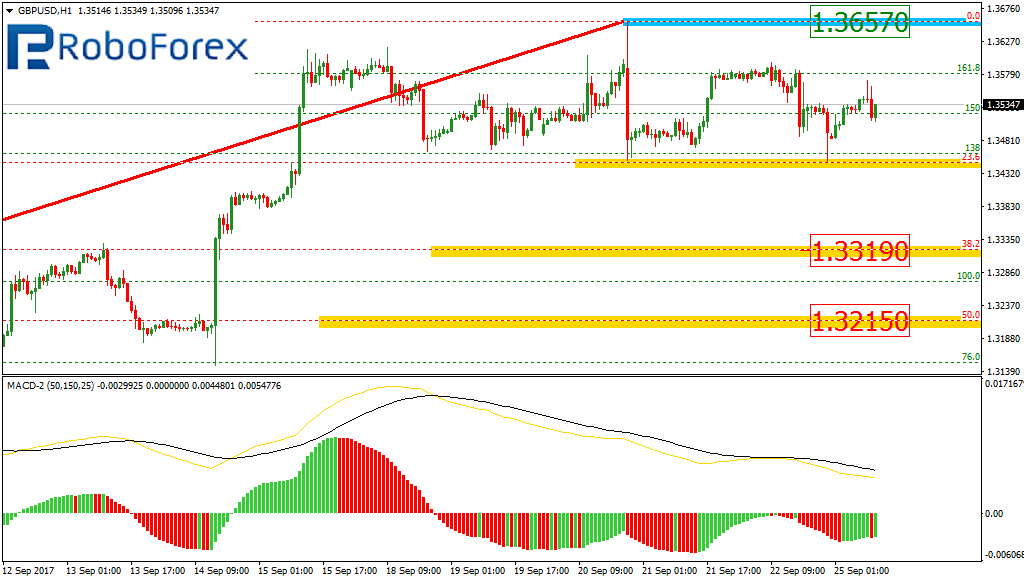
As we can see at the H4 chart, the GBP/USD pair is being corrected. By now, it has been corrected by 23.6%. The next targets of the correction may be the retracements of 38.2% and 50.0% at 1.3319 and 1.3215 respectively. The closest resistance level is at 1.3657.

At the H1 chart, the situation is quite similar, but more detailed.


EUR JPY, “Euro vs. Japanese Yen”

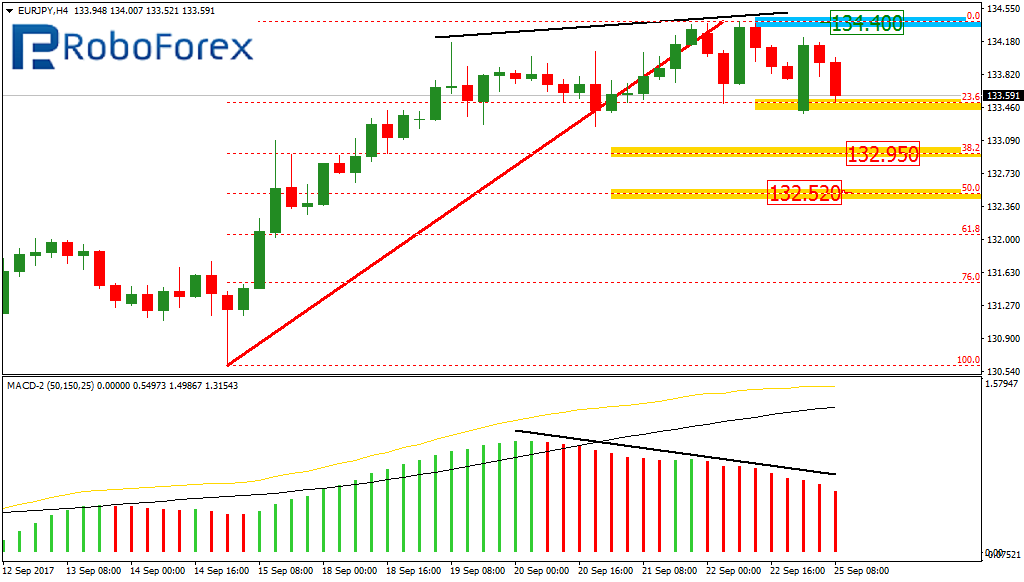
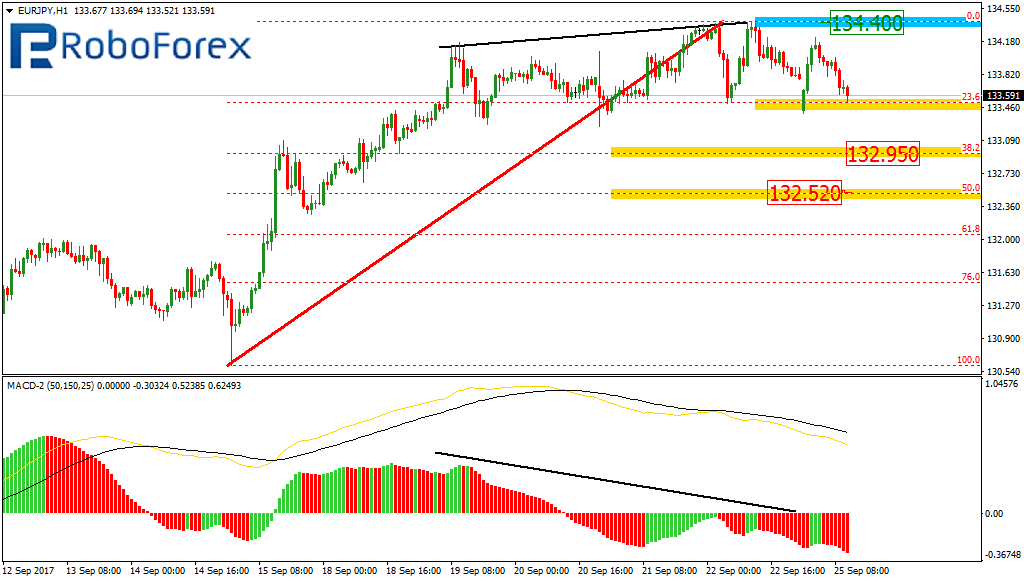
As we can see at the H4 chart, after finishing the divergence, the EUR/JPY pair has been corrected by 23.6% and may continue this correction deeper. The targets of the correction may be the retracements of 38.2% and 50.0% at 132.95 and 132.52 respectively. The resistance level is at 134.40.

At the H1 chart, the situation confirms the H4 chart scenario.


RoboForex Analytical Department

Article By RoboForex.com

Attention!
Forecasts presented in this section only reflect the author’s private opinion and should not be considered as guidance for trading. RoboForex LP bears no responsibility for trading results based on trading recommendations described in these analytical reviews.

Forex Technical Analysis & Forecast 25.09.2017 (EUR/USD, GBP/USD, USD/CHF, USD/JPY, AUD/USD, USD/RUB, GOLD, BRENT)

Article By RoboForex.com

EUR USD, “Euro vs US Dollar”

The EUR/USD pair is growing towards 1.1958. Later, in our opinion, the market may fall to break 1.1909. the local target is at 1.1858.


GBP USD, “Great Britain Pound vs US Dollar”

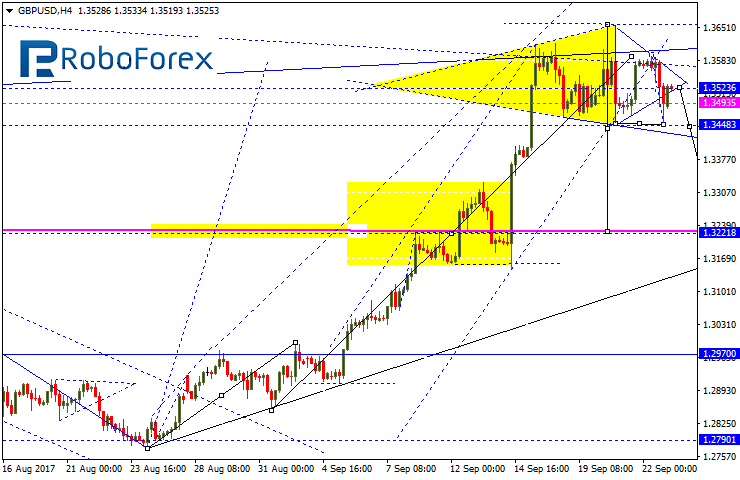
The GBP/USD pair is still consolidating. After breaking this range to the downside, the price may fall towards 1.3222 and then resume growing with the target at 1.3444.


USD CHF, “US Dollar vs Swiss Franc”

The USD/CHF pair is falling towards 0.9686. After that, the instrument may grow to break the upside border of the range. The local target is at 0.9800.


USD JPY, “US Dollar vs Japanese Yen”

The USD/JPY pair is still consolidating. We think, today the price may reach 111.82 and then grow towards 112.11. If the instrument breaks this range to the downside, the market may continue falling with the target at 109.57.


AUD USD, “Australian Dollar vs US Dollar”

The AUD/USD pair is consolidating near its lows. Possibly, the price may form another ascending structure towards 0.8000. Later, in our opinion, the market may fall to break 0.7912. The local target is at 0.7812.


USD RUB, “US Dollar vs Russian Ruble”

The USD/RUB pair is forming the fifth descending structure to reach the target at 56.54. Possibly, today the price may be corrected towards 57.87. After that, the instrument may continue falling to reach the above-mentioned target.


XAU USD, “Gold vs US Dollar”

Gold is moving downwards. The next target is at 1284.40. Later, in our opinion, the market may be corrected towards 1320.00.


BRENT

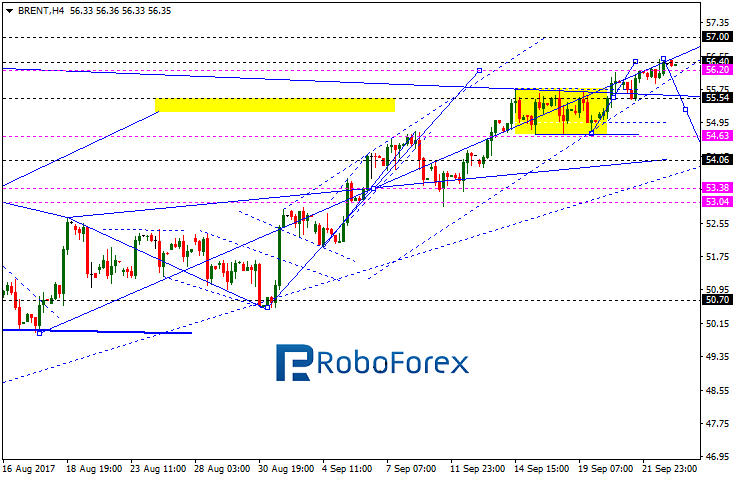
Brent has expanded its consolidation range to the upside. We think, today the price may fall towards 55.55 and then form another ascending structure to reach 57.00. After that, the instrument may start another correction with the target at 51.00.


RoboForex Analytical Department

Article By RoboForex.com

Attention!
Forecasts presented in this section only reflect the author’s private opinion and should not be considered as guidance for trading. RoboForex LP bears no responsibility for trading results based on trading recommendations described in these analytical reviews.

Steady open on currency markets after the German election

By Veselin Petkov, Alpari

The Bundestag elections in Germany are over, with Angela Markel’s ruling party having won the most votes. Trading on currency markets this morning opened relatively peacefully.

Parliamentary elections were also held in New Zealand over the weekend. The ruling National Party received the most votes, although it wasn’t enough to win them a majority of seats in parliament and form a government. The NZDUSD pair has opened down this Monday, with a gap of around 1%.

Day’s news (GMT+3):

  • 11:00 Germany: IFO business climate (Sep).
  • 15:30 USA: Fed member Dudley’s speech.
  • 16:00 Eurozone: ECB President Draghi’s speech.
  • 19:40 USA: Fed member Evans’ speech.

Today, attention will be focused on the Bank of England’s Financial Policy Committee, which is scheduled to make a statement today at 12:30 (GMT+3). Any information concerning the BoE’s monetary policy has the potential to increase volatility on the pound.

EUR/USD

From chart analysis on the 4-hour timeframe, we can see that the EURUSD pair is testing the line of the upwards trend for the second time since the Fed’s meeting:

This calls into serious doubt whether this upwards trend will continue. So, in my view, there’s currently no buy signal.

On the hourly timeframe, the EURUSD keeps failing to renew the key top of the correctional movement and is consequently in the lower half of the price range:

Still, it’s relatively risky to buy EURUSD in the lower part of this range considering that the price has been unable to reach the upper half for two weeks now. As it stands, I can’t see any clear buy or sell signals on this pair.

At the time of writing, the EURUSD pair is trading at 1.1934.

GBP/USD

On the 4-hour timeframe, the GBPUSD pair is once again testing the resistance line of the upwards trend:

Considering that the GBPUSD pair is trading at the upper part of the upwards trend, I’m going to refrain from buying.

On the hourly timeframe, the GBPUSD pair is trading within this potential range:

There currently aren’t any clear signals that the price will exit this range.

At the time of writing, the GBPUSD pair is trading at 1.3542.

USD/CHF

The USDCHF currency pair is testing the upper line of the downwards trend on the daily timeframe:

I haven’t changed my opinion that if the US economy recovers in the second half of this year, the USDCHF pair will break through the trend line on D1 and rise to 0.9950 by the end of the year. I have a long position on this pair, which was opened at 0.9679, with a Stop loss at 0.9390. Here, I’m looking to gain around 300 pips (from 0.9679 to 0.9950), while at the same time risking a drop of similar magnitude (from 0.9679 to 0.9390). The position was opened on the daily timeframe. If some doubts start to arise about the US’s economic recovery, I’ll close the position myself.

At the time of writing, the USDCHF pair is trading at 0.9708.

Stock Market’s “Proper Value” Is Nonsense — Here’s Why

See why there is no reliable standard of value for the stock market

By Elliott Wave International

Should investors rely on traditional ways of evaluating the stock market’s “proper value”? You might be surprised at what these four charts show.


3 Videos + 8 Charts = Opportunities You Need to See.

Join this free event hosted by Elliott Wave International and you’ll get a clear picture of what’s next in a variety of U.S. markets. After seeing these videos and charts you will be ready to jump on opportunities and sidestep risks in some major markets. This free report (a $29 value) will present a unique outlook and give you a new perspective on the markets you won’t get anywhere else.

Get your FREE report now – for a limited time >>

This article was syndicated by Elliott Wave International and was originally published under the headline Stock Market’s “Proper Value” Is Nonsense — Here’s Why. EWI is the world’s largest market forecasting firm. Its staff of full-time analysts led by Chartered Market Technician Robert Prechter provides 24-hour-a-day market analysis to institutional and private investors around the world.

COT Report: USD bets more bearish. Crude bets spike while Metals bets cool off

By CountingPips.com – Get our weekly COT Reports by Email

Here is a short summary and this week’s links (below) to the latest Commitment of Traders changes.

US Dollar Speculators increased USD bearish bets for 5th week

WTI Crude Oil Speculator bets rebounded sharply this week

10-Year Note Speculators bullish bets were up for a 2nd week

Gold bets dropped sharply after 8 weeks of gains

– Large S&P500 Speculators bets turned bullish this week

Silver Speculator bets cooled off after 8 weeks of gains

Copper Speculators decreased bets for a 2nd straight week


Forex Speculators continued to raise bearish US Dollar positions this week

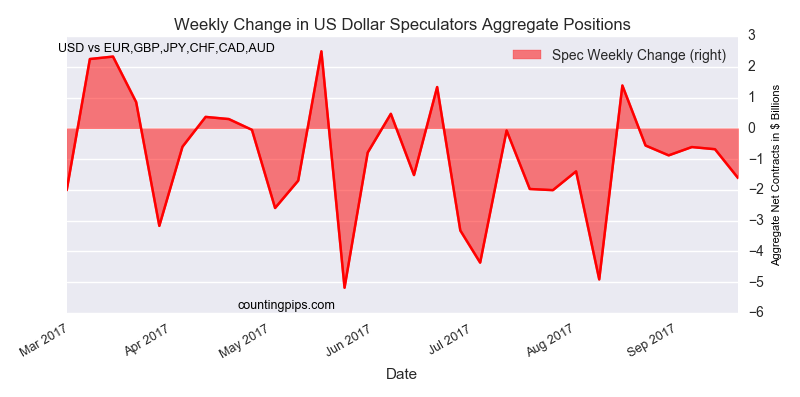
US Dollar net speculator positions leveled at $-13.19 billion as of Tuesday

The latest data for the weekly Commitment of Traders (COT) report, released by the Commodity Futures Trading Commission (CFTC) on Friday, showed that large traders and currency speculators continued to increase their bearish bets against the US dollar this week. See full article


WTI Crude Oil Speculators sharply boosted bullish net positions this week

The non-commercial contracts of WTI crude futures totaled a net position of 418,074 contracts, according to data from last week. This was a lift of 43,594 contracts from the previous weekly total. See full article


Gold Speculators lowered bullish net positions after 8 weeks of gains

The large speculator contracts of gold futures totaled a net position of 236,089 contracts. This was a weekly decline of -18,671 contracts from the previous week. See full article


10-Year Note Speculators added to bullish net positions for 2nd week

The large speculator contracts of 10-year treasury note futures totaled a net position of 270,120 contracts. This was a weekly increase of 18,441 contracts from the previous week. See full article


S&P500 Speculators boosted their bets to new bullish position this week

The large speculator contracts of S&P 500 futures totaled a net position of 869 contracts. This was a rise of 6,708 contracts from the reported data of the previous week. See full article


Silver Speculators decreased bullish bets for 1st time in 9 weeks

The non-commercial contracts of silver futures totaled a net position of 67,803 contracts, according to data from last week. This was a weekly fall of -7,184 contracts from the previous totals. See full article


Copper Speculators sharply lowered bullish net positions this week

The large speculator contracts of copper futures totaled a net position of 32,587 contracts. This was a weekly shortfall of -14,027 contracts from the data of the previous week. See full article


Article by CountingPips.com

The Commitment of Traders report data is published in raw form every Friday by the Commodity Futures Trading Commission (CFTC) and shows the futures positions of market participants as of the previous Tuesday (data is reported 3 days behind).

To learn more about this data please visit the CFTC website at http://www.cftc.gov/MarketReports/CommitmentsofTraders/index.htm


Forex Speculators continued to raise bearish US Dollar positions this week

By CountingPips.comGet our weekly COT Reports by Email

US Dollar net speculator positions fell to $-13.19 billion this week

The latest data for the weekly Commitment of Traders (COT) report, released by the Commodity Futures Trading Commission (CFTC) on Friday, showed that large traders and currency speculators continued to increase their bearish bets against the US dollar this week.

Non-commercial large futures traders, including hedge funds and large speculators, had an overall US dollar position totaling $-13.19 billion as of Tuesday September 19th, according to the latest data from the CFTC and dollar amount calculations by Reuters. This was a weekly decline of $-1.62 billion from the $-11.57 billion total position that was registered the previous week, according to the Reuters calculation (totals of the US dollar contracts against the combined contracts of the euro, British pound, Japanese yen, Australian dollar, Canadian dollar and the Swiss franc).

The aggregate US dollar position is down for five straight weeks and a whopping twelve out of the past thirteen weeks with the only gain coming on August 15th.


Weekly Speculator Contract Changes:

The individual major currencies had three weekly changes above the (+ or -) 10,000 contract mark this week in the speculators category.

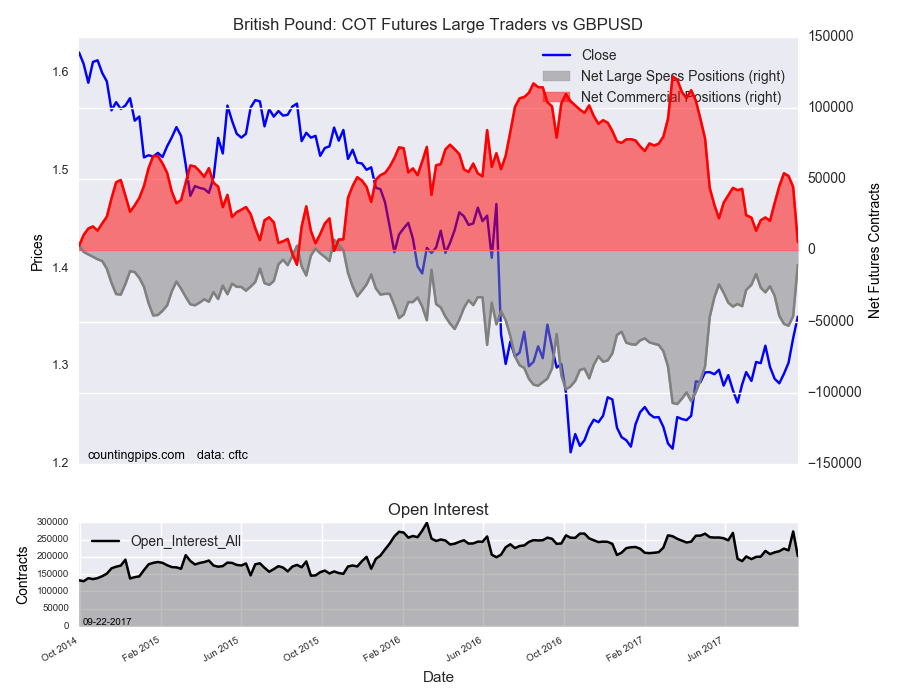
  • British pound sterling bets jumped mightily by over +35,000 net contracts this week on the back of higher inflation and a possible interest rate increase coming. The GBP speculative standing is now at its best level since November 2015.
  • Euro bets fell by over -10,000 bets for a second straight week and are down for three out of the last four weeks. Overall, euro bets are still in a bullish standing at +62,753 net contracts but at the lowest level in twelve weeks.
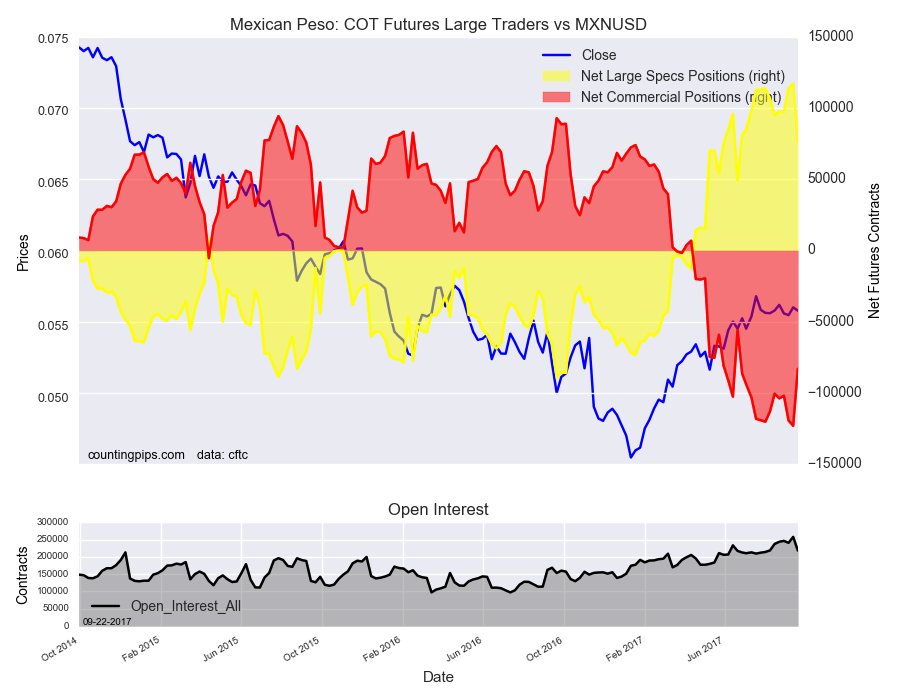
  • Mexican peso bets dropped by over -40,000 contracts this week after speculators had pushed bullish positions to the highest speculative level of the year above +115,000 net contracts.

Overall, the major currencies that improved against the US dollar last week were the British pound sterling (35,924 weekly change in contracts), Japanese yen (5,975 contracts), Canadian dollar (8,347 contracts) and the Australian dollar (9,479 contracts).

The currencies whose speculative bets declined last week versus the dollar were the euro (-23,305 weekly change in contracts),  Swiss franc (-255 contracts), New Zealand dollar (-5,680 contracts) and the Mexican peso (-40,046 contracts).


Table of Weekly Commercial Traders and Speculators Levels & Changes:

CurrencyNet CommercialsComms Weekly ChgNet SpeculatorsSpecs Weekly Chg
EuroFx-87,33828,84762,753-23,305
GBP5,845-38,624-10,16135,924
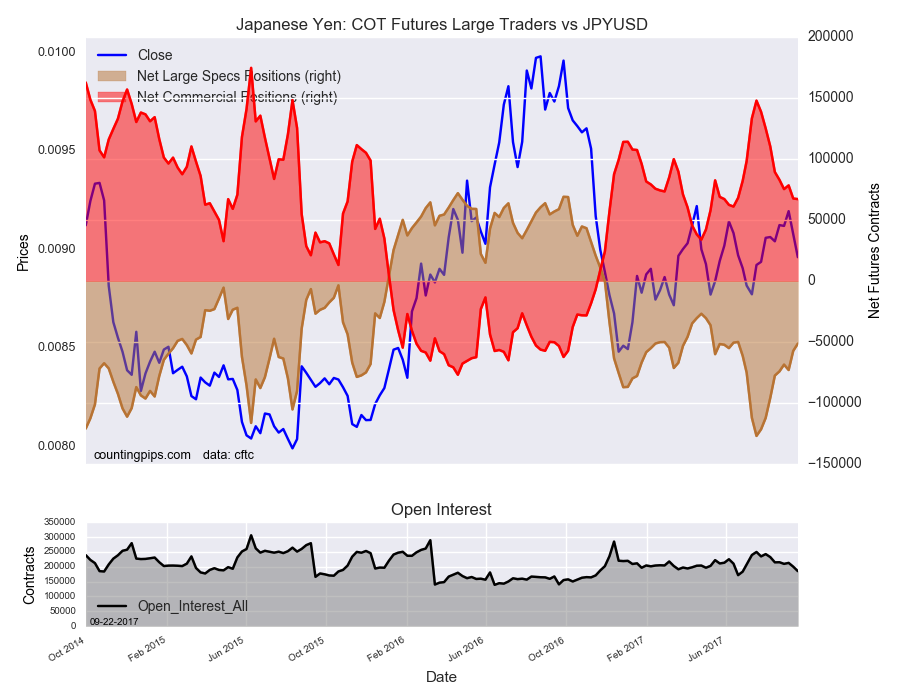
JPY67,008-494-51,3225,975
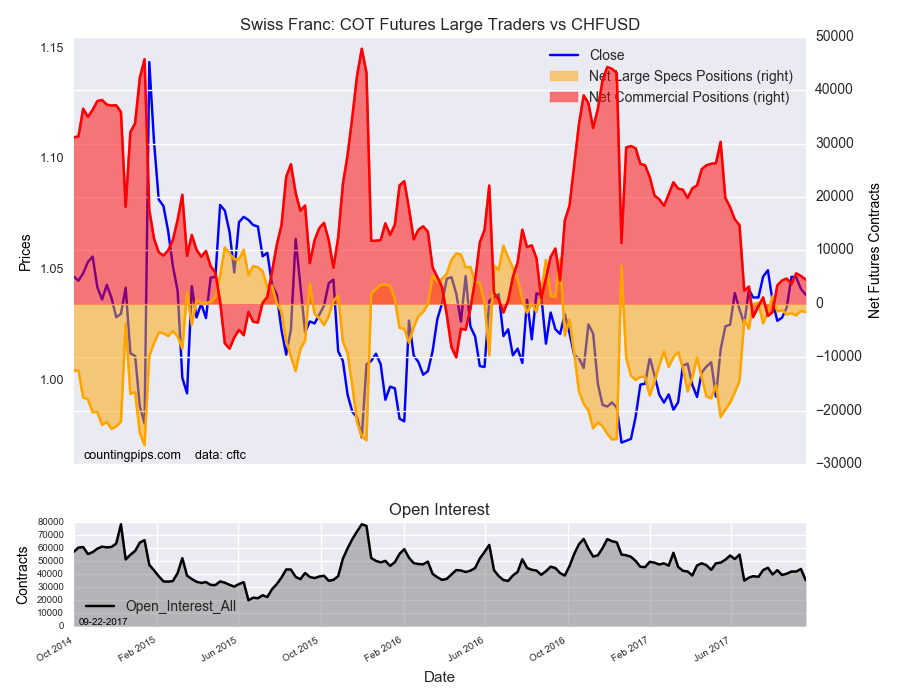
CHF4,554-654-1,569-255
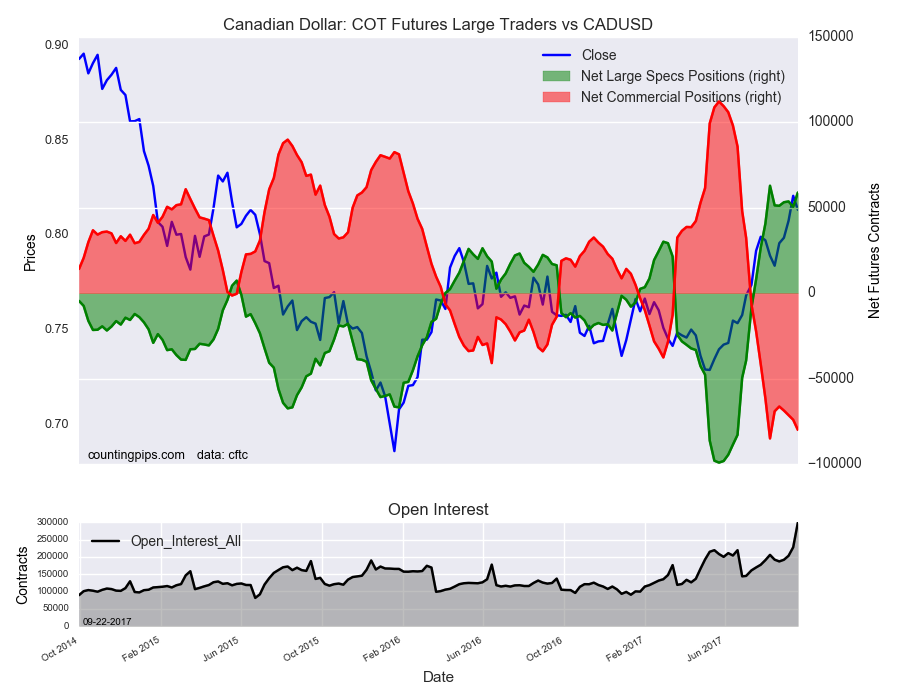
CAD-79,971-5,90058,8468,347
AUD-87,022-3,76972,5129,479
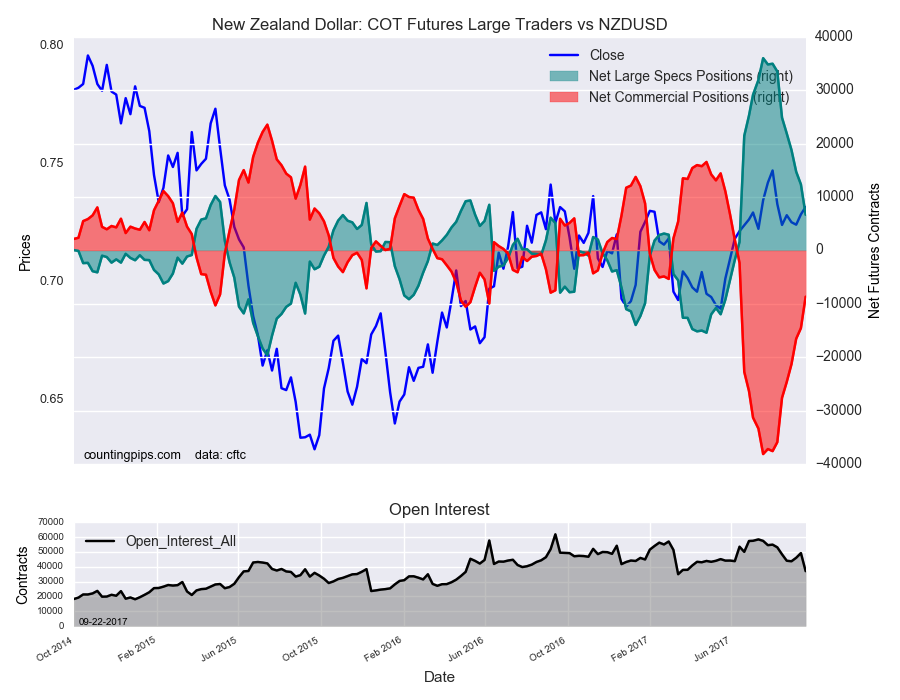
NZD-8,6735,8716,670-5,680
MXN-83,14239,97676,952-40,046


This latest COT data is through Tuesday and shows a quick view of how large speculators or non-commercials (for-profit traders) as well as the commercial traders (hedgers & traders for business purposes) were positioned in the futures markets. All currency positions are in direct relation to the US dollar where, for example, a bet for the euro is a bet that the euro will rise versus the dollar while a bet against the euro will be a bet that the dollar will gain versus the euro.


Weekly Charts: Large Trader Weekly Positions vs Price

EuroFX:


British Pound Sterling:


Japanese Yen:


Swiss Franc:


Canadian Dollar:


Australian Dollar:


New Zealand Dollar:


Mexican Peso:

*COT Report: The weekly commitment of traders report summarizes the total trader positions for open contracts in the futures trading markets. The CFTC categorizes trader positions according to commercial hedgers (traders who use futures contracts for hedging as part of the business), non-commercials (large traders who speculate to realize trading profits) and nonreportable traders (usually small traders/speculators). Find CFTC criteria here: (http://www.cftc.gov/MarketReports/CommitmentsofTraders/ExplanatoryNotes/index.htm).

The Commitment of Traders report is published every Friday by the Commodity Futures Trading Commission (CFTC) and shows futures positions data that was reported as of the previous Tuesday (3 days behind).

Each currency contract is a quote for that currency directly against the U.S. dollar, a net short amount of contracts means that more speculators are betting that currency to fall against the dollar and a net long position expect that currency to rise versus the dollar.

(The charts overlay the forex closing price of each Tuesday when COT trader positions are reported for each corresponding spot currency pair.) See more information and explanation on the weekly COT report from the CFTC website.

Article by CountingPips.com

WTI Crude Oil Speculators sharply boosted bullish net positions this week

By CountingPips.comReceive our weekly COT Reports by Email

WTI Crude Oil Non-Commercial Speculator Positions:

Large energy speculators sharply raised their bullish net positions in the WTI Crude Oil futures markets this week, according to the latest Commitment of Traders (COT) data released by the Commodity Futures Trading Commission (CFTC) on Friday.

The non-commercial futures contracts of WTI Crude Oil futures, traded by large speculators and hedge funds, totaled a net position of 418,074 contracts in the data reported through Tuesday September 19th. This was a weekly jump of 43,594 contracts from the previous week which had a total of 374,480 net contracts.

Speculative positions had fallen five out of the previous six weeks before this week’s surge higher. The overall bullish position is now back above the +400,000 net contract level for the first time in four weeks.

WTI Crude Oil Commercial Positions:

The commercial traders position, categorized by the CFTC as hedgers or traders engaged in buying and selling for business purposes, totaled a net position of -419,937 contracts on the week. This was a weekly decrease of -40,622 contracts from the total net of -379,315 contracts reported the previous week.

USO:

Over the same weekly reporting time-frame, from Tuesday to Tuesday, the USO Crude Oil ETF, which tracks the price of WTI crude oil, closed at approximately $10.11 which was a rise of $0.24 from the previous close of $9.87, according to unofficial market data.

*COT Report: The COT data, released weekly to the public each Friday, is updated through the most recent Tuesday (data is 3 days old) and shows a quick view of how large speculators or non-commercials (for-profit traders) as well as the commercial traders (hedgers & traders for business purposes) were positioned in the futures markets. The CFTC categorizes trader positions according to commercial hedgers (traders who use futures contracts for hedging as part of the business), non-commercials (large traders who speculate to realize trading profits) and nonreportable traders (usually small traders/speculators). Find CFTC criteria here: (http://www.cftc.gov/MarketReports/CommitmentsofTraders/ExplanatoryNotes/index.htm).

Article by CountingPips.comWeekly COT Report