Author Archive for InvestMacro – Page 491

How To Fight Corruption in the Philippines

By Dan Steinbock

Despite opposition, President Duterte’s Anti-Corruption Commission is vital in light of Philippine history and international experience. To be effective, the anti-corruption agency must be independent.

On October 4, President Duterte signed Executive Order 4 creating the Presidential Anti-Corruption Commission (PACC). The Commission is mandated “to directly assist the President in investigating and/or hearing administrative cases primarily involving graft and or corruption against all presidential appointees.””

Opposition has renounced the PACC as “unconstitutional”, “redundant” and “afflicted with congenital infirmity.” While some critics have expressed legitimate concerns, others may have a more self-interested agenda.

Yet, the fact remains that the Philippines ranks 101st in the current Corruption Perceptions Index (CPI); well behind China, India and Indonesia. Clearly, there is a reason for a strong and different anti-corruption initiative. The former is critical for effectiveness; the latter is vital because other efforts have failed.

In light of historical and international evidence, the effort to raise living standards in the Philippines is not viable without a broad and deep anti-corruption initiative.

Historical realities

When the Ramos era ended in the late 1990s, average Philippine per capita income was about $3,100, which meant 112th rank in the world.  In the corruption index, its score (3.3) was one of the lowest worldwide.

During the Estrada rule, per capita income grew to $3,600 but, after a hopeful start, the country fell further in the Index. In the Arroyo era, per capita income climbed to more than $5,500 but corruption remained widespread and got worse in the subsequent political turmoil.

In 2010, President Aquino began his term with a stated anti-corruption campaign. Barely three years later, the Inquirer cited his speech at the World Economic Forum: “Anti-corruption program [is] now bearing fruits.” In May 2016 – at the eve of the presidential election – the Rappler headlined: “PH anti-corruption drive most improved,” relying on consultant experience of 16 countries.

Yet, in light of the global corruption index, Aquino’s mid-term showed only slight improvement as the Index initially climbed to the Estrada-era level, only to fall further back at Ramos-era figures. So after two decades and much talk about progress, the Philippines corruption score was where it had been in the late 1990s – as if nothing had happened (see Figure).

If anything, corruption moved to an entirely new level as drugs proliferated from shantytowns to chic clubs as the Philippines became a transshipment hub for drug syndicates operating in East Asia and cooperating with Mexico’s Sinaloa cartel. When Duterte warned about the coming of a “narco-state” during his campaign, that was bypassed as political propaganda until abundant evidence became available about the spread of narco-money.

Corruption, poverty, illicit finance and bribery tend to go hand in hand.

Figure Corruption and Slow Progress in Per Capita Incomes

International experience

Today, Singapore is one of the world’s most attractive destinations, clean and wealthy, known for its strict rule of law.  Yet, in the postwar era, corruption was rampant in the city-state.

In 1952, the British colonial government created the Corrupt Practices Investigation Bureau (CPIB) at the Attorney-General’s Chambers. Yet, not much happened until Singapore attained self-government in 1959, when Prime Minister Lee Kuan Yew moved the CPIB into his office so that it would be independent from the police force and other government agencies.

Today, Singapore ranks 5th in the global corruption index; well ahead of Canada, Germany, and the UK.

Hong Kong learned from Singapore. In the 1970s, it was still widely considered one of the most corrupt cities in the world.  Reforms came only after huge protests, which led to the launch of the Independent Commission Against Corruption (ICAC), with wide investigative and executive powers and answerable to only the Governor Hong Kong, unlike the old police Anti-Corruption Branch.

Today Hong Kong is 15th in the corruption index; before Japan, US and France.

Upon taking office in the early 2010s, China’s President Xi Jinping pledged to crack down on “tigers and flies.” The anti-corruption campaign has been executed largely under the direction of Central Commission for Discipline Inspection (CCDI), and its smart and tough secretary Wang Qishan, along with corresponding judicial and military bodies. The CCDI has gone after both high-level officials and lower-level civil servants; from former military leaders, such as Xu Caihou and Guo Boxiong, and former politburo member Zhou Yongkang to Chongqing’s former party chief Bo Xilai.

As of 2016, the Chinese campaign had ‘netted’ over 120 high-ranking officials, including about a dozen high-ranking military officers, several senior executives of state-owned companies, and five national leaders.

The lessons

Ordinary people appreciate anti-corruption initiatives. Today, one of the most popular TV dramas in China is “In the Name of People.” Its plot revolves around a prosecutor’s effort to unearth corruption in a present-day fictional Chinese city.

But there are other common denominators in successful anti-graft campaigns. In each case – Singapore, Hong Kong and China – many talked a lot about corruption. Yet, anti-corruption struggle became effective only when leaders executed a truly independent campaign against graft.

In each case, critics initially accused the anti-corruption campaign for political purges, personal vendettas and economic destabilization. In reality, the latter often proved to be a pretext for an effort by corrupt officials not to get caught and to retain looted funds and illicit economic privileges.

In each case, too, not much success was achieved until truly untouchable officials took charge of the campaign, while reporting directly and only to the nation’s leader.

The Philippines is no different. After two decades of anti-graft rhetoric, an effective initiative requires independent leadership that must target both “tigers and flies,”” and report directly to the country’s chief executive.

In the long-term, corruption, left unpunished, will doom all branches of government, including state, society and church, even police and military – as evidenced by the recent Philippines history as well.

What the Philippines needs is a tough but humane, independent but responsive, broad but deep anti-corruption initiative. Without such a campaign, even rapid growth will only mean polarization and poverty to most Filipinos.

About the Author:

Dr Steinbock is the founder of the Difference Group and has served as the research director at the India, China, and America Institute (USA) and a visiting fellow at the Shanghai Institutes for International Studies (China) and the EU Center (Singapore). For more information, see http://www.differencegroup.net/

The original commentary was released by The Manila Times on October 9, 2017


RoboForex is launching trading CFDs on cryptocurrencies

Limassol (CY), October 9, 2017 – RoboForex, an international brokerage group, which provides online trading services on the global financial markets, has expanded the list of its offers available to clients and enabled access to trading CFDs on cryptocurrencies. Two of the most liquid digital currencies, bitcoin and ethereum, have been added to the list of trading instruments in MT4 and MT5 terminals. Therefore, RoboForex responded to its clients, who requested to make virtual assets that were becoming more and more popular available for trading.
RoboForex gave its clients an opportunity to trade two of the most advanced and popular instruments, BTC/USD and ETH/USD. Not only traders will benefit from trading with new cryptocurrency instruments, but the partners, who will get their partner commission for cryptocurrency CFD orders, as well. All trading instruments mentioned above are already available to RoboForex clients.

At the moment, bitcoin and ethereum are one of the most popular and volatile trading instruments that draw the interest of both traders and investors. Over the last 8 months, bitcoin has almost tripled its price and once again attracted a lot of attention of professional traders and beginners of the currency market. Ethereum growth rates are also impressive: at the beginning of the year it cost just 8 USD, but nowadays its price equals to 295 USD. Right now, the market capitalization of ethereum is about 27.3 billion USD, of bitcoin – 64.5 billion USD.

Impressive growth of the cryptocurrencies market capitalization reflects the strong interest of buyers and investors to these assets. Kiryl Kirychenka, Product Manager at RoboForex, says: “We’ve decided to enable cryptocurrencies for CFDs trading in the first place because of the keen interest of traders from all over the world to these assets. From now on, our clients will be able to derive profit from the fast growing cryptocurrency market without having to buy them. RoboForex offers one of the most favorable trading conditions for transactions involving digital currencies for both traders and investors. In the nearest future, we’re planning to continue developing in this direction and fundamentally improve our offers by adding new instruments and making trading conditions better”.

According to many specialists, the cryptocurrency market has a great potential. Today’s average daily turnover of transactions involving cryptocurrencies is worth about 3 billion USD. Since the beginning of 2017, this number has increased eightfold and is still growing. The interest in cryptocurrencies continues rising and some countries have already accepted them as an official payment instrument. The number of goods and services that can be bought or exchanged for cryptocurrencies is also increasing, which makes these assets more liquid.

About RoboForex

RoboForex is a financial group, which delivers brokerage services on a world-wide basis. The group provides traders, who work on financial market, with access to its own trading platforms. The group includes RoboForex (CY) Ltd, a European broker with the CySEC license No. is 191/13, and RoboForex Ltd, an international broker, regulated by the IFSC with the license IFSC/60/271/TS/17. More detailed information about RoboForex can be found on the official website at www.roboforex.com


Short-term trading idea FX EUR/USD – bull speculation: right shoulder to form

By Gabriel Ojimadu, Alpari

Trading opportunities on the currency pair: Since dropping to 1.1662, the rate has formed an inverse head and shoulders model on the daily and weekly timeframes. For its completion, the right shoulder needs to form with a target of around 1.1880 by 23/10/17. By the end of October, downwards movement should resume. Therefore, from 1.1880, we can start betting on the rate to decline. It seems to me that ideally, this reversal model won’t work out. Trade carefully.

Background

The last idea to come out on the EURUSD currency pair was on the 10th of July, 2017. At the time of writing, the euro was trading at 1.14 USD. From there, I was expecting a rebound from the upper boundaries of the A-A and C-C channels. I used the zone from 1.1475 to 1.1595 to sell euros with targets of 1.12 and 1.0925. Things didn’t turn out as I expected. Buyers shifted all resistance levels and the price didn’t even stop.

In mid-July, the price exited the C-C channel. Within 4 weeks, the euro reached 1.1910. At the beginning of September, the price hit 1.2092. This rally resumed as a result of weak US data, a reduction in Treasury bond yields, and talk about curtailing the ECB’s stimulus program.

Current situation

The euro bulls eventually ran out of steam at around 1.2092. After breaking through the TR2 trend line, or the lower boundary of the D-D channel, they started to take profit on their long positions. The bullish trend lasted for 28 weeks.

Then, in the space of a week, the euro dropped 54 pips to 1.1734 against a low of 1.1669. On Friday the 6thof October, the euro closed up. Buyers managed to recover the losses incurred by the NFP report and the announcement that North Korea plans to test another missile, which could reach the US’s western coast. The weekend went by peacefully.

Fig 1. Weekly chart. Source: TradingView

On Friday, the price dropped to August’s low of 1.1662. Due to the fact that the growth from 1.1662 to 1.2092 was quickly reversed, we’ve got an inverse head and shoulders model forming on the daily and weekly timeframes. For this model to complete its formation, the right shoulder needs to form with a target of around 1.1880 by 23/10/17. I got this date based on an analysis of the daily timeframe. Downwards movement should resume by the end of October.

At this stage, I can’t see the price dropping below the neckline. Here, we need to see whether or not buyers can consolidate the price above 1.1800 before Thursday. The more traders who notice a head and shoulders model, the less likely it is to be realised.

If buyers meet resistance at 1.1760, there’s an increased risk of the price dropping to 1.16 or the upper boundary of the C-C channel. A return to the C-C channel would tip the balance in favour of the bears. In such a case, buyers may have to retreat as far as 1.13/1.1350. If sellers don’t manage to bring the euro down to 1.1560 by 12/11/17, the rally should resume until 14/05/18.

Fibonacci Retracements Analysis 09.10.2017 (GOLD, USD/CHF)

Article By RoboForex.com

XAU USD, “Gold vs US Dollar”

At the H4 chart of the XAU/USD pair, after finishing the convergence, the price started a new ascending correction, which has already reached the retracement of 23.6% and may continue towards the retracements of 38.2% and 50.0% at 1297.60 and 1309.00 respectively. The resistance level is still close to the local high at 1357.31, and the support one – at 1260.85.

GOLD1

As we can see at the H1 chart, the pair is starting a new ascending movement. If the price breaks the local low, the instrument may start falling towards the post-correctional extension area between the retracements of 138.2% and 161.8% at 1251.32 and 1245.37 respectively.

GOLD2


USD CHF, “US Dollar vs Swiss Franc”

As we can see at the H4 chart, the USD/CHF pair has already been corrected to the upside by 38.2% and may continue growing towards the retracements of 50.0% and 61.8% at 0.9883 and 0.9990 respectively. In addition to that, the price is forming the divergence. According to the most probable scenario, the instrument may grow towards 0.9883 and then return to the retracements of 23.6% and 38.2% at 0.9705 and 0.9650 respectively.

USDCHF1

At the H1 chart, the situation is similar and confirms the H4 chart scenario.

USDCHF1


RoboForex Analytical Department

Article By RoboForex.com

Attention!
Forecasts presented in this section only reflect the author’s private opinion and should not be considered as guidance for trading. RoboForex LP bears no responsibility for trading results based on trading recommendations described in these analytical reviews.

EUR/USD: Bull hammer on daily chart

By GrowthAces.com

Macroeconomic overview:

  • U.S. employment fell in September for the first time in seven years as Hurricanes Harvey and Irma left displaced workers temporarily unemployed and delayed hiring, the latest indication that the storms undercut economic activity in the third quarter. The Labor Department said on Friday nonfarm payrolls decreased by 33k jobs last monthamid a record drop in employment in the leisure and hospitality sector. The decline in payrolls was the first since September 2010. Leisure and hospitality payrolls plunged 111k, the most since records started in 1939, as employment at restaurants and bars fell 104.7k. There were also decreases in retail and manufacturing employment last month.
  • The unemployment rate hit a more than 16-and-a-half-year low of 4.2% and annual wage growth accelerated to 2.9%. The decrease in the unemployment rate reflected a 906k surge in household employment, which eclipsed a 575k increase in the labor force.
  • The annual increase in wages in September was the largest since December 2016 and followed an upwardly revised 2.7 percent rise in August. The revision to August’s annual increase from 2.5 percent raised hope that wage growth was finally picking up.
  • The unemployment rate is now below the Federal Reserve’s median average forecast for the fourth quarter.
  • Strong wage gains and shrinking labor market slack left financial markets almost fully pricing in a December interest rate increase from the U.S. central bank.
  • The dollar initially rose against a basket of currencies as investors focused on the jobless rate and wages, before surrendering gains to trade little changed.
  • Boston Fed President Eric Rosengren said the Federal Reserve must respond to “very tight” U.S. labor markets by gradually raising interest rates. “Failing to respond to very tight labor markets with rates remaining negative in real terms could potentially risk unnecessarily shortening the economic recovery,” added Rosengren, who does not vote on policy this year but whose views often portend overall Fed policy.
  • “Even though inflation is currently somewhat below our longer-run objective, I judge that it is still appropriate to continue to remove monetary policy accommodation gradually,” said New York Fed President William Dudley, whose regular meetings with Fed Chair Janet Yellen bolster his influence among Fed policymakers.
  • While other policymakers largely agreed, they also said they were keeping a close eye on the data, particularly on inflation. And one offered a strong rebuttal, saying the central bank risked a “policy mistake” if it continues raising rates despite inflation data that remains stalled.
  • St. Louis Federal Reserve bank President James Bullard said he is increasingly concerned that his colleagues’ “zeal” to raise interest rates despite weak inflation amounts to a policy mistake that harm progress toward the Fed’s targets. “The December meeting is going to be too early to make a determination on whether inflation is coming back. I don’t see how we can get the data on that. I am getting more concerned that we might make a policy mistake.”
  • Atlanta Fed President Raphael Bostic, the newest of the 12 Fed presidents, said that he continues to believe the U.S. central bank should raise interest rates again by the end of the year, though he is “not wedded” to that position and continues to track data closely.
  • And Robert Kaplan, chief of the Dallas Fed, said that inflation is “likely building” given the low unemployment rate, which would make the case for further rate hikes. Though the number of jobs fell in September for the first time in seven years, the unemployment rate fell to 4.2% and hourly wages rose more than expected.
  • Last month, the Fed left rates unchanged and announced the well-telegraphed start to a gradual shrinking of its USD 4.5 trillion balance sheet, which was swollen by massive purchases of Treasury bonds and mortgage-backed securities in the aftermath of the 2007-2009 financial crisis and recession.
  • But market expectations are high that the Fed will hike rates again in December, especially after Fed Chair Janet Yellen outlined why she is fairly confident that inflation, now at 1.4% by the Fed’s preferred measure, will rise toward the Fed’s 2% target over the medium term. It would be imprudent, she said in late September, to wait until inflation actually reached that target to raise rates. We think that a rate hike is December is a done deal.

Technical analysis and trading signals:

  • Friday closed up on the day after setting a new low, forming a bull hammer. The pair tested 7-day exponential moving average at 1.1752 in Asia, but is a little easier now. We think that there is a risk of upward move as slow stochs uptick and have room to run.
  • A very strong support area is 1.1585/1605.
  • We think that current levels are good opportunity to open long position with stop-loss at 1.1585 or below.

EURUSD Daily Forex Signals Chart


VIP Traders Club members should expect to receive forex and precious metals trading signals updates at least twice a day. We will send you:

  1. Buy and sell forex, precious metals signals (entry level, target, stop-loss)
  2. Suggested position size that you can easily adjust to your trading account size – this would help you in risk management and you will survive longer drawdown periods
  3. Early heads-up about the potential trading opportunities or rationale to taken positions ( fundamental analysis, technical analysis )
  4. Forecasts of most important macroeconomic indicators prepared by our economists and econometricians.

JOIN VIP TRADERS CLUB NOW!

About the Author:

By GrowthAces.com – Daily Forex Trading Strategies


Forex Technical Analysis & Forecast 09.10.2017 (EUR/USD, GBP/USD, USD/CHF, USD/JPY, AUD/USD, USD/RUB, GOLD, BRENT)

Article By RoboForex.com

EUR USD, “Euro vs US Dollar”

The EUR/USD pair is being corrected to the upside. Possibly, the price may reach 1.1755 and complete the correction. Later, in our opinion, the market may start another descending wave with the target at 1.1633.


GBP USD, “Great Britain Pound vs US Dollar”

The GBP/USD pair also being corrected upwards. Possibly, the price may reach 1.3157 and finish the correction. After that, the instrument may form another descending wave towards 1.2918.


USD CHF, “US Dollar vs Swiss Franc”

The USD/CHF pair is being corrected towards 0.9760. We think, today the price may complete the correction and start growing to reach the target at 0.9868.


USD JPY, “US Dollar vs Japanese Yen”

The USD/JPY pair is still consolidating and trying to rebound from the downside border of the Triangle pattern. Possibly, today the price may reach 112.90. If later the instrument breaks this range to the upside, the market may reach 113.60; if to the downside – start another correction with the target at 111.23.


AUD USD, “Australian Dollar vs US Dollar”

The AUD/USD pair has reached the target at 0.7733. We think, today the price may consolidate near the lows between 0.7797 and 0.7731. If later the instrument breaks this range to the upside, the market may start another correction with the target at 0.7927.


USD RUB, “US Dollar vs Russian Ruble”

The USD/RUB pair is consolidating. Possibly, today the price may fall to reach 57.75. If later the instrument breaks this range to the upside, the market may grow towards 58.67; if to the downside – continue forming the fifth wave with the target at 56.55.


XAU USD, “Gold vs US Dollar”

Gold has reached the target of the descending wave and right now is growing towards 1285.85 Later, in our opinion, the market may fall to reach 1273.00. After completing the correction, the instrument may continue growing with the target at 1311.00.


BRENT

Brent is forming another descending correctional structure. We think, today the price may reach 55.95 and then fall towards 54.80 to finish the correction. After that, the instrument may grow with the target at 57.15.


RoboForex Analytical Department

Article By RoboForex.com

Attention!
Forecasts presented in this section only reflect the author’s private opinion and should not be considered as guidance for trading. RoboForex LP bears no responsibility for trading results based on trading recommendations described in these analytical reviews.

Short-term trading idea FX GBP/USD – bull speculation: rebound from the TR2 trend line

By Gabriel Ojimadu, Alpari

Trading opportunities on the currency pair: Since the 20th of September, the British pound has shed around 600 pips against the US dollar. The drop started with a pin bar model. From looking at the cycles, I’m expecting the rate to drop to the TR2 trend line or the range from 1.3000 to 1.3016, followed by a recovery to 1.3350 – 1.3490. We should keep the 21st of October and 29th of November in mind for possible reversal dates. From the trend line, I’ll start trying to trade with the trend with targets of 1.3350 and 1.1390. After the 28th of November, I’m expecting a downwards reversal and a breakout of the TR2 trend line.

Background

The last idea on the GBPUSD currency pair was published on the 29th of May. At the time of writing, one British pound was trading for 1.2805 USD. After the UK’s GDP figures for the first quarter were revised downwards, the pound dropped to 1.2775, breaking through the lower boundary of the A-A channel and the TR trend line. In my forecast, I was expecting the rate to drop to 1.2643 in time for the FOMC meeting (13th– 14th of July). It didn’t happen quite the way I expected, but the rate fell to 1.2635 by the 14th of July. After the FOMC meeting, the bullish trend was restored from 1.2589 with renewed strength.

Fig 1. Daily chart. Source: TradingView

According to the latest COT (Commitments of Traders) report, which was published on Friday by the CFTC, large speculators have cashed in on their long and short positions.

Large speculators (Non-commercial): long positions have been reduced by 1,507 to 76,958 contracts, while short positions have dropped by 17,000 to 59,167 contracts. Net long positions for the week increased by 2,216 to 15,573 contracts.

Small speculators (Non-reportable positions): long positions increased by 2,395 to 39,650 contracts. Short positions fell by 435 to 27,695 contracts. Net long positions increased by 2,825 to 11,950 contracts.

From this latest report, we can see that large speculators have abandoned their long positions on the back of the British pound’s slide (possibly due to stop levels being activated) and have taken profit on the short positions opened during the pair’s rally to 1.3657. Conversely, small speculators increased their long positions during the downwards movement; expecting that the pound would resume its upwards trajectory.

Last week, the GBPUSD pair shed 305 pips, reaching 1.3027. The increased probability of a rate hike from the US Fed at the end of the year put pressure on the pound. On Friday, after the payrolls report, the pound/dollar pair closed down. Now, I’m predicting a drop to the TR2 trend line at 1.3000 – 1.3016, followed by a recovery to 1.3350 – 1.3490. It’s difficult to say here just how much ground the pound will recover. For now, 21/10 and 29/11 are the dates to look out for a reversal.

Given the rate at which the pound is dropping; thanks to the bears, the price should get at least as far as 1.2875. If we allow for downwards movement with divergences, it could go as far as 1.2775. I’m waiting for the rate to drop to the trend line, and then I’ll try trading with the trend with targets of 1.3350 and 1.1390.

EURUSD: test of the B-B channel expected

By Gabriel Ojimadu, Alpari

Previous:

On Friday the 6th of October, trading on the euro closed up. Before the US data was released, the euro/dollar pair was trading within a 30-pip range of 1.1686 to 1.1716. Volatility on the pair surged as the NFP report was being published. The rate initially reacted with a 40-pip drop to 1.1670, followed by a 69-pip surge to 1.1739. These sharp fluctuations continued for a couple of hours before the pair entered a sideways trend.

The number of new jobs created outside the agricultural sector in the US fell by 33,000 against a forecast of +90,000. The reading for July was revised from 189,000 to 138,000, and for August from 156,000 to 169,000. The aggregate revision comes to -38,000.

The workforce participation rate grew from 62.9% to 63.1%. Unemployment dropped from 4.4% to 4.2% (forecast: 4.4%). The average hourly earnings index in the US for June came to 0.5% (forecast: 0.3%, previous reading revised from 0.1% to 02%).

Traders focused on the more positive aspects of the report, but the dollar’s attack petered out regardless. News that North Korea is planning another missile test and that Hurricane Nate is approaching the Gulf of Mexico beat the dollar into submission.

Day’s news (GMT+3):

  • 09:00 Germany: industrial production (Aug);
  • 19:00 Eurozone: ECB’s Lautenschläger Speech;
  • n/a US: Columbus Day;
  • n/a Canada: Thanksgiving Day.

Fig 1. EURUSD rate on the hourly. Source: TradingView

From the D2 line, the euro recovered to the balance line. During trading in Asia, the price jumped to 1.1748. In my forecast, I’m expecting a rebound to the LB balance line, with a subsequent jump to 1.1756. Given that the US and Canada have national holidays today, I’ve set a low target.

I tend not to pay attention to the news on Mondays as markets tend to ignore it. They need to digest the payrolls data and then decide how they will respond if the head and shoulders model start to be realised on the daily and weekly timeframes. For the formation to be complete, the right shoulder needs to form with a target of around 1.1880 by 23/10/17. By the end of October, downwards movement should resume. From 1.1880, we can expect the rate to drop.

There are two channels on the hourly timeframe; A-A and B-B. For the right shoulder to form, we need to break out of 1.1750 and 1.1790 levels. Exiting the B-B channel would open the way to 1.1880. If sellers manage to bring the rate down below 1.17 by Wednesday, we can expect the rate to continue falling.

Can Mali Maintain Its Gold Mining Status?

By OilPrice.com

Mali’s gold exports are falling, and new discoveries aren’t enough to make up for the loss of its giant legacy mines, where production is already dead or winding down, and the fate of one of the biggest of them all—Sadiola—now hangs in the balance.

The world-class Sadiola gold mine needs an investment of $380 million to keep it open for another 10 years, accessing 3.4 million ounces in reserves.

But there are signals that negotiations over the deal to extend the productive life of Sadiola by at least another decade have stalled within the government, putting the investment at risk.

The reason for the stalled negotiations remain unclear, but what’s at stake for Mali is as visible as ever: Sadiola is crucial for Mali’s reputation as one of Africa’s top three gold producers. Next to this, it is a crucial lifeline for new jobs and much-needed state revenues.

How the stalled negotiations over Sadiola are resolved could be a litmus test for a government heading into elections next year—and a government that relies heavily on foreign aid, while working hard to create an attractive investment climate.

The investment climate in theory has improved immensely in recent years, but putting this into practice has proved to be challenging in this terrain.

So far, it’s been moving in the right direction. But many industry eyes will be on the Sadiola deal ahead of the Invest in Mali Forum 2017, which will be held in Bamako in early December and supported by the World Bank.

Sadiola—A Legacy with a Lot More Gold to Give

The Sadiola mine is a joint venture between Canadian miner IAMGOLD (NYSE:IAG) (TSX:IMG) with 41 percent, operator AngloGold Ashanti (NYSE:AU) with 41 percent, and the Government of Mali with 18 percent.

Located in southwest Mali near the border with Senegal in a remote part of the Kayes region, the giant Sadiola permit covers 302 square kilometers.

The existing plant was built to process soft rock, or oxides, and the soft rock is now running out. But Sadiola has much more to give with the massive hard-rock, or sulphides, deposit that lies beneath the depleted oxides. This is now a ‘hard rock’ story, and IAMGOLD and AngloGold Ashanti are keen to invest in a major plant modification that would enable hard-rock processing.

The Sadiola mine has had a major, positive economic impact on Mali since it opened in 1997, following liberalization of the sector. That same year, gold had already become the primary source of Mali’s foreign currency. By 1999, it had become its biggest export. By 2001, Mali had risen to become the third top gold producer in Africa.

It wouldn’t have happened without Sadiola—one of three key mines behind Mali’s preeminence as an African gold giant. The other two mines are Morila and Yatela.

The Morila mine, owned by Randgold Resources, AngloGold Ashanti and the government, is scheduled to be closed down in 2019, after producing over 200 tonnes of gold since it opened in 2000.

Yatela—a joint venture between IAMGOLD with 40 percent, operator AngloGold Ashanti with 40 percent and the Government of Mali with 20 percent—has already reached the end of its productive life, and closure activities continue.

Originally, Yatela’s planned mine life would have seen it closed in 2007. But the exploration efforts of IAMGOLD and AngloGold Ashanti extended the life of the mine by an exceptional seven years. The partners continually opened up additional economically exploitable deposits at Yatela, pushing the closure back repeatedly.

But Yatela is much more expensive to exploit than Sadiola, which has been producing gold at a lower total cash cost.

If negotiations fail over the terms necessary to invest in Sadiola’s ‘hard rock’ gold, much could be lost.

What’s at Stake for Mali

Mali’s industrial gold production rose negligibly from 2015 to 2016, with 2015 coming in at 46.5 tonnes and 2016 just squeaking past at 46.9 tonnes, according to Reuters. But total gold exports fared even worse, falling from 70 tonnes to 67 tonnes during that same period.

With Morila winding down, Yatela closed, and Sadiola stuck in apparent bureaucratic purgatory, the next couple of years will be an uphill struggle to maintain production—even with new discoveries.

Mali’s state revenues from mining companies rose only 1 percent last year—but it wasn’t due to an uptick in exports; rather, gold prices saw a bit of a bump.

Indeed, industrial gold production will fall this year to 45 tonnes, with no new mines slated to come online until 2018—if all goes well.

With gold representing about 25-30 percent of government revenues, getting more out of a giant legacy mine like Sadiola is critical.

So, what’s at stake? Nearly 56,000 tonnes of ore containing 3.4 million ounces of gold. And these are proven and probable reserves, which already have a demonstrated economic viability.

Though the ‘soft rock’ is nearing depletion, the ‘hard rock’ is bursting at the seams, and Sadiola is ready to fast-track its expansive development. But getting past the politics in Mali is no easy task—even when you have a track record of extending the life of another legacy mine—Yatela—for seven years.

Sadiola has been operating for 20 years. Because the soft rock is being depleted, production has dropped from 600,000 ounces in 2000 to less than 200,000 ounces today.

But it could go for another ten years if IAMGOLD and AngloGold Ashanti are given the green light to invest some $380 million to process the hard rock.

Not only government revenues would increase, the investment would create additional jobs for Malians.

Sadiola, with soft-rock production slowing, is now employing around 1,000 people, 93 percent of whom are Malian nationals. If Sadiola’s hard-rock expansion plans are green-lighted, it would not just protect, but expand those jobs for a country that is struggling to keep its growing numbers of young people gainfully employed.

And for Mali, this means much more than putting food on the table. For the government, it means security. With over half of the Malian population under the age of 35, and that figure expected to double by 2030, there is a direct link between unemployment and crime or terrorism. And when criminal-terrorist groups offer money for new recruits, security is increasingly compromised.

Getting the Gold Out

The Sadiola mine is surrounded by some 46 villages and a few hamlets, as well as a mining village created specifically for Sadiola employees, with housing, a medical clinic, recreation facilities, a supermarket, a sewage treatment facility and recreation facilities, among other things.

Water comes from a 55-kilometer pipeline from the Senegal River, providing the villages with drinking water and the mine with water for operations. The site and its surrounding villages are powered using diesel-fueled generators.

Sadiola’s expansion project will use existing infrastructure, but also build new infrastructure. The plan is to connect the mine to the Malian power grid, which may also facilitate distribution of electricity to local villages.

But 2018 is an election year, and in Mali, this means uncertainty, especially for the fate of mining deals, but also for the investment climate as a whole.

IAMGOLD, for one, is closely watching the developments, and what they might mean for the investment environment.

In an interview with Oilprice.com, IAMGOLD CEO Stephen J.J. Letwin noted that the “Sadiola mine has been a remarkable success for all stakeholders in Mali for two decades.”

The Canadian giant has operating mines in Burkina Faso, Suriname, Mali and Canada, and exploration projects in Senegal, Brazil, Mali, Canada and Nicaragua.

While Essakane, in Burkina Faso, is IAMGOLD’s biggest mine and its most prolific, Mali was “the birthplace of our company,” Letwin said. “And we will always be committed to exploring opportunities in Mali, and West Africa more generally.”

IAMGOLD did not comment on rumors of a possible deadlock over the Sadiola deal.

To make Sadiola work for Mali and its people, the energy-intensive expansion to access the deep sulphides requires a world-class miner and the right economics. The gold is there, the economics are there from a mining perspective, and the miner has been there successfully for 20 years and is particularly known for an intense focus on mine optimization—but the government, whose representatives are struggling for political capital ahead of crucial elections, is hamstrung.

In the meantime, 3.4 million ounces of gold remain stuck in the hard-rock at Sadiola.

Link to original article: http://oilprice.com/Metals/Gold/Can-Mali-Maintain-Its-Gold-Mining-Status.html


COT Report: Specs trim USD shorts. Gold, Silver, Crude, 10YR bets all fall

By CountingPips.com

– US Dollar Speculators decreased their USD bearish bets for 1st time in 7 weeks

– WTI Crude Oil Speculator bets fell after 2 weeks of gains

– 10-Year Note Speculators decreased bullish bets for 2nd week

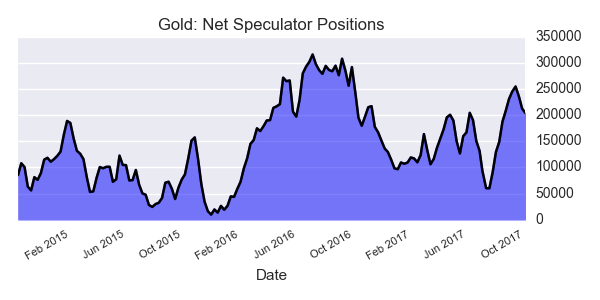
– Gold speculators dropped bullish bets for 3rd week

– Large S&P500 Speculators went into small short position

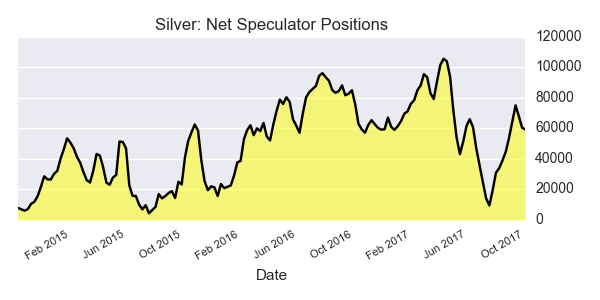
 Silver Speculator bets declined for 3rd week

– Copper Speculators raised bullish bets after 3 down weeks


Forex Speculators raised US Dollar bets for 1st time in 7 weeks

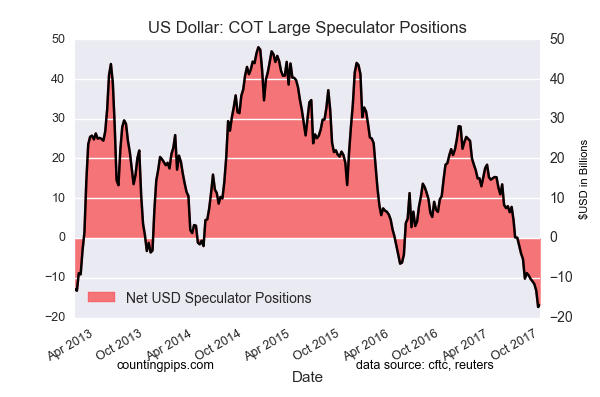
US Dollar net speculator positions leveled at $-16.83 billion as of Tuesday

The latest data for the weekly Commitment of Traders (COT) report, released by the Commodity Futures Trading Commission (CFTC) on Friday, showed that large traders and currency speculators raised their bets for the US dollar last week following six straight weeks of declines. See full article


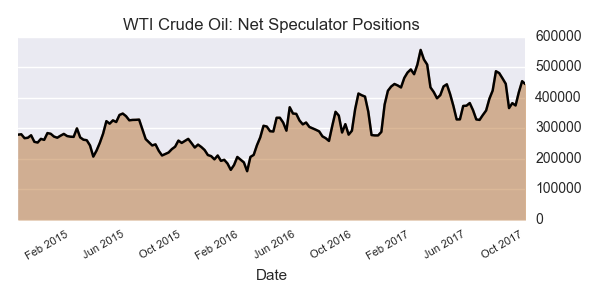
WTI Crude Oil Speculator bets fell for 1st time in 3 weeks

The non-commercial contracts of WTI crude futures totaled a net position of 444,316 contracts, according to data from last week. This was a slide of -9,792 contracts from the previous weekly total. See full article


Gold Speculators cut back on bullish net positions for 3rd week

The large speculator contracts of gold futures totaled a net position of 203,855 contracts. This was a weekly decline of -8,739 contracts from the previous week. See full article


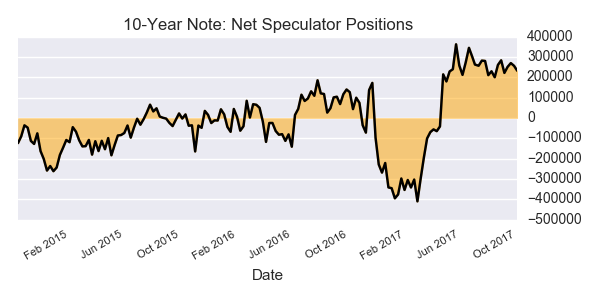
10-Year Note Speculators lowered bullish net positions for 2nd week

The large speculator contracts of 10-year treasury note futures totaled a net position of 232,156 contracts. This was a weekly reduction of -24,470 contracts from the previous week. See full article


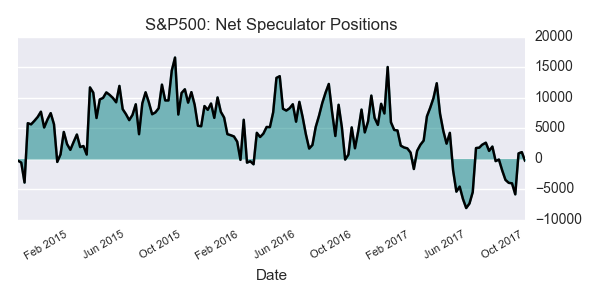
S&P500 Speculators reduced their net positions to a short position

The large speculator contracts of S&P 500 futures totaled a net position of -376 contracts. This was a decrease of -1,458 contracts from the reported data of the previous week. See full article


Silver Speculators cut back on bullish net positions for 3rd week

The non-commercial contracts of silver futures totaled a net position of 59,179 contracts, according to data from last week. This was a weekly fall of -1,081 contracts from the previous totals. See full article


Copper Speculators lifted net positions for 1st time in 4 weeks

The large speculator contracts of copper futures totaled a net position of 33,829 contracts. This was a weekly boost of 3,693 contracts from the data of the previous week. See full article


Article by CountingPips.com

The Commitment of Traders report data is published in raw form every Friday by the Commodity Futures Trading Commission (CFTC) and shows the futures positions of market participants as of the previous Tuesday (data is reported 3 days behind).

To learn more about this data please visit the CFTC website at http://www.cftc.gov/MarketReports/CommitmentsofTraders/index.htm