Author Archive for InvestMacro – Page 489

Silver Speculator positions dipped slightly this week, lower for 4th week

By CountingPips.comReceive our weekly COT Reports by Email

Silver Non-Commercial Speculator Positions:

Large speculators very slightly reduced their net positions in the Silver futures markets this week, according to the latest Commitment of Traders (COT) data released by the Commodity Futures Trading Commission (CFTC) on Friday.

The non-commercial futures contracts of Silver futures, traded by large speculators and hedge funds, totaled a net position of 59,108 contracts in the data reported through Tuesday October 10th. This was a weekly reduction of -71 contracts from the previous week which had a total of 59,179 net contracts.

Speculative positions have now fallen for four straight weeks although remain in strong bullish territoryat just under +60,000 net contracts. Net positions have stayed above the +50,000 contract level for seven consecutive weeks.

Silver Commercial Positions:

The commercial traders position, categorized by the CFTC as hedgers or traders engaged in buying and selling for business purposes, totaled a net position of -70,608 contracts on the week. This was a weekly fall of -1,891 contracts from the total net of -68,717 contracts reported the previous week.

SLV ETF:

Over the same weekly reporting time-frame, from Tuesday to Tuesday, the SLV ishares ETF, which tracks the price of silver, closed at approximately $16.15 which was an increase of $0.44 from the previous close of $15.71, according to unofficial market data.

*COT Report: The COT data, released weekly to the public each Friday, is updated through the most recent Tuesday (data is 3 days old) and shows a quick view of how large speculators or non-commercials (for-profit traders) as well as the commercial traders (hedgers & traders for business purposes) were positioned in the futures markets. The CFTC categorizes trader positions according to commercial hedgers (traders who use futures contracts for hedging as part of the business), non-commercials (large traders who speculate to realize trading profits) and nonreportable traders (usually small traders/speculators). Find CFTC criteria here: (http://www.cftc.gov/MarketReports/CommitmentsofTraders/ExplanatoryNotes/index.htm).

Article By CountingPips.comReceive our weekly COT Reports by Email

Copper Speculators advanced their bullish net positions for 2nd week

By CountingPips.comReceive our weekly COT Reports by Email

Copper Non-Commercial Speculator Positions:

Large speculators increased their bullish net positions in the Copper futures markets this week, according to the latest Commitment of Traders (COT) data released by the Commodity Futures Trading Commission (CFTC) on Friday.

The non-commercial futures contracts of Copper futures, traded by large speculators and hedge funds, totaled a net position of 40,738 contracts in the data reported through Tuesday October 10th. This was a weekly gain of 6,909 contracts from the previous week which had a total of 33,829 net contracts.

Speculative positions are at their highest level in four weeks and are back above the +40,000 level for the first time since September 12th.

Copper Commercial Positions:

Meanwhile, the commercial traders position, categorized by the CFTC as hedgers or traders engaged in buying and selling for business purposes, totaled a net position of -46,596 contracts on the week. This was a weekly loss of -6,807 contracts from the total net of -39,789 contracts reported the previous week.

JJC ETF:

Over the same weekly reporting time-frame, from Tuesday to Tuesday, the JJC iPath Bloomber Copper ETN, which tracks the price of copper, closed at approximately $34.85 which was an advance of $1.27 from the previous close of $33.58, according to unofficial market data.

*COT Report: The COT data, released weekly to the public each Friday, is updated through the most recent Tuesday (data is 3 days old) and shows a quick view of how large speculators or non-commercials (for-profit traders) as well as the commercial traders (hedgers & traders for business purposes) were positioned in the futures markets. The CFTC categorizes trader positions according to commercial hedgers (traders who use futures contracts for hedging as part of the business), non-commercials (large traders who speculate to realize trading profits) and nonreportable traders (usually small traders/speculators). Find CFTC criteria here: (http://www.cftc.gov/MarketReports/CommitmentsofTraders/ExplanatoryNotes/index.htm).

Article By CountingPips.comReceive our weekly COT Reports by Email


Ichimoku Cloud Analysis 13.10.2017 (AUD/USD, NZD/USD, USD/CAD)

Article By RoboForex.com

AUD USD, “Australian Dollar vs US Dollar”

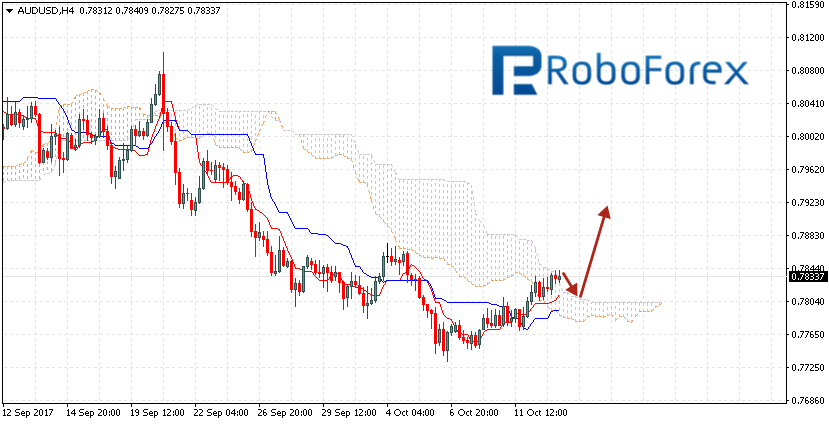
The AUD/USD pair is trading at 0.7833; the instrument is still moving above Ichimoku Cloud, which means that it may continue growing. We should expect the price to test the broken border of the cloud at 0.7810 and continue moving upwards to reach 0.7925. However, the scenario that implies further growth may be cancelled if the price breaks the downside border of the cloud and fixes below 0.7760. In this case, the pair may continue falling towards 0.7690.

AUDUSD


NZD USD, “New Zealand Dollar vs US Dollar”

The NZD/USD pair is trading at 0.7139; the instrument is still moving inside Ichimoku Cloud, which means that it is moving sideways. We should expect the price to test the upside border of the cloud at 0.7145 and then continue moving downwards to reach 0.7090. However, the scenario that implies further decline may be cancelled if the price breaks the upside border of the cloud and fixes above 0.7155. In this case, the pair may continue growing towards 0.7255. If the price fixes below 0.7060, the descending tendency may continue.

NZDUSD


USD CAD, “US Dollar vs Canadian Dollar”

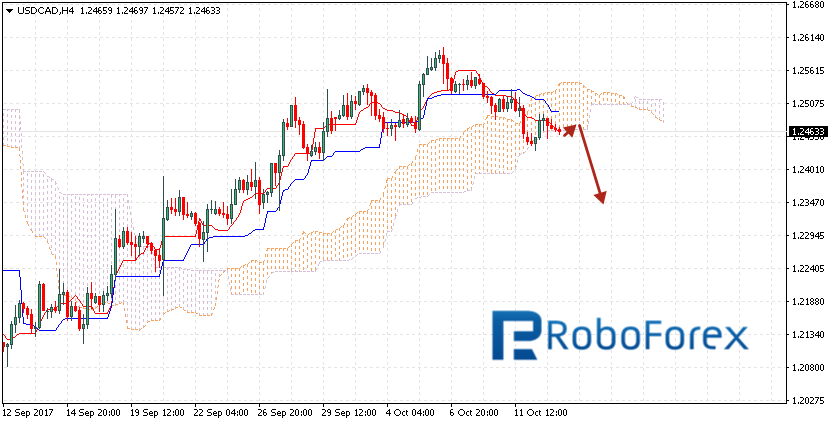
The USD/CAD pair is trading at 1.2463; the instrument is still moving below Ichimoku Cloud, which means that it may continue falling. We should expect the price to test the downside border of the cloud at 1.2465 and then continue moving downwards to reach 1.2345. However, the scenario that implies further decline may be cancelled if the price breaks the upside border of the cloud and fixes above 1.2550. In this case, the pair may continue growing towards 1.2640.

USDCAD


RoboForex Analytical Department

Article By RoboForex.com

Attention!
Forecasts presented in this section only reflect the author’s private opinion and should not be considered as guidance for trading. RoboForex LP bears no responsibility for trading results based on trading recommendations described in these analytical reviews.

Forex Technical Analysis & Forecast 13.10.2017 (EUR/USD, GBP/USD, USD/CHF, USD/JPY, AUD/USD, USD/RUB, GOLD, BRENT)

Article By RoboForex.com

EUR USD, “Euro vs US Dollar”

The EUR/USD pair is forming another descending wave; it has already the first impulse and broken the ascending channel. Possibly, today the price may consolidate at 1.1839. If later the instrument breaks this range to the downside, the market may fall towards the first target at 1.1796.


GBP USD, “Great Britain Pound vs US Dollar”

The GBP/USD pair is forming another ascending structure. We think, today the price may reach 1.3313. Later, in our opinion, the market may fall towards 1.2964.


USD CHF, “US Dollar vs Swiss Franc”

The USD/CHF pair has rebounded from the Neckline and started growing. Possibly, today the price may continue forming the wave towards 0.9850, which is the first target of another ascending structure. An alternative scenario implies that the instrument may fall to test 0.9707 and then start growing towards the target at 0.9850.


USD JPY, “US Dollar vs Japanese Yen”

The USD/JPY pair is moving downwards. Possibly, the price may break the downside border of the range. The target is at 111.38. After that, the instrument may be corrected towards 112.40.


AUD USD, “Australian Dollar vs US Dollar”

The AUD/USD pair is still consolidating at the top of the ascending wave. Possibly, today the price may break the top and extend the correction towards 0.7920.


USD RUB, “US Dollar vs Russian Ruble”

The USD/RUB pair is trading to rebound from 57.81. Possibly, the price may reach 57.53 and then form another consolidation range. After breaking this range to the downside, the instrument may fall to reach 56.67.


XAU USD, “Gold vs US Dollar”

Gold is trading to rebound from 1290. Possibly, the price may continue growing towards 1311 and then start resume falling inside the downtrend to reach 1260.


BRENT

Brent is trading to rebound from 55.85. We think, the price may grow to reach 57.10. And that’s just a half of another ascending structure. The local target is at 58.57.


RoboForex Analytical Department

Article By RoboForex.com

Attention!
Forecasts presented in this section only reflect the author’s private opinion and should not be considered as guidance for trading. RoboForex LP bears no responsibility for trading results based on trading recommendations described in these analytical reviews.

EURUSD: drop to 1.1796 expected

By Gabriel Ojimadu, Alpari

Previous:

On Thursday the 12th of October, trading on the euro/dollar currency pair closed down. The rate fell from 1.1880 to 1.1827. At the beginning of the European session, the euro dropped further as the dollar rose across the board. It then received some support from the euro/pound cross following reports that Brexit talks had hit a deadlock. The price briefly recovered from 1.1827 to 1.1851 before falling back to 1.1827.

The euro/pound cross hit a new daily low, but the euro kept trading above 1.1824 against the dollar. Such behavior from speculators was down to a slide on the dollar across the board along with the pound’s recovery.

The pound recovered its losses after a report from the German publication Handelsblatt that the EU is prepared to offer the UK a two-year transitional deal. Such an offer, however, would depend on the UK fulfilling its financial obligations to the EU.

US data:

  • Initial jobless claims (6 Oct): 243,000 (forecast: 254,000, previous: 258,000).
  • PPI (Sep): 0.4% (forecast: 0.4%, previous: 0.2%).
  • PPI ex food & energy (Sep): 0.4% (forecast: 0.2%, previous: 0.1%).

Day’s news (GMT+3):

  • 09:00 Germany: CPI (Sep);
  • 10:15 Switzerland: producer and import prices (Sep);
  • 15:30 USA: CPI (Sep), retail sales (Sep);
  • 17:00 USA: Michigan consumer sentiment index (Oct);
  • 17:15 Eurozone: ECB vice president Constancio’s speech;
  • 17:25 USA: Fed’s Evans speech;
  • 18:30 USA: FOMC member Kaplan’s speech;
  • 20:00 USA: Baker Hughes US oil rig count, FOMC member Powell’s speech.

Fig 1. EURUSD rate on the hourly. Source: TradingView

Yesterday’s predictions came off. Sellers first broke the trend line of the C-C channel before successfully breaking out of the D-D channel. The 45th degree at 1.1824 is acting as a support. The price has tested this level three times.

At the time of writing, the euro is trading at 1.1847, at around the 22nd degree. The dollar is trading down against all the majors. Nevertheless, my forecast today looks downwards, with a target of 1.1796 (67 degrees).

I can’t see the rate dropping any lower than 1.1796 at this stage, since the 38.2% Fibo level runs through 1.18 (taken from the upwards movement from 1.1670 to 1.1880). This is a strong support level.

I reckon that from 1.1880, we need to make a series of three highs, after which buyers can test 1.19 levels. Yesterday, ECN head Mario Draghi announced that interest rates would remain at their record low levels even after the regulator’s asset purchasing program comes to an end.

Since the Stochastic oscillator is up, I expect the single currency to fall against the greenback as trading gets underway in Europe. Despite this morning’s growth on the euro crosses, the euro/pound cross is in bear territory. It’ll be interesting to find out whose luck will runs out this Friday the 13th; the bulls or the bears.

Japanese Candlesticks Analysis 12.10.2017 (USD/CAD, GOLD)

Article By RoboForex.com

USD CAD, “US Dollar vs Canadian Dollar”

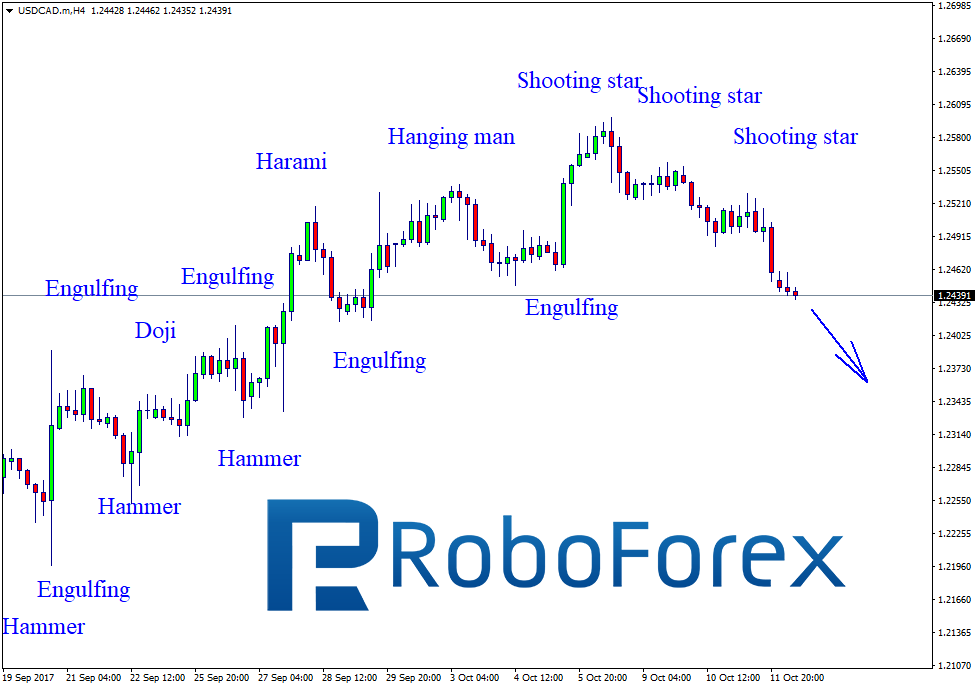
At the H4 chart, the USD/CAD pair formed the ascending channel with Hammer, Doji, Engulfing, and Shooting Star reversal patterns at support and resistance levels to define its borders. By now, the price has broken the downside border and at the moment is moving towards the support level at 1.2427. Later, the instrument is expected to break it and continue falling.

USDCAD

XAU USD, “Gold vs US Dollar”

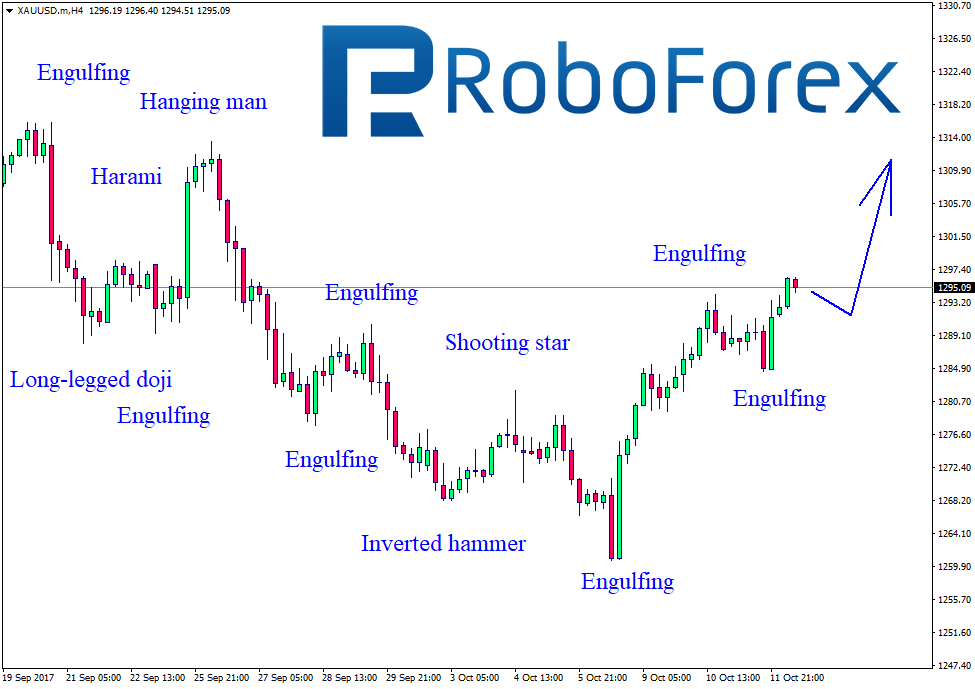
At the H4 chart, the instrument completed its descending movement and started forming the ascending channel with Engulfing, Shooting Star, and Inverted Hammer patterns at the support and resistance level to define its borders. The upside target is the resistance level at 1311.37.

GOLD


RoboForex Analytical Department

Article By RoboForex.com

Attention!
Forecasts presented in this section only reflect the author’s private opinion and should not be considered as guidance for trading. RoboForex LP bears no responsibility for trading results based on trading recommendations described in these analytical reviews.

The Struggle for Bolivia Is About to Begin

By Dan Steinbock    

While middle class Bolivians are demonstrating against the incumbent president’s bid to extend term limits, the country is thriving after a decade of progress under Evo Morales.

Recently, thousands of Bolivians took part in protests in San Francisco square in La Paz demonstrating against President Evo Morales’ bid to extend term limits.

In a referendum last year, some 51 percent of Bolivian voters rejected Morales’ proposal to reform the constitutions to end current term limits.

In September, Morales’ Movement to Socialism (MAS) party requested the highest court to remove legal limits, which bar officials from seeking re-election indefinitely. The court has until December to rule on the request or extend the deadline for a decision.

In La Paz, the narrow urban middle classes expressed concerns that Morales was attempting to tighten his grip of power in a way that was reminiscent of President Nicolas Maduro in Venezuela.

But Bolivia is not Venezuela and Morales is not Maduro.

A decade of progress

As Bolivia’s first president to come from the indigenous population, Evo Morales began his political career as a trade unionist, like Brazil’s former President Lula. He has focused on greater equity, and poverty reduction.

When Morales won the presidential election in 2006, per capita income in Bolivia was less than $4,200. Today, it exceeds $7,550. At the same time, Gini index, which measures income inequality, has plunged from more than 58 to 47.

Figure Bolivian Per Capita Income and Gini Index, 2005-2015

Sources: Per capita income, IMF; Gini Index, World Bank.

Unlike some of his predecessors, Morales has vocally criticized neoliberal policies and sought to reduce Bolivia’s dependence on the World Bank (WB) and International Monetary Fund (IMF).

Morales’ MAS represents a progressive alliance of indigenous people, mestizo working class, particularly miners, and socialist intellectuals. While 70 percent of Bolivians are mestizos, 20 percent are indigenous. Not surprisingly, his policies continue to be criticized by the domestic elite and US-led international organizations.

Nevertheless, Morales has a strong track record in people first policies, which shun the power of capital and highlight the importance of a truly independent Bolivia.

“A day like today in 1944 ended Bretton Woods Economic Conference, in which the IMF and WB were established,” Morales tweeted last June. “These organizations dictated the economic fate of Bolivia and the world. Today we can say that we have total independence of them.”

In the past, Bolivia’s dependence on these agencies was so great that the IMF actually had an office in government headquarters and even participated in their meetings. That was very much in line with the economic interests of the ruling oligarchy, which MAS perceives as “anti-national.”

During the past decade, Bolivia’s trading relations have shifted, however. Today, the US and Japan account for 20 percent of Bolivian exports, whereas the share of Brazil, Argentina and China is twice as high. Similarly, the US and Japan account for 15 percent of imports, whereas the share of China, Brazil and Argentina is 50 percent.

From neoliberal inequities to inclusive growth

Since the postwar era, some of Bolivia’s largest struggles have targeted economic policies carried out by the IMF and the WB, particularly privatization and austerity measures, including cuts to public services, wage reductions, and the weakening of labor rights.

After Morales came to power in 2006, hydrocarbons have been nationalized, while social spending on health, education, and poverty programs has increased by over 45 percent. Poverty has been reduced from 60 percent to less than 40 percent and the rate of illiteracy from 13 percent to 3 percent.

Even as much of Latin America lingers in economic slowdown, Morales’ Bolivia has thrived as GDP has been tripled with an average growth of 5 percent annually, even as minimum wage has been quadrupled.

Nevertheless, the new normal of lower commodity prices and Bolivia’s critical economic transition translate to a precarious phase of development. In September, Morales asserted the country is entering the industrialization stage. Consequently, sharply lower commodity prices pose challenges to making further progress towards the objectives laid out in the Patriotic Agenda 2025, including eradication of extreme poverty, better access to health and education, and state-led industrialization.

As the authorities implement their 5-year development plan – Plan de Desarrollo Económico y Social 2016–20 – last decade’s sizable fiscal and external current account surpluses have turned into large deficits.

Real output growth is projected at 3.7 percent in 2016, on the back of large twin deficits and rapid credit growth, and is expected to converge towards 3.5 percent over the medium term, consistent with the new commodity price normal.

What next?

Obviously, Bolivia’s right-wing opposition wants to make sure that Morales cannot run for a fourth term in the 2019 race. Yet, as Justice Minister Hector Arce has said, “any constitutional reform needed can be implemented when the will of the people is at stake.”

After all, historical precedents do not bode well. In the mid-1960s, after 12 years of progressive rule by the Revolutionary Nationalist Movement (MNR), a military junta captured power in Bolivia, while the US Central Intelligence Agency (CIA) provided both training and finances to the Bolivian military dictatorship. Until the 1980s, that paved way to decades of weak governments and violent military coups.

Moreover, U.S. efforts at regime change in Venezuela and indirect interventions in Brazil highlight the likelihood of intensified pressures by Washington that could well undermine the progress of the past decade in this nation of 11.4 million people.

While Morales’ Western critics are suspicious about his bid to extend term limits, Morales knows only too well that his departure could strengthen the opposition that is centered in the wealthy eastern lowland province of Santa Cruz, the narrow urban middle class and the conservative oligarchy.

The struggle for Bolivia’s future is about to begin.

About the Author:

Dr Dan Steinbock is the founder of Difference Group and has served as research director at the India, China and America Institute (USA) and visiting fellow at the Shanghai Institutes for International Studies (China) and the EU Center (Singapore). For more, see http://www.differencegroup.net/ 


Forex Technical Analysis & Forecast 12.10.2017 (EUR/USD, GBP/USD, USD/CHF, USD/JPY, AUD/USD, USD/RUB, GOLD, BRENT)

Article By RoboForex.com

EUR USD, “Euro vs US Dollar”

The EUR/USD pair has reached 1.1870 and right now is still moving upwards. Possibly, the price may extend this growth to reach the upside border of the Expanding Triangle pattern. If later the instrument rebounds from this border, the market may fall towards 1.1650, break it, and then continue moving downwards with the target at 1.1450.


GBP USD, “Great Britain Pound vs US Dollar”

The GBP/USD pair has broken its consolidation channel to the upside. We think, today the price may continue growing towards 1.3320. Later, in our opinion, the market may fall to reach 1.2920.


USD CHF, “US Dollar vs Swiss Franc”

The USD/CHF pair has broken its consolidation range downwards. Possibly, today the price may reach 0.9700. After that, the instrument may start growing towards the target at 0.9850.


USD JPY, “US Dollar vs Japanese Yen”

The USD/JPY pair is still consolidating in the center of the range. We think, today the price may break the downside border and continue falling to reach 111.38.


AUD USD, “Australian Dollar vs US Dollar”

The AUD/USD pair has reached the target of the ascending wave. Possibly, today the price may start forming another descending structure with the target at 0.7780.


USD RUB, “US Dollar vs Russian Ruble”

The USD/RUB pair is falling towards 57.30. We think, today the price may test 57.75 and then fall inside the downtrend to reach 56.55.


XAU USD, “Gold vs US Dollar”

Gold is trading to break the consolidation range to the upside. Possibly, the price may grow towards 1311 and then start falling to reach 1260.


BRENT

Brent is consolidating around 56.40. Possibly, the price may continue growing to reach 57.30 Later, in our opinion, the market may break this level and continue moving upwards with the target at 59.50.


RoboForex Analytical Department

Article By RoboForex.com

Attention!
Forecasts presented in this section only reflect the author’s private opinion and should not be considered as guidance for trading. RoboForex LP bears no responsibility for trading results based on trading recommendations described in these analytical reviews.

EURUSD: pair ready for a downwards correction

By Gabriel Ojimadu, Alpari

On Wednesday the 11th of October, trading on the euro/dollar pair closed up. In the European session, the euro appreciated to 1.1845. In the US session, buyers advanced further to 1.1869.

The single currency was boosted by a general weakening of the US dollar and a slide in US bond yields. The euro was also helped as tensions surrounding the Catalonian independence crisis slightly subsided. Catalan leader, Carles Puigdemont, has thus far held off on making an official declaration of independence. Spanish Prime Minister, Mariano Rajoy, has given the Catalan leader 5 days to clarify his position.

The FOMC minutes did nothing to help the dollar. Most members of the committee are worried about low inflation and feel that one more rate hike this year is justified. The Fed is currently expecting one more rate hike this year, and 3 next year.

Day’s news (GMT+3):

  • 11:30 UK: BoE credit conditions survey;
  • 12:00 Eurozone: industrial production (Aug);
  • 15:30 Canada: new housing price index (Aug);
  • 15:30 USA: PPI (Sep), PPI core (Sep), initial jobless claims (6 Oct);
  • 17:30 Eurozone: ECB president Draghi’s speech;
  • 17:30 USA: FOMC member Brainard’s speech, FOMC member Powell’s speech;
  • 18:00 USA: EIA crude oil stocks change (6 Oct);
  • 22:15 Canada: BoC deputy governor Wilkins’ speech.

Fig 1. EURUSD rate on the hourly. Source: TradingView

My predictions concerning the euro’s strengthening yesterday came off in full. The euro/dollar pair reached the 1.1860 mark. Today, in Asia, that growth continued to 1.1878. Now the price continues to rise with momentum on its side.

Now, I’d like to bring your attention to two upwards channels; C-C and D-D. Where do they differ from one another? The C-C channel is based on the trend line that runs from the low of 1.1699, while the D-D channel is formed from the tops of the upwards movement. They’ve turned out to have slightly different inclines.

So what do they tell us? The C-C channel gives us some rough targets for growth and for a trend reversal in the event of a breakout of the trend line. The D-D channel shows the levels at which the price may stray from the trend line to mark a false breakout. With the situation as it is, we could see the price drop to 1.1840 before rebounding upwards.

Today, I predict a downwards correction on the euro/dollar to the 45th degree at 1.1824. The price has reached the trend line. The target on the daily timeframe was 1.1880. The right shoulder of the inverse head and shoulders pattern has fully formed. Now sellers have a chance to induce a reversal.

The 45th degree is located below the 2 channels. It’s unlikely that we’ll break out of the C-C channel immediately, but I think that sellers will manage it on the second attempt. The hourly indicators need to unload.

What Happens When the Fed FINALLY Reduces Its $4.5 Trillion Balance Sheet?

From the Insights column of our Interest Rates Pro Service

By Elliott Wave International

So, there we have it. Deflation has started.

The Federal Reserve announced last month that they would start to reduce their $4.5 trillion balance sheet in October, thereby starting the process we call Quantitative Tightening (QT). As expected, they are aiming to do it gently and quietly, by not reinvesting bonds as they mature, starting with sums of around $6 billion of Treasuries and $4 billion in Mortgage-Backed Securities (MBS). The scale of non-reinvestment will gradually increase. Once in full swing, the Fed’s balance sheet could reduce by up to $150 billion each quarter.

Conventional analysis might conclude that the Fed’s balance sheet reduction (deflation) would be bad for US Treasuries and MBS — after all, those are the instruments not now being bought by the Fed. Notwithstanding the fact that we dismiss that sort of causality thinking anyway, we’re not conventional analysts, and take a different angle.

As the Insights column of our Interest Rates Pro Service alluded to last month, the Fed’s QE program has crowded out investors in the US Treasury space. The market supply of US Treasuries was reduced by the Fed’s program and so it forced bond investors to buy other instruments, such as corporate bonds. Now that more US Treasuries are going to be available for investment, those funds may be tempted to switch the corporate bonds they hold back into (“safer”) US Treasuries. The unintended consequence of QT, therefore, may well turn out to be a widening in corporate bond yield spreads.

So, what to look for? Our Bond Market Monitor tracks corporate bond spreads on a daily basis, so the first sign of stress can be seen there. We will be keeping an especially close eye on the trend of the Bloomberg Barclays Global Aggregate Credit index yield spread because, as our chart below shows, it may have found solid support at the old 2014 low.

Credit Index

Your Bond Fund: It’s Riskier Than You Think

Quantitative Easing (QE) changed the bond markets in ways many don’t realize. And now that QE is unwinding, investing in bonds comes with pitfalls that are too risky to overlook. This new resource from EWI’s Murray Gunn offers insights you don’t want to miss. Get your free report, Your Bond Fund: It’s Riskier Than You Think.

Get free, instant access

This article was syndicated by Elliott Wave International and was originally published under the headline What Happens When the Fed FINALLY Reduces Its $4.5 Trillion Balance Sheet?. EWI is the world’s largest market forecasting firm. Its staff of full-time analysts led by Chartered Market Technician Robert Prechter provides 24-hour-a-day market analysis to institutional and private investors around the world.