Author Archive for InvestMacro – Page 487

EURUSD: today’s situation is 50/50

By Gabriel Ojimadu, Alpari

Previous:

On Tuesday the 17th of October, the US dollar continued its growth against the majors. In the US session, the euro dropped to 1.1736. Market participants share the opinion that the dollar’s rise in the first half of the day was down to talk that John Taylor, an advocate of tight monetary policy, could become the next Chair of the US Federal Reserve. Donald Trump is expected to announce his choice for the post before the 3rd of November. With the support of some of the euro crosses, the daily candlestick on the euro/dollar instrument closed at 1.1766.

Day’s news (GMT+3):

  • 02:30 Australia: Westpac leading index (Sep);
  • 11:10 Eurozone: ECB president Mario Draghi’s speech;
  • 11:30 UK: claimant count change (Sep), ILO unemployment rate (Aug), average earnings including bonus (Aug) – the pound is very sensitive to these indicators;
  • 14:45 Eurozone: ECB’s Praet speech;
  • 15:00 USA: Fed’s William Dudley speech, FOMC member Kaplan’s speech;
  • 15:30 Canada: manufacturing shipments (Aug);
  • 15:30 USA: building permits (Sep), housing starts (Sep);
  • 17:15 Eurozone: ECB’s Cœuré speech;
  • 17:30 USA: EIA crude oil stocks change (13 Oct);
  • 21:00 USA: Fed’s beige book – this generally doesn’t affect markets.

Fig 1. EURUSD rate on the hourly. Source: TradingView

My predictions for Tuesday rang true. The euro dropped to the 112th degree before rebounding from it.

At the time of writing, the euro is trading at 1.1761. At the moment, we have the following picture. The rate corrected to 1.1781. From here, selling recommenced. The price missed the LB balance line by 5 pips. It also missed the balance line on the 16th of October.

The technical situation is unclear as different timeframes contradict each other. The H3 and H4 timeframes indicate a weakening euro, while the H6 and H8 timeframes are signaling that the upwards correction is set to continue. Cycles on the hourly timeframe suggest the euro will continue growing until the weekend. If this happens, the euro’s growth won’t fit into the head and shoulders model.

In my forecast, I’m expecting a new low to be reached at 1.1730 based on historical patterns on days of the week. Given that different timeframes contradict each other, on Wednesday, I’m not expecting a particularly sharp drop on the euro. In theory, in order for the rate to move towards 1.1670, it should first consolidate below the balance line (1.1780) by Thursday. There’s no way the price will exit the A-A channel.

I think that it’s too risky to trade on the euro/dollar pair today. Better to spend the day on the sidelines. I’d advise those with short positions to stick to their trading plan.

EUR/USD: Head and shoulders on daily charts

By GrowthAces.com

Macroeconomic overview:

  • The Federal Reserve said industrial production increased 0.3% last month after a 0.7% drop in August that was smaller than initially reported. The U.S. central bank said the “continued effects of Hurricane Harvey and, to a lesser degree, the effects of Hurricane Irma combined to hold down the growth in total production in September by a quarter percentage point.”
  • Despite the hurricane-related setback, manufacturing remains on solid ground amid a weakening dollar, firming global economy and inventory accumulation by businesses. Factory sentiment is also at multi-year highs. In September, mining production rose 0.4%, reflecting gains in oil and gas extraction. Utilities production rose 1.5% last month. With output tepid last month, industrial capacity use rose 0.2 percentage point to 76.0%, and is 3.9 percentage points below its long-run average.
  • Officials at the Fed tend to look at capacity use as a signal of how much “slack” remains in the economy and how much room there is for growth to accelerate before it becomes inflationary.
  • The dollar rose against a basket of currencies yesterday as investors focused on the Labor Department report showing a 0.7% jump in import prices in September.  Last month’s increase in import prices was the biggest since June 2016 and followed a 0.6% rise in August. In the 12 months through September, import prices climbed 2.7% after advancing 2.1% in August.
  • The USD is strengthening on progress on U.S. tax reforms. U.S. Senate Republicans on Monday gained crucial support for a vote on a budget resolution that is vital to President Donald Trump’s hopes of signing tax reform legislation into law before January.
  • With the Federal Reserve expected to raise interest rates for the third time this year in December, markets are looking to who will replace Janet Yellen as chair when her term expires in February. U.S. President Donald Trump has a pool of five candidates to choose from for the next chair of the Federal Reserve and is likely to announce his choice in early November. Trump has an interview scheduled on Thursday with current Fed Chair Janet Yellen. She is one of the five candidates. The others consist of his chief economic adviser, Gary Cohn, along with former Fed Governor Kevin Warsh, Fed Governor Jerome Powell and Stanford University economist John Taylor.
  • Investors will focus on U.S. Beige Book data later in the day, with some likely to be wary of buying dollars aggressively after disappointing U.S. inflation data.

Technical analysis and trading signals:

  • The EUR/USD is continuing its downward move and is likely to test the base of the cloud at 1.1703. The close under 7-day exponential moving average has increased bearish sentiment.
  • Daily charts show a large head and shoulders top, beginning in August. Neckline line is at 1.1670. Another important support level is 50% fibo of June-September rise at 1.1605.
  • We think that current fall in EUR/USD could be a good opportunity to open a long position. We estimate that EUR/USD fair value is 1.2400 now and this is our medium-term target.

EURUSD Daily Forex Signals Chart


GBP/USD: Only temporary boost from wages data

Macroeconomic overview:

  • British pay growth has lagged behind inflation again, official data showed, but the figures are likely to cement expectations among investors that the Bank of England will soon raise interest rates for the first time in a decade.
  • The data also showed the unemployment rate between June and August held at its 42-year low of 4.3%, one of the reasons why the BoE thinks pay is likely to pick up soon.
  • Despite a slowdown in Britain’s economy this year, the central bank is widely expected to increase its Bank Rate to 0.50% from an all-time low of 0.25% on November 2, at the end of its next meeting.
  • The BoE has said it expects pay growth to pick up speed soon because the unemployment rate is below the 4.5% level that it considers to be a trigger for inflation pressure in the economy. It also thinks Brexit will increase price growth in Britain.
  • The Office for National Statistics said on Wednesday that workers’ total earnings, including bonuses, rose by an annual 2.2% in the three months to August and it slightly revised up growth in the three months to July to 2.2% as well. The reading was slightly above market expectations for 2.1% growth.
  • Excluding bonuses, earnings rose by 2.1%, a touch stronger than the market forecast of 2.0%.
  • Wages have steadily fallen behind inflation which hit 3% in September, its highest level in more than five years.
  • In August alone, total wages picked up speed to grow by 2.2% after a slowdown in July to 1.7%.
  • The steady loss of spending power for households is not just a headache for the BoE. Prime Minister Theresa May has promised help for households and has proposed a cap on power tariffs to ease the squeeze on their budgets. Finance minister Philip Hammond is under pressure to come up with further measures when he announces his budget plan in November. But he has little margin for error given the still weak state of Britain’s public finances.
  • Sterling got only a temporary boost from data showing British wage growth edging above forecasts on Wednesday.
  • Bank of England Governor Mark Carney said on Tuesday the central bank still had to balance the need to support job creation and growth with an inflation rate that is running above its target. “Inflation rising potentially above the 3% level in coming months is something that we have anticipated,” Carney told lawmakers in Britain’s parliament, saying the BoE had said before last year’s Brexit vote that a fall in sterling would push up prices. The BoE has said most of its rate-setters think they will need to raise interest rates “in the coming months” to head off a build-up of inflation pressure. Carney has previously said he is part of that majority.

Technical analysis and trading signals:

  • Thin daily Ichi cloud, 1.3085-1.3052, could still help pull the GBP/USD lower. An important support level is 1.3027 low on October 6. Trend stays with the bulls on longer term charts, but we see risk of further downward move in the short term.
  • We stay sideways.

GBPUSD Daily Forex Signals Chart


VIP Traders Club members should expect to receive forex and precious metals trading signals updates at least twice a day. We will send you:

  1. Buy and sell forex, precious metals signals (entry level, target, stop-loss)
  2. Suggested position size that you can easily adjust to your trading account size – this would help you in risk management and you will survive longer drawdown periods
  3. Early heads-up about the potential trading opportunities or rationale to taken positions ( fundamental analysis, technical analysis )
  4. Forecasts of most important macroeconomic indicators prepared by our economists and econometricians.

JOIN VIP TRADERS CLUB NOW

About the Author:

By GrowthAces.com – Daily Forex Trading Strategies


The US Dollar is Vulnerable, But It’s Temporarily

By Dmitriy Gurkovskiy, Senior Analyst at RoboForex

The US Dollar can’t manage to continue growing, and the more attempts to rise it makes, the more doubts appear that it can really rise during this particular period of market fluctuations. The EUR/USD has clearly set a course for 1.20 and may resume falling only after reaching this level.

The statistics is against the USD so far. The numbers published last week, which were followed with insight, turned out to be weaker than expected and investors lost their interest (that was already very low) to the American currency. For example, the Retail Sales expanded by 1.6% m/m in September, which is quite good in comparison with the August reading of –0.1% m/m, but it’s still less than the expected number of +1.7% m/m. The same can be told about the inflation in September. The CPI increased by 0.5% m/m after adding 0.4% in August. And that’d be okay, but investors expected +0.6% m/m. On top of that, the Core Inflation added only 0.1% m/m although it was expected to increase by 0.2% m/m.

Taken together, these two catalysts were able to make investors’ attitude to the USD even more negative. The US Federal Reserve with the plan to sell assets on its balance sheet and the U.S. Department of the Treasury that was ready to increase the national debt were put on the back burner. Like it was already said, and it’s still true, both of these plans will lead to the US Dollar strengthening. It’s just a question of time.

There will be a lot of interesting statistical reports from the USA this week. In addition to that, Janet Yellen, the Chairwoman of the Federal Reserve, will speak on Friday. Speculations about candidates for her position died down for a while, but may revive at any moment.

Any information about possible activities of the US monetary authorities will support the Dollar regardless the market situation at that moment. One just have to wait, that’s all.

The technical chart of the EUR/USD pair shows that the uptrend has transformed into the downtrend. We should also note that after breaking the main trend line, the price has fallen by the distance, which equals the width of the previous channel. If the instrument breaks the current support level, it may fall and reach 1.1550.

This chart shows the current descending movement in more details. The downtrend is clearly defined by the resistance and support levels. The sellers may worry that right now the price is moving close to the resistance level, because the pair may break it to the upside and grow to reach 1.2000, which is a psychologically-crucial level. However, if the “bears” push strong enough, the instrument may reverse and reach the support level at 1.1550.

Author: Dmitriy Gurkovskiy, Senior Analyst at RoboForex

Attention!

Forecasts presented in this section only reflect the author’s private opinion and should not be considered as guidance for trading. RoboForex bears no responsibility for trading results based on trading recommendations described in these analytical reviews.


Forex Technical Analysis & Forecast 16.10.2017 (EUR/USD, GBP/USD, USD/CHF, USD/JPY, AUD/USD, USD/RUB, GOLD, BRENT)

Article By RoboForex.com

EUR USD, “Euro vs US Dollar”

The EUR/USD pair has formed another consolidation range at 1.1798 and right now is trading to break its lows. Possibly, the price may continue the descending wave towards 1.1724. After that, the instrument may be corrected to return to 1.1798.


GBP USD, “Great Britain Pound vs US Dollar”

The GBP/USD pair is trading to break the consolidation channel downwards. We think, today the price may reach 1.3170 and then start another correction towards 1.3250. Later, in our opinion, the market may resume falling inside the downtrend with the target at 1.2960.


USD CHF, “US Dollar vs Swiss Franc”

The USD/CHF pair has formed another consolidation range around 0.9750. Possibly, today the price may grow to reach 0.9790 and then start another correction towards 0.9750. After that, the instrument may continue growing with the target at 0.9870.


USD JPY, “US Dollar vs Japanese Yen”

The USD/JPY pair is forming the fifth descending structure. We think, today the price may reach 111.59 and then test 111.94 from below. Later, in our opinion, the market may continue falling with the target at 111.37.


AUD USD, “Australian Dollar vs US Dollar”

The AUD/USD pair has broken the ascending channel. Possibly, today the price may reach 0.7821 and then grow towards 0.7866, thus forming another consolidation range. If later the instrument breaks this range to the upside, the market may grow and reach 0.7920; if to the downside – resume falling inside the downtrend towards 0.7680.


USD RUB, “US Dollar vs Russian Ruble”

The USD/RUB pair is forming the fifth descending wave with the target at 56.55. Possibly, today the price may be corrected to the upside and reach 57.55. After that, the instrument may fall towards the local target at 56.65.


XAU USD, “Gold vs US Dollar”

Gold is forming another descending structure towards 1287. Later, in our opinion, the market may grow to reach 1299, thus forming another consolidation channel. If later the instrument breaks this channel to the upside, the market may reach 1311; if to the downside – resume falling inside the downtrend with the target at 1260.


BRENT

Brent has formed the consolidation range at 57.36. We think, today the price may grow to reach the local target at 58.90 and then start another correction towards 57.40. After that, the instrument may resume growing with the target at 59.50.


RoboForex Analytical Department

Article By RoboForex.com

Attention!
Forecasts presented in this section only reflect the author’s private opinion and should not be considered as guidance for trading. RoboForex LP bears no responsibility for trading results based on trading recommendations described in these analytical reviews.

Murrey Math Lines 17.10.2017 (NZD/CHF, EUR/JPY)

Article By RoboForex.com

NZD CHF, “New Zealand Dollar vs Swiss Franc”

As we can see at the H4 chart, the NZD/CHF pair has rebounded from the 3/8 level at 0.7019. Later, the price is expected to resume moving downwards to reach the support at the 0/8 level at 0.6835.

NZDCHF1

At the H1 chart, the resistance at the 8/8 level (0.7019) is the same as the 3/8 level at the H4 chart. The price has also rebounded from the 8/8 level and may continue falling towards 0.6835.

NZDCHF2

At the M15 chart, the pair may break the downside line of the VoltyChannel indicator and, as a result, continue moving downwards to reach 0.6835.

NZDCHF3


EUR JPY, “Euro vs. Japanese Yen”

As we can see at the H4 chart, the EUR/JPY pair is trading at the 5/8 level at 132.03. If the price rebounds from this level, it may resume growing towards the resistance at the 8/8 one (134.37).

EURJPY1

At the H1 chart, the price is moving close to the support at the 0/8 level at 132.03, which means that it may continue growing with the target at 134.37.

EURJPY2

At the M15 chart, the pair may break the upside line of the VoltyChannel indicator and, as a result, continue moving upwards to reach 134.37.

EURJPY3


RoboForex Analytical Department

Article By RoboForex.com

Attention!
Forecasts presented in this section only reflect the author’s private opinion and should not be considered as guidance for trading. RoboForex LP bears no responsibility for trading results based on trading recommendations described in these analytical reviews.

EURUSD: price approaching the neckline

By Gabriel Ojimadu, Alpari

On Monday the 16th of October, trading on the euro/dollar pair closed slightly down. The pair spent most of its time in a sideways trend. After dropping to 1.1781, the euro recovered its lost ground to reach 1.1819. Still, the price didn’t make it to the balance line, which at that point ran through 1.1826 levels.

The price also missed the 45th degree as a result of pressure on the euro. This pressure is due to the situation regarding Catalonian independence. According to the Spanish government, Carles Puigdemont, the president of Catalonia, has yet to clarify whether or not he actually made an official declaration of independence from Spain last week.

After the formation of a three-wave upwards correction, euro sales have recommenced.

Day’s news (GMT+3):

  • 11:00 Eurozone: ECB vice president Vitor Constancio’s speech;
  • 11:30 UK: CPI (Sep), retail price index (Sep), PPI input (Sep), PPI output (Sep);
  • 12:00 Germany: ZEW economic sentiment (Oct);
  • 12:00 Eurozone: ZEW economic sentiment (Oct);
  • 13:00 Eurozone: CPI (Sep);
  • 13:15 UK: BoE governor Carney’s speech;
  • 15:30 USA: import price index (Sep);
  • 16:15 USA: industrial production (Sep), capacity utilisation (Sep);
  • 17:00 USA: NAHB housing market index (Oct);
  • 20:00 USA: FOMC member Harker’s speech;
  • 23:30 USA: API weekly crude oil stock.

Fig 1. EURUSD rate on the hourly. Source: TradingView

Trading on the euro/dollar pair on Monday closed at 1.1796. This drop continued into the Asian session. The euro fell to 1.1767. The price missed the balance line by 6 pips before starting this drop. At the time of writing, the euro is trading at 1.1770.

An inverse head and shoulders model is continuing to form on the daily timeframe with the neckline at 1.1662. The daily indicators are looking downwards. If the fundamentals don’t turn the market on its head, the price will be at the neckline within the next 2 days.

Next week’s ECB meeting is going to be a constant negative for the euro until it takes place. Euro bulls expect the regulator to announce the reversal of its QE program.

Today, I expect the euro to trade within the downwards channel, dropping to the 112th degree. Given that yesterday’s upwards correction didn’t amount to much, don’t be surprised to see some sharp rebounds today. The events calendar is pretty full, so high volatility is expected until trading closes in Europe.

GBP/USD: Big risk for sterling bulls is dovish hike in November

By GrowthAces.com

Macroeconomic overview:

  • New Bank of England Deputy Governor Dave Ramsden said today he was in no hurry to vote for an interest rate hike because he saw little sign of inflation pressure building in Britain’s labour market.
  • New Bank of England rate-setter Silvana Tenreyro said she was not ready to vote to raise the BoE’s record low interest rates in November although she might do so in the coming months if inflation pressure builds in Britain’s labour market.
  • The BoE surprised investors last month when it said most of its rate-setters expected to increase borrowing costs “in the coming months”, even though Britain’s economy is growing more slowly than other European economies and uncertainties about Brexit are mounting.
  • But Ramsden said he was not part of the majority, which included BoE Governor Mark Carney. Financial markets have betted on a first hike as soon as November 2, at the end of the BoE’s next policy meeting.
  • The BoE believes that Britain’s departure from the European Union will mean the economy will not be able to grow as quickly as before without generating excessive inflation because of lower migration and weaker investment by companies.
  • Britain’s inflation rate hit 3% in September, above the BoE’s 2% target, data published today showed. The reading was in line with market expectations. Rising inflation – driven largely by the pound’s fall since last year’s vote to leave the European Union – has squeezed household incomes, causing broader economic growth to slow. Core consumer price inflation, which strips out changes in the typically volatile prices of energy, food, alcohol and tobacco, was steady at 2.7%, as expected.

Technical analysis and trading signals:

  • Weak GBP/USD close on Monday and today’s short-lived reaction to UK inflation data suggests the short-term outlook  is bearish. The Monday’s low at 1.3225 is the first support level.
  • We think that the downside move will be limited and the pair will probably not break below October 6 low at 1.3027 as the BoE is preparing for a hike in November. The biggest risk for sterling bulls besides an unchanged policy shock on November 2 is if the BoE delivers a “dovish hike” (the USD eased after the Fed’s “dovish hike” in March). A “dovish hike” could prompt GBP bulls to close longs established in the hope that the BoE will follow its forecast hike with another one or two more in 2018.
  • We stay sideways now as in our opinion no position is justified from risk/reward perspective.

GBPUSD Daily Forex Signals Chart


NZD/USD supported by inflation data, but political uncertainty still weighs on kiwi

Macroeconomic overview:

  • New Zealand’s inflation rate jumped in the third quarter to overtake central bank forecasts, but was unlikely to alter the bank’s determination to keep rates on hold for years.
  • The consumer price index picked up 0.5% in the three months to the end of September, after a flat reading for the previous quarter.
  • The CPI grew 1.9% on an annual basis, driven by housing and food costs and beating market expectations for a 1.8% rise. The reading was also well above the 1.6% predicted in August by the Reserve Bank of New Zealand.
  • The third quarter gains in price growth were led by housing related costs, with rents rising an annual 2.2%. New Zealand’s booming population, stoked by record net migration, has created strong demand for housing in the past few years, though house prices themselves have eased this year as central bank restrictions on lending took effect.
  • Food bills rose 1.1% on strong global prices for soft commodities, while new government charges pushed non-tradables inflation, excluding housing, to a three year high of 2.2%.
  • New Zealand’s previously robust economic growth slowed in recent quarters as skill shortages led to capacity constraints and red-hot house prices cooled.
  • Added to that was intense uncertainty about the direction of the country’s next government after an inconclusive election last month left a small, nationalist party holding the balance of power. New Zealand acting Prime Minister Bill English on Monday said it could take until the end of the week to confirm the next government.
  • The country has been in political limbo since September 23 when neither the National Party, which has led the government since 2008, or the Labour Party scored enough seats to form a government. National won 56 seats at the September election, meaning it would only need NZ First’s nine seats to have a majority in parliament. Labour, with 46 seats, will have to go into coalition with both the Greens and NZ First to be able to govern. The NZ First has held negotiations with both over the past week, but has kept the country guessing over which way it was leaning.

Technical analysis and trading signals:

  • The NZD/USD recovered slightly in recent days, but the 7-day exponential moving average remains below 14-day ema and the bullish momentum is fading. The political uncertainty weighs on the market. We think that the NZD will rally if National Party forms a new government, but there is also a risk of stronger downside move if Labour Party, Greens and NZ First come into power.
  • We stay sideways on this pair as we want to wait for a new government to be able to trade in line with macroeconomic fundamentals with political risk off the table.

NZDUSD Daily Forex Signals Chart


VIP Traders Club members should expect to receive forex and precious metals trading signals updates at least twice a day. We will send you:

  1. Buy and sell forex, precious metals signals (entry level, target, stop-loss)
  2. Suggested position size that you can easily adjust to your trading account size – this would help you in risk management and you will survive longer drawdown periods
  3. Early heads-up about the potential trading opportunities or rationale to taken positions ( fundamental analysis, technical analysis )
  4. Forecasts of most important macroeconomic indicators prepared by our economists and econometricians.

JOIN VIP TRADERS CLUB NOW

About the Author:

By GrowthAces.com – Daily Forex Trading Strategies


EUR/USD: Strong U.S. economy calls for gradual rate hikes – Yellen

By GrowthAces.com

Macroeconomic overview:

  • The Labor Department said its CPI increased 0.5% last month after advancing 0.4% in AugustThe rise was the biggest since January and lifted the year-on-year gain in the CPI to 2.2% from 1.9% in August. Excluding the volatile food and energy components, consumer prices ticked up 0.1% as the increase in rental accommodation slowed and the cost of new motor vehicles, furniture and medical care declined. The so-called core CPI rose 0.2% in August. In the 12 months through September, the core CPI increased 1.7%. The year-on-year core CPI has now advanced by the same margin for five consecutive months.
  • The Fed tracks the personal consumption expenditures price index excluding food and energy, which has consistently undershot the U.S. central bank’s 2% target for more than five years. Fed Chair Janet Yellen has said that temporary factors such as one-off price cuts by wireless telephone companies are holding back inflation.
  • In a separate report on Friday, the Commerce Department said retail sales jumped 1.6% in September likely as reconstruction and clean-up efforts in areas devastated by Harvey and Irma boosted demand for building materials and motor vehicles. Retail sales were also buoyed by a surge in receipts at service stations, which reflected higher gasoline prices. Last month’s increase in retail sales was the largest since March 2015. Excluding automobiles, gasoline, building materials and food services, retail sales increased 0.4% last month after being unchanged in August. These so-called core retail sales correspond most closely with the consumer spending component of GDP.
  • The pick-up in core retail sales suggests the drag on the economy from the hurricanes will probably be modest. The growth outlook was boosted by another report from the Commerce Department showing inventories recorded their biggest gain in nine months in August. inventories increased 0.7% after rising 0.3% in July. Inventories are a key component of GDP. They slipped 0.1% in July. August’s gain suggests inventory investment could contribute to GDP in the third quarter after adding just over one-tenth of a percentage point to the 3.1% annualized pace of growth in the April-June period.
  • The Atlanta Fed raised its third-quarter GDP growth estimate by two-tenths of a percentage point to a 2.7% pace after the data.
  • Federal Reserve Chair Janet Yellen said the U.S economy remains strong and the strength of the labor market calls for continued gradual increases in interest rates despite subdued inflation. Yellen also said she expected the U.S. economy to exceed its long-term trend during the second half of the year and repeated the impact of recent hurricanes on the economy should be temporary.
  • Fed officials largely shrugged off a weak jobs report for September and pinned the decline in employment on Hurricanes Harvey and Irma temporarily displacing workers. In her speech, Yellen said the most recent wage gains contained in the September jobs report were encouraging and that she expected the central bank to raise interest rates further.
  • Boston Fed President Eric Rosengren said the Federal Reserve will probably need to raise interest rates in December and then three of four times “over the course of next year,” assuming the U.S. unemployment rate continues to fall and inflation rises.
  • To stabilize inflation at 2%, Rosengren said, “you might have to overshoot” by pushing rates higher than the level expected in a healthy economy. In September, Fed officials estimated that so-called neutral rate to be 2.8%. The comments mark Rosengren, who does not vote on policy this year, as slightly more hawkish than most of his colleagues.
  • Young conservative star Sebastian Kurz is on track to become Austria’s next leader after an election on Sunday, but his party is far short of a majority and likely to seek a coalition with the resurgent far right. Foreign Minister Kurz, who is just 31, managed to propel his People’s Party to first place by taking a hard line on immigration that left little space between it and the far-right Freedom Party (FPO).  Both parties increased their share of the vote from the last parliamentary election in 2013, projections showed, marking a sharp shift to the right in the wake of Europe’s migration crisis. Chancellor Christian Kern’s Social Democrats were in a close race with the FPO for second place.
  • Catalan leader Carles Puigdemont was expected to clarify whether he is calling for the region’s independence from Spain today. Spain’s Prime Minister Mariano Rajoy had given him a Monday deadline to clarify his position, and until Thursday to change his mind if he insists on a split, and said Madrid would suspend Catalonia’s autonomy if he chooses independence.
  • But Carles Puigdemont’s letter, released about two hours before the deadline was set to expire, did not clarify whether he indeed had proclaimed that Catalonia had broken away from Spain. The central government had explicitly asked him to respond with a simple “yes” or “no” to that question. Instead, Puigdemont replied with a four-page letter seeking two months of negotiations and mediation. Spain has repeatedly said that it is not willing to sit down with Puigdemont if calls for independence are on the table, or accept any form of international mediation.
  • Spain’s government will take control of Catalonia and rule it directly if Catalan leader Carles Puigdemont does not drop a bid to split the region from Spain by Thursday at 8:00 GMT, deputy Prime Minister Soraya Saenz de Santamaria said.
  • The European Central Bank’s asset purchases are due to expire at the end of the year, and policymakers are set to decide on October 26 whether to prolong themPolicymakers are homing in on extending their stimulus programme for nine months at their next meeting while scaling it back. They will have to reconcile the bloc’s best growth run in a decade with an inflation rate expected to undershoot the bank’s target of almost 2% for years.
  • The next move is still up for discussion, but there is a consensus that it should signal both the need to cut support in light of strong economic growth, while also committing to an extended period of monetary accommodation. The biggest debate is likely to be whether to keep the programme open ended, giving the ECB the flexibility to extend it once again, or to send a firm signal about the end. While hawks led by Germany want the ECB to signal its intent to wind down and end the purchases, policy doves want at least the same type of flexibility the bank has now to extend purchases in case the outlook worsens.

Technical analysis and trading signals:

  • The EUR/USD is slightly below 7-day exponential moving average now. Last week’s reversal on the candles and break below 1.1800 is encouraging for the bears and the daily cloud base at 1.1703 could be their short-term target. The nearest support levels are: 10-dma at 1.1780 and daily low on October 10 at 1.1740.
  • Our trading strategy is to use current dip to open a long position with the target at 1.2400, which we assess as a fair EUR/USD value from the fundamental point of view. We placed our stop-loss at 1.1585, below 50% fibo of June-September rally.

EURUSD Daily Forex Signals Chart


AUD/USD: Support from Chinese data, eyes on jobs report this week

Macroeconomic overview:

  • Upbeat economic news from underpinned sentiment toward the commodity currencies. Data out on Monday showed China’s producer prices rising at a rapid 6.9% annual pace in September, largely driven by strength in commodities.
  • China’s central bank governor predicted the economy would grow a brisk 7% in the second half of this year, accelerating from the first six months and defying fears of a slowdown. China publishes its third-quarter gross domestic product number on Thursday, with economists on average expecting growth of 6.8%.
  • The main domestic event for the Aussie will be jobs figures for September on Thursday where we forecast a smaller rise of 22k following August’s outsized gain of 54.2k.
  • Supporting the Aussie was a second session of gains for iron ore, the country’s single biggest export earner, amid rising prices for steel in China.

Technical analysis and trading signals:

  • The AUD/USD rally off October’s low extends. The 14-day exponential moving average was pierced on Friday.
  • We stay long for 0.8120.

AUDUSD Daily Forex Signals Chart


VIP Traders Club members should expect to receive forex and precious metals trading signals updates at least twice a day. We will send you:

  1. Buy and sell forex, precious metals signals (entry level, target, stop-loss)
  2. Suggested position size that you can easily adjust to your trading account size – this would help you in risk management and you will survive longer drawdown periods
  3. Early heads-up about the potential trading opportunities or rationale to taken positions ( fundamental analysis, technical analysis )
  4. Forecasts of most important macroeconomic indicators prepared by our economists and econometricians.

JOIN VIP TRADERS CLUB NOW 

About the Author:

By GrowthAces.com – Daily Forex Trading Strategies


Forex Technical Analysis & Forecast 16.10.2017 (EUR/USD, GBP/USD, USD/CHF, USD/JPY, AUD/USD, USD/RUB, GOLD, BRENT)

Article By RoboForex.com

EUR USD, “Euro vs US Dollar”

The EUR/USD pair has formed another consolidation range and right now is trading to break 1.1800 downwards. Possibly, the price may form the third structure towards 1.1730. After that, the instrument may be corrected to return to 1.1800 and then resume falling with the target at 1.1715.


GBP USD, “Great Britain Pound vs US Dollar”

The GBP/USD pair is consolidating at the top of the ascending wave. We think, today the price may break 1.3220 downwards. The downside target is at 1.3175. Later, in our opinion, the market may be corrected to return to 1.3220.


USD CHF, “US Dollar vs Swiss Franc”

The USD/CHF pair is forming another ascending structure. Possibly, today the price may reach 0.9785 and then start another correction towards 0.9747. After that, the instrument may continue growing with the target at 0.9870.


USD JPY, “US Dollar vs Japanese Yen”

The USD/JPY pair is forming the fifth descending structure towards 111.38. Later, in our opinion, the market may be corrected towards 112.40 and form a wide consolidation channel. After breaking the channel to the downside, the instrument may continue falling with the target at 109.10.


AUD USD, “Australian Dollar vs US Dollar”

The AUD/USD pair is moving downwards. Possibly, the price may be corrected towards 0.7822 and then start growing to reach 0.7920 to complete the fourth wave. After that, the instrument may start the fifth wave towards 0.7680.


USD RUB, “US Dollar vs Russian Ruble”

The USD/RUB pair is forming the fifth descending wave with the target at 56.55. We think, today the price may form the third structure of this wave. The local target is at 56.65.


XAU USD, “Gold vs US Dollar”

Gold is moving upwards. Possibly, today the price may reach the correctional target at 1311 and then start another consolidation channel and a reversal pattern. The market is expected to resume falling inside the downtrend to reach 1230.


BRENT

Brent has broken 57.30 upwards. We think, the price may grow to reach 58.20 and then start another correction to return to 57.30. Later, in our opinion, the market may resume growing with the target at 58.80.


RoboForex Analytical Department

Article By RoboForex.com

Attention!
Forecasts presented in this section only reflect the author’s private opinion and should not be considered as guidance for trading. RoboForex LP bears no responsibility for trading results based on trading recommendations described in these analytical reviews.

Ichimoku Cloud Analysis 16.10.2017 (AUD/USD, NZD/USD, USD/CAD)

Article By RoboForex.com

AUD USD, “Australian Dollar vs US Dollar”

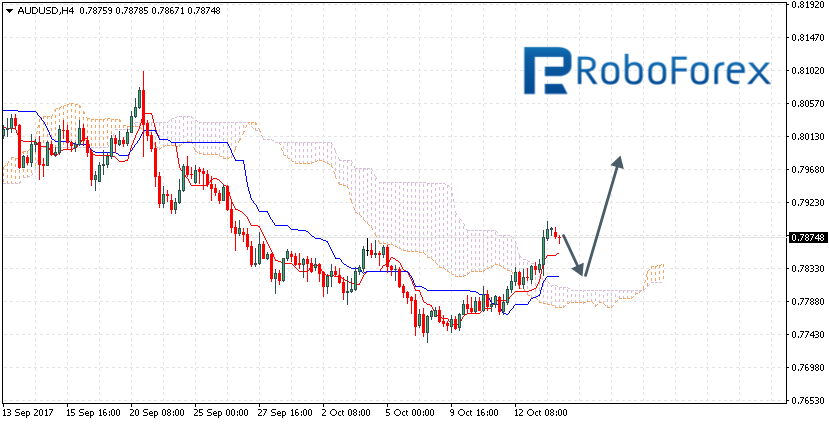
The AUD/USD pair is trading at 0.7874; the instrument is still moving above Ichimoku Cloud, which means that it may continue growing. We should expect the price to test Tenkan-Sen and Kijun-Sen at 0.7825 and continue moving upwards to reach 0.7985. However, the scenario that implies further growth may be cancelled if the price breaks the downside border of the cloud and fixes below 0.7755. In this case, the pair may continue falling towards 0.7640.


NZD USD, “New Zealand Dollar vs US Dollar”

The NZD/USD pair is trading at 0.7175; the instrument is still moving above Ichimoku Cloud, which means that it may continue growing. We should expect the price to test the upside border of the cloud at 0.7150 and then continue moving upwards to reach 0.7290. However, the scenario that implies further growth may be cancelled if the price breaks the downside border of the cloud and fixes below 0.7075. In this case, the pair may continue falling towards 0.6970.


USD CAD, “US Dollar vs Canadian Dollar”

The USD/CAD pair is trading at 1.2482; the instrument is still moving inside Ichimoku Cloud, which means that it is moving sideways. We should expect the price to test the upside border of the cloud at 1.2490 and then continue moving downwards to reach 1.2350. However, the scenario that implies further decline may be cancelled if the price breaks the upside border of the cloud and fixes above 1.2500. In this case, the pair may continue growing towards 1.2630.


RoboForex Analytical Department

Article By RoboForex.com

Attention!
Forecasts presented in this section only reflect the author’s private opinion and should not be considered as guidance for trading. RoboForex LP bears no responsibility for trading results based on trading recommendations described in these analytical reviews.