Author Archive for InvestMacro – Page 474

The Trump Administration’s IP Battle Against China

By Dan Steinbock

In recent weeks, friction between the White House and China has escalated in intellectual property. The question is, will it result in a global trade war.

In mid-August, President Trump asked U.S. Trade Representative Robert Lighthizer to open an investigation into China’s intellectual property (IP) practices. “This is just the beginning,” Trump told reporters.

In turn, Lighthizer, a veteran Reagan administration trade hawk, seized the notorious Section 301 of the Trade Act of 1974, which in the 1980s was used against the rise of Japan.

The investigation could lead to steep tariffs on Chinese goods – but it could also trigger a global trade war.

Contradictory views

Since the early 2010s – in parallel with the dramatic rise of Chinese innovation and outward direct investment – the Commission on the Theft of American Intellectual Property has argued that the plunder of American intellectual property is a systemic threat to the U.S. economy in which China has a central role. As US Commerce Secretary Wilbur Ross put it in the Financial Times last August: “American genius is under attack from China.”

According to the Commission, IP theft amounts anything between $225 billion and $600 billion annually in counterfeit goods, pirated software, and theft of trade secrets. While the Obama administration and Congress enhanced the policy mechanisms to mitigate IP theft, the Commission believes it is time to implement more “aggressive” policies to protect American IP.

While the Commission believes that the Chinese government “forces” US companies to relinquish its IP to China, U.S. IP experts that work on IP transactions in China find little evidence of such practices. What is more typical are transactions in which Chinese public companies and state-owned enterprises have pushed hard to get the other party – U.S., European and Japanese companies – to part with its IP for a low price. Foreign companies operating in China do not adequately protect their technology, or believe that partnerships automatically protect their technology. From the IP standpoint, many foreign companies, particularly SMEs and technology startups, do not appropriately understand IP risks, feel that they do not have other choices for financial reasons, or have misguided views of their IP protection.

In highly regulated and strategic industries, Chinese overview is more stringent but that applies to both Chinese and foreign companies. Conversely, Chinese companies have faced many barriers in the US in similar strategic areas, from CNOOC’s failed effort to buy US oil company Unocal (eventually acquired by US-based Chevron) to Huawei’s failed attempt to invest in America (which led to congressional hearings).

Interestingly, in contested legal cases, Chinese government has often supported foreign companies. As the Wall Street Journal reported last year, when foreign companies sue in Chinese courts, they typically win. From 2006 through 2014, foreign plaintiffs won more than 80% of their patent-infringement suits against Chinese companies, virtually the same rate as domestic plaintiffs.

In fact, it is a not-so-secret secret that for years foreign multinationals have been exchanging their technology expertise for market share in China (and several other large emerging economies). Semiconductors are a case in point. Reportedly, technology transfers increased significantly amid the global crisis in 2007-9, when Intel, which then made over 70% of its sales outside the US, opened a $2.5 billion wafer fabrication foundry in Dalian, northeast China. In contrast to simple assembly plants, these “fabs” represent the tech giant’s IP crown jewels. Unsurprisingly, the move attracted many other foreign technology companies to create a foothold in the mainland.

As the global crisis dragged major advanced economies into stagnation but China grew vigorously another half a decade, that bet proved very lucrative. At the time, Intel’s chairman was Craig Barrett, former CEO. Yet, today Barrett is one of the commissioners of the U.S. IP Commission who would like to challenge China’s IP practices.

Advocacy in the name of independence

The Trump administration has relied heavily on the IP Commission, which provides ammunition to its “First America” views. It has been portrayed as an independent actor in the IP debate. But that portrayal is not valid.

The IP Commission is co-chaired by Dennis Blair, former US Director of National Intelligence and Navy admiral who was commander of US forces in the Pacific; and Jon Huntsman, Trump’s current ambassador to Russia and former ambassador to China who left his post after a controversial appearance amid a planned pro-democracy protest in Beijing.

In addition to Intel’s Barrett, the Commissioners include veteran senator Slade Gorton whose focus is on economic and trade threats against America, from the “9/11 Commission” and the bipartisan Partnership for Secure America to the Slade Gorton International Policy Center funded by the National Bureau of Asian Research. The latter originates from the ‘70s, when the anti-communist Senator Henry M. Jackson, a hero of the neoconservatives, raised the need for what was initially called a “National Sino-Soviet Center.”

The IP commissioners also include former US Deputy Secretary of Defense William J. Lynn III, a longtime lobbyist of Raytheon, a major $25 billion US defense contractor that is focused on crushing China’s air defenses, among other things. In turn, Deborah Wince-Smith is President and CEO of the US Council on Competitiveness who swears in the name of “Made in America,” has criticized China-Canada free trade agreement and expects US to replace China as the leading global manufacturer by 2020. Finally, Michael K. Young, the President of Texas A&M University, is a Mormon official who served in President Bush’s US Commission on International Religious Freedom and remains an ardent advocate of religious freedom and global democracy.

Of course, the point is not that these members of the US Commission are not qualified. On the contrary, all are highly-regarded in their respective areas of expertise. Rather, the point is that the Commission is not an independent or a neutral broker. Rather, it is a highly partisan advocacy group for “America First” interests operating outside yet closely with the government.

Let’s be real: If President Xi Jinping would launch a Chinese IP Commission that Chinese media would portray as independent but which would be headed by a former admiral and intelligence director, an ex-Chinese U.S. ambassador, anti-U.S. leaders of China’s People’s Congress, contractors of the People’s Liberation Army, chiefs of Chinese competitiveness councils and the Communist Party’s leading theorists – well, perhaps U.S. observers might then make a point of possible moral hazards that may undermine independence and neutrality. Precisely the same applies to the U.S. IP Commission.

Certainly, a truly unbiased investigation into Chinese trade practices in the US and elsewhere would be highly welcome (as would be similar enquiries into US trade practices in China and elsewhere). But to foster credibility, such studies must be truly independent and neutral.

Historical timing of the IP debacle

On October 10, the first public hearing about Chinese trade conduct took place in Washington, D.C. Afterwards, Bloomberg reported the obvious: “Trump Is Warned His Intellectual-Property Probe Risks a Trade War With China.” Led by the U.S. Trade Representative, Office of Intellectual Property and Innovation, and the Council of Economic Advisers, the hearing involved four panels, which reflected IP, legal, business and union interests, along with the views of U.S. and Chinese think-tanks.

Unsurprisingly, government officials argued that “China’s IP theft” represents the “greatest transfer of wealth in history,” which was seconded by the IP Commission’s opinion of China as a “party state” in which “companies are afraid to report abuses.” In contrast, legal experts praised China for strides in “combating counterfeit products” suggesting that U.S. government views were “completely untrue.” Interestingly, business interests sought to push back aggressive claims of forced IP transfer.

The dissension illustrates a clash between facts, myths and ideological views on Chinese IP. Historically, the timing of the IP friction itself is relevant. More than a decade ago, I predicted in the National Interest that the then- conventional wisdom that China would remain “world’s factory” was a myth. Emerging Chinese multinationals were “no longer satisfied with imitating. Instead, they seek to convert cost advantages to more sustainable competitive advantages – often through innovation.”

Unsurprisingly, the current IP debacle is escalating at a historical moment when Chinese companies are beginning to compete among world-class leaders, cutting-edge innovation and lucrative brands. The shift is reflected by increasingly global struggle for innovation. According to the number of total patent applications, China’s role exploded since mid-2000s. Two decades ago, it was still far behind the US, Japan, South Korea and Germany; the world’s leading patent players. Now it is ahead of all of them (Figure 1).

Figure 1 Total Patent Applications, 1985-2014 (WIPO)


But in these rivalries, not all patents are of equal value. The so-called triadic patents, which are registered in the US, EU, and Japan to protect the same invention, tend to be the most valuable. In triadic patents, too, China’s patent power has increased dramatically and is about to surpass that of Korea and Germany. The patents of Japan and the US peaked around 2005-6. Despite some progress, US patents are still 15% below their peak, whereas those of China increased more than sixfold in the past decade (Figure 2).

Figure 2 Triadic Patent Families, 1985-2014 (OECD)


Now, since patent competition is accumulative, catch-up requires time. But here’s the thing. Yet, the trend line is clear: If, for instance, US and Chinese triadic patents would increase in the future as they have in the past five years – which is likely because, despite growth deceleration, Beijing is accelerating the economy’s rebalancing from investment and exports to innovation and consumption – China is likely to surpass the US by the late 2020s. And perhaps that’s why Trump is targeting China’s IP today.

Not surprisingly, some US observers suspect that the Trump administration’s IP investigation is less a scrutiny of forced technology transfers than a negotiation ploy to start bargaining from a more favorable starting-point. That’s typical to Trump’s tactics, as spelled out in his Art of the Deal (1987). But it is also a Pandora’s Box that can undermine progress in US-Chinese trade and further penalize global growth prospects.

In fact, much of China’s IP progress can be explained on the basis of past technology transfer and the government’s high investment in science and technology. Moreover, as Chinese companies have rapidly moved up the value-added chain, they have begun to emphasize the need for IP protection.

Indeed, the Trump administration could achieve far more in innovation by steering greater investment into new and emerging technologies in the U.S. than penalizing China for its progress.

About the Author:

Dr Dan Steinbock is the founder of Difference Group and has served as research director at the India, China and America Institute (USA) and visiting fellow at the Shanghai Institutes for International Studies (China) and the EU Center (Singapore). For more, see https://www.differencegroup.net/ 

A slightly shorter version of this commentary was originally released by the Georgetown Journal of International Affairs on November 14, 2017
 

Fibonacci Retracements Analysis 14.11.2017 (EUR/USD, USD/JPY)

Article By RoboForex.com

EUR USD, “Euro vs US Dollar”

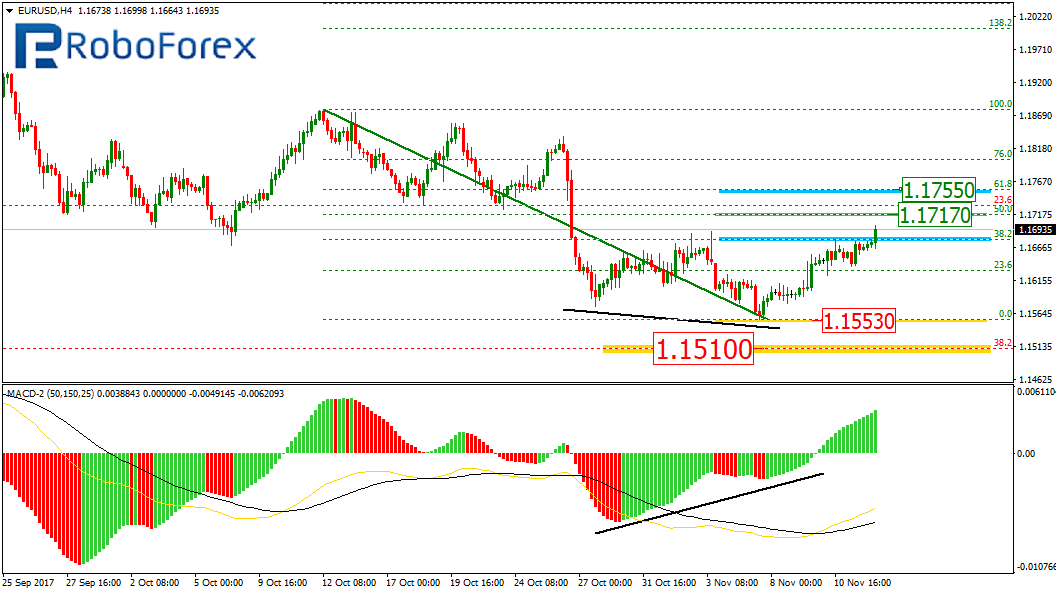
As we can see at the H4 chart, the EUR/USD pair is still being corrected to the upside and has already reached the retracement of 38.2%. The next targets may be the retracements of 50.0% and 61.8% at 1.1717 and 1.1755 respectively. We should note that the downtrend may yet continue; its closest target may be the retracement of 38.2% at 1.1510, but only after the pair breaks the local low at 1.1553.

EURUSD1

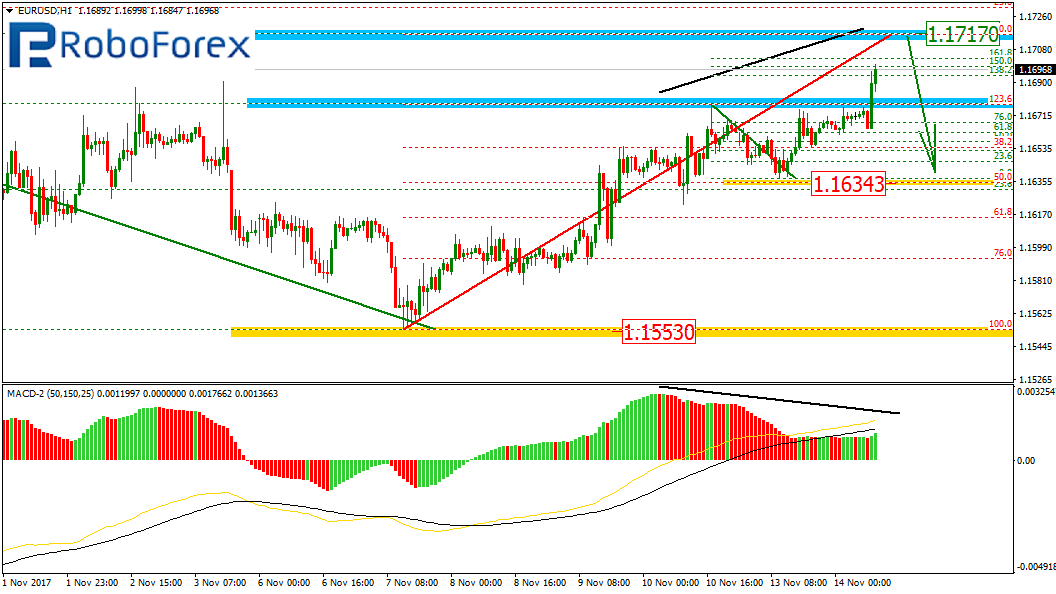
At the H1 chart, the short-term uptrend continues towards 1.1717. The pair has already reached the post-correctional extension area between the retracements of 138.2% and 161.8%. At the same time, the divergence that is being formed may indicate a possible pullback towards the retracement 50.0% at 1.1634.

EURUSD2


USD JPY, “US Dollar vs. Japanese Yen”

As we can see at the H4 chart, the USD/JPY pair has started a new correction, which has already reached the retracement of 50.0%. The current movement may be described as the start of a new ascending impulse. The closest targets may be inside the post-correctional extension area between the retracements of 138.2% and 161.8% at 115.34 and 115.75 respectively. In the nearest future, the upside targets may be the retracements of 61.8% and 76.0% at 114.11 and 114.33 respectively. A further mid-term decline is also possible. Its target may be at 112.83.

USDJPY1

At the H1 chart, the situation is similar and confirms the scenario described above.

USDJPY2


RoboForex Analytical Department

Article By RoboForex.com

Attention!
Forecasts presented in this section only reflect the author’s private opinion and should not be considered as guidance for trading. RoboForex LP bears no responsibility for trading results based on trading recommendations described in these analytical reviews.

EURUSD: high volatility expected due to a busy day of economic events

By Gabriel Ojimadu, Alpari

Previous:

On Monday the 13th of November, trading on the euro/dollar pair closed 11 pips up. The euro dropped during the first half of the day before going on to mount a recovery. The rebound from the low of 1.1637 was partially down to growth on the euro crosses. The biggest mover among these in terms of growth was the euro/pound cross.

The euro bulls took advantage of the pound’s weakness, which came under pressure over developments in the UK. It was revealed that some members of the ruling Conservative Party were preparing a vote of no confidence in Prime Minister Theresa May. The euro, as a result, rose against the dollar to 1.1675 before stabilising around the 1.1665 mark.

Day’s news (GMT+3):

  • 10:00 Germany: harmonised index of consumer prices (Oct), GDP (Q3).
  • 11:15 Switzerland: producer and import prices (Oct).
  • 12:00 Eurozone: ECB’s Lautenschläger Speech.
  • 12:30 UK: CPI (Oct), retail price index (Oct), PPI input (Oct), PPI output (Oct).
  • 13:00 Eurozone: GDP (Q3), industrial production (Sep), ZEW survey – economic sentiment (Nov).
  • 13:00 Germany: ZEW survey – economic sentiment (Nov).
  • 13:00 Japan: BoJ governor Kuroda speech.
  • 16:15 USA: FOMC member  Bullard’s speech.
  • 16:30 USA: PPI (Oct).
  • 16:30 Eurozone: ECB’s Cœuré Speech.
  • 20:30 UK: MPC member Cunliffe speech.

Fig 1. EURUSD rate on the hourly. Source: TradingView

The LB balance line along with the rising crosses held sellers up at 1.1640. By the end of the day, buyers had recovered their losses and ended the day slightly up. With an empty economic calendar, growth was limited. The price stalled as it reached the upper boundary of the A-A channel and entered a correctional phase.

Given the number of economic events scheduled for today, I’m not going to make a forecast as volatility is expected to be high. The most awaited of these events among traders are the preliminary GDP figures from the Eurozone and Germany and well as speeches from the heads of central banks at a conference organised by the ECB in Frankfurt. Among the key speakers are Mario Draghi, Janet Yellen, Haruhiko Kuroda, and Mark Carney.

Yesterday, I gave you a technical view of the euro. According to the pricing model, it’s set to undergo a sharp increase, meaning that it should rise against the dollar to exit the A-A channel. Hourly indicators on the euro index contradict this picture. Today’s news should resolve this conflict.

I’ve decided not to make a forecast given that news items can render any kind of technical signal irrelevant. Moreover, there is a lot of news expected today. To those who have stayed in the market, I wish the best of luck in weathering today’s major developments. To anyone who isn’t currently in the market, I advise remaining on the sidelines for today.

The US Dollar Doesn’t Like Talks About The Rate

Author: Dmitriy Gurkovskiy, Chief Analyst at RoboForex

Despite being pretty clear and logical, talks about the benchmark key rate increase in the USA in December are “haunting” some monetary politicians and investors. These doubts, which were mentioned in Patrick Harker’s comments below, put pressure upon the “sensitive” USD.

Not long time ago, the FOMC member Patrick Harker said that one should be very careful when estimating the USA inflation and the Federal Reserve had to be ready for any stresses and shocks in the economy. Nevertheless, Harker said he would support the key rate increase next month, although he thought that the necessity in the rate hike had been decreasing recently.

He’s not the first American monetary politician to say that inflation risks may be a reason to postpone the key rate hike. In September 2017, the CPI in the USA expanded up to 2.2% y/y and by 0.5% m/m. The last time the indicator improved in the similar way was in January. Between January and September, the inflation growth varied from 0.09% m/m (May and June) to 0.30% m/m. There was even the deflation in July, when the CPI lost 0.07% m/m.

One should admit that the indicator is rather unstable. However, the Fed’s target is at 2% and from this point of view, the index is doing well. “Mood swings” relating to the key rate increase will affect the US Dollar until the regulator’s meeting scheduled for December is over.

The USD perspectives are better seen at the EUR/USD pair chart. From the technical point of view, the downtrend continues. The pair is trading to test the upside border of the current channel and, as a result, may break it and move beyond 1.1690. The uptrend may continue if the price reaches 1.1840, which is the upside border of the projected channel.

Attention!

Forecasts presented in this section only reflect the author’s private opinion and should not be considered as guidance for trading. RoboForex bears no responsibility for trading results based on trading recommendations described in these analytical reviews.


EUR/USD: Long for 1.1960

By GrowthAces.com

Macroeconomic overview:

  • The euro rose to a more than two-week high on Tuesday as investors resumed buying risky assets in Europe on growing expectations that economic growth will remain strong against a backdrop of record low interest rates.
  • Eurostat confirmed that the Eurozone economy advanced 0.6% on quarter in the three months to September of 2017, in line with market expectations and following 0.7% growth in the previous period.
  • The mood among German investors improved further in November, a survey showed on Tuesday, suggesting that markets expect Europe’s biggest economy to continue its solid upswing in coming months. The Mannheim-based ZEW research institute said its monthly survey showed its economic sentiment index rose to 18.7 from 17.6 in October. This undershot market consensus forecast for an increase to 20.0. A separate gauge measuring investors’ assessment of the economy’s current conditions shot up to 88.8 from 87.0 last month. This compared with the market consensus forecast predicting an increase to 88.0.
  • Also in focus, European Central Bank chief Mario Draghi, Federal Reserve Chair Janet Yellen, Bank of Japan Governor Haruhiko Kuroda and Bank of England head Mark Carney will form a panel on central bank communication at an ECB-hosted conference in Frankfurt on Tuesday.

Technical analysis and trading signals:

  • A drop below 50% fibo of June-September rise (1.1605) was not continued. The rejection of the downward move is a bullish signal. The EUR/USD remains supported above the daily cloud, spanning 1.1654/1.1633. A break of 21-dma at 1.1685 is encouraging for EUR/USD bulls. If it closes above this level today, the next target could be Ichi cloud base at 1.1816.
  • Our short position was stopped today and we have switched to long, which is in line with our fundamental view. We see also technical arguments for continuation of upward move.

EURUSD Daily Forex Signals Chart


EUR/GBP supported by lower-than-expected British CPI reading

Macroeconomic overview:

  • British inflation held at its highest level in five-and-a-half years in October, and wrong-footed expectations from the Bank of England that it would hit a new peak.
  • Consumer price inflation held at an annual rate of 3.0% in October, the Office for National Statistics said, below market average expectation for a 3.1% annual rise.
  • The BoE said this month, after it raised interest rates for the first time in a decade, that inflation would probably peak at 3.2% in October and then fall slowly to just above its 2% target in three years’ time.
  • Tuesday’s figures are likely to reinforce doubts about the wisdom of the BoE’s decision to raise rates at a time when the economy is sluggish, especially as the effect of last year’s Brexit vote on import prices was already at its high point.
  • BoE Governor Mark Carney has said the overshoot of the 2% target was due to the effect of the more than 10% fall in the pound after last year’s Brexit vote pushing up the price of imported goods.
  • British inflation surged from a subdued 0.5% at the time of the Brexit vote in June 2016 to its highest since April 2012 in September.
  • The Office for National Statistics said October’s steady reading reflected falls in fuel prices being offset by a higher cost of food.
  • The alternative measure of retail price inflation, which is used to calculate payments on government bonds and many commercial contracts, rose to a near six-year high of 4.0% – bad news for finance minister Philip Hammond as he prepares an annual budget due on November 22.
  • However, the failure of consumer price inflation to exceed 3% means Carney will be spared a legal duty of having to write a letter to Hammond alongside next month’s rate decision, explaining why inflation is more than a percentage point above target.
  • Costs of manufacturers’ raw materials – much of them imported – were 4.6% higher than in October 2016, down from an inflation rate of 8.1% in September. The market had expected a fall to 4.8%.
  • Sterling slipped to its lowest in almost three weeks against the euro on Tuesday, while Britain’s main FTSE 100 stock index jumped to a session high, after UK inflation data came in slightly weaker than expected.

Technical analysis and trading signals:

  • The EUR/GBP broke above 55-dma at 0.8920 and the daily cloud base at 0.8928 today. A sustained move into the cloud targets the cloud top at 0.9027. Daily slow stochs are near OB territory but the bulls show no sign of letting up just yet.
  • We have raised our bid to 0.8915.

EURGBP Daily Forex Signals Chart

VIP Traders Club members should expect to receive forex and precious metals trading signals updates at least twice a day. We will send you:

  1. Buy and sell forex, precious metals signals (entry level, target, stop-loss)
  2. Suggested position size that you can easily adjust to your trading account size – this would help you in risk management and you will survive longer drawdown periods
  3. Early heads-up about the potential trading opportunities or rationale to taken positions ( fundamental analysis, technical analysis )
  4. Forecasts of most important macroeconomic indicators prepared by our economists and econometricians.

JOIN VIP TRADERS CLUB – TRIAL MONTH FOR $1 NOW

About the Author:

By GrowthAces.com – Daily Forex Trading Strategies


Forex Technical Analysis & Forecast 14.11.2017 (EUR/USD, GBP/USD, USD/CHF, USD/JPY, AUD/USD, USD/RUB, GOLD, BRENT)

Article By RoboForex.com

EUR USD, “Euro vs US Dollar”

The EUR/USD pair is consolidating at the top of the ascending structure. We think, today the price may continue forming the descending wave towards 1.1530. An alternative scenario implies that the instrument may try to break the range upwards to reach 1.1703. Later, in our opinion, the market may continue falling inside the downtrend to reach 1.1530.

EURUSD


GBP USD, “Great Britain Pound vs US Dollar”

The GBP/USD pair is consolidating around 1.3106. Possibly, today the price may continue falling inside the downtrend with the target at 1.2993.

GBPUSD


USD CHF, “US Dollar vs Swiss Franc”

The USD/CHF pair is consolidating in the center of the range; right now, it is moving upwards with the target at 0.9992. After that, the instrument may fall towards 0.9955 and then start another growth to reach 1.0070.

USDCHF


USD JPY, “US Dollar vs Japanese Yen”

The USD/JPY pair is moving upwards to reach 114.00. Later, in our opinion, the market may fall towards 113.50 or even 113.00. Later, in our opinion, the market may resume growing inside the uptrend to reach 115.00.

USDJPY


AUD USD, “Australian Dollar vs US Dollar”

The AUD/USD pair has reached the predicted target of the descending wave. Possibly, today the price may grow to reach 0.7661. After that, the instrument may start another decline towards 0.7593 and then resume moving upwards to reach 0.7750.

AUDUSD


USD RUB, “US Dollar vs Russian Ruble”

The USD/RUB pair is consolidating at the top of the ascending wave. If later the instrument breaks this range to the upside, the market may grow towards 60.21; if to the downside – continue the correction to reach 58.30.

USDRUB


XAU USD, “Gold vs US Dollar”

Gold is trading to rebound from 1279 downwards. We think, today the price may reach 1268 and then start another decline with the target at 1250.

GOLD


BRENT

Brent is moving downwards. Possibly, the price may reach 62.10 and then grow with the target at 64.00. If later the instrument breaks this range to the upside, the market may start another wave to reach 66.75; if to the downside – continue the correction towards 61.00.


BRENT


RoboForex Analytical Department

Article By RoboForex.com

Attention!
Forecasts presented in this section only reflect the author’s private opinion and should not be considered as guidance for trading. RoboForex LP bears no responsibility for trading results based on trading recommendations described in these analytical reviews.

COT Report: USD bets continue to improve. WTI,10YR,Gold & Silver bets rise

By CountingPips.com – Receive our weekly COT Reports by Email

Here is a short summary and this week’s links (below) to the latest Commitment of Traders changes.

-FX Speculators continued to trim US Dollar bearish positions for 6th straight week

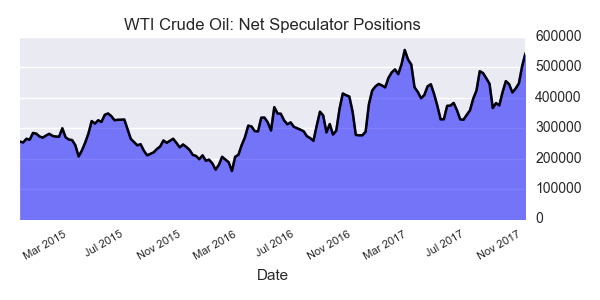
WTI Crude Oil Speculators sharply lifted bullish bets for 4th week

10-Year Note Speculators bullish bets rebounded this week

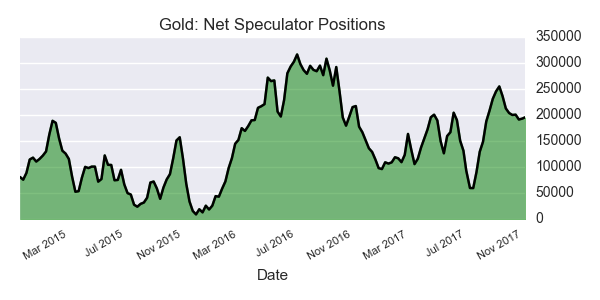
Gold Speculators raised bullish net positions for 2nd week

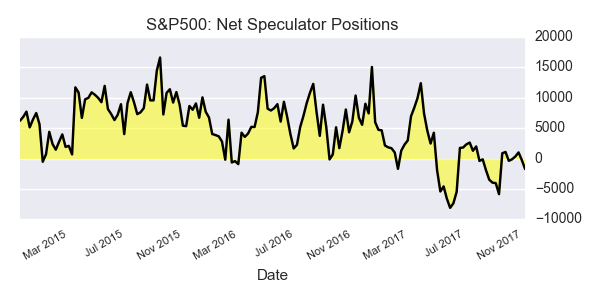
S&P500 Speculators raised their bearish net positions

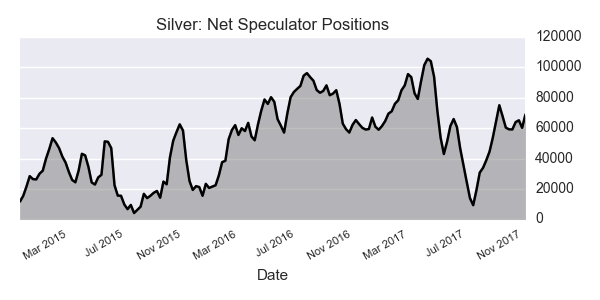
Silver Speculators boosted their bullish bets to 8 week high

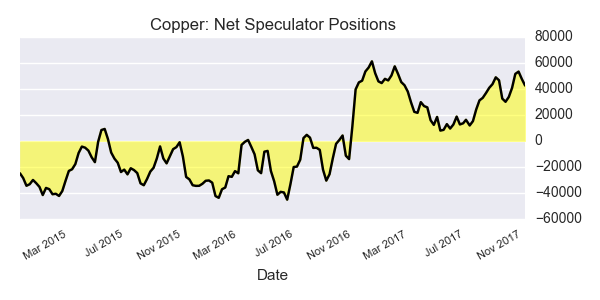
Copper Speculators cut back on bullish bets for 2nd week


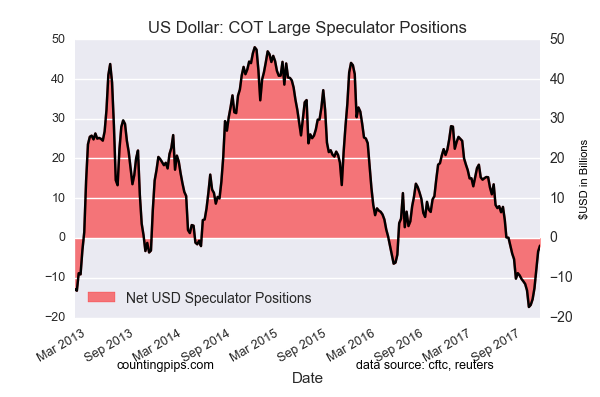
Currency Speculators improved US Dollar positions for 6th straight week

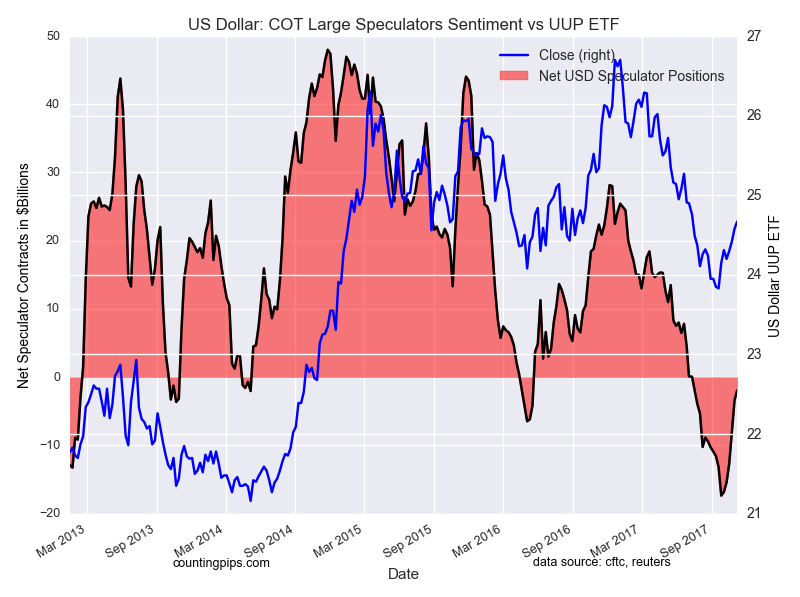
US Dollar net speculator positions leveled at $-1.92 billion as of Tuesday

The latest data for the weekly Commitment of Traders (COT) report, released by the Commodity Futures Trading Commission (CFTC) on Monday due to the Veteran’s Day holiday, showed that large traders and currency speculators continued to trim their bearish bets of the US dollar last week. See full article


WTI Crude Oil Speculators sharply increased bullish bets for 4th week

The non-commercial contracts of WTI crude futures totaled a net position of 545,206 contracts, according to data from this week. This was a lift of 42,257 contracts from the previous weekly total. See full article


Gold Speculators advanced their bullish net positions for 2nd week

The large speculator contracts of gold futures totaled a net position of 195,790 contracts. This was a weekly advance of 2,695 contracts from the previous week. See full article


10-Year Note Speculators net positions rebounded last week

The large speculator contracts of 10-year treasury note futures totaled a net position of 50,063 contracts. This was a weekly increase of 47,339 contracts from the previous week. See full article


S&P500 Speculators increased net short positions this week

The large speculator contracts of S&P 500 futures totaled a net position of -1,725 contracts. This was a decrease of -1,477 contracts from the reported data of the previous week. See full article


Silver Speculators boosted net positions to best level in 8 weeks

The non-commercial contracts of silver futures totaled a net position of 68,902 contracts, according to data from this week. This was a weekly gain of 8,750 contracts from the previous totals. See full article


Copper Speculators lowered their net positions for 2nd week

The large speculator contracts of copper futures totaled a net position of 42,575 contracts. This was a weekly shortfall of -5,018 contracts from the data of the previous week. See full article


Article by CountingPips.com

The Commitment of Traders report data is published in raw form every Friday by the Commodity Futures Trading Commission (CFTC) and shows the futures positions of market participants as of the previous Tuesday (data is reported 3 days behind).

To learn more about this data please visit the CFTC website at http://www.cftc.gov/MarketReports/CommitmentsofTraders/index.htm


Currency Speculators improved US Dollar positions for 6th straight week

By CountingPips.comGet our weekly COT Reports by Email

US Dollar net speculator positions leveled at $-1.92 billion this week

The latest data for the weekly Commitment of Traders (COT) report, released by the Commodity Futures Trading Commission (CFTC) on Monday due to the Veteran’s Day holiday, showed that large traders and currency speculators continued to trim their bearish bets of the US dollar last week.

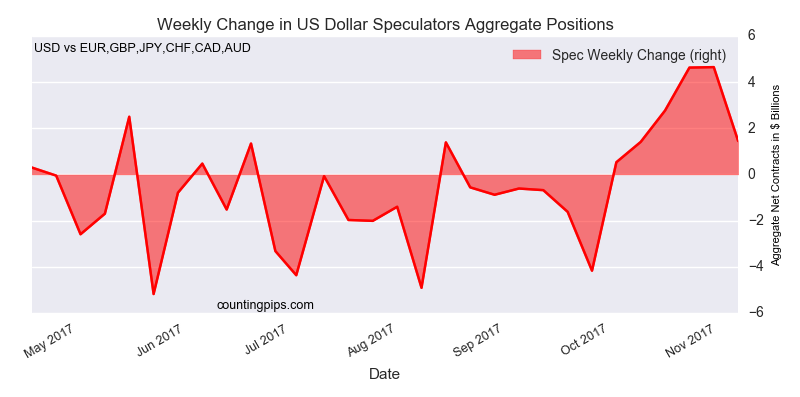
Non-commercial large futures traders, including hedge funds and large speculators, had an overall US dollar net position totaling $-1.92 billion as of Tuesday November 7th, according to the latest data from the CFTC and dollar amount calculations by Reuters. This was a weekly rise of $1.45 billion from the $-3.37 billion total position that was registered the previous week, according to the Reuters calculation (totals of the US dollar contracts against the combined contracts of the euro, British pound, Japanese yen, Australian dollar, Canadian dollar and the Swiss franc).

Speculative positions have improved for the dollar for six straight weeks and the bearish level is at the smallest standing since July 18th when the aggregate position totaled $-1.91 billion.


Weekly Speculator Contract Changes:

The individual major currencies saw two weekly changes above the (+ or -) 10,000 contract mark this week in the speculators category.

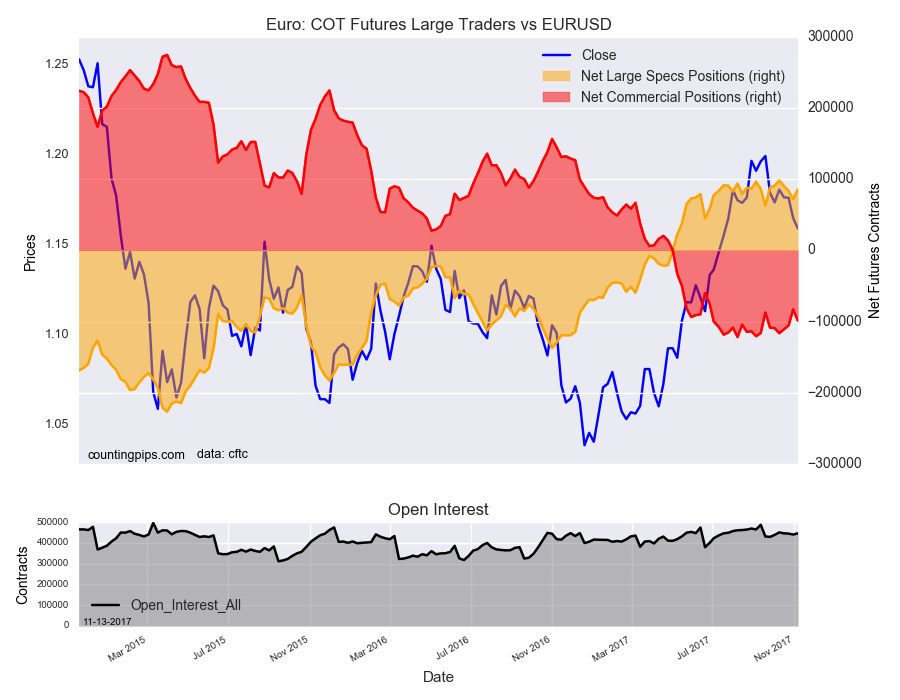
* Euro positions rose by over +13,000 contracts this week after positions had declined for three straight weeks. The EUR speculative bets are back above the +80,000 contract level and in the highest position in three weeks.

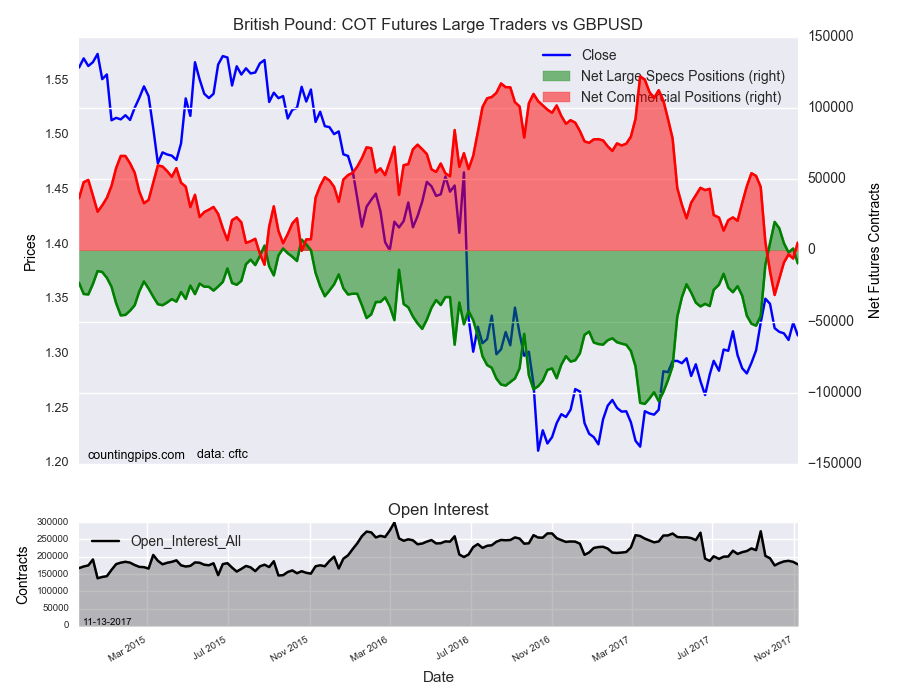
* British pound sterling positions, meanwhile, dropped by over -10,000 contracts and fell into an overall bearish position last week after a week in a net bullish standing. GBP bearish positions are now at their lowest position since September 19th when contracts were at -10,161 contracts.

Overall, the major currencies that improved against the US dollar this week were the euro (13,358 weekly change in contracts) and the Mexican peso (1,729 contracts).

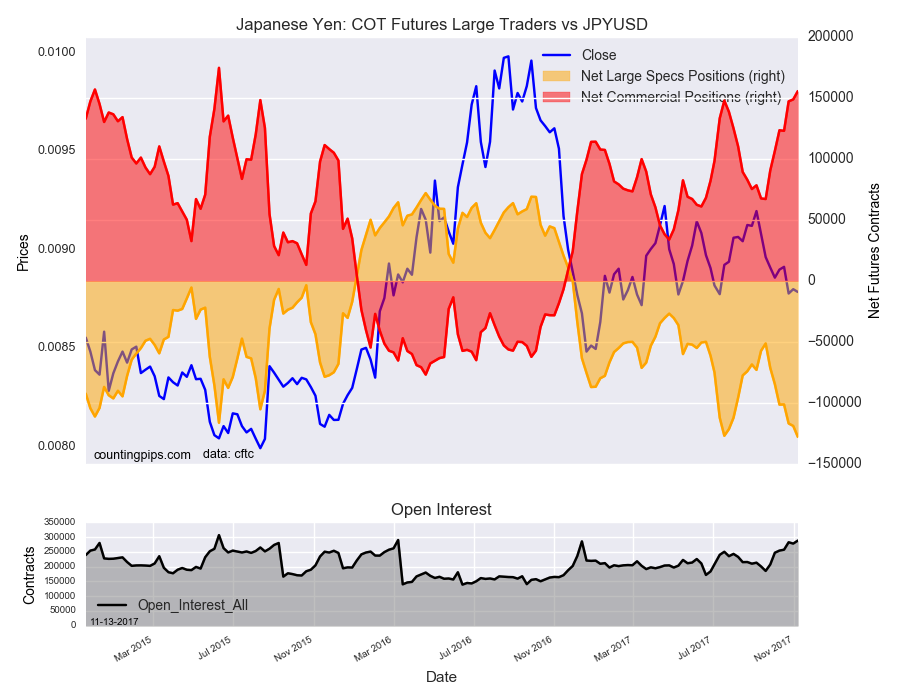
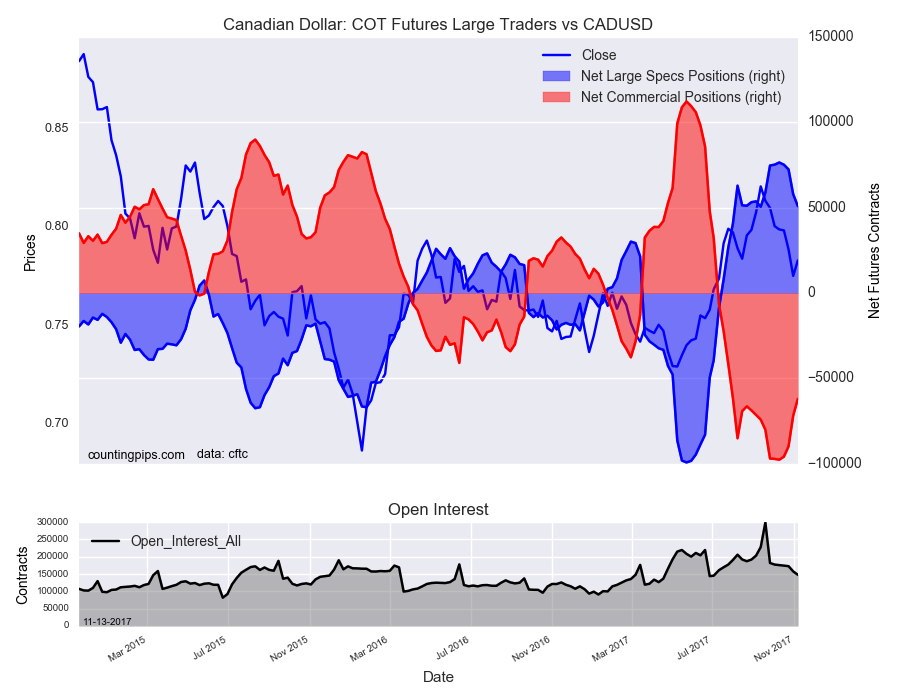
The currencies whose speculative bets declined this week versus the dollar were the British pound sterling (-10,443 weekly change in contracts), Japanese yen (-8,979 contracts), Swiss franc (-4,439 contracts), Canadian dollar (-6,950 contracts), Australian dollar (-6,171 contracts) and the New Zealand dollar (-5,480 contracts).


Table of Weekly Commercial Traders and Speculators Levels & Changes:

CurrencyNet CommercialsComms Weekly ChgNet SpeculatorsSpecs Weekly Chg
EuroFx-98,828-15,69685,45513,358
GBP5,49311,269-9,198-10,443
JPY155,4086,791-127,848-8,979
CHF44,5726,752-25,110-4,439
CAD-61,9419,83750,889-6,950
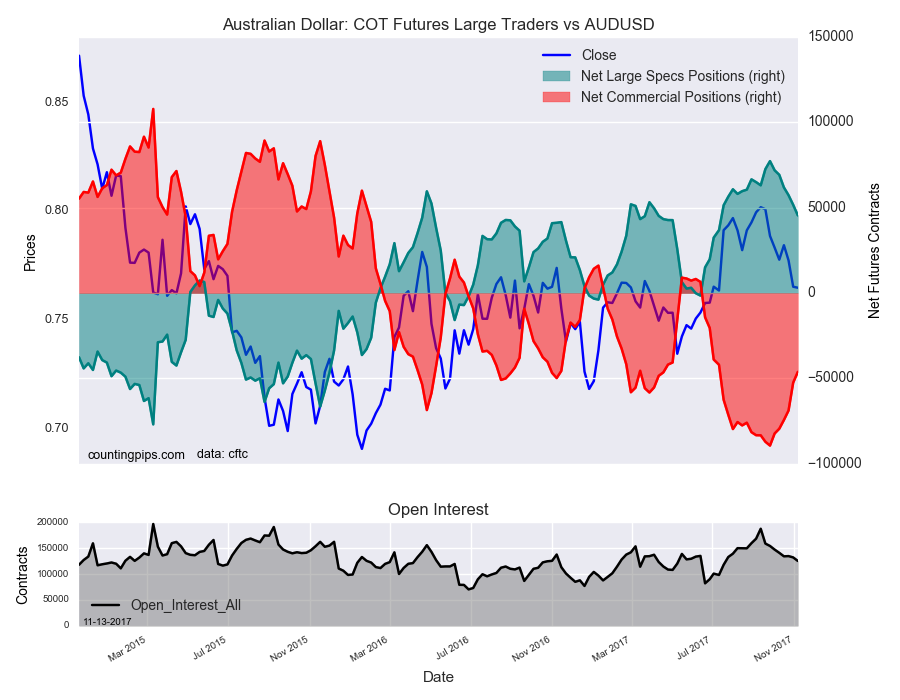
AUD-46,1346,30945,437-6,171
NZD12,7235,263-11,187-5,480
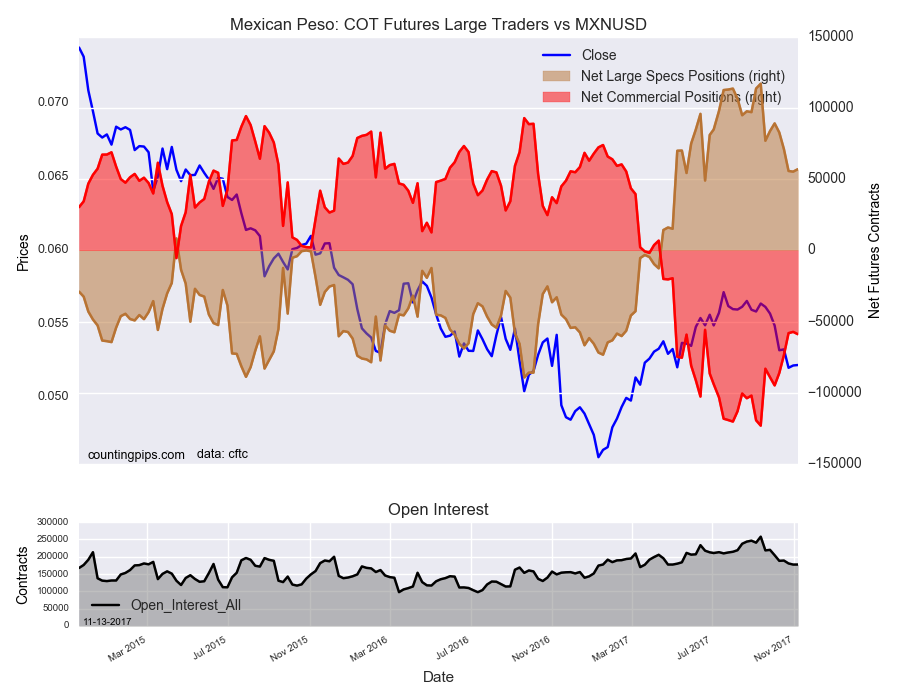
MXN-58,907-1,63356,9751,729


This latest COT data is through Tuesday and shows a quick view of how large speculators or non-commercials (for-profit traders) as well as the commercial traders (hedgers & traders for business purposes) were positioned in the futures markets. All currency positions are in direct relation to the US dollar where, for example, a bet for the euro is a bet that the euro will rise versus the dollar while a bet against the euro will be a bet that the dollar will gain versus the euro.


Weekly Charts: Large Trader Weekly Positions vs Price

EuroFX:


British Pound Sterling:


Japanese Yen:


Swiss Franc:


Canadian Dollar:


Australian Dollar:


New Zealand Dollar:


Mexican Peso:

*COT Report: The weekly commitment of traders report summarizes the total trader positions for open contracts in the futures trading markets. The CFTC categorizes trader positions according to commercial hedgers (traders who use futures contracts for hedging as part of the business), non-commercials (large traders who speculate to realize trading profits) and nonreportable traders (usually small traders/speculators). Find CFTC criteria here: (http://www.cftc.gov/MarketReports/CommitmentsofTraders/ExplanatoryNotes/index.htm).

The Commitment of Traders report is published every Friday by the Commodity Futures Trading Commission (CFTC) and shows futures positions data that was reported as of the previous Tuesday (3 days behind).

Each currency contract is a quote for that currency directly against the U.S. dollar, a net short amount of contracts means that more speculators are betting that currency to fall against the dollar and a net long position expect that currency to rise versus the dollar.

(The charts overlay the forex closing price of each Tuesday when COT trader positions are reported for each corresponding spot currency pair.) See more information and explanation on the weekly COT report from the CFTC website.

Article by CountingPips.com


WTI Crude Oil Speculators sharply increased bullish bets for 4th week

By CountingPips.comReceive our weekly COT Reports by Email

WTI Crude Oil Non-Commercial Speculator Positions:

Large oil speculators continued to boost their bullish net positions in the WTI Crude Oil futures markets this week, according to the latest Commitment of Traders (COT) data released by the Commodity Futures Trading Commission (CFTC) on Monday due to the Veteran’s Day holiday.

The non-commercial futures contracts of WTI Crude Oil futures, traded by large speculators and hedge funds, totaled a net position of 545,206 contracts in the data reported through Tuesday November 7th. This was a weekly advance of 42,257 contracts from the previous week which had a total of 502,949 net contracts.

Speculative positions have now risen by +98,379 net contracts in just the past two weeks and by a total of +128,145 net contracts in the past four weeks. The current net position of 545,206 contracts is the second highest level of all time after the 556,607 net contracts that was recorded on February 21st of this year.

WTI Crude Oil Commercial Positions:

The commercial traders position, hedgers or traders engaged in buying and selling for business purposes, totaled a net position of -551,407 contracts on the week. This was a weekly fall of -48,533 contracts from the total net of -502,874 contracts reported the previous week.

USO:

Over the same weekly reporting time-frame, from Tuesday to Tuesday, the USO Crude Oil ETF, which tracks the price of WTI crude oil, closed at approximately $11.49 which was a boost of $0.56 from the previous close of $10.93, according to unofficial market data.

*COT Report: The COT data, released weekly to the public each Friday, is updated through the most recent Tuesday (data is 3 days old) and shows a quick view of how large speculators or non-commercials (for-profit traders) as well as the commercial traders (hedgers & traders for business purposes) were positioned in the futures markets. The CFTC categorizes trader positions according to commercial hedgers (traders who use futures contracts for hedging as part of the business), non-commercials (large traders who speculate to realize trading profits) and nonreportable traders (usually small traders/speculators). Find CFTC criteria here: (http://www.cftc.gov/MarketReports/CommitmentsofTraders/ExplanatoryNotes/index.htm).

Article By CountingPips.comReceive our weekly COT Reports by Email

10-Year Note Speculators net positions rebounded last week

By CountingPips.comReceive our weekly COT Reports by Email

10-Year Note Non-Commercial Speculator Positions:

Large treasury speculators boosted their net positions in the 10-Year Note futures markets last week following a deep decline the previous week, according to the latest Commitment of Traders (COT) data released by the Commodity Futures Trading Commission (CFTC) on Monday due to the Veteran’s Day holiday.

The non-commercial futures contracts of 10-Year Note futures, traded by large speculators and hedge funds, totaled a net position of 50,063 contracts in the data reported through Tuesday November 7th. This was a weekly lift of 47,339 contracts from the previous week which had a total of 2,724 net contracts.

Speculative positions had dropped by -150,873 contracts the previous week before rebounding last week while the net bullish level remains under the +100,000 standing for a second week.

10-Year Note Commercial Positions:

The commercial traders position, hedgers or traders engaged in buying and selling for business purposes, totaled a net position of 195,713 contracts on the week. This was a weekly decrease of -59,360 contracts from the total net of 255,073 contracts reported the previous week.

IEF ETF:

Over the same weekly reporting time-frame, from Tuesday to Tuesday, the 7-10 Year Treasury Bond ETF (IEF) closed at approximately $106.55 which was a rise of $0.55 from the previous close of $106.00, according to unofficial market data.

*COT Report: The COT data, released weekly to the public each Friday, is updated through the most recent Tuesday (data is 3 days old) and shows a quick view of how large speculators or non-commercials (for-profit traders) as well as the commercial traders (hedgers & traders for business purposes) were positioned in the futures markets. The CFTC categorizes trader positions according to commercial hedgers (traders who use futures contracts for hedging as part of the business), non-commercials (large traders who speculate to realize trading profits) and nonreportable traders (usually small traders/speculators). Find CFTC criteria here: (http://www.cftc.gov/MarketReports/CommitmentsofTraders/ExplanatoryNotes/index.htm).

Article By CountingPips.comReceive our weekly COT Reports by Email