Author Archive for InvestMacro – Page 458

Eclipse of US Free-Trade Legacy in Americas and Asia Pacific

By Dan Steinbock

Recently, all major US free trade deals in North America, Latin America and Asia Pacific have fallen under fire. As American legacy in free trade is dimming, there is a new opportunity for real free trade in Asia Pacific.

Recently, Canadian Prime Minister Justin Trudeau concluded a visit to China. The joint talks about a free trade pact began over a year ago. As Trudeau left Beijing, Western media headlined “Trudeau leaves China empty-handed,” while Chinese Foreign Ministry said that “both China and Canada showed willingness to negotiate and sign a free trade agreement.”

In reality, the world of free trade is now in the kind of flux that has not been since the post-1945 era.

If the US withdraws from the North American Free Trade Agreement (NAFTA), that would start a six-month legal process before official termination. While President Trump may see this as a negotiating tool to force Canada and Mexico to accept its demands, the latter may use the time to complete trade talks with Brazil and the European Union (EU).

After the fifth round of NAFTA talks ended amid simmering tensions, Canada and Mexico are hedging their bets against a potential NAFTA collapse by pushing for deals with new partners, particularly with China and other Asian countries.

The rise and fall of NAFTA

NAFTA is not just another free-trade agreement. It is America’s post-Cold War blueprint for other free traded agreements (FTAs). It came into force in 1994, amid the globalization boom. Despite fanfares, the key leaders faced a brutal aftermath.

President Bill Clinton’s alleged abuses of public power led to a special counsel in the 1990s. After Prime Minister Brian Mulroney was blamed for fraud by the Canadian Justice Department, he won an out-of-court settlement but reportedly neglected to inform the courts about payments that could have affected the settlement. Mexico’s President Carlos Salinas was appointed WTO’s Director-General and left Mexico as his brothers were prosecuted in a multimillion dollar fraud case; his older brother, a figure in cocaine cartel trade, was convicted for murder; the younger brother was found dead with a plastic bag strapped around his head.

In public, NAFTA was promoted as a receipt for regional success in the US, Canada, and Mexico. Yet, its record has proved mixed. While the agreement has benefited consumers in three countries, it has also contributed to investment outflows, unemployment and offshoring.

Recently, US officials have sought to subdue NAFTA tensions by extending the timetable for renegotiations but that has just poured oil on the simmering fire. In Mexico, tight elections in mid-2018 will complicate the NAFTA talks; in Canada, conservatives are positioning for 2019 elections.

The rise and fall of FTAA

Yet, in the 1990s, Washington’s trade bureaucrats embraced the NAFTA as a blueprint that could be expanded and extended elsewhere. The proposed Free Trade Agreement of the Americas (FTAA) was the first case in point.

Venezuela’s Hugo Chavez condemned the FTAA as a “tool of imperialism.” However, Latin America’s leaders, including then presidents of Brazil, Luiz Inácio Lula da Silva, and Argentina, Néstor Kirchner, did not oppose the FTAA but demanded the pact to eliminate US agriculture subsidies, effective access to foreign (read: US) markets and consideration towards their member states’ needs.

In contrast, Washington sought to extend NAFTA with non-trade-related concessions through the FTAA. Instead of opening South America to free trade, the FTAA split the region into two blocs, as President Lula had predicted.

Historically, the TPP was déjà vu all over again. Not only did it split Asia Pacific; it also divided the United States from within.

The rise and fall of TPP

As he had pledged in the campaign trail, Trump killed the Trans-Pacific Partnership (TPP), President Obama’s legacy deal, during his first day in office. But the move did not come out of the blue.

Through the Cold War, most Americans still believed in international engagements, which had bipartisan support in Washington. After the Cold War, Americans have grown more skeptical, even hostile to international commitments.

Historically, the TPP originated from a 2005 free trade deal among Brunei, Chile, New Zealand and Singapore. Its original version had more economic, transparent and inclusive foundations. After 2010, Washington began to lead talks for a significantly expanded FTA, which reflected US interests in Asia and Americas. So the talks were assigned to the new US Trade Representative Michael Froman, a former security and Soviet Union expert.

The new TPP was an integral part of Obama’s “pivot to Asia.” That’s why these negotiations were more geopolitical, secretive and exclusive by nature and China was excluded from the pact.

After the US 2016 election, some TPP partners began to push a revised TPP without the US. In the process, many of them – including Japan – began to hedge between a revised TPP, a bilateral free trade deal with the US, and China-led talks at a Regional Comprehensive Economic Partnership (RCEP).

In November, 11 countries announced their commitment to resurrecting the TPP, without the US. But a new deal would have to be signed and ratified by each country.

Toward real free trade in Asia Pacific

In fact, the idea of free trade in Asia Pacific has been around since at least 1966 when Japanese economist Kiyoshi Kojima advocated a Pacific Free Trade agreement. Practical measures ensued during the 1994 meeting in Indonesia, when APEC leaders opted for free and open trade and investment in Asia Pacific.

In 2006, C. Fred Bergsten, then chief of the influential US think-tank Peterson Institute for International Economics, made a forceful statement in favor of the Free Trade Area of the Asia Pacific (FTAAP). If the agreement could be achieved, he argued, it would represent the largest single liberalization in history.

Oddly enough, the Obama Administration set the FTAAP aside to focus on the geopolitical TPP talks.

What Asia Pacific really needs is an inclusive free trade agreement. No sustainable free trade pact in the region can ignore either China or the United States, or both. Perhaps that’s why China now seeks to couple its One Road One Belt initiative with a renewed effort at the FTAAP that would be broader and more inclusive than all past efforts.

About the Author:

Dr Dan Steinbock is the founder of Difference Group and has served as research director at the India, China and America Institute (USA) and visiting fellow at the Shanghai Institutes for International Studies (China) and the EU Center (Singapore). For more, see https://www.differencegroup.net/ 

The original, shorter commentary was published by South China Morning Post (Hong Kong) on December 18, 2017


Ichimoku Cloud Analysis 20.12.2017 (AUD/USD, NZD/USD, USD/CAD)

Article By RoboForex.com

AUD USD, “Australian Dollar vs US Dollar”

The AUD/USD pair is trading at 0.7661; the instrument is still moving above Ichimoku Cloud, which means that it may continue growing. We should expect the price to test Tenkan-Sen and Kijun-Sen at 0.7650 and then continue moving upwards to reach 0.7740. However, the scenario that Implies further growth may be cancelled if the price breaks the downside border of the cloud and fixes below 0.7570. In this case, the pair may continue falling towards 0.7470. After breaking the upside border of the Triangle pattern and fixing above 0.7690, the price may resume moving upwards.

AUDUSD


NZD USD, “New Zealand Dollar vs US Dollar”

The NZD/USD pair is trading at 0.6959; the instrument is still moving above Ichimoku Cloud, which means that it may continue growing. We should expect the price to test the upside border of the cloud at 0.6945 and then continue moving upwards to reach 0.7080. However, the scenario that implies further growth may be cancelled if the price breaks the downside border of the cloud and fixes below 0.6915. In this case, the pair may continue falling towards 0.6815.

NZDUSD


USD CAD, “US Dollar vs Canadian Dollar”

The USD/CAD pair is trading at 1.2868; the instrument is still moving above Ichimoku Cloud, which means that it may continue growing. We should expect the price to test the upside border of the cloud at 1.2845 and then continue moving upwards to reach 1.2995. However, the scenario that implies further growth may be cancelled if the price breaks the downside border of the cloud and fixes below 1.2735. In this case, the pair may continue falling towards 1.2560.

USDCAD


RoboForex Analytical Department

Article By RoboForex.com

Attention!
Forecasts presented in this section only reflect the author’s private opinion and should not be considered as guidance for trading. RoboForex LP bears no responsibility for trading results based on trading recommendations described in these analytical reviews.

EUR/USD long at 1.1830

By GrowthAces.com

EUR/USD jump driven by rise in yields

Macroeconomic overview:

  • Minneapolis Federal Reserve Bank President Neel Kashkari, who this year has dissented three times in votes at the U.S. central bank’s policy meetings which raised rates despite low inflation, on Tuesday repeated his view that the labor market still shows signs of slack and could be improved.
  • He added that by his estimate, a million workers are sidelined and could return to the workforce if the job market continues to strengthen. “We are better off letting inflation come to us than preemptively cutting off the expansion by raising rates prematurely.”
  • The Fed last week raised interest rates even though inflation has weakened despite an unemployment rate of 4.1%. The decision also drew dissent from Chicago Fed president Charles Evans.
  • Kashkari said his dissent also stemmed from his worry that the flattening yield curve suggests the bond market is betting on low growth and low inflation ahead, despite a tax plan that Republican members of Congress and the administration say will boost growth.
  • A provision in the tax plan that would encourage companies to repatriate cash from overseas, he said, would likely spur stock buybacks rather than investment in new factories, as some Republicans have suggested is the aim.
  • Still, he said, long-term bond yields do suggest investors are not worried about financing the tax cuts, estimated to add USD 1.5 trillion to the federal debt over 10 years. Over the long term, a rising federal debt is a big threat to economic growth, Kashakari said.
  • U.S. single-family homebuilding and permits surged to more than 10-year highs in November, in a hopeful sign for a housing market that has been hobbled by supply constraints.
  • The bullish report from the Commerce Department on Tuesday followed a survey on Monday that showed confidence among homebuilders soaring to near an 18-and-a-half-year high in December. That bolstered expectations builders will ramp up construction and help alleviate an acute shortage of homes that has driven prices higher and sidelined some first-time buyers.
  • The Commerce Department said single-family homebuilding, which accounts for the largest share of the housing market, jumped 5.3% to a rate of 930k units. That was the highest level since September 2007.
  • Pointing to further gains, single-family home permits rose 1.4% to a pace of 862k units, a level not seen since August 2007. The jump in groundbreaking on single-family housing units indicated housing could contribute to gross domestic product in the fourth quarter.
  • It added to data on retail sales, the labor market and manufacturing in suggesting the economy was ending the year on a strong note.
  • The EUR/USD rose strongly driven by a jump in European bond yields on Tuesday after Germany unveiled a plan to issue more 30-year debt next year.

Technical analysis and trading signals:

  • The close above the daily cloud is bullish for the EUR/USD. The cloud spans 1.1712/1.1823 on Wednesday and has flipped to support. Slow stochs are upticking and we could see a break back into the 1.1900s. Key resistance levels are: December 14 high at 1.1862 and 23.6% fibo of November-December fall at 1.1864. A break above would open the way to 1.1960 November peak.
  • We keep our long position unchanged.

EURUSD Daily Forex Signals Chart


USD/JPY: BoJ to keep its monetary policy unchanged

Macroeconomic overview:

  • U.S. Senate approved the US tax bill. Later today, the bill is expected to be approved by the House, which already approved it yesterday, but has to vote on it again for procedural reasons.
  • The dollar briefly extended its gains against the yen. Gains in the dollar were limited as many market players looked to the Bank of Japan’s two-day policy meeting ending on Thursday for clues to whether the BOJ will join the U.S. Federal Reserve and European central banks in winding back stimulus.
  • A speech by BOJ Governor Haruhiko Kuroda in November sparked speculation of a stimulus taper when he mentioned the concept of a ‘reversal rate’ – a level at which low interest rates start to have more harmful side-effects than benefits. The BOJ is widely expected at this week’s meeting to keep its short-term interest rate target at minus 0.1% and pledge to guide 10-year bond yields around zero percent.
  • Since the previous BoJ meeting, GDP growth has proven to be firmer than initially expected (largely driven by business investment) and inflation has maintained its slow ascent. However, it still looks too soon for any meaningful changes to the wording as the bank has an interest in maintaining the positive momentum. Therefore, we expect the statement to retain the flexibility in monetary policy.
  • That said, in 2018, markets should brace for a small, yet meaningful, change in the BoJ’s stance – most likely manifested through an adjustment in the yield-curve-management program. Economic growth is on a strong footing (currently running above potential), business surveys underscore improved sentiment, the labor market is tightening and the currency is still very competitive. Overall, we expect range-bound trading for USD/PY going into year-end, but next year should see a stronger yen. The risk going into tomorrow’s meeting is that the BoJ may sound a touch less dovish on the back of the improving economic developments. We see this as a low-probability event, but if it materializes, USD/JPY would likely face downward pressure amid lower-than-usual liquidity.

Technical analysis and trading signals:

  • The USD/JPY has managed to break above the daily tankan line, which is now at 112.89 on Tuesday, but marginally failed to register a daily close above. The market is subdued while stuck within the thick daily cloud, which at the moment spans wide 111.03-113.40 region. There are two important resistance levels ahead: 113.40 (daily cloud top) and 113.74 (high on December 12).
  • Our short is under pressure, but it is too early to give up as there are no clear bullish signals.

USDJPY Daily Forex Signals Chart


TRADING STRATEGIES SUMMARY:

FOREX – MAJOR PAIRS:

Please enable images to upload to view this email properly

FOREX – MAJOR CROSSES:

Please enable images to upload to view this email properly

PRECIOUS METALS:

Please enable images to upload to view this email properly

How to read these tables?

1. Support/Resistance – three closest important support/resistance levels
2. Position/Trading Idea:
BUY/SELL – It means we are looking to open LONG/SHORT position at the Entry Price. If the order is filled we will set the suggested Target and Stop-loss level.
LONG/SHORT – It means we have already taken this position at the Entry Price and expect the rate to go up/down to the Target level.
3. Stop-Loss/Profit Locked In – Sometimes we move the stop-loss level above (in case of LONG) or below (in case of SHORT) the Entry price. This means that we have locked in profit on this position.
4. Risk Factor – green “*” means high level of confidence (low level of uncertainty), grey “**” means medium level of confidence, red “***” means low level of confidence (high level of uncertainty)
5. Position Size (forex)– position size suggested for a USD 10,000 trading account in mini lots. You can calculate your position size as follows: (your account size in USD / USD 10,000) * (our position size). You should always round the result down. For example, if the result was 2.671, your position size should be 2 mini lots. This would be a great tool for your risk management!
Position size (precious metals) – position size suggested for a USD 10,000 trading account in units. You can calculate your position size as follows: (your account size in USD / USD 10,000) * (our position size).
6. Profit/Loss on recently closed position (forex) – is the amount of pips we have earned/lost on recently closed position. The amount in USD is calculated on the assumption of suggested position size for USD 10,000 trading account.
Profit/Loss on recently closed position (precious metals) – is profit/loss we have earned/lost per unit on recently closed position. The amount in USD is calculated on the assumption of suggested position size for USD 10,000 trading account.


VIP Traders Club members should expect to receive forex and precious metals trading signals updates at least twice a day. We will send you:

  1. Buy and sell forex, precious metals signals (entry level, target, stop-loss)
  2. Suggested position size that you can easily adjust to your trading account size – this would help you in risk management and you will survive longer drawdown periods
  3. Early heads-up about the potential trading opportunities or rationale to taken positions ( fundamental analysis, technical analysis )
  4. Forecasts of most important macroeconomic indicators prepared by our economists and econometricians.

JOIN VIP TRADERS CLUB NOW!

About the Author:

By GrowthAces.com – Daily Forex Trading Strategies


Forex Technical Analysis & Forecast 20.12.2017 (EUR/USD, GBP/USD, USD/CHF, USD/JPY, AUD/USD, USD/RUB, GOLD, BRENT)

Article By RoboForex.com

EUR USD, “Euro vs US Dollar”

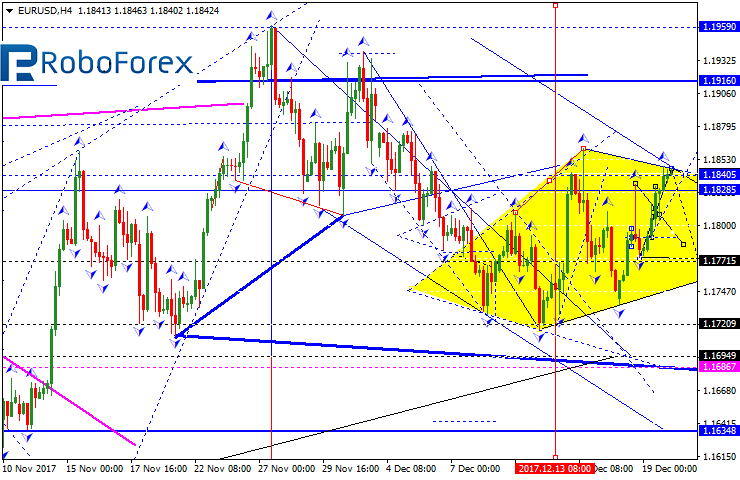
The EUR/USD pair is moving upwards. After breaking 1.1850 to the upside, the instrument may grow towards 1.1900 (an alternative scenario). According to the main scenario, the price may continue its decline with the target at 1.1686.

EURUSD


GBP USD, “Great Britain Pound vs US Dollar”

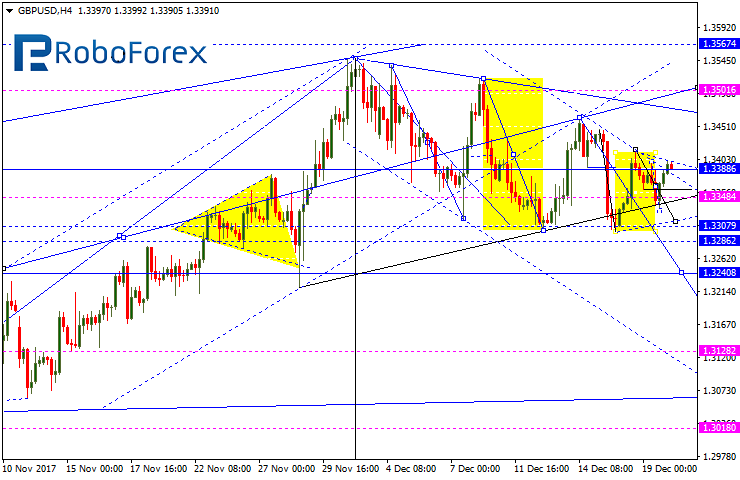
The GBP/USD pair is consolidating. According to the main scenario, the price may fall to reach 1.3240.

GBPUSD


USD CHF, “US Dollar vs Swiss Franc”

The USD/CHF pair is consolidating near the lows. Possibly, today the price may grow towards 0.9930, break it, and then continue growing inside the uptrend to reach the local target at 1.0100.

USDCHF


USD JPY, “US Dollar vs Japanese Yen”

The USD/JPY pair has reached 112.90 and right now is consolidating around it. If later the instrument breaks this range to the upside, the market may move upwards to reach 113.85; if to the downside – start another correction with the target at 112.45.

USDJPY


AUD USD, “Australian Dollar vs US Dollar”

The AUD/USD pair is consolidating close to the upside border of the Triangle pattern. If later the instrument breaks this range to the upside, the market may start another ascending structure towards 0.7760; if to the downside – fall to reach 0.7575.

AUDUSD


USD RUB, “US Dollar vs Russian Ruble”

The USD/RUB pair is consolidating above 58.53. If later the instrument breaks it, the market may continue falling inside the downtrend to reach the local target at 57.70.

USDRUB


XAU USD, “Gold vs US Dollar”

Gold is consolidating near the top of the ascending wave. According to the main scenario, the price may fall towards 1257 and then grow to reach 1268.

GOLD


BRENT

Brent is moving upwards. According to the main scenario, the price may continue growing inside the uptrend. The next target is at 64.97. After that, the instrument may fall towards 63.60.

BRENT


RoboForex Analytical Department

Article By RoboForex.com

Attention!
Forecasts presented in this section only reflect the author’s private opinion and should not be considered as guidance for trading. RoboForex LP bears no responsibility for trading results based on trading recommendations described in these analytical reviews.

Volatility: Dead – or Just “Sleeping”?

Learn about the danger of “quiet markets” (and what happens after)

By Elliott Wave International

Watch as our own Murray Gunn explains why you shouldn’t get too comfortable with the lack of volatility in the markets.


Don’t Get Blindsided by Big Market Turns

Low volatility can lull you into complacency about your investments. It’s important to have a method that alerts you to trends and turns in the markets. Learn the basics of the Elliott Wave Principle with this informative FREE 11-page report. It will introduce you to the basic method to help you establish your investment strategy and reduce risk.

Get instant access now!

This article was syndicated by Elliott Wave International and was originally published under the headline Volatility: Dead – or Just “Sleeping”?. EWI is the world’s largest market forecasting firm. Its staff of full-time analysts led by Chartered Market Technician Robert Prechter provides 24-hour-a-day market analysis to institutional and private investors around the world.

Ichimoku Cloud Analysis 19.12.2017 (AUD/USD, NZD/USD, USD/CAD)

Article By RoboForex.com

AUD USD, “Australian Dollar vs US Dollar”

The AUD/USD pair is trading at 0.7671; the instrument is still moving above Ichimoku Cloud, which means that it may continue growing. We should expect the price to test Tenkan-Sen and Kijun-Sen at 0.7655 and then continue moving upwards to reach 0.7750. However, the scenario that Implies further growth may be cancelled if the price breaks the downside border of the cloud and fixes below 0.7570. In this case, the pair may continue falling towards 0.7470.

AUDUSD


NZD USD, “New Zealand Dollar vs US Dollar”

The NZD/USD pair is trading at 0.7004; the instrument is still moving above Ichimoku Cloud, which means that it may continue growing. We should expect the price to test Tenkan-Sen and Kijun-Sen at 0.6995 and then continue moving upwards to reach 0.7080. However, the scenario that implies further growth may be cancelled if the price breaks the downside border of the cloud and fixes below 0.6915. In this case, the pair may continue falling towards 0.6815. After breaking the upside border of the Triangle pattern and fixing above 0.7020, the price may resume moving upwards.

NZDUSD


USD CAD, “US Dollar vs Canadian Dollar”

The USD/CAD pair is trading at 1.2857; the instrument is still moving above Ichimoku Cloud, which means that it may continue growing. We should expect the price to test the upside border of the cloud at 1.2845 and then continue moving upwards to reach 1.2995. However, the scenario that implies further growth may be cancelled if the price breaks the downside border of the cloud and fixes below 1.2735. In this case, the pair may continue falling towards 1.2560.

USDCAD


RoboForex Analytical Department

Article By RoboForex.com

Attention!
Forecasts presented in this section only reflect the author’s private opinion and should not be considered as guidance for trading. RoboForex LP bears no responsibility for trading results based on trading recommendations described in these analytical reviews.

The Oil Calmed Down After Forties Pipeline System Failure

Last week, the commodity market was very sensitive to the news about the Forties pipeline system breakdown and the fact that the pipeline had to be closed for maintenance. Brent reached the local high at 65.83 USD per barrel. However, after a couple of days this “bullish frenzy” died down and investors started analyzing the situation. It became quite clear why Brent was rising so fast, WTI was behind, and what was the reason of all this.

The Forties pipeline is very important for the United Kingdom and the oil extraction in the North Sea in general. In fact, it’s the only way to transport northern oil to the continent. At first, there was information about a small crack in the pipeline, which resulted in a spillage. It was assumed that the problem might be resolved by reducing the pressure the pipe section where the crack had been detected. However, this plan didn’t work, the crack got bigger, and the pipeline had to be closed for unscheduled maintenance.

Brent’s response to this was pretty obvious. Forties is one of the BFOE and influences the total Brent price. First of all, the cost of Brent is some kind of a baseline for the Middle East countries for pricing their own oil. This pricing policy is quite complicated, but it’s clearly seen that all parts of this chain are closely connected. Hence the reactions that were seen last week.

The Forties pipeline system maintenance will last about two weeks, considering that it is empty for already a week. They are planning to get it back to operation by New Year, and that’s when the price of Brent will exclude the risk factor.

Last Friday’s statistics on the Oil Rigs changes in the USA from Baker Hughes showed the decrease by 1 unit and didn’t attract much attention. The components of the report indicated that the number of gas rigs increased by 3 units and the number of oil rigs decreased by 4. There is nothing really surprising in this, it’s quite usual. This year, the number of rigs has expanded by one third, and this is what really should be taken into account when analyzing this indicator.

From the technical point of view, the chart of Brent is quite mixed, but very interesting. After breaking the resistance line of the previous channel, the price moved back, and reached a new low, which may start a new rising channel. The upside target may be the resistance line at 67.05. However, we should ignore a possibility that the downtrend may yet continue. If the price breaks the support line of the current trend channel and fixes below 62.60, it may fall towards the projected support line at 59.20.

Author: Dmitriy Gurkovskiy, Chief Analyst at RoboForex


Attention!

Forecasts presented in this section only reflect the author’s private opinion and should not be considered as guidance for trading. RoboForex bears no responsibility for trading results based on trading recommendations described in these analytical reviews.


AUD/USD: Long at 0.7640, target 0.7815, stop-loss 0.7555

By GrowthAces.com

EUR/USD: House likely to vote on U.S. tax bill today

Macroeconomic overview:

  • With the House and Senate leaders having reached an agreement on a compromise tax bill last Friday, the House of Representatives is expected to vote on the final legislation today. The bill will then head to the Senate for consideration and a vote either today or tomorrow. There is little doubt that Republicans have the votes to pass the bill in both chambers of congress and send it to the president’s desk before the end of the week.
  • The USD has returned on offer across the board. It is difficult to read much into these market moves as the nearing of the Christmas period is typically characterized by lower trading volumes and thinner-than-usual liquidity. Still, there are two things worth noting: 1. the fact that the dollar has not managed to capitalize, even on a short-term basis, on the US tax reform progress illustrates that the market is (rightly) disregarding all this “noise” and focusing on long-term fundamentals, which remain USD-bearish; and 2. commodity prices are rallying strongly, with raw industrials leading the way, something that should turn out to be good for commodity-related FX.
  • The Munich-based Ifo economic institute said its business climate index edged down to 117.2 from an upwardly revised reading of 117.6 in November which was the highest on record. The December reading came in lower than market forecast for a value of 117.5. The slight drop in the headline figure was due to less optimistic business expectations while assessments of the current business situation were more positive, Ifo said.

Technical analysis and trading signals:

  • Spikes above the daily cloud top have been limited for EUR/USD recently but another run looks likely. The cloud spans 1.1698/1.1823 on Tuesday while 1.1834 was Monday’s peak. Slow stochs are upticking. The December 12 1.1718 low and cloud base are supports.
  • We stick to our bullish view on this pair.

EURUSD Daily Forex Signals Chart


AUD/USD: RBA expressed more confidence about economic outlook

Macroeconomic overview:

  • Australia’s central bank has become more confident about the economic outlook in recent months, but weakness in consumer spending remains a “significant risk” amid slow income growth and high debt levels.
  • Minutes of the Reserve Bank of Australia’s December meeting showed policy makers again balanced subdued inflation against record high household debt while leaving interest rates at 1.50%.
  • “Over the prior year or so, the unemployment rate had fallen and inflation had moved closer to target,” Tuesday’s minutes showed. “Recent data had increased confidence there would be further progress on these fronts.”
  • However, it also noted household consumption had been weighed by slow wages growth, something of a global phenomenon. “How far and when stronger conditions in the economy and labour market might feed through into higher wage growth and inflation remained important considerations shaping the outlook.”
  • The RBA has spent more than seven years now without raising interest rates, the longest span since the official cash rate was introduced in 1990.
  • Interbank futures suggest this period of record-low rates could be here to stay for at least another year.
  • Policy makers got some encouraging signs in the days following the December 5 meeting, with third quarter GDP data showing the economy expanded at its fastest annual pace in over a year. October retail sales also bounced after months of lukewarm activity in a promising sign for Christmas sales. Data out last week showed employment surged past all expectations to notch up a 14th straight month of gains in November, the longest stretch of rises since the early 1990s. In addition, government spending on public infrastructure had boosted non-mining business investment and was likely to support economic growth for some time.
  • “In these circumstances, spare capacity in the labour market was expected to be absorbed gradually and wage growth was expected to pick up over time,” members noted.
  • Yet the recent run of better data was still not enough for policy makers to start considering a rate hike.
  • The RBA last month cut its forecasts for core inflation, which is now seen lurking under its long-term 2-3% band for another two years.
  • Meanwhile, wages are growing at an annual pace of just 2%, sapping consumer spending power. Indeed, household consumption rose just 0.1% in the third quarter to post its smallest increase since 2008. “The outlook for household consumption continued to be a significant risk, given that household incomes were growing slowly and debt levels were high,” the bank warned.

Technical analysis and trading signals:

  • The Aussie has been on an uptrend since last week, rising in six of the last seven sessions, helped by strong data at home as well as from China, Australia’s top trading partner. A positive cross of 7- and 14-day ema is an important bullish signal. The pair pierced above the 23.6% fibo of September-December fall.
  • We opened a long position at 0.7640 on Friday and set the target at 0.7815.

AUDUSD Daily Forex Signals Chart

TRADING STRATEGIES SUMMARY:

FOREX – MAJOR PAIRS:

Please enable images to upload to view this email properly

FOREX – MAJOR CROSSES:

Please enable images to upload to view this email properly

PRECIOUS METALS:

Please enable images to upload to view this email properly

How to read these tables?

1. Support/Resistance – three closest important support/resistance levels
2. Position/Trading Idea:
BUY/SELL – It means we are looking to open LONG/SHORT position at the Entry Price. If the order is filled we will set the suggested Target and Stop-loss level.
LONG/SHORT – It means we have already taken this position at the Entry Price and expect the rate to go up/down to the Target level.
3. Stop-Loss/Profit Locked In – Sometimes we move the stop-loss level above (in case of LONG) or below (in case of SHORT) the Entry price. This means that we have locked in profit on this position.
4. Risk Factor – green “*” means high level of confidence (low level of uncertainty), grey “**” means medium level of confidence, red “***” means low level of confidence (high level of uncertainty)
5. Position Size (forex)– position size suggested for a USD 10,000 trading account in mini lots. You can calculate your position size as follows: (your account size in USD / USD 10,000) * (our position size). You should always round the result down. For example, if the result was 2.671, your position size should be 2 mini lots. This would be a great tool for your risk management!
Position size (precious metals) – position size suggested for a USD 10,000 trading account in units. You can calculate your position size as follows: (your account size in USD / USD 10,000) * (our position size).
6. Profit/Loss on recently closed position (forex) – is the amount of pips we have earned/lost on recently closed position. The amount in USD is calculated on the assumption of suggested position size for USD 10,000 trading account.
Profit/Loss on recently closed position (precious metals) – is profit/loss we have earned/lost per unit on recently closed position. The amount in USD is calculated on the assumption of suggested position size for USD 10,000 trading account.


VIP Traders Club members should expect to receive forex and precious metals trading signals updates at least twice a day. We will send you:

  1. Buy and sell forex, precious metals signals (entry level, target, stop-loss)
  2. Suggested position size that you can easily adjust to your trading account size – this would help you in risk management and you will survive longer drawdown periods
  3. Early heads-up about the potential trading opportunities or rationale to taken positions ( fundamental analysis, technical analysis )
  4. Forecasts of most important macroeconomic indicators prepared by our economists and econometricians.

JOIN VIP TRADERS CLUB NOW!

About the Author:

By GrowthAces.com – Daily Forex Trading Strategies


Japanese Candlesticks Analysis 19.12.2017 (USD/CAD, AUD/USD)

Article By RoboForex.com

USD CAD, “US Dollar vs Canadian Dollar”

After reaching the resistance level once again, the USD/CAD pair has formed several reversal patterns, including Shooting Star and Engulfing. Taking into account that the previous rebound, we may assume that the price may resume falling again towards the support level.

USDCAD


AUD USD, “Australian Dollar vs US Dollar”

As we can see at the H4 chart, the AUD/USD pair is still forming reversal patterns close to the resistance level, such as Harami and Shooting Star. These patterns indicates that the price may start a new decline towards the support level quite soon.

AUDUSD


RoboForex Analytical Department

Article By RoboForex.com

Attention!
Forecasts presented in this section only reflect the author’s private opinion and should not be considered as guidance for trading. RoboForex LP bears no responsibility for trading results based on trading recommendations described in these analytical reviews.

Fibonacci Retracements Analysis 18.12.2017 (GOLD, USD/CHF)

Article By RoboForex.com

XAU USD, “Gold vs US Dollar”

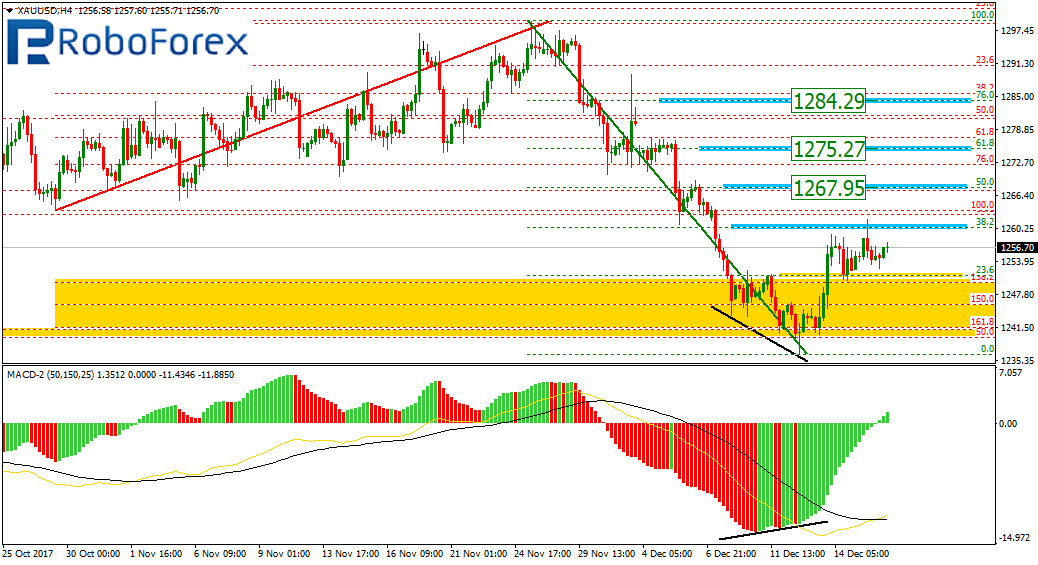
At the H4 chart, after the convergence and reaching the post-correctional extension area between the retracements of 138.2% and 161.8%, the XAU/USD pair started a new correction to the upside, which has already reached the retracement of 38.2%. The next upside targets maybe the retracements of 50.0%, 61.8%, and 76.0% at 1267.95, 1275.27, and 1284.29 respectively.

GOLD1

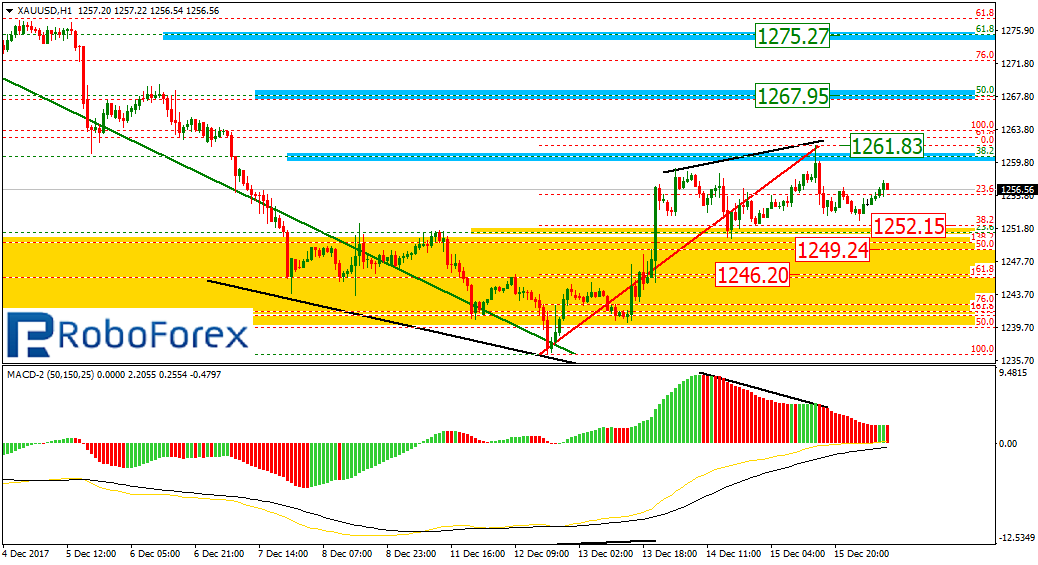
At the H1 chart, we can see the divergence, which made the price start a new descending correction, which has already reached the retracement of 38.2%. In case this movement continues, the price may reach the retracements of 50.0% and 61.8% at 1249.24 and 1246.20 respectively. After breaking the current high, the instrument may move to break the targets from the daily chart.

GOLD2


USD CHF, “US Dollar vs Swiss Franc”

As we can see at the H4 chart, the previous short-term ascending impulse has been corrected by 50.0%. The next targets may be the retracements 61.8% and 76.0% and 0.9827 and 0.9793 respectively. The upside target may be inside the post-correctional extension area between the retracements of 138.2% and 161.8% at 1.0030 and 1.0062 respectively. However, the instrument may reach it only after breaking the current high.

USDCHF1

At the H1 chart, the pair may continue growing towards the retracements of 76.0% at 0.9945, and then to reach the high at 0.9978.

USDCHF2


RoboForex Analytical Department

Article By RoboForex.com

Attention!
Forecasts presented in this section only reflect the author’s private opinion and should not be considered as guidance for trading. RoboForex LP bears no responsibility for trading results based on trading recommendations described in these analytical reviews.