Author Archive for InvestMacro – Page 310

Fibonacci Retracements Analysis 19.12.2018 (GBPUSD, EURJPY)

Article By RoboForex.com

GBPUSD, “Great Britain Pound vs US Dollar”

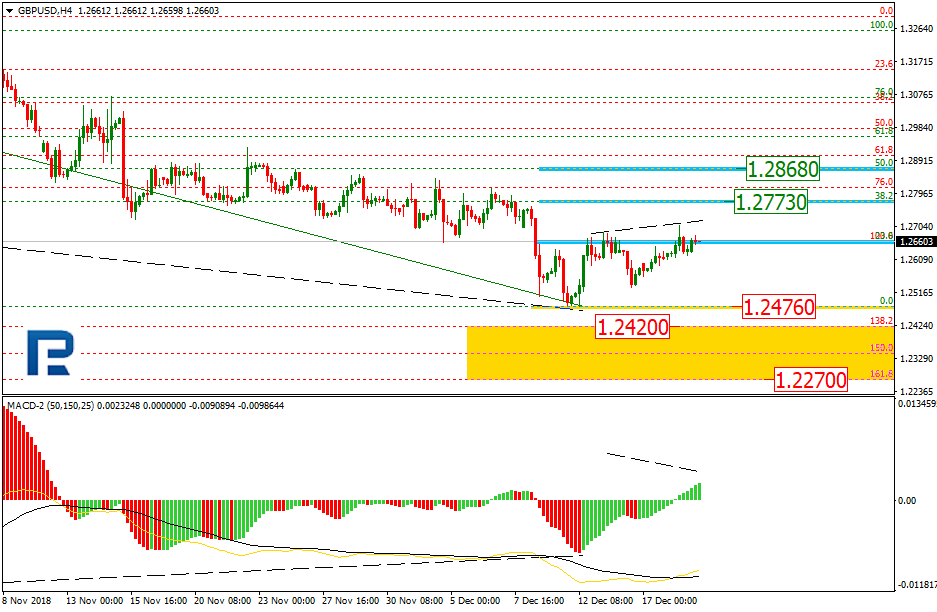
As we can see in the H4 chart, there was a convergence on MACD, so after breaking the low, GBPUSD started a new correctional uptrend, which has already reached the retracement of 23.6%. In the future, the correction may continue towards the retracements of 38.2% and 50.0% at 1.2773 and 1.2868 respectively. If the price breaks the low at 1.2476, the instrument may continue falling towards the post-correctional extension area between the retracements of 138.2% and 161.8% at 1.2420 and 1.2270 respectively.

GBPUSD1
Risk Warning: the result of previous trading operations do not guarantee the same results in the future

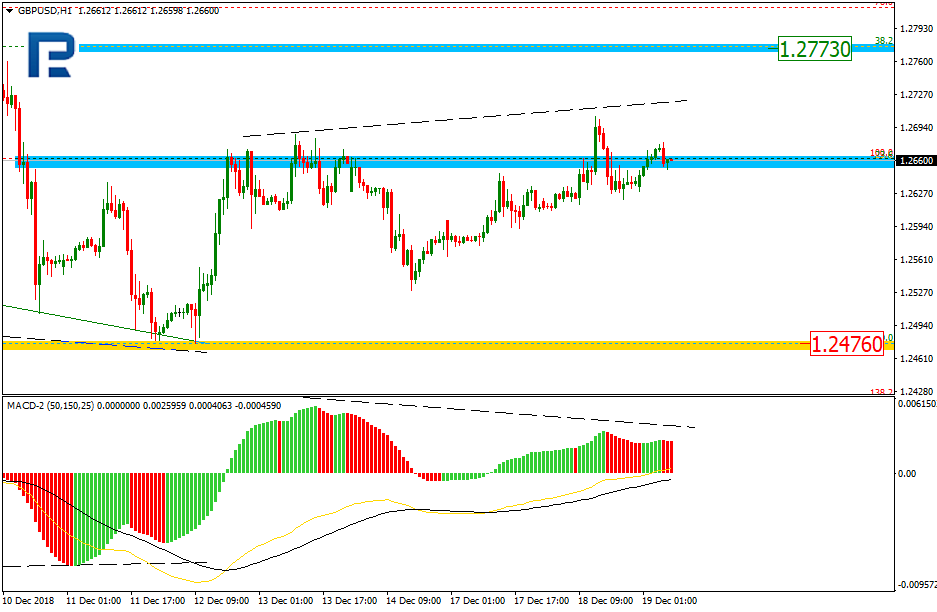
In the H1 chart, the pair is trading upwards to reach the retracement of 38.2% at 1.2773. At the same time, there is a divergence on MACD, which means that the price may start a new pullback after reaching the target.

GBPUSD2
Risk Warning: the result of previous trading operations do not guarantee the same results in the future

EURJPY, “Euro vs. Japanese Yen”

In the H4 chart, EURJPY is still consolidating. The resistance is the retracement of 23.6% at 129.30. If the price breaks the above-mentioned level, the pair may grow to reach the high at 130.15. The support is the retracement of 76.0% at 127.47. After breaking it, the instrument may start falling towards the key low at 126.63.

EURJPY1
Risk Warning: the result of previous trading operations do not guarantee the same results in the future

As we can see in the H1 chart, the divergence made the pair started a new correction to the upside, which has already reached the retracement of 23.6%. The next targets may be the retracements of 38.2%, 50.0%, and 61.8% at 128.26, 128.54, and 128.64 respectively. The support is the low at 127.64.

EURJPY2
Risk Warning: the result of previous trading operations do not guarantee the same results in the future

Article By RoboForex.com

Attention!
Forecasts presented in this section only reflect the author’s private opinion and should not be considered as guidance for trading. RoboForex LP bears no responsibility for trading results based on trading recommendations described in these analytical reviews.

Investors Took a Wait-and-See Attitude Before the Fed Meeting

by JustForex

The US dollar continues to decline against a basket of major currencies. The dollar index (#DX) closed in the negative zone (-0.68%) yesterday. Today, the Fed will decide on the interest rate. The regulator is expected to raise the base interest rate by 0.25 percentage points to 2.25-2.50% per annum. At the same time, investors are worried that the central bank may signal a slowdown in monetary policy tightening. It should be recalled that earlier the US President, Donald Trump, once again criticized the Fed chairman for raising interest rates. We recommend paying attention to the comments by the FOMC officials.

Yesterday, the German IFO business climate index was also published, which counted to 101.0 and was worse than 101.8. Today, the European Commission may approve the new draft budget of Italy for 2019. We also recommend paying attention to the news feed of the UK and Canada.

The “black gold” prices are recovering after the collapse the day before. At the moment, futures for the WTI crude oil are testing the mark of $46.75 per barrel. At 17:30 (GMT+2:00), a report on crude oil inventories will be published in the US.

Market Indicators

Yesterday, there was a variety of trends in the US stock market: #SPY (-0.11%), #DIA (+0.39%), #QQQ (+0.63%).

The 10-year US government bonds yield has continued to decline. Currently, the indicator is at the level of 2.81-2.82%.

The news feed on 19.12.2018:

– Consumer price index in the UK at 11:30 (GMT+2:00);
– Core consumer price index in Canada at 15:30 (GMT+2:00);
– Existing home sales in the US at 17:00 (GMT+2:00);
– Fed interest rate decision at 21:00 (GMT+2:00);
– GDP data in New Zealand at 23:45 (GMT+2:00).

by JustForex

Bitcoin and other Cryptocurrencies: Time to Regulate

Image Source

In the financial space, anything unregulated and unregistered would cause doubts and uneasiness. In the case of cryptocurrencies, such as bitcoin, financial regulators all over the world have started to find ways to oversee the blockchain, or the record of all cryptocurrency transactions, as well as to address the irregularities presented by these virtual currencies that mostly bypass financial firms, exchanges, and regulated banks. The most popular of all cryptocurrencies, bitcoin, chiefly operates outside of the conventions of a financial system; and this worries regulators as it has the potential to be linked to money laundering, tax evasion, fraud, and terrorist funding.

In November of last year, a businessman from Brooklyn was charged in a case with promoting currencies, which are backed by investments in diamonds and real estate that, according to the US prosecutors, do not exist. The Securities and Exchange Commission also filed charges.

Earlier this year, more than half a billion dollars in cryptocurrencies from a Japanese exchange called ‘Coincheck’ had been stolen by hackers. Experts say that more of such attacks can be expected in the future, as all of the hackers in the world may now be targeting cryptocurrencies.

For investors and owners of cryptocurrencies, this is worrisome. Here’s what the US regulators are currently doing to address doubts on cryptocurrencies:

Securities and Exchange Commission

SEC is a federal agency responsible for protecting investors and keeping order in markets. In a statement released in March, the SEC argued that under US security laws, digital assets such as coins and tokens offered and sold in initial coin offerings (ICOs) fall under the definition of “security.” The statement may mean that trade digital currencies would be required to be registered with the SEC, just like all of the national securities exchanges such as the New York Stock Exchange.

Internal Revenue Service

For tax purposes, the IRS states that bitcoin must be considered as property; therefore a capital gain or loss must be recorded, or be accessed through the blockchain as if it were an exchange that involves property. If it is used as payment, it should be treated as currency, and the bitcoin price must be converted to its fair market value checked on an exchange.

Department of Treasury

The department is taking the lead and is bringing federal agencies together to coordinate regulation on cryptocurrencies. It has formed a virtual currency working group, which includes the Federal government and the Securities and Exchange Commission, which will be watching bitcoin and other cryptocurrencies closely.

State Laws

Cryptocurrencies started out as “stateless” entities, but the cynicism towards them eventually drew a realization that regulation is necessary. In introducing cryptocurrency regulations, California and New York, which are home to a large number of crypto businesses, are taking the lead. Other states are quickly catching up.  The National Conference of Commissioners on Uniform State Laws had voted in favor of providing a model act for the regulation of cryptocurrency businesses at the state level.

There had been measures in regulating cryptocurrency, and we can expect more developments in the future. Reports on irregularities, scams, and fraud surrounding cryptocurrency are indeed alarming, which is why it is important to remain vigilant and cautious in all of your investment activities; and be on the lookout for bitcoin news and other updates on cryptocurrencies.

About the Author:

Contact us at Hogan Injury for expert legal advice.

None of the content on Hoganinjury.com is legal advice nor is it a replacement for advice from a certified lawyer. Please consult a legal professional for further information.


EURUSD: pair attempting to strengthen before Fed decision

By Matthew Anthony, Alpari

Previous:

On Tuesday the 18th of December, trading on the euro closed up. Multidirectional dynamics were observed throughout the day. During the first half of the European session, the euro rose to 1.1402. During the US session the euro lost its gains, dropping to 1.1350. The pressure on the US dollar was caused by doubts by market participants that instead of the planned three rate hikes in 2019, there would be two.

In addition, the US President has been pressing the Fed. On Tuesday, he expressed hope that Fed would think twice and not raise rates.

The price of Brent crude fell by almost 6%, putting pressure on the Canadian dollar. Thus, major pairs corrected at the end of the day, and EURUSD dipped to 1.1350.

Day’s news (GMT+3):

  • 11:30 UK: CPI (Nov), PPI (Nov).
  • 14:00 UK: CBI industrial trends survey orders (Dec).
  • 16:30 Canada: CPI (Nov).
  • 16:30 US: current account (Q3).
  • 17:00 Switzerland: SNB quarterly bulletin.
  • 18:00 US: existing home sales (Nov).
  • 18:30 US: EIA crude oil stocks change (Dec 14).
  • 22:00 US: FOMC economic projections.
  • 22:30 US: FOMC press conference.

Current situation:

I did not prepare a forecast today due to the FOMC meeting and Jerome Powell’s press conference.

In Asian trading, the euro rose against the dollar by 33 pips. It is currently trading at 1.1392. Buyers are approaching a resistance at 1.1400. The market compressing towards the resistance, which is a bullish signal that buyers are ready to move northward to 1.1428.

It is still unknown where exactly the pair will close, but the likelihood of a rise to above 1.1450 has increased. If the US Fed doesn’t raise rates today, the euro will jump to 1.15. If the Fed raises rates by 25 base points and confirms a three-fold hike in 2019, the euro will fall to 1.1340. Traders are awaiting the Fed’s press conference which will determine whether the euro will close up or down on Wednesday.

Why Chinese Reforms Will Stay the Course

By Dan Steinbock

After four decades of reforms and opening, China is accelerating the transition to post-industrial society.

By Dan Steinbock

As Chinese President Xi Jinping gave his highly-anticipated speech on Monday on the 40th anniversary of Chinese reforms and opening-up policies, it was closely watched internationally in light of the 90-day truce in the U.S. trade wars.

Xi called the pursuit of reform and opening-up and socialism with Chinese characteristics “a milestone in realizing the Chinese nation’s rejuvenation.” He emphasized the importance of innovation, which has been prominently displayed by world-class productivity in the Greater Bay Area of South China, and international cooperation, as evidenced by the One Road One Belt initiative that’s fueling 21st century globalization.

In particular, Xi’s speech was very clear about China’s historical debt to Deng Xiaoping other reformers – and the need to go further.

China’s pragmatic transitions

In Chinese modern history, it was Sun Yat-sen, the founding father of the nation, who paved the way for sovereignty with his “three principles” of nation, democracy and socialism. But followingr imperial disintegration and Western colonialism, these efforts could be started only after world wars, Japanese invasion and a Civil War.

When in 1949 Mao Zedong could finally declare that “the Chinese people have stood up!”, China began the march to a new future. In the early 1950s, Mao’s economic policies unleashed state-led industrialization, which started promisingly but stagnated amid the Cold War polarization. In historical view, Mao’s crucial contribution was the establishment of Chinese sovereignty.

Already by the early 1960s, foreign minister Zhou Enlai called for the “Four Modernizations” in agriculture, industry, defense, and science and technology. These reforms started in the late ‘70s, when Deng Xiaoping initiated the “reform and opening” era, with the Special Economic Zones (SEZs) first in Southern China, then in Shanghai, Beijing and elsewhere.

It was Deng’s bold pragmatism – “It doesn’t matter if the cat is black or white as long as it catches the mice,” as he put it – that finally led to the inflow of foreign investment and technology, business success, and parallel price structures. With extraordinary foresight, Deng understood the opportunities of globalization, but also knew the risks of the international environment in the Reagan-Thatcher era when “one had to cross the river by feeling the stones” – a phrase that Xi quoted approvingly in his speech.

As President Jiang Zemin pushed the role of the private sector – “the Three Represents” doctrine – and Premier Zhu Rongji began the struggle against corruption in the 1990s, China became the member of the World Trade Organization (2001). That paved the way to a decade of export-led double-digit growth, which President Hu Jintao characterized as “China’s peaceful development.”

The fourth great transition – the shift to post-industrialization – has been intensified by the Xi leadership.

Trade, markets and the Party

Just as the WTO membership allowed China to execute tough reforms, U.S. trade wars may actually accelerate Chinese reforms, as long as compromise makes pragmatic sense.

Xi’s reform speech offered clarity in a difficult international environment that is often overshadowed by ideological misinterpretations of economic fundamentals. Recently, New York Times reported that China was amid “a steep downturn.” Yet, the growth forecast for the year remains 6.5- 6.6%, after a strong first half. Moderation will ensue in the second half and especially in 2019, depending on U.S. tariffs and slower demand worldwide.

U.S. may be navigating toward a correction by 2019-20, which will prove challenging to all major economies. Indeed, many Americans oppose President Trump’s policies and the word “impeachment” is getting louder in the Capitol Hill. Meanwhile, a bipartisan group of senators -Rob Portman (R-Ohio), Doug Jones (D-Ala.) and Joni Ernst (R-Iowa) – seeks to claw back trade power from Trump with legislation. They hope to “better align” Section 232 of the Trade Expansion Act of 1962 with its “original intent,” which was to respond “to genuine threats to national security.” Foreign cars and car parts are not exactly a typical geopolitical threat.

In his speech, Xi also emphasized the role of the Chinese Communist Party in the reforms. Historically, when China has thrived, it has been attributed to “Westernization” in the West, and when China has ailed, it has been attributed to Chinese communism.

The West has not yet come to terms with the inconvenient truth that China’s economic miracle has been possible because of the Party’s leadership, not despite it. Unlike the West where middle classes continue to shrink at the expense of the ultra-wealthy, China is expanding middle classes, fighting corruption and fostering sustainability.

Irrespective of Washington’s trade actions, U.S. trade wars will not change the course of Chinese reforms which will continue to broaden and deepen. China will “stay the course,” as Xi put it, while stressing that “no one is in a position to dictate to the Chinese people what should or should not be done.”

Like Liu He, Xi’s economic adviser, Chinese reformers are determined to complete by the late 2020s the rebalancing of their economy, which is rapidly moving toward consumption and world-class innovation.

About the Author:

Dr Dan Steinbock is the founder of the Difference Group and has served as the research director at the India, China, and America Institute (USA) and a visiting fellow at the Shanghai Institutes for International Studies (China) and the EU Center (Singapore). For more, see http://www.differencegroup.net/  

The original commentary was published by China Daily on December 18, 2018
 

Japanese Candlesticks Analysis 18.12.2018 (GOLD, NZDUSD)

Article By RoboForex.com

XAUUSD, “Gold vs US Dollar”

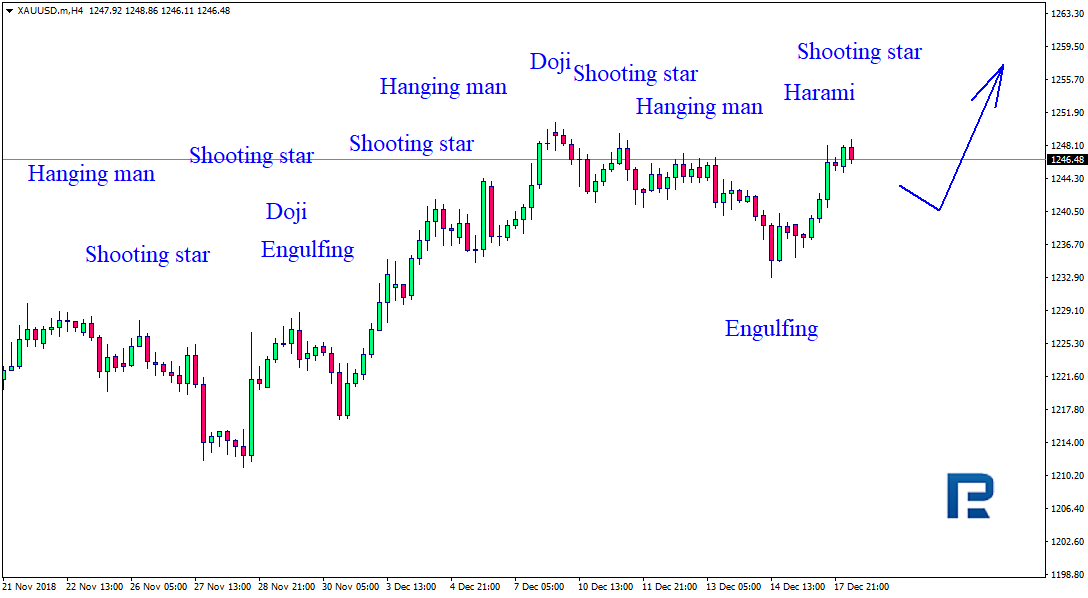
As we can see in the H4 chart, XAUUSD is still trading below the resistance level and forming Hanging Man, Shooting Star, and Harami reversal patterns. Judging by the previous movements, it may be assumed that after finishing another pullback the instrument may start a new ascending movement.

GOLD
Risk Warning: the result of previous trading operations do not guarantee the same results in the future

NZDUSD, “New Zealand vs. US Dollar”

As we can see in the H4 chart, NZDUSD is still moving upwards from the resistance level and forming Harami, Engulfing, and Doji reversal patterns. By now, it has finished Shooting Star pattern. Judging by the previous movements, it may be assumed that after completing the pullback the instrument may continue its growth.

NZDUSD
Risk Warning: the result of previous trading operations do not guarantee the same results in the future

Article By RoboForex.com

Attention!
Forecasts presented in this section only reflect the author’s private opinion and should not be considered as guidance for trading. RoboForex LP bears no responsibility for trading results based on trading recommendations described in these analytical reviews.

Ichimoku Cloud Analysis 18.12.2018 (AUDUSD, NZDUSD, USDCAD)

Article By RoboForex.com

AUDUSD, “Australian Dollar vs US Dollar”

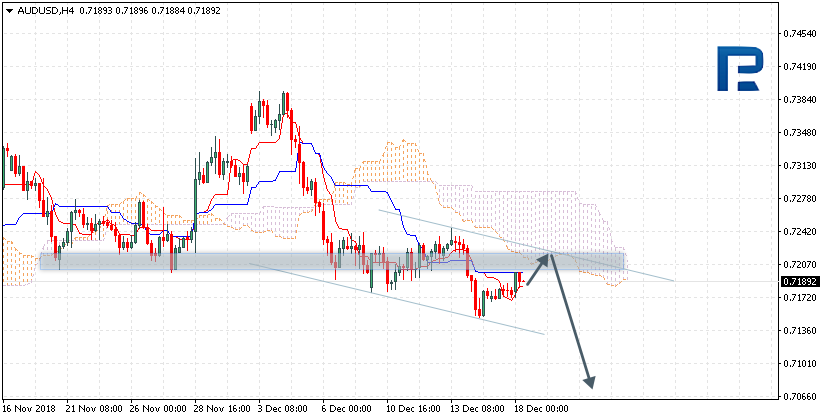
AUDUSD is trading at 0.7189; the instrument is moving below Ichimoku Cloud, thus indicating a descending tendency. The markets could indicate that the price may test the downside border of the cloud at 0.7205 and then resume moving downwards to reach 0.7085. Another signal to confirm further descending movement is the price’s rebounding from the channel’s upside border. However, the scenario that Implies further decline may be cancelled if the price breaks the upside border of the cloud and fixes above 0.7285. In this case, the pair may continue growing towards 0.7375.

AUDUSD
Risk Warning: the result of previous trading operations do not guarantee the same results in the future

NZDUSD, “New Zealand Dollar vs US Dollar”

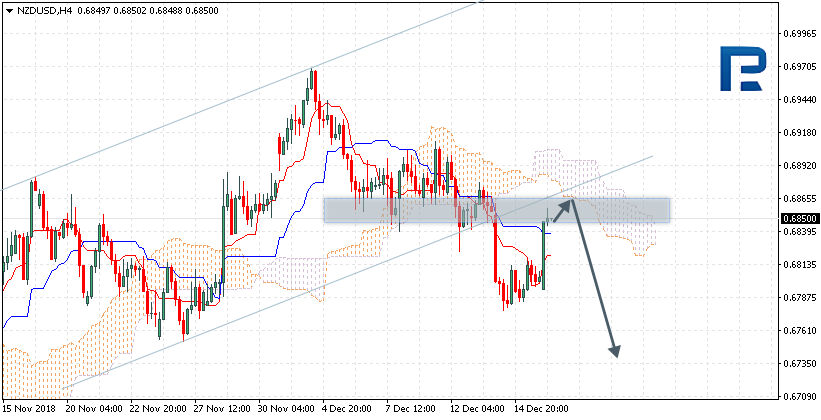
NZDUSD is trading at 0.6850; the instrument is moving below Ichimoku Cloud, thus indicating a descending tendency. The markets could indicate that the price may test the downside border of the cloud at 0.6865 and then resume moving downwards to reach 0.6735. Another signal to confirm further descending movement is the price’s rebounding from the resistance level. However, the scenario that Implies further decline may be cancelled if the price breaks the upside border of the cloud and fixes above 0.6910. In this case, the pair may continue growing towards 0.6995.

NZDUSD
Risk Warning: the result of previous trading operations do not guarantee the same results in the future

USDCAD, “US Dollar vs Canadian Dollar”

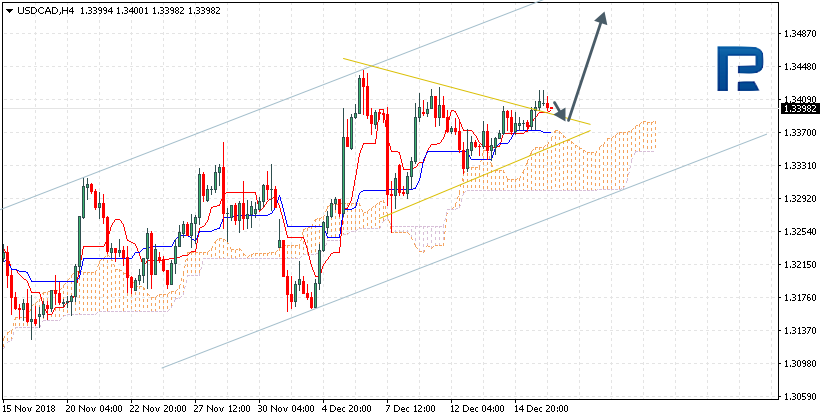
USDCAD is trading at 1.3398; the instrument is moving above Ichimoku Cloud, thus indicating an ascending tendency. The markets could indicate that the price may test Tenkan-Sen and Kijun-Sen at 1.3375 and then resume moving upwards to reach 1.3535. Another signal to confirm further ascending movement is the price’s rebounding from the upside border of the Triangle pattern. However, the scenario that implies further growth may be cancelled if the price breaks the downside border of the cloud and fixes below 1.3290. In this case, the pair may continue falling towards 1.3195.

USDCAD
Risk Warning: the result of previous trading operations do not guarantee the same results in the future

Article By RoboForex.com

Attention!
Forecasts presented in this section only reflect the author’s private opinion and should not be considered as guidance for trading. RoboForex LP bears no responsibility for trading results based on trading recommendations described in these analytical reviews.

Investors Took a Wait-and-See Attitude Before the Fed Meeting

by JustForex

The US dollar is falling against a basket of major currencies. Yesterday, the dollar index (#DX) moved away from local highs and closed in the negative zone (-0.26%). Investors took a wait-and-see attitude before the Fed’s decision on the interest rate. The Fed meeting will start today and last two days. The regulator is expected to raise the base interest rate by 0.25 percentage points to 2.25-2.50% per annum. Investors will carefully assess the comments by representatives of the regulator regarding the further monetary policy tightening.

The euro strengthened against the US currency despite weak economic data. The consumer price index in the Eurozone counted to 1.9% (year on year) in November and was worse than the expected value of 2.0%. The euro was supported by news that Italy reached an agreement with the EU on a new budget project for 2019. Italian Prime Minister, Giuseppe Conte, reported that the government would reduce the budget deficit target for 2019 to 2.04% of GDP instead of 2.4% of GDP.

The “black gold” prices are falling. At the moment, futures for the WTI crude oil are testing the mark of $49.25 per barrel.

Market Indicators

Yesterday, aggressive sales were observed in the US stock market: #SPY (-1.96%), #DIA (-2.07%), #QQQ (-2.27%).

The 10-year US government bonds yield is at the level of 2.83-2.84%.

The news feed on 18.12.2018:

– German IFO business climate index at 11:00 (GMT+2:00);
– Statistics on the real estate market in the US at 15:30 (GMT+2:00).

by JustForex

Natural Gas Breaks Lower Towards Our $3.00 Target

By TheTechnicalTraders.com

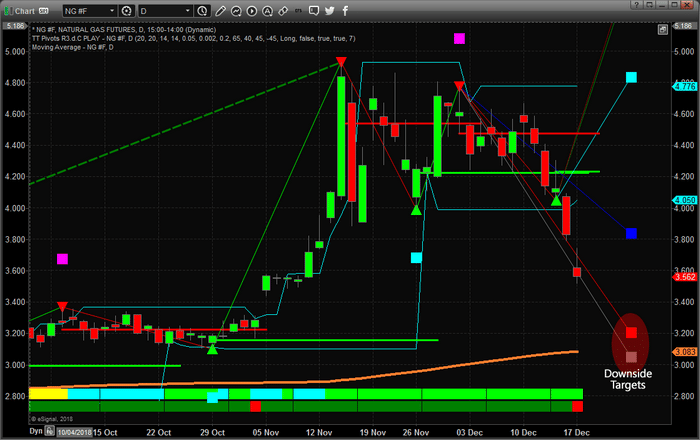
Just about seven days ago we alerted all of our followers to a massive breakdown move that was about to unfold in Natural Gas.  At that time, we predicted the price of Natural Gas would break below $4.30 and fall quickly towards the $3.00~3.20 level. Taking a look at that call now, with the price below $3.60, it seems our analysis was perfectly timed.

This Daily Natural Gas chart highlighting our predictive Fibonacci price modeling system shows the downside price targets that are waiting to confirm price support and a potential “deep V bottom formation”.  If you recall from our earlier research, we believe this downside move will end rather quickly with a deep V type of price bottom setting up near the end of 2018.  This means we expect the price of Natural Gas to begin to rally into 2019 after reaching the $3.00~3.20 level soon.


This is an incredible move for skilled traders.  We are watching a $2.50 price move in Natural Gas unfold right before our eyes – and it appears this rotation will complete before the end of February 2019.  -$1.40 to the downside, then +1.20 to the upside.  Just follow the predictive modeling systems and ride it out.

We’ll alert you when the bottom sets up and when the upside move it about to unfold, but for now, we are watching for NG to move into the support zone (near $3.20).  Once that level is reached, a technical price bottom should start to set up and the new rally back towards $4.00 will likely start in early January 2019.

Want to learn how our advanced price modeling tools can make calls like this weeks and months in advance?  Visit TheTechnicalTraders.com to learn about our research, services, daily videos, and more solutions to help skilled traders stay ahead of these market moves.  Our advanced predictive modeling solutions and years of market research provide our members with a clear advantage you won’t find anywhere else.  Consider joining our services as a Christmas Gift to yourself!

Chris Vermeulen
Technical Traders Ltd.


EURUSD: sellers opened the way for buyers to 1.1360

By Matthew Anthony, Alpari

Previous:

On Monday the 17th of December, trading on the euro closed up. It recovered all of Friday’s losses against the background of an overall weakening of the US dollar and reports that Italian politicians reached an agreement on a new 2019 draft budget.

The dollar suffered from the statements of US President Donald Trump. He expressed surprise at the plans by the US Fed to continue raising interest rates. Before the FOMC meeting, there were doubts across the market about Wednesday’s rate hike. If by Wednesday in previous FOMC meetings the probability of a rate hike was more than 90%, now it’s at 70%, having fallen yesterday from 75%. Trump wanted to send Jerome Powell packing, so there is the chance that on Wednesday the Fed will find a reason no avoid raising rates so as not to raise the ire of the US President.

Day’s news (GMT+3):

  • 9:45 Switzerland: SECO economic forecasts.
  • 12:00 Germany: IFO business climate (Dec), IFO current assessment (Dec), IFO expectations (Dec).
  • 16:30 Canada: manufacturing shipments (Oct).
  • 16:30 US: building permits (Nov), new housing starts (Nov).

Fig 1. MA channel on the EURUSD hourly chart.

Current situation:

Sellers who aggressively sold the euro on the 14th of December at 11:00 candlestick (GMT+3) defended at the levels of 1.1305 and 1.1350. At present, they remain strong, and I see the strengthening of the euro as a correctional movement towards a drop from 1.1393 to 1.1270.

At the time of writing, the euro sits at 1.1338. I attached lines to the bases that are parallel to the line drawn along the lows 1.1306 – 1.1311. The dot represents the support. If the price bounces off the current level and updates the high from the Asian session, then we should prepare for the rate to rise to 1.1398. If the US Fed does not hike rates, then it will rise to 1.1470.

I made this forecast before the US session, and according to this, I am expecting a drop to the LB line – 1.1328, then after a correction to 1.1340, a drop to 1.1320. All euro crosses are trading in the red, so the drop could take place without a bounce.

Source: EURUSD: sellers opened the way for buyers to 1.1360