Dollar High on Yen and Euro Prior to ADP Jobs Data

By TraderVox.com

Tradervox (Dublin) – The US dollar rose for the third day against the euro as reports from the 17-nation trading bloc showed that European manufacturing shrank for the ninth month as unemployment rose in the region’s greatest economy. The report has escalated concerns that the debt crisis in the region will slow the regions economic growth.

After the report, the euro came to close to two-week low against the yen prior to European policy makers meeting tomorrow. Investors and analysts are speculating that the policy makers will signal steps towards interest rates cut to spur growth.

According to Ian Stannard of Morgan Stanley in London, the weak data from the euro zone reflects the deterioration that has been seen in the region. He also added that the trouble is not limited to the struggling countries alone but is now affecting the large economies in the region. Some analysts have projected that the euro will come under immense pressure from major currencies. The dollar has improved against most of the currencies in the last few days and its expected to continue on this trend through out the week.

The US dollar increased by 0.7 percent against the euro to trade at $1.3145 per euro. It had earlier climbed by 0.8 percent which is the strongest since April 23. The greenback also increased against the yen by 0.3 percent to trade at 80.31 yen. The 17-nation currency declined against the yen by 0.4 percent to exchange at 105.56 yen. The euro had dropped against most of its peers after reports from the region and downgrading of Spain.

The yen continued to decline against the dollar after Moody’s Investor Service indicated that sentiments from Ichiro Ozawa who is a lawmaker in tax reforms may have impact of country’s credit rating. The US QE3 speculations continue to be dampened by reports and sentiments from the world’s largest economy.

Disclaimer
Tradervox.com is not giving advice nor is qualified or licensed to provide financial advice. You must seek guidance from your personal advisors before acting on this information. While we try to ensure that all of the information provided on this website is kept up-to-date and accurate we accept no responsibility for any use made of the information provided. Opinions expressed at Tradervox.com are those of the individual authors and do not necessarily represent the opinion of Tradervox.com or its management. 

Article provided by TraderVox.com
Tradervox.com is a Forex News Portal that provides real-time news and analysis relating to the Currency Markets.
News and analysis are produced throughout the day by our in-house staff.
Follow us on twitter: www.twitter.com/tradervox

5 Boring Stocks, 5 Sexy Yields

By The Sizemore Letter

Investing is not all that different from choosing a spouse.  At some point in every man’s life, he has to make a choice.  Does he go for the alluring but volatile young vixen who will ultimately put him in an early grave, or does he take the more rational course of action and choose a mature, dependable companion to spend his life with?  (Women face similar choices themselves; to marry the handsome but unpredictable young buck or the more stable—if somewhat boring—workhorse?).

It’s nice if you can have it all, of course; romance and stability in a partner.

For investors, much the same can be said about stocks.   Sexy “glamour” stocks—and the heartburn they often bring—are best left to shorter-term traders.  Bonds offer stability but nothing in the way of excitement.   If you are looking for something in the middle—predictable, long-term wealth building—dividend-paying stocks are likely your best option.  They allow you reach your financial goals while still managing to sleep at night.

Today, I’m going to recommend five boring stocks with sexy yields.  We’ll start with that most mundane of American retailers Wal-Mart (NYSE: $WMT).

Wal-Mart is about as dull as it gets as a company; the world’s largest retailer of the basic “stuff” of modern life—everything from food to build-it-yourself furniture.

But Wal-Mart also  happens to be a dividend-growing dynamo.  In 2002, just 10 years ago, Wal-Mart paid $0.075 per quarter in dividends.  Today, it pays $0.398—an increase of more than five times.

With Wal-Mart’s domestic expansion slowing in the years ahead (and thus needing less cash for investment), I expect the company to continue aggressively raising its dividend.  The stock currently yields an attractive 2.7%, which is substantially more than what most bonds pay.

Next on the list is consumer products giant Kimberly-Clark (NYSE:$KMB).  If you thought it was impossible for a company to be more boring than Wal-Mart, then you failed to consider Kimberly-Clark.  The company manufactures and sells diapers, Kleenex, and other basic products you might find in your bathroom.

But like Wal-Mart, Kimberly-Clark is a dividend-raising dynamo.  Over the past decade, its quarterly dividend has risen from $0.30 to $0.74; not too shabby when you consider what a volatile decade it has been.  Kimberly-Clark currently yields 3.7%.

I can’t mention Kimberly-Clark without mentioning its much larger rival Procter & Gamble (NYSE: $PG).  Chances are good that half or more of the products in your bathroom and laundry room were made by Procter & Gamble, at least if you are an American (overseas, rival Unilever (NYSE:$UL) tends to dominate).  They make Crest toothpaste, Gillette razors, Charmin toilet paper, and Pampers diapers, among many, many other brands.  This is a company that Warren Buffett has dabbled in for years, and it’s easy to understand why.  Demand for its products is stable, and its brands have incredible intangible value.

Over the past decade, P&G has raised its quarterly dividend from $0.19 to $0.562; again, not a bad run.  The stock currently yields 3.5%.

Moving on, let’s take a look at the oh-so-boring world of natural gas transportation.   On this front, I recommend Williams Companies (NYSE: WMB).

Stop for a minute and think.  Can you think of anything more boring than natural gas transportation?  Yeah, me neither.

But William’s dullness is its strength.  Natural gas pipelines are stable, predictable businesses, regardless of what happens to the price of gas.  And if anything, the current glut in natural gas supplies should bode well for pipeline companies like Williams.  Cheaper prices encourage higher consumption.

Williams Companies is an IRA-friendly way to get access to the master limited partnership Williams Partners (NYSE:$WPZ).  For tax reasons that go beyond the scope of this article, master limited partnerships cannot be held in IRA accounts.  But as a corporation with a large ownership interest in a partnership, WMB can.

Williams Companies  currently yields 3.1%, and I expect this to rise substantially over time.

Finally, I want to put out one recommendation that is likely to get your pulse racing a little more than the rest: Spanish telecom juggernaut Telefonica (NYSE: $TEF).

There is little more boring than a telecom utility.  While you may “ooh and ah” over your latest iPhone, you generally spend very little time thinking about the company that provides cellular service to it.

Telefonica would have to be considered “riskier” than the rest of these recommendations by virtue of being domiciled in Spain.  But with a yield of over 11% at current prices, I consider it a risk worth taking.

Telefonica gets nearly half of its revenues from the fast-growing markets of Latin America, so continued recessionary conditions in Spain do not present an undue risk to Telefonica’s business.  Disruptions to the European financial system could result in the company cutting its dividend to preserve cash, but I consider this unlikely and, again, a risk worth taking for the potential rewards.

Disclosures: All securities mentioned are holdings of the Sizemore Capital Dividend Growth Portfolio.

AUD Tumbles Following Interest Rate Cut

Source: ForexYard

The AUD took heavy losses vs. its main currency rivals during yesterday’s trading session, falling a bigger than expected cut in Australian interest rates. The AUD/USD fell over 100 pips following the news, reaching as low as 1.0304 during early morning trading. The aussie also fell close to 100 pips against the JPY and 145 pips against the euro. Turning to today, traders will want to focus on the UK Construction PMI at 8:30 GMT, followed by the US ADP Non-Farm Employment Change at 12:15 GMT. Any positive news could help both the British pound and US dollar reverse their current bearish trends.

Economic News

USD – US Manufacturing PMI Gives USD Boost

After taking losses against most of its main currency rivals throughout the overnight and morning sessions yesterday, the USD was able to stage a mild recovery following a better than expected US ISM Manufacturing PMI. The news resulted in a spike of over 30 pips for the USD/JPY, bringing the pair back above the psychologically significant 80.00 level. Against the Swiss franc, the dollar was able to move up over 50 pips reaching as high as 0.9087.

Turning to today, all eyes will likely be on the US ADP Non-Farm Employment Change figure, scheduled to be released at 12:15 GMT. The ADP figure is considered an accurate predictor of Friday’s all important Non-Farm Payrolls figure, and consistently leads to market volatility. At the moment, analysts are forecasting today’s news to come in at 178K, well below last month’s figure. If true, the dollar may reverse the gains it made yesterday. That being said, the ADP figure has proven notoriously difficult to predict. If today’s news comes in above analyst forecasts, the dollar may be able to extend yesterday’s bullish momentum going into the second half of the week.

EUR – EUR Stays Range Bound During Slow Trading Day

While most European markets were closed yesterday due to the May Day holiday, the euro saw mild gains as poor news out of the US and UK continued to drive market sentiment. The EUR/USD was up around 30 pips during mid-day trading, reaching as high as 1.3275 before staging a downward correction following positive US news. The pair eventually stabilized at 1.3220. The common-currency saw similar gains against the Japanese yen. The EUR/JPY traded as high as 106.02 before correcting itself and stabilizing at 105.80.

Turning to today, euro traders will want to pay attention to the German Unemployment Change figure at 07:55 GMT. As the strongest euro-zone economy, German indicators tend to have a significant impact on the EUR. With analysts predicting the figure to come in worse than last month’s, the euro may take some losses during mid-day trading today. Additionally, the European Unemployment Rate, scheduled to be announced at 09:00 GMT is forecasted to go up to 10.9%. If true the euro could turn bearish against safe haven currencies like the USD and JPY.

Gold – Gold Reverses Gains Following Positive US News

The price of gold steadily went up in value during the first part of the European session yesterday, as poor global data caused investors to shift their funds to the precious metal. That trend abruptly changed, following a better than expected US ISM Manufacturing PMI which resulted in increased demand for the US dollar. Gold fell over 600 pips following the news before stabilizing around $1662 an ounce during afternoon trading.

Turning to today, gold traders will want to pay attention to the US ADP Non-Farm Payrolls figure, scheduled to be released at 12:15 GMT. With analysts predicting today’s news to come in below last month’s, gold may rebound during the afternoon session. That being said, should the US indicator come in above expectations, gold may see further downward movement today.

Crude Oil – US Manufacturing Data Signals Increase in Oil Demand

A better than expected US ISM Manufacturing PMI signaled an increase in demand for crude oil in the world’s largest oil consuming country yesterday, and resulted in a significant boost in prices. Following the news, crude oil shot up over $1.50 a barrel, reaching as high as $106.29 during the afternoon session.

Whether or not oil can maintain its current bullish trend is largely dependent on US news scheduled to be released later today. Should the ADP Non-Farm Employment Change figure exceed expectations, it may convince investors that the US economic recovery is continuing, despite several setbacks in recent weeks. Investors could take any positive news as a sign of increased demand for oil, which could help the commodity extend its gains.

Technical News

EUR/USD

The Williams Percent Rang e on the daily chart has crossed over into overbought territory, indicating that downward movement could occur in the near future. Additionally, a bearish cross has formed close to the 80 level on the same chart’s Slow Stochastic. Going short may be the wise choice for this pair, ahead of a possible downward correction.

GBP/USD

In a sign that a downward correction could occur in the near future, the Relative Strength Index has crossed into overbought territory. This theory is supported by the weekly chart’s Williams Percent Range, which is currently well above the -20 level. Going short may be the wise choice for this pair.

USD/JPY

The daily chart’s Williams Percent Range has crossed over into oversold territory, indicating that this pair could see upward movement in the near future. Additionally, the weekly chart’s Slow Stochastic seems to be close to forming a bullish cross. Traders will want to keep an eye on the Slow Stochastic. Should the cross form, opening long positions may be the wise choice.

USD/CHF

The daily chart’s Williams Percent Range has dropped into oversold territory indicating that upward movement could occur in the near future. That being said, most other long term technical indicators show this pair range trading. Taking a wait and see approach may be the best choice for this pair.

The Wild Card

Crude Oil

A bearish cross has formed on the daily chart’s Slow Stochastic, indicating that downward movement could occur in the near future. In addition, the Relative Strength Index (RSI) on the same chart is approaching the overbought region. Forex traders will want to keep an eye on the RSI. If it crosses above 70, it may be a good time to open short positions.

Forex Market Analysis provided by ForexYard.

© 2006 by FxYard Ltd

Disclaimer: Trading Foreign Exchange carries a high level of risk and may not be suitable for all investors. There is a possibility that you could sustain a loss of all of your investment and therefore you should not invest money that you cannot afford to lose. You should be aware of all the risks associated with Foreign Exchange trading.


How Did We Get It So Wrong on Australian Housing?

By MoneyMorning.com.au

It’s hard to admit it when you get something wrong.

The fact is, we predicted a huge and painful Aussie house price crash.

With the exceptions of the Gold Coast, some areas in Perth, and the holiday home market, the house price crash hasn’t happened.

So, after getting it so wrong, how come we’re so keen to talk about it? The answer is simple…

While we predicted disaster for the Australian housing market, what we didn’t predict is what’s happening right now.

And that is something much, much worse than anything we could have predicted.

Lower Interest Rates Won’t Help Aussie House Prices

It’s funny, in recent months almost every reason the property spruikers gave to support their argument has collapsed.

One argument they could still fall back on was the idea that the Reserve Bank of Australia (RBA) could cut rates to support the Australian housing market.

But even that argument is dead. After the release of the latest RP Data housing index, National Australia Bank economist Rob Henderson told The Age:

‘Three months after two interest rate cuts, what has happened to house prices? They have fallen.

‘So it doesn’t suggest interest rate cuts are much of a panacea for the housing market does it?’

They laughed at your editor when we said lower interest rates wouldn’t help house prices.

Two years ago we pointed out the level of interest rates was only part of the reason for the housing bubble. The biggest factor was the credit boom.

The credit boom blew up the bubble…the lack of a credit boom would burst the bubble.

So when the credit boom ends – as it has – it would be over for the Australian housing market.

But rather than a crash, what’s happening to the Australian property market is worse. It’s a slow and painful death. The reason it’s so bad is that most homebuyers and homeowners can’t see what’s happening.

They assume because house prices haven’t crashed, they must be doing OK. But according to RP Data, Melbourne house prices fell 7% over the past year.

Add to that interest repayments of 7% and that’s a 14% hit. Add another year of even a flat housing market and thanks to interest repayments, the average homebuyer is down 21%.

We don’t know about you, but in our portfolio any investment where we lose 21% within two years is a bad investment.

As we’ve said many times, at these prices Australian housing is a bad investment.

And if you think low interest rates will help the Australian housing market, think again. You only have to look at the U.S. housing market to see that nearly four years of low interest rates haven’t helped to boost house prices.

Will an RBA Interest Rate Cut Matter?

If credit doesn’t expand, the interest rate doesn’t matter…house prices won’t rise.

Even so, the RBA has taken a desperate step to try and boost asset prices. It had an immediate – if short-lived – impact on the Aussie stock market yesterday.

You’ve probably seen the news that the RBA cut interest rates by 0.5%. That cut is the largest single rate cut since the RBA cut rates by 1% in February 2009.

So, was the RBA right to cut?

Why ask us? We don’t know. The fact is, no individual can know what the price of money (interest rates) should be.

The only true way to find the real price of money is to leave it to the market. That financial markets bet billions of dollars based on a decision by a group of faceless men and women is ridiculous.

They can’t possibly get it right. If a free market determined interest rates, the rate would change according to market forces. It would provide a clear signal to investors, letting them know if they should spend or save.

But when a central bank intervenes, investors get mixed messages. And so the market behaves in ways you wouldn’t expect.

Cheers.
Kris.

Related Articles

The Conference of the Year “After America” DVD

Why You MUST Speculate

Disruptive Technology Stocks For Smart Small-Cap Investors


How Did We Get It So Wrong on Australian Housing?

The Twilight Zone Trader

By MoneyMorning.com.au

In Slipstream Trader, Murray Dawes explained the bizarre state of the market in a recent update to his subscribers:

‘The twilight zone of bad news being good news and good news being good news can’t last forever…’

Sure enough, yesterday the RBA said:

‘This decision [to lower interest rates] is based on information received over the past few months that suggests that economic conditions have been somewhat weaker than expected…’

Weak economy? Why wouldn’t you buy stocks!

Of course, it’s not quite that simple. Investors try to buy and sell in advance of good or bad news. When you get the good or bad news, that’s often seen as the time to buy…or sell.

Investors who bought yesterday figured that lower interest rates would stimulate the economy, which would be good news for stocks.

Last week Murray told us that this is one of the toughest markets he’s traded during his 20-year career. We can see why when the stock market seemingly trades the opposite to what a rational person would expect.

But what the stock market did yesterday is history. What’s more important is what the stock market will do today and tomorrow.

Will the stock market continue with the ‘bad news is good, good news is good’ mentality? Or will we finally see Aussie investors wake from their daydream of believing Australia is the best-managed economy in the world?

Either way, the outcome will shock most unprepared investors. To make sure that you’re not shocked, you better get ready for more big market moves…in either direction.

Cheers.
Kris.

Related Articles

The Conference of the Year “After America” DVD

Why You MUST Speculate

Disruptive Technology Stocks For Smart Small-Cap Investors


The Twilight Zone Trader

Expect Eurozone Panic as Spanish House Prices Tumble With it’s Economy…

By MoneyMorning.com.au

‘Mortgages get paid in good times and bad. Anyone raising this problem as one of the issues for the Spanish financial system is saying something stupid.’

So said Alfredo Saenz, chief executive of Spanish bank Banco Santander.

That’s the kind of quote you can’t help thinking will go down in history alongside credit crunch classics such as this 2007 line from Ben Bernanke: ‘we believe the effect of the troubles in the subprime sector on the broader housing market will likely be limited.’

We suspect so…

Spain’s Housing Bubble is Like Ireland’s Magnified

The credit rating of Spain’s economy was cut by two notches to BBB+, which is the same as Italy’s. Standard & Poor’s wasn’t telling us anything we didn’t know. You only have to look at Spain’s cost of borrowing – hovering around the 6% mark – to see that it’s a troubled economy.

What’s bothering S&P in particular is the risk that Spain’s banks will need more support from the government. S&P’s Mortiz Kraemer told Reuters: ‘It’s not going to be an easy job for most Spanish banks to find funding in the market. So the state may be called for.’

When you look at the Spanish economy’s  public debt-to-GDP figure, you wonder why it’s in trouble. As a proportion of GDP, the national debt is only 68% (as of the end of 2011).

Yes, it’s hardly anything to be proud of. But compared to its troubled peers, Greece (165%), Italy (120%), Portugal and Ireland (108% each), it’s positively frugal. And Britain and France are both on 86%.

But if you’re confused, it’s only because you’re looking in the wrong place. Spain’s economic problem lies in its private sector lending. In terms of its problems, you can think of Spain as being a big version of Ireland. Easy credit drove a massive bubble in the Spanish property market. That bubble has burst.

So the fear is that the banks will be left in such a bad state, that the government will end up needing to bail them out. As a result, that dodgy private sector debt will end up on the government’s balance sheet. And as happened with Ireland, foreign lenders will no longer be willing to fund Spain’s spending.

As Vincent Cignarella put it in the Wall Street Journal last month: ‘It’s not hard to imagine a transfer from private to public sector debt rapidly blowing the sovereign debt ratio toward 100% of GDP in the next few years. Does Spain then become the next Greece?’

Spain’s Suspiciously Healthy Housing Market

The Spanish government hasn’t been sitting on its hands. It has already rescued several of the smaller lenders – in fact, there have been ‘three rounds of forced clean-ups and consolidations’ so far, notes Reuters.

As a result of all this, the banks have put aside enough to protect themselves against any losses on loans to property developers, notes The Economist.

Trouble is, ‘there are almost no provisions’ for all the other loans on the banks’ balance sheets. This includes residential mortgages, of which there are more than €600bn outstanding. The Bank of Spain says that less than 3% of these loans are in trouble.

To put it gently, that seems odd. The optimistic argument on Spanish property is that Spanish banks were more cautious lenders than banks in the US, for example.

But as the New York Times put it last week, when you’ve got unemployment above 24%, ‘the distinction between a prime and subprime borrower can be hazy.’

And given that, as a whole, dud loans are at their highest level since 1994, it seems particularly unlikely that the mortgage sector has escaped unscathed.

What’s more likely is that Spanish banks have done just what British banks have done. The strategy is ‘extend and pretend.’ Shift people to interest-only home loans, to cut their payments. Try to avoid repossessing homes. If you do repossess, keep them off the market where possible, in the hope that better times will come.

But as the Spanish economy continues to deteriorate, and inventory builds up, it’ll get harder and harder to continue with this line. As analysts at JP Morgan tell Bloomberg, mortgages may be the ‘next leg downward in a prolonged banking crisis where solvency remains a risk.’

What’s the solution? Well, temporary money printing by the European Central Bank (ECB) certainly didn’t do it. But in essence, it’s because the LTRO was temporary.

The ECB gave money to Spanish banks to buy Spanish government debt. The money ran out. So now banks of questionable solvency hold even more debt owed by a government of questionable solvency. Why would anyone sane give either party more money?

The Fate of the Euro Will Be Decided by Voters

The likely end result of all this is that the Spanish economy needs some sort of bail-out. But Spain’s economy would be very expensive to bail out. Whatever funds exist are probably not sufficient.

So once again we’ll end up going to the wire. As Jeremy Batstone-Carr of Charles Stanley notes, we may have to see Spanish 10-year bond yields above 7% before we get the next panicky move to settle the eurozone down.

What’ll that mean for the euro? One thing that’s become clear about this crisis is that the euro comes down to politics. As long as there is the political will – in other words, as long as people want it – the euro will be around.

For all that the populations of many European countries are suffering, they don’t so far seem to blame the euro currency itself for their woes. The idea of going back to their old currencies is a frightening step into the unknown.

If they blame anything, they’re angry with Germany for not sanctioning money printing and fiscal transfers.

In the long run, the euro can’t survive. There are too many countries, with too many different needs. But it may take a larger, more self-confident nation, declaring that it’s had enough of the currency and can go its own way.

Perhaps Germany will get fed up subsidising the others and leave. Or post-election, perhaps France will be next to be targeted by the markets and stomp off in a huff. My gut feeling is that the ECB will eventually be persuaded to print money, and that a formal break up will remain further off in the future. But the final decision will be down to voters, rather than markets.

John Stepek

Editor, MoneyWeek (UK)

Publisher’s Note: This article originally appeared in MoneyWeek (UK)

From the Archives…

Why Graphite is the High Tech Commodity of the Future
2012-04-27 – Dr. Alex Cowie

Why Gold is Hands-Down the Best “Money” You Can Buy
2012-04-26 – Kris Sayce

12% Compulsory Super – Get Ready for the Government’s Next Tax Grab
2012-04-25 – Kris Sayce

Westfield – The Aussie Retail Stock That Could Make You Money
2012-04-24 – Shae Smith

Why Natural Gas Is Still My Favourite Resource Opportunity
2012-04-23 – Kris Sayce


Expect Eurozone Panic as Spanish House Prices Tumble With it’s Economy…

Don’t Write Off Natural Gas

By MoneyMorning.com.au

Natural gas has been described as the ‘fuel of the future’. But it’s not behaving like it.

Prices in the key US market have plunged by 75% in the last four years. And they’re still falling. In 2012 alone, natural gas futures have dropped by 35%.

That’s been welcome news for American consumers. But from an investment point of view, does it mean that natural gas has now become a busted flush?

Far from it. In fact, now is the right time to position your portfolio for a recovery.

Don’t Expect Natural Gas Prices to Recover Soon

No mass energy source is perfect: coal is too messy; nuclear energy is seen as too risky; solar and wind are too expensive.

Natural gas looks like a great long-term alternative to all of these. It’s the cleanest-burning fossil fuel, and it’s non-toxic. All we need to do now is convert our cars and power stations to natural gas, and the planet’s energy problems will be solved.

Not only that, but anyone invested in natural gas would profit handsomely as natural gas demand soared along with natural gas prices.

Of course, it’s not that simple.

It takes lots of time and money to convert large numbers of vehicles and power plants. And meanwhile, existing natural gas consumers are using less of the fuel.

Last winter was the warmest in the US since 2000, says the National Climatic Data Center. That’s one reason why the US price of natural gas has just hit its lowest point in a decade at around $2 per million British thermal units (MBtus).

But it’s not just down to depressed demand. American natural gas companies have been ramping up their output, which has resulted in excess supply. Indeed, US stockpiles are at record levels for the time of year.

‘The weather exacerbated the problem,’ says J Marshall Adkins at Raymond James & Associates. ‘But when gas supply is up 8-10% year-on-year, you’re going to have a problem.’

This natural gas glut won’t evaporate in a hurry. Marketed gas production will increase by 4.5% this year, says the US Energy Department. So barring a freak cold spell, there’s limited chance of the US natural gas price picking up much in the near future.

Understandably, the shares of many natural gas producers have been clobbered along with the gas price. So should we just forget about investing in natural gas for the moment?

Natural Gas is An Obvious Choice For ‘Fuel of the Future’


The short answer is no, we shouldn’t. I won’t try to predict exactly when the price of natural gas will bottom out, but I do believe in the long-term case for the fuel – and that the price will eventually recover sharply.

The potential supply is huge, and that makes natural gas a clear frontrunner in the race to be ‘fuel of the future’.

The discovery of vast reserves of shale gas under North America is a game changer for the US. This January, President Obama claimed that the US now has 100 years of natural gas supply. A few people have since queried his maths, but whatever the precise truth, there’s still plenty to be going on with.

The UK may soon join the party. Two weeks ago the British Geological Survey said that UK offshore reserves of shale gas – ie natural gas extracted from shale rock formations – could exceed one thousand trillion cubic feet (tcf).

That compares with Britain’s current gas consumption rate of 3.5 tcf a year. Even if only 10-20% of total reserves are currently recoverable, the UK should still become energy self-sufficient. With our oil running out, that’s got to be good news. And with our North Sea oil production expertise, Britain is well placed for offshore shale gas extraction.

Sure, there’s been some controversy about the technique used to extract natural gas. Hydraulic fracturing, or ‘fracking’, involves pumping pressurised water, sand and chemicals underground to open fissures and to improve the flow of oil and gas to the surface. This has led to concerns about chemicals escaping into water sources.

But a recent University of Texas study says that there’s no direct link between groundwater contamination and the fracking process. And this month, a UK government report once again backed onshore shale gas drilling after a temporary fracking ban.

Natural Gas Prices to Recover?

If the potential future supply of natural gas is this large, then why will prices recover? Because the future potential demand is even larger. The US Energy Information Administration forecasts that by 2035, 80% of all America’s new electricity generation capacity will come from natural gas-fired power plants.

That alone looks a good reason for being bullish on natural gas. But the real story lies outside the US. Natural gas prices around the rest of the world are much higher – $11.5/MBtu in Spain, $13.65/Mbtu in India and $16.65/Mbtu in Japan.

So as soon as it can build enough facilities, America will export much more of its natural gas glut to meet global demand.

Further, the smart money is now moving into the sector. Australian oil and gas firm Aurora is run by some clever operators, and it’s looking to snap up shale deals while natural gas prices are in the doldrums.

‘We expect gas prices to remain subdued through this year and next year,’ says Aurora’s boss, Jon Stewart. ‘But it’s unsustainable for gas prices to remain as low as they presently are, because there’s little if any incentive for companies to drill gas wells.’

David Stevenson

Associate Editor, MoneyWeek (UK)

Publisher’s Note: This article originally appeared in MoneyWeek (UK)

From the Archives…

Why Graphite is the High Tech Commodity of the Future

2012-04-27 – Dr. Alex Cowie

Why Gold is Hands-Down the Best “Money” You Can Buy

2012-04-26 – Kris Sayce

12% Compulsory Super – Get Ready for the Government’s Next Tax Grab

2012-04-25 – Kris Sayce

Westfield – The Aussie Retail Stock That Could Make You Money

2012-04-24 – Shae Smith

Why Natural Gas Is Still My Favourite Resource Opportunity

2012-04-23 – Kris Sayce

For editorial enquiries and feedback, email [email protected]


Don’t Write Off Natural Gas

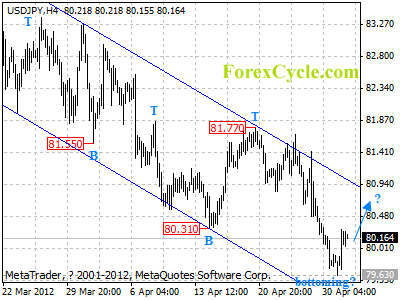
USDJPY may be forming a cycle bottom

USDJPY may be forming a cycle bottom at 79.63 on 4-hour chart. Another rise to test the resistance of the downward price channel would likely be seen, a clear break above the upper line of the channel will signal completion of the downtrend from 84.17 (Mar 15 high), then the following upward movement could bring price back to 83.00 zone. However, as long as the channel resistance holds, the rise from 79.63 is treated as consolidation of the downtrend, and one more fall to 79.00 is still possible.

usdjpy

Daily Forex Forecast

Central Bank News Link List – 1 May 2012

By Central Bank News
Here's today's Central Bank News link list, click through if you missed the previous central bank news link list.  Remember, if you want to submit links for inclusion in the daily link list, just email them through to us or post them in the comments section below.