The Manic-Depressive Stock Market: What to Make of It

The psychology of the market may be teetering on the edge

By Elliott Wave International

The stock market: one week it acts like Dr. Jekyll, the next week it’s Mr. Hyde.

That shift can even occur in the course of a single session.

These dramatic fluctuations appear to be impulsive; and we know that impulse does not flow from cold reason. Even so, the Efficient Market Hypothesis would have us believe that investors are constantly applying reason and logic to reach some objective market pricing, via the latest news or measure of stock market valuation.

The February 2010 Elliott Wave Theorist provides insight:

The Efficient Market Hypothesis (EMH) and its variants in academic financial modeling…rely at least implicitly but usually quite explicitly upon the bedrock ideas of exogenous cause and rational reaction. Stunningly, as far as I can determine, no evidence supports these premises…

EMH argues that as new information enters the marketplace, investors revalue stocks accordingly. If this were true, then the stock market averages would look something like the illustration shown [below].

We know that the market does not unfold in the way illustrated above. But we do know that the market has unfolded like this:

So in 2000, did a sudden burst of logic lead investors to realize that the NASDAQ was over-valued?

No. Technology stocks had absurd price/earnings ratios long before the NASDAQ top.

The NASDAQ’s abrupt switch from Hyde to Jekyll stemmed from investors’ collective unconscious. Consider the gazelle that runs in panic because others are: it does not pause to rationally survey the landscape. It explodes in a burst of speed that reaches 90 km/hr within seconds.

Decades ago, multimillionaire stock market operator Bernard Baruch said

…the stock market is people. It is people trying to read the future. And it is this intensely human quality that makes the stock market so dramatic an arena, in which men and women pit their conflicting judgments, their hopes and fears, strengths and weaknesses, greeds and ideals.

This psychology of the marketplace unfolds in waves. That is what we study.


Want to learn what REALLY drives the markets?

The FREE 50-page Independent Investor eBook will challenge conventional notions about investing and explain market behaviors that most people consider “inexplicable.”

You’ll learn how extreme market psychology affects the markets, with some eye-opening charts that provide shocking evidence of the real forces at play in the markets.

We promise to show you a whole new way of thinking about investing. Download the FREE 50-Page Independent Investor eBook Now >>

This article was syndicated by Elliott Wave International and was originally published under the headline The Manic-Depressive Stock Market: What to Make of It. EWI is the world’s largest market forecasting firm. Its staff of full-time analysts led by Chartered Market Technician Robert Prechter provides 24-hour-a-day market analysis to institutional and private investors around the world.


ECB Press Conference Helps Euro Recover

Source: ForexYard

After falling throughout the morning session, the euro was able to stage a partial recovery during afternoon trading yesterday, following comments from ECB President Draghi who reiterated his earlier predictions of euro-zone economic growth during the second half of the year. Turning to today, investors will be carefully monitoring the US Non-Farm Payrolls, set to be released at 12:30 GMT. Analysts are forecasting today’s news to come in at 173K. While that number would represent a significant increase over last month’s Non-Farm figure, it is not considered high enough to signal strong growth in the US labor sector. Still, should today’s news come in at or above expectations, the greenback could see gains to close out the week.

Economic News

USD – All Eyes on Today’s US Non-Farm Payrolls Report

The dollar saw steady gains vs. its main currency rivals during morning and mid-day trading yesterday, as the combination of a disappointing Spanish debt auction and a better than expected US Unemployment Claims figure caused investors to shift their funds back to the greenback. The EUR/USD fell around 70 pips, reaching as low as 1.3095 during the afternoon session, before staging a correction during the second half of the day. The pair eventually recovered, reaching as high as 1.3178. Against the yen, the dollar gained over 40 pips over the course of the day, before falling due to a worse than expected US Non-Manufacturing PMI. The USD/JPY eventually stabilized around the 80.30 level.

As we close out the week, traders will want to pay careful attention to the US Non-Farm Payrolls figure, scheduled to be released at 12:30 GMT. The employment statistic is widely considered to be the most significant indicator on the forex calendar, and consistently leads to market volatility. Analysts are forecasting the indicator to come in at 173K, which if true would represent a substantial increase over last month’s disappointing 120K end result. Should today’s figure exceed expectations, the dollar could see gains against most of its main currency rivals, including the euro and yen. That being said, should the news come in below the forecasted level, the greenback could see heavy losses.

EUR – Euro Reverses Bearish Trend Following ECB Statement

Following a somewhat disappointing Spanish debt auction yesterday, the euro dropped against its main currency rivals, including the British pound and Japanese yen. That being said, the common currency was able to stage a recovery later in the day, following a speech from the ECB President, where he restated his expectations of economic growth during the second half of the year. The EUR/GBP rose by 40 pips following the speech, reaching as high as 0.8142 before staging a downward correction. Against the yen, the common currency shot up close to 70 pips, peaking at 106.11 before moving downward. The pair eventually stabilized at 105.75.

Turning to today, the euro is likely to see heavy volatility when the US Non-Farm Payrolls figure is released. The euro saw significant gains against the dollar following last month’s worse than expected Non-Farm figure. Should today’s news come in below the predicted value of 173K, the EUR may be able to repeat last month’s gains. Turning to next week, traders will want to note the results of elections in France and Greece scheduled to take place this weekend. Any dramatic changes in either of the governments may result in euro losses to start off the week.

Gold – Gold Slips Following US Unemployment Claims

A lower than expected US Unemployment Claims figure led to a drop in the price of gold during trading yesterday. 365K people filed for unemployment insurance in the US last week, well below the forecasted level of 381K. The news led to some dollar gains during afternoon trading, which subsequently caused gold to fall. A bullish USD typically causes gold to fall, as it makes the precious metal more expensive for international buyers. By the afternoon session, gold was trading below $1635 an ounce, down from $1647 earlier in the day.

Turning to today, traders can anticipate volatility in the price of gold following the release of a highly significant US employment figure. Should today’s news result in additional USD gains, the price of gold could drop further. At the same time, if today’s news disappoints and the dollar turns bearish, gold may be able to recoup some of yesterday’s losses.

Crude Oil – US Oil Inventories Causes Oil to Fall

The price of crude oil fell by over $2 a barrel during European trading yesterday, following an increase in US inventories which signaled decreased demand in the world’s largest oil consuming country. By the afternoon session, oil was trading below $103 a barrel, its lowest level in over a week.

Turning to today, the direction oil takes will largely be determined by the US Non-Farm Payrolls figure and what impact the news will have on risk taking in the marketplace. Should the news lead to gains for the US dollar, the price of oil could continue to drop ahead of markets closing for the week. At the same time, if riskier currencies move up following the news, oil could recoup some of yesterday’s losses.

Technical News

EUR/USD

The MACD/OsMA on the daily chart appears close to forming a bearish cross, indicating that this pair could see upward movement in the near future. Additionally, the Williams Percent Range on the same chart is moving down at the moment and could soon cross into oversold territory. Traders will want to keep an eye on these indicators, as they may signal an impending upward correction.

GBP/USD

The Williams Percent Range on the weekly chart is in overbought territory, meaning that this pair could see downward movement in the near future. Furthermore, the MACD/OsMA on the daily chart appears to be forming a bearish cross. Going short may be the preferred strategy for this pair.

USD/JPY

A bullish cross on the daily chart’s Slow Stochastic points to a possible upward correction. That being said, most other long-term technical indicators show this pair trading in neutral territory, meaning that no defined trend can be predicted. Traders may want to take a wait and see approach, as a clearer trend may present itself shortly.

USD/CHF

Most long-term technical indicators show this pair range-trading, meaning that no defined trend can be predicted at this time. That being said, the weekly chart’s MACD/OsMA appears close to forming a bearish cross. Traders will want to keep an eye on this indicator. Should the cross form, it may be a sign of impending bearish movement.

The Wild Card

NZD/JPY

The Williams Percent Range on the daily chart has dropped into oversold territory, indicating that this pair could see an upward correction in the near future. Furthermore, the Slow Stochastic on the same chart appears close to forming a bullish cross. Should the cross form, it may be a good time for forex traders to open long positions.

Forex Market Analysis provided by ForexYard.

© 2006 by FxYard Ltd

Disclaimer: Trading Foreign Exchange carries a high level of risk and may not be suitable for all investors. There is a possibility that you could sustain a loss of all of your investment and therefore you should not invest money that you cannot afford to lose. You should be aware of all the risks associated with Foreign Exchange trading.


Political Uncertainty May Weigh Down on EUR

Source: ForexYard

printprofile

The euro took mild losses against its main currency rivals ahead of today’s highly significant US Non-Farm Payrolls report. The EUR/USD fell over 20 pips to 1.3125 during morning trading, while the EUR/JPY dropped as low as 105.20.

The euro may be able to reverse its bearish trend before markets close for the week if today’s Non-Farm statistic comes in below the expected 170K. That being said, analysts are quick to warn that with elections in France and Greece this weekend, any gains the common currency makes could be temporary. Opposition parties are expected to take power in both countries, which may lead to a conflict with other euro-zone countries regarding recent austerity measures in the region.

Traders will want to pay attention to the results of the elections, which are scheduled to be released before markets open on Sunday night. Should any signs of a disagreement between either France or Greece and other euro-zone countries come about, the euro could start off next week’s session on a bearish note.

Forex Market Analysis provided by ForexYard.

© 2006 by FxYard Ltd

Disclaimer: Trading Foreign Exchange carries a high level of risk and may not be suitable for all investors. There is a possibility that you could sustain a loss of all of your investment and therefore you should not invest money that you cannot afford to lose. You should be aware of all the risks associated with Foreign Exchange trading.

Market Review 4.5.12

Source: ForexYard

printprofile

The US dollar saw very little movement during overnight trading as investors eagerly anticipate the outcome of today’s US Non-Farm Payrolls figure. Crude oil continued to fall during the Asian session, as poor fundamental indicators out of the euro-zone and an increase in US stockpiles weighed down on the commodity.

Main News for Today

US Non-Farm Employment Change-12:30 GMT

o Largely considered the most important indicator on the forex calendar
o Analysts are forecasting today’s news to come in at 170K
o Should the news come in below expectations, the dollar could see losses against the yen before markets close for the week

Next Week

Euro-Zone Elections 6.5.12

o Elections in both Greece and France are forecasted to generate volatility in the marketplace
o Opposition leader is forecasted to win in France, which could result in losses for the euro during next week’s trading

Forex Market Analysis provided by ForexYard.

© 2006 by FxYard Ltd

Disclaimer: Trading Foreign Exchange carries a high level of risk and may not be suitable for all investors. There is a possibility that you could sustain a loss of all of your investment and therefore you should not invest money that you cannot afford to lose. You should be aware of all the risks associated with Foreign Exchange trading.

Why China’s New Consumer Economy Won’t Give You the Trade of the Decade

By MoneyMorning.com.au

Today, we’re back to giving you some actionable advice…rather than just throwing a few thoughts at you.

Yesterday we explained that China’s economy wasn’t going to be a global economic saviour.  Instead, it’s about to head towards an economic death as it shifts directly from a producing economy to a consumer economy.

But what you need to know is how to make a quid from this shift…or whether you should ignore it.  We’ll show you our idea in a moment.  But first let me fill you in on the background story…

New Model for France

‘I want a new model for France where success will be admired, where talent and merit will be rewarded.  I want a new model for France, where those who’ve worked all their lives can live through their retirement without being a burden on their children’ – French President, Nicolas Sarkozy (as quoted by the Australian Financial Review)

We wonder if M. Sarkozy listen to Martin Luther King Jr.’s ‘I have a dream’ speech before delivering his own garbled (and much less inspiring) effort.

We hear the same message time and again from world leaders about rewarding talent.  But you know the saying.  They like to talk the talk, but they never walk the walk.

Why?

If you leave the market alone, it could go in any direction and do all sorts of impulsive and amazing things.

This is what markets do every day and it works perfectly…as long as busybody bureaucrats keep their noses out.

But that’s the thing, the maniacs who seek political office do so because they want power.  The power to change things and interfere.  You don’t seek high office just so you can sit there and not fiddle with things.

But when bureaucrats fiddle, it’s to curry favour with parts of the electorate.  And that will always create distortions and bad investments within an economy.

But not everyone agrees with us.  In fact, it puts us in the corner opposite to David Thomas, an expert on the BRIC nations (Brazil, Russia, India and China).  He spoke at the After America conference in March.

At the conference, he told the crowd:

‘I think one of the things about China — and everybody in China always says to me — is that if you want to know where China is going, just read the five–year plan because it tells you. There’s no surprise. They don’t miss targets that they set in their five–year plan. This particular five–year plan that was just released last year is one of the most colossal documents they’ve ever produced.

It’s extremely detailed. It took years to create. It involved debate and discussion at every level of the government and I think it’s one that we can rely on quite well. It’s also a bit of a turning point because after 30 years of sort of growth at any cost type activity, now they’re actually turning their economy into a modern–type economy.  I think looking at the five–year plan gives us a lot of clues as to where the future opportunities are doing to be, both from a business perspective, but also as investors.’

David Thomas urged the crowd to read China’s five–year plan.  He guessed that no one would.

And we won’t either.  We see little enjoyment in reading the rambling words of maniacal clones who genuinely think they can steer the Chinese and global economies as they see fit.

But it is true, some Australian industries will gain from the shift to Chinese consumerism.  David Thomas listed a whole bunch of them.  He included tourism and financial services.

Trying to Ride China’s Consumer Dragon Won’t Work

But we’d advise caution about trying to ride the Chinese consumer dragon. Because if you think it will be a repeat of the Resources Boom, you could be in for a nasty surprise…

The easiest (and frankly, most obvious) trade is to make the following judgement: China bought Aussie resources when it was building its infrastructure.  And so China will buy lots of Aussie services when it becomes a consumer economy.

Hold fast.  Investing isn’t that easy.

For a start, Australia isn’t called the ‘Lucky Country’ for nothing.

It’s lucky that it contains some of the biggest and most wide-ranging mineral and energy deposits in the world.  Having a natural resource doesn’t take skill.  Of course finding it and digging it up does take skill.

But if a country doesn’t have natural resources such as iron ore, copper, oil, uranium or gold, there’s not much anyone can do about it.

Another speaker at the After America conference was global strategist at Societe Generale, Dylan Grice.  When he got back to the U.K., he wrote this:

‘I had a great time in Oz: fantastic people, wonderful atmosphere, and a truly beautiful country.  But I felt more relaxed when Australians called themselves the ‘lucky country’ with their typical honesty, realism and humility.  Now that it’s been upgraded to the status of ‘miracle’ I’m worried.’

Grice was referring to a book by journalist George Megalogenis, where he talks about the ‘Australian miracle’.

Of course, having a bunch of resources isn’t a miracle.  It’s luck.  Australia was dealt a good hand in the resources department thanks to Mother Nature, rather than skill.  But what about the consumer services sector?  How do things stack up for the Aussie economy there?

That’s a completely different kettle of fish.

Yes, Australia has a consumer services sector, but so does every other country.

Yesterday we wrote about competitive advantage.  China’s economy has a competitive advantage over others due to a large population and cheap labour.

Exactly where is Australia’s advantage in the consumer services industry?  To use David Thomas’s two examples — tourism and financial services — where does Australia stack up compared to other nations?

First tourism.  Let’s compare flight times between Beijing and Sydney, and Beijing and San Francisco…both are roughly 12 hours.  So no advantage there.

And financial services?  We hear talk that many would like to make Sydney an Asia financial hub…surely if that happens it will attract the Chinese, right?

Clearly those who think that have never heard of a place governed by China since 1997…we’re talking about Hong Kong.  A city that already has one of the most developed financial markets in the world.

Why would China leapfrog Hong Kong, where it can set its own rules and regulations, to support a finance industry in a foreign city that’s a 12-hour flight away?

But what about the idea that Aussie services companies are poised to strike when China’s consumers unleash themselves on the world?  We ask, ‘Where are all those services companies now?’

If they can’t get their act together to sell to the 5.5 billion people in the world who aren’t Chinese, why assume they’ll do any better when 1.5 billion Chinese start buying?

You only have to look at the weak online efforts of most Aussie retailers.  Aussie services companies are totally unprepared for globalisation and exports.

The Best Investment Idea for the Next Eight Years – Won’t Rely on Chinese Consumerism

All that explains why we’re ignoring this line of investment completely.  It’s too obvious and it’s a darn bad idea.

Instead, we’re looking where few others dare look.  Where exactly?  Africa and Europe.  And we’re not wasting our time on waiting for the Chinese consumer to start spending, either.

Because if you wait for that, sure, it could happen soon…but it may never happen.  And if you’ve been twiddling your thumbs waiting to make a killing from the Chinese consumer, you’ll have wasted a lot of time and many good opportunities.

So our advice is this.  Forget the Chinese consumer for now.  If it ever happens, you don’t need to be in the trade from day one.  You won’t miss much if you turn up late.

And rather than focus on pie–in–the–sky investments, we’re looking at companies that are searching for and producing things industries and consumers need right now — energy.

If you want a trade that could set you up for life, here’s our advice…

Punt on stocks where Aussie companies have plenty of skill and knowledge.  Companies that will see a strong demand for their products whether China becomes a consumer–driven economy or not…we’re talking about oil and natural gas.

That’s where Australia has a competitive advantage.

It’s the trade for 2012.  And as we see it, it’s the trade for the rest of the decade.

Cheers.
Kris

Related Articles

The Conference of the Year “After America” DVD

Why You MUST Speculate

Disruptive Technology Stocks For Smart Small-Cap Investors


Why China’s New Consumer Economy Won’t Give You the Trade of the Decade

Reverse Polarity in World Markets

By MoneyMorning.com.au

In order to talk about cycles, and how they can help your understanding of world markets, brings me to an idea I want to share with you. It’s also an idea that describes and predicts great change in the world.

The idea is that the world’s financial markets might be subject to the same kind of polarity reversal our own planet has periodically experienced. This reversal amounts to an enormous change in asset allocation models and even the way people think about risk. And according to PIMCO’s Ramin Toloui, the way to start preparing for this rebalancing of growth is to buy more government bonds in emerging markets.

A rebalancing of the world’s available pool of investable cash, based on a fundamental shift in attitudes toward risk, is basically the end of the world for the US dollar standard. PIMCO doesn’t say that. But it’s telling investors to plan for it and to profit from it.

But let me back up a second and explain what I mean about reverse polarity in scientific terms. For the planet, I’m talking about an event where the magnetic poles of the Earth reverse. North becomes South and South becomes North. It’s actually happened quite often, according to scientists And it will certainly happen again.

As you might expect, this kind of change can be pretty disruptive, especially if you’re eating your lunch at your desk on a Tuesday. It probably won’t be good for real estate values…anywhere. In fact, some scientists speculate that reverse polarity is what allowed the solar wind to blow away the atmosphere on Mars and make that planet less hospitable to life.

A Sudden Change of Direction for World Markets

I thought of reverse polarity because it’s one of the only metaphors that could describe a sudden change in the way the world’s large money managers and investors perceive risk. The current distinction is between the developing world and the developed world, between emerging markets and emerged markets, or between the US/Europe/Australia/ Japan and Brazil/China/Russia/South Africa/India/Indonesia/Korea etc.

Up until 2007, the idea is that one category of countries (the developed world) is “safe” while the other countries are “risky.” Thus, “risk on” trades saw investors buy emerging markets and commodities while “risk off” trades saw rallies in the US dollar, yen, euro (generally) and blue chip developed world stocks.

It’s a pretty simple way of thinking about the world markets and where to put your money at the right time. The only trouble is this description of the world no longer matches the world. The description needs to change. And like any change in investment markets, being ahead of it is better than getting run over by it.

Besides, after two years of constant crisis, the government bonds of developed world countries like the US, Spain, the UK, and Italy can hardly be described as “safe.” And in any event, their yields (on the shorter-term debt) are all nearing zero in nominal terms and below zero in real terms. The news about various bond auctions is a giant distraction.

Meanwhile, in the so-called developing world, government debt ratios as a percentage of GDP tend to be lower, savings rates higher, and GDP per/capita growing (rather than shrinking). Yet investments in the so-called developing world are still considered “risky” while US debt is considered “safe.”

This general attitude toward risk is subject to a pole reversal. It occurred to me that attitudes toward risk can change quickly too, with huge investment consequences. Attitudes at the margin are already changing. The fact that it’s showing up in PIMCOs advice to clients is another sign that the idea could reach a “tipping point.”

But a “tipping point” is another way of saying an event needs a catalyst to initiate what chemists would call a “phase change.” Solids don’t turn to liquids without a phase change. Liquids don’t turn into gasses without a phase change. And investors don’t suddenly change their attitude toward the world without a similar phase change.

Dan Denning

Editor, Australian Wealth Gameplan

From the Archives…

Why Graphite is the High Tech Commodity of the Future

2012-04-27 – Dr. Alex Cowie

Why Gold is Hands-Down the Best “Money” You Can Buy

2012-04-26 – Kris Sayce

12% Compulsory Super – Get Ready for the Government’s Next Tax Grab

2012-04-25 – Kris Sayce

Westfield – The Aussie Retail Stock That Could Make You Money

2012-04-24 – Shae Smith

Why Natural Gas Is Still My Favourite Resource Opportunity

2012-04-23 – Kris Sayce

For editorial enquiries and feedback, email [email protected]


Reverse Polarity in World Markets

Visa, MasterCard Still Charging Forward

By The Sizemore Letter

Credit card rivals MasterCard (NYSE:$MA) and Visa (NYSE:$V) released earnings on Wednesday, and both knocked the ball out of the park.

We’ll start with MasterCard.  This smaller of the two rivals enjoyed earnings growth of 25% in the first quarter and a 17% increase in worldwide purchase volumes.  Not to be outdone, Visa announced a 30% rise in earnings per share on an 11% rise in payments volume.

I admit, I’m a little partial to Visa.  The stock was my pick last year in InvestorPlace’s “10 Stocks for 2011” contest, and it crushed the competition.  (Alas, Turkcell (NYSE:$TKC), my pick for 2012, is off to a slower start—for now).

But as great as Visa’s performance has been over the past year and a half, MasterCard has been the better stock.

As a smaller, nimbler company, MasterCard’s growth has been more impressive than Visa’s in recent years, and MasterCard suffered less fallout from the Dodd-Frank Durbin Amendment fiasco that sought to limit the fees charged to merchants for debit cards.  Yet I contend that Visa remains the better long-term buy for reasons I’ll address shortly.  First, I’ll throw a bone to MasterCard bulls.

One of the provisions of the Durbin Amendment allowed merchants to choose the network that they used to process debit card transactions.  As the bigger of the two networks, Visa had far more to lose than MasterCard, and MasterCard has profiting handsomely at Visa’s expense.  Visa’s debit volume grew by only 2% for the quarter, while MasterCard’s grew by over 20%.  MasterCard will likely continue to nip at Visa’s heels for the foreseeable future in the U.S. debit market, which is the single most important segment of Visa’s business.

MasterCard and Visa have both benefitted from improving consumer sentiment in the United States and, outside of Europe, a healthier global economy.  But even if consumer spending growth is tepid in the years ahead, there is every reason to believe that both MasterCard and Visa can continue to see spectacular growth in purchase volumes (both credit and debit).

The world is going cashless.  Perhaps nothing illustrates this more than the various new iPhone credit-card-swiping apps.  Yes, next time you borrow $20 from your buddy, you can pay him back using nothing more than a credit or debit card and an iPhone.  Gotta love it.

Yet despite the seeming ubiquity of credit and debit cards, roughly 40% of all transactions are still carried out by cash and paper checks in the United States.  Remember, the United States is the most heavily penetrated of all major markets, so the percentage is much lower virtually everywhere else in the world.

This brings me to my primary reason for favoring Visa over MasterCard—Visa is far better positioned to profit from the rise of the emerging market consumer.

Visa already gets nearly half of its revenues from overseas, and most of this is from emerging markets. As incomes rise in the developing world, consumers have far more discretionary income than they used to, and they are spending a greater percentage of that with a swipe of plastic .

Alas, I would be remiss if I didn’t mention one big negative for Visa.  During the earnings release conference call, Visa announced that the U.S. Department of Justice was investigating the company for potential anti-trust violations related to debit card processing.  It’s too early to say how serious the investigation is or what Visa’s potential liability is, but the news sent the share price down sharply after hours.

At this stage, I do not see the investigation having a significant impact on Visa’s business, and I recommend using any weakness in the share price as an opportunity to accumulate more shares.

Disclosures: Visa is held by Sizemore Capital clients.


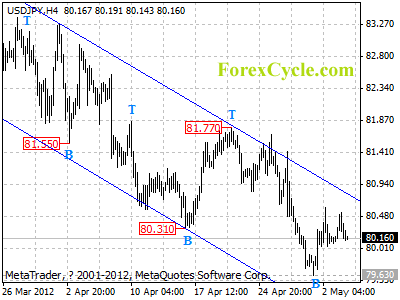
USDJPY remains in downtrend from 84.17

USDJPY remains in downtrend from 84.17, the price action from 79.63 is treated as consolidation of the downtrend. Resistance is at the upper line of the price channel on 4-hour chart, as long as the channel resistance holds, downtrend could be expected to resume, and another fall to 79.00 is still possible. On the other side, a clear break above the channel resistance will indicate that the downward movement from 84.17 has completed at 79.63 already, then the following upward movement could bring price back to 83.00 zone.

usdjpy

Daily Forex Forecast

Central Bank News Link List – 3 May 2012

By Central Bank News
Here's today's Central Bank News link list, click through if you missed the previous central bank news link list.  Remember, if you want to submit links for inclusion in the daily link list, just email them through to us or post them in the comments section below.

Next Week Forecast for Major Pairs

By TraderVox.com

Tradervox (Dublin):

EUR/USD: the pair has remained in range over the week with ADP report causing the pair to increase considerably. Next week we are expecting some good reports from Germany which might cause the pair to continue with its current bullish trend. The pair might break the 1.31 to move higher to 1.3212 resistance level during the next week.

GBP/USD: the British pound closed the week 130 pips higher, and it has maintained its strength amidst safe haven demand during the week. Investors are looking at the sterling as a better option for risk aversion than the dollar amidst mixed reports from the country. The pair opened the week above 1.60 but later dropped to mid 1.60. We expect the pair to remain at mid 1.61 during the coming week. Our outlook for the GBP/USD remains bullish.

USD/JPY: this pair has maintained its 80.0 level for most of the week. With poor data from the US, the yen might advance as more investors choose the yen over the dollar as safe haven currency. However, such advance will be mitigated by the Bank of Japan which is expected to do any possible to keep the yen weak. Over the next week, the dollar/yen pair may not see much of change. Our outlook for the pair of the next week is neutral.

USD/CHF: the pair traded at a narrow range over the past week and closed the week almost unchanged at 0.9060. The pair has been somehow quiet with only two releases. However, the coming week will be busy with three major reports from Switzerland expected to be released on May 7. Other reports from the US to be released later in the week will also affect this pair. The USD/CHF opened the week just under 0.91 at 0.9097 gaining weak resistance at 0.9204. Next week’s outlook for the pair remains neutral and we might see it remain at higher 0.90.

Disclaimer
Tradervox.com is not giving advice nor is qualified or licensed to provide financial advice. You must seek guidance from your personal advisors before acting on this information. While we try to ensure that all of the information provided on this website is kept up-to-date and accurate we accept no responsibility for any use made of the information provided. Opinions expressed at Tradervox.com are those of the individual authors and do not necessarily represent the opinion of Tradervox.com or its management. 

Article provided by TraderVox.com
Tradervox.com is a Forex News Portal that provides real-time news and analysis relating to the Currency Markets.
News and analysis are produced throughout the day by our in-house staff.
Follow us on twitter: www.twitter.com/tradervox