Euro Drops after Greek and French Elections

By TraderVox.com

Tradervox (Dublin) – Greek and French elections have put great pressure on the euro and other high yielding currencies as concerns about the region’s ability to deal with sovereign debt crisis increased. The euro dropped to a 3-month low after Francois Hollande won the French election against the incumbent Nicolas Sarkozy who got 48 percent of the vote against 52 percent for the Socialist party leader Hollande. In Greece, voters are supporting anti-bailout and anti-austerity parties as the preliminary election was held on Sunday. These results have increased concerns that austerity programs in the 17-nation trading bloc will be derailed.

The euro declined for the sixth day today, making it the longest decline period since September last year. This has come at a time when elections in the region are showing continued resentment of the austerity efforts. The German Chancellor’s party registered the worst election result in Schleswig-Holstein state in more than half a century compounding the problems raised by the Greek and French elections. In the meanwhile, the yen and the greenback rose, as the market sought for safe haven.

According to some market analysts, traders are showing their concerns about the euro as voters in Greece and France are showing their dissatisfaction with the austerity measures. Results from France and Greece are indications that the debt crisis in Europe might prevail for a longer period as new negotiations are expected to be started. The debt crisis in Europe has driven several economies in the region back into recession including Spain and Netherlands. The austerity measures taken by the region were meant to deal with the debt crisis in the region but this has now gotten a blow as major supporters of the program have been defeated in their domestic political elections.

The euro declined against the US dollar to trade at $1.2986, after it had earlier declined to $1.2955, which the weakest since January 25. The 17-nation currency dropped 0.9 percent against the yen to trade at 103.59 yen.

Disclaimer
Tradervox.com is not giving advice nor is qualified or licensed to provide financial advice. You must seek guidance from your personal advisors before acting on this information. While we try to ensure that all of the information provided on this website is kept up-to-date and accurate we accept no responsibility for any use made of the information provided. Opinions expressed at Tradervox.com are those of the individual authors and do not necessarily represent the opinion of Tradervox.com or its management. 

Article provided by TraderVox.com
Tradervox.com is a Forex News Portal that provides real-time news and analysis relating to the Currency Markets.
News and analysis are produced throughout the day by our in-house staff.
Follow us on twitter: www.twitter.com/tradervox

Aussie and Kiwi Fall over Europe Elections

By TraderVox.com

Tradervox (Dublin) – Risk appetite declined in the market as election results from France and Greece elicited concerns that the region will encounter difficulties in implementing austerity measures. The Australian and New Zealand dollars fell amid these concerns as risk appetite declined.

The Aussie dropped to the weakest this year against the US dollar after France election results were announced declaring Francios Hollande the new French president defeating pro-bailout and pro-austerity incumbent president Surkozy. In Greece, anti-bailout parties gained momentum hence compounding the sovereign debt crisis resolve efforts. The effects of the elections in Europe could not be counseled by positive domestic reports showing gains in Retail Sales and Building Approvals. Its counterpart, the New Zealand dollar, fell against the US dollar and the Yen as Asian stocks continued with a global rout.

According to Senior Currency Strategist, Sean Callow, of Westpac Banking Corp, the election results from Europe may bring the next wave of instability in the region as voters express there rejection of the austerity measures. He also said that the Kiwi and Aussie are expected to remain under pressure as this crisis continues. Francios Hollande got about 52 percent of the votes against 48 percent of the incumbent Nicolas Sarkozy. In Greece, the New Democracy and the Socialist Party, which are the two parties that secured a second bailout for Greece, are expected to be defeated in the election falling short of 151 seats needed to win a majority.

The Aussie fell by 0.4 percent against the dollar to trade at $1.0142, after it had touched this year’s lowest of $1.0110, which was last registered in December 29 last year. The Australian dollar is set for its longest spell of daily decline as it goes for the sixth day. The Aussie lost 0.4 percent against the yen to trade at 80.95 yen after touching 80.57, the lowest since January 30.

The kiwi declined to 79.07 US cents, it lowest since January 13, before trading 0.4 percent lower than May 4 close at 79.25. The kiwi was 0.5 percent down against the yen to trade at 63.24 yen.

Disclaimer
Tradervox.com is not giving advice nor is qualified or licensed to provide financial advice. You must seek guidance from your personal advisors before acting on this information. While we try to ensure that all of the information provided on this website is kept up-to-date and accurate we accept no responsibility for any use made of the information provided. Opinions expressed at Tradervox.com are those of the individual authors and do not necessarily represent the opinion of Tradervox.com or its management. 

Article provided by TraderVox.com
Tradervox.com is a Forex News Portal that provides real-time news and analysis relating to the Currency Markets.
News and analysis are produced throughout the day by our in-house staff.
Follow us on twitter: www.twitter.com/tradervox

Week Ahead: Major Events

By TraderVox.com

Tradervox (Dublin) – After voters in Greece and France voted against austerity measures, the euro is expected to have a tough week ahead. In Greece, the new government is expected to try and renegotiate the bailout conditions and this is expected to hurt the euro in the short term. In France, Francios Hollande’s victory is expected to change the austerity policy in Europe. These are some of the issues that will affect the euro in the short term; however, here are some of other major events that will move the market during the week.

Monday 7

The ANZ job Advertisements report for April will be released at 0130hrs GMT. This report will show the number of jobs advertised in the month of April which is an indication of future employment growth. A high number is regarded as bullish for the AUD while low reading is bearish.

Another report expected to affect the market is the Swiss Unemployment rate NSA. It is expected that the rate of unemployment dropped during the month fro, 3.2 percent to 3.1 percent. This is expected to strengthen the CHF against the dollar and the euro.

Tuesday 8

At 1130hrs GMT, the market will get the NFIB Business Optimism Index in the US. The previous reading was at 92.5 but the market is expecting a decrease in this value following the poor NFP report coming from the world’s largest economy.

Wednesday 9

The market will be keen on the Japan Leading Economic Index for the month of March. The report will be released by the cabinet office at 0500hrs GMT and it is expected to show an increase to 97.0 from the previous reading of 96.3. The report is expected to show confidence in the Japan economy.

Thursday 10

On this day, the UK Rate decision is the main event that will carry the day. The report is scheduled to be released at 1100hrs GMT. The market expects the BOE Monetary Policy Committee to maintain the current 0.50 percent interest rate.

Friday 11

The major event of the day will be the US PPI. The market is expecting the reading to remain unchanged for the second month.

Disclaimer
Tradervox.com is not giving advice nor is qualified or licensed to provide financial advice. You must seek guidance from your personal advisors before acting on this information. While we try to ensure that all of the information provided on this website is kept up-to-date and accurate we accept no responsibility for any use made of the information provided. Opinions expressed at Tradervox.com are those of the individual authors and do not necessarily represent the opinion of Tradervox.com or its management. 

Article provided by TraderVox.com
Tradervox.com is a Forex News Portal that provides real-time news and analysis relating to the Currency Markets.
News and analysis are produced throughout the day by our in-house staff.
Follow us on twitter: www.twitter.com/tradervox

Market Review 7.5.12

Source: ForexYard

printprofile

The euro sank to a three-month low against the US dollar during overnight trading as investors continue to digest the results of yesterday’s elections in France and Greece. Crude oil extended its bearish trend as well, dropping over $2 a barrel during Asian trading.

Main News for Today

EUR Sentix Investor Confidence- 08:30 GMT
o Level of investor confidence is forecasted to have dropped since last month
o A final result of below -15.3 may lead to additional losses for the euro

EUR German Factory Orders- 10:00 GMT
o Factory orders in Germany forecasted to have gone up since last month
o A final result of over 0.5% could give the euro a temporary boost

CAD Building Permits- 12:30 GMT
o USD saw major gains against CAD due to risk aversion in the marketplace
o With today’s news forecasted to come in well below last month’s, the loonie’s bearish trend may contine
o A final result of below -0.5% could lead to additional losses for CAD

Forex Market Analysis provided by ForexYard.

© 2006 by FxYard Ltd

Disclaimer: Trading Foreign Exchange carries a high level of risk and may not be suitable for all investors. There is a possibility that you could sustain a loss of all of your investment and therefore you should not invest money that you cannot afford to lose. You should be aware of all the risks associated with Foreign Exchange trading.

Another Nail in the Coffin of the US Economic Recovery

By MoneyMorning.com.au

On Friday night we had April’s US employment numbers. They showed that the economy added just 115,000 jobs during the previous month.

That may not sound too bad, but doesn’t go very far across a population of 312 million people recovering from a financial crisis.


The other problem is that this is now the second month in a row that these numbers have been a bit ‘soggy’.

From October of last year to this February, the monthly job numbers seemed to be gathering momentum. After being up and down like the proverbial for the last two years, they finally seemed to be forming a trend.

2 months of soggy US new jobs numbers

2 months of soggy US new jobs numbers

Source: forexfactory

But these last few months have put the US economic ‘recovery’ into question.

This is a big reason why the US markets fell so badly on Friday night. The S&P500 fell 1.61%. And the Dow Jones Industrial Average fell 168 points, or 1.27%. Where the US markets go, the Australian market follows. This morning the Aussie market is down more than 1%.

Unfortunately, this rule works much better when the market falls than when it rises.

What is strange is that even though April’s employment numbers were disappointing, the US unemployment number actually FELL from 8.2% to 8.1%.

This has been falling steadily for months now. It was 9.1% just 6 months ago. But the market wasn’t impressed, and with good reason. The number is pretty meaningless, as it ignores those people that have given up looking for work.

My good pal and colleague, Murray Dawes, the editor of Slipstream Trader, has been following this for his subscribers, so I picked his brains for you this morning. Here’s a snapshot of our chat this morning. I started off by asking him what the job numbers meant for the markets…

Murray: ‘Friday night’s data has put the nail in the coffin of the idea that this recovery is gathering steam. The numbers are even worse if you dig a little beneath the surface. The BLS (Bureau of Labor Statistics) keeps fudging the numbers to make them look better than they are. For example the participation rate fell yet again by 0.2 to 63.6%. It is now at its lowest level since 1981. By lowering the participation rate the unemployment rate falls. Therefore the reported unemployment rate dropped 0.1 to 8.1%. This figure is a mirage. Without the falls in the participation rate the US unemployment rate would be well over 11%. The household survey said that the number of people employed actually fell by 169,000. The situation is much worse than it appears.’

Alex: ‘So Murray, you’ve been expecting the market to turn down for a while now, and Friday night’s drop in the US markets was fairly meaty. You have been telling your readers to short the market in preparation for this. Just how bearish are you now?’

Murray: ‘I have a strongly bearish view. In Slipstream Trader we currently have the biggest short position that I’ve had for over a year. US markets are having a false break of last April’s high and my immediate target for the S+P 500 is 1280-1300. That’s 7% below current levels. But that’s only an initial target. If Europe unravels the S+P 500 could head even lower – unless [US Federal Reserve chairman, Ben] Bernanke waves his wand and prints more money.’

Alex: ‘The Australian market is down on the back of the US data, but wouldn’t you say yesterday’s French election result is having an effect too? It’s ‘Au revoir’ to Mr Sarkozy, and ‘Bonjour’ to Presidente Hollande. As France is the second biggest economy after Germany, what do you reckon this election result means for the mess that Europe is in?’

Murray: ‘The elections in Europe are just a continuation of the change of leadership that’s occurring across the whole Eurozone as a result of the crisis. I don’t think France will be saved by installing a tax-and-spend socialist. The reason they are in the mess they’re in is because of the Welfare State paradigm. Now they want to do more of what caused the problem. Expect to see yet more ‘can-kicking’ at every opportunity until the whole thing blows sky high. Watching the bond market’s reaction to the French election will be interesting.’

The New Dynamic in Europe

The relationship between the outgoing Sarkozy and the German Chancellor, Angela Merkel, has been a cornerstone of how Europe has handled the crisis. But President Hollande was voted in on a mandate of renegotiating this relationship, and their countries plans for Europe.

Symbolically, his first meeting as President will be with Merkel, so he’s not wasting any time.

Those European bond markets Murray mentioned start trading later on today. The Spanish yields in particular had been worrying the markets as they jumped in the last few months. They have since pulled back. But that could change with so much uncertainty around Europe.

One thing looks certain. The market will see a lot of volatility in the coming weeks. And if there’s one thing traders like, its volatility. For traders that’s great news as it gives them the chance to profit from both rising and falling prices. To see where Murray thinks the market is heading next, check out his stock market update on his YouTube channel tomorrow, for a special update on the French elections, US employment data and the significance of the US market breaking through a key technical level.

Dr. Alex Cowie
Editor, Diggers & Drillers

Related Articles

The Conference of the Year “After America” DVD

Why You MUST Speculate

Disruptive Technology Stocks For Smart Small-Cap Investors


Another Nail in the Coffin of the US Economic Recovery

Why You Should Be Watching Japan’s Economy

By MoneyMorning.com.au

The next phase of this ongoing global crisis may take place in Japan’s economy, not in Europe or the US. This may seem unlikely, given what’s still going on in Europe. Youth unemployment is over 50% in Spain. You’re seeing the limits of economic and monetary policy in Europe. People (some of whom admittedly have vested interests in keeping a cheque from the government coming) are resisting the elite’s policy changes and money shuffling.


The next stage of the European debt crisis is political. But the next stage of the world monetary crisis will probably begin in Japan’s economy. It all goes back to last year’s devastating earthquake, tsunami, and nuclear crisis. That sequence of events has turned Japan into a long term net energy importer. And that single change threatens to send Japan into a major debt crisis this year.

Here are the relevant facts about Japan’s situation:

  • Fiscal deficit 10% of GDP
  • Annual revenues of ¥45 trillion
  • Government debt-to-GDP ratio of 230%
  • First full-year trade deficit since 1980
  • Interest expense will consume revenues at higher interest rates

Japan has run a huge government deficit for years. The current debt-to-GDP ratio of 230% is the highest in the developed world. Before last year’s earthquake, this wasn’t a problem. Japan was a nation of savers. And with a current account surplus, it could finance its own deficits with its own savings. Japanese savers were happy to buy government bonds, which, after all, were a lot better than stocks or real estate – especially for a large group of savers approaching retirement age.

Well, retirement age is now upon Japan. That is one complicating factor for Japan’s ability to sustain large deficits. Retirees are starting to live off their savings, instead of socking the money away with the government. But it gets worse.

The single-biggest economic consequence of last year’s three-part tragedy is that Japan is likely to run current account deficits for a long time. Why? It will now have to import energy, which means buying it at competitive prices on global markets (this is good for Australia, actually).

Japan’s fleet of nuclear power plants will stay idle for some time. It may never get back to full capacity. As you know, Japan is not a nation that’s rich in hydrocarbons. But it’s high end manufacturing industry requires tremendous amounts of electricity.

That electricity will have to come from either coal or natural gas.

It’s not hard to see where this story is going. And we’ll get their shortly. But aside from the rather bullish energy picture, the other major economic consequence is that Japan’s fiscal deficit is becoming more unstable by the day. As the figures above show, the interest on public debt has grown so large that it’s nearly consuming all of the government’s annual tax takings. Annual deficits continue to grow.

The Ponzi Finance Phase for the Japanese Economy

When you reach the point where you have to borrow more money just to pay the interest on money you’ve previously borrowed, you’ve reached what Hyman Minsky called the stage of “Ponzi Finance”. Japan is nearly there.

Now, the first consequence of reaching this point is that Japanese interest rates may start going up. That would be disaster. A rise in interest rates would consume even more of the government’s annual tax takings. You’d see a feedback loop in which debt costs quickly spiral out of control.

But that’s only if Japan must borrow in international markets. Keep in mind the Japanese government is not the only government seeking to borrow trillions of dollars (yen, euro) in the next five years.

This demand for credit will crowd out corporate borrowers. And in any event, the borrowing needs of governments exceed the amount of savings the world has accumulated. Something has to give.

What I expect to happen is that the Japanese will simply monetise new debt. Instead of selling the debt to investors, who will demand higher interest rates based on Japan’s deteriorating fiscal condition, the Bank of Japan will print money. This means Japan may be the first Western Welfare State that reaches the endgame phase of Ponzi Finance.

Dan Denning
Editor, Australian Wealth Gameplan

From the Archives…

Why China’s New Consumer Economy Won’t Give You the Trade of the Decade
2012-05-04 – Kris Sayce

Why China Could Be The Next Destination For the Financial Crisis
2012-05-03 – Merryn Somerset Webb

How Did We Get It So Wrong on Australian Housing?
2012-05-02 – Kris Sayce

This Indicator Shows the Copper Price Could Be Set to Soar
2012-05-01 – Dr. Alex Cowie

How Gold Nanoparticles Will Create A New Kind of Gold Rush
2012-04-30 – Michael Robinson


Why You Should Be Watching Japan’s Economy

Why Buy or Invest in Gold?

By MoneyMorning.com.au

Why buy gold?

One of the problems with putting a price on gold – as gold perma-bears regularly point out – is that it doesn’t pay an income.

Generally, the starting point with valuing an investment is to work out how much income it will pay you in the future, then work out how much you are willing to pay for that.

With gold paying neither dividends nor rent, you can’t do that. So how do you value it?

I’ve just read an interesting report from Julian Jessop at Capital Economics that has a crack at it…

Three Scenarios for Gold: From $1,000 an Ounce to $5,000

Capital Economics has outlined three scenarios for gold over the coming few years. The basic assumption underlying the scenarios is that gold ultimately benefits from financial shocks. In this case, their biggest concern is the eurozone.

Jessop notes that gold has ‘moved fairly closely in line with the cost of insuring against sovereign defaults in Europe.’ In other words, as anxiety grows about the condition of Europe, the gold price tends to rise.

Their central scenario is that Europe experiences a ‘relatively orderly’ break-up, with one or more small countries leaving the eurozone. As a result, the Federal Reserve would keep monetary policy ultra-loose (even if it avoids more quantitative easing), and gold would rise to $2,200. Even at this price, it would still be lower than the inflation-adjusted all-time high of 1980 (which was $2,400 in real terms). It would also be reasonably priced compared to oil.

But what about other outcomes? There’s the disaster scenario, of course. If there’s ‘a chaotic break-up of the euro’, then this could well result in a Lehman-style financial crisis. Throw in a military conflict between the West and Iran, and you could see the gold price spike to ‘as high as $5,000’. It’s a pretty extreme, though not unthinkable outcome, and Capital Economics only assigns a 10% chance to this scenario.

The other possibility, is the more optimistic view. The global economy continues to recover. The eurozone manages to hold it together. As a result, the Fed starts to tighten monetary policy earlier than expected. In this case, Jessop reckons that ‘the downside for gold should still be limited by strong and rising demand from emerging economies, and we would not expect to see a return to the November 2008 lows [of $710 an ounce].’ But $1,000 an ounce would be a possibility.

I’d say that’s a pretty sensible range of views. But it leaves us with a very wide range of predictions – $1,000 to $5,000 an ounce. And realistically, these could be well off the mark. If the global economy went into meltdown, who knows just how high gold would go? Alternatively, if the economy recovers, and the Fed starts raising interest rates, would $1,000 really mark the bottom?

And none of this takes into account the danger of a hard landing in China. Hedge fund manager Hugh Hendry of Eclectica sees this as being an even bigger threat to the financial world than Europe. Everyone is focusing on Europe, as he notes. Very few people are really paying attention to the risks from China.

So as an investor, what does this mean for you in practical terms?

Gold’s Role in Your Portfolio

We like gold. But as we’ve also noted a number of times, you shouldn’t have all of your money in gold – and certainly not in gold mining stocks. We all have our own views on asset allocation, and what’s right for you will depend on your own circumstances. But I’d see 10% as a reasonable sort of holding.

Gold is insurance. It’s there to diversify your wealth. But it’s also there to ensure that even in a worst-case scenario, you’d still have something of value in your portfolio.

Gold is not like cash in the bank. Its nominal value can go up or down. If you’d piled all your money into gold at the 1980 peak, you’d still be sitting on a loss in real terms (ie after inflation). Just as if you’d piled into stocks at the height of the tech bubble. That should be obvious to anyone who can look at a price chart, but with descriptions like ‘safe haven’ often bandied about, it bears mentioning.

The point of gold is that it offers you some protection when most other assets are going down. Gold’s ultimate advantage over any other asset is that its value cannot fall to zero. It can’t go bankrupt. You can’t say that for any other asset.

So when people are fretting about the state of the global financial system, and the integrity of all other assets, that’s good for gold. Once confidence returns, and other assets start looking more attractive, that’ll be bad for gold.

The point is – as with any asset – to make sure that you aren’t over-exposed to gold, so that even when the bull market in gold ends, the rest of your portfolio is benefiting from the return of the good times.

However, with Europe on the edge, and China wobbling too, I suspect we’re at least one big panic away from genuine confidence being able to return to the market. So I can easily see gold hitting new highs before this bull market is over.

John Stepek

Editor, MoneyWeek (UK)

Publisher’s Note: This article originally appeared in MoneyWeek (UK)

From the Archives…

Why China’s New Consumer Economy Won’t Give You the Trade of the Decade

2012-05-04 – Kris Sayce

Why China Could Be The Next Destination For the Financial Crisis

2012-05-03 – Merryn Somerset Webb

How Did We Get It So Wrong on Australian Housing?

2012-05-02 – Kris Sayce

This Indicator Shows the Copper Price Could Be Set to Soar

2012-05-01 – Dr. Alex Cowie

How Gold Nanoparticles Will Create A New Kind of Gold Rush

2012-04-30 – Michael Robinson

For editorial enquiries and feedback, email [email protected]


Why Buy or Invest in Gold?

The Dollar and Manipulation Control the Market

By Chris Vermeulen, GoldAndOilGuy.com

Over the weekend I had an interesting conversation with a local trader. We typically meet a few times a year to share our market outlooks, new trading tools and techniques, and usually finish our session off in a debate about the US market manipulation and how to trade around it.

Talking about market manipulation always opens up a can of worms and sparks some interesting theories… And while everyone has their own views and opinion on this subject I thought I would briefly share the main points I pulled from our conversation.

I did talk about the dollar index last week, but the recent price action unfolding today is important so I’m going to recap on it again.


My Weekend Conversation Key Thoughts:

Point form thoughts supporting Lower Equity prices and a Higher Dollar:

–          Dollar index looks ready for a major rally (high dollar means lower stocks)

–          SP500 may have just formed a double top

–          SP500 closed strongly below the 20 day moving average

–          First week of May for the past two years have been intermediate market tops

Points supporting Higher Equity prices and a Lower Dollar:

–          Countries around the globe are trying to keep their currency value low including the United States.

–          Presidential cycle strongly favors higher stocks prices which means the dollar should not rally until Nov.

What do all these points mean? Let’s take a look at the dollar charts below…


4 Hour Dollar Index Chart:

This chart time frame allows us to see all intraday price action while being able to zoom out several months for patterns along with key support and resistance levels.

As you can see over the past few months the dollar has been consolidating sideways. Within this consolidation it has formed two bullish falling wedges with the most recent one breakout last week right on queue.

Using this 24 hour futures dollar index chart we can see where things are trading through the weekend. On Friday the dollar index closed around the 79.50 level. As you can see the dollar has surged Sunday night by more than half a penny breaking through its down trend line.

The next few weeks will continue to be exciting ones as strong moves in the dollar will create wild movements in stocks and commodities.


Long Term Weekly Dollar Index Chart:

If you zoom WAY OUT using the weekly chart this shows you the two major areas where the dollar index is likely to reach come November. Also with these levels are my SP500 price points which are simply numbers I pulled from the charts using basic analysis. I say this because I’m not into long term forecasting but rather shorter term price movements. A lot can change between now and then.

So, if the dollar index rallies to the 86 – 88 level then I would expect the SP500 to be trading back down at the 1000 level. If this takes place, the Fed will likely issue QE3 to jam the dollar back down and boost equities.

The flip side of the coin is that the dollar rolls over here and gets pulled down. This will boost stock prices in favor for the president’s election. After that the dollar would likely rally which in turn would put a major top in the stock market, kick starting a bear market.


The big question…

Do you short the market in anticipation of rising dollar and falling stock prices? OR do you buck the trend and stick with the theory of a lower dollar value and presidential cycle?

The charts above clearly show how we are entering a major tipping point for the market and the next couple months are likely going to provide some big price swings for stocks, commodities and currencies.

If you want to get my thoughts and market ideas each morning before the opening bell be sure to join my video newsletter GoldAndOilGuy.com

Chris Vermeulen


The Dollar & Gold Have Eyes on Europe

By JW Jones – www.OptionsTradingSignals.com

Friday saw heavy selling pressure coming into risk assets, specifically equities and oil. However, the real driving force behind the selling pressure is likely the result of several unrelated economic/geopolitical events. Clearly the unemployment report had an impact on price action, but strangely enough it would appear to those more in tune with reality that market participants want lower prices so that the next quantitative easing program can be initiated.

Another key development in equities price action as of late has been selling pressure in Apple (AAPL). A few weeks ago we witnessed a sharp downturn after prices surged higher into a blowoff top. Earnings came out and prices jumped again and we have watched Apple’s stock price drop considerably since.

Friday saw sellers circling the wagons pushing the tech behemoth down around 2.25% as of the scribbling of this article. When AAPL was rallying it helped the Nasdaq Composite and the S&P 500 grind higher. Now that it has clearly given up the bullish leadership role, it now appears to be a drag on the price action of domestic indices.

Additionally there was a mountain of economic data released out of Europe overnight which was entirely negative. Spain, Italy, France, Germany, and the Euro-area in general saw their Service PMI readings all come in below expectations. Europe is moving into a recession which whether economists want to acknowledge it or not has implications on domestic U.S. markets. The Eurozone as a whole is the largest economy in the world. Clearly the European economy is slowing, and our exports to Europe will slow as well.

This leads me to the final data point which is still unknown. What will the outcome of the French and Greek elections over the weekend mean for the Eurozone’s geopolitical ties as well as the potential impact on the Euro currency itself?

The answer to that question will likely not be known until late Sunday evening; however by the time U.S. markets open this coming Monday the cat(s) will be out of the bag. This final question leads me to the real topic of this article. The question I want to know is what impact these elections could have on the value of the U.S. Dollar Index as well as gold?

As an option trader, I am always focused on the volatility index (VIX) as well as implied volatility on a number of underlying assets. I came across the following chart courtesy of Bloomberg which appeared in an article posted on zerohedge.com. The chart below illustrates the differential between European Union equities’ implied volatility levels and the EUR/USD currency pair.

Currency Trading

Chart Courtesy of Bloomberg

It is rather obvious that EU stocks and the EUR/USD implied volatility levels have diverged. Generally speaking, when volatility increases it means that price action will typically move lower. The higher levels of volatility, the lower the price the underlying will move. There are exceptions to that rule such as earnings reports or key headlines which drive volatility higher, but generally speaking high volatility levels correlate with uncertainty and risk.

What is particularly troubling about the chart above is that the EUR/USD currency pair is seeing reduced implied volatility. This essentially means that the market is not expecting any major moves in the currency pair amid all of the poor economic numbers coming out of Europe.

For those not familiar, the EUR/USD currency pair reflects the value of the Euro against the Dollar. Thus, if the EUR/USD is rising, this means that the Euro is moving higher against the Dollar. The opposite is true when EUR/USD is selling off.

At present implied volatility levels are quite low by comparison to European equities. The zerohedge.com article entitled “Is EURUSD Volatility About to Explode?” shares the following statement to readers, “The last two times this has occurred (in the last year), EURUSD implied vol has rapidly caught up to equity’s risk.”

What that statement means is that it is becoming more likely that implied volatility of the EUR/USD currency pair is going to increase back in par with European stocks. If that takes place, which based on recent data is likely, the intraday volatility in the EUR/USD will increase thus intraday price ranges and sharp moves will become more prevalent.

The long story short is if implied volatility picks up in EUR/USD then it is likely going to be quite beneficial to the U.S. Dollar. The largest concern for Fed Chairman Ben Bernanke has to be the potential for a monstrous move higher in the U.S. Dollar should an unforeseen event arise in Europe. An event such as a disastrous auction or the discussion by German Parliament about leaving the Euro could both help push the Dollar much higher than anyone expects.

A higher Dollar is negative for risk assets and Mr. Bernanke does not like the word deflation at all. None of the central banks around the world like deflation because it means all of the debt they are holding and helping to prop up has a much more significant intrinsic value. If the Dollar is worth more, Dollar denominated debt is also more expensive to pay off.

The U.S. Dollar Index has languished for several weeks, but recently the greenback started to reverse higher and at this time has managed to push above major resistance levels overhead on the daily timeframe. The daily chart of the U.S. Dollar Index is shown below.

US Dollar Trading

If the Dollar remains firm into the bell on Friday which appears likely, the results of the two key European elections over the weekend could provide the ammo needed to really force the U.S. Dollar higher or lower depending on market sentiment. It appears the Dollar wants to go higher currently, but a sharp reversal is not out of the question.

The key level to watch is the 80.76 price level on the U.S. Dollar Index futures. If that level gets taken out, the Dollar could extend to recent highs and beyond should the situation in Europe begin to unravel.

If the Dollar surges what will that mean for gold? Generally speaking most readers would expect gold and silver to move lower on Dollar strength. For a time, that would likely be true, but if a real currency crisis plays out gold and the Dollar might rally together as citizens would try to move their wealth into safe, liquid assets.

Under that type of scenario, gold and silver could both rally along with the Dollar. When the moment finally arrives where the Euro begins to selloff sharply, physical gold and silver will be tough to acquire in Europe.

In the short to intermediate term, gold will likely continue to drift lower searching for a critical bottom. The weekly chart of gold futures below demonstrates the key support and resistance levels that may have to be tested before a major reversal can play out.

Gold Trading

Make no mistake, I remain a gold bull in the long term. However, in the short run the Dollar has the potential to outperform gold under the right circumstances. Ultimately it is important to recognize the distinction between selling pressure and what would likely happen in a full blown currency crisis in Europe which is possible, if not ultimately inevitable.

The price action over the weekend on Monday will likely be telling and we could see the beginning of a major move in a variety of underlying assets depending on the election results. Clearly times have changed when U.S. market participants are concerned about what is going on in Europe more so than domestic issues. Unfortunately, we live in very strange times.

Looking for a Simple ONE Trade Per Week Trading Strategy?
If So Join  www.OptionsTradingSignals.com today

Jw Jones

This material should not be considered investment advice. J.W. Jones is not a registered investment advisor. Under no circumstances should any content from this article or the OptionsTradingSignals.com website be used or interpreted as a recommendation to buy or sell any type of security or commodity contract. This material is not a solicitation for a trading approach to financial markets. Any investment decisions must in all cases be made by the reader or by his or her registered investment advisor. This information is for educational purposes only.


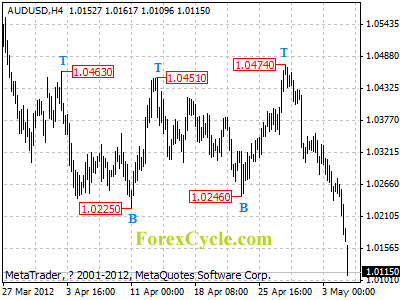
AUDUSD breaks below 1.0225 previous low

AUDUSD breaks below 1.0225 previous low support and reaches as low as 1.0110, suggesting that the downtrend from 1.0855 (Feb 29 high) has resumed. Further decline could be expected after a minor consolidation, and next target would be at 1.0000 area. Resistance is at 1.0200, as long as this level holds, the downtrend from 1.0474 will continue.

audusd

Forex Signals