What Will The Most Important Man in Oil and Gas Say in Adelaide Today?

By MoneyMorning.com.au

The oil and gas world meets in Australia this week.

Today and for the next two days I’m at the 50th annual get-together for APPEA – that’s the ‘Australian Petroleum Producer and Explorer Association’.

I packed my bags and kissed the family goodbye last night to fly up here for this year’s conference. It’s a busy day ahead and I’ll tell you more about it tomorrow.

But this morning I just wanted to give you a heads up on the key issues driving the global energy market…what they mean for Australia…and most importantly what they mean for you…

With over 3000 delegates meeting at Adelaide’s Convention Centre it’s by far Australia’s biggest oil and gas conference.

No wonder it was so hard to find a hotel room!

The important thing to note is that this is not the kind of resources conference that’s full of big and small companies spruiking their story. APPEA is a real industry event where the biggest players in the game get together to talk technical.

In fact, the keynote speaker is none other than Saudi Arabia’s oil minister, ‘His excellency’ Ali Al-Naimi.

Saudi Oil and Gas

As guardian of the world’s largest oil and gas exports, he may be the most powerful person in the world of energy. They call him The Central Banker of Oil’.

As I write, he hasn’t spoken yet. But his talk this morning will be on ‘The future of oil and gas – a Saudi Arabian perspective’.

But the real question everyone wanted to ask is just how Saudi Arabia hopes to increase its oil output to the levels it keeps telling the world it can.

Every time the oil price creeps up, the Saudi’s talk the price down. They say they’ll increase production to suppress the price. Why do they want a lower oil price? Excessively high prices make people look for alternatives, which is no good for a country that makes all its money from oil.

It’s a clever trick, because Saudi Arabian oil exports have never even come close to the levels they claim possible.

Oil fields have a natural lifespan, and Saudi’s fields are no spring chickens.

This chart shows Saudi Arabian oil exports since 1970. It’s never been above 10 million barrels a day, let alone the 12.5 million barrels a day – the red line – Saudi Arabia claim they can produce.

Saudi Arabian oil exports – never come close to claimed potential

Saudi Arabian oil exports - never come close to claimed potential
Click here to enlarge

Source: TTMYGH, via Grand Private Equities

I’d like to ask ‘His Excellency’ about the mismatch between actual production levels and claimed production potential, but unfortunately there isn’t a Q&A after Ali Al-Naimi’s speech. So I’ll have to bail him up later instead, and maybe soften our friendly teetotaler up over a few hot chocolates.

I could also ask him if he reckons his country can keep the US as an ally. Especially when the shale gas revolution will see the US become far less dependent on Saudi oil in the coming decades.

Saudi Arabia is in an interesting position right now, so I’m keen to hear what he has to say.

In a resources market that has taken some serious body blows in the last 6 months, oil and gas stocks are still doing well. One reason is this doubt that Saudi Arabia has any spare supply. The bigger reason energy stocks are doing well is simple: the world’s energy needs are increasing.

The International energy Agency (IEA) estimates global energy demand will increase by ONE THIRD in the next 25 years. That’s a huge jump.

Most importantly, the IEA reckon China and India will account for HALF of this growth.

Australia’s Big Bet on Oil and Gas

China is already Australia’s biggest customer, taking a quarter of our exports. But don’t overlook India. In recent years it has gone from 1%, to now taking 7% of our commodity exports. And India is a story to keep watching in coming years. Both these numbers are rising fast. This gives Australia’s fast expanding energy sector a great opportunity.

This is why Aussie firms are making a colossal bet on things panning out like this.

The total investment in Australia’s oil and gas sector in the period to 2020 is estimated to be $330 billion.

To put that in context, it would be like spending a THIRD of Australia’s super-fund pool on oil and gas projects in the next 8 years.

The $330 billion to be spent on oil and gas projects is also an incredible 60% of the $550 billion planned investment for all resource industry investments in that time.

Like I said, we’re betting big on oil.

The CEO of Total S.A. [NYSE: TOT], one the world’s biggest oil companies, is also talking about turning Australia into a ‘global energy hub on par with the Middle East, Canada and Russia’.

I’ve tipped oil and gas stocks for Diggers and Drillers readers this year, and plan on tipping more. This is maybe the most important theme in the resources market today.

And after this weekend’s terrible economic numbers from China – showing imports have all but stopped growing – oil and gas will be one of the few areas of the resource sector that stand to keep performing for the foreseeable future.

Dr. Alex Cowie
Editor, Diggers and Drillers

Related Articles

The Conference of the Year “After America” DVD

The Great Push North for Arctic Oil Continues

Why Europe Will Ditch Green Energy


What Will The Most Important Man in Oil and Gas Say in Adelaide Today?

Energy Supply: Europe to Spark a Natural Gas Boom

By MoneyMorning.com.au

Without supplies – whether it’s energy or food – a nation and its economy will quickly collapse.

We’ve see it proven time and again through history.


Whether it’s World Wars I and II, the Punic Wars, the Napoleonic Wars, Middle East wars, or the U.S. Revolutionary and Civil Wars, if you control the supply lines, you control the war and its outcome.

The Europeans know this more than anyone else.

Throughout history, barely a decade passes without one European state declaring war on another…or a civil war or revolution tearing a nation apart.

So, it’s essential to secure supply lines.

But it’s not military supply lines I’m talking about today – although you shouldn’t rule out the prospect of war, revolution or civil war in Europe at some point.

Securing supply lines is just as important in peacetime as in wartime. And one of those supply lines is crucial during both. I’m talking about energy.

To understand the scale of Europe’s problem, consider this, from a September 2011 report from the European Commission:

‘More than half of the EU-27′s energy comes from countries outside the EU – and this proportion is rising. Much of this energy comes from Russia, whose disputes with transit countries have threatened to disrupt supplies in recent years – for example, between 6 and 20 January 2009, gas flows from Russia via Ukraine were interrupted.’

Natural Gas Energy Means Great News for the U.S. – But What About Europe?

The U.S. is in the process of securing its energy future, cutting off its dependence on Middle East energy. It’s in large part thanks to the development of 862 trillion cubic feet of shale gas on U.S. territory.

And that, according to global energy company BP, the U.S. is set to be energy independent and a net exporter of energy by 2030.

That’s great news for the U.S.

But right now, I can’t say the same about Europe.

Of course, ideologically, the U.S. and Europe are different. Despite its move towards statism, the U.S. is far more entrepreneurial and free-market than Europe.

Europeans are still more likely to seek and rely on government involvement than Americans. This means that when national governments or the European Union intervenes, businesses and individuals expect it…most actually look forward to it.

The bottom line is, because bureaucrats are always sticking their noses in, it takes much longer for European nations to get things done.

And because national economies are so influenced by government (run by politicians seeking re-election), politicians are more likely to be influenced by vested interests that are keen to maintain their influence by resisting change (resistance to change is the enemy of entrepreneurialism).

As a report last year in the Economist noted:

‘The old continent [Europe] has nearly as much technically recoverable shale gas (natural gas trapped in shale formations) as America. Europe’s reserves are 639 trillion cubic feet, compared with America’s 862, according to America’s Energy Information Administration, a government agency…

‘Costs are higher in Europe, for several reasons. First, European geology is less favourable: its shale deposits tend to be deeper underground and harder to extract.

‘Second, America has a long history of drilling for oil and gas, which has spawned a huge and competitive oil-services industry bristling with equipment and know-how. Europe has nothing to compare with that. In 2008, at the height of the gas boom in America, 1,600 rigs were in operation. In Europe now there are only 100. America’s more cut-throat market drives costs down. A single gas well in Europe might cost as much as $14m to sink, three-and-a-half times more than an American one, estimates Deutsche Bank.

‘Third, America’s gas industry faces fewer and friendlier regulations than Europe’s. Call it the Dick Cheney effect. And fourth, in America wildcat drillers, if they strike it rich, enjoy access to a spider’s web of existing pipelines, so they can get their gas to market. Europe has no such network nor open-access rules.’

The Problem With Europe’s Energy Supply

It’s no wonder Europe imports so much of its energy. Government and bureaucracy make it hard and expensive for energy companies to exploit oil and natural gas reserves.

And that makes it hard for innovation to take hold.

But it’s not impossible.

It just means Europe will be pushed much closer to an energy precipice than the U.S.

And that’s where you have the chance to profit as the inevitable happens. Soon, Europe’s flirtation with uneconomical ‘green’ energy such as wind, wave and solar power will end. And so it will have to secure its energy future with the only long-term commercially viable energy source…

Natural gas.

That’s why it’s important for Europe to reassess where it invests its energy dollars. And it’s my belief this will result in a boon for the greenest of the fossil fuels – natural gas.

Yet you may be wondering about the U.S. gas glut that has pushed U.S. gas prices down to record lows. Today, U.S. natural gas is trading at USD$2.38 per million British thermal units (mmBtu).

The price of U.S. natural gas has fallen 55% in the past year. That surely isn’t a good sign for gas explorers. Well, stop right there and take a look at the chart below.

European Natural Gas Price

European Natural Gas Price

Source: Mongabay.com

While U.S. natural gas prices have dropped like a stone, European benchmark prices have moved higher. In fact, according to the World Bank, European natural gas prices are 9.4% higher than 12 months ago.

Why Are Natural Gas Prices Higher in Europe?

There are three reasons. First, European natural gas prices are benchmarked to the crude oil price. So when crude oil goes up, so does the natural gas price.

Second is the issue of supply. Much of Europe’s gas comes from Russia. And as Europe saw in 2009, Russia isn’t afraid to turn off the taps when it feels like it.

Third, high prices in any market – whether it’s oil, gas or coffee beans – is a signal to investors and entrepreneurs that there’s money to be made due to a shortage of supply.

The increased investment in oil and gas exploration due to high prices should eventually see prices fall… just as we’ve seen in the U.S. natural gas market.

But until then, the signal is clear – Europe needs more natural gas exploration and production.

Kris Sayce
Editor, Australian Small-Cap Investigator

From the Archives…

What Newton Knew About House Prices …That the IMF Should
2012-05-11 – Kris Sayce

Why a Greek Exit From the Eurozone Could Be Great News For Markets
2012-05-10 – John Stepek

Why Europe Will Ditch Green Energy
2012-05-09 – Kris Sayce

Why It’s Time to Buy Gold
2012-05-08 – Dr. Alex Cowie

Why You Should Be Watching Japan’s Economy
2012-04-07 – Dan Denning


Energy Supply: Europe to Spark a Natural Gas Boom

Investors Need to Know The Financial World Has Changed

By MoneyMorning.com.au

Investors need to accept the fact that ‘the game as we have all known it appears to be over’, says US investor Bill Gross. The co-founder of the world’s biggest bond fund, PIMCO, reckons that investors need to change their strategies in the wake of the financial crisis.

To understand how different things are now we have to look at the history of leveraging, before the financial crisis, says Gross. Since the early stages of the 20th century ‘the trend towards financial leverage has been ever upward’. Politicians set the rules, by relaxing regulation and freeing paper currency from real world constraints like gold.

Meanwhile ‘the private sector was more than willing to play the game, inventing new forms of credit, loosely known as derivatives’. The ever-expanding credit had a profound effect on investing attitudes, says Gross.  ‘“Stocks for the long run” was the almost universally accepted mantra, but… for most of the last half century [it was] “financial assets for the long run” – and your house was included by the way in that category of financial assets even though it was just a pile of sticks and stones.’

Investors became used to the idea that extra leverage would push up the value of financial assets in the future. ‘P/e ratios rose, bond prices for 30-year Treasuries doubled, real estate thrived, and anything that could be levered did well because the global economy and its financial markets were being levered and levered consistently.’ In effect, wealth was ‘brought forward and stolen from future years’, says Gross.

The New Normal

But growth expectations ‘exceeded the abilities of global economies to consistently replicate them’. The crash came and now some countries and economies are trying to pay off debt instead of adding more. Globally credit is still going up but far more slowly than before.

The result is ‘negative real interest rates and narrow credit and equity risk premiums; a state of financial repression… that promises to be with us for years to come’. In this “new normal” ‘real growth as opposed to financial wizardry becomes predominant’. But achieving that growth is made more difficult ‘by excessive fiscal deficits and high debt/GDP levels’, says Gross.

So what does that mean for investors? Gross reckons that in the “new normal” commodities and “real” assets will be the star performers. If you are going to go for financial assets then pick those that pay back quickly. So for bonds ‘favour higher quality, shorter duration and inflation protected assets’. And if you want shares look for dividend payers, rather than the longer-term promise of growth stocks.

James McKeigue

Contributing Writer, MoneyWeek

Publisher’s Note: This article originally appeared in MoneyWeek (UK)

From the Archives…

What Newton Knew About House Prices …That the IMF Should

2012-05-11 – Kris Sayce

Why a Greek Exit From the Eurozone Could Be Great News For Markets

2012-05-10 – John Stepek

Why Europe Will Ditch Green Energy

2012-05-09 – Kris Sayce

Why It’s Time to Buy Gold

2012-05-08 – Dr. Alex Cowie

Why You Should Be Watching Japan’s Economy

2012-04-07 – Dan Denning

For editorial enquiries and feedback, email [email protected]


Investors Need to Know The Financial World Has Changed

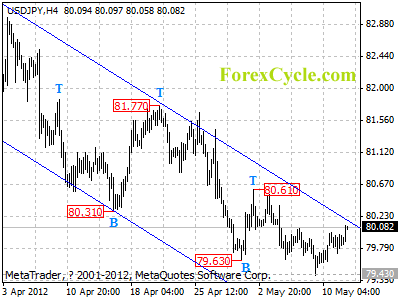
USDJPY is facing channel resistance

USDJPY is facing the resistance of the upper line of the price channel on 4-hour chart, a clear break above the channel resistance will signal completion of the downtrend from 84.17 (Mar 15 high), then further rise to 83.00 area could be seen. On the downside, the downtrend could be expected to resume after touching the channel resistance, and as long as the channel resistance holds, one more fall to 78.00 area to complete the downward movement is still possible.

usdjpy

Daily Forex Forecast

Currency Speculators add to US Dollar long positions. Australian dollar longs fall sharply

By CountingPips.com

The latest Commitments of Traders (COT) report, released on Friday by the Commodity Futures Trading Commission (CFTC), showed that large futures speculators raised their overall US dollar long positions last week for the first time in four weeks as speculators increased their euro short positions to the highest level since February and Australian dollar long positions fell sharply.

Non-commercial futures traders, including hedge funds and large speculators, increased their total US dollar long positions to $20.95 billion on May 8th from a total long position of $13.31 billion on May 1st, according to the CFTC COT data and calculations by Reuters which calculates the dollar positions against the euro, British pound, Japanese yen, Australian dollar, Canadian dollar and the Swiss franc.

Individual Currencies:

EuroFX: Currency speculator sentiment declined for the first time in three weeks in the euro currency as euro net short positions or bets against the currency increased to 106,990 contracts on May 8th from the previous week’s total of 106,990 net short contracts on May 1st. This is the highest level for euro short positions since February 13th when short contracts totaled 148,641.


The COT report is published every Friday by the Commodity Futures Trading Commission (CFTC) and shows futures positions as of the previous Tuesday. It can be a useful tool for traders to gauge investor sentiment and to look for potential changes in the direction of a currency or commodity. Each currency contract is a quote for that currency directly against the U.S. dollar, where as a net short amount of contracts means that more speculators are betting that currency to fall against the dollar and net long position expect that currency to rise versus the dollar. The graphs overlay the forex spot closing price of each Tuesday when COT trader positions are reported for each corresponding spot currency pair.

GBP: British pound sterling positions rose last week for a fourth consecutive week and ascended to their highest level in over a year. British pound positions saw a total of 25,339 net long contracts on May 8th following a total of 16,493 net long contracts registered on May 1st. Pound positions have continued to rise higher and are now at the highest level since May 3rd 2011 when long contracts equaled 30,807.

JPY: Japanese yen speculative contracts improved last week for a fourth consecutive week as Yen positions totaled 41,093 net short contracts reported on May 8th following a total of 50,173 net short contracts on May 1st. The improvement in the Japanese positions has coincided with the USDJPY spot price declines as the pair currently trade under the 80.00 level.

CHF: Swiss franc speculator positions decreased last week after improving the previous week. Speculator positions for the Swiss currency futures registered a total of 16,494 net short contracts on May 8th following a total of 14,311 net short contracts as of May 1st.

CAD: Canadian dollar positions declined last week after reaching the highest level of the year the previous week. Canadian dollar positions fell to a total of 60,095 net long contracts as of May 8th following a total of 70,223 long contracts that were reported for May 1st. CAD positions had recently surpassed their previous highest level of the year and reached their best level since March of 2011 on May 1st.

AUD: The Australian dollar long positions dropped sharply after increasing the previous week. Aussie positions fell to a total net amount of 25,104 long contracts on May 8th after rising to 52,280 net long contracts reported as of May 1st. AUD speculative positions are now at their lowest level since November 2011 when long contracts equaled 12,542.

NZD: New Zealand dollar futures speculator positions declined for a third week as NZD contracts decreased to a total of 6,224 net long contracts as of May 8th following a total of 8,025 net long contracts on May 1st.

MXN: Mexican peso speculative contracts trended slightly lower after edging higher the previous week. Peso long positions decreased to a total of 36,928 net long speculative positions as of May 8th following a total of 42,045 long contracts that were reported for May 1st.

COT Currency Data Summary as of May 8, 2012
Large Speculators Net Positions vs. the US Dollar

EUR -143984
GBP +25339
JPY -41093
CHF -16494
CAD +60095
AUD +25104
NZD +6224
MXN +36928


People’s Bank of China Cuts RRR 50 basis points

By Central Bank News
The People’s Bank of China (PBOC) announced a 50 basis point cut in the required reserve ratios (RRR) for deposit taking financial institutions, effective 18 May 2012.  The new required reserve ratios will average 20.00% for large banks, and 18.00% for small banks.  The move is expected to add as much as 400 billion yuan of liquidity to the financial system.  The move marks a continued shift in the policy bias to loosening, with the PBOC previously being content to use open market operations to adjust liquidity, in contrast to the higher profile RRR.

The last reduction in the RRR was a 50 basis point cut in February this year, while the People’s Bank of China last raised the reserve requirements by 50 basis points in June 2011 to peak at an average 21.50% for large banks, and 19.50% for small banks.  The PBC also adjusted the reserve requirement rules in August, effectively resulting in tightening of about 100bps.  Meanwhile the People’s Bank of China last raised the benchmark interest rate 25bps to 6.56% in early July last year.  

China reported annual inflation of 3.4% in April, down from a high of 6.5% in July last year.  Meanwhile the Chinese economy grew an annual 8.1% in the March quarter (8.9% in Q4, 9.1% in Q3, 9.5% in Q2).  The Chinese Yuan (CNY) has appreciated by about 3% against the US dollar over the past year, with the USDCNY exchange rate last trading around 6.31.

The Slow Death of Australian House Prices

By MoneyMorning.com.au

The rate cuts in November and then December were supposed to save Australian house prices.

Yet less than six months later, recent economic data suggest things are getting worse.

According to RP Data, capital city house prices lost a combined 4.5% last year.


But ever the optimist, RP Data called this decline in April a ‘renewed softness’.

Even Tim Lawless, RP Data’s research director, admitted interest rate cuts won’t help the housing market. He said:

‘Our estimate of transaction volumes to February suggest that the two interest rate cuts in November and December last year are yet to provide a sustained stimulus to the market, with transaction volumes remaining reasonably steady around 31,000 each month. Comparing this with the sales rate through mid 2009 when around 45,000 homes were selling each month, the slowdown in buyer activity becomes quite clear.’

Housing sales by volume are down 31% since mid-2009. Adding to the housing woes is the amount of ‘housing stock’ available. It’s double that of five years ago.

number of properties advertised for sale nationally

Source: Macrobusiness/RPData.com


And not only are more houses available, but they’re cheaper as well.

Increased housing stock is dragging down house prices. Yet, what will happen to house prices when high debt levels catch up with us?

Take a look the two charts below. In the first chart, the blue line shows you Australia’s private debt to disposable income. It stands at 150%. In comparison, at the peak, Americans had a private debt level of 300%.

The peak in American private debt levels occurred just as house prices began to fall.

aggregate private debt

The next chart gives you an idea of just how big the housing crash was in the US (blue line)…and a warning of what Aussie home owners can expect:

real house price indices

Source: debtdeflation.com/blogs


Those charts come from Professor Steve Keen. He’s an economist who predicts a US style housing crash in Australia. He’s convinced that high personal debt levels will bring on a crash in Aussie home values, much like what happened in the US.

Professor Keen’s thinking used to be at the fringe of economic thought. Today, it’s mainstream.

The International Monetary Fund (IMF) has confirmed the correlation of debt levels and house prices. In their World Economic and Financial Surveys publication, the IMF said:

‘Based on an analysis of advanced economies over the past three decades, we find that housing busts and recessions preceded by larger run-ups in household debt tend to be more severe and protracted.’

The thing is, even if we don’t see a US style housing crash, monthly housing data suggests home values are falling at a steady rate.

So rather than a quick housing bust, Aussie homeowners face a long-term housing bust.

And it’s already underway. Even so, some spruikers still won’t admit it. They won’t say prices have fallen, they’ll tell you prices are soft…weakening…easing…. Or any other word they can think of to avoid saying, ‘Aussie house prices are falling‘.

The good news is the spruikers can’t hide behind industry-speak for much longer. Each month, fresh numbers show a dismal housing market.

One in permanent decline.

How long will it last? We don’t know that for sure. But this sort of decline could drag on for years. The US is into its sixth year of falling house prices.

The housing bubble took two decades to build up…it might take another two decades before house prices go up again.

Shae Smith
Editor, Money Weekend

The Most Important Story This Week…

Every day it seems like the news gets worse in Europe. Greece is in political turmoil. France is going to change government. Spain has been forced to bail out a bank. The entire euro currency is under threat. You would have to be crazy to invest in Europe, right? Hold that thought. Practically every investing book says to go against the crowd or to buy “when there is blood in the streets”. This is because when investors are afraid, assets go cheap. Fear drives prices down, just as greed drives them up.

A climate of fear is the investor’s best chance to buy low and later sell high. It’s easier said than done. But it’s not enough for an asset just to be cheap. It might stay cheap. There needs to be an underlying trend of demand…an exciting catalyst for change coming….a spark for an asset to be re-rated by the market. Europe is the biggest trading bloc on the planet. It needs energy. How? Wind? Solar? No. Kris Sayce explains Why Europe Will Ditch Green Energy and the change he sees coming for investors to strike now.

Other Recent Highlights…

Dr. Alex Cowie on Why It’s Time to Buy Gold: “The Reserve Bank of Australia’s 50 basis point interest rate cut last week has really taken the wind out of the Aussie. Judging by the down-leg in previous interest rate cycles – not to mention the state of the Australian economy – more cuts are coming. Which should mean the Aussie may have further to fall yet…right now Australian gold investors are looking at a very good opportunity to buy gold.”

Dan Denning on Why You Should Be Watching Japan’s Economy: “When you reach the point where you have to borrow more money just to pay the interest on money you’ve previously borrowed, you’ve reached what Hyman Minsky called the stage of ‘Ponzi Finance’. Japan is nearly there. Now, the first consequence of reaching this point is that Japanese interest rates may start going up. That would be disaster.”

John Stepek on What the European Elections Mean for the Euro: “The euro is a political construct, not an economic one. As it stands, the euro cannot function in the long term, from an economic point of view. The various countries involved are too different. So the main thing holding the euro together so far is that European voters, by and large, still want it…they don’t yet blame the currency for their woes. This could be the year that all that changes…”

James Baldwin on The Great Push North for Arctic Oil Continues: “The Kremlin has been looking for ways to incentivize producers to help Rosneft replace waning production. Tax breaks have been one way, but companies also want a little bit of insurance when they work with Moscow… The answer is ‘hostage taking.’”

To End the Week…


The Slow Death of Australian House Prices

European Elections: Voters Say “No” to Economic Reality

By MoneyMorning.com.au

‘Europe fights back against austerity,’ was how The Daily Telegraph headlined its weekend European election coverage. ‘Anti-austerity movements are gathering pace across Europe following political earthquakes in France and Greece. A total of 12 European governments have now been dismissed in three years.’

As the European welfare state is officially in its death-throes none of us should be surprised if political strife gets cranked up to eleven. I firmly expect that we will see much more of this in the future.

While I can understand the anger of the electorate and sympathize with the sense of desperation and foreboding, I cannot, however, consider the electoral choices of the weekend particularly enlightened. They do not reflect a coherent, let alone intelligent strategy as the Daily Telegraph headline seems to imply.

If those who “won” a European election deliver on their promises, economic disintegration will only accelerate. What is being offered in terms of ‘solutions’ is a dangerous assortment of economic poisons, more suitable to describe the European disease than provide a recipe for stronger growth.

Recovery through early retirement and infrastructure spending? – C’mon. Nobody can take that seriously.

But it seems that just because this heap of economic stupidity can neatly be swept under the wide tent of ‘anti-austerity’, the commentariat seems somehow willing to believe in the wisdom of the crowds and look for some deeper insights here.

I guess the reason for this is that the economic ideologies that are now being strenuously interpreted into the European election results rhyme with the economic prejudices of most commentators. They, too, believe that state bankruptcy is best to be ignored or not to be taken too seriously so that we can spend our way out of this mess.

The Perceived Wisdom is Wrong

For a long time media pundits have treated us to the perceived wisdom that economic growth can only come from the actions of the government. Only devaluation through euro-exit, inflation through more money printing and more government deficit-spending, preferably by the still credit-worthy Germans and then fiscally-transferred to the maxed-out Greeks, can revive the economy because only this can lift aggregate demand, which is the magic cure-all of economic problems.

What is lost on these commentators is that the European mess is nothing but the inevitable result of government-stipulated aggregate demand. Easy money funded the Spanish and Irish real estate booms and bankrupted their banks and by extension their governments.

Easy money allowed Greece’s political class to go on a borrowing binge that has now bankrupted the country and lured large parts of the population into zero-productivity, soon-to-be-eliminated public sector jobs.

Do you still want the state to ‘stimulate’ the economy? Be careful what you wish for.

The real culprit of high youth unemployment in Spain and Italy is not ‘austerity’, which hasn’t even started there, but a bizarrely overregulated and sclerotic labour market in which it is almost impossible for firms of a certain size to fire people. The incentives are thus stacked massively against hiring.

Yet, in France one of Hollande’s election promises is not to deregulate the labour market. If I were unemployed in France I would not be counting my chances of getting a job over the next five years. In France the state runs more than half the economy, yet Hollande promises not to privatize state-run industry. Where is the wisdom in that?

Yet, the statists and socialists are delighted. Paul Krugman, who never saw a debt crisis you could not borrow and spend your way out of, rejoices at such display of economic genius. We are all Keynesians now!

Listening to Krugman you would think Greek and French voters were not using the ballot to cling desperately to some remnants of the welfare state but were in fact positively advertising the wisdom of government stimulus and the mystical ‘multiplier’.

Some of the commentators tried to argue that what happened was also some kind of anti-establishment vote, a verdict against centralisation and the dominance of the deservedly despised bureaucratic elite in Brussels.

Nice try, but that is rubbish.

This was not an anti-establishment vote at all. It was not a vote for change but a desperate vote for the status quo. Of course, the old elite deserved the sack but they were largely booted out not because people got tired of the old policies but because the leadership now finally admitted that they could no longer deliver on the old promises.

The established parties lost because they could not continue upholding the false promise that had kept them in office for years or decades, the promise to make the ‘European model’ work. They had to admit that the European welfare state was now bankrupt. Kicking the can down the road is increasingly not an option as the end of the road is now in sight.

Shooting the Messenger

And the European election winners were those who had the chutzpah to maintain that drastic belt-tightening and painful reform were not required but that the people just had to ‘stick it to the man’, who is Angela Merkel and sits in Berlin. The tactic is straightforward. Shoot the messenger!

In France that meant voting for a charisma-free Socialist bureaucrat who will revive France with higher taxes, early retirement and a Hoover dam funded by Eurobonds and the ECB. In Greece, the big winner was an ex-Communist firebrand who admires Hugo Chavez, and who has raged against austerity measures and structural reform.

I guess we now know what the electorate is against. ‘Say no to cuts!’ But what is it for? Over in Ireland, the deputy leader of Sinn Fein, Mary Lou MacDonald, had the answer: ‘A No vote (to the “Austerity Treaty”) in Ireland will strengthen those arguing for jobs and growth.’

Well, who could not love a politician who promises jobs and growth? But the relationship between politics and jobs and growth is a tenuous one. Politicians are not savers who fund the creation of a capital stock through saving, and they are not entrepreneurs who put that capital to productive use.

Politicians are people who spend other people’s money. In Ireland the budget deficit runs at 13 percent of GDP per annum, which according to Krugman’s logic must be a fantastic recipe for jobs and growth. Let’s just sit back and watch how that economic miracle is going to unfold.

My guess is that many people in Europe still know, or at least instinctively sense, that the promises of jobs and growth through state spending and money printing are hollow. They know that the state is bust and cannot keep spending money it doesn’t have. The policy options are much more limited than the campaign rhetoric indicates. On trend, fiscal consolidation and structural reform will continue, and Germany’s negotiating position will remain strong.

Yet, on the margin this was an indication that Europe, and in particular France, remain in many areas unreformable, and that the pressure on the ECB to sustain the unsustainable with sizable money injections will, if anything, intensify.

Detlev Schlichter

Contributing Writer, Money Morning

Publisher’s Note: Detlev Schlichter is the author of Paper Money Collapse.

From the Archives…

Why China’s New Consumer Economy Won’t Give You the Trade of the Decade
2012-05-04 – Kris Sayce

Why China Could Be The Next Destination For the Financial Crisis
2012-05-03 – Merryn Somerset Webb

How Did We Get It So Wrong on Australian Housing?
2012-05-02 – Kris Sayce

This Indicator Shows the Copper Price Could Be Set to Soar
2012-05-01 – Dr. Alex Cowie

How Gold Nanoparticles Will Create A New Kind of Gold Rush
2012-04-30 – Michael Robinson


European Elections: Voters Say “No” to Economic Reality

Monetary Policy Week in Review – 12 May 2012

By Central Bank News

The past week in monetary policy saw three central banks announcing interest rate changes: Poland increased 25 basis points to 4.75%, Malawi hiked rates 300bps to 16.00%, while Belarus cut rates -200bps to 34.00%.  Those that held interest rates unchanged were: UK 0.50%, Russia 8.00%, Indonesia 5.75%, Korea 3.25%, Norway 1.50%, Malaysia 3.00%, Serbia 9.50%, Peru 4.25%, and Sri Lanka 7.75%. Elsewhere the People’s Bank of China released its quarterly monetary policy report.


Looking at the central bank calendar, the week ahead in monetary policy will be relatively quiet on the meeting front with just Iceland on the list (the following week is more busy). However there are monetary policy meeting minutes due from the Reserve Bank of Australia and the US Federal Reserve’s FOMC. The Bank of England also has its regular inflation report due out.

May-16
ISK
Iceland
Central Bank of Iceland


Source: www.CentralBankNews.info

Article source: http://www.centralbanknews.info/2012/05/monetary-policy-week-in-review-12-may.html

April 2012 Headlines at Central Bank News

By Central Bank News
Following is a list of all the headlines on Central Bank News during the month of April. The month in central banking in April was relatively quiet, but with a couple of notable interest rate changes in emerging markets (Brazil -75bps to 9.00% and India -50bps to 8.00%, also Vietnam cut rates). In the quantitative easing space the UK, ECB, and US monetary authorities kept their asset purchase programs unchanged, while the Bank of Japan added another 5 trillion yen to its quantitative easing program.

March 2012 Headlines at Central Bank News

Central Bank News Link List – 1 April 2012

Central Bank News Link List – 4 April 2012

Central Bank News Link List – 5 April 2012

Central Bank News Link List – 6 April 2012

Monetary Policy Week in Review – 7 April 2012

Central Bank News Link List – 11 April 2012

Central Bank News Link List – 12 April 2012

Central Bank News Link List – 13 April 2012

Monetary Policy Week in Review – 14 April 2012

Central Bank News Link List – 14 April 2012

Central Bank News Link List – 16 April 2012

Reserve Bank of India Cuts Rate 50bps to 8.00%

Central Bank News Link List – 18 April 2012

Central Bank News Link List – 20 April 2012

Brazil Central Bank Cuts Selic Rate 75bps to 9.00%

Monetary Policy Week in Review – 21 April 2012

Central Bank News Link List – 22 April 2012

Central Bank News Link List – 24 April 2012

Central Bank News Link List – 25 April 2012

Central Bank News Link List – 27 April 2012

Monetary Policy Week in Review – 27 April 2012

Central Bank News Link List – 29 April 2012


Source: www.CentralBankNews.info