Market Review 30.5.12

Source: ForexYard

printprofile

The EUR/USD hit a fresh two-year low in morning trading due to concerns about higher debt yields. The pair is currently trading around 1.2450, down close to 130 pips over the last 24 hours. Another Spanish credit downgrade yesterday also affected the price of crude oil, which had been steadily increasing earlier in the week. The price of crude has dropped over $2 a barrel since yesterday afternoon and is currently trading below $90.

Main News for Today

Italian 10-y Bond Auction
• Investors will be watching the bond auction for clues as to whether the debt crisis is spreading to other countries in the euro-zone
• Unless there is solid demand for Italian bonds, the euro could see additional losses as a result
US Pending Home Sales-14:00 GMT
• Analysts are forecasting the home sales figure to come in well below last month’s figure
• Anything below the expected 0.0% could lead to dollar losses against the yen
ECB President Draghi Speaks- 15:30 GMT
• Investors will be monitoring the speech for clues as to any plans to assist Spain recover from its debt issues
• The euro may see additional losses unless concrete steps are outlined to help contain the debt crisis

Read more forex news on our forex blog

Forex Market Analysis provided by ForexYard.

© 2006 by FxYard Ltd

Disclaimer: Trading Foreign Exchange carries a high level of risk and may not be suitable for all investors. There is a possibility that you could sustain a loss of all of your investment and therefore you should not invest money that you cannot afford to lose. You should be aware of all the risks associated with Foreign Exchange trading.

Spain Concerns Cause Additional Euro Losses

Source: ForexYard

After reaching as high as 1.2573 against the US dollar in early morning trading yesterday, the euro once again turned bearish as investor concerns regarding the health of Spanish banks weighed down on the common currency. Turning to today, traders will want to pay attention to the results of an Italian debt auction followed by a speech from the ECB President. Any signs that the euro-zone debt crisis is spreading to other countries in the region may lead to further euro losses. In addition, the US Pending Home Sales figure may lead to some market volatility. With analysts predicting the figure to come in below last month’s the dollar could see losses against the JPY.

Economic News

USD – Home Sales Data May Lead to Dollar Losses

The US dollar was able to advance on several of its higher-yielding currency rivals during European trading yesterday, as investors reverted to safe-haven assets amid concerns regarding the health of the Spanish banking system. After coming within reach of the 0.9900 level during early morning trading, the AUD/USD began to fall, eventually reaching as low as 0.9822 during mid-day trading. The EUR/USD fell close to 60 pips yesterday, eventually hitting 1.2516 before staging a slight upward correction to stabilize at 1.2540.

Turning to today, dollar traders will want to pay attention to the US Pending Home Sales figure, scheduled for 14:00 GMT. At the moment, analysts are forecasting the figure to come in well below last month’s result. If true, investors may take is as a sign that the US economic recovery is not proceeding quickly enough, which could result in dollar losses against the safe-haven Japanese yen. That being said, with the majority of attention still being devoted to euro-zone news, it is unclear how a disappointing home sale figure would impact the dollar against riskier currencies like the euro and GBP.

EUR – Italian Bond Auction Set to Impact EUR

Fears that a weakening banking sector in Spain may soon cause the country to request a bailout resulted in significant losses for the euro during trading yesterday. Spain’s fourth largest bank recently requested significant amounts of aid to help it recover from recent losses. Against the Japanese yen, the common-currency fell 45 pips over the course of the day, eventually reaching as low as 99.48. The euro performed even worse against the aussie. The EUR/AUD dropped as low as 1.2691 during the afternoon session, down close to 60 pips for the day.

Today, euro traders will want to carefully monitor the results of the Italian 10-y Bond Auction. Analysts are warning that the slightest bit of negative news out of the euro-zone could result in additional losses for the common-currency. Should today’s bond auction not perform as expected, the euro could see further downward pressure. Later in the day, ECB President Draghi is scheduled to give a speech. Unless his speech offers concrete proposals on how to help the euro-zone recover from the debt crisis, the EUR could extend its bearish trend.

Gold – Gold Fails to Break Above $1600

Euro-zone debt fears prevented gold from making any significant gains during yesterday’s trading session. While the precious metal has turned bullish over the last week, it has been unable to break past the psychologically significant $1600.00 an ounce level. The price of gold increased by just over $10 yesterday, reaching as high as $1582.36 before staging a slight downward correction.

Today, analysts are warning that it will be difficult for gold to move up significantly higher without the release of positive global economic data. Traders will want to monitor potentially impacting news out of the euro-zone and US. Should any of the data disappoint, the price of gold may fall as a result.

Crude Oil – Iran Worries Lead to Modest Increase in Price of Oil

Crude oil saw additional bullish movement during mid-day trading yesterday after hitting a seven-month low last week. Analysts attributed the commodity’s upward momentum to supply side fears out of Iran following inconclusive talks with the West regarding that country’s disputed nuclear program. The price of crude reached as high as $92.03 a barrel yesterday, up over $1 for the day.

Today, oil traders will want to pay attention to euro-zone news. While the situation in Iran has turned the commodity slightly bullish as of late, any disappointing European news could result in significant risk-aversion in the marketplace which has the potential to weigh down on riskier assets, like oil. In addition, with US Pending Home Sales expected to come in below last month’s figure, investors may choose to place their funds with more stable assets.

Technical News

EUR/USD

A bullish cross on the weekly chart’s Slow Stochastic indicates that this pair could see upward movement in the coming days. This theory is supported by the Williams Percent Range on the same chart, which has crossed into oversold territory. Going long may be the preferred strategy for this pair.

GBP/USD

Technical indicators on the daily chart, including the Relative Strength Index and the Slow Stochastic, indicate that this pair could see an upward correction in the near future. In addition, the weekly chart’s Williams Percent Range has crossed into oversold territory. Opening long positions may be the wise choice for this pair.

USD/JPY

While the Williams Percent Range on the weekly chart is in oversold territory, most other long term technical indicators show this pair range trading. Traders may want to take a wait and see approach, as a clearer picture is likely to present itself in the near future.

USD/CHF

The weekly chart’s MACD/OsMA has formed a bearish cross, indicating that downward movement could occur in the coming days. This theory is supported by the Williams Percent Range on the same chart, which has crossed into overbought territory. Going short may be the wise choice for this pair.

The Wild Card

EUR/JPY

The Relative Strength Index on the daily chart has dropped into oversold territory, indicating that this pair could see upward movement in the near future. Furthermore, the Williams Percent Range is moving downward and appears close to dropping below the -80 level. Forex traders will want to keep an eye on this indicator. If it drops below -80, it may be a good time to open long positions.

Forex Market Analysis provided by ForexYard.

© 2006 by FxYard Ltd

Disclaimer: Trading Foreign Exchange carries a high level of risk and may not be suitable for all investors. There is a possibility that you could sustain a loss of all of your investment and therefore you should not invest money that you cannot afford to lose. You should be aware of all the risks associated with Foreign Exchange trading.


The US Dollar – The “Strongest of the Weak”

By MoneyMorning.com.au

The idea of risk is a very personal thing.

What we see as risky, you may not.

And what you see as risky, we may see as completely safe.

One trick to successful investing isn’t to just figure out what you see as risky, but to also figure out whether other investors see it as risky too.

If you can pull off that trick it can help you stay one step ahead of the crowd. More below…

The following headline from Bloomberg News caught your editor’s eye this morning, ‘Dollar Scarce As Top-Quality Assets Shrink 42%’.

‘Dollar Scarce’?

It doesn’t seem possible.

After all, you’ve no doubt seen this chart from the Federal Reserve Bank of St. Louis:

Federal Reserve Bank of St. Louis

Source: Federal Reserve Bank of St Louis


It shows the explosion of US dollars on issue since 2008.

How can US dollars be scarce when the monetary base has increased from USD$800 billion in 2008 to USD$2.7 trillion today?

The answer is risk.

The Bloomberg News story explains more:

‘International investors and financial institutions that are required to own only the highest quality assets to meet investment guidelines or new regulations are finding fewer options beyond dollar-denominated assets. The US is one of only five major economies with credit-default swaps on their debt trading at less than 100 basis points, meaning they are viewed as almost risk free. A year ago, eight Group-of-10 nations fit that category…’

For the past four years, most of the talk has focused on the US. And most of that talk has centred on the US budget deficit, government debt and the devaluation of the greenback due to money-printing.

To some degree the US dollar has taken a back seat as markets and commentators focus on the euro…and its inevitable demise.

Just as it looks like the euro crisis is over, another spanner gets jammed in the works. The latest problem is with Spanish bank, Bankia S.A.

The Weakest of the Weak

Overnight, the European Central Bank (ECB) rejected the Spanish government’s proposal to prop up Bankia. We’re not surprised. It was nothing more than an indirect way of Spain tapping the ECB for a bailout.

The Spanish government had proposed issuing a bunch of debt to Bankia, which it could then use as collateral with the ECB. The ECB saw through this snide plan and so it looks like the Spanish government will have to bailout Bankia directly…undoubtedly causing the Spanish government to go further into debt, with Spanish bond yields going higher.

As the chart below shows, Spanish government bond yields are now near the highs of last November:

Spanish government bond yields

Source: Bloomberg


So, why are Spanish bond yields going up? Because big investors see Spain as too risky. Only last week savers withdrew 10% of deposits at Bankia on fears it would collapse.

As Slipstream Trader Murray Dawes told us this morning, ‘Why would you believe what the other banks say? You’d sell now and ask questions later.’

But with European nations holding a single currency, grouping together basket-cases like Spain with non-basket-cases like Germany, it’s not just a case of selling Spain and buying Germany.

However, many investors are doing that, which is why German 10-year bond yields are at a record low of 1.36% (During the market crash of 2008, the 10-year bond yield barely dipped below 3%).

But when push comes to shove, investors are going where they’ve gone during every previous crisis – the US dollar and US bonds.

The Strongest of the Weak

At the end of March, foreign holdings of US government bonds totalled USD$5.1 trillion. That’s a 14% increase from the same time last year. 10-year U.S. government bonds are trading at 1.7% – a higher yield than German bonds.

As risky as the US dollar seems, investors are still willing to buy it.

So, what’s the takeaway from this?

Simply this: as expected you’re seeing investors migrate from the weakest of the weak and towards the strongest of the weak.

You could say it was the next logical step towards the end of paper currencies. If you’re worried about your Spanish savings, you sell them and buy German savings. You hold those until you’re worried about the safety of your German savings.

After that, it’s into the lap of the world’s reserve currency, the US dollar.

How can you tell when that’s started to happen? We can’t say for sure. But a likely sign is in the following chart:

Spanish government bond yields

Source: Bloomberg


The orange line is the US government bond yield. The green line is the German bond yield. German bond yields have fallen as investors seek the safety of German assets over other European assets, to the extent that yields are lower in Germany than in the US.

The signal that investors are genuinely fearful over the future of the euro (rather than just Greece leaving the euro) will be when the green line starts ticking up and perhaps even rises above US bonds.

That should tell you that one more paper currency is about to fail as money flows into the strongest of the weak – the US dollar.

This is a key chart to watch over the coming months.

Cheers,
Kris.

P.S. My old pal, Australian Wealth Gameplan editor, Dan Denning recently published a report explaining how investors can potentially profit from globally falling yields. To check out how Dan recommends his readers do this, click here.

Related Articles

The Conference of the Year “After America” DVD

APPEA – Day One at the Oil & Gas Show: Sand Dunes, Scuba Diving and Camels

Get in Early to Shale Gas


The US Dollar – The “Strongest of the Weak”

It’s Getting Hard to Make Any Real Money in China

By MoneyMorning.com.au

I wrote a few weeks ago about the slightly bonkers diversification strategies of some of China’s big companies.

Leo Lewis picks up the story in the Times. He notes, as I did, the weirdest one of all – Wuhan Steel – a company which, while it hasn’t entirely abandoned its core business, now trades in wine and olive oil, and is in the middle of setting up a 10,000-pig farm. However, he also points to the fact that Wuhan is beginning to have significant competition in what it calls its “one flagship business, multi secondary business” operating strategy.


State-owned grains trader, Cofco, is building luxury hotels in Beijing; copper producer Tongling is moving into timber; and Ansteel is getting into coal. Most interesting of all, however, is the fact that Beijing Electric Power Company, a subsidiary of State Grid, is building a 180 hectare chateau and vineyard in Yanqing county. Hainan Airlines is doing something similar, and so are various power utilities and the state-run Shaanxi Coal Industry Company.

So what’s going on? The wine making is probably part property scam: local authorities desperate for cash find it easier to justify selling land for productive purposes than for real estate, but once companies have the land they can then put the planned business on a small part of it and use the rest for the usual hotels, resorts and villas. After all, the returns from wine take a long time to appear, so other projects are obviously required to tide wine investors over.

However, these obvious property scams aside, a large part of the more general diversification move is about the fact that these big companies are not making much in the way of profits from their core businesses. Take Wuhan: in 2010 it made ¥185bn in revenue, but its profit margin was a pretty pathetic 2%, half of which came from the non-steel businesses (which makes up only about 8% of the business). No wonder it wants to expand.

The second point is the one that Lewis indicates. According to him, Beijing Electric, like the rest of State Grid, is “awash with cash” and “desperately looking for ways to invest it”. Clearly they can’t find any particularly good ways.

The lack of interesting investment opportunities in China is something several people have mentioned to me recently – in conjunction with this subject (alongside that of the rising cost of labour in China) but also in relation to capital flight from China. Hong Kong financiers report money flowing through Hong Kong and out, for example. A decline in renminbi deposits in Hong Kong backs this up (they fell 6% between November and December last year), as does a recent fall in the country’s foreign exchange reserves.

The very rich – unable to see a way to make more money in China, or perhaps to keep the money they already have safe – are moving it out. That’s why gaming revenues in Macau (the obvious way to get money out of China) rose 35% in January.

All these things suggest that it is getting harder to make a profit in China; that is also getting harder to find projects to invest in at all; and that those who have made their money aren’t prepared to risk another spin of the wheel. None of these are things you usually find in very fast growing economies. Another hint for those who still need one, is that China is no longer a very fast growing economy.

Merryn Somerset-Webb
Contributing Editor, Money Morning

Publisher’s Note: This article originally appeared in MoneyWeek (UK)

From the Archives…

Free of the Dragon: Why the Energy Market Doesn’t Need China
2012-05-25 – Kris Sayce

China Stirs Up Troubled Waters in the South China Sea
2012-05-24 – Dan Denning

How Chinese Stocks Are Fading Fast
2012-05-23 – Lars Henriksson

LNG: Why Australia Will Be a New Global Gas Leader
2012-05-22 – Dr. Kent Moors

A Shocking Week for China’s Economy
2012-04-21 – Dr. Alex Cowie


It’s Getting Hard to Make Any Real Money in China

Good News for Natural Gas Stocks

By MoneyMorning.com.au

Finally – encouraging news for beaten down natural gas stocks.

The fossil fuel welcomed words from the International Energy Agency (IEA) Tuesday that gushed about the boom in unconventional natural gas over the next two decades. The agency said the incoming supply increase would let the United States and other countries enjoy cheaper energy and shift the export reliance away from the Middle East.

IEA Chief Economist Faith Birol told Reuters that growth in shale gas and other new available forms of natural gas could mirror gains made in conventional gas in Russia, the Middle East and North Africa combined.

“Unconventional natural gas will fracture the status quo and will be a complete game changer with major geopolitical implications,” Birol said.

Over the past years, high natural gas prices were a driving force behind new ventures into previously unavailable, unconventional gas reserves including tight-gas, shale gas and coal-bed methane resources.

But recently, ample stores and waning demand have weighed on natural gas prices, taking the commodity down to record low levels.

However, things are about to change.

Forecasts differ as for when the natural gas price channels will start churning and push domestic prices higher, but the tide will turn as the fuel becomes more widely used.

Jim Brick, macro-energy analyst at research consultant Wood Mackenzie, told Forbes he believes the U.S. could start exporting 3.2 billion cubic feet of LNG a day by 2030, as America moves away from its reliance on foreign energy sources and takes on a more advanced role as a worldwide energy supplier.

And as surplus domestic supplies begin to dwindle, natural gas prices will take off.

Mike Breard of Hodges Capital deems the chance of natural gas doubling in five years is better than the odds of oil doubling over the same period. The jump, according to Breard, could be sudden.

Diane Alter
Contributing Writer, Money Morning

Publisher’s Note: This is an edited version of an article that originally appeared in Money Morning USA

From the Archives…

Free of the Dragon: Why the Energy Market Doesn’t Need China
2012-05-25 – Kris Sayce

China Stirs Up Troubled Waters in the South China Sea
2012-05-24 – Dan Denning

How Chinese Stocks Are Fading Fast
2012-05-23 – Lars Henriksson

LNG: Why Australia Will Be a New Global Gas Leader
2012-05-22 – Dr. Kent Moors

A Shocking Week for China’s Economy
2012-04-21 – Dr. Alex Cowie


Good News for Natural Gas Stocks

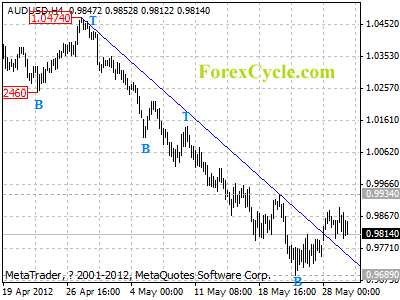
AUDUSD is in consolidation of downtrend

AUDUSD is in consolidation of the downtrend from 1.0474. Range trading between 0.9689 and 0.9934 would likely be seen over the next several days. As long as 0.9934 resistance holds, one more fall towards 0.9500 is still possible after consolidation. However, a break above 0.9934 key resistance will indicate that the whole decline from 1.0855 (Feb 29 high) has completed at 0.9689 already, then the following upward move could bring price back to 1.0600 zone.

audusd

Daily Forex Analysis

Eurobonds: What Are They and Why Do They Matter?

By The Sizemore Letter

By the time you read this article, Greece may or may not still be in the Eurozone.  But whether Greece is in or out, the European sovereign debt crisis will almost certainly still be raging on.  The focus of investor worry has, in any event, moved westward to Spain.  The Spanish 10-year bond yield hit 6.5% on Monday, and the spread between Spanish and German yields hit a euro-era record.

While there are no quick fixes, one of the options on the table is the issuance of Eurobonds.  The precise mechanics of how an issuance would work remain unresolved, but the basics are simple: the 17 member states of the Eurozone would issue bonds collectively and accept joint liability for the outstanding debt.

Before you draw the wrong conclusions, this is not at all similar to the United States federal government issuing Treasury securities.  In that case, the U.S. federal government raises funds for its own operations, not the operations of the 50 U.S. states.  Imagine instead the 50 U.S. states borrowing collectively and distributing the funds amongst themselves, and you can quickly see why the proposal is controversial.  Texas, a low-tax, small-government state would not be particularly fond of effectively guaranteeing the debts of, say, big-spending, high-safety-net California.  Likewise, German or Dutch citizens would resent lending their own country’s credit rating to less-disciplined problem countries like Spain or Italy.  And in the case of Germany specifically, such a move would likely be unconstitutional.

Suffice it to say, the issuance of Eurobonds would be one of the more difficult solutions to implement, but the idea is not without its merits.

For smaller, non-crisis countries, such as Austria or Luxembourg, the increased liquidity of a Eurobond relative to their current, relatively illiquid domestic markets would mean lower yields and borrowing costs.

And for crisis-wrecked countries like Spain or Italy, their bonds would effectively enjoy Germany’s rating, and yields would be more than halved overnight.  Such a move would make their debts payable and take away the immediate threat of meltdown.

Unfortunately, there is that pesky little critter known as “moral hazard” that presents a challenge.  Germany wants to keep the pressure on the Eurozone’s problem children in the hopes that the fear of meltdown will force them to implement needed economic reforms.  And they rightly fear that bailing out the periphery countries too soon will breed complacency and that the reforms will simply never happen.  Essentially, they want to avoid creating another Greece.

For these reasons, a Eurobond scheme would have to have some kind of enforcement mechanism to ensure that the problem states kept their budgets under control.  But this would also mean some kind of new treaty, because nothing in the European Union’s assorted arrangements or institutions allows for anything strict enough to make the plan workable.

Whatever Europe’s leaders decide to do, they had better do it quickly.  Their indecision has consequences.

Virtually everyone practicing the investment management profession today was taught in business school that markets efficiently process information and reflect that information in market prices. Prices reflect the underlying reality.    Therefore, rising bond yields reflect investor fears about the creditworthiness of the borrowers in question.

The problem, as George Soros explained in his Theory of Reflexivity, is that the tail also wags the dog.  Prices not only reflect the underlying reality; they affect it as well.  Rising yields have a way of creating a self-fulfilling prophecy; investors, by pushing yields to unsustainable levels, effectively create the event that they feared most by pushing the borrower into default.

At time of writing, I do not believe that Spain or Italy is at risk of default, and in fact I have several open positions in Spanish stocks (see “Bargain Hunting in Spain“).  But part of my bullishness is predicated on my belief that the European Central Bank will act aggressively to force down yields to more sustainable levels. I also expect Germany to take a more relaxed stance when presented with the truly awful alternative of a Eurozone meltdown.

We shall see.  But until something close to an agreement is made, expect the volatility of recent months to continue.

“Under-Valued” Gold Stalls Again as New Chinese Stimulus Rumored, UK Austerity Challenged, Spain Looks to Add Debt

London Gold Market Report

from Adrian Ash

BullionVault

Tues 29 May, 08:15  EST

PROFESSIONAL WHOLESALE prices in the gold investment market reversed an early lift for the second day running in London Tuesday morning, easing back to last week’s finish at $1573 per ounce as the Euro currency also reversed its early rise to $1.26.

European stock markets cut their gains but held 0.7% better by lunchtime, while commodity prices were broadly higher but the silver price fell to new 3-session lows beneath $28.30 per ounce.

US, UK, German and French government bonds rose yet again, pushing the annual yield on 10-year Bunds down to 1.35%.

The official statistics agency today pegged Germany’s consumer price inflation at 1.9% year-on-year by, down from 2.1% in April.

Spanish retail sales fell last month by almost 10% from April 2011 according to new data. Spain’s cost of living, however, rose 2.1% on the official CPI measure.

“We still believe that gold has become increasingly undervalued,” says a note from South Africa’s Standard Bank, pointing again to $1640 per ounce as “fair value” in the gold investment market.

“Gold looks the healthiest metal currently,” says David Jollie at Japanese trading conglomerate Mitsui, “but new drivers may be needed to encourage the price back above $1,600 and reinvigorate the rest of the precious metals.”

With Indian consumer demand still poor thanks to the weak Rupee, “We have seen other Asian physical buyers such as China pick up some of the slack, as well as central banks,” says Swiss refiner MKS’s trading desk in Sydney, Australia.

Shanghai shares rose 1.2% on Tuesday amid rumors of a new consumer stimulus package from Beijing.

An official told Reuters on Monday that rural workers and owners of small-engine cars will receive unspecified subsidies to encourage them to trade in their old vehicles for new.

Credit Suisse analysts forecast a stimulus package ranging from CNY1-2 trillion (up to $315bn) – around half the size of China’s 2008 program.

UK chancellor George Osborne will meantime not tax pies and other baked goods, the Treasury said overnight, losing £75 million per year ($110m) in extra revenue from the so-called “pasty tax” and other levies now reversed.

“[It] is true that a change [of policy] would weaken the government’s credibility,” writes Financial Times columnist Martin Wolf. “But this is because the government made an unwise commitment [to austerity].

“Cameron/Osborne are sharply tightening fiscal policy in the face of a depressed economy,” says New York Times columnist Paul Krugman – who is lecturing at the London School of Economics on Tuesday, and whose new book End This Depression Now! is apparently in its fourth printing in Spain.

“Britain is choosing to emulate both the United States and the troubled nations of Europe when it doesn’t have to – all in the name of an economic theory that was foolish two years ago, and completely discredited now.”

Irish Taoiseach Enda Kenny today warned that Dublin’s credit rating – already cut to “junk” status by Moody’s despite the €85 billion rescue in 2010 by the IMF, European Central Bank and European partner states – would be downgraded further if voters don’t back the new European fiscal treaty in Thursday’s referendum.

Peaking above 14% per year last summer, Ireland’s 10-year government bond yields today ticked above 6.0% in early trade.

Back in the gold investment market, “Support at 1532/22 has held once more and continues to underpin” the Dollar price, says the latest weekly chart analysis from Commerzbank in Luxembourg.

However, “We believe that this significant area will be retested in the months to come and that it will give way when this occurs.”

Spanish government bonds fell further Tuesday morning, pushing 10-year costs for Madrid above 6.5% after a spokesman was quoted saying that choosing between cash or newly-issued government debt to fund the latest €19 billion rescue of the Bankia lender was now only a “marginal” issue.

“The phrase ‘house of cards’ comes to mind,” says Georg Grodzki at London’s £391 billion Legal & General insurance and investment group.

“We do not believe that Bankia is unique [in Spain] in the extent of new losses identified,” the Financial Times quotes analysts at Rabobank, noting Friday’s restatement of 2011’s profits from a €309m profit into a €2.97bn loss.

Madrid is also “considering” allowing Spain’s regional governments – now some €140bn in debt – to issue joint bonds, guaranteeing them by setting aside tax revenues so that creditors are paid first, according to Bloomberg.

“It would provide some comfort to investors at a time when a guarantee from the Spanish sovereign is not exactly gold plated,” says Credit Agricole strategist Harpreet Parhar in London.
Adrian Ash

BullionVault

Gold price chart, no delay   |   Buy gold online at live prices

Adrian Ash is head of research at BullionVault, the secure, low-cost gold and silver market for private investors online, where you can buy gold today vaulted in Zurich on $3 spreads and 0.8% dealing fees

(c) BullionVault 2012

Please Note: This article is to inform your thinking, not lead it. Only you can decide the best place for your money, and any decision you make will put your money at risk. Information or data included here may have already been overtaken by events – and must be verified elsewhere – should you choose to act on it.


Events Expected to Affect USD/CAD Cross This Week

By TraderVox.com

Tradervox (Dublin) – The Canadian dollar retreated against the greenback last week but the buck/loonie pair never crossed critical resistances. Some of the events that were major last week included the Core Retail sales for March, which came in weaker than expected. The minimal increment of 0.1 percent on Core Retail sales indicates an improvement in the economy which is good for the loonie. Here are some of the events this week that will affect the cross.

On Wednesday at 12:30, the Raw Materials Price Index report will be released. The previous reading showed a decline of 1.6 percent in March after 0.6 decline in February. Analysts indicated that the decrease was as a result of mineral fuels and crude oil petroleum decreasing but there was some gain in the grain prices. Further, the Industrial Product Price Index (IPPI) increased by 0.2 percent in march due to price increase of petroleum. This time, the RMPI is predicted to come in at 2.1 percent while the IPPI is projected to gain to 0.1 percent.

On Thursday at 12:30 a report on Canadian current account will be released. The last report showed that the current account deficit contracted to $10.3 billion in the fourth quarter last year as a result of a $3.1 billion merchandise surplus, which indicated market improvement. The report is expected to show an increase in the current account deficit to $11.1 billion.

Another report on Friday is expected to change the USD/CAD pair and might determine whether the cross will close on a high or low is the Canada’s GDP report. The economy was reported to contract in February by 0.2 percent against the market expectation of a 0.2 percent growth. The decline will have a negative report for the first quarter growth rate and it may delay an interest rate hike that has been highly predicted. The GDP report is expected to show an expansion of 0.3 percent.

Disclaimer
Tradervox.com is not giving advice nor is qualified or licensed to provide financial advice. You must seek guidance from your personal advisors before acting on this information. While we try to ensure that all of the information provided on this website is kept up-to-date and accurate we accept no responsibility for any use made of the information provided. Opinions expressed at Tradervox.com are those of the individual authors and do not necessarily represent the opinion of Tradervox.com or its management. 

Article provided by TraderVox.com
Tradervox.com is a Forex News Portal that provides real-time news and analysis relating to the Currency Markets.
News and analysis are produced throughout the day by our in-house staff.
Follow us on twitter: www.twitter.com/tradervox