BOJ May Overhaul its Bond Purchases Program

By TraderVox.com

Tradervox (Dublin) – After losing that battle to deflate the yen due to reluctance of government bondholders, the Bank of Japan may be forced to overhaul its asset purchases program in its coming meeting on June 14-15. The meeting will be held just two days before Greece goes into an election which might ultimately seal its fate in the euro region. The crisis in the euro area has already forced the BOJ to miss its target for purchases twice last month. After a surge in the demand for riskier assets in market, safe haven demand has returned as investors await important reports next week.

Statements from Bank of America Merrill Lynch indicate that the current disruptions to the BOJ program has compounded the pressure on the Bank of Japan Governor Masaaki Shirakawa to establish effective measures to support the economy expected to slow after a good show in the first quarter. Masayuki Kichikiwa who is the Chief Economist for the bank added that the BOJ might be forced to extend bond maturity in the coming month. The BOJ extended the maturity of its two-year bonds to three years as a measure to ease long-run borrowing costs.

The Bank of Japan failed to raise enough one- and two-year notes it needed in May 16 and later failed to attract enough offers for bond buying operation. This is a reflection of the dampening demand for riskier assets as investors speculate Euro zone crisis will worsen. Analysts have predicted a souring outlook for global economy which has forced policy makers around the world to establish measures to curb any emergent issue. Some of the countries that have taken such measures include China, which has lowered its interest rate for the first time since 2008, Brazil, and the US is said to be considering stimulus.

Disclaimer
Tradervox.com is not giving advice nor is qualified or licensed to provide financial advice. You must seek guidance from your personal advisors before acting on this information. While we try to ensure that all of the information provided on this website is kept up-to-date and accurate we accept no responsibility for any use made of the information provided. Opinions expressed at Tradervox.com are those of the individual authors and do not necessarily represent the opinion of Tradervox.com or its management. 

Article provided by TraderVox.com
Tradervox.com is a Forex News Portal that provides real-time news and analysis relating to the Currency Markets.
News and analysis are produced throughout the day by our in-house staff.
Follow us on twitter: www.twitter.com/tradervox

Gold Falls Following “Bernanke Curve Ball”, US “Lacks Credible Fiscal Plan”

London Gold Market Report
from Ben Traynor
BullionVault
Friday 8 June 2012, 08:30 EDT

WHOLESALE MARKET prices for gold bullion hit a low of $1561 an ounce during Friday’s Asian session – 4.8% down on this week’s high – while stocks and commodities also fell this morning and major government bond prices gained.

On the currency markets, the Euro dropped back below $1.25 as the Dollar rallied, after Federal Reserve chairman Ben Bernanke yesterday “disappointed” traders by not making a firm commitment to a third round of quantitative easing, known as QE3.

Gold prices managed to recover some ground by Friday lunchtime in London, rising back above $1580 an ounce, but gold bullion was still down 2.5% on the week, having unwound most of last Friday’s jump.

Silver bullion meantime dipped below $28 an ounce in early London trading, before it too recovered some ground, adding about 50 cents ahead of the US session.

“Gold bulls were very disappointed by the Bernanke testimony yesterday,” says Lynette Tan, investment analyst at Phillip Futures in Singapore.

“Bernanke gave few clues on QE3,” adds the latest note from Swiss precious metals group MKS, “and attributed much of the recent job weakness to seasonal factors.”

“This morning, we are seeing some support for [precious metals] despite a persistently strong Dollar,” says Marc Ground, commodities strategist at Standard Bank.

“This support is most likely coming from the physical market as buyers find current price levels once again more attractive…however, we would not completely discount another leg down.”

At his testimony to the Joint Economic Committee on Thursday, Bernanke warned Congress that current US fiscal policy is “clearly unsustainable”. The Fed chairman added that the so-called fiscal cliff – the expiration of tax cuts and reduced government spending currently due to happen at the start of 2013 – poses “a significant threat to the recovery”.

A day earlier, European Central Bank president Mario Draghi also drew attention to fiscal policy issues, saying on Wednesday that “some of [Europe’s] problems have nothing to do with monetary policy…[which should not be used] to compensate for other institutions’ lack of action.”

Europe “poses significant risks to the US financial system”, Bernanke said yesterday.

“The Federal Reserve remains prepared to take action as needed to protect the US financial system and economy in the event that financial stresses escalate,” he added. Later in his testimony, Bernanke argued there is “no justification” for fears that QE poses a risk of high inflation.

“[Bernanke is] saying what he has said before,” reckons Fabian Eliasson, New York-based vice president of currency sales at Mizuho Corporate Bank.

“[He is] reassuring people that they will act if things deteriorate further.”

A day before Bernanke’s testimony, Fed vice chair Janet Yellen told an event in Boston she was “convinced that scope remains for [the Fed] to provide further policy accommodation either through its forward guidance or through additional balance-sheet actions”.

“Bernanke threw traders a curve ball,” complained one Chicago analyst following the Fed chairman’s testimony.

“After his vice chair made it seem like [QE] was a foregone conclusion, he really messed people up.”

Despite its rhetoric, the Fed is actually tightening policy, argues Grant’s Interest Rate Observer publisher Jim Grant. In an interview with CNBC this week, Grant pointed out that the Fed’s balance sheet has contracted over the last three months.

“The Fed is withdrawing stimulus even as more and more [Fed policymakers] are talking about QE3,” said Grant, who nevertheless says he expects there will be a third round of quantitative easing.

Here in Europe meantime, Spain is due to ask the European Union to inject funds into its banking sector, according to a Reuters report which cites EU and German officials.

“The government of Spain has realized the seriousness of their problem,” the newswire quotes a senior German official.

Spanish banks hold €184 billion in real estate loans described as “problematic” by the Economy Ministry, news agency Bloomberg reports.

Ratings agency Fitch downgraded Spain’s sovereign credit rating from A to BBB Thursday, putting it two notches above junk.

Fitch also warned Thursday that it will cut its rating for the US next year if it does sufficiently address its fiscal problems.

“The United States is the only [AAA-rated] country which does not have a credible fiscal consolidation plan,” said Fitch sovereign ratings analyst Ed Parker.

China, the world’s biggest buyer of gold bullion in the six months to March, is due to publish several pieces of key economic data this weekend, including the latest consumer price inflation, money supply and trade figures.

China’s central bank cut interest rates yesterday for the first time since early 2009, a move that surprised many analysts.

“This rate cut is a clear indication the government sees further weakness in the May economic data,” reckons Stephen Green, head of research, Greater China at Standard Chartered in Hong Kong.

Ben Traynor
BullionVault

Gold value calculator   |   Buy gold online at live prices

Editor of Gold News, the analysis and investment research site from world-leading gold ownership service BullionVault, Ben Traynor was formerly editor of the Fleet Street Letter, the UK’s longest-running investment letter. A Cambridge economics graduate, he is a professional writer and editor with a specialist interest in monetary economics.

(c) BullionVault 2011

Please Note: This article is to inform your thinking, not lead it. Only you can decide the best place for your money, and any decision you make will put your money at risk. Information or data included here may have already been overtaken by events – and must be verified elsewhere – should you choose to act on it.


EUR/USD Hits 10-Day High

Source: ForexYard

The euro hit a ten-day high against the US dollar during trading yesterday, following a positive Spanish bond auction which led to an increase in risk taking. By the end of European trading, the EUR/USD rose as high as 1.2609, an increase of close to 70 pips for the day. As markets get ready to close for the week, traders will want to pay attention to several indicators that could lead to volatility. The British PPI Input figure, set to be released at 8:30 GMT, could help the pound extend its recent bullish movement against the USD if it comes in above the forecasted -1.2%. Later in the day, the US Trade Balance figure could potentially lead to additional losses for the greenback if it comes in below expectations.

Economic News

USD – Dollar Takes Losses against Riskier Currencies

The US dollar extended its recent bearish trend against its higher-yielding currency rivals yesterday, as several global indicators generated risk taking in the marketplace. A significantly better than expected Australian Employment Change figure resulted in the AUD/USD moving up some 120 pips over the course of the day, eventually reaching just below the psychologically significant 1.000 level. Later in the day, the EUR/USD was able to hit a ten-day high after solid demand at a Spanish bond auction helped ease fears regarding the health of Spain’s banking sector.

Turning to today, dollar traders will want to pay attention to the US Trade Balance figure, set to be released at 12:30 GMT. Analysts are forecasting that the figure will come in around -49.3B, which if true, would represent a slight improvement over last month. Should the figure come in at or above expectations, the dollar could recoup some of its recent losses before markets close for the week. At the same time, analysts are warning that any gains could be temporary, as investors are still concerned with the possibility that the US economic recovery has stalled.

EUR – Euro Sees Mixed Trading Day

While the euro saw significant gains against its safe-haven rivals yesterday, including the USD and JPY, it dropped against other riskier currencies including the AUD. In addition to the 70 pip gain against the USD, the euro was able to advance close to 120 pips against the JPY. By the end of the European session, the EUR/JPY was trading around the 100.50 level. At the same time, better than expected Australian employment data resulted in the EUR/AUD falling more than 100 pips over the course of the day. The pair reached as low as 1.2592 before staging a slight upward correction to stabilize at 1.2629.

Turning to today, traders will want to pay attention to any announcements out of the euro-zone, particularly with regards to Spain and Greece. While the euro has seen a fairly significant recovery against the dollar and yen this week, analysts are warning that the economic and political problems that have plagued the euro-zone still have the potential to weigh down on the common-currency. Any negative indicators out of the region may cause the euro to quickly reverse its earlier gains.

Gold – Gold Reverses Gains amid Investor Risk Taking

An increase in investor risk taking yesterday, following positive news events out of Australia and the euro-zone, caused gold to reverse some of its earlier gains. Gold has recently been treated as a safe-haven asset due to economic turmoil in the US and euro-zone. The precious metal fell close to $30 an ounce during European trading, eventually hitting $1599.94.

Today, gold traders will want to pay attention to news out of the euro-zone. If riskier currencies like the euro and Australian dollar continue their current upward trend, gold may take additional losses to close out the week. At the same time, if any developments out of the euro-zone lead to risk aversion in the marketplace, gold could recoup some of yesterday’s losses.

Crude Oil – Crude Oil Moves Up Following Chinese Interest Rate Cut

Crude oil saw gains throughout European trading yesterday, after a surprise Chinese interest rate cut was taken as a sign that global demand could go up in the near future. The price of crude oil was up by over $2 a barrel, eventually reaching as high as $86.98 during mid-day trading before staging a mild downward correction. The commodity eventually stabilized around $85.85.

As we close out the week, oil traders will want to pay attention to the US Trade Balance figure at 12:30 GMT. With analysts predicting that the figure will show some improvement over last month, the news could result in modest dollar gains during afternoon trading. If true, investors may take the news as a sign that oil demand will go up in the US, which could help the price of crude move up further.

Technical News

EUR/USD

The weekly chart’s Slow Stochastic has formed a bullish cross, indicating that this pair may extend its recent upward movement. In addition, the Williams Percent Range on the same chart has crossed into oversold territory. Going long may be the wise choice for this pair.

GBP/USD

Long-term technical indicators are currently placing this pair in neutral territory, meaning that no defined trend can be determined at this time. Traders may want to take a wait-and-see approach, as a clearer picture may present itself in the near future.

USD/JPY

A bullish cross on the daily chart’s MACD/OsMA points to a possible upward correction in the near future. Furthermore, the Slow Stochastic on the weekly chart appears to be forming a bullish cross as well. Traders will want to keep an eye on this indicator. If the cross does form, it may be a good time to open long positions.

USD/CHF

The Slow Stochastic on the weekly chart has formed a bearish cross, indicating that this pair could see a downward correction in the coming days. Additionally, the Williams Percent Range on the same chart is hovering around the overbought zone. Opening short positions may be a wise choice for this pair.

The Wild Card

GBP/NZD

The daily chart’s Williams Percent Range has fallen into the oversold zone, indicating that this pair could see an upward correction before markets close for the week. This theory is supported by the Slow Stochastic on the same chart, which has formed a bullish cross. Going long may be the wise choice for forex traders.

Forex Market Analysis provided by ForexYard.

© 2006 by FxYard Ltd

Disclaimer: Trading Foreign Exchange carries a high level of risk and may not be suitable for all investors. There is a possibility that you could sustain a loss of all of your investment and therefore you should not invest money that you cannot afford to lose. You should be aware of all the risks associated with Foreign Exchange trading.


Euro Weakens Prior to German Export Data

By TraderVox.com

Tradervox (Dublin) – The 17-nation currency has lost against most of its peers after gaining for the better part of the week. This has come just before a report from Germany, the region’s biggest economy, is set to show that exports fell in April due to concerns of deteriorating economy as a result of prolonged European debt crisis. Investors are staying safe as they buy haven assets boosting demand for the yen and dollar. Euro is set to close the week on a low as risk appetite diminishes.

According to most economist, a report from Germany will show that the country’s exports decreased by 0.7 percent in April from March when they increased by 0.8 percent. Alex Sinton, who is a director for Institutional Foreign Exchange at Australia & New Zealand Banking Group Ltd, while talking about the report said that the situation in Europe is still shaky with a bunch of problems to deal with. He added that the recent euro rally will put more pressure on the currency as investors look for better reports and data from the region. The euro remains the worst performer in the last six months dropping by 3.7 percent while the dollar and the yen increased by 3.4 and 0.9 percent respectively over the same period.

Concerns about the euro area has dampened demand for riskier assets sending the Australian dollar down 0.4 percent against the US dollar to trade at 98.55 US cents and 0.8 percent lower against the yen to exchange at 78.16 yen. The 17-nation currency dropped 0.7 percent against the yen to trade at 99.33 yen per euro while it lost 0.3 percent against the dollar. It traded at $1.2518 during the mid-day trading in Tokyo.

Analysts and investors are now looking forward policy makers’ meeting in Japan and US on June 14-15 and 19-20 respectively. They will keep a close eye on any changes that might be proposed by the two nations.

Disclaimer
Tradervox.com is not giving advice nor is qualified or licensed to provide financial advice. You must seek guidance from your personal advisors before acting on this information. While we try to ensure that all of the information provided on this website is kept up-to-date and accurate we accept no responsibility for any use made of the information provided. Opinions expressed at Tradervox.com are those of the individual authors and do not necessarily represent the opinion of Tradervox.com or its management. 

Article provided by TraderVox.com
Tradervox.com is a Forex News Portal that provides real-time news and analysis relating to the Currency Markets.
News and analysis are produced throughout the day by our in-house staff.
Follow us on twitter: www.twitter.com/tradervox

How to Bet Against China’s ‘Ridiculous’ Economy

By MoneyMorning.com.au

‘The idea many investors have that China can make a seamless transition to a consumer-driven economy is ridiculous. There is no precedence for it. They don’t have a system, cultural, legal, economic or political, that would accommodate that kind of transition.’ – Michael Aronstein, Marketfield Asset Management

It’s good to see we’re not the only one who sees through China’s economic charade.


Michael Aronstein at Marketfield Asset Management thinks China’s days are numbered. He told Bloomberg:

‘It worries me, particularly in China, where the expectations about a developing middle class are, I think, way off the mark. The wealth China has developed has been mostly a function of either demand or capital coming from external sources.’

He’s dead right. And he’s backing it up by short-selling an exchange traded fund (ETF) that invests in Chinese stocks. Of course there’s a much better way to sell China, and it’s right here on the Aussie stock exchange…

Why China is an Anti-Consumer Economy

To hear most people talk about China’s economy, you’d think they’d created a magic formula to guide an economy to eternal success.

Some formula. The Chinese have simply spent and borrowed (yes, borrowed) to build huge infrastructure projects. When that stops, what happens next?

We had a chat about this with some old broker chums over an all-you-can eat buffet lunch (cauliflower soup, roast lamb and veg, and apple crumble with custard and ice cream) at the RACV Club in Melbourne last week.

We made this simple point. The notion that many in the West have is that China will allow its subjects (citizens would be a generous term) the freedom to become consumers.

We just don’t see it happening. A consumer-driven economy requires a free people and a mostly free market. At the very least it needs a competitive market.

It needs an economy where consumers can make choices about what they do, where they go, and what they buy.

A consumer economy is where you decide whether to use that five dollar note to buy a magazine, a bag of lollies or a coffee. Then you have to choose which magazine, which bag of lollies, or which coffee.

We’re sorry to say it, but most Chinese don’t have that choice. And the Chinese economy has no experience of a competitive market where consumers make choices. When you’re building a skyscraper you want steel, copper and glass. Those are commodities. To a large degree it doesn’t matter which steel, which copper or which glass you buy.

One of Pavlov’s dogs could run the Chinese economy. More steel? Press a button, more steel arrives. More copper? Press a button, more copper arrives. And so on.

How does that work in a consumer economy? It doesn’t. They can’t bulk order one product or service and allot it to the entire population. And if they do, it’s not what most of the people want…because it’s decided by a central planner rather than by the consumer.

Not a Cross-Section of Chinese Living Standards

Perfect examples in the West are public healthcare, schooling and housing. Forcibly paid for by taxpayers who don’t need it, don’t want it, or would prefer something else…something they could choose.

But, we hear you ask, ‘Ah, but what about the pictures you see of the rich folks in Shanghai wearing Rolex’s and driving Ferrari’s. Isn’t that proof consumer culture exists and can be successful?’

Again, we mentioned this over lunch last week. The Rolex’s and Ferrari’s are what you can see. What about what you can’t see?

Using the rich in Shanghai as a sample of consumerism in China is like taking a snapshot of consumers in Toorak, Vaucluse and Beverly Hills and assuming that’s a fair picture of all consumers in Melbourne, Sydney and the Los Angeles area.

The rich in Shanghai are consumers because their mates in China’s ruling elite let them be consumers. But don’t expect the Chinese government to give the same personal and consumer freedom to the masses.

Because the rulers know that once they lose control over what the people can buy and sell, they’ll lose power. And power is the biggest weapon the Chinese rulers have.

In China There Can Be No Freedom Without the Loss of State Power

In the May issue of Australian Small-Cap Investigator we wrote that until the Industrial Revolution, ‘There was no progress or improvement in the standard of living because no-one knew the concept of wanting to do better for themselves.’

Kings ruled kingdoms, Lords ruled their estates, and the serfs and servants obeyed their masters. They knew no better. They certainly never dreamt of becoming a King or Lord.

But once the Industrial Revolution arrived, people gained some freedom. And they got a taste for it and the chance to better themselves.

The point is it didn’t happen overnight. It took time. It needed a situation where individuals could exercise some choices. And it needed an environment where capitalists could lure labourers away from hand-to-mouth living, towards earning a wage.

At the time of the Industrial Revolution this was new to everyone. They couldn’t have known the impact it would have, and how it would result in more freedom for the lower classes and less power for the ruling classes.

But that’s not how it is in China. If they’ve done their homework, the ruling powers will know what will happen if they allow individuals to become free and make their own choices. It will mean loss of power and control.

Freedom and State power are the two extremes. You can’t have both in equal measures. You can’t have absolute power and absolute freedom. It’s one or the other or something in between. So something has to give.

And that is the last thing China’s rulers want. Consumerism in the Chinese economy won’t happen. Not without a fight.

Sell Aussie Miners – Sell China

That’s why we’re a fan of the ‘sell big Aussie miners trade’.

Companies such as BHP Billiton [ASX: BHP], Rio Tinto [ASX: RIO] and Fortescue Mining [ASX: BHP] are almost 100% pure plays on the Chinese economy.

Shares in these companies did amazingly well between 2003 and 2007. Why? Because they had what the Chinese needed – millions of tonnes of bulk materials: iron ore, copper, and coal.

You need a lot of that stuff when you’re building skyscrapers, freeways, houses and sports stadiums. But…you don’t need quite so much iron ore, copper, and coal when you’re making consumers goods.

Such as handbags, lollies, toothpaste and shoes.

The big Aussie miners have already taken a tumble this year. BHP is down 26%, Rio is down 30%, and Fortescue is down 27%.

Our bet is all three have much further to fall.

And quite frankly, we doubt if there’s a better trade in the world to sell China’s economy than the opportunity Aussie investors have to short sell these three stocks.

Cheers,

Kris.
Related Articles

Market Pullback Exposes Five Stocks to Buy

The US Dollar – The “Strongest of the Weak”

How Bad Monetary Policy Will End the Welfare State


How to Bet Against China’s ‘Ridiculous’ Economy

A Liberty Investor’s Guide to Latin America

By MoneyMorning.com.au

Words, indeed, are powerful things. As an Englishman in America, my personal favorite is freedom.

It’s embodied by those words penned so long ago by a young Thomas Jefferson…

It’s the idea that “We hold these truths to be self-evident, that all men are created equal, that they are endowed by their Creator with certain unalienable Rights, that among these are Life, Liberty and the pursuit of Happiness.”

That’s not only the foundation for what I believe, but it’s also the basis for how I invest.

It’s a technique I call “Liberty Investing.”

As such I like to invest in countries and companies whose operations are compatible with freedom, as defined by the Founding Fathers and the best U.S. political and economic traditions.

To me, this is ultimately the right way to run both societies and companies. And when we follow them, our returns will be consistently superior over the long term.

I often look for a number of characteristics in the countries where I invest.

For instance, market signals should be paramount and government participation in the markets should be relatively low. The Heritage Foundation Index of Economic Freedom is a good measure of this.

Each country should also have a high level of integrity-meaning they follow the rule of law. A good score on Transparency International’s Corruption Perceptions Index is a good measure of this.

They should also be generally free and democratic, and should have a fairly small government and moderate taxation. Interest rates also should be above the level of inflation, so they don’t deprive their economies of domestic savings.

Finally the local bureaucracy should be reasonable to deal with. The World Bank has an Ease of Doing Business Survey that tells you this.

You see how this freedom-based investing technique works?

They’re also fairly unlikely to expropriate your investments, and will maintain your right to property.

That’s why I’m suddenly more interested in investing in Latin America. To tell you the truth, you should be too.

Here’s why.

Liberty Investing in Latin America

Latin America as a whole has averaged 4% real growth in the last decade, far more than you would have gotten in Europe, North America or even much of Asia outside of China and India.

That gives us the kind of growth we need to watch our investments grow.

Yet the region remains a minefield for investors.

Certain populist governments have been expropriating companies, making property rights extremely vulnerable.

However there are a few bright spots. Namely they are countries where things are improving -albeit gradually.

Given these trends, the region is too good to pass up – even though it does still carry risks.

A Liberty Investor’s Tour of Latin America

Bearing those in mind, here’s a Liberty Investor’s tour of Latin America as I see it.

Investing in Argentina and Venezuela: Other than both countries being democracies, they obey none of the Liberty Investing criteria. Foreign investments are not safe from expropriation while both countries score low on integrity and have governments that dominate every sector of their economies.

Interest rates in both countries are below the level of inflation, and the local bureaucracies are arbitrary and chauvinistic. Finally, the government overrules the free market in both countries at every opportunity.
Mark this Pair: “Not a Chance”

Investing in Brazil: This darling of the international investment community is also not suited for a Liberty Investor. Until recently interest rates were well above inflation, but the government has lowered them several times and plans to lower them further.

Government in Brazil is too large, and meddles in many sectors of the economy, seeking to build Brazilian champions in such areas as shipbuilding.

Until 2009, the resource sector was fairly safe from government meddling, but that is no longer the case. Finally the World Bank ranks Brazil an appalling 126th on its Ease of Doing Business survey, below Russia.
Mark this one: “I Don’t Think So”

Investing in Mexico: Ranks 54th on the Heritage Foundation’s Index of Economic Freedom, which is not too bad. Mexico is also above Brazil on the corruption index and a respectable 53rd on the Ease of Doing Business Index.

On the other hand, in sectors such as energy, the government is completely dominant, more so than in Brazil. Mexico has an election in July, which could go either way.
Mark this one: “Avoid for Now”

Investing in Peru: This one ranks a high 42nd on the Index of Economic Freedom and 41st on the World Bank Ease of Doing Business Index. Its government is relatively small, and the market sector dominant, although current policy is to increase government participation.

On the other hand, interest rates are below the inflation rate and the current president Ollanta Humala is left-of-center. Overall, Peru is acceptable, but no more than that at this stage.
Mark this one: “A Maybe Later”

Investing in Colombia: This one is similar to Peru, but better. It has rankings of 45th on the Index of Economic Freedom and 42nd on the Ease of Doing Business. Like Peru, it has a relatively small government, but unlike Peru the government is strongly pro-market.

Add to this the fact that it has recently signed a free trade agreement with the United States, and is enjoying an oil and infrastructure boom, and you can see the investment opportunities in Colombia are very interesting indeed.
Mark this one: “A Buy”

Investing in Chile: Finally, there’s Chile. It has a stellar ranking of 7th on the Heritage Foundation index – three places above the United States.

It also ranks above the U.S. on the Corruption Perceptions Index, but is only 39th on the Ease of Doing Business index, with construction permits being a particular problem area. Its government is small by global standards and its taxation moderate, with a privatized social security system that has been a model to many other countries.

Only interest rates are a problem, with the central bank rate below 1% while inflation is running at around 4%. Still, like Colombia, Chile is an excellent home for your investments.
Mark this one: “A Buy” as well.

Freedom is a simple word, but a powerful force. Follow it and you can change the world as well as your investments. It is only when you lose sight of it that the train comes off the tracks.

Martin Hutchinson
Contributing Editor, Money Morning

Publisher’s Note: This article originally appeared in Money Morning (USA)

From the Archives…

How Bad Monetary Policy Will End the Welfare State
2012-06-01 – Dan Denning

The Setting Sun of the Japanese Economy
2012-05-31 – Greg Canavan

The US Dollar – The “Strongest of the Weak”
2012-05-30 – Kris Sayce

Europe’s Energy Resource Puzzle
2012-05-29 – Kris Sayce

The Market Has Crashed, But This Graphite Stock Has More Than Doubled
2012-05-28 – Dr. Alex Cowie


A Liberty Investor’s Guide to Latin America

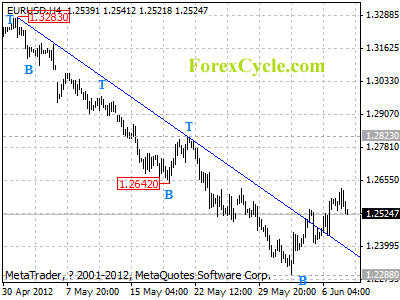
EURUSD’s bounce extends to 1.2585

EURUSD’s bounce from 1.2288 extends to as high as 1.2585. Another rise to test 1.2670 key resistance would likely be seen later today, as long as this level holds, the price action from 1.2288 could be treated as consolidation of the downtrend from 1.3283, and another fall towards 1.2000 is still possible after consolidation. On the upside, a break above 1.2670 will indicate that the downward movement from 1..3283 has completed at 1.2288 already, the the following upward movement could bring price back to 1.3000 zone.

eurusd

Daily Forex Forecast

The Day of American Austerity: What Will It Look Like?

In the United States, the belt-tightening has just begun
June 07, 2012

By Elliott Wave International

Since the start of the European sovereign debt debacle, the word “austerity” has been bandied about a lot.

It wasn’t an everyday word, and may send some people to the dictionary. Merriam-Webster defines “austerity” this way: enforced or extreme economy.

But even knowing this definition might leave one wondering how “austerity measures” relate to Europe’s debt crisis. The Associated Press (5/13) provided this overview:

Austerity has been the main prescription across Europe for dealing with the continent’s nearly 3-year-old debt crisis, brought on by too much government spending. But what does it mean for the average European? Imagine paying sales tax of 23 percent or more. Or having your wages cut by 15 percent. Austerity comes in many forms: higher taxes, fewer state benefits, more job cuts, working longer until retirement, you name it.

How about America? Will austerity measures be imposed on the world’s largest economy? Well, a Marketwatch columnist says “America’s new Age of Austerity is already here…Yes, America is already in a depression.” (5/29)

We agree. In fact, Robert Prechter said as much in the September 2011 Elliott Wave Theorist:

Bulls say the economy is in recovery, albeit a weak one. Bears are calling for a “double dip” recession, like the back-to-back recessions of 1980 and 1982. But, as is often the case, we disagree with both camps: The economic contraction of 2007-2009 was not a recession; the respite since then is not the start of a new economic expansion; and the economy is not going to have another “dip” into recession. The economy has been sliding into depression.

The signs of an American austerity are becoming widely visible. And nowhere is this belt-tightening more evident than in state and local governments. Recent years have seen a multitude of stories that describe reduced services. And in the overall economy, we’re seeing a de-leveraging of debt. Unemployment remains relatively high. Here’s a CNBC headline from today (5/30):

Sign of the Times: 20,000 Apply for 877 Auto Job Openings

This story about a new automobile plant in Montgomery, Alabama is one of many like it that feature jobless or under-employed individuals standing in line.

Above I showed the September 2011 quote from Robert Prechter. Yet he actually foretold much of what is financially happening today in his 2002 book Conquer the Crash.

That’s right. Ten years ago, he described what this age of austerity would look like. Much of what he described looks just like what is going on today. But how about the rest of what’s described in Conquer the Crash?

Yes, there’s more. You see, Prechter pointed out much more than what unfolded in the 2007-2009 financial crisis. Do yourself the biggest of favors and learn what he has to say. Be one of the few who are prepared vs. the majority who will be caught off-guard.

How? Right now, Elliott Wave International is offering a special FREE report with 8 lessons from Conquer the Crash to help you prepare for your financial future.

In this 42-page report, you’ll get valuable lessons on:

  • What to do with your pension plan
  • How to identify a safe haven (a safe place for your family)
  • What should you do if you run a business
  • Calling in loans and paying off debt
  • Should you rely on the government to protect you?
  • Money, Credit and the Federal Reserve Banking System
  • Can the Fed Stop Deflation?
  • A Short List of Imperative Do’s and Don’ts

It’s not too late to prepare yourself for what’s ahead. Get Your FREE 8-Lesson Conquer the Crash Report Now

This article was syndicated by Elliott Wave International and was originally published under the headline The Day of American Austerity: What Will It Look Like?. EWI is the world’s largest market forecasting firm. Its staff of full-time analysts led by Chartered Market Technician Robert Prechter provides 24-hour-a-day market analysis to institutional and private investors around the world.


Fed ready to act if financial stress escalates – Bernanke

By Central Bank News
    The United States economy should continue to expand at a moderate pace in the next few quarters but the situation in Europe poses significant risks and the Federal Reserve stands ready too take appropriate action, Chairman Ben Bernanke said.
     Speaking to U.S. lawmakers, Bernanke said U.S. households continue to spend, consumer sentiment is still noticeably higher than last year and demand for U.S. exports has held up.

   “Nevertheless, the situation in Europe poses significant risks to the U.S. financial system and economy and must be monitored closely. As always, the Federal Reserve remains prepared to take action as needed to protect the U.S. financial system and economy in the event that financial stresses escalate,” he told the Joint Economic Committee.
     “Economic growth appears poised to continue at a moderate pace over coming quarters, supported in part by accommodative monetary policy” Bernanke said.