A Proven Investment Strategy for Uncertain Times

Article by Investment U

A Proven Investment Strategy for Uncertain Times

Forget about emotions. Stop trying to time the market. Stick to following a proven investment strategy.

I know stocks aren’t exactly a fun asset class to be in right now.

Since April, the S&P has dropped 9%. And you can sense the roller coaster ride isn’t going to end soon either.

What’s worse, investors like you and I have been dealing with the same old issues for a few years.

The Eurozone is still a mess. The possibility of it disbanding heats up and cools off almost every other day.

Meanwhile, the U.S. economy merely keeps sputtering along. And as the U.S. government attempts to spend its way to prosperity, the next recession feels like it’s just around the corner.

These days, there’s even more to worry about too. China’s economy is slowing. New and expensive wars could begin in Iran and North Korea. There’s also no telling whether or not the U.S. housing market has found a bottom.

Everything mixed together is the perfect recipe for volatility in the stock market.

But I don’t care how bad things seem, nobody knows where stocks will be 12 months from now or even tomorrow.

And just as things could get worse, they could get much better as well.

For example, from October 2007 to March 2009, who could’ve predicted stock prices would plummet over 50%?

By the same token, did anybody foresee stocks turning around in 2009 and soaring up around 80% today?

No.

That’s why it’s so important to forget about our emotions and trying to time the markets altogether. And instead, stick to following a proven strategy when approaching our stock investments.

It’s All About The Plan

Today, there are two common mistakes novice investors make that really burns them when the markets go sour.

First, they don’t know how much money to put into any given stock. And second, they don’t know how to protect their profits – exit strategies are of utmost importance.

So, here are two very important elements of any successful investing strategy:

  • Never put more much more than 4% of your total portfolio into any single stock purchase. For example, if you have $50,000 set aside to invest in stocks, limit the amount of money you put into any stock to $2,000. You may not see it now but you’ll appreciate this when that high-flyer turns out to be the next Enron.
  • Next, always protect yourself with a trailing stop around 25%. This will automatically sell your shares whenever one of your stocks pulls back 25% from its closing high. By doing this, you’ll instantly limit your losses on any stock to 1% of your total portfolio.

With just these two principles in place, you can maximize your earnings by letting your profits run. And you can minimize the risk you take on by not overexposing yourself to any one investment.

Because, no matter how uncertain things seem, there are still plenty of opportunities to profit out there.

Already this year, Investment U Plus subscribers have had the opportunity to cash in on 40 different stocks that could’ve returned single and double digit gains as high as 34%, 57%, and 60%.

Marc Lichtenfeld even recommended a pharmaceutical company at the beginning of the year that has jumped as high as 105%.

At our sister organization under Oxford Financial Publishing, The Oxford Club also directed by IU Chairman Alexander Green – members are averaging gains of 35% across 22 open positions. In fact, Alex has been ranked by The Hulbert Financial Digest – the industry’s top watchdog – as high as 3rd in the nation overall for his stock selections. And currently his Oxford Club portfolio ranks 5th for performance based on their 10-year, risk-adjusted return.

Risk isn’t always rewarded. But with the right strategy, you can cut your losses off at the knees and keep ride your winning positions to massive windfalls in the future. And that’s advice that you can take to the bank for the rest of your life.

Good Investing,

Mike Kapsch

Article by Investment U

Investing in Mexico: Profit From This New Manufacturing Superpower

Article by Investment U

Investing in Mexico: Profit From This New Manufacturing Superpower

While Mexico’s challenges make headlines, its strengths are making money for investors.

I have noticed that many people go to great lengths to travel the world but inexplicably ignore sites in their own backyard. Take me for example. I have lived in Colorado for about 12 years and have yet to visit the Grand Canyon.

And while I have visited more than 30 countries around the globe, I have not even been to Mexico. When in San Diego with my family on multiple occasions, I took a pass being a bit spooked by all the headlines on border drug and gang violence.

This type of thinking is unfortunately keeping many investors away from Mexico – a big mistake.

As I have highlighted at Oxford Club investment summits over the past year, while Mexico’s challenges make headlines, its strengths are making money for investors.

And Mexico’s strength is that that it has emerged as a major manufacturing and industrial power.

Mexican Exports Hitting Record Highs

U.S. industrial production is still at pre-2007 levels while Mexico got back to this level in early 2011. 80% of Mexico’s exports are manufactured goods and trade now represents 60% of GDP – a figure that has more than tripled since 1980. Mexican exports hit a record high in April of this year.

My view is that Mexico is on the way to replacing China as the premier global manufacturing platform for selling into North and South American markets.

China’s huge advantage in labor costs is evaporating. In 2000, Mexico’s manufacturing wages were 240% higher than in China. Now they are only 12% higher and given all the logistical issues and transportation costs that come with shipping parts to China and then bringing the final product back you can easily see Mexico’s advantage.

Mexico’s competitive edge is supercharged by a weak peso policy that has pushed the peso down an incredible 1,500% against the dollar since 1987 (though the peso is beginning to trend upward).

This is why American, European, Japanese, South Korean and, yes, even China are falling over each other to invest in Mexican production facilities. One example is the recent opening of Italian tire maker Pirelli’s first ever plant in Mexico. This ties in with Mexican auto production which was up 20% in April year-over-year.

Mexico’s Geographical Edge

Always keep in mind Mexico’s geographical edge next to two huge markets and as a Pacific Rim country, ready access to Asia-Pacific markets.

Let’s take a moment and look at the big picture. While U.S. debt is approaching 90% of GDP, Mexico is at 27%. America’s budget deficit is 8.6% of GDP while Mexico is at 2.5%. In addition, inflation in Mexico is at a manageable 4.4% and, unlike Brazil, has no restrictions on capital inflows.

Mexico is open for business worldwide. Get a piece of the action but remember that picking the right stock for a country on an upward trend is not an afterthought – it is the most important part. One of my favorite picks – Grupo Simec (NYSE: SIM) – is up 13.7% so far this year while emerging markets as a whole are down 6.2%.

Simec provides the finished steel that goes into manufacnuring plants being built hand over fist by global companies taking advantage of Mexico’s edge. In 2011 sales were up 19%, operating income was up 123% while Simec posted in the first quarter of 2012 a 24% increase in net sales and a 145% jump in operating earnings. Sales within Mexico were up 33% as the company exports about half of its production.

The stock is still trading below book value, at merely 65% of sales and at only 6.4 times trailing earnings.

And there’s more where that came from. In today’s Investment U Plus, I share another undervalued Mexican industrial company that is poised for incredible growth. It’s currently trading at just 75% of its book value and just 6.6 times trailing earnings.

Good Investing

Carl Delfeld

Editor’s Note: To find out Carl’s exclusive Investment U Plus pick for today along with our experts’ recommendations with each daily issue for pennies a day, click here.

Article by Investment U

Central Bank News Link List – June 10, 2012

By Central Bank News
Here’s today’s Central Bank News link list, click through if you missed the previous central bank news link list.  Remember, if you want to submit links for inclusion in the daily link list, just email them through to us or post them in the comments section below.

Market Review 11.6.12

Source: ForexYard

printprofile

The euro moved up over 150 pips against the USD and 140 pips against the JPY during overnight trading, following news that a $125 billion bailout was secured by Spain to help its ailing banking sector. Crude oil also advanced more than $2 a barrel, reaching as high as $86.60. That being said, crude has already started reversing its gains and is currently trading around $85.80.

Main News for the Week

Tuesday

• UK Manufacturing Production

Wednesday

• US Core Retail Sales
• US Retail Sales
• US PPI

Thursday

• US Core CPI
• US Unemployment Claims

Friday

• US Prelim UoM Consumer Sentiment

Read more forex news on our forex blog

Forex Market Analysis provided by ForexYard.

© 2006 by FxYard Ltd

Disclaimer: Trading Foreign Exchange carries a high level of risk and may not be suitable for all investors. There is a possibility that you could sustain a loss of all of your investment and therefore you should not invest money that you cannot afford to lose. You should be aware of all the risks associated with Foreign Exchange trading.

Monetary Policy Week in Review – 10 June 2012

By Central Bank News

    The past week in monetary policy saw interest rate decisions announced by 11 central banks around the world.
    Those that cut interest rates were: China, by 25 basis points to 6.31%, Australia, by 25 points to 3.5% and Vietnam by 100 points to 11.0%.
    There were no central banks that raised rates.
    Those central banks that left rates unchanged were the European Central Bank at 1.0%, the Bank of England at 0.5% , the Bank of Canada at 1.0% the Bank of Mexico at 4.5%, the Bank of Korea at 3.25%, the National Bank of Poland at 4.75%, the Central Reserve Bank of Peru at 4.25% and the State Bank of Pakistan at 12.0%.


    Looking at the central bank calendar , the week ahead features monetary policy decisions by three SouthEast Asian countries; Indonesia, Thailand and the Philippines. All three central banks are expected to keep rates unchanged.
    The Reserve Bank of New Zealand is also widely expected to keep its cash rate at 2.5%, and the Central Bank of Iceland’s Monetary Policy Committee meets on Wednesday. The Swiss National Bank publishes its Monetary Policy Assessment on Thursday. The SNB’s in-depth assessment is only carried out four times a year. The Bank of Japan meets on Friday, with some economists looking for monetary easing.

Jun-12
IDR
Indonesia
Bank Indonesia
Jun-13
THB
Thailand
Bank of Thailand
Jun-13
ISK
Iceland
Central Bank of Iceland
Jun-14
NZD
New Zealand
Reserve Bank of New Zealand
Jun-14
PHP
Philippines
Central Bank of Philippines
Jun-14
CHF
Switzerland
The Swiss National Bank
Jun-15
JPY
Japan
Bank of Japan


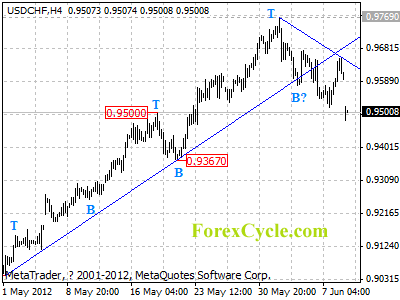
USDCHF breaks below 0.9500 key support

USDCHF breaks below 0.9500 key support and reaches as low as 0.9478, suggesting that the uptrend from 0.9043 has completed at 0.9769 already. The pair is now in downtrend, further decline could be expected over the next several days, and next target would be at 0.9300 area. Resistance is located at the downward trend line on 4-hour chart, as long as the trend line resistance holds, downtrend will continue.

usdchf

Forex Signals

Why You Should Wish For a Falling Market

By MoneyMorning.com.au

If you needed any further evidence of how trying to subvert natural forces is utterly destructive over the long run, look no further than Europe…and then perhaps China…and then…where do you stop?

For now, I’ll stick with Europe. The situation there is ruinous. EU elites are sacrificing the Greek and Spanish societies to maintain the façade of a workable monetary union and protect the banking system. The story is an old one, but it’s worth looking into again.


You can’t fight against nature and expect to win. Not in the long run. The European Monetary Union (EMU) is a flawed concept and the depressions in Spain and Greece are testament to that. Making matters worse, the Eurocrats demand fiscal austerity and deny exchange rate flexibility to ‘help’ these countries make the necessary economic adjustments to stay in the Eurozone.

This obviously matters for Australians. Every time Europe flashes red, global markets swoon. Our market and economy – perched on the edge of the world, open and exposed – seem to cop the brunt of the fallout. That won’t change anytime soon.

That might not be a soothing thought. But I want to show you why letting nature take its course in Europe would be a good thing, and why falling share prices would also be a good thing.

Why?
Because it would finally signal nature triumphing over the manipulators’ attempts to create wealth from nothing and ignore losses. Only then would the global economy be in a position to generate wealth – in a sustainable manner – again.

But the longer this game goes on, the more interference and bailouts inflicted on the market, the greater the final denouement will be. Let’s take the recent events in Spain as an example.

Spanish Influenza

The country’s banking system is imploding. Years of abundant credit (a product of the flawed EMU) created a historic housing bubble. Now the market has turned the credit tap off, exposing the overinvestment. Bad debts infect the Spanish banking system.

The Spanish Bank ‘Bankia’ is the poster child for this banking sickness. Formed in December 2010 from the consolidation of seven regional ‘cajas’, the Spanish government initially injected €4.5 billion into the bank.

That amount predictably evaporated and Bankia is now subject to a massive recapitalisation plan. The government has committed another €19 billion to the bank. Except the government doesn’t have the cash. It must borrow it. And the market is not too keen on giving Spain more cash to bail out the banks.

Spanish bond yields reflect this reluctance to lend. The 10-year yield is now over 6%.  This is a prohibitive interest rate. It makes it very hard for Spain to grow out of its debts. The interest rate plays a major part in ‘debt dynamics’. This is the trajectory of a country’s debt-to-GDP ratio.

All you need to know to work out a country’s debt dynamics:

  • What is its economic growth rate?
  • What is the interest rate it pays on its debt? And…
  • What is the country’s primary budget balance (i.e. before interest payments) as a percentage of GDP?

To get the change in debt, subtract the growth rate from the interest rate. Then subtract the primary budget balance. To have any hope of reducing debt, you want that equation to produce a positive number.

Spain is in recession, meaning its economic growth rate is negative. It has a budget deficit. And its interest rate is very high. This points to a rapidly deteriorating debt-to-GDP ratio…Spain is on the slippery slope to a bailout.

And given that the problems at Bankia are just a reflection of the whole Spanish banking system it looks like the country will need assistance. I predict you’ll see Spain join Greece, Ireland and Portugal in the bailout lounge.

What does this actually mean? In practice it means the market has shut off Spain’s tab. The EU rescue fund will need to fund Spain at a much lower interest rate to help improve its debt dynamics.

But here’s where things get interesting. The Spanish government is itself not massively indebted (its debt-to-GDP ratio was around 70% at the end of 2011, forecast to rise to 80% in 2012). The problem in Spain is the household and banking sector, weighed down by debts from the property bust.

So if Spain does get a bailout, it will be a bailout of the banking sector.

Greg Canavan
Editor, Sound Money. Sound Investment.

From the Archives…

How Bad Monetary Policy Will End the Welfare State
2012-06-01 – Dan Denning

The Setting Sun of the Japanese Economy
2012-05-31 – Greg Canavan 

The US Dollar – The “Strongest of the Weak”
2012-05-30 – Kris Sayce 

Europe’s Energy Resource Puzzle
2012-05-29 – Kris Sayce 

The Market Has Crashed, But This Graphite Stock Has More Than Doubled
2012-05-28 – Dr. Alex Cowie


Why You Should Wish For a Falling Market

Why Graphite is One of the Few Places For Savvy Investors to Make Money

By MoneyMorning.com.au

May was quite simply a nightmare month for investors.

The ASX200 lost 7.3% in a month – its worst result in 2 years. Half the market is still shell shocked. So this Queen’s birthday long weekend gives us a welcome breather.

With the good ship China creaking and groaning as it decelerates, resource stocks were some of the worst effected. The ASX300 Metals and Mining index (XMM) lost 12%.

Most hedge funds lost money. Despite clever trading strategies, the average hedge fund lost 1.6% in May according to analysts Hedge Fund Research Inc.

So with this backdrop, it was a very unlikely time for my latest Diggers & Drillers tip to gain 154% during the month…

Those readers who bought this stock saw the share price more than double in just 2 days, on the back of incredible drilling results. And this happened just as the market was going through its worst few days of the month.

Frankly there are very few places to make money in this market right now.

So it’s very satisfying to help readers more than double their money – particularly when the rest of the market is going down in flames. Putting opportunities like this in front of my readers is what gets me out of bed every morning.

This sector, which is still making investors money now, is graphite.

After May, the ASX200 is now right back to where it started the year.

That’s a big fat ZERO percent gain for the Aussie market.

In stark contrast, graphite stocks have had an incredible 2012 so far:

graphite stocks

The ranks are growing too. In just the last month, we’ve seen stocks like Kibaran appear on the radar.

This is what happened on the Canadian resource market. There is so much money to be made in graphite that the number of graphite stocks tripled in the space of a year. Some huge gains are being made by jumping on the stories at the very start.

But why is the graphite sector booming at a time like this?

In short – the opportunity has been quietly building for a few years. But the market only spotted it this year.

The graphite price has been rising strongly for a while. In fact, between 2008 and 2012, high quality graphite tripled in price. The price is still rising now as demand increases faster than supply.

Graphite Price Quietly Tripled


Graphite Price Quietly Tripled

Source: Northern Graphite Company

But the whole time the price was rising, no one seemed to be watching.

Then word got out a few months ago, and travelled quickly around the market. The price of graphite stocks are now making up for lost time.

It’s not simply a supply and demand story though.

Graphite is a ‘strategic mineral’, which means the supply is unreliable and prone to disruptions…

Graphite – Nearly All of it Comes From China

Graphite - Nearly All of it Comes From China


Source: Libertas

People are being very quick to brush graphite off as a bubble. The quick assumption is that it is ‘the new rare earths’. Some similarities are there: both are obscure strategic minerals, both are controlled by China, and both sectors went off like a rocket.

There is one very important difference.

There are different types of graphite, and the type of graphite investors are after is ‘flake graphite’. This makes up about a third of the market, and has the highest demand growth.

And when it comes to flake graphite – China has very little of it. China is in fact an IMPORTER of the stuff.

Rare earths prices have soared and then crashed as China kept changing its rare earths export policies.

But flake graphite’s current price rally has nothing to do with Chinese policies.

This is important because it means China hasn’t got the power to bring the price back down again, as it did with rare earths.

China’s power over rare earths prices was the key reason I side-stepped the whole rare earths frenzy a few years ago, and never tipped any rare earths stocks in Diggers and Drillers.

In direct comparison, the flake graphite price rise is not at the mercy of Chinese policy, and so is far more sustainable.

So I think those dismissing graphite as the latest hot commodity will be very surprised at just how long this graphite stock rally will run for.

And also just how much money savvy investors will make from investing in the right graphite stocks.

Dr. Alex Cowie
Editor, Diggers & Drillers

Related Articles

Market Pullback Exposes Five Stocks to Buy

This ‘Strategic’ Minerals Stock Has Just Doubled: What to Do Next

Europe’s Energy Resource Puzzle


Why Graphite is One of the Few Places For Savvy Investors to Make Money

The Complete Strategy Traders

By Taro Hideyoshi

As you may have read, I wrote an article to give you the idea what the strategy traders are. I also wrote another one to let you know a few benefits of strategy trading over other methods of trading.

And here, in this article, we are still talking about strategy traders. Actually, it is the complete strategy traders.

So, who are the complete strategy traders and what are the differences between the regular strategy traders and the complete strategy traders?

The complete strategy traders are traders who have learned to use advanced cash management principles, trade in multiple markets, and may also trade multiple strategies in each market.

The successful traders realize that the most important keys to make money in long run is how they manage their money, not what method or indicator are used.

While most traders are trying to predict the market and looking for the Holy Grail method or indicator, the successful traders are not. They understand that strategy trading is not unlike most other businesses and, as a result, have turned their trading into a sophisticated business based on sound business principles.

In order to be a successful in trader, you have to treat your trading like doing a business. From my experiences, I have realized that many successful business do not possess the best products but they are still leader in their business. It is because they manage their business effectively.

For example in the restaurant business, it is not only the food that makes a successful restaurant. It needs more than good chef and good food such as costs and services. However, the key is to master in restaurant management. You can see it clearly in fast food business where selling bad food but still in business.

It is the same in trading. Traders have to understand trading management to be able to become successful. Trading management is nothing to do with indicators. Of course, you have to use solid indicators in order to enable you to make money. However, the trading management is another thing, it is how you manage your money, your cash flow, your risk also your trades. And you have to manage them effectively.

Successful traders are traders who understand that more than simply a great indicators or trading system is needed to be successful.

So, if you want to be one of a successful traders who trades strategy, you need to be a complete strategy trader.

About the Author

Taro has strong will to share his experiences to others who are living in hard economic times like these days and trying to survive in financial markets. So, he has written and published articles on subjects such as personal finance, investment and money management.

His articles could be found at the websites – eFinanceZine.com & MetaStockTradingSystem.com.


$7,200 in Dividends From a $10,000 Investment

By Amy Calistri , globaldividends.com

$7,200 in Dividends From a $10,000 Investment

It’s the most lucrative investing strategy I’ve ever found. It won’t happen overnight, but I’m convinced anyone can earn a significant amount of money with this strategy.

Let me explain…

Over the past few weeks, I’ve shared the details of my “Daily Paycheck” strategy (you can read those issues here, here, and here).

Consider your typical income portfolio. It holds a position in a few dividend payers and maybe a fund or two. You get paid occasional dividends, that’s for sure. But because you only hold a few positions that pay quarterly dividends, the income you receive is inconsistent.

That’s where my “Daily Paycheck” strategy is different. The goal is to build a high and steady stream of income. And as I’ve told you before, I want to build a portfolio that pays a dividend for every day of the year.

So right now, I’m earning more than 30 dividend checks a month from my portfolio. At the same time, I’m generating an average yield of 7.2%… and that’s when interest rates — which fuel the yields on most “normal” income investments — are their lowest in history.

There’s a major caveat, though. And it’s one that will cause most investors to never take the first step to start their own “Daily Paycheck” portfolio. Most investors don’t have the most important characteristic that allows you earn the greatest wealth via this strategy — patience.

Take a $10,000 investment. In a portfolio like mine that earns an average yield of 7.2%, that amount would earn $720 in dividend income during the year. I wouldn’t sneeze at $720, but it’s just a fraction of what you could earn if you simply let your portfolio pay you year after year.

The table below shows exactly what I mean. It shows how much you’d earn… if you have patience. As you can see, even modest amounts can generate substantial dividends.

Your $10,000 investment would earn a staggering $7,200 in dividends in a decade. And that amount is before any capital gains and ignores any dividend increases.

How Much Can You Earn? Simply Look For Your Portfolio Size
Time Period:1 Month1 Year5 Years10 Years
Portfolio Size:
$10,000$60$720$3,600$7,200
$25,000$150$1,800$9,000$18,000
$50,000$300$3,600$18,000$36,000
$100,000$600$7,200$36,000$72,000
$200,000$1,200$14,400$72,000$144,000
$500,000$3,000$36,000$180,000$360,000
$1,000,000$6,000$72,000$360,000$720,000
*Numbers based on 7.2% average yield (the current average yield of my portfolio). All investing carries risk and no results are guaranteed. The figures above will also be subject to taxes and commissions.


I want to make something clear… this isn’t a “get-rich-quick” scheme. You aren’t going to invest a few thousand dollars and be buying expensive sports cars or going on exotic vacations.

But I think that’s part of what makes this style of investing so powerful…

See, if you want to become wealthy in the stock market, it’s probably not going to happen overnight. (Just ask early investors in Facebook (Nasdaq: FB)) … they’re already down 26% on their original investment — and the stock has only been trading for a week.)

The key is finding stocks that will pay you consistent dividends… and having the patience to let them grow your wealth over the long-term.

Truth be told, there’s a lot more to share about my “Daily Paycheck” strategy. I’ve been building my own portfolio for more than two years, earning more than $28,000 in total dividends so far. To learn more about how you can do the same — without having to watch a video — you can read my presentation here.

Always searching for your next paycheck,

Amy Calistri
Chief Investment Strategist — The Daily Paycheck

P.S. — Don’t miss a single issue! Add our address, [email protected], to your Address Book or Safe List. For instructions, go here.

Disclosure:  Amy Calistri does not own shares of the securities mentioned in this article. In accordance with company policies, StreetAuthority always provides readers with at least 48 hours advance notice before buying or selling any securities in any “real money” model portfolio. Members of our staff are restricted from buying or selling any securities for two weeks after being featured in our advisories or on our website, as monitored by our compliance officer.