The Austrian Banking Collapse That Predicts Trouble For Australia

By MoneyMorning.com.au

Years ago I read The Great Depression by Lionel Robbins. He was an eminent British economist who took over the chair of the London School of Economics in 1929. A young Friedrich A. Hayek was one of his first appointments. Having experienced the Great Depression, he wrote about it without the benefit of hindsight or new economic theories. He published his work in 1934.

For some reason, a particular part of the book stuck with me. It was the part about Austria being the unlikely source of the real crisis in 1931. Up until the collapse of the Kredit Anstalt bank in that year, the world thought it was recovering from the 1929/30 stock market slump. In fact, it was just the beginning.

That in itself wasn’t a revelation. It was more in the language used by Robbins to describe Austria’s implosion. It fascinated me. Perhaps because when I read it I knew that same thing was happening again.

I’ll explain the modern day link, and what it means for Australia, in a moment. But first, a few snippets from the book:

‘Throughout the years since the war, the inhabitants of the Republic of Austria had been gradually consuming their capital…the expenditure of the Viennese municipality on its housing programme alone since the Armistice exceeded the total value of the capital of all Austrian manufacturing joint-stock companies.’

‘One by one, the financial houses in Vienna put up their shutters. The slump intensified the capital consumption. Early in May 1931, the Kredit Anstalt, which had taken over the bad debts of its predecessors, announced that it could not meet its liabilities.

The actual smash is sometimes attributed to the political tension aroused by the untimely proposals for an economic Anschluss between Germany and Austria. Whether this is so or not, there can be no doubt that the ultimate cause of the difficulty was the capital consumption of the years which had preceded it.’

The Danger of Low Interest Rates

The collapse of the Austrian banks started a domino effect that reverberated around the world. It was the start of the Great Depression.

I’ve been thinking a lot about the effect of ultra-low government interest rates around the world. As the financial crisis intensifies, capital flows into government coffers. I should say some government coffers. No one wants to give Greece a cent, but investors are happy to hand hundreds of billions to the US, UK, Japanese, and German governments, to name a few. Even Australia’s government can borrow for 10 years at less than 3%.

The thing is, governments consume capital. They do not produce anything. The more that private capital flees to the ‘safety’ of government bonds, the more that capital gets ‘consumed’ by the government.

How long can this go on?

Well, things have certainly changed since the 1930s. Central banks now openly monetise the debt created by governments. Government borrowing (and spending) requirements are so huge central banks need to print money to help them finance their deficits.

Bizarrely, this act ‘creates’ capital.

Let me explain.

Central Banks Warping the System

Capital in the true sense of the word is accumulated savings. That is, an individual accumulates savings through hard work and consuming less than he or she produces.

In contrast, central banks create savings — or the appearance of savings — by printing money. They do this by buying a government bond with newly created cash. What they’re actually doing is taking a debt security out of the system and replacing it with an asset — money.

Someone in the system holds that money. If they ‘save’ it, it becomes a part of their capital. And they may even choose to buy government debt with that capital. That’s how a central bank can ‘create capital’ for the government to consume.

But it’s not real capital. It’s not the product of ingenuity and hard work. This has major implications for the global economy. The production of fake capital gives the impression of plentiful savings, which keeps interest rates low. Put another way, a low rate of interest is the result of an excess of money in an economy…itself the product of excess savings.

But in this instance, it’s the central banks who have manufactured the ‘savings‘.

The ‘consumer’ economies of the West (the adjective says it all) consumed a great majority of their capital prior to the credit bubble bust in 2008. To replace that bubble, governments are stepping in to fulfil the role of consumer of last resort. And to help them out, central banks produce fake capital for the governments to spend.

In Austria in the 1930s, the evaporation of real capital led to collapse. 80 years on, in a globalised world where the government/central bank/bank nexus seems unbreakable, it will lead — eventually — to currency crises, bond market meltdowns and soaring inflation.

This is a story for 2013 and beyond. And because Australia is an importer of capital, it’s a story that will have a major impact on your investments.

Greg Canavan

Editor, Sound Money. Sound Investments.

From the Archives…

The Hard Lesson of a Stock Trader: No Pain, No Gain

2012-06-29 – Kris Sayce   

How Gold Prices Look Set to Climb As Banks Crumble

2012-06-28 – Peter Krauth

‘Big Wednesday’ For the Aussie Dollar

2012-06-27 – Dr. Alex Cowie

Three Reasons Why Silver Could Take Off in 2012

2012-06-26 – Dr. Alex Cowie  

Who is Winning the Battle Between the Bulls and Bears?

2012-06-25 – Kris Sayce


The Austrian Banking Collapse That Predicts Trouble For Australia
Australian Banks Are Moving Into Bust Phase

By MoneyMorning.com.au

Credit and money lending have gained bad reputations recently.

Yet, without them the economy would grind to a halt. Innovation would cease, and living standards would drop.

As long as it’s well managed, credit is a virtue.

But as we all know, sometimes it isn’t well managed. And that’s where things don’t always go to plan…

You see, when there’s too much credit, an economy booms. But if it booms too much, it can overheat. Of course, in a free market that shouldn’t be a problem, as an economy has a natural cleansing system.

Firms go bust, investors lose money, but the economy ‘refreshes’ and things move on. The result is capital flowing toward its most productive use. To where it’s useful, rather than being locked up in bad businesses or investments.

This process of boom, bust and recovery is the business cycle.

The thing is, those in government only like the booming part of the process. They aren’t keen on the bust. So as you’d expect, governments tend to interfere in the market to sustain booms and avoid busts.

That’s what the world economy is going through now. The latest European bailout package is a classic example — solving a debt problem by issuing more debt.

But it doesn’t solve anything. Consumers and businesses become too afraid to borrow. And banks won’t lend because they’re too busy shoring up their balance sheets…to make sure they don’t collapse under the weight of bad loans on their books.

That means banks worldwide are seeing their margins squeezed, and profit growth slowing…even going into reverse.

A Slipping Lifeline for Australian Banks

Last week The Age ran a story trumpeting the success of the major Australian banks. The article noted:

‘Australia’s big banks have been ranked the most profitable in the developed world for the second year running by the influential Bank for International Settlements…

‘Commonwealth Bank, Westpac, ANZ and NAB posted pre-tax profits equal to 1.19 per cent of their assets in 2011…’

Australian banks may be top of the pile, but there isn’t much to be proud of.

To put things in perspective, in order for Commonwealth Bank [ASX: CBA] to make a $6 billion profit, it needs a loan book of $500 billion.

That’s a lot of effort and risk to make a tiny 1.19% return on assets. And that’s the pre-tax number. After tax, the return on assets is less than 1%.

Even so, it wouldn’t be so bad, if not for the fact that this profit margin comes at the top of the Aussie banking business cycle.

And remember how the business cycle works. What comes after the boom? That’s right…the bust.

That’s what central bankers and governments the world over are doing their darnedest to avoid.

Cheers,
Kris.

PS. In the latest issue of Australian Small-Cap Investigator, we took a closer look at the Aussie lending market and discovered a company that not only has a sensible risk-weighted approach to setting interest rates, but is also an innovator in the market. To find out more about this company, click here to take out an obligation-free trial to Australian Small-Cap Investigator.

Related Articles

Market Pullback Exposes Five Stocks to Buy

The Interest Rate Banana Your Stocks Will Slip On

‘Big Wednesday’ For the Aussie Dollar


Australian Banks Are Moving Into Bust Phase

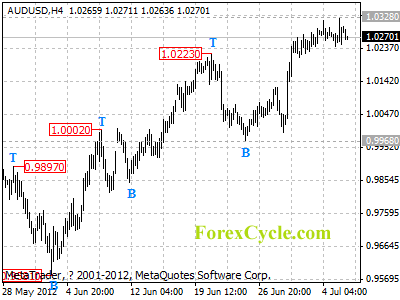
AUDUSD’s upward movement extends to 1.0328

AUDUSD’s upward movement extends to as high as 1.0328. Support is now at 1.0240, a breakdown below this level will indicate that a cycle top has been formed on 4-hour chart, then consolidation of the uptrend could be seen to follow, and the trading range would be between 1.0180 and 1.0328. On the upside, as long as 1.0240 support holds, the uptrend from 0.9968 could be expected to continue, and another rise towards 1.0400 is still possible.

audusd

Forex Signals

Central Bank News Link List – July 6, 2012

By Central Bank News

    Here’s today’s Central Bank News link list, click through if you missed the previous link list. The list is updated during the day with the latest news about central banks so readers don’t miss any important developments.

Charles Sizemore Discusses His Favorite Beer Stocks on Bloomberg TV

By The Sizemore Letter

Crack open a cold one, and watch Charles Sizemore give his thoughts on international beer stocks on Bloomberg TV.


If you cannot view the video, please follow this link to Bloomberg’s site: Playing the World of Beer Stocks

Stocks mentioned: Boston Beer ($SAM), Anheuser-Busch InBev ($BUD), Heineken ($HINKY), Molson-Coors ($TAP)

If you liked this article, consider getting Sizemore Insights via E-mail. 

Related posts:

Denmark cuts interest rates by 25 bps to negative rate

By Central Bank News

    The Danish central bank cut its key interest rate by 25 basis points to a negative 0.20 percent following a rate reduction by the European Central Bank.
     Danmark’s Nationalbank said in a statement that the benchmark certificate of deposit rate was cut to minus 0.2 percent, which means that banks are in the unusual situation of paying to deposit their money with the central bank.
    The bank’s lending rate was also cut by 25 basis points to 0.20 percent from 0.45 percent. The bank last cut the deposit rate to 0.05 percent in May.
    “In connection with the introduction of negative interest rate on certificates of deposit the current account limits will be revised upward,” the bank said in a statement.

    The objective of Denmark’s monetary policy is to maintain a fixed exchange rate to the euro and thus create a basis for low inflation.  Denmark is not a member of the 17-nation euro area that shares the euro currency.
    By lowering interest rates on the Danish crown currency, it will have a tendency to weaken relative to the euro and following the move by Nationalbanken, the crown eased to 7.44 to the euro but later rebounded. The crown has been under upward pressure as a safe-haven currency due to the debt problems in the euro area.
    www.CentralBankNews.info


China cuts interest rate by 31 bps to 6.0%

By Central Bank News
    China’s central bank cut its benchmark rate by 31 basis points to 6.0 percent, the second time in a month that the People’s Bank of China (PBoC) has reduced its interest rates.
    PBoC said in a statement that it also cut the one-year deposit rate by 25 points to 3 percent and lowered the floor for lending rates to 70 percent of benchmark rates from 80 percent.
    The previous cut in rates by China’s central bank came on June 7 when the benchmark rate was cut by 25 basis points to 6.31 percent.
    www.CentralBankNews.info


Is Investing in Facebook (Nasdaq: FB) Still a Bad Idea?

Article by Investment U

Is Investing in Facebook (Nasdaq: FB) Still a Bad Idea?

Until Facebook (Nasdaq: FB) manages to stabilize itself a bit and show actual signs of growth, investors may want to consider placing their money elsewhere.

It’s been over a month now since Facebook (Nasdaq: FB) debuted on the Nasdaq to much excitement… and then much frustration.

Though the social media site’s fair value estimates rose from $25.54 in March 2011 to $29.73 in December, its IPO was finally priced at $38 on May 17, the day before it hit the markets. While Facebook steadfastly stands by that valuation, shareholders seem to think it wholly insupportable.

And their opinion reigns supreme for now, as the stock tanked to a low of $25 in early June, and barely saw $33 since.

Diehard Facebook groupies (if they exist) might blame the shares’ slow start on the disastrous way Nasdaq handled the IPO. Somehow unprepared for the ensuing volume, it had to delay the opening by nearly half an hour, sending chaotic shockwaves throughout the rest of the offering.

Admittedly, that kind of widely publicized start is unnerving enough to keep many investors out of the company for a while, even if Facebook isn’t to blame. But recent reports, statements and admissions – some from before the IPO and some after – have cast more negative light on the company.

Recognizing the market’s unrest, CEO Mark Zuckerberg and his team are trying to implement significant changes to the way they do business, especially when it comes to advertising.

But the question remains whether their efforts will be worthwhile or not.

Hope and Change Facebook Style

For all of its faults, Facebook does understand investors’ main gripe against it: Its advertising problem.

As a social media site, it relies heavily on advertising revenue to advance its bottom line. That’s why it features a sidebar filled with one-by-two-inch teasers from wireless services, credit card companies, insurance offers, shoe sites and the like.

But that format might be flawed considering how General Motors pulled its sales campaign right before the IPO. Since then, Debra Williamson of eMarketer notes that other large companies have begun to second guess the association: “… last year they spent a lot of money acquiring ‘likes’ and now they want to know what to do with them.”

And an ExactTarget study done a few months ago postulated that Facebook ads worked less efficiently than their mail and direct-mail counterparts.

Part of that seems to be the changing times, specifically the shift from PCs to smartphones. In February, the Financial Times reported that nearly half of Facebook’s 845 million active users logged on through handheld devices, a number that’s likely to only increase from here.

That’s problematic for a few reasons, including the tiny size of the ads themselves and the overwhelmingly negative response other sites have received for trying to generate revenue from their smartphone-using customers. (Just ask Twitter.)

In the past – possibly for that very reason – Facebook controlled exactly where its members saw ads, and smartphones seemed to be off limits. But after weeks of uninspiring stock growth, Zuckerberg now seems willing to push those boundaries.

Reuters reported in June that the company “is making it easier for advertisers” by “letting marketers craft ads destined specifically for mobile… or users’ news feeds.”

Follow the Earnings, Not the Hype

To be fair, Facebook might actually succeed in its struggle for advertising relevance and revenue. It might manage to somehow appeal to both the companies demanding more screen time and the users who don’t want their social interactions cluttered by sales pitches.

It might pull it off… But then again, it may not.

Leading web analytics service, comScore, just found that Facebook’s audience isn’t doing as well as it could be… The site brought in 158.93 million unique U.S. visitors in March, but only 158.69 million in April and just barely 158 million in May.

CBS, meanwhile, noted a 4.8% drop in unique U.S. visitors over a six-month time frame. That might be due to the unauthorized and/or unannounced changes it frequently makes, such as switching everybody’s listed email addresses to @Facebook.com this week.

Between its often-annoyed member base and its often-frustrated client base, there are just too many signs that Facebook has an uphill battle to fight. And its current valuation leaves little room for error…

With a PEG ratio of more than two and a P/E of nearly 80, substantial growth is already priced into the stock – meaning the price could be very sensitive to any hiccups in growth over the next few years.

For a good example of what I’m talking about, look at what happened to the stock of Netflix (Nasdaq: NFLX) last year with its price-hike dilemma. In mid-July 2011, it was trading at insane valuations based on rapid growth. By September, the market had shaved off half of its stock price and now it trades at less than two-thirds its 52-week high. And all this arguably stemming from one poor decision by management.

So until Facebook manages to stabilize itself a bit and show actual signs of growth, investors may want to consider placing their money elsewhere.

Good Investing,

Jeannette Di Louie

Article by Investment U

How to Survive the Coming Bond Bubble Collapse

Article by Investment U

There’s a huge opportunity coming in bonds. It won’t look like an opportunity to most; the press will actually call it a bust.

But, with the right planning in place, it’ll produce huge returns with virtually no risk.

In fact, as this “bust” develops, you’ll actually be able to increase your returns.

The tricky part will be fighting the urge to sell when everyone – and I mean everyone – will be cutting and running.

For the informed investor, this will be the biggest bonanza of the new millennium, and all you have to do is not sell.

Here’s how it will develop…

The Interest Rate Explosion

While the whole market is fixated on the Eurozone, the slowdown in China, India’s issues and “Obamacare,” interest rates are slowly simmering and looking for an excuse to explode.

The good news is that this explosion (and it will be a big bang when it hits) is very predictable. So you can prepare for it and actually set up yourself for a rich retirement while the rest of the market goes down the drain.

These increasing interest rates will affect every investment – stocks and bonds. It’ll be devastating for the unprepared.

For a big dose of reality about how bad this can get, take a look at rates in the early 80s and what they did to the stock and bond markets.

The DOW was in the 600s. Bonds were paying double-digit rates and selling for next to nothing.

But, if you’re in the right place, this unavoidable sell-off will be a huge payday!

How It Will Begin…

Interest rates can, and will, go back up when any of the following conditions fall into place. Obviously, this isn’t a complete list, but it includes the most obvious factors:

  • The world business community loses faith in our ability to pay our bills. That will cause the cost of our government borrowing to sky rocket and, with it, interest rates.
  • Our economy finally gets going again and the normal growth/interest patterns re-emerge. Under normal conditions, when growth gets into high gear, the Fed raises rates to control inflation.
  • Our money printing finally results in inflation. Rates have to go up to try to control inflation. This is the one we don’t want to see. But that’s for another article…

There’s no magic here. Any, or all of these three forces, can and will fall into place, and it will look like 2008, 2000 and 1987 all over again.

One of the Few Safety Valves…

In the stock market, one of the few safety valves that’ll protect your assets will be tight trailing stops. Properly used, they get you out as stocks start to drop – and they will drop.

Lock in your gains and limit your losses… that’s the best strategy for stocks as the market absorbs the higher rates.

Bonds will drop, too – a lot. Virtually no investment will be spared.

But, if you hold the right type of bonds, the way to make money will be to not sell. It’s counter intuitive, I know, but this may be the only way to actually make money in the coming rising interest rate environment.

What to Do About Bonds

As rates go up, the existing bonds on the market will drop in value.

But, and this is a huge but, bonds will pay their interest and mature at $1,000 no matter what happens to their market value. The bondholder just needs to sit tight, let it happen and collect the interest and principal.

That’s asking a lot of most small investors. Most want to get out and guarantee a loss.

One way of preparing yourself mentally to “not fix what isn’t broken.” Know, before you buy a bond, how much you can expect to make from it, and what your worst-case scenario is before you invest.

This is where all the money will be lost or made.

Here’s a bond that’ll pay enough to keep most people in place and allow you to cash in on the panic selling in bonds of all types that has to come.

The Edgen Murray Corporation has a B-rated bond (cusip: 280148AC1) that’s paying a coupon of 12.25% (that means you get $122.50 in interest per bond every year). It matures in January of 2015. It also has a call date of January 2013 when the company has the option to buy back the bond before maturity at 106, or $1,060. If called we would earn a return of about 20% annually.

Besides the very high coupon of 12.5% and a 20% return to the call, here’s what I really like about this bond…

It has a maturity of about two and a half years. Short maturities are an absolute necessity to survive the coming panic selling that will accompany increasing rates.

When rates move up, a bond with this maturity will drop in value about one-third of what a 10-year maturity will. That will decrease the possibility of selling in a panic when you get your account statement and thus keep you in the black.

Staying put is absolutely essential! Cut and run and you become one of the losers.

The silver lining of very short maturities is that you’ll have fresh money coming out of maturing bonds to buy into a rising interest rate market. This is how you turn a bad situation into a big payday.

Waiting 10 years for money to come due when your market value is dropping is a Herculean task for anyone. Two years is a whole different story. It’s being able to see the end that makes it more manageable, and two years is manageable for anyone.

As this unfolds you’ll be buying bonds at pennies on the dollar, earning incredible annual returns, yes, higher than 13% and 20%, from bonds being sold at huge losses by uninformed investors.

So just like that, dropping bond prices just became a very big positive for your portfolio. The key though is you must be disciplined enough to ride out what will be a horrible storm for most. Ugly doesn’t begin to describe what will happen to long-term bondholders and panic sellers.

One of the most beneficial aspects of the Edgen Murray bond – and all bonds – is that before you put one cent into this bond you will know exactly how much you will be paid annually and at maturity. No guessing!

This is the one part of bonds that will make riding out the coming storm easier. And it’s one more psychological edge we have helping us stay put during the coming sell-off.

MEAR: Minimum Expected Annual Return

So how do you figure out your return beforehand?

I use an equation I call MEAR, or minimum expected annual return.

Here’s the MEAR for this bond:

Edgen Murray Corporation Bond:          

  • Rate = 12.25
  • Maturity = 01/15/2015
  • Price = 101.500 (Think of this as a percentage of $1,000)

This bond will pay us six interest payments of $61.25 per bond on January and July 1 until maturity in January 2015.

6 x 61.25 = $367.50

There’s a slight premium for this bond of $15 – it’s selling for about $1015 – so we must deduct that from our total interest payments.

$367.50 – $15 per bond = $352.50

We’ll hold this bond for about 30 months so we divide our total, $352.50, by 30, and divide by our cost of $1,015 per bond.

$352.50 / 30 / 1015

Times 12 for a one-year average.

$352.50 / 30 / 1015 x 12 = 13.89%

Yes, 13.89%! Whether the bond’s market value goes up or down.

Right now, defaults in all corporate bonds, investment grade and high yield, or junk bonds, are about 1% to 3%. That means 97% to 99% of corporate bonds are paying exactly as promised. That’s a huge advantage over stocks and a bet that makes this a possible play for almost everyone.

So, the most probable worst-case scenario for corporate bonds (97% to 99% of the time anyways) is you hold them to maturity, collect your interest and get your $1,000 in principal back no matter what the market does.

I can do that, especially when I’m earning 13% -plus per year for waiting it out.

The keys to this strategy are disciplined buying, understanding what’s really happening, knowing before you buy a bond what you’ll make, and that you may have to hold it to maturity. If you’re making enough from your bonds and prepared for the volatility, that should be easy.

Remember, when interest rates hit the fan:

  • Own short maturities in companies with good fundamentals.
  • Sit tight when bond market values drop.
  • Collect your interest and principal.
  • As your bonds mature buy back into the market’s rising rates and lower prices.
  • Finally, laugh all the way to the bank.

Good Investing,

Steve McDonald

P.S. In today’s Investment U Plus, I’m sharing one of four new bond recommendations for my trading service, Oxford Bond Advantage. It’s a much safer bond (but with less return) than the Edgen Murray one mentioned in today’s article.

Registration is currently closed for the service, but you can get this recommendation along with daily recommendations from all of our experts by becoming an Investment U Plus subscriber here.

Article by Investment U

How is the Keystone XL Pipeline Progressing?

Four and a half years of studies and five failed votes in the House later, exactly where are we with the Keystone XL pipeline? Stuck on the US-Canadian border where it is likely to remain until mid-2013 despite the headline-grabbing issuance of one of three permits to begin construction in Texas for the smaller and much less controversial portion of the pipeline.

On 26 June, the US Army Corps of Engineers granted TransCanada Corp one of three permits required in order to begin construction on the $2.3 billion southern section of the Keystone XL pipeline, which would run from Cushing, Oklahoma to the Gulf of Mexico in Texas. This first in the permit series covers construction across the wetlands and waterways of Texas’ Galveston district. TransCanada still needs to more permits from Tulsa, Oklahoma and Forth Worth, Texas, to complete this southern Gulf portion of the pipeline extension. Tulsa is set to rule on the second permit in a month and a half.

This southern section of the extended pipeline will carry 700,000 barrels a day of crude, to start with, to Texas refineries from Cushing. Construction will begin this summer. The southern line, permits pending, could be functional by mid-to-late next year. Indeed, Obama pledged to speed up the approval process to make this a reality.

But these permits are only for the southern extension of the Keystone pipeline, which seeks to extend the existing Keystone pipeline from Cushing, Oklahoma to the Gulf of Mexico. This is a much less controversial piece of the pipeline project, which by dint of not crossing the US-Canadian border and which is being pursued by TransCanada independently from the rest of the Keystone XL pipeline extension, does not require complicated approval.

The “greater” Keystone XL pipeline project would extend the existing Keystone pipeline, which runs from Hardisty in Alberta, Canada, then eastwards in Canada, dropping southwards into the US, through North Dakota, South Dakota, Nebraska, Kansas and ending in Cushing, Oklahoma, with an eastern branch spiking off at Steele City, Nebraska and running to Patoka, Illinois.

The proposed extension would run from Hardisty across the border through Phillips Country, Montana, and meet up with the existing pipeline at Steele City. This would represent 1,179 miles of new pipeline that would carry Canadian tar sands crude eventually to the Gulf of Mexico, with an initial capacity of 830,000 barrels per day.

In order to speed things up after President Barack Obama initially rejected the project in January this year, TransCanada has split the pipeline extension project into the northern and southern sections, pursuing the southern branch independently.

As such, issuing permits to begin construction on the southern extension through Texas and Oklahoma does not signify that the Keystone XL project is progressing just yet. Because the much larger northern extension crosses an international border, it must first obtain presidential approval, in accordance with an executive order implemented under George W. Bush in 2004.

A comment period on the proposal began Jun. 15, 2012, and will continue until 30 July 2012, but the State Department has said it would not be able to complete its review of the process until the first quarter of 2013. Approval is contingent upon whether the project is demonstratively in the country’s national interest.

So, the trillion-dollar question is whether Keystone XL is in fact in the country’s national interest. The more urgent question of course is whether Keystone XL is in the Obama administration’s interests, specifically in the run-up to presidential elections.

On 27 June, House and Senate negotiators reached a tentative agreement over two-year bill to overhaul federal highway and transit programs-a bill Obama had vowed to veto if there were any attempts to slip approval of Keystone XL in the legislation. Republicans backed down over their insistence of language that would approve the pipeline in the bill.

The former question is complicated enough; the latter even more so. From an environment and jobs perspective, Keystone XL is not in the Obama administration’s interests. Organized labor is not as interested as it might be in the jobs this would create at a time when the administration has been fairly successful at creating energy jobs elsewhere. On the environmental front, the Obama administration’s hesitancy over the project is the stuff of heroism.

The Republicans had hoped to deal Obama a lethal campaign blow by setting a two-month deadline for the administration to approve Keystone XL in January. The Republicans knew that two months was not nearly enough to evaluate the project from an environmental and economic aspect, and that the administration would have to reject the project. The idea was to force the administration into publicly denouncing massive job creation and working against US energy independence ahead of the elections.

This hasn’t been as successful as the Republicans had hoped. They had not counted on the relatively sober response from organized labor. The Obama administration has also racked up some very significant points in energy development that it can cash in to replace the loss of Keystone XL, and that includes (clean) job creation that is keeping organized labor at bay.

In terms of the oil and gas industry, here, too, the Obama administration doesn’t have much to gain by approving Keystone XL ahead of the elections. It would not be the end-all for the oil lobby’s harassment of the administration.

Back to our first question: Is Keystone XL in the country’s national interest? It is almost a mute point in an election year, but we will entertain the notion simply to avoid being labeled cynical. The answer is, “no”. It will create plenty of jobs, which is hardly a contested point, but there are plenty of other energy-related jobs already being created rather successfully. Environmentally, the project flies in the face of the administration’s clean energy ambitions with the associated risk of oil spills and the increase in greenhouse gas emissions as a result of increased tar sands (dirty oil) extraction.

In terms of economics, there is some solid research showing that Keystone XL is more likely to result in higher prices at the pump. Canadian tar sands crude pumped into the Midwest and intended for domestic gas consumption would be diverted to the Gulf Coast where it would be used in diesel production and for global exports. It could very well mean reduced gas supplies and higher gas prices in the end.

Much like the Republican attempt to force Keystone XL to fail early on and force a vote loss on the Obama, the issuance of the first Texas permit for the southern extension is but a Democratic bone to big oil and a job-hungry public. It has little marrow. The Republicans lost this battle when TransCanada split the project in half, allowing the Obama administration to score points by supporting the smaller version while avoiding a decision on the larger project. Nothing will happen on the “greater” Keystone XL this year.

Source: http://oilprice.com/Energy/Crude-Oil/Whatever-Happened-to-the-Keystone-XL-Pipeline.html

By. Jen Alic of Oilprice.com