Loonie Up to Two-Year High against Euro

By TraderVox.com

Tradervox.com (Dublin) – The Canadian dollar has strengthened to two-year high after the European Central Bank decided to cut interest rates and lowered deposit rate to zero. The loonie also increased against the US dollar as risk appetite gripped the market despite positive report from ADP Nonfarm payrolls showed an unexpected increase in the month of June. Other countries that changed their monetary policy this week include China and UK. Decisions by central banks to reduce interest rates or add stimulus come as a global coordinated effort to increase credit in the market as leaders struggle to keep global economy from recession.

According to Camilla Sutton, who is the Chief Currency Strategist at Bank of Nova Scotia in Toronto said that the such a move shows the commitment of central bankers around the world to protect the financial market. He noted that this is a positive measure which will support growth and support commodity related currencies such as the New Zealand, Australia, and Canada dollars. The Canadian dollar also increased as the one-month Implied Volatility for the loonie against the 17-nation currency dropped to 7.92 percent from June 6 reading of 9.53 percent. Implied Volatility is quoted by traders when setting option prices; it signals the expected pace of the currency change.

The Canadian dollar gained by one percent against the 17-nation currency to exchange at C$1.2569 per euro at the close of trading in Toronto. This is the strongest it has been against the euro since June 2010. The loonie was trading at C$1.0142 against the US dollar after it had reached its strongest level since May 16.

According to Ed Devlin of Pacific Investment Management Co, economists are not long on Canadian market as the interest rates in the country are not favorable. He said this after the ECB and Chinese central bank decided to lower their interest rates in what has been termed as global coordination in trying to prevent deterioration of the world economy.

Disclaimer
Tradervox.com is not giving advice nor is qualified or licensed to provide financial advice. You must seek guidance from your personal advisors before acting on this information. While we try to ensure that all of the information provided on this website is kept up-to-date and accurate we accept no responsibility for any use made of the information provided. Opinions expressed at Tradervox.com are those of the individual authors and do not necessarily represent the opinion of Tradervox.com or its management. 

Article provided by TraderVox.com
Tradervox.com is a Forex News Portal that provides real-time news and analysis relating to the Currency Markets.
News and analysis are produced throughout the day by our in-house staff.
Follow us on twitter: www.twitter.com/tradervox

ECB Rate Cut May Causes SNB Cap Breach

By TraderVox.com

Tradervox.com (Dublin) – The European Central Bank cut its benchmark interest rate to 0.75 percent from 1 percent as predicted while it dropped the deposit rate to zero percent. Moments after the announcement, the euro dropped against major currencies, retracting its gains last week. The sharp downward move put a lot of pressure on the Swiss National Bank as it tries to maintain it 1.20 cap against the euro. The pressure on the SNB is further compounded by the poor data from the euro zone which is indicative of a recession. The decision by ECB has put the EUR/CHF under huge pressure which led to a breach in yesterday’s trading moments after the announcement of the ADP Non-Farm Payrolls in US.

The 1.20 level provided a lot of resistance after the ECB decision, but the pressure proved strong when the ADO NFP showed a relatively huge gain from what was expected. The unofficial report showed that the NFP rose by 176,000 against an estimate of 90,000. It is expected that the weakening euro might break the cap and many investors are waiting to see how long it will last. Analysts have suggested that if this cap is broken, then it will be a fast ride down and this may pose a great risk to Swiss economy.

Thomas Jordan, who was appointed the Swiss National Bank president after former President Philipp Hildebrand left, is now faced with a tough task of ensuring that the cap is upheld. He has reiterated in many occasions that the SNB is prepared to do all it takes to preserve its monetary policy which he says is good for the country’s export trade.

The euro has also declined against the greenback and the pound after the Bank of England decided to expand its quantitative easing program to 375 billion pounds.

Disclaimer
Tradervox.com is not giving advice nor is qualified or licensed to provide financial advice. You must seek guidance from your personal advisors before acting on this information. While we try to ensure that all of the information provided on this website is kept up-to-date and accurate we accept no responsibility for any use made of the information provided. Opinions expressed at Tradervox.com are those of the individual authors and do not necessarily represent the opinion of Tradervox.com or its management. 

Article provided by TraderVox.com
Tradervox.com is a Forex News Portal that provides real-time news and analysis relating to the Currency Markets.
News and analysis are produced throughout the day by our in-house staff.
Follow us on twitter: www.twitter.com/tradervox

BOJ Meeting and the Strong Yen

By TraderVox.com

Tradervox.com (Dublin) – Japan released its trade data yesterday raising the yen to 0.6 percent from one-month high against the euro. The strong yen was also as a result of increased safe haven appetite in the market resulting from decline in Asian stocks. The yen also increased prior to Bank of Japan meeting on July 11-12.

The Bank of Japan policy makers will meet this week to discuss the monetary policy where they are expected to consider the recent ECB decision to lower interest rates. The BOJ Governor Masaaki Shirakawa has assured the market of the bank’s commitment to pursuing powerful monetary easing to achieve its one percent inflation target. So far, Bank of Japan has expanded its asset purchases program by 20 trillion yen; this is the bank’s main policy tool aimed at spurring growth in the country.

According to Citigroup Inc’s Currency Strategist Osamu Takashima, the BOJ will probably leave the policy unchanged when they meet this week. However, should the BOJ act against these expectations, the result would be a stronger yen which is against the BOJ will. On the other hand, the dollar index used by the Intercontinental Exchange inc to track the US dollar against currency of six major counterparts has slowed on its advance from last week on speculations that Federal Reserve will introduce more measures to support economic growth. The index rose by 2.1 percent in the last five days up to July 6, to reach 83.275.

Chinese data has also added to the increased demand for safe haven currencies. Consumer prices rose by 2.2 percent in June from a year earlier. However, Chinese Premier Wen Jiabao said that the government will embark on intense measures to avert the downside risk on the economy which forced the Australian dollar to decline.

The Japanese currency declined to 97.92 from 97.89 yen per euro after it had earlier touched it’s strongest in a month of 97.43 yen. Against the dollar, the Japanese currency was trading at 79.70 up from 79.66 yen per dollar.

Disclaimer
Tradervox.com is not giving advice nor is qualified or licensed to provide financial advice. You must seek guidance from your personal advisors before acting on this information. While we try to ensure that all of the information provided on this website is kept up-to-date and accurate we accept no responsibility for any use made of the information provided. Opinions expressed at Tradervox.com are those of the individual authors and do not necessarily represent the opinion of Tradervox.com or its management. 

Article provided by TraderVox.com
Tradervox.com is a Forex News Portal that provides real-time news and analysis relating to the Currency Markets.
News and analysis are produced throughout the day by our in-house staff.
Follow us on twitter: www.twitter.com/tradervox

Euro Dips before EuroFin Meeting; SNB under Great Pressure

By TraderVox.com

Tradervox.com (Dublin) – Euro Regional Finance Ministers will meet today to discuss measures taken by the heads of government in last month’s EU meeting. The euro has reacted, touching its lowest in two years after declining for three days since the ECB decided to lower interest rates, forcing the SNB to consider drastic measures to counter. The ECB president Mario Draghi will address the European parliament today in Brussels where he is also expected to touch on the banks decision, Italy and Spain crisis, as well as measures taken to avert further deterioration in the region.

The Japanese currency increased against the euro to almost a month high, after the country released balance trade data for the month of May. Further, the yen increased as the Asian stock decline increased safe haven appetite. The Australian dollar was also down as Chinese premier Wen Jiabao indicated that the economy was still under great downward pressure. China is the largest trading partner for Australia.

According to Mike Jones, a Wellington-based Bank of New Zealand Ltd Currency Strategist, there is a great risk in the coming finance ministers meeting as cracks in European unity might arise showing reluctance in governments commitment to implementing measures agreed on at the EU leaders’ meeting. If this happens, the euro will probably lose more grounds against major currencies.

The euro declined to $1.2251 which is its weakest since July 2010, before appreciating to 1.2288 at the start of the day in London. The 17-nation currency bought 97.43 yen, the weakest since June 5, before appreciating to 97.92.

The current decline has forced the Swiss National Bank to react with Economy Minister Johan Schneider-Ammann saying that the SNB should defend its 1.20 cap and prepare for worse times ahead as euro region economy continues to show weaknesses. The minister also said that the government is considering all measures to ensure that the cap is protected including introducing negative interest rates. He, however, expressed skepticism on introduction of negative measures.

Disclaimer
Tradervox.com is not giving advice nor is qualified or licensed to provide financial advice. You must seek guidance from your personal advisors before acting on this information. While we try to ensure that all of the information provided on this website is kept up-to-date and accurate we accept no responsibility for any use made of the information provided. Opinions expressed at Tradervox.com are those of the individual authors and do not necessarily represent the opinion of Tradervox.com or its management. 

Article provided by TraderVox.com
Tradervox.com is a Forex News Portal that provides real-time news and analysis relating to the Currency Markets.
News and analysis are produced throughout the day by our in-house staff.
Follow us on twitter: www.twitter.com/tradervox

Late News: Bankers Rig Interest Rates, No-One Fired

By MoneyMorning.com.au

It’s a scandal that has cost one top banker his £14 million ($21.2m) a year job.

It cost his bank £290 million ($440m) in fines.

And, on the back of other recent scandals (JPMorgan’s USD$2 billion trading loss, and UBS’s USD$2.3b rogue trading loss) it could threaten London’s spot as the world financial capital.

We’re referring to the Barclays’ LIBOR (London Interbank Offer Rate) scandal, and the attempts by bankers to rig the USD$360 trillion market.

We get it that folks have got their pants in a twist about attempts by a group of bankers to rig a market. But there’s another group of bankers who have got off scot-free. They continue to rig the market to this very day.

In fact, within hours of the exec’s resignation, this other group of bankers showed no shame. They released their latest wave of market manipulation…

Last week, Reuters reported:

‘China, the euro zone and Britain loosened monetary policy in the space of less than an hour on Thursday, signalling a growing level of alarm about the world economy…

‘…the surprise move was from Beijing which lowered its lending rate by 31 basis points to 6 percent following an interest rate cut just a month ago that also came out of the blue.

‘The European Central Bank cut rates to a record low 0.75 percent following a dire run of economic data. But it steered clear of bolder moves such as reviving its government bond-buying program or flooding banks with more long-term liquidity.

‘The Bank of England, whose rates are already at a record low 0.5 percent, said it would restart its printing presses and buy 50 billion pounds of assets with newly created money to help the economy out of recession.’

The regulators found Barclays guilty of fiddling with LIBOR so it could profit at the expense of others. That includes Barclays own customers.

But as far as fiddles go, Barclays’ efforts are small-fry compared to the world’s central bankers.

Fiddling with the Interest Rates

We’ll show you what we mean. The big evidence against Barclays is that in late 2008 its interest rates – as declared for the calculation of LIBOR – were higher than the other banks that take part in setting LIBOR. As this chart from the Economist shows:

three month $libor

Source: Bloomberg, The Economist

You can see that as markets crashed in 2008, and banks went bust, interest rates went up. Why? Because savers demanded a higher interest rate in return for lending money.

So far, so good.

But while banks began pricing risk properly – although much too late – the mother of all interest rate fiddles kicked in.

You see, in 2008 interest rates should have moved higher (as they did) and then stayed higher (as they didn’t) for a period of time.

This would have drawn in savers who would have been prepared to lend money in return for a higher interest rate.

Trouble is, high interest rates were the last thing a certain group of bankers wanted. They knew that with all the high-risk and bad loans on the market, high interest rates would see the value of these assets plunge.

Remember that bond prices move in the opposite direction to bond yields. So if banks hold a whole bunch of high risk debt, and the interest rate soars, the value of this debt falls. And that would have a negative impact on bank balance sheets.

So, this other group of bankers put their plan into action. They used every power and tool to hand to force interest rates lower. As the following chart shows:

Source: Money Morning

At the start of 2008, the interest rate was 4.25%. By August the bankers had pushed the rate down to just 2%. And just a few months later, the ruse reached an epic scale as they forced the rate to below 0.25%.

You know who we’re talking about. We’re talking about the leader of this interest rate fiddling cartel, the US Federal Reserve.

Still Messing With the Interest Rates – Four Years Later

When interest rates should have risen to reflect higher risk, Fed Chairman, Dr. Ben S. Bernanke pushed them down…to an all-time record low.

It’s funny. Barclays played with a key interest rate for a few months in 2008. Yet four years later, the Fed and the world’s other major central banks are still manipulating interest rates, and on a much bigger scale.

One man (ex-Barclays CEO, Bob Diamond) loses a high-paying job and almost branded a crook for his bank’s part in something he possibly knew nothing about. Then there are many other men (Bernanke, King, Draghi and Stevens) branded as geniuses for their active part in playing with interest rates on a much bigger scale.

Of course, you shouldn’t for a minute think that we’re on the side of the banks.

As central banks printed money, the banks have willingly taken part in it and benefited. Money printing that has devalued the wealth of prudent savers while at the same time keeping the banks afloat, allowing the likes of Bob Diamond to earn £14 million per year.

The big number touted is that LIBOR impacts a USD$360 trillion market for interest rates. That’s undoubtedly a big number. And as Dylan Matthews writes in the Washington Post:

‘The LIBOR scandal was Barclay’s making money by hurting you…

‘That means that when LIBOR rises, so do the prices ordinary consumers pay to, say, get a mortgage. Which means a bank that mucks with the LIBOR rate isn’t just playing around with esoteric derivatives that will only affect other traders: They’re playing with the real economy that most of us participate in every day.’

That’s right. But it misses a much bigger point. And that is, LIBOR isn’t a standalone interest rate. The banks determine the rate. And how do banks determine it?

That’s right, based on the rates set by other banks and…central banks.

If LIBOR impacts USD$360 trillion-worth of securities, we can only guess the value of all securities that rely on central bank interest rates to determine their price. $600 trillion…$900 trillion…$1 quadrillion…More?

An Interest Rate Headline You Haven’t Seen

Stock markets don’t rise or fall on the latest LIBOR rate announced in London each day. But they do rise or fall based on the latest fiddling by central banks.

Look at the market rally in 2009 when the US Fed began printing money (now known as QE I), and again in 2010 when it started QE II.

Look at the volatility in stock markets in recent months. Stocks have soared then sank as traders bet on the European Central Bank coming up with new schemes to boost the European economy.

We don’t ever remember reading a news story with the headline, ‘Market Soars/Crashes as LIBOR Hits New High/Low’. But we do remember these headlines:

‘European stocks advance on stimulus hopes’ – Sydney Morning Herald

‘Asian stock markets climb as Japan central bank calls unscheduled meeting’ – Fox News

‘World stocks, euro up on apparent ECB bond buying’ – BusinessWeek

And don’t forget that one of the key inputs for the Black-Scholes options pricing model is the ‘risk free interest rate’. In other words, the price of government bonds, which are in large part determined by central bank interest rates.

In short, we’re sure that Barclays fiddling about with LIBOR is a big scandal. And it’s right that heads should roll.

But compared to the fiddling by the world’s central bankers, the LIBOR banking scandal is a drop in the ocean. If the regulators really are serious about stamping out undue fiddling of interest rates, they should look no further than the biggest fiddlers of all – the central banks.

They’re the folks who should lose their jobs and go to the slammer. But that will never happen.

After all, it would make for an awkward situation. Especially as central banks not only fiddle with interest rates, but in most countries they are one of the major regulators too!

Cheers,
Kris.

P.S. Don’t forget to check out Greg’s interview on China and the bust you’ll want to avoid. Click here to watch now.

Related Articles

Market Pullback Exposes Five Stocks to Buy

LIBOR: When Bankers Try to Shift the Blame

The Data On The Chinese Economy You Really Should Read


Late News: Bankers Rig Interest Rates, No-One Fired

What I Wish Ben Bernanke Knew About Japan’s Economy

By MoneyMorning.com.au

I’ve called Japan my “other” home since 1989 and in that time I’ve seen it change in ways that ought to scare the pants off you.

I say that not to ruin your day, but because I fear we are headed down the same exact road as long as Ben Bernanke and his central banking buddies think it’s easier to print money than actually stimulate real growth.

In doing so, they are re-creating Japan’s “Lost Decades” here at home with years of smouldering, piss-poor growth as our destiny.

Yet it doesn’t have to be that way. We can still choose a different path.

Here are 10 lessons from Japan’s economy I would share with Chairman Bernanke right now if I sat down with him:

1) All the cheap money in the world won’t matter if banks hoard it and customers don’t want it. You could lower interest rates to zero and it won’t make a difference. Japan tried this to no avail. At this point, low rates are hardwired into the Japanese business system to the extent that any increase whatsoever is likely to cause a massive wave of corporate and personal bankruptcies. Don’t let that happen here. You still have a chance to prevent this.

2) At some point somebody has to take the loss. You cannot pretend that the debt you’ve advanced is performing any more than the debt the Japanese have. No matter how much money you inject into the system, the deleveraging process will continue until excess credit is bled out of the system one way or another. Defaults happened with alarming regularity before Central Banks tried to stave them off. There have been literally hundreds in Eastern Europe, Africa, Asia, and Latin America over the centuries. Spain and France failed six and eight times each in the 16th century alone.

3) Trying to manage any singular crisis will only result in a much bigger one down the road. The longer you prop things up, the worse they’re going to get and the more consolidation you will see. Five of the 10 largest banks in the world were Japanese in 1990. Today the only bank to make the cut is 5th on the list (the Japan Post Bank Co. Ltd according to Bankers Accuity).

4) When politicians find it easier to borrow money than make hard policy decisions, they will because they prefer their short-term re-election prospects over the long-term economic interests of the country. Japan has had 15 Prime Ministers in the last 12 years. Granted, their system works a little differently than ours, but continual reshuffling diminishes the effectiveness of any solution. Take advantage of the situation and act decisively before our elections risk a reset. You’re supposedly apolitical. Prove it by acting with conviction instead of giving us more FedSpeak.

5) Cheaper capital actually means fewer jobs. Businessmen will always substitute money for labor when the cost of money is too low versus inflation. They know that creating jobs when you can borrow at real negative rates is a losing proposition. Japan’s economy has lost a generation to part time work so far and is losing more of its middle class every day. We’re on the same track here in the U.S. as middle class families – and young families in particular – fall even further behind just as they have in Japan as full-time employment is eliminated and jobs are consolidated.

6) When the cost of money is low, governments will waste it and businessmen will not invest. Make it profitable for them to do so, and they will. Lending money to the government cuts twice. Once because it’s an implied tax that robs the private sector of the wealth needed for innovation and growth. And twice, because the dollar gets debased. The Japanese economy now carries total debt to GDP of nearly 500%.

Source: MOF/Goldman Sachs/Zerohedge

7) High interest rates do not preclude investment but taxes and spending do. When money is cheap, productivity falls as do margins even though overall business activity expands for a time. High interest rates force efficient capital allocation and cause businessmen to make decisions based on what they must have versus what’s nice to have (just as individuals do).

8) Rate cuts are not short cuts to growth. They are simply more drugs for the addicts who are addicted to the fallacy of stimulus. Zero is still zero.

9) You have to let the dead actually die. The notion that we can have an “all gain no pain” recovery is asinine. Capitalism works because the assets of failed businesses are eventually reabsorbed by viable undertakings. Call me crazy but how is creating more debt that’s used to pay back other debtors supposed to get us out of hock? Allen Stanford and Bernie Madoff both tried this and ended up in prison.

10) Socializing the repayment of excess debt is impossible. You have to reduce it to a level that borrowers can repay. Otherwise, the economic distortion that’s caused by effectively freezing out creditworthy borrowers simply moves from one bubble to another. We’ve gone from Internet stocks to mortgages to bonds. Now we’ve moved up the ladder to sovereign debt. There’s literally nowhere else to go.

For most people who are unable to reconcile the prospect of another decade of slow to no growth and mountains of debt, this is terrifying.

But you know what, that doesn’t mean the next decade has to be unprofitable for us as investors.

At the end of the day, whether or not we are turning Japanese really doesn’t matter.

What matters is that you stay in the game and be prepared just in case.

Keith Fitz-Gerald

Contributing Editor, Money Morning

Publisher’s Note: This is an edited version of an article that originally appeared in Money Morning (USA).

From the Archives…

The Australian Housing Shortage That Never Existed
06-07-2012 – Kris Sayce

Did the European Summit Change the Market Trend?
05-07-2012 – Murray Dawes

Why Government Intervention Hinders Progress and Innovation
04-07-2012 – Kris Sayce

The Big Opportunities in the Oil Market That Will Lead to Profit
03-07-2012 – Dr. Alex Cowie

LIBOR – The Banking Scandal That Could Cause A Riot
02-07-2012 – Dr. Alex Cowie


What I Wish Ben Bernanke Knew About Japan’s Economy

How the Apple iPad Mini Will Crush Tablet Rivals

By MoneyMorning.com.au

If Apple Inc. (Nasdaq: AAPL) does unveil an iPad Mini – and fresh reports from both Bloomberg News and The Wall Street Journal indicate it will – the new device could help Apple lock up the tablet market for years.

The iPad Mini, as tech pundits are calling it, could debut as early as October. It’s thought to have a 7.85-inch screen, significantly smaller than the 9.7-inch display of the three iPad models released so far.

Such a product would compete directly with Amazon.com’s (Nasdaq: AMZN) Kindle Fire as well as the just-announced Nexus 7 from Google Inc. (Nasdaq: GOOG). Both sport 7-inch screens and a $199 price tag aimed at buyers unwilling to pay $499 or more for a new iPad (or $399 for an older iPad 2).

“It would be the competitors’ worst nightmare,” Shaw Wu, an analyst at Sterne Agee & Leach Inc., told Bloomberg. “The ball is in Apple’s court.”

There was no word on what the iPad Mini might cost, but in a note Thursday Topeka Capital analyst Brian White estimated a range of $250-$300.

“That would lure certain consumers away from these competitors with an overall better experience that includes a much more robust ecosystem,” White said.

Apple’s desire for generous profit margins will keep it from pricing an iPad Mini at $199. Both the Amazon Kindle and Nexus 7 lose money at $199.

With its impressive ecosystem, Apple can get away with charging more for a similar product. That ecosystem, built upon the iOS platform that runs all of the Cupertino, CA company’s mobile devices, includes the iCloud remote storage service as well as 225,000 apps designed just for the iPad.

“This isn’t like the old days, when it cost thousands of dollars more to buy an Apple product,” Wu said. “Fifty or a hundred bucks wouldn’t be enough to make someone switch.”

Fear the Apple iPad Mini

An Apple entry into the 7-inch tablet market would rob rival tablet makers of an obvious competitive niche.

The smaller form factor and much lower price gave many hardware makers (most using Google’s free Android operating system) true differentiation from the previous iPad models.

The iPad Mini would extend Apple’s reach much deeper into the tablet market – and there’s little competitors can do about it. It’s hard to cut prices to gain market share when your margins are razor-thin or you’re selling at a loss.

Even without an iPad Mini, sales of non-Apple tablets have been weak. Only the Kindle Fire has had any real success. Now both the Nexus 7 and the iPad Mini are coming for the Fire.

According to research firm IDC, Apple’s tablet controlled 70% of the worldwide market in the first quarter of 2012. Analysts had been predicting that Apple would gradually lose market share over the next few years to tablets running Android and Microsoft Corp.’s (Nasdaq: MSFT) upcoming Windows 8 operating system.

But an iPad Mini would change that math. Such a product would appeal not only to cost-conscious customers in places like the United States, but also to millions of customers in less wealthy nations.

An Apple Dominance Strategy

Note, too, the timing of the iPad Mini “leaks” to two major news sources.

Coming just days after the announcement of the Google Nexus 7 and a mere week after Microsoft unveiled its own Surface tablet, it certainly looks intentional.

Why? Putting out word that an iPad Mini is on the way will retard sales of other 7-inch tablets while consumers wait for the Apple device to arrive in the fall.

And it’s the second such incident in the past week.

Last week Bloomberg ran a story based on leaked information about an iTunes upgrade mere minutes after Google announced the Google Play store would add movies, TV shows and magazine subscriptions.

So much for Apple’s legendary secrecy.

A likely explanation is that the Apple of Tim Cook is determined not to repeat the mistakes of its past. The company clearly intends to do whatever it takes to prevent iOS from suffering the same fate the Mac did at the hands of Windows in the 1990s.

That includes everything from intentional leaks to the press, to patent wars, to wielding the market power of its vertically integrated ecosystem.

In a recent article for PCMag.com, Tim Bajarin, president of research firm Creative Strategies said many tablet makers fear Apple indeed has the power to “iPod” the tablet market – that is, dominate for years and years.

“The bottom line is that it’s really all about the platform. At the moment, I don’t see anybody creating a unified and powerful enough platform that comes close to what Apple already has in the market,” Bajarin wrote. “Unless something changes dramatically in the Android and Windows camps to bring about a seriously cohesive platform, Apple could potentially “iPod’ the tablet market given its initial iPad momentum and the mature platform.”

David Zeiler

Associate Editor, Money Morning

Publisher’s Note: This article originally appeared in Money Morning (USA)

From the Archives…

The Australian Housing Shortage That Never Existed
06-07-2012 – Kris Sayce

Did the European Summit Change the Market Trend?
05-07-2012 – Murray Dawes

Why Government Intervention Hinders Progress and Innovation
04-07-2012 – Kris Sayce

The Big Opportunities in the Oil Market That Will Lead to Profit
03-07-2012 – Dr. Alex Cowie

LIBOR – The Banking Scandal That Could Cause A Riot
02-07-2012 – Dr. Alex Cowie


How the Apple iPad Mini Will Crush Tablet Rivals

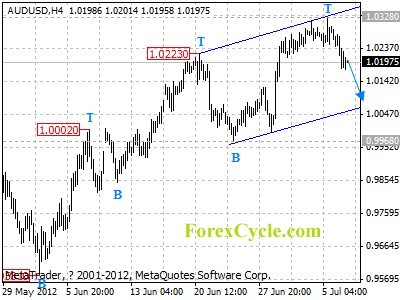
AUDUSD breaks below 1.0240 support

AUDUSD breaks below 1.0240 support, suggesting that a cycle top has been formed at 1.0328 on 4-hour chart. Further decline would likely be seen over the next several days, and the target would be at the lower line of the price channel. As long as the channel support holds, the price action from 1.0223 is treated as consolidation of the longer term uptrend from 0.9581, and one more rise towards 1.0600 is still possible.

audusd

Forex Signals

Central Bank News Link List – July 9, 2012

By Central Bank News

    Here’s today’s Central Bank News link list, click through if you missed the previous link list. The list is updated during the day with the latest news about central banks so readers don’t miss any important developments.

Most Accurate Stock Market Predictions Using the US Dollar Index– Next Major Move

By Chris Vermeulen, GoldAndOilGuy.com

The term Stock market predictions is a very controversial topic and does seem to give off a negative/non-credible overtone to most traders, investors and the general public. We all know you cannot predict the market with 100% certainty, but knowing that you can still predict the market more times than not if done correctly. Keep in mind that the term “market prediction” is also known as a market forecast or technical analysis outlook and is nothing more than a estimated guess of where the price for a specific investment is likely to move in the coming minutes, hours, days, weeks and even months.

Getting back on topic, this report clearly shows how the US dollar plays a dominant role in the price of other investments. Understanding how to read the Dollar Index will make you a better trader all around when trading stocks, ETF’s, options or futures.

SP500 Stock Market predictions – 10 Minute Chart:
These charts clearly show the inverse relationship between the stock market and the dollar index. Knowing how to read charts (candle sticks, chart patterns, volume etc…) is not enough to give you a winning edge. You must also understand inter-market analysis as all markets are linked together in some way and the dollar plays a major role in where stock prices will move next. Review the charts and comments below on how I came up with my stock market prediction and trade idea.

Most Accurate Stock Market Predictions

Most Accurate Stock Market Predictions


Gold Market Prediction – 10 Minute Charts
Gold is another investment which is directly affected by the price of the dollar. Review charts for more details.


Gold Market Forecast Procetions

Gold Market Forecast Procetions


Long Term Stock Market Forecast:
The weekly dollar chart is VERY IMPORTANT to watch as a short term trader and long term investor because trend changes in the dollar means you open positions will also likely change direction.

So, if we apply technical analysis to the dollar chart as seen below. You will notice we are able to create a market forecast and predict roughly where price is likely to move and how long it should take to get there. If the dollar can break above the red resistance level then we can expect a rally for 4 – 8 weeks and a price target around the 87-88 level.

If this is the case then stocks and commodities would likely do the inverse price action and move lower, sharply lower…

Dollar Long Term Market Forecast

Dollar Long Term Market Forecast


Stock Market Predictions & Gold Market Forecast Conclusion:

In short, the next weekly candle stick on the dollar chart could be a game changer for those who are long the overall stock market.

I will admit that the current market conditions are not easy to trade because of all the headline news rolling out of Europe each week along with economic data. And I feel as though we have been tip toeing through a mine field for the past 12+ months waiting for extremely negative news are extremely positive news to trigging a wave of buying or selling that will make our jaw drop, but it has yet to happen. Remember always use stops and don’t get over committed in a headline driven market.

If you would like to receive my free weekly analysis like this, be sure to opt-in to my list: www.GoldAndOilGuy.com

Chris Vermeulen