How Commodity Stocks Provide High Yields and a Hedge Against Inflation

By MoneyMorning.com.au

For years now I’ve been pounding the table on two big themes…

The first is that income investing is a great way to boost not only your returns but your cash flow. And second, that every investor should have a substantial chunk of their portfolio invested in commodity stocks.

Here’s the good news: it is perfectly possible to combine the two strategies, earning the benefits of both worlds.

In fact, by investing in income-producing commodity stocks, you get a steady stream of income along with the best possible protection against the ravages of inflation.

That combination is tough to beat. Let me explain…

Commodity Stocks With Income + Appreciation

The truth is, income investing is crucial for three reasons.

The first is obvious. No matter how well-off you become, the bills just keep getting worse and worse. I never met anyone that couldn’t use more cash.

The next two aren’t nearly as evident to most investors – even though both are of the utmost importance to their portfolios.

Stocks that pay steady, consistent dividends add a measure of certainty to share prices. It’s why top quality dividend stocks typically do well even in bear markets. Conversely, since earnings are so easily manipulated, companies with fancy bottom lines but no dividend usually turn out to be a scam and end up being priced accordingly when things turn south.

Finally, dividends themselves keep management honest (or fairly honest). Cash that is paid out to shareholders cannot be used for grandiose expansion plans, or to pump up the stock price to help inflate top management’s stock options.

As a result, companies that pay decent dividends are less likely to suffer value-destroying scams than those that don’t and are likely to be around longer. For investors, that offers stability – invaluable these days.

Why You Should Favour Commodity Stocks

As for commodity stocks, I’ll be the first to admit they are not a universal panacea. But two long-term factors currently favor them.

The first is in emerging markets which tend to consume more commodity-intensive goods as their national wealth grows.

The second trend is a bit less agreeable though one of the most powerful movers of commodity prices. It’s the world’s central bankers.

For the past five years, global monetary policy has been jammed into accelerator mode, with interest rates far below the inflation rate. This tends to raise commodity prices, especially in gold and silver, since they are thought to be good protection against inflation.

But here’s the payoff for investors: commodity stocks are actually cheap right now.

Commodity prices have come off their spring 2011 highs, indeed declining more than the stock market in general. Still, commodity prices have remained quite strong, so many commodity-related stocks are selling at very attractive valuations. With global monetary policy becoming even more expansive and emerging market growth continuing strong, the stage is set for a sharp commodities-related rally.

In fact, even if the markets as a whole are weak in the second half of 2012, commodity stocks with moderate leverage and good dividends are likely to outperform.

Martin Hutchinson
Contributing Editor, Money Morning

Publisher’s Note: This article first appeared in Money Morning (USA)

From the Archives…

The Credit Market Debt Bubble and the Role of Gold
13-07-2012 – Greg Canavan

How to Survive and Thrive from China’s Bust
12-07-2012 – Kris Sayce

Payday Loans: Why This Lender of Last Resort Isn’t the Bad Guy
11-07-2012 – Kris Sayce

What A Slowing Chinese Economy Means For Pork Chops
10-07-2012 – Dr. Alex Cowie

Late News: Bankers Rig Interest Rates, No-One Fired
09-07-2012 – Dr. Alex Cowie


How Commodity Stocks Provide High Yields and a Hedge Against Inflation

Trading Forex with Elliott Doesn’t Have to be Complicated [VIDEO]

Watch a simple lesson on Elliott waves from Chief Currency Strategist Jim Martens

By Elliott Wave International

Understanding the Wave principle doesn’t have to be hard. In fact, as you’ll see in this 5-minute clip, learning from EWI’s Chief Currency Strategist Jim Martens can be downright entertaining.

Watch as the 20-year veteran analyst explains how learning to use Elliott waves can be as simple as counting to 5 and knowing your A-B-Cs.


Want to learn more? Get 10 Lessons on the Elliott Wave Principle — FREE!The Elliott Wave Basic Tutorial is a 10-lesson comprehensive online course with the same content you’d receive in a formal training class — but you can learn at your own pace and review the material as many times as you like!Get 10 FREE Lessons on The Elliott Wave Principle that Will Change the Way You Invest Forever >>


This article was syndicated by Elliott Wave International and was originally published under the headline Trading Forex with Elliott Doesn’t Have to be Complicated [VIDEO]. EWI is the world’s largest market forecasting firm. Its staff of full-time analysts led by Chartered Market Technician Robert Prechter provides 24-hour-a-day market analysis to institutional and private investors around the world.


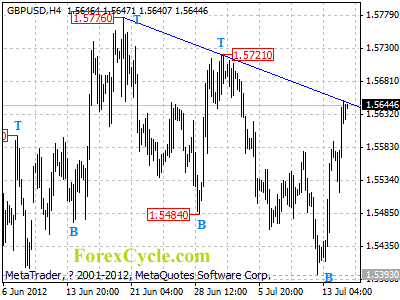
GBPUSD is facing trend line resistance

GBPUSD is facing the resistance of the downward trend line from 1.5776 to 1.5721. As long as the trend line resistance holds, we’d expect the downtrend to resume, and another fall towards 1.5000 is still possible. However, a clear break above the trend line resistance will suggest that the downtrend from 1.5776 has completed at 1.5393 already, then the following upward movement could bring price to 1.6000 zone.

gbpusd

Forex Signals

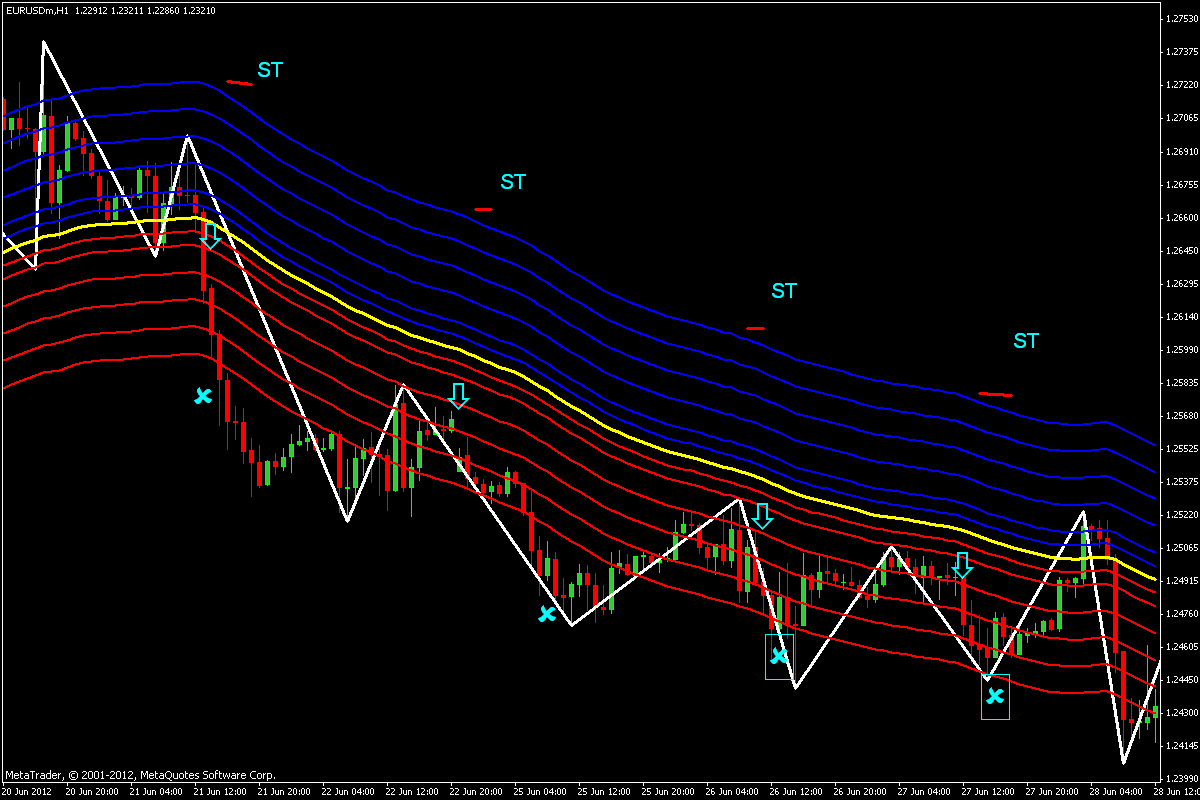
EMA 75 Swing Strategy

EMA 75 SWING  STRATEGY

Time frame: 1H
Pair: major

Indicators: EMA  75 , YELLOW COLOR

                 ENVELOPES    PERIOD  EMA 75  DEVIATION   0.05  BLUE , RED, COLOR
                 ENVELOPES    PERIOD  EMA 75  DEVIATION   0.10  BLUE , RED, COLOR                                      
                 ENVELOPES    PERIOD  EMA 75  DEVIATION   0.20  BLUE , RED, COLOR
                 ENVELOPES    PERIOD  EMA 75  DEVIATION   0.30  BLUE,  RED, COLOR
                 ENVELOPES    PERIOD  EMA 75  DEVIATION   0.40  BLUE , RED, COLOR
                 ENVELOPES    PERIOD  EMA 75  DEVIATION   0.50  BLUE,  RED, COLOR
              
                 ZIGZAG ,  WHITE

SHORT OR LONG POSITION:  WHEN PRICE HIT  NEAR 75 SMA YELLOW  ENTRY AND EXIT  PRICE HIT BELOW LAST  ENVELOPE LINE  AND RE ENTRY THE A SAME RULE.

STOP LOSS ABOVE  LAST ENVELOPE LINE .


Example below – click for larger view

Unemployment Claims Falls as EUR/USD Edges Closer to Critical Support

By TraderVox.com

Tradervox.com (Dublin) – The weekly jobless claims dropped from 376,000 to 350,000 this week, which is a big shift from the trend experienced before. Most economists have termed this as a one-off event and is not reflective of a change in trend. Such numbers were seen at the beginning of the year, and the current figure is a new four-year low.

Despite such encouraging data, there are reasons to worry as currencies fail to react. The USD/JPY which increases on positive US data is still lower at 79.20 while the EUR/USD is still low at $1.2180. There have been credible explanations of the lower than expected data with some analysts saying this might have resulted from the celebration of the Independence Day in the US which was on July 4, which was in the middle of the week. This might have caused many unemployed people to fail to claim their benefits. Further, economists have also cited that most companies that shutdown for summer were not shut hence significantly reducing the number of unemployment claims.

The EUR/USD pair is edging closer to breaking critical support, and this might be the reason why this pair did not react as support levels show much strength. However, the pair is still at new 2-year low as investors analyze the Spanish bond performance and the FOMC data. The EUR/USD has broken the important support line of 1.22 and there is no other line prior to the critical support at 1.2150. This line was a major separator when the market collapsed after the first Greece bailout in May 2010.

The pair fell after FOMC meeting minutes showed that only two of the members support additional dollar printing as a measure to spur growth while others taking a wait and see stance. Further, bad news came from Europe, where Spain is due to receive 30 billion euros to help its financial institution. However, the government is paying dearly with the PM announcing a 65 billion euro package to solve the debt crisis in the country. This means additional VAT shooting from 18 to 21 percent, unemployment benefit cut, and cancellation of Christmas bonus. These measures will weigh heavily on the people and the market is waiting to see how people will react.

Disclaimer
Tradervox.com is not giving advice nor is qualified or licensed to provide financial advice. You must seek guidance from your personal advisors before acting on this information. While we try to ensure that all of the information provided on this website is kept up-to-date and accurate we accept no responsibility for any use made of the information provided. Opinions expressed at Tradervox.com are those of the individual authors and do not necessarily represent the opinion of Tradervox.com or its management. 

Article provided by TraderVox.com
Tradervox.com is a Forex News Portal that provides real-time news and analysis relating to the Currency Markets.
News and analysis are produced throughout the day by our in-house staff.
Follow us on twitter: www.twitter.com/tradervox

Major Events that Will Affect the GBP/USD Cross This Week

By TraderVox.com

Tradervox.com (Dublin) – The sterling pound closed the week almost a cent higher than the previous week, following some strong releases at the end of the week. The strong Manufacturing production and industrial production reports came in above the market expectation hence boosting the demand for pound as a safe haven. However, the pair has pared its gains at the start of trading on Monday, after Rightmove HPI report showed that the index fell to the least in eight months. The index fell by 1.7 percent.

Other events that will shape the trading of the cross include the CPI data that will be released on Tuesday at 0830hrs and the BOE governor Mervyn King speech thirty minutes later. The CPI data has shown a downward trend in the recent releases and a slight decline is expected this time. The Bank of England Governor Mervyn king will speak at 0900hrs where investors will be keen on sentiments and directions given by the governor.

On Wednesday, the Claimant Count Change and the MPC Meeting Minutes will be released at 0830hrs. The claimant count change disappointed last month as the figure came out stronger than expected. The market expects the data to stand at 7,400 while the unemployment rate is expected to remain stagnant at 8.2 percent. The BOE Meeting Minutes will show the voting patterns during the BOE recent rate decision and the Asset purchases Facility program.

There will be one important event on Thursday and another on Friday where the Retail Sales data will be released on Thursday and the public sector net borrowing will be on Friday; both reports will be released at 0830hrs GMT. The market estimates a drop of 0.6 percent in the July reading of the Retail sales. This indicator is followed closely by investors as it gives the trend of most important gauges of consumer spending. The Public Sector Net Borrowing is expected to came in at 12.5 billion pounds for the month of July.

Disclaimer
Tradervox.com is not giving advice nor is qualified or licensed to provide financial advice. You must seek guidance from your personal advisors before acting on this information. While we try to ensure that all of the information provided on this website is kept up-to-date and accurate we accept no responsibility for any use made of the information provided. Opinions expressed at Tradervox.com are those of the individual authors and do not necessarily represent the opinion of Tradervox.com or its management. 

Article provided by TraderVox.com
Tradervox.com is a Forex News Portal that provides real-time news and analysis relating to the Currency Markets.
News and analysis are produced throughout the day by our in-house staff.
Follow us on twitter: www.twitter.com/tradervox

Central Bank News Link List – July 16, 2012

By Central Bank News

    Here’s today’s Central Bank News link list, click through if you missed the previous link list. The list is updated during the day with the latest news about central banks so readers don’t miss any important developments.

Technical Analysis for the USD/JPY Cross

By TraderVox.com

Tradervox.com (Dublin) – The pair has been trading on its regular trend but lost uptrend support last week. With Bank of Japan’s monetary policy meeting minutes due to be released this week, the cross is expected to remain neutral over the course of the week. The Bank of Japan resolved last week to keep the interest rates between 0.0 percent and 0.1 percent and made a technical move of moving 5 trillion yen from its credit facility fund to its asset purchasing program. There are two major events this week that will affect this pair from Japan. Here is a look at those events as technical analysis for the cross.

The first major event set to affect this pair is the Bank of Japan Monetary Policy meeting minutes that will be released on Tuesday at 2350hrs GMT. Masaaki Shirakawa, the BOJ Governor has showed concern about the worsening debt crisis in Europe and the economic slowdown in China which is Japan’s major export destination. Investors will looking at how the member voted as well as their sentiments.

The other major event that will affect this cross is the All industries Activity report which will be released on Thursday at 0430hrs. In April, the report showed an increase of 0.1 percent. The report also showed a drop in construction sector of 5.6 percent and 0.2 in industrial output. The pace of growth in all industry activity declined from 5.5 percent in the previous to 4.1 percent in April. Economists are expecting a further decline from this report.

Investors and market analysts will be looking for any suggestion that the pair will change from the current range. It is important to note that the uptrend support has been broken which had more significant than the uptrend resistance. Market analysts remain neutral on this cross as the forces pushing these two safe haven currencies remain fairly balance over the week.

Disclaimer
Tradervox.com is not giving advice nor is qualified or licensed to provide financial advice. You must seek guidance from your personal advisors before acting on this information. While we try to ensure that all of the information provided on this website is kept up-to-date and accurate we accept no responsibility for any use made of the information provided. Opinions expressed at Tradervox.com are those of the individual authors and do not necessarily represent the opinion of Tradervox.com or its management. 

Article provided by TraderVox.com
Tradervox.com is a Forex News Portal that provides real-time news and analysis relating to the Currency Markets.
News and analysis are produced throughout the day by our in-house staff.
Follow us on twitter: www.twitter.com/tradervox

Gold Market “Nervous and Thin” Ahead of Bernanke Testimony, Analysts Prepared to be “Disappointed”

London Gold Market Report
from Ben Traynor
BullionVault
Monday 16 July 2012, 07:30 EDT

THE DOLLAR cost of buying gold  fell to $1583 an ounce during Monday morning’s London trading, in line with where last week’s range, while European stock markets also edged lower and US Treasury bonds gained, with markets focused on Federal Reserve chairman Ben Bernanke’s testimony before Congress tomorrow.

Prices to buy silver fell to $27.11 per ounce – nearly 1% off last week’s close – as other industrial commodities also ticked lower.

On the currency markets the Euro fell against the Dollar, dropping back below $1.22.

“Keep an eye on the Dollar and the stock market for clues as to the next direction [for gold],” says David Govett, precious metals manager at brokers Marex Spectron.

“But all in all, [the market] should stay quiet, albeit thin and nervous as usual.”

“Markets are settling back into wait-and-see mode,” adds a note from ANZ Bank, “ahead of testimony by Fed Chairman Bernanke.”

Bernanke is due on Tuesday to give his semi-annual monetary policy report to Congress.

“Any sign of an inclination towards quantitative easing would encourage gold,” reckons Jinrui Futures analyst Chen Min in China, “though we think the chances of the QE3 in July are very small but the Fed may launch it in the next couple of months.”

“He’ll certainly suggest that [QE] is possible,” adds Mitul Kotecha, Hong Kong-based head of global foreign exchange at Credit Agricole.

“[But] markets may just come away a little bit disappointed.”

“Gold prices…remain below the level implied by the current 10-Year TIPS yields,” say analysts at Goldman Sachs, referring to the yield on Treasury Inflation Protected Securities.

“Our US economists forecast subdued growth and further easing by the Fed, which should push the market’s expectations of real [interest] rates back down and gold prices back to our 6-month forecast of $1840 per ounce.”

Elsewhere in the US, the Federal Reserve Bank of New York on Friday released documents “related to actions of the [New York Fed] in connection with the Barclays-Libor matter”, in particular the allegations that Barclays reported facing artificially low borrowing costs during the banking crisis of 2008.

The documents reveal the New York Fed made a number of recommendations to the Bank of England four years ago, suggesting ways in which Libor reporting could be tightened up. The Bank’s governor Mervyn King, who at the time described the suggestions as “sensible” before passing them on to the British Banking Association, has faced criticism for not taking greater action.

Britain’s economy meantime will see zero growth in 2012, according to forecasters at the Ernst & Young Item Club, who have cut their projection from their previous estimate of 0.4%.

On the gold futures and options market, the so-called speculative net long – calculated as the difference between bullish and bearish positions held by noncommercial traders – fell nearly 14% in the week ended last Tuesday, data from the Commodity Futures Trading Commission show.

“Positioning remains weak,” says a note from Standard Bank this morning.

“Net speculative length is extremely low. This underscores the fragility of any rally in gold at the moment, unless the market is sustained by the promise of further quantitative easing from the Fed.”

The world’s biggest gold ETF the SPDR Gold Trust meantime continued to see net outflow of gold bullion, with the amount of gold held to back shares dropping 0.7% to 1269.7 tonnes over the course of last week to Friday.

Indian demand to buy gold meantime is set to fall for a second year in a row, as people cut spending and hoard cash, the World Gold Council has said.

“What is more, there is less money available for buying gold as a result of a poorer than expected monsoon season,” says a note from Commerzbank.

Over in China – which in recent months has overtaken India as the world’s biggest gold buying market – gold over the past year has outperformed investment in wines such Chateau Lafite Rothschild, newswire Bloomberg reports.

Chinese policymakers meantime should “intensify the strength of prudent and moderately loose monetary policy”, according to Chen Dongqi, deputy chief at government think-tank the Academy of Macroeconomics Research.

“In particular we should prevent producer deflation from expanding to the consumer area in the second half of 2012…once deflation happens in consumer prices, we would pay a big price for policy changes to solve the problem.”

Ben Traynor
BullionVault

Gold value calculator   |   Buy gold online at live prices

Editor of Gold News, the analysis and investment research site from world-leading gold ownership service BullionVault, Ben Traynor was formerly editor of the Fleet Street Letter, the UK’s longest-running investment letter. A Cambridge economics graduate, he is a professional writer and editor with a specialist interest in monetary economics.

(c) BullionVault 2011

Please Note: This article is to inform your thinking, not lead it. Only you can decide the best place for your money, and any decision you make will put your money at risk. Information or data included here may have already been overtaken by events – and must be verified elsewhere – should you choose to act on it.