How to Trade the UK Retail Sales: GBP/USD

By TraderVox.com

Tradervox.com (Dublin) – The UK Retail Sales is regarded as an important indicator as it provides traders and analysts with the direction of consumer spending in Britain. This report will be released on Thursday, July 19 and 0830 hrs GMT. Here are more details about this indicator and its possible effects on the pound-dollar pair.

The indicator has been providing important perspective on consumer confidence and spending. If the indicator has a strong reading, this is considered significant for economic growth in the country. The UK Retail Sales was higher than the market expectation in June when it jumped to 1.4 percent. This month, the indicator is expected to increase by 0.6 percent.

There are general bearish sentiments in the UK as major sectors in the country have been contracting. Despite, the recent pound rally last week, the general trend of the pound-dollar pair has been bearish since July. Significant sectors in the economy such as the housing, construction, and manufacturing have been contracting as crisis in Europe continues to take toll on the UK economy. Moreover, the bleak global economic outlook has forced investors to favor the safe haven provided by the dollar and the yen, as such, the GBP/USD pair outlook remains bearish.

When this report is announced, some of the technical levels to keep in mind include: 1.5930, 1.5805, 1.5750, 1.5648, 1.56, and 1.5521. If this indicator comes within the market expectations, –that is 0.3 -0.9 percent, then the pair is expected to rise within range with a slim chance of breaking higher. If it comes above expectations (1.0-1.3 percent) the pair might break one resistance line. However, if the indicator comes in well above the market expectations, the GBP/USD cross is expected to break a second resistance line.

On the other hand, if the indicator is below the market expectation –that is a reading between -0.1 and 0.2 percent, the cross may move downwards with a possibility of breaking below one support level. A well below expectation reading will probably cause the pair to break a second support level.

Disclaimer
Tradervox.com is not giving advice nor is qualified or licensed to provide financial advice. You must seek guidance from your personal advisors before acting on this information. While we try to ensure that all of the information provided on this website is kept up-to-date and accurate we accept no responsibility for any use made of the information provided. Opinions expressed at Tradervox.com are those of the individual authors and do not necessarily represent the opinion of Tradervox.com or its management. 

Article provided by TraderVox.com
Tradervox.com is a Forex News Portal that provides real-time news and analysis relating to the Currency Markets.
News and analysis are produced throughout the day by our in-house staff.
Follow us on twitter: www.twitter.com/tradervox

How an Interest Rate Rise Could Trigger a ‘Punch Bowl’ Rally

By MoneyMorning.com.au

We hate to do it.

As much as we try.

But he’s impossible to ignore.

That’s right, we’re talking about US Federal Reserve Chairman, Dr. Ben S. Bernanke.

He’s just finished giving testimony to the US Congress. Asked about the impact of low interest rates, the Fed Chairman said the Fed was ready to take ‘away the punch bowl’.

In other words, raise interest rates.


That’s bad news for stock markets, right? Maybe not. In fact, if history is anything to go by, it could result in the best bull-run the market has seen in nearly 10 years…

Our view on the global economy and markets is that it’s stuffed.

But, that’s not new. The global economy and markets have been stuffed for years. The trick is to recognise that so you can protect your wealth when things go pear-shaped, but also to take advantage of wild market moves — whether that’s up or down.

And that means paying close attention to what’s happening in global markets…

Will We See a Repeat Rally From an Interest Rate Rise?

We were intrigued by Fed Chairman Bernanke’s comment that when the US economy stabilises and inflation starts rising, the Fed will simply ‘take away the punch bowl’ by raising interest rates.

The immediate reaction is to think that will be bad news for stocks. After all, with all the debt in the economy, higher interest rates means higher interest costs.

But is that necessarily true? Certainly there’s an element of truth to it. But nothing is ever as simple as it seems. One consequence of higher interest rates is that investors will be more prepared to save and lend…because they’re getting a better return for their money.

That should make it easier for firms to borrow money. And so what if they’re paying a higher interest rate, at least they can borrow funds to grow their business.

And if we look at the effect of rising interest rates on stock markets, if the last time the Fed took ‘away the punch bowl’, maybe the impact won’t be as bad as most think.

Here’s a chart of the US Federal Funds Rate from 2002 to 2012:

Source: The US Federal Reserve

After dropping interest rates to 1% in 2003, the US Fed kept rates low before raising them from 2004 through to 2006. By the time the Fed stopped raising rates, the Fed Fund rate was at 5.25%.

But what about the stock market?

Here’s the interesting part. Check out this chart:

Source: Google Finance

The red line is the Aussie ASX/S&P 200 index. The blue line is the U.S. S&P 500 index.
The first green bar covers the time when US interest rates were at 1%. The purple line shows the period when the Fed raised rates from 1% to 5.25%. And the second red line covers the period when rates were at the peak.

From bottom to top, the US market gained 80%. It gained 35% during the period of 1% interest rates and then added another 40% as rates climbed.

Where is the US market now?

Stocks at 2003 Prices

Over a period when the Fed has kept interest rates lower for a much longer period, the US market is up 75%. So if — and it’s a big if — the US economy does stabilise and the Fed indicates rate rises are on the way (not likely before 2014), it could be the cue for the market to head higher.

And the prospects for the Australian share market could be even better. Notice that from 2003 the US market took off much faster than the Aussie market.

So that while today the US market is less than 10% below its 2007 peak, the Aussie market is still 40% below the 2007 peak. It has a whole bunch of catching up to do.

The major difference of course is that Australia has a much less diversified economy. And a much less diversified stock market — resources and banking.

But if the global economy recovers, it should mean more demand for Aussie resources. We don’t mean it will be a return to the China-led resources boom, but if investors are more realistic about the potential returns from resources stocks, you should see stocks rise from their current beaten-down level.

As we say, we’re still sceptical about the chances of a global economic recovery. But you shouldn’t discount the possibility.

Things are playing out eerily similar to the last time the Fed fiddled around with interest rates. If the Fed does eventually ‘take away the punch bowl’, stock markets (including the Aussie market) could see the biggest bull-rally in more than 10 years.

Cheers,
Kris.

Related Articles

Market Pullback Exposes Five Stocks to Buy

When the Going Gets Tough, Entrepreneurs Innovate

Is This Man the Ultimate Contrarian Indicator for Mining Shares?


How an Interest Rate Rise Could Trigger a ‘Punch Bowl’ Rally

Cumpulsory Voting for a Violent State

By MoneyMorning.com.au

Last night your editor went to dinner at the Olio Cucino restaurant in Melbourne. We heard John Hirst talk about ‘Why Australia should abolish compulsory voting’.

We listened with interest. And we agreed that voting shouldn’t be compulsory…but we thought that anyway.

What was more interesting was the history of latent violence by the State against Australian citizens. How the State used police to ensure people enrolled for elections.

And how the government employed ‘spies’ — postmen and the police — to inform on Aussies if they failed to re-enrol to vote after moving house.

According to Hirst, the passive Aussie attitude to State violence comes from the lack of civil unrest in Australian history. People have grown to trust government and authority rather than question it.

As Hirst said, for a country that has a cop-shooting petty criminal as a national icon (Ned Kelly), it’s surprising how compliant people are in obeying authority.

But after all the debate about the pros and cons of compulsory voting, we asked Hirst a simple question:

‘Considering the abuses of the State in compulsory voting and non-compulsory voting nations, and the abuses of authoritarian States, isn’t the issue that government is the problem, rather than the voting mechanism?’

Hirst didn’t agree. But we are right. Regardless of the form, the State is a violent body. It steals from those it hates (the people) and gives to those it adores (employees and contractors of the State).

Cheers,
Kris.

Related Articles

Market Pullback Exposes Five Stocks to Buy

When the Going Gets Tough, Entrepreneurs Innovate

Is This Man the Ultimate Contrarian Indicator for Mining Shares?


Cumpulsory Voting for a Violent State

Why Gold is Flowing into China

By MoneyMorning.com.au

I recently received a fascinating letter from a Sound Money. Sound Investments subscriber who was ‘…born, educated, and obtained my university degree in an Eastern European Communist Country. On the day of my graduation I escaped the country and regime that I grew to hate’.

In his letter, he shared his experiences of life in a communist regime and his insight into what possible outcomes are ahead for China as their economy is undone.

I found this reader’s insight very interesting.  Because it came from someone who has experienced this type of economic system before. Granted, there are obviously differences between Eastern European communism and Chinese communism. And there will be differences between the revolutions of Eastern Europe and whatever is to come in China.

I want you to think differently about China and the way the Western media presents its economic development. There is no doubt China’s economy has some real challenges.

One question the reader asked was if it’s possible China is cornering the gold market to solve their problems.

Now, I’m not suggesting this is a way out for China’s economy. I’d like to point out that it’s the only way for China to mitigate some of the fallout it will experience from abandoning its old growth model…that is, moving from export and investment-led growth to a system based on internal growth.

How China is Rebalancing
the National Balance Sheet with Gold

Think of it this way.

Most of China’s economic assets are other countries’ debt…for example, US Treasuries. This is not a sound or stable asset base. But if China accumulates gold, it’s buying a pure asset. There is no liability, or counterparty, on the other side of the asset.

Say it amasses 5,000 tonnes of gold. At a price of $1,600 an ounce, that’s a value of $282 billion. Not much in the scheme of things. But at $5,000 an ounce, the value of the gold hoard jumps to $882 billion. At $10,000 gold, it becomes $1.76 trillion. At that level, gold would represent around 50% of China’s reserves.

Can you see how this increase in asset value, without any corresponding increase in liabilities (debt) improves China’s national balance sheet? And can you see how the same applies to the individual’s balance sheet?

An increase in assets without an increase in liabilities translates into increased equity. Equity represents unencumbered ownership. For want of a better word, it represents an increase in wealth.

A major revaluation in gold represents a transfer of wealth from issuers and owners of debt to owners of gold. This strategy is not a panacea for China’s economy, but it’s certainly a way to reduce the cost of its past policy mistakes and ease the social tension that will arise from its upcoming transition to a new growth model.

Speaking of China and gold, Bloomberg reports that Hong Kong customs data showed gold imports into China from Hong Kong were 76 metric tonnes for the month of May. This represents a six-fold increase on last year.

Physical gold is flowing from West to East. It’s as simple as that.

Greg Canavan
Editor, Sound Money. Sound Investments

Ed Note: To read the fascinating story of life behind the ‘Iron Curtain’ and why Greg believes the Chinese economy is about to become undone, click here to take out an obligation-free trial to Greg’s investment advisory service…

From the Archives…

The Credit Market Debt Bubble and the Role of Gold
13-07-2012 – Greg Canavan

How to Survive and Thrive from China’s Bust
12-07-2012 – Kris Sayce

Payday Loans: Why This Lender of Last Resort Isn’t the Bad Guy
11-07-2012 – Kris Sayce

What A Slowing Chinese Economy Means For Pork Chops
10-07-2012 – Dr. Alex Cowie

Late News: Bankers Rig Interest Rates, No-One Fired
09-07-2012 – Dr. Alex Cowie


Why Gold is Flowing into China

Who Will Be Next in the LIBOR Manipulation Scandal?

By MoneyMorning.com.au

Barclays Plc paid out over $450 million in fines for its role in the LIBOR  manipulation scandal, but who will be the next guilty party?

One thing’s for sure: Regulators are on the hunt.

The New York Federal Reserve last week confirmed that U.S. Treasury Secretary Timothy Geithner sent a memo to British regulators in 2008 over concerns of banks manipulating LIBOR.

Geithner maintained that he and the Fed sent a long list of recommendations to the Bank of England and the British Bankers’ Association, which oversees the LIBOR-setting process.

In light of the LIBOR scandal, U.S. Federal Reserve Chairman Ben Bernanke was questioned about the Fed’s inaction regarding LIBOR manipulation at his testimony before Congress on Tuesday.

Bernanke also made clear that the Fed was not aware that Barclays was manipulating the rates for its own profit. Instead the Fed believed the bank was simply manipulating interest rates to maintain the appearance that everything was fine with the company (which surely wouldn’t affect a bank’s profit…).

Bernanke insisted the Fed followed up on the disclosures and that in cases like this there is not much more U.S. regulators can do than make suggestions.

Possible U.S. Culprits of the LIBOR Scandal

It’s hard to believe that the Fed did all it could do to prevent LIBOR manipulation. And if it couldn’t prevent the LIBOR scandal, the Fed certainly had the power and the knowledge of what was going on to keep it from ballooning to what it is today.

Jim Rickards, author of Currency Wars, thinks there is much more that could have been done to prevent the ‘largest financial scandal’ he has ever seen.

He has gone as far as to say Geithner should be charged with aiding and abetting a crime. He explained that Geithner was aware of a crime, fraud, taking place, and did nothing to stop it.

Geithner is set to testify and face questions about the issue next week when he appears in front of the House Financial Services Committee.

So far U.S. banks have only felt a twinge of the possible repercussions that could stem from this mess.

JPMorgan Chase and Citigroup are the only two banks that have admitted to being under investigation, while other U.S. banks such as Bank of America remain under heavy suspicion.

The English Players in the LIBOR Manipulation Scandal

Considering that LIBOR is controlled by English regulators it would make sense that Barclays is not the only British wrongdoer in this scandal.

There is Bank of England’s deputy governor Paul Tucker, who has been questioned about his correspondence with Barclays former CEO Bob Diamond.

Tucker said he pressed Barclays, HSBC Holdings and the Royal Bank of Scotland to urge the British Bankers Association (BBA) to carry out a more detailed review of Libor in 2008.

‘We wanted to give the BBA the message that they shouldn’t just do their normal annual review of LIBOR but do a much broader, global consultation of LIBOR and its governance,’ Tucker told lawmakers. ‘We decided to say to the banks that this broader review shouldn’t be conducted at the level of the normal committee, which is desk level, but should be more senior. I called roughly the number two’s and number three’s at all the big sterling banks to say that.’

This contrasts with a story Tuesday by the Associated Press concerning Bank of England’s governor Mervyn King. King said the first he knew of any alleged wrongdoing during 2008 ‘was when the reports came out two weeks ago.’

‘We have been through all our records. There is no evidence of wrongdoing or reporting of wrongdoing to the Bank (of England),’ King said.

King also said that the Federal Reserve of New York did not show him any evidence of manipulation or misreporting of LIBOR when they raised concerns in 2008.

King, speaking to a House Commons committee, said during the 2008 financial crisis there were concerns regarding what LIBOR was indicating about the health of banks, but not about LIBOR manipulation.

King was asked about Geithner’s suggestion to ‘prevent accidental or deliberate misreporting’ and ‘eliminate incentive to misreport.’

‘When you design any self-reporting scheme you have rules to prevent misreporting,’ King said. ‘That isn’t the same as saying you’ve got evidence that there is misreporting, nor did the Fed or anyone else send us any evidence of misreporting.’

Lastly, Britain’s Financial Services Authority is under speculation. They faced questioning on Monday from Parliament as to why regulators failed to respond to concerns about LIBOR manipulation going back to December 2007.

Members of Parliament accused the Financial Services Authority of not acting quickly enough and even the chairman of the British regulator, Adair Turner, admitted they had not dealt with the potential risks of LIBOR.

The Financial Services Authority is currently investigating several other global financial institutions about their role in the interest rate scandal.

For now all we know is that the LIBOR scandal is just picking up and it remains to be seen who will be punished the most, or even at all.

Ben Gersten

Contributing Writer, Money Morning

Publisher’s Note: This article originally appeared in Money Morning (USA)

From the Archives…

The Credit Market Debt Bubble and the Role of Gold
13-07-2012 – Greg Canavan

How to Survive and Thrive from China’s Bust
12-07-2012 – Kris Sayce

Payday Loans: Why This Lender of Last Resort Isn’t the Bad Guy
11-07-2012 – Kris Sayce

What A Slowing Chinese Economy Means For Pork Chops
10-07-2012 – Dr. Alex Cowie

Late News: Bankers Rig Interest Rates, No-One Fired
09-07-2012 – Dr. Alex Cowie


Who Will Be Next in the LIBOR Manipulation Scandal?

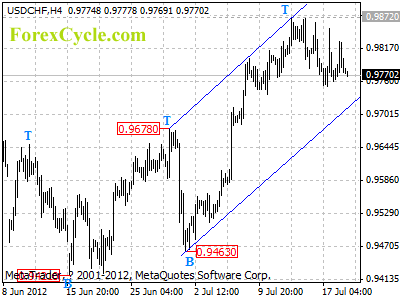
USDCHF stays in a upward price channel on 4-hour chart, and remains in uptrend from 0.9421, the fall from 0.9872 is treated as consolidation of the uptrend. Further decline to test the support of the lower border of the channel would likely be seen, as long as the channel support holds, uptrend could be expected to resume, and another rise to 1.0000 is still possible. On the downside, a clear break below the channel support will indicate that the uptrend from 0.9421 has completed at 0.9872 already, the the following downward movement could bring price back to 0.9500 zone.

usdchf

Daily Forex Forecast

Is Apple (Nasdaq: AAPL) the Tech Sector’s Safe Haven?

Article by Investment U

View the Investment U Video Archive

In focus this week: Apple may be the only safe place in technology, a portfolio that was set up in 1935 that’s still kicking butt, and the SITFA.

AAPL to $1000?

Apple (Nasdaq: AAPL) is on a tear again. A recent Barron’s article described it as a safe haven in an otherwise tech landscape rife with fear.

Estimates for the tech industry have been cut by just about everyone because of economic fears, a weak pc market and weak IT spending by corporations.

Apple, on the other hand, is in complete control according to Barron’s. A 50% profit margin and the ability to hold its prices put it in another class in the tech sector.

Apple has the world’s attention and everyone, it seems, is waiting for the next gizmo.

The key here is expectation, not delivery. Tiernan Ray of Barron’s says this one will be running again as soon as this September in anticipation of the new iPhone model.

The rest of the industry can’t put a dent in AAPL and since it broke above $600 again. It looks like we’ll have all kinds of predictions of a $1,000 AAPL again.

I’m not sure $1,000 is realistic, but when the hype starts rolling on this one, and the momentum builds, there seems to be no end to the run. But there always is.

A 1935 Portfolio That’s Still Cooking

In 1935, a portfolio of 30 stocks was set up with the idea of not doing anything, or at least as little as possible to it. The theme then and now is “no manager, no problem.”

The best part, over the last 10 years this little doozy has outperformed the market by 56%, and compared to other large cap funds by an even greater percentage.

In fact several of its holdings tripled in price in just the last 10 years; Praxair (NYSE: PX), Union Pacific (NYSE: UNP) and Burlington Northern (NYSE: BNI).

ING Corporate Leaders Trust has $750 million in 22 stocks that reads like a who’s who of Wall Street: Union Pacific, DuPont (NYSE: DD) and their largest holding, Exxon (NYSE: XOM).

The founders wanted blue-chip dividend payers that could thrive for decades. They look for brands and sustainable competitive advantages. It seems to be working very well.

But the ride hasn’t always been a smooth one. It lagged badly during the tech boom of the 90s and recently held EK until it went below $1.00. So, while it may look like the perfect play for the “buy and go to sleep crowd,” it too has given its shareholders lots of reason to cut and run.

This fund was originally set up as a UIT, unit investment trust, which as a tool for equities fell from grace long ago. I can’t remember the last time I read anything about an equity UIT.

These long-term, big performers always look so simple until you take a closer look at what you had to put up with to get the great returns.

What looks so simple on the surface never is. Is it?

And the SITFA

Here’s a good one.

A recent WSJ article described the reported inflation rate in China as unreliable because the Communist government in place there manipulates prices to control the markets.

The Communists manipulate the markets? What? Here in the United States, we just exclude energy and food from our inflation numbers. That’s not manipulation? You’re kidding, right?

How about our unemployment numbers? We just exclude those who have given up looking for work and the unemployment rate goes down. It’s really about 15%, not 8%.

Manipulation? The Chinese could take lessons from Washington on this one.

What a joke! Talk about the Emperor’s new clothes.

See you all next week.

Article by Investment U

Wealth Gap Investing: Nordstrom (NYSE: JWN) Staying Strong

Article by Investment U

Nordstrom (NYSE: JWN) Staying Strong

Considering that Nordstrom (NYSE: JWN) executives are already plotting their moves well into 2018, they seem confident that their popularity isn’t going anywhere.

Most Americans believe that retailers are struggling right now. And they have good reason to think that way, with all the dismal jobs report numbers in the news.

Everyone knows that Americans without jobs means Americans without cash to burn on all of those little and not so little extras in life.

For many, it’s difficult to justify an additional bottle of soda, that bag of Oreos or a set of sirloin steaks at the grocery store without some additional cash readily available. It’s tough to throw maturity to the wind and buy a $59.99 blouse, another completely unnecessary power tool, or new kitchen cabinets when it’s a fiscal headache just balancing each month’s bills.

So it’s completely understandable if average investors feel uncomfortable putting their money into the retail sector.

But one company is showing that wealthier Americans, at least, are still shopping luxuriously Nordstrom Inc. (NYSE: JWN).

And it’s the latest example of how investors are being rewarded for sticking to the furthest ends of the luxury-discount spectrum. (For more about “Class Warfare” investing, check out Carl Delfeld’s article from last October.)

Keep in mind that nationwide discount chains like Dollar Tree (Nasdaq: DLTR) and Dollar General Corporation (NYSE: DG) are also doing very well. Both are showing rapid growth, rising stock and continuing profits – for the precise reason that economic issues are still weighing heavily on the lower classes.

But that’s no reason to avoid retailers that cater to the crème de la crème among us. As Nordstrom shows, vanity pays… quite nicely, in fact.

Don’t Discount This High-End Retailer

A plain and simple pair of beige, low-heeled, women’s Jimmy Choo shoes for $525.00.

A single pair of men’s Todd Snyder wool trousers for $385.00.

La Mer moisturizing cream for $265.00 a bottle.

Ray-Ban sunglasses for $210.00.

It’d be the easiest thing in the world to look at Nordstrom as one of the worst possible places to park money in during tough economic times. Yet somehow and someway, the high-end, nationwide chain is one of America’s fastest-growing retailers right now.

Its spread of holdings includes Nordstrom department stores, off-price Nordstrom Rack retailers, both Jeffrey and treasure&bond boutiques, and Last Chance clearance stores, along with the shopping it offers online, of course. And apparently, the larger company knows how to manage those properties, because it keeps consumers clamoring for more…

In 2008, Nordstrom Inc. added 10 stores, and in 2009, it completed another nine. For 2010, it pulled off a whopping 12 new fully functional locations and by the end of last year, it beat that already impressive number to add 14 stores, for a total of 225 across the country.

And the vast majority of them make a great deal of money, giving the larger business an enviable bottom line…

Vanity is Paying a 2% Dividend…

Looking back over Nordstrom’s last few fiscal years, it quickly becomes apparent that the company is doing just fine despite the reoccurring waves of negativity washing over so many other retailers every few months.

In 2009, Nordstrom made a gross profit of $3.2 billion and operating income of $834 million. It raised both the following years to $3.8 billion and $1.1 billion, respectively. And for its fiscal year ending on January 27, 2012, the company proved its worth yet again with a profit of over $4.2 billion and operating income of $1.2 million.

For its first quarter this year, analysts predicted earnings of $0.75 a share. And while Nordstrom fell five cents below that, net earnings still rose 2.9% compared to the same time the previous year.

In other words, it’s still growing.

For that matter, it continued growing even in June, a month that had most other American retailers – including rival Macy’s (NYSE: M) – discounted and disheartened. Not Nordstrom though: Its same store sales grew 8.1% over the previous five-week period.

The company’s stock reflects those positive results. Since its low in 2008, it seems set on hitting a new record, climbing ever so steadily towards the $45 mark it originally breached early in 2007. It also pays a 2.1% dividend and looks to have plenty of room to increase that number with a 30% payout ratio.

A look at its price progression over the last two or five years shows a company that can take the hits and rise right back above them before long.

Considering that Nordstrom executives are already plotting their moves well into 2018 – particularly with a much-awaited grand opening in New York City – they seem confident that their popularity isn’t going anywhere. And neither are their profits.

Good Investing,

Jeannette Di Louie

Article by Investment U

The India Fund: Best Emerging Market GARP Play of 2012?

Article by Investment U

Emerging market stocks rallied strongly this year in the first quarter. (You can get an easy snapshot by following the iShares MSCI Emerging Market Index (NYSE: EEM). But with increasing evidence of an economic slowdown in the United States and Europe, they sold off hard in the second quarter.

That has created an attractive opportunity for global investors, especially those aware of intriguing developments in the world’s second-most-populous nation. Let me explain…

Asia, Latin America and Eastern Europe are primarily export markets. That makes them sensitive to economic softness in the developed world since these are end markets for many of their raw materials, natural resources and manufactured products.

At current levels, emerging markets represent compelling value. They’re home to the world’s fastest growing economies, but their stock markets also sport the world’s lowest valuations. For instance, the average stock in the United States currently sells for 12 times earnings. In Japan, it’s the same. In Europe, it’s 10 times earnings. But the average stock in the MSCI Emerging Markets Index sells for less than nine times earnings.

One of the most promising of these markets is India. Bear in mind, India has been growing at 7.4% a year for the last decade. And there are good reasons to believe this growth will remain strong, even if Europe and the United States start to fade.

Unlike China, India is an economy that thrives on domestic consumption. And that consumption will only rise in the years ahead. In fact, India is expected to overtake China as the world’s largest population by 2030. It also has one of the youngest populations among emerging market nations. Nearly half of its citizens are under 25.

Seventy percent of India’s population is rural. But better jobs and pay can be found in the nation’s urban areas. Economists estimate that the movement of labor from agriculture to manufacturing and services will add 1% to growth annually.

Plus, India is the world’s fifth-largest oil importer. With oil prices down more than 20% this year, this is likely to improve both Indian economic growth and profit margins.

The government in India, traditionally plagued by bureaucratic inefficiency, is taking positive steps, too. In May it cut in half long-term capital gains taxes on private equity investors while simultaneously postponing the implementation of new tax laws for at least two years. The Reserve Bank of India is poised to lower interest rates, as well.

This is one of the world’s great development stories, yet most Americans have little or no money invested here. Get invested, but skip the many opened-ended mutual funds that invest in this region and buy a good quality closed-end fund like The India Fund (NYSE: IFN) instead.

Why? For starters, the fund is currently selling at a 13% discount to its net asset value, near the high end of its range. (For example, the fund sold at just a 2% discount only a few months ago.) And the fund’s expense ratio is a reasonable 1.3%. Open-end funds like the Dreyfus India Fund (DIIAX), Goldman Sachs India Equity (GIAAX) and Wasatch Emerging India (WAINX) have average annual expenses that exceed 2%.

In short, emerging markets are poised for dramatic growth. India, in particular. The India Fund gives you broad exposure to one of the cheapest and most-promising markets in the already-cheap emerging market universe.

Good Investing,

Alex

Article by Investment U

More finance not always better – BIS paper

By Central Bank News

    If credit and finance helps businesses grow, it follows that a country should encourage a vibrant and large financial sector. That, at least, was the logic behind the wave of financial deregulation that swept through advanced economies in the 1990s.
    But with the repercussions of the 2008 financial crises still reverberating, economists are starting to question that belief with some concluding that finance can indeed become excessive and this has a negative effect on growth.
    The latest contribution to this debate comes from the Bank for International Settlements (BIS), with a working paper that concludes that at low levels, such as in developing economies, a large financial system can spur faster growth in productivity.
    “But there comes a point – one that many advanced economies passed long ago – where more banking and more credit are associated with lower growth,” wrote BIS chief economist Stephen Cecchetti, and BIS staff economist Enisse Kharroubi in Reassessing the impact of finance on growth.”

    The financial sector becomes a drag on growth when private credit exceeds a country’s total output or when more than 3.5 percent of workers are employed in the financial sector, the paper finds. Close to 5 percent of all workers were estimated to have been employed in the U.S. financial sector prior to the financial crises.
    The paper also finds that faster growth in finance is bad for overall growth, a finding that leads the authors to conclude that financial booms are inherently bad for a nation’s trend growth.
    The authors admit that at first, the conclusions are surprising. However, after closer scrutiny, they realize the consequences of financial booms mirror the dotcom boom of the 1990s when investors threw money at internet start-ups.
    “It is only when they crash, after the bust, that we realise the extent of the overinvestment that occurred. Too many companies were formed, with too much capital invested and too many people employed. Importantly, after the fact, we can see that many of these resources should have gone elsewhere,” the paper said.
     The theme of an excessive finance was also explored in the recent IMF paper “Too Much Finance?” which also suggested that finance starts having a negative effect on growth when credit to the private sector reaches 100 percent of GDP.
    The understanding that a financial sector can become excessive is not only important for advanced economies but also for emerging economies that are trying to develop their own financial industry and markets.
    “In their quest for optimal financialisation, the countries that are attempting further deregulation and development of financial markets would benefit from an understanding of how excess financialisation manifests itself,” said Y.V. Reddy, former governor of the Reserve Bank of India, in last month’s Per Jacobsson lecture in Basel, Switzerland.
    The experience of advanced economies may thus help developing economies avoid the negative consequences of an excessively large financial sector.
    “Research has associated higher growth with the development of the financial sector, but more recent evidence on trade-offs between growth in the real sector and the financial sector is equivocal,” Reddy said.
    www.CentralBankNews.info