How to Play the New Bull Market in Dark Chocolate

Article by Investment U

It’s delicious. It’s healthful. It’s profitable, too. Isn’t it time you found a way to play the new bull market in chocolate?

On Tuesday, Swiss confectioner Barry Callebaut AG won the backing of the European Food Safety Authority for its claim that cocoa flavanols, the compounds found in dark chocolate, are good for blood circulation. The company has carried out more than 20 clinical studies since 2005, looking at effects of products made with a special process it developed that preserves up to 80% of flavanols.

While the request to use the health claim still awaits approval from the European Commission, the food agency’s blessing indicates that chocolate makers are likely to see an uptick in business as they offer new health claims on product labels.

Not that the industry was hurting before…

Chocolate is a $60 billion global industry today. The average American consumes 12 pounds of chocolate per year (58 million pounds are sold around Valentine’s Day alone). And the Swiss, Austrians, Germans, Irish, British, Norwegians, Danes, Belgians, Swedes and Australians all eat more than we do.

The confection has a long and storied history. Mesoamericans first cultivated cacao beans more than three thousand years ago. The Mayans made it into a sacred drink, offered it in tribute to kings, and placed it in the tombs of the nobility so they could savor it in the afterlife.

Common folk enjoyed it, too. Five hundred years ago, Spanish historian Oviedo y Valdes wrote, “It is the habit among Central American Indians to rub each other all over with pulpy cocoa mass and then nibble at each other.” (No word about the resulting population explosion.)

By the time Columbus arrived, cacao beans were the coin of the realm.  And it wasn’t long before Europeans back home were clamoring for it

The Healthy Side of Chocolate

But it isn’t just tasty. A 2006 Johns Hopkins study showed that eating a little bit every day is good for your health. Cacao helps the body process nitric oxide, a compound for healthy blood flow and blood pressure. It contains antibacterial agents that fight tooth decay. The cocoa butter in chocolate contains oleic acid, a mono-unsaturated fat that raises good cholesterol. Chocolate also contains phenyl ethylamine (a mild mood elevator) and flavonoids keep blood vessels elastic. Studies show that eating a little bit of chocolate once a week can reduce your risk of stroke by 25% to 45%.

Cacao is a storehouse of natural minerals. It’s a source of copper in our diet and an antioxidant on the order of green tea, protecting against heart disease and helping alleviate stress. Dark chocolate is rich in polyphenols, as is red wine. Chocolate can provide an energy boost, too. It’s an easy way to fuel up before, and during, intense activity.

Now that the chocolate industry can translate these health claims into greater profits, how do you play it?

Good, Better, Best…

You could buy Swiss giant Nestle (OTC: NSRGY.PK), but this is actually the world’s largest food company. So the effect of higher chocolate sales could easily be diluted by soft sales in other sectors.

A better way is the Hershey Company (NYSE: HSY). The Pennsylvania-based candy company is already bumping up against its 52-week high. And no wonder. In the recent quarter, earnings jumped 24% on an 11% increase in sales. I estimate Hershey will earn $3.25 this year and about 20% more next year. You’ll earn a 2.1% dividend yield here, too.

But perhaps the purest play is Barry Callebaut AG (OTC: BYCBF.PK). The Swiss confectioner is the world’s largest chocolate manufacturer, with a $4.5-billion market cap and operations that span the globe. In last year’s second half, the company reported a 20% increase in net income on a 7.2% increase in sales volume.

Today the stock is trading near the low end of its range. But thanks to new health and marketing claims, business should pick up in the months ahead. That makes chocolate – and companies like this that sell it – a pretty sweet opportunity.

Good Investing,

Alex

Article by Investment U

Real Forex Daily review – 26.07.2012

Forex Daily review brought to you by REAL FOREX | www.Real-forex.com


Tracking the EUR/USD pair


Date: 25.07.2012   Time: 16:21 Rate: 1.2120
Daily chart
Last Review
As it was written in yesterday’s review, breaking of the 1.2067 price level will probably continue the downtrend towards the 1.1877 price level, this is a level which was given in the weekly chart review and is used as the “Head and shoulders” pattern target. On the other hand, breaching of the 1.2122 price level and its establishment above it will probably lead the price to a ranging period between this level and the 1.2290 price level.
 
Current review for today
On the one hand, the price did not break the 1.2067 price level, on the other hand- it is unable to breach the 1.2122 price level and base above it. Breaking of the 1.2067 price level will probably continue the downtrend towards the 1.1877 price level, this is a level which was given in the weekly chart review and is used as the “Head and shoulders” pattern target. On the other hand, breaching of the 1.2122 price level and its establishment above it will probably lead the price to a ranging period between this level and the 1.2290 price level.
 
You can see the chart below:
EUR/USD 
 
4 Hour chart
Date: 25.07.2012   Time: 16:27  Rate: 1.2118
Last Review
The price is still holding at the last low at the 1.2067 price level while its breaking will probably continue the downtrend towards the daily chart review around the 1.1900 price level. On the other hand, breaching of the 1.2167 price level will probably lead the price to the next resistance on the 1.2250 price level.
 
Current review for today
The price has checked the ability of the 1.2167 price level to be a resistance level for two times and now it is back at the middle of the range between this level and the 1.2067 price level which is currently used as a support level. Breaking of the 1.2067 price level will probably indicate the continuation of the downtrend towards the daily chart target around the 1.1900 price level. On the other hand, breaching of the 1.2167 price level will probably lead the price to check the next resistance on the 1.2250 price level.
 
You can see the chart below:
EUR/USD
 
 
GBP/USD
 
Date: 25.07.2012   Time: 16:32  Rate: 1.5471
4 Hour chart
Last Review
The price is still checking the 1.5517 price level while it moves from both sides and it is used as a balance point. Breaking of the 1.5485 price level will sign the continuation of the downtrend towards the 1.5400 price level. On the other hand, stoppage of the price at the current area will probably lead to a technical correction in size of between a third and two thirds of the downtrend which started from the 1.5740 price level.
 
Current review for today
The price has broken the 1.5486 support level and currently stopped at the 1.5460 support level. Breaking of this level will probably lead the price towards the last low on the 1.5400 price level. On the other hand, stoppage of the price at the current area will indicate that it is possible to see a correction in size of between a third and two thirds of the downtrend started on the 1.5740 price level.
 
You can see the chart below:
GBP/USD 
  
 
AUD/USD
 
Date: 25.07.2012   Time: 17:02 Rate: 1.0276
4 Hour chart
Last Review
The price has corrected the last downtrend (red broken line) and from this point it is possible that we will see a breaking of the 1.0251 price level which will probably lead the price at first stage to the 1.0232 price level which is a 61.8% Fibonacci correction level of the uptrend marked in blue broken line, breaking this level will probably lead the price to the closest support on the 1.0202 price level. On the other hand, only breaching of the 1.0326 resistance level in a proven way might lead the price to check the last peak on the 1.0444 price level.
 
Current review for today
The price has continued its way downwards to the 1.0202 price level as it was written on yesterday’s review, while its stoppage at this area led the price to an ascending move and 50% technical correction of the last descending move (red broken line). Another breaking of the 1.0202 price level will indicate that it is possible to see the price reaching the last low on the 1.0100 price level again. On the other hand, breaching of the 1.0326 resistance level in a proven way will indicate that the price will probably check the last peak on the 1.0444 price level again.
 
You can see the chart below:AUD/USD
 
Important announcements for today:
10.30 (GMT+1) EUR – ECB President Draghi Speaks
13.30 (GMT+1) USD – Core Durable Goods Orders (Monthly)
13.30 (GMT+1) USD – Unemployment Claims
15.00 (GMT+1) USD – Pending Home sales
 

Market Review 26.7.12

Source: ForexYard

printprofile

The euro saw gains in overnight trading following positive comments from an official at the European Central Bank. That being said, most analysts said that any bullish movement by the common-currency is likely to be temporary, as rising Spanish bond yields continue to weigh down on the euro-zone economic recovery. Gold was able to extend yesterday’s bullish trend, and is still trading well above the psychologically significant $1600 an ounce level.

Main News for Today

US Core Durable Goods Orders- 12:30 GMT
• Forecasted to come in at 0.1%, well below last month’s 0.7%
• If true, the dollar could extend its recent losses against the JPY

US Unemployment Claims- 12:30 GMT
• Last week’s unemployment claims came in significantly higher than expected, resulting in dollar losses
• If today’s news comes in above the expected 381K, the dollar could see losses against its main rivals

US Pending Home Sales- 14:00 GMT
• Forecasted to come in at 0.6% , well below last month’s 5.9%
• If true, investors may take the news as a sign that the US economic recovery is slowing down, and could result in additional dollar losses in afternoon trading

Read more forex news on our forex blog

Forex Market Analysis provided by ForexYard.

© 2006 by FxYard Ltd

Disclaimer: Trading Foreign Exchange carries a high level of risk and may not be suitable for all investors. There is a possibility that you could sustain a loss of all of your investment and therefore you should not invest money that you cannot afford to lose. You should be aware of all the risks associated with Foreign Exchange trading.

The Upcoming Interest Rates Shock You Should Prepare For

By MoneyMorning.com.au

‘[John Williams, President, Federal Reserve Bank of San Francisco] added that there would be benefits in having an open-ended programme of QE…The main benefit from my point of view is it will get the markets to stop focusing on the terminal date [when a programme of purchases ends] and also focusing on, “Oh, are they going to do QE?” he said. Instead, markets would adjust their expectation of Fed purchases as economic conditions changed.’

– Financial Times

‘European Central Bank council member Ewald Nowotny said there are arguments in favour of giving Europe’s rescue fund a banking license…Granting a banking license to Europe’s permanent bailout fund, the European Stability Mechanism, would give it access to ECB lending, easing concerns that its 500 billion-euro ($602.5 billion) cash pot won’t be enough if Spain or Italy require aid.’

– Bloomberg News

‘Reserve Bank governor Glenn Stevens says Australian governments are enjoying their lowest borrowing rates in more than a century, sparking debate about whether the Commonwealth should exploit the cheap cash and go into deficit to fund infrastructure projects.’

– The Age

Something isn’t right in the world. And it’s playing havoc with your investments.

We’ll call out these acts of interest rate manipulation for what they are: crimes against humanity.

We’ll explain why below…

It’s the institutionalised plundering of the savings of private investors…taken indirectly by the State in order to preserve the excesses and corruption of the Welfare State.

The aim is for the government to get its money for nothing, while crippling your savings and those of other investors.

But in typical mainstream style, those cheering on the government just don’t understand the harm caused by fiddling with interest rates.

The following quote appeared in today’s Age from Deloitte Access Economics’ Chris Richardson:

‘On the Commonwealth side, you have real yields currently for 2020 at 20 basis points. So, in a sense, if you take inflation out, the government’s almost getting interest-free money, which is a great result for the Australian government, and that’s obviously also a good result for the taxpayer.’

Not so. It’s a terrible result for the taxpayer…

Why Low Interest Rates —
are Bad for Savers and Taxpayers

Low interest rates (free money) encourage the government to put the taxpayer on the hook for more than it otherwise would if interest rates were higher.

Not only that, but it’s only free money in that the government pays next to no interest for borrowing it.

But it’s not free to the taxpayer, because whoever the government borrows from will expect to get their money back. And because the government doesn’t generate its own revenue and profits, it can only repay the lender by borrowing more money (kicking the can down the road), or taking more money from taxpayer pockets.

So we’re not quite sure how that is ‘a good result for the taxpayer.’

And as Henry Hazlitt writes in Man vs The State, whenever the government expropriates money from the private sector, it will always use it for grandiose and wasteful projects.

By contrast, if left to the private investor, things would be different. Private investors would be worried about how their money is spent. As Hazlitt notes:

‘Private investors, for example, might lend more freely for toll roads and bridges, and similar projects that promised to be self-liquidating, than for those that yielded no monetary return.’

That’s not to say that all private investors and entrepreneurs get everything right. The point is, if a project is a dud (such as a toll road no-one uses), then the entrepreneur and his or her investors lose out. But those who didn’t want the project haven’t suffered or lost anything.

Those who crave government spending on wasteful infrastructure follies often forget the reality that infrastructure isn’t only expensive to build, but it’s expensive to maintain, too.

It’s one thing to put the taxpayer on the hook for a fancy road while interest rates are low, but what about the ongoing expenditure to finance this unnecessary folly?

Interest Rates and the Art of Land Speculation

That’s why governments worldwide come up with ever more elaborate schemes to pay for these things. In yesterday’s Money Morning we mentioned the call to use tax increment financing (TIF) for a new Melbourne rail line.

We revealed TIF for what it was — a fancy way of spending tomorrow’s money today, backed by the ancient art of land speculation.

And once a government starts spending not just today’s tax dollars, but also borrowing in advance of tomorrow’s tax dollars, it’s a slippery slope of no return. As Hazlitt observed of Uruguay in the 1960s:

‘Uruguay’s warning to the United States, and to the world, is that governmental welfarism, with its ever-increasing army of pensioners and other beneficiaries, is fatally easy to launch and fatally easy to extend, but almost impossible to bring to a halt — and quite impossible politically to reverse, no matter how obvious and catastrophic its consequences become. It leads to runaway inflation, to state bankruptcy, to political disorder and disintegration, and finally to repressive dictatorship. Yet no country ever seems to learn from the example of another.’

There’s a simple reason countries don’t learn — nationalistic bias and cheerleading.

The old, ‘we’re different’…’it couldn’t happen here’ mentality.

You’ll remember that from the Australian housing debate. It didn’t take long for those arguments to shatter.

But even when there’s proof a country isn’t different and that it did happen here, the mainstream still cheers for those in power. The belief that despite the evidence, our central bankers, bureaucrats and politicians are smarter than everyone else’s.

See the way the mainstream press and certain commentators hang on every word uttered by the RBA governor and his minions. Feel the anticipation in the media as Budget night approaches…awaiting the next one-year central plan.

It’s clear that a certain type of people want to be led. They can’t and won’t think for themselves. And they urge the government to take their money to spend as the government sees fit.

And because they’re unable to think, they demand that others shouldn’t think either. And that the government should take the money of the thinkers along with that of the non-thinkers. Because, well, it’s only fair that everyone contributes.

But after all the fiddling and the theft of personal wealth, one day they’ll realise the damage they’ve caused…

Prepare for an Extreme Shock to Interest Rates —
and Your Investments

Eventually, low interest rates lead to trouble in the future…when they begin to rise (look at Europe). You can see in the following chart from The Economist that artificially low interest rates can cause an extreme economic shock when they eventually revert to their natural level:

Source: The Economist

US interest rates are at their lowest in over a century. And Spanish and Italian interest rates have soared after being held artificially low for too long.

So high interest rates in Australia and even in the US are inevitable.

That’s why it’s important to do all you can now to protect and grow your wealth. It’s certainly not too late to get started.

We’ll have more on what you can do about it tomorrow.

Cheers,
Kris.

Related Articles

Market Pullback Exposes Five Stocks to Buy

Don’t Believe ‘the Bull’ on Australian House Prices

No Mr. President, Entrepreneurs Did Build That…


The Upcoming Interest Rates Shock You Should Prepare For

Why You Should Stick With Gold Through the Eurozone Crisis

By MoneyMorning.com.au

It was a race to reach the border.

On one side were the Austrian police and army. Their job was to seal every road and rail track in and out of the country.

Against them were ordinary citizens. They needed to get their cash – their life savings and their life’s work – out of Austria-Hungary before the security forces executed their blockade.

When the Austro-Hungarian currency went down after World War I, it took savers with it. All the contingency plans and bail-outs and money printing came apart on one fateful day – the day Yugoslavia decided to quit the currency union.

Then all hell broke loose. Savers raced across fields in the dead of night with wheelbarrows full of cash. One by one the other nations fell out of the currency union. Savers rushed from one country to the next across the old empire, in the hope of recovering some of their paper’s value.

The collapse of the krone tells me something very important about currency crises – they develop slowly at first, then very suddenly. So how can you protect your wealth if the euro goes the same way?

European Stocks Look Cheap –
But They Could Get Cheaper

My colleague Seán Keyes wrote in more detail about the currency crisis in the Austro-Hungarian empire.

There are some interesting parallels between what happened then and what’s happening now. My concern is that if Greece is finally forced out of the euro, the eurozone crisis will burn quicker and brighter than ever before.

Like Austrian and Yugoslavian savers in 1918, there’ll be a race to evacuate wealth from the periphery before it’s too late. Indeed, money is already fleeing the area. Spain is the latest economy in the market’s crosshairs.

However, it isn’t all bad news. We are now at a stage where European stock markets seem to be sensibly valued. A lot of the bad news is already priced in. SocGen analysts Albert Edwards and Dylan Grice recently compared US stocks to European ones.

The cyclically adjusted price/earnings ratio (CAPE) smooths out profits over the economic cycle, Europe is much cheaper than the US. On this measure, European p/e ratios are now at a level they last saw in 1982, at the dawn of the last great bull market.

That doesn’t make them outstandingly cheap. I still expect a correction in stock markets courtesy of the European debt crisis. But they are starting to look attractive. As Edwards and Grice suggest: ‘Investors are reluctant to invest amid all the ongoing chaos in the eurozone. But the macro backdrop always looks awful when the market is this cheap.’

So although I don’t think the timing is yet right to be plunging into European stocks, it may well soon be time to start investigating some of the more compelling opportunities available in the eurozone.

Hang On to Gold

Equities, of course, are only part of the bigger picture. Gold remains attractive. Although it has had a less than stellar year so far, I’m willing to be patient. Consider what asset manager Simon Mikhailovich said during a recent interview with US financial newspaper Barron’s.

When asked if he could imagine another Lehman Brothers-style event, he responded: ‘It’s just a matter of time. This financial system is completely unsustainable… The ability of governments to sustain the unsustainable ultimately rests on their ability to maintain faith in their creditworthiness…

‘If this devaluation of financial assets proceeds apace and the moment of clarity comes for many investors in the West who realise they need to diversify into assets that can protect against devaluation, demand for physical gold has the potential to rise dramatically.’

The beauty of gold is that it offers a chance to protect against both deflation and inflation. It’s difficult to point to gold’s credentials as a deflationary hedge because prior historic periods of deflation occurred when its price was fixed. The most recent deflationary period was limited to Japan, at a time when the rest of the world economy was booming.

But as deflation (in financial asset terms) is associated with acute financial stress, it seems reasonable to expect gold to provide some diversifying relief from that stress. Particularly because (unlike sovereign debt, for example) it is nobody else’s liability.

And as an inflationary hedge, it is worth noting that gold has remained a store of value for literally thousands of years.

Gold is also now getting attention from the unlikeliest of sources. Bond fund manager Bill Gross of Pimco recently wrote: ‘As [investors] question the value of much of the $200 trillion which comprises our current [monetary] system, they move marginally elsewhere – to real assets such as land, gold and tangible things, or to cash and a figurative mattress where at least their money is readily accessible.’

In short, investors are faced with a choice between vast abundance (in paper assets and all things debt-like), and genuine scarcity (tangible and real assets, especially gold). In a deleveraging world and in light of the ongoing financial crisis, it makes sense to vote for scarcity.

Tim Price
Contributing Editor, Money Morning

Publisher’s Note: This is an edited version of an article that first appeared in MoneyWeek (UK)

From the Archives…

No Mr. President, Entrepreneurs Did Build That…
20-07-2012 – Kris Sayce

How an Interest Rate Rise Could Trigger a ‘Punch Bowl’ Rally
19-07-2012 – Kris Sayce

When the Going Gets Tough, Entrepreneurs Innovate
18-07-2012 – Kris Sayce

Is This Man the Ultimate Contrarian Indicator for Mining Shares?
17-07-2012 – Dr. Alex Cowie

How Gold Stocks Could Become Your Gilded Lifeboat
16-07-2012 – Dr. Alex Cowie


Why You Should Stick With Gold Through the Eurozone Crisis

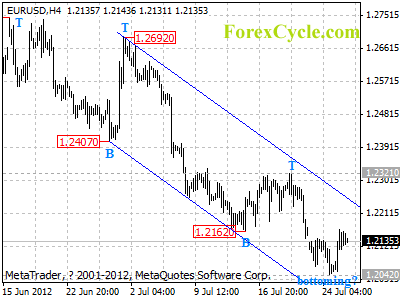
EURUSD may be forming a cycle bottom at 1.2042

EURUSD may be forming a cycle bottom at 1.2042 on 4-hour chart, further rise to test the resistance of the upper line of the downward price channel on 4-hour chart would likely be seen. As long as the channel resistance holds, the bounce from 1.2042 is treated as consolidation of the downtrend from 1.2747 (Jun 18 high), and another fall towards 1.1876 (2010 low) is still possible after consolidation. On the upside, a clear break above the channel resistance will indicate that the fall from 1.2747 has completed at 1.2042 already, then the following upward movement could bring price back to 1.2400-1.2500 area.

eurusd

Forex Signals

New Zealand holds rate, less pessimistic about euro crises

By Central Bank News

    The Reserve Bank of New Zealand (RBNZ) held its benchmark Official Cash Rate (OCR) unchanged at 2.50 percent, as expected, and said inflation was expected to settle around its target in the medium term and the domestic economy was expected to expand modestly over the next few years.
    Although the RBNZ said the outlook for its trading partners, including the euro zone, remains poor, the central bank struck a more optimistic tone about the outlook than many other central banks.

    There remains a limited risk that conditions in the euro area deteriorate very significantly. The Bank continues to monitor the situation carefully given the potential for rapid change,” the bank said.

    The RBNZ has held its key rate steady at a record-low 2.50 percent since February 2011 and New Zealand’s inflation rate eased to 1.0 percent in the second quarter, down from 1.6 percent in the first quarter. The central bank targets inflation of 1-3 percent.

    “It remains appropriate for the OCR to be held at 2.5 percent,” the central bank said in a statement, quoting Governor Alan Bollard.
    “Underlying annual inflation, which recently moved below 2 percent, is expected to settle near the mid-point of the target range over the medium term,” he added.
    The bank said the economic outlook was consistent with its June monetary policy statement and reconstruction after the earthquakes was expected to boost the construction sector. This was offset by fiscal tightening and a firm exchange rate.
    www.CentralBankNews.info


How To Position Yourself For A 10 Year Pattern Breakout

By Chris Vermeulen, GoldAndOilGuy.com

As mentioned last Friday just before things took a dive on the weekend, a look at the major market indices did not look promising.  If we take an even longer term look and examine the monthly charts we can see that The S&P 500 as well as the Dow Jones have been approaching multi-decade rising channel resistance lines.  Further, they also appear to be forming bearish rising wedge patterns.


Monthly Long Term Chart Analysis & Thoughts:

Monthly SPX Index Trading

As many of my longer term subscribers can attest to, I always preach that technical analysis is one part  art and one part science:  you can never be completely certain on what the outcome of a pattern is going to be.  However, we can use historical analysis to make better investments. The great American Novelist Mark Twain probably said it best in that “history does not repeat itself, but it rhymes”.  Regarding a rising wedge pattern, we know that roughly two-thirds of the time they will break to the downside.  This also means that one-third of the time they break to the upside.

In accomplishing our goal of capital growth we must do a number of things.  We must make returns on our investments, we must protect our investments, and we must limit our losses.  While all three aspects work in tandem with each other, there are times when focus must be allocated to one specific approach.

Regarding the current technical setup, I’m not so focused on the 67% chance that these wedges will break to the downside, but more so the impact of each outcome on the average Joe’s portfolio and mom and pop businesses.  The S&P 500 and the Dow are approaching long term resistance lines that have been in place for decades.  If we do break to the downside, which I suspect we will, there could be a very significant sell off with consequences that no one can predict at this point though I mention some things in the chart above.  Alternatively, there is significant overhead resistance in the various indices, and I don’t believe an upside break would be too monumental.

That being said, I always like to keep an open outlook and wait for the right opportunity.  I’m trying to think of scenarios that would prelude further upside action and I really am not coming up with much.  As evidenced by the completion of the recent 5 wave uptrend on the S&P that coincided nicely with the various quantitative easing policies, Ben Bernanke and the fed have had less and less impact.  I truly can’t see many fiscal developments that would prompt any significant bullish action.

The only scenario I really think that could pump up equities is a series of positive earnings announcements.  A lot of expectations, earnings numbers, guidance, etc… have been revised downwards over the last couple of quarters, so there is the opportunity for some positive surprises that could lead to some bullish price action.  In absence of such a scenario, I really can’t think of much else that would prompt a run up.

Look at these charts of positive and negative earnings surprises… and the dates and remember what happened following this negative data….


Positive Earnings Surprise

Earnings Positive Surprises


Negative Earnings Surprise

Earning Negative Surprises

That being said, I am recommending two courses of action.  For those steadfast bulls, lock in some profits and/or buy some protection.  Missing out on some of the upside is a lot better than losing some of the gains you have fought so hard for over the past couple of years.  For the more aggressive traders and investors, start following my updates a little more regularly as I foresee many shorting opportunities coming up in the future.  As many of you know, sell-offs are often quick and abrupt, and timing is extremely important when playing the downside.

Further, trading could get very volatile in the near future.  Historically, and even more so looking forward as August and September have been very costly for the average investor.  Our focus will be in taking the highest probability trades that offer the best risk to reward scenarios.  There will be times when we miss trades, and times when they’re not timed perfectly.  But, as those who have been with me for a while can attest to, patience pays off in the long run…

Join my Free Market Analysis & Trade Idea Newsletter Now: GoldAndOilGuy.com

Chris Vermeulen


Forex Daily review- 25.07.2012

Forex Daily review brought to you by REAL FOREX | ECN Broker | www.Real-forex.com


Tracking the EUR/USD pair


Date: 24.07.2012   Time: 16:02  Rate: 1.2078
Daily chart
Last Review
As it is possible to see, the price could not breach the 1.2290 resistance level and descended to complete the “One in, one out” pattern target by reaching the 1.2122 price level. The price is moving now around this level while at the moment it is used as a balance point. It is possible to assume that breaking the 1.2067 price level will continue the downtrend towards the weekly chart target around the 1.1900 price level. on the other hand, establishment of the price at the current area and breaching the 1.2290 price level will indicate that we are headed towards a Fibonacci correction in size of between a third and two thirds of the down trend which started at the 1.2692 price level.
Current review for today
As it was written in yesterday’s review, breaking of the 1.2067 price level will probably continue the downtrend towards the 1.1877 price level, this is a level which was given in the weekly chart review and is used as the “Head and shoulders” pattern target. On the other hand, breaching of the 1.2122 price level and its establishment above it will probably lead the price to a ranging period between this level and the 1.2290 price level.
You can see the chart below:
eur/usd
 
4 Hour chart
Date: 24.07.2012   Time: 16:10  Rate: 1.2077
Last Review
It is clearly possible to say that the price has reached the “Wolfe waves” pattern target by reaching the line connecting points 1 and 4. Now it is possible that the price will perform an ascending move to check the 1.2167 price level, which is used as a support level and it is possible that will be checked by the price as a resistance as well. Breaking of the 1.2067 price level will probably continue the downtrend towards the 1.1900 level area. On the other hand, breaching of the 1.2167 price level will indicate that it is possible we will see the price checking the 1.2250 price level again.
Current review for today
The price is still holding at the last low at the 1.2067 price level while its breaking will probably continue the downtrend towards the daily chart review around the 1.1900 price level. On the other hand, breaching of the 1.2167 price level will probably lead the price to the next resistance on the 1.2250 price level.
You can see the chart below:
eur/usd
GBP/USD
 
Date: 24.07.2012   Time: 16:13  Rate: 1.5518
4 Hour chart
Last Review
The price has reached under the 1.5517 price level, but it happened by a continuous downtrend without making a correction. Now the price is checking whether this level can change its function from a support to resistance, while breaking the 1.5485 price level will sign the continuation of the downtrend towards the 1.5400 price level. On the other hand, stoppage of the price at the current area will indicate that it is possible to see a Fibonacci correction in size of between a third and two thirds of the downtrend which started at the 1.5740 price level.
Current review for today
The price is still checking the 1.5517 price level while it moves from both sides and it is used as a balance point. Breaking of the 1.5485 price level will sign the continuation of the downtrend towards the 1.5400 price level. on the other hand, stoppage of the price at the current area will probably lead to a technical correction in size of between a third and two thirds of the downtrend which started from the 1.5740 price level.
You can see the chart below:
gbp/usd
AUD/USD
 
Date: 24.07.2012   Time: 16:56  Rate: 1.0287
4 Hour chart
Last Review
The price has corrected exactly 50% of the uptrend marked in blue broken line towards the 1.0270 price level and stopped at this area, at this point it is possible that the price will perform a correction in size of between a third and two thirds of the last downtrend which started at the 1.0444 price level. On the other hand, another breaking of the last low of the area at the 1.0240 price level will indicate that it is possible to see the price reaching the last low at the 1.0200 price level.
Current review for today
The price has corrected the last downtrend (red broken line) and from this point it is possible that we will see a breaking of the 1.0251 price level which will probably lead the price at first stage to the 1.0232 price level which is a 61.8% Fibonacci correction level of the uptrend marked in blue broken line, breaking this level will probably lead the price to the closest support on the 1.0202 price level. On the other hand, only breaching of the 1.0326 resistance level in a proven way might lead the price to check the last peak on the 1.0444 price level.
You can see the chart below:
aud/usd
Important announcements for today:
08.00 (GMT+1) EUR – German IFO Business Climate
Forex Daily review brought to you by REAL FOREX | ECN Broker | www.Real-forex.com

Central banks supply safe havens in volatile times – BIS

By Central Bank News

    Central banks in emerging markets tend to push down global bond yields, including those of  U.S. treasuries, when financial markets are calm, but when market volatility spikes the process goes into reverse as banks sell their safe assets, providing liquidity to jittery investors, according to a working paper from the Bank for International Settlements (BIS).
    Global bond yields decline because central banks in emerging markets respond to capital inflows into their countries by buying dollars against their own currencies to resist the upward pressure on the exchange rates. Those dollars are then invested in bonds from major reserve currencies,  reinforcing the market’s risk-on mode, wrote Robert McCauley, senior advisor at the Swiss-based BIS.
    “Thus, calm periods, marked by leveraged investing in emerging markets, lead to an asymmetric asset swap (risky emerging market assets against safe reserve currency assets) and leveraging up by emerging market central banks,” McCauley wrote, adding:
    “In declining and volatile global equity markets, these flows reverse, and, contrary to some claims, emerging market central banks draw down reserves substantially. In effect emerging market central banks then release safe assets from their reserves, supplying safe havens to global investors.”

    Click to read the BIS working paper: “Risk-on/risk-off, capital flows, leverage and safe assets”


www.CentralBankNews.info