Dollar Trades Low versus Euro Prior to US GDP Report

By TraderVox.com

Tradervox.com (Dublin) – The US dollar was near two-week low against the euro prior to a report expected to show that US economy expanded slowest in a year. Dollar’s demand was also clipped by the gains in global stock yesterday, which increased the demand for riskier assets. The dollar was also down as speculations of a third round of quantitative easing rose in the market. The euro strengthened for the third day against the dollar and the Japanese currency as European Central Bank President Mario Draghi indicated that the bank will do whatever is necessary to protect the euro.

Robert Rennie who is the Chief Currency Strategist in Sydney at Westpac Banking Corp indicated that the market might be headed for a short term risk-on period as there are signs of combined additional stimulus from the Fed and the ECB. The continued release of poor data from the US, has spurred speculations of QE3 while ECB council member has hinted that there are arguments in favor of giving ESM a banking license which would give it unlimited firepower to fight euro zone debt crisis. In addition, Draghi’s comment on commitment to fighting the euro crisis comes just a week after Fed Chairman Ben S. Bernanke indicated that the Fed is looking for ways to address weaknesses in the US economy.

The US Gross Domestic Product report, which shows the value of goods and services produced by the US, is projected to have expanded by 1.4 percent in the second quarter down from 1.9 expansion in the first quarter of the year. The dollar closed the day yesterday in New York at $1.2330 against the euro, which is the weakest it has been since July 10. It was trading at $1.2281 against the euro during the Tokyo trading session today. The dollar is set for a weekly drop against the euro as it has fallen one percent this week. Against the yen, the greenback was little changed at 78.23 from 78.21 yen, it has fallen by 0.3 percent against the yen this week.

Disclaimer
Tradervox.com is not giving advice nor is qualified or licensed to provide financial advice. You must seek guidance from your personal advisors before acting on this information. While we try to ensure that all of the information provided on this website is kept up-to-date and accurate we accept no responsibility for any use made of the information provided. Opinions expressed at Tradervox.com are those of the individual authors and do not necessarily represent the opinion of Tradervox.com or its management. 

Article provided by TraderVox.com
Tradervox.com is a Forex News Portal that provides real-time news and analysis relating to the Currency Markets.
News and analysis are produced throughout the day by our in-house staff.
Follow us on twitter: www.twitter.com/tradervox

Canadian Dollar advances on Draghi Remarks

By TraderVox.com

Tradervox.com (Dublin) – The Canadian dollar climbed to its strongest in more than two months against the greenback after the European Central Bank president Mario Draghi indicated that the central bank would do everything possible to protect the euro, sparking demand for riskier assets. Further, the increase came as world commodities including stocks and crude oil prices increased. The Canadian dollar is set to record a weekly gain against the US dollar this week.

The market has been moved by Draghi’s comment today, which is something Ravi Bharadwaj, a market analyst in Washington at Western Union Business Solution noted in an interview today. He also added that the risk appetite, which is propelling the Canadian dollar, may recede if the ECB fails to back up Draghi’s comments. The Canadian dollar also moved up as the Standard & poor’s 500 Index advanced to by 1.7 percent while crude oil for September delivery increased by the same margin to settle at $90.47 per barrel in New York. Stocks and crude oil are some of the commodities related to the Canadian dollar. Crude oil is Canada’s largest export commodity to the US.

However, as the Canadian dollar was increasing, the Government bonds dropped for a second day, while the ten-year yields increased by six basis points to 1.65 percent. The Canadian dollar, which has risen by 2 percent this year, strengthened past the 50-, 100-, and 200-day moving averages leading to option traders paying less for the protection against the currency declines versus the US counterpart. In analyzing the currency movements, Jeremy Stretch who is the Chief Currency Strategist in London at Canadian Imperial Bank of Commerce, noted that the 100-moving average of C$1.0087 has been a significant level to the market than the 200-day moving average.

The Canadian dollar increased by 0.9 percent against the dollar to trade at C$1.0102 at the close of trading yesterday in Toronto, which is its strongest since May 16.

Disclaimer
Tradervox.com is not giving advice nor is qualified or licensed to provide financial advice. You must seek guidance from your personal advisors before acting on this information. While we try to ensure that all of the information provided on this website is kept up-to-date and accurate we accept no responsibility for any use made of the information provided. Opinions expressed at Tradervox.com are those of the individual authors and do not necessarily represent the opinion of Tradervox.com or its management. 

Article provided by TraderVox.com
Tradervox.com is a Forex News Portal that provides real-time news and analysis relating to the Currency Markets.
News and analysis are produced throughout the day by our in-house staff.
Follow us on twitter: www.twitter.com/tradervox

Gold and Silver: The Un-deletable Assets

By MoneyMorning.com.au

‘When at the summit of his power, he [King Canute] ordered a seat to be placed for him on the sea-shore when the tide was coming in; thus seated, he shouted to the flowing sea, “Thou, too, art subject to my command, as the Iwid on which I am seated is mine; and no one has ever resisted my commands with impunity. I command you, then, not to flow over my land, nor presume to wet the feet and the robe of your lord.” The tide, however, continuing to rise as usual, dashed over his feet and legs without respect to his royal person. Then the king leaped backwards, saying: “Let all men know how empty and worthless is the power of kings, for there is none worthy of the name, but He whom heaven, earth, and the sea obey by eternal laws.”‘ – The Chronicle, Henry of Huntingdon, 13th century

The acts of central bank interest rate manipulation and government central planning are like King Canute trying to hold back the tide.

The difference is that Canute knew it was impossible for one man — however powerful — to influence the tide. So he showed his toadying bureaucrats that he was only human and not a God.

The central bankers and politicians wouldn’t dare do the same. For a start, they aren’t as humble. They believe they can turn back the tide. That all they have to do is change the interest rate, raise a tax and subsidise an industry…and hey presto! The economy booms.

Only it doesn’t, because there’s no turning back the natural law of the free market. The free market goes where the components of the market (individuals) want it to go…and that’s in millions of different directions…

That’s what the bureaucrats and central planners can’t handle. When you’ve got millions of people making decisions in their own lives, it makes it hard for the central planner to gain power and grant favours to their buddies.

The only way they can resolve this is to pass laws that force individuals to act in a certain way…and use the threat of violence to ensure individuals comply.

Unfortunately, there seems to be no limit to what the politicians will do to hang on to power and spend your money. Overnight, the European Central Bank (ECB) president, Mario Draghi said:

‘Within our mandate, the ECB is ready to do whatever it takes to preserve the euro. And believe me, it will be enough.’

In other words, the ECB will turn back the tide. We’ll watch how that works out with interest.

Protect Your Savings Now

But it’s not just overseas where politicians and bureaucrats are harming and taking personal wealth. This week we received the following email from the Australian Treasury:

‘The exposure draft for the transfer of State and Territory unclaimed superannuation to the Commonwealth regulations and the accompanying explanatory materials has been released for public consultation…[This] will allow prescribed public sector superannuation schemes to pay unclaimed superannuation money to the Australian Taxation Office (ATO).’

We first warned you over three years ago about the threat the government posed to your retirement savings.

We told you the expropriation of retirement savings would happen in stages. Of course, as with our call warning of a housing crash and the fragility of the world economy, our critics ridiculed us.

But slowly, as time passes, once again we’re being proven right. This time the government is even taking money from its ‘own people’ – public sector workers.

Of course, we’ve less sympathy for public sector employees than private sector employees. But what concerns us more is that this is simply the next step on the government’s path to take all private wealth.

Not that the government sees this as theft. Naturally, when the government does anything, it’s always spun as a benefit to the people. In this case, the government authorising the tax office to take personal savings will…

‘…improve the administration of superannuation by facilitating the transfer of various unclaimed monies to the ATO.’

[Clap, clap, clap…]

Very clever.

But as we say, this is only the beginning.

It’s set to get worse.

The ultimate government aim is to take all private wealth, whether directly (taxes) or indirectly (inflation), and then fob the rightful owners off with a piddly little government pension.

As much as we’re not fans of the big banks and their investment performance, we know for sure private investments are a far better bet than anything the government will give you.

That’s why it’s important you take steps to plan for your retirement now…and preserve your wealth outside the financial system

Gold and Silver:
The Assets The Government Can’t Delete

The best way to do that is with gold and silver.

The fact is gold remains the best way to protect your wealth against government tyranny.

Bank savings, shares and other securities, are all electronically traded. The government can freeze these assets at the flick of a switch. And if it wants to, delete and expropriate them.

The government can close the banks and shut down the stock exchange.

But gold and silver are physical and tangible assets.

It’s not easy for the government to close down the gold and silver markets, because anyone with any sense will hold physical gold and silver. The government can’t delete your gold.

Of course, cash in your hand (or under the mattress) is a physical asset too. But unlike gold, cash only has a value as long as the government allows it to have value.

You can hoard as much cash as you like, but if the government decides to withdraw or cancel the currency from circulation, your hoarded paper dollars will be worth no more than any other piece of paper.

So holding physical assets like gold and silver is important for anyone who’s serious about protecting their wealth from government meddling.

How much you own is up to you. We’ve heard of some people who have more than 90% of their wealth in gold and silver.

But we’d suggest at least 5-10% of your wealth in gold and silver…more if you’re really serious, and worried about the threat of government meddling with your wealth.

It’s important to hold a portion of your wealth outside the financial system. Banks worldwide are under immense financial pressure due to the fragility of the banking system (Australian banks included).

And governments are struggling to pay for the Welfare State benefits they’ve promised to generations of people. As governments don’t generate their own revenues and profits, their only funding sources are debt and taxes.

Both are close to reaching saturation point. The market can’t handle much more debt and taxes are already oppressively high. That’s why governments are looking towards a third source — expropriation of private wealth.

Gold and Silver Will Prevail
Where Paper Money Will Fail

That’s why it’s important to act now and seek out ways to protect your wealth. But where do you start?

Our advice is to start with Dr. Alex Cowie’s May 2011 issue of Diggers & Drillers. In that issue he set out in detail how to buy gold and silver, and how to store it safely.

It’s a must read if you’re serious about protecting your wealth. In fact, that one issue alone is worth the subscription fee.

When the ECB president admits he’ll do everything it takes to protect the institution of paper currencies, it tells you the destruction of the euro (and eventually paper currencies) is certain.

When that happens, there will only be two ways to protect your wealth, and they are gold and silver.

Cheers,
Kris

Related Articles

Market Pullback Exposes Five Stocks to Buy

Why You Should Stick With Gold Through the Eurozone Crisis

China’s Big Move Could be a Game-Changer for Gold


Gold and Silver: The Un-deletable Assets

Get Ready to Pin Back Your Ears With Gold Stocks

By MoneyMorning.com.au

Being a long-standing gold bull, I get at least a dozen gold research reports in my inbox every week.

Every now and then, you get one that warrants special attention.

The annual Erste Bank gold report is in this category.

It is a long read at 120 pages or so, but is written in plain English by Ronald Stoeferle, who has been picking the big trends for gold very well for the 6 years he has been doing this report. There are also enough charts in there to keep chart-nerds like myself busy for weeks.

This report comes at a good time. It gives good cause to hang on, just as gold stock investors are reaching ‘the point of maximum despair’ after more than 12 months of terrible performance.

Gold stocks have been crunched by disappearing margins thanks to rising production costs and falling gold prices.

Gold to Rally?

But some relief may not be far away. Although we are in a seasonally slow period for gold due to the Indian monsoon season, this could end as soon as next month. As Ronni argues:

‘The foundation for new all-time-highs is in place. As far as sentiment is concerned, we definitely see no euphoria with respect to gold. Skepticism, fear, and panic are never the final stop of a bull market. In the short run, seasonality seems to argue in favor of a continued sideways movement, but from August onwards gold should enter its seasonally best phase. USD 2,000 is our next 12M price target. We believe that the parabolic trend phase is still ahead of us, and that our long-term price target of USD 2,300/ounce could be on the conservative side.’

That’s great for gold bullion holders, but what does this mean for gold shares? These make up a large proportion of the Diggers and Drillers tips, from low-cost, dividend paying, growing producers, to an extremely undervalued, near-term producer and an advanced explorer.

‘We believe that the gold mining sector has a solid base. Although the pessimism is about as profound as four years ago, the fundamental shape of the gold industry is substantially healthier today than it was back then. Strong balance sheets, high free cash flows, a substantial increase in margins, low debt levels, and rising dividends all speak in favour of the sector. There are also only few sectors that are more underweighted by investors. In addition, it seems as if the industry has reassessed its former “growth at any cost” approach and is heading towards increasing shareholder value.

We believe that solid mining shares in politically stable regions currently represent a high-leverage bet on the gold price, with an attractive risk/return profile. We therefore believe that the current, historically low valuations offer a good opportunity to invest. At this point, we wish to point out again that we regard gold as a currency and thus as a form of saving, whereas we regard gold shares as a form of investment.’

The report includes a chart I’ve not seen before — not showing the data over such a long time frame anyway.

This chart shows 40 years of the valuation of the world goldmining index relative to the gold price.

Gold Stocks — So Cheap They Are Back to 1989 Valuations!

Source: Erste Bank

Gold stocks are back to GFC valuations. Or putting it another way, they are back to valuations last seen in 1989 — back when gold was $400 / ounce. Gold stocks would have to increase in value by 43% just to get back to the long term average. Yet they just keep falling.

This is obviously an unsustainable state of affairs.

Nothing stays this cheap forever.

Something has to give…but what?

Watch the Gold Miners

We need higher margins for gold stocks to command better prices. So either production costs fall (no chance), or the gold price rises (inevitable).

An interesting observation in this report was that there is good correlation between analysts revising their earnings projections for gold stocks, and turning points in the gold stock index. Analysts have been busy revising their gold stock profit projections down for 12 months now, and their bad news is slowing down. For the last 20 years, you can see this has signalled the start of the next leg up for gold stocks.

Gold Stocks (yellow) Tend to Rally After Long Periods of Analyst Downgrades (circled)

Source: Erste Bank

No one can say whether gold stocks will turn back up next week, next month, or next quarter. But the stage is definitively set for some real fireworks to happen, and soon.

The first chart above shows gold stock valuations over a 40 year period, but if you zoom in on what’s been happening the last few months, gold stocks may have finally found a floor.

This chart shows the HUI gold stocks index, which is a good representation of the whole sector. After falling for nearly a year, it has bounced from the current level a few times in recent months. This can be a good technical sign that the gold market has found its low point.

Gold Stocks – Finally Finished Selling Off?

Source: StockCharts

Everything seems to be pointing towards gold stocks facing better times ahead. I wrote to Diggers and Drillers subscribers yesterday to say:

‘I wouldn’t expect all gold stocks to start recovering overnight, but it is worth keeping an eye on gold stock indices over the next month or two — to see if they continue to at least hold their ground around this level.

If so, then I’d be buying good gold stocks with my ears pinned back!’

Watch this space!

Dr. Alex Cowie
Editor, Money Morning

From the Archives…

No Mr. President, Entrepreneurs Did Build That…
20-07-2012 – Kris Sayce

How an Interest Rate Rise Could Trigger a ‘Punch Bowl’ Rally
19-07-2012 – Kris Sayce

When the Going Gets Tough, Entrepreneurs Innovate
18-07-2012 – Kris Sayce

Is This Man the Ultimate Contrarian Indicator for Mining Shares?
17-07-2012 – Dr. Alex Cowie

How Gold Stocks Could Become Your Gilded Lifeboat
16-07-2012 – Dr. Alex Cowie


Get Ready to Pin Back Your Ears With Gold Stocks

Jim Chanos Says China’s Bad Debts Dwarf Greece and Spain’s

By MoneyMorning.com.au

Jim Chanos spies trouble ahead for China’s banks.

Veteran US investor Jim Chanos has a pretty impressive record of spotting – and profiting from – investment disasters in the making.

He is widely credited as the first person to short Enron, the seemingly solid US energy conglomerate that blew up spectacularly in 2002. He was also one of the first to spot the US housing bubble, which he began shorting in 2005.

And with the economic news coming out of China steadily deteriorating, it seems Chanos may have got another huge call right.

Chanos has been warning that the Chinese economy was due a crash for the last two years. At first, few people listened to him, especially when he admitted that he had never been to the country. But now, with even Chinese leaders admitting that growth will slow, Chanos’s view has become a lot more popular.

In one particularly infamous quote, Chanos said China looked like ‘Dubai times 1,000 – or worse,’ referring to the country’s real estate boom. Now that his take on that sector seems to be coming good, he’s delivered another pithy quote on the banking sector.

One of China’s main problems is ‘bad credit and credit extension that makes Greece and Spain look like child’s play’, Chanos said in recent interview with Opaleque TV. Too much money has been lent for construction projects in particular that will never make big enough returns to repay the original debt.

Chanos isn’t just negative about China’s macro-economic prospects. He is even more scathing about its companies. ‘When you get to the micro of individual companies, they look even worse. The accounting is horrible, they all seem to have negative cash-flow, non-collectable receivables… they all seem to not earn their cost of capital.’

But while this may not be good for China’s economy, it throws up lots of good investment opportunities for him, he says. Kynikos Associates – a hedge fund Chanos founded in 1985 – has short positions on several China-related stocks, which means he will profit if their value falls.

After starting out shorting ‘property companies, developers, cement companies, steel companies, as well as the original iron ore minors in Australia and Brazil’, he has added the Chinese banks too, because they are ‘the nexus for… all of this credit-driven investment.’

James McKeigue

Contributing Editor, Money Morning

Publisher’s Note: This article originally appeared in MoneyWeek (UK)

From the Archives…

No Mr. President, Entrepreneurs Did Build That…
20-07-2012 – Kris Sayce

How an Interest Rate Rise Could Trigger a ‘Punch Bowl’ Rally
19-07-2012 – Kris Sayce

When the Going Gets Tough, Entrepreneurs Innovate
18-07-2012 – Kris Sayce

Is This Man the Ultimate Contrarian Indicator for Mining Shares?
17-07-2012 – Dr. Alex Cowie

How Gold Stocks Could Become Your Gilded Lifeboat
16-07-2012 – Dr. Alex Cowie


Jim Chanos Says China’s Bad Debts Dwarf Greece and Spain’s

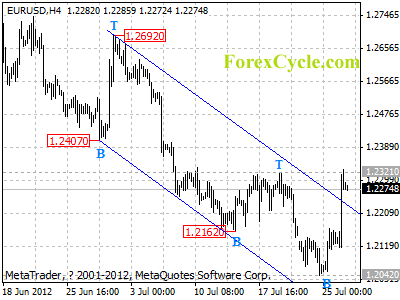
EURUSD breaks above channel resistance

EURUSD breaks above the resistance of the upper line of the price channel on 4-hour chart, suggesting that a cycle bottom has been formed at 1.2042, and the fall from 1.2747 (Jun 18 high) has completed. Further rally could be expected over the next several days, and the target would be at 1.2400-1.2500 area. Key support is at 1.2042, only break below this level could trigger another fall towards 1.1876 (2010 low).

eurusd

Daily Forex Forecast

Gold Bullion Prices Testing Important Level

By Chris Vermeulen, GoldAndOilGuy.com

The past 48 hours the stocks market has been on verge of a major meltdown in my opinion. The people with power who manipulate the markets are trying their hardest to hold prices up.

Yesterday we saw rumors about the Fed I the WSJ that they wanted to do more easing ASAP. That news could not have come at a better time as it saved the day/markets from more heavy selling. That news also helped prop gold bullion prices up.

Take a look at the 4 hour candle stick chart for a visual:

Buy Gold Bullion

Now look at what Mario Draghi’s comments have done with spot gold prices in the daily chart below:

Gold is not nearing key resistance but the recent move up has been on nothing but rumors and comments… nothing set in stone. This makes me think sellers will continue to control gold prices as we near resistance.

Purchase Gold Bullion


When gold does breakout of this pattern I expect we see $2300 level reached. A great safe place to buy gold which I own some is through BullionVault and the even give you a FREE GRAM OF GOLD just for taking the 4 minutes to open up an account!

Get my Trade Alerts & Analysis Here: GoldAndOilGuy.com

Chris Vermeulen


SP500, Russell 2K, Dollar Index and Gold’s – Fake out or Shakeout

By JW Jones, OptionsTradingSignals.com

Today has been quite a trading session with risk assets rocketing higher after Mario Draghi of the European Central Bank reiterated what has already been stated. The S&P 500 Index (SPX) is posting some nice gains, but price has not taken out the recent ascending trendline illustrated in the daily chart of SPX shown below. Until that ascending trendline is taken out, the bears remain in control of the price action.

S&P 500 Index (SPX) Daily Chart

SPX Index Chart

Today’s rally has certainly served to work off short term oversold conditions. With the first GDP estimate for the 2nd Quarter scheduled for tomorrow things could get interesting. In the meantime, the closing price today is key. My expectation is that we will not see the S&P 500 Index push back above the ascending trendline today. For the price action to flip back bullish, we need a much stronger than expected GDP result tomorrow.

Another key daily chart which helps provide support that the bears remain in control of the price action is the Russell 2000 Index (RUT). The RUT has given back roughly 50% of its entire move and at this point has failed to even regain the 200 period moving average on the daily chart. Price action would need to climb over 20 points to simply backtest the breakdown level illustrated below.

Russell 2000 Index (RUT) Daily Chart

IWM Index Chart

As long as the RUT holds below the key rising trendline, the bulls must be questioned. However, should the S&P 500 Index and the RUT push back above the ascending trendlines on their daily charts I will become much more constructive regarding the short to intermediate time frames for risk assets.

The other key chart of the day can be found no further than the U.S. Dollar Index futures. The U.S. Dollar Index futures absolutely collapsed today and move all the way down to test the 50 period moving average on the daily chart. So far, the short-term rising trendline has offered support along with the 50 period moving average and the Dollar has bounced sharply higher.

U.S. Dollar Index Futures Daily Chart

UUP Dollar Index Chart


As long as price holds above the short-term rising trendline, the Dollar will be able to continue to push higher from this level. Should a breakdown occur we have even more support below around the $81 price level. After a move this strong, it could take days and maybe even weeks for the Dollar to regain its footing. However, the forthcoming Federal Reserve announcement next week will likely seal the Dollar’s fate.

Gold and silver futures are both trading nicely higher on the session in light of the weaker Dollar. However, both precious metals have faded later today as the Dollar started to drift back to the upside. Gold and silver are trying to breakout, but we need to see some continuation before I intend to get involved.

Gold Futures Daily Chart

Gold Bullion Chart

Sometimes weak breakouts in price action can lead to ugly reversals. I’m not suggesting that a failed breakout will occur in gold and silver futures, but I remain cautious as the breakout so far does not have me totally convinced. Volume in silver is not spiking like it should be and gold volume is also weak considering the possibility that major breakouts are taking place.  Another element that is simply not confirming with strong price action or volume is the gold miners. On a day like today, all that they can muster is a relatively small gain on super light volume. Caution is warranted!

Oil futures are also not shooting considerably higher even though the Dollar remains under pressure. To me, today seems like it could be a misdirection day based on the price action and lack of volume we are seeing to the upside in hard assets like gold, silver, and oil. In addition, volume in the major equity indices and futures is super light. For now, I am going to remain cautious and will likely look to avoid taking on any major risk until the dust settles on the GDP number and the Fed’s future decision. Sometimes sitting in cash is not so bad afterall!

Simple ONE Trade Per Week Trading Strategy?
Join OptionsTradingSignals.com today with our 14 Day Trial

Jw Jones


NFA Tightens FCM and RFED Requirements

By forexindustryinsider.com

In a “technical amendment” notice made to the NFA’s Forex Requirements the NFA announced several new requirements for all FCMs/RFEDs operating in the US.  The NFA listed these as “minor amendements”, and while a couple of the changes minor, one is somewhat more substantial.

The full amendment reads:

Notice I-12-16

July 26, 2012

Effective Date of Technical Amendments to NFA’s Forex Requirements

NFA recently made several minor amendments to its forex requirements – amending NFA Financial Requirements Section 14 and the interpretive notice entitled Forex Transactions to conform the requirements to applicable CFTC Regulations and amending the interpretive notice related to bulk assignment and liquidation
to clarify the reporting responsibilities of assignor/transfer or FDMs
and assignee/transferee FDMs. These amendments, which are described more
fully below, do not impose any additional or new obligations on FDMs
and are effective immediately.

NFA Financial Requirements Section 14

NFA Financial Requirements Section 14 and CFTC Regulation 5.8(a)
require FCMs/RFEDs to calculate the amount owed to retail forex
customers and hold assets equal to or in excess of that amount in one or
more qualifying institutions. Currently, Section 14 requires the
calculation only with respect to U.S. customers while the CFTC
requirement applies to all retail forex customers. Therefore, NFA is
amending Section 14 to remove the reference to U.S. customers.

NFA’s Interpretive Notice entitled Forex Transactions

In September 2011, as required by the Dodd-Frank Act, the CFTC
implemented changes to its regulations to remove any references to
relying on credit ratings. To keep NFA’s requirements consistent with
the underlying rationale of the CFTC’s amendments, NFA is amending its
interpretive notice entitled Forex Transactions to remove
references to credit ratings as a factor NFA considers in determining
whether to approve an FDM’s affiliate or an unregulated person as a
person which the FDM may use to hold firm assets or to cover forex
transactions for purposes of calculating adjusted net capital.

NFA Interpretive Notice entitled NFA Compliance Rule 2-40: Procedures for Bulk Assignments or Liquidation of Forex Positions: Cessation of Customer Business

NFA is amending its interpretive notice on bulk assignments and
liquidation of forex positions to clarify that immediately after the
bulk assignment, liquidation or transfer, Assignee/Tranferee FDMs must
provide NFA with a list of affected accounts and the value of each
account as of the date of the transaction.

More information on this Interpretive Notice can be found in NFA’s March 8, 2012 Submission Letter to the CFTC. Questions concerning these amendments should be directed to Rachel Brandenburg, Manager, Compliance at [email protected] or 312-781-1472 or Sarah Walsh, Manager, Compliance at [email protected] or 312-781-1202.

Original text here
The first amendment to Section 14 of the NFA Financial Requirements should make clients sleep easier and will require brokers to hold not only a percentage of US clients’ funds in a qualifying bank but also a percentage of non-us clients’ assets as well.  Where a US RFED may have 400 US clients with a total of $4million on deposit, and 250 non-us clients with a total of $2 million on deposit the broker used to be required to keep between 10-40% of that $4million on deposit will not be required to keep between 10-40% of the entire $6 million on deposit.

All in all, the more funds a broker has in their bank, the safer they are from liquidation – That is unless your broker has been forging bank statements for the past 20 years.

Article by forexindustryinsider.com