Gordon Brown’s Bottom and Gold’s Double Bottom

By MoneyMorning.com.au

The 30th Olympics began in London this morning. Over 10,000 athletes will be competing for one thing…a gold medal.

Sadly, the gold medals handed out at the Olympics haven’t been solid gold since the Swedish held the event in 1912.

So how much is a gold medal worth? These days, not much. The gold medal hanging around an athlete’s neck will have a face value of $706.

No, we’re not missing any numbers. The low value of the medal is simply because of the minimal gold content. The International Olympic Committee mandates each gold medal have ‘at least’ 1.34% gold. And the host country decides if they want to add anymore.

In this case the Brits have decided to stick with the minimum amount. Not surprising, seeing as former UK Chancellor of the Exchequer (Treasurer), Gordon Brown, sold half of Britain’s gold from 1999-2002, at an average price of USD$275 an ounce…when gold was at a 20-year low. This event has become so infamous among gold bugs that it’s now called the ‘Brown Bottom’!

But anyway, the remainder of the winner’s prize is made of 92.5% silver and about 6.16% copper.

Meaning the 400 gram medal contains a tiny 5.3 grams of gold.

Time to Buy Gold Stocks

Yep, our athletes are working their hardest for just one fifth of an ounce.

However, all the work and effort for 5.3 grams of gold hardly seems worth it. And so, rather than training five hours a day in a swimming pool or running round an athletic track, we’ve found a better way to get access to the precious metal.

Adding a few gold shares to your portfolio.

We know, right now it doesn’t look good for precious metal mining stocks.

Take the Junior Gold Miners ETF [NYSE: GDXJ] for example, down 22% this year. And the HUI Index [NYSE: HUI] has lost 20%.

As a result, holders of gold mining shares have had a rough ride. And according to Dr Alex Cowie, editor of Diggers & Drillers, there’s one reason for that:


‘Gold stocks have been crunched by disappearing margins thanks to rising production costs and falling gold prices.’

But the crunch may be over for shareholders.


‘Interest in gold stocks is picking up again,’
said Alex, ‘and could be about to start a long and overdue rally.’

As Alex pointed out to his subscribers recently, we ‘…are in a traditionally slow period for gold due to the Indian monsoon season…this could end as soon as next month.’

And the Erste Bank Gold report claims the same thing. However, it also adds a price target for gold over the next twelve months:


The foundation for new all-time highs is in place. As far as sentiment is concerned, we definitely see no euphoria with respect to gold… In the short run, seasonality seems to argue in favour of a continued sideways movement, but from August onwards gold should enter its seasonally best phase. USD 2,000 is our next 12M price target. We believe that the parabolic trend phase is still ahead of us, and that our long-term price target of USD 2,300/ounce could be on the conservative side.’

This is the good news investors needed to hear, says Alex. ‘This report comes at a good time. It gives good cause to hang on, just as gold stock investors are reaching ‘the point of maximum despair’ after more than 12 months of terrible performance.’

However, one bullish report does not cause a bull rally.

But there’s been a turnaround in a key gold bugs indicator to suggest one might be about to happen. This could be the next leg up for the gold price.

And the HUI Index may be presenting you with the perfect buying opportunity.

Also known as the ‘Amex Gold Bugs Index’, the last couple of trading days shows a potential ‘double bottom’ forming.

This is a technical term that simply describes the price dropping, then rebounding. Often followed by a decline to either the same or similar level. And then finally, one more rebound. Think of a double bottom as looking like a ‘W’.

When these double bottoms happen, it often hints the start of a new rally.

HUI Index: Is a Double Bottom Happening?

HUI Index
Click here to enlarge

Source: StockCharts


Part of the reason gold bugs use the HUI is because it’s made up of 18 gold related mining stocks, with short term hedging. The constituents all hedge their gold production within 18 months.

Because of this short term outlook, the HUI is useful in spotting short term movements of the gold prices.

And any spike in the gold price should lead to higher prices for gold stocks. Alex says:


‘Gold and silver stocks should and traditionally do outperform gold and silver as metals. That’s because, when gold and silver prices rise, the companies that mine it see an increase in revenue without an increase in costs.’

If this double bottom pans out, it will present a great buying opportunity for gold stocks, and Alex is ready to take advantage of it. He has five gold stocks on his watch list that he considers ‘highly undervalued‘ and any spike in the gold price could see some serious gains for stock holders.

To find out more on why Alex is backing gold stocks, click here.

Shae Smith
Money Weekend

The Most Important Story This Week…

The ongoing financial crisis is hiding the fact that there is another serious problem developing in the world – in food. High food prices sparked riots around the world in 2008 and were also a major reason for the “Arab Spring”. This year the drought in the USA has caused huge spikes in the cost of wheat and corn.

These are symptoms of the growing shortages in supplies in the face of growing demand as the world population rises. Savvy investors are waking up to a huge trend – food production needs to rise in a big way. That means investigating opportunities in agriculture. One of these opportunities is fertilizers that increase crop yields and the companies who produce them. Resource expert Dr. Alex Cowie explains more in Why Potash Stocks Are Set to Gain From a Global Food Warning.

Other Recent Highlights…

Kris Sayce on Don’t Believe ‘the Bull’ on Australian House Prices: “But indebted housing investors needn’t worry – if they believe BIS Shrapnel and academics at two Aussie universities – because help is on the way. In what form? Trains and the end of the resources boom! To find out the latest excuses used to justify a housing boom, read on…”

Dan Denning on The End of Growth Through Currency Wars: “This is just the beginning. If the currency war moves from interest rates and monetary and fiscal policy to cyber weapons, price manipulation and an attack on the financial architecture of the modern world, then a threat exists that is neither fully understood nor appreciated. So what can and should you about this emerging threat?”

Shah Gilani on The Real Villain Behind the Curtain in the LIBOR Scandal: “There’s nothing like pulling back the curtain on the fraud that’s centre stage in the LIBOR manipulation scandal and finding the levers are really being pulled by central banks. It’s not about the banks doing what they did. The revelation is this: Central banks are the biggest impediment to free markets and the reason capital markets have become casinos.”

Dr. Alex Cowie on Get Ready to Pin Back Your Ears With Gold Stocks: “Gold stocks are back to GFC valuations. Or putting it another way, they are back to valuations last seen in 1989 – back when gold was $400 / ounce…Yet they just keep falling. This is obviously an unsustainable state of affairs. Nothing stays this cheap forever. Something has to give…but what?”


Gordon Brown’s Bottom and Gold’s Double Bottom

How You Could Profit Profit From Cheap Natural Gas Prices

By MoneyMorning.com.au

‘The future of manufacturing is in America, not China,’ declared Vivek Wadhwa in Foreign Policy magazine.

Wadhwa argues that technology is going to save the US. In fact, ‘technical advances will soon lead to the same hollowing out of China’s manufacturing industry that they have to US industry over the past two decades.’

Robotics is the first saviour. It’ll soon be cheaper to build and install robots than to use human labour. As Wadhwa notes, Taiwan-based Foxcomm plans to install one million robots in the next three years. ‘It has found even low-cost Chinese labour to be too expensive and demanding.’

Meanwhile, advances in artificial intelligence, and 3D printing, will enable non-experts to design and personalise products, then “print” them off at home or at local manufacturing hubs.

Combine all this with the magic of ‘America’s ability to innovate’, and the US will be a world leader in manufacturing within the next decade.

It’s all very exciting stuff. But there’s another big trend with the potential to drive all this that Wadhwa doesn’t address. And it’s one you can profit from right now…

Futuristic Technology is Very Exciting, but Cheap Natural Gas is More Important

Robotics, artificial intelligence and 3D printing are all fascinating topics. And we think there are ways to profit from all of these futuristic technologies.

However, while the idea of localised factories driving a creative manufacturing renaissance in the States is attractive, we think there’s a far more down-to-earth reason for companies to do more business in the US.

It all boils down to the shale gas revolution.

In short, at the start of this century, the US was looking at becoming a natural gas importer. Now, thanks to the opening up of shale gas fields, some believe the country has nearly a century’s worth of gas supplies. It’s now looking at exporting the surplus, rather than being forced to import new supplies.

As a result, natural gas prices have plunged. That’s meant big shifts in the US energy mix. Gas now provides nearly a quarter of America’s electricity, up from a fifth in 2006.

Meanwhile, use of coal has dropped. Indeed, as The Economist points out, America’s greenhouse gas emissions have fallen by 450 million tonnes over the past five years, ‘the biggest anywhere in the world.’

Last year, accountancy group PricewaterhouseCoopers argued that by 2025, ‘the manufacturing sector could save $11.5bn in energy costs.’ The group suggested that as many as a million new US manufacturing jobs could result from cheap gas.

Among the biggest beneficiaries are chemicals companies. Why? Because, as The Economist notes, they use gas ‘to make chemicals such as methanol and ammonia, a vital ingredient of fertiliser.’

As a result, petrochemicals have remained cheap, ‘even as oil prices have peaked’. In turn, cheap petrochemicals mean lower costs for all the other businesses who use them, from car manufacturers to agriculture companies.

So you can see that there’s a virtuous circle going on here. The cheap natural gas gives rise to both cheaper energy and cheaper raw materials. As PwC point out, you also have added demand for manufacturers to build products for the gas extraction industries.

Can You Profit From Natural Gas?

This is where it gets more complicated. Cheap natural gas is great news for energy users. But it’s not so good for natural gas producers. An inevitable result of natural gas falling in price as far as it has is that it becomes less attractive to keep looking for it.

Indeed, the number of rigs drilling for natural gas is near a 13-year low, according to oil services firm Baker Hughes. So far this has had little impact on prices, as it will take a while for gas output to be affected, mainly because natural gas is still being produced as a by-product of oil wells.

But in the longer run, if prices don’t support production at economic levels, then production will simply have to fall until prices pick up. This suggests that the natural producers who can survive the hard times might be in the best position to profit when natural gas prices recover.

John Stepek
Contributing Editor, Money Morning

Publisher’s Note: This article originally appeared in MoneyWeek (UK)

From the Archives…

No Mr. President, Entrepreneurs Did Build That…
20-07-2012 – Kris Sayce

How an Interest Rate Rise Could Trigger a ‘Punch Bowl’ Rally
19-07-2012 – Kris Sayce

When the Going Gets Tough, Entrepreneurs Innovate
18-07-2012 – Kris Sayce

Is This Man the Ultimate Contrarian Indicator for Mining Shares?
17-07-2012 – Dr. Alex Cowie

How Gold Stocks Could Become Your Gilded Lifeboat
16-07-2012 – Dr. Alex Cowie


How You Could Profit Profit From Cheap Natural Gas Prices

Market Review 30.7.12

Source: ForexYard

printprofile

The euro took losses during the overnight session, but managed to remain well above its recent lows against the US dollar and Japanese yen. Expectations that the European Central Bank will act to lower Spanish and Italian borrowing costs on Thursday have helped boost the common-currency in recent days. Crude oil and gold remain elevated as well, as risk taking has returned to the marketplace.

Main News for Today

Italian 10-Year Bond Auction
• The main reason behind the euro’s bearish trend last month was rising borrowing costs in Spain and Italy
• If today’s news signals that demand for Italian bonds is low or that borrowing costs have gone up, the euro could reverse some of its recent gains during afternoon trading

Read more forex news on our forex blog

Forex Market Analysis provided by ForexYard.

© 2006 by FxYard Ltd

Disclaimer: Trading Foreign Exchange carries a high level of risk and may not be suitable for all investors. There is a possibility that you could sustain a loss of all of your investment and therefore you should not invest money that you cannot afford to lose. You should be aware of all the risks associated with Foreign Exchange trading.

How No ‘Plan B’ For The Australian Economy Could Boost Aussie Stocks

By MoneyMorning.com.au

Over the weekend, Great Britain missed out on what some thought was a certain gold medal for champion cyclist, Mark Cavendish.

After Bradley Wiggins won the Tour de France, victory for Britain seemed certain.

It wasn’t to be. Cavendish came in a lowly 29th.

So how did it all go so terribly wrong for Cavendish before his home crowd?

Simple. Cavendish didn’t have a Plan B.

It’s a problem faced not just by British cyclists. In fact, the failure to have a Plan B is staring the Australian economy square in the chops today.

And it’s a failure that could have a startling impact on the economy and financial markets. Here’s why…

We’ll get back to Plan B shortly. But first, in a speech last week to the Anika Foundation Lunch, Reserve Bank of Australia governor, Glenn Stevens signalled he sees no limit to what it can do to prop-up the Australian economy:

‘We might find that, in an extreme case, the Reserve Bank — along with other central banks — would need to step in with domestic currency liquidity, in lieu of market funding. The vulnerability to this possibility is less than it was four years ago; our capacity to respond is undiminished and, if not actually unlimited, is not subject to any limit that seems likely to bind.’

That, we dare say, includes ramping up the printing presses. And when central banks do that, there are two assets you want to own to help you profit from money printing: gold and…shares.

The following chart shows you the performance of five key assets since the market bottomed in March 2009:

Source: Google Finance

The green line is the gold price. The yellow line is the U.S. S&P 500 index. The blue line is the U.K. FTSE 100 index. And the red line is the Aussie S&P/ASX 200 index.

Oh, and the purple line. The line that shows a 30% gain since 2009 is the Aussie gold price.

So for all the talk by the mainstream gold bears about gold being a terrible investment that doesn’t do anything, well, the breaking news is that it’s beating the Aussie stock market by three-and-a-half to one.

And for those same gold bears there’s no getting around it, the Aussie stock index is the worst performing out of the five assets.

But this chart means more than just the percentage gains shown. It shows you that a country that controls its own currency, in effect, can boost asset prices more effectively than those without this control.

Printing Stock Gains

Whether you’re in favour of money printing or not (we most certainly aren’t, for the reasons we’ve given many times, including the terrible inflationary impact for those who don’t know how to protect themselves), the impact on asset prices is certain.

To show you what we mean, look at the following chart:

Source: Yahoo! Finance

It’s a bit jumbled, but we’ll try to explain it. As we see it, stocks are in three groups.

In the top group you’ve got the U.S., U.K., and German markets. The U.S. and U.K. central banks have printed money like it’s going out of fashion.

The German economy has benefited from this as it has exported its manufactured goods and services to these economies.

Plus Germany has for a long time been the strongest economy in Europe.

The middle group contains Australia (gold line). Australia hasn’t yet needed the RBA to print oodles of new money. Mainly because exports to China have kept money flowing into the economy.

But it still hasn’t been perfect for the Australian economy. While the resources sector has boomed, the rest of the economy has struggled. This morning’s news that Ford Australia will likely close its local car-making business comes barely a few months after the Aussie government fed it a multimillion dollar taxpayer funded bailout.

And it’s hot on the heels of a number of high profile business collapses.

Then you’ve got the bottom group. This includes economies in the euro such as France and Spain that could do with more money printing (again, we’re not saying we believe in money printing, we’re just saying that in the short-term at least, it does have a positive impact on stock prices).

And as we reported last week, the bottom-dwelling euro nations may get what they wish for. European Central Bank president, Mario Draghi has vowed to do whatever it takes to make sure the euro doesn’t fail.

That can only mean more central bank stimulus.

It helps explain Friday’s 3.9% rise for the Spanish IBEX index, and the 2.3% gain for the French CAC40 index.

But what about Australia? Right now, the idea of the RBA printing money seems unlikely. But it’s not completely off the table as the quote from Glenn Stevens above shows…

No Plan B for the Australian Economy

You can hardly pick up an Aussie paper without reading about how great things are here. Why the Australian economy is different to the Northern Hemisphere economies. And why we’ll muddle through even if things go a bit wrong.

But where’s the Australian economy’s Plan B? Plan A is to sell lots of stuff to China…lots of resources.

What if that plan doesn’t last as long as the mainstream hopes? Already Ken Henry’s claim that the resources boom would last until 2050 is looking a bit shaky.

So what happens next?

In the Olympic road race competition, Mark Cavendish’s problem was that his British team only had a Plan A. That was to hope none of their competitors would break away from the main group. So that when they approached the finish line after 260 km of racing, Cavendish could use his burst of speed to beat the rest.

It turns out everyone else figured that was Britain’s plan. So it wasn’t surprising that nearly 40 riders broke away from the group by the half-way point.

In bike racing it’s common for the main group to catch up with the breakaway group. But not in this case. The British team couldn’t rein them in because no-one else in the main group would help.

(Nearly every country was represented in the breakaway group, so if the riders in the main group helped to catch them, they knew that Cavendish would win, potentially robbing one of their own countryman of a win.)

In other words, Britain didn’t have a Plan B.

If Plan A didn’t work, there was nothing to fall back on. That’s the position Australian economy finds itself in now. There’s no Plan B for after the resources boom ends. That’s bad news for the Aussie economy in the long term.

But in the short term, if North America and Europe is anything to go by, it’s almost certain the RBA will follow the carefully laid out plan used by other central banks. That is, printing money.

As bad as the long-term economic and stock market consequences may be (look at Japan’s economy), in the short term we’ve seen that it can and does boost stock markets.

That’s why we don’t suggest you completely abandon the stock market.

The Aussie market has gotten a boost this morning from Europe’s potential money printing plan (up over 1% as we write). But when the inevitable happens and the RBA has to print in order to protect the Australian economy as the resources boom ends, you can be almost certain Aussie stocks will soar higher.

And when that happens, you don’t want to be left with a portfolio of no stocks.

Cheers,
Kris.

Related Articles

Market Pullback Exposes Five Stocks to Buy

Why You Should Stick With Gold Through the Eurozone Crisis

China’s Big Move Could be a Game-Changer for Gold


How No ‘Plan B’ For The Australian Economy Could Boost Aussie Stocks

Central Banks Are Buying Gold – Is This a Sign to Sell?

By MoneyMorning.com.au

Never, ever fall in love with an investment. No matter how much money it’s made you.

If you had bought technology stocks in the early 1990s, then by the end of the decade you’d have made a fortune – on paper. By that point, parting with those companies would have felt very painful. But if you had kept holding for just a little longer, you’d have seen your paper fortune evaporate.

The same thing happened with the property bubble in the early ’00s. Lots of erstwhile real estate barons ended up bankrupt.

So what about investing in gold? Since the start of the century, it’s been one of the best-performing assets on the planet. It’s made early investors a lot of money, and it’s an investment we’ve been very keen on.

But as anyone who bought in 1980 will know, while gold might be a good store of value over the very long run, it can endure some pretty awful bear markets too.

And while we think it’s worth having a portion of your portfolio in gold consistently as insurance, you don’t want to have the lion’s share of your wealth invested in it when the next down-cycle comes.

Gold’s suffered something of a lull in recent months. Combined with the fact that central banks – never great market timers – became net buyers last year for the first time in decades, it’s worth asking if their interest in the yellow metal is a sign to the rest of us to get out.

Central Bankers Have a Poor Investment Record

Central bankers have generally made a hash of managing the global economy. Rather than reining in over-exuberance during the bubble years, they fuelled it, by cutting interest rates at the first hint of any slowdown.

This knack for doing the wrong thing at the wrong time extends to their investment decisions too. As Ronald-Peter Stoeferle of Erste Group Research puts it in one of his recent mammoth reports on gold, ‘central banks tend to be civil servants with an extremely pro-cyclical investment behaviour’.

In other words, they’re very good at buying at the top and selling at the bottom. They are a classic “contrary indicator”. The obvious example is Britain’s decision to sell gold in 1999.

Clearly this was driven by then-chancellor Gordon Brown, so it’s not all down to the Bank of England. But in any case, the sale meant that the UK missed out on the gold bull of the next 13 years.

Indeed, the decision was so badly handled that it led to claims that Brown was acting to protect several major banks from a disastrous decision to short gold. GATA (the Gold Anti-Trust Action Committee) argue that this is still going on.

The LIBOR scandal means that we can’t rule anything out. However, for now the evidence points to cock-up rather than conspiracy. Indeed, at the time, The Economist called the BoE’s gold sale, ‘sensible portfolio diversification’.

Moreover, The Economist also pointed out that ‘Britain’s sales are not unusual; nor are the amounts particularly large. Canada, Belgium and the Netherlands have each sold more than the 415 tonnes Britain plans to dispose of.’ Even Switzerland began selling gold, a process that has led to their gold reserves falling by 60%.

In short, the BoE wasn’t the only central bank to get its gold timing badly wrong.

Which Central Banks
Have Been Piling into the Gold Market?

So that raises the question: should we be worried now that central banks are starting to buy gold again? As Stoeferle notes, net purchases in 2011 were the highest seen since 1964.

However, we’re not so sure we need to be worried yet. As Stoeferle points out, the majority of the gold has been bought by central banks in developing economies, such as Mexico, Russia and Turkey. At this stage, such central banks are generally just “catching up” with developed markets.

For example, troubled peripheral eurozone nations Portugal and Greece have 90% and 80% respectively of their central bank reserves in gold. The US isn’t far behind. China and Saudi Arabia, on the other hand, have less than 10% of reserves in gold.

“Compared with the industrialised nations, the majority of central banks in emerging nations remain clearly underweighted in gold.” That means they need more to hedge their huge exposure to the US dollar. It’s also worth noting that China and Russia have been net buyers in the last decade, so it’s not as though their behaviour has suddenly changed.

However, if developed economy central banks started buying gold again, that would be more worrying. Indeed, says Stoeferle, given the BoE’s track record, if it ‘were to announce purchases, we would… regard this as a warning signal for the gold price’.

The good news is that this hasn’t happened yet. And it may be some time before it does. Most developed-world central banks are more preoccupied with money printing and setting negative interest rates in order to inflate away some of their debt burdens. Given these policies, we think gold could see more significant gains before its time in the sun is over.

Matthew Partridge
Contributing Editor, Money Morning

Publisher’s Note: This article originally appeared in Money Morning (UK)

From the Archives…

Get Ready to Pin Back Your Ears With Gold Stocks
27-07-2012 – Dr. Alex Cowie

The Upcoming Interest Rates Shock You Should Prepare For
26-07-2012 – Kris Sayce

Don’t Believe ‘the Bull’ on Australian House Prices
25-07-2012 – Kris Sayce

Why the Melbourne Property Market Could Be Set For Two Years of Pain
24-07-2012 – Dr. Alex Cowie

The End of Growth Through Currency Wars
23-07-2012 – Dan Denning


Central Banks Are Buying Gold – Is This a Sign to Sell?

AUDUSD breaks above 1.0443 resistance

AUDUSD breaks above 1.0443 previous high resistance, and continues its upward movement from 0.9581 (Jun 1 low). Further rise could be expected over the next several days, and the target would be at the upper line of the price channel on 4-hour chart. Support is at 1.0400, only break below this level could signal completion of the short term uptrend from 1.0176.

audusd

Forex Signals

Monetary Policy Week in Review – July 28, 2012

By Central Bank News

     The past week in monetary policy saw interest rate decisions by nine central banks around the world, with two large emerging market central banks cutting rates, and the remaining seven banks keeping rates unchanged.
    Both the Colombian and the Philippine central banks that cut rates cited falling inflation that allowed them room to cut rates and help buffer the economy against lower global growth.
     Of note was the statement by the Reserve Bank of New Zealand, which struck a much-less pessimistic view of the euro area debt crises than most other observers, saying there was only a limited risk that conditions there would deteriorate significantly.
    LAST WEEK’S MONETARY POLICY DECISIONS:
  
COUNTRY
NEW RATE
OLD RATE
RATE 1 YR AGO
ISRAEL
2.25%
2.25%
3.25%
HUNGARY
7.00%
7.00%
6.00%
NIGERIA
12.00%
12.00%
8.75%
THAILAND
3.00%
3.00%
3.25%
NEW ZEALAND
2.50%
2.50%
2.50%
PHILIPPINES
3.75%
4.00%
4.50%
COLOMBIA
5.00%
5.25%
4.50%
EGYPT
9.25%
9.25%
8.50%
ZAMBIA
9.00%
9.00%
                N/A
   
    NEXT WEEK:
    Looking at the central bank calendar for next week, there is intense speculation that the European Central Bank (ECB) will follow up with measures to ease strains in sovereign bond markets following President Mario Draghi’s statement that the ECB would “do whatever it takes to preserve the euro,” within its mandate.
    Speculation about some form of coordinated central bank action – similar to the November 30, 2011 coordinated expansion in U.S. dollar swap arrangements to ease liquidity strains in markets – was stoked by news that U.S. Treasury Secretary Timothy Geitner would meet top European leaders, including Draghi, on Monday.
    A few days after that coordinated action, the ECB on December 8 launched its two longer-term refinancing operations (LTROs) that quickly eased strains in European debt markets.
    The U.S. Federal Reserve is also expected to expand its stimulus programme while neither the Bank of England or the Reserve Bank of India are expected to cut rates.
   
COUNTRY
MEETING DATE
OLD RATE
RATE 1 YR AGO
INDIA
31-Jul
8.00%
8.00%
UNITED STATES
1-Aug
0.25%
0.25%
UNITED KINGDOM
2-Aug
0.50%
0.50%
EURO ZONE
2-Aug
0.50%
1.50%
CZECH REPUBLIC
2-Aug
0.50%
0.75%
ROMANIA
2-Aug
5.25%
6.25%

Covered Call Options: Earning “Rent” on Your Shares

Article by Investment U

Most investors think that when they buy shares of a company, the only thing they can do is hold onto them in the hopes of generating a profit.

But in a volatile market environment like today, writing – or selling – covered call options are giving many shareholders the chance to generate even higher returns by “renting out” the shares they own to speculative investors in exchange for monthly income.

It sounds crazy, but it’s absolutely true. And today I’d like to show you exactly how it works.

Like Renting Out Real Estate

It may seem complicated at first, but writing a covered call option is like renting out a home with the option to buy.

The way these leases work, tenants agree to pay a certain amount of rent each month to a homeowner for a certain period of time.

At the end of that time period, the renter then has the option to buy the home from the property owner.

When you write a covered call option, you’re basically doing the same thing.

As the “share landlord” in this case, you already own the shares of the stock you’re “renting out.”

The buyer of the option would pay you a premium (or the rent) for the right to become the new owner of your shares if that stock hits, or rises above, a certain price (strike price) by a specified date (expiration date).

The concept is really that simple.

In fact, many investors today get their feet in the options market trading covered call options because, while there is risk involved, most of it comes from owning the stock – not selling the call.

Let’s look at a few examples. Just keep in mind though, one options contract represents 100 shares. So you’ll need at least that many to use this strategy.

Covered Call Scenario #1: Shares Become “in-the-Money”

If you’re really bullish on a stock for the in the short term, writing covered call options is probably not a good strategy.

That’s because if the stock price becomes “in-the-money” – that’s when shares rise above the strike price by the expiration date – your call option will be exercised and you’ll be obligated to sell each option, 100 shares per contract, to the buyer.

The bad news here is if the stock continues to climb higher, you’re going to miss out on any of the extra gains that come after shares hit the strike price.

However, on the bright side, you will still make a profit from the stock price rising. It just won’t be as much as if you simply held onto the shares from the very beginning.

Another plus, you’ll be able to keep the premium that the buyer paid you, which will add to your returns.

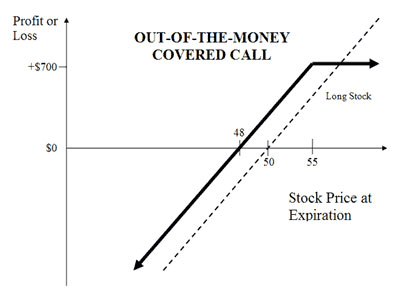
As you can see below, by writing the covered call (the bold line), you’re limiting the upside. As once the stock hits the strike price, the options buyer will likely exercise the option and take your shares. However, you get to keep the premiums and capital gains you collected up to that point.

Covered Calls: Earning “Rent” on Your Shares

(Source: www.theoptionsguide.com)

Of course, this is just one example.

Covered Call Scenario #2: Shares Go Down

Remember, when you write a covered call option, you have to own the shares of the company upfront.

That’s why, in this second scenario, two things will happen when the stock price goes down by the time your covered call option expires.

One, you’ll lose money because the value of the stock went down.

But number two, you’ll offset your losses somewhat because you get to keep the premium for selling the option.

Here’s where things can go really well though…

Covered Call Scenario #3: Shares Go Up, But Stay “Out-of-the-Money”

For covered call sellers, this is the ideal scenario.

That’s because the call option you sold will be “out-of-the-money” – that’s when the option expires worthless since the stock never actually hit the strike price – and, therefore, you won’t be obligated to let go of your shares.

An added benefit here is you’ll still make money from the price increase of the stock. In addition, you’ll also make extra money on the premium from selling the option.

It’s really a win-win-win situation.

Studies have even shown that the return on investment from writing covered call options of U.S. stocks typically ranges anywhere from 3% to 9% per month.

In today’s market environment, this basic options strategy may be a useful tool for investors – willing to take on some risk – to bump their returns even higher, without risking everything they have.

Good Investing,

Mike

P.S. As the seller, a general rule of thumb, think about 2% of the stock value as an acceptable premium to offer. You may also want to consider 30 to 45 days in the future as a good expiration date to start out with. Remember, with options, the further out in time you go, the harder it is to predict which direction a stock will head – but you’ll also be able to charge a higher premium because of the time-value of money.

P.P.S. Don’t forget to consult your broker and do your own additional research before writing covered call options. Also, check out The Investment U Bookstore for some great resources to get you started in the options market.

Article by Investment U

The Ultimate Investor’s Guide to the Dividend Payout Ratio

Article by Investment U

Now that my book Get Rich with Dividends is a bestseller, I’ve had a lot of requests to be interviewed by the media. And the first question the host always asks me when I mention a dividend-paying stock is, “What’s the yield?”

I don’t blame them. That’s usually the first thing most investors want to know. And it is important. If you’re going to achieve your financial goals by investing in dividend-paying stocks, you do need a decent yield.

But more important than the amount you’re getting paid is the likelihood that you’re going to get paid at all…

That’s where the dividend payout ratio comes in.

The payout ratio is the percentage of earnings that’s paid out in dividends.

For example, if a company has $100 million in earnings and pays out $50 million in dividends, the payout ratio is 50%. It pays out 50% of its earnings in dividends.

The payout ratio formula is simple:

Dividend Payout Ratio = Dividends paid/Net income

A Balancing Act

As an investor, you want to get paid as high a dividend as possible. However, as a long-term investor, you don’t want to get paid so much that the dividend is unsustainable.

For example, if a company paid out 100% of its earnings in dividends and the next year net income falls, the company may have to lower its dividend. That would likely send the stock price lower and disappoint shareholders who rely on the dividend for income.

But if last year, a company had $100 million in earnings and paid out $50 million in dividends, for a 50% payout ratio – and this year, earnings fall to $80 million, it could still pay out that $50 million in dividends (or even raise the dividend if the company chose to).

To ensure that the dividend is safe, I look for stocks that have a dividend payout ratio of 75% or lower.

Let’s look at an example from The Oxford Club’s Perpetual Income Portfolio.

Kimberly-Clark (NYSE: KMB) earned $1.8 billion in the last 12 months and paid out $1.1 billion in dividends for a payout ratio of 61%.

An investor can feel fairly confident that the dividend will be paid even if earnings fall since the company has only paid out 61% of its earnings in dividends.

Cash Flow is King

Now, that you understand the idea, let’s take it one step further. We’re going to use the same concept, but instead of using earnings to figure out the dividend payout ratio, we’re going to use cash flow from operations.

Cash flow from operations is a more accurate gauge of a company’s ability to pay dividends. You see, earnings have several non-cash figures in the formula. Things like depreciation, amortization and stock-based compensation are accounting tools that affect net income but don’t represent actual cash that the company is earning or paying out.

Cash flow from operations removes non-cash items and is a more accurate indicator of how much cash the company took in over the quarter or year.

The formula for the payout ratio is the same. Just substitute cash flow from operations for net income. [Note: “Dividends paid” and “cash flow from operations” are both located on a company’s “Statement of Cash Flows.”]

Dividend Payout Ratio (using cash flow) = Dividends paid/Cash flow from operations

Using the Kimberly-Clark example, cash flow from operations is $2.6 billion, dividends paid is $1.1 billion (same as above) and the payout ratio using cash flow 42%.

So you can see that Kimberly-Clark paid out just 42% of the cash it took in from operating its business, giving it plenty of room to grow the dividend (as it has for 40 years in a row), even if earnings and cash flow decrease.

How Safe is the Dividend?

Here’s another example of why you should look at cash flow rather than earnings when determining the safety of the dividend.

Over the past 12 months, Taiwan’s United Microelectronics (NYSE: UMC) earned NT$10.6 billion (NT$ = New Taiwan Dollar) and paid out NT$14 billion in dividends. That sounds unsustainable. The company is paying out over NT$3 billion more than it earned.

But when we look at its statement of cash flows, we see that cash flow from operations was NT$41.6 billion, in large part due to over NT$32 billion in depreciation and amortization (non-cash expenses that lower earnings).

So when we look at the dividend payout ratio based on cash flow, it’s a very reasonable 34%.

The payout ratio, particularly using cash flow, will give you a good idea of how safe the dividend is.

A strong dividend yield is great, but it hardly matters if it’s not safe. Now you know the first question to ask when researching dividend-paying stocks.

Good Investing,

Marc

Editor’s Note: Along with the article above, Marc provided Investment U Plus readers with a large-cap energy stock yielding just under 5% with a dividend payout ratio from cash flow below 20%. Along with many energy stocks, it’s dirt cheap, too. Its P/E is below 7 and its trading at just 1.2 times its book value. He sees the recent weakness as a major opportunity to get in to an incredible stock with a very healthy yield.

To find out how to get “in the know” and access our experts’ premium recommendations with each and every daily issue (and for just pennies a day at that), click here.

Article by Investment U

How to Spot the Best Cheap Bonds (And Why Ratings Aren’t Enough)

Article by Investment U

In the 30 years I’ve been banging around the markets, I’ve seen a lot of blood in the streets because of panic.

Most of that “blood” turned out to be solid moneymaking opportunities for more savvy investors.

“Blood in the streets” is the simple result of out-of-favor companies being panic sold – or when the whole market is in a dump mode. But as I’ve written in the past, it’s also an opportunity if you’re trained to spot it.

Learning to look for the right kind of out-of-favor buys takes a long time. It isn’t an easy transition. But, if you survive until you get to the point where you can see the opportunity in sell-offs, you can really start making money.

Think of it as buying a winter coat in the summer time. Most people wait until autumn or winter and pay full price for a coat. But the savvy shoppers will look to find a comparable coat for half the price in July.

The Same Goes for Stocks and Bonds…

This is as true for bonds as it is for stocks. But bonds in out-of-favor companies offer a lot of opportunity and a lot more predictability – along with faster rebound times, too.

In the current market, companies in the business of energy, printing, tech and paper are some of the most unwanted of the street. But some of them can offer big – perhaps very big – paydays.

Not every cheap bond is a good one, though. There are plenty of cheap bonds you should stay away from. These, like some beaten-down stocks, can be costly value traps if you pick the wrong ones. And the wrong one is usually the highflier that catches the eye of rate pigs.

Below is one out-of-favor bond that looks bad and then one that looks much more attractive… You’ll see that just relying on the ratings isn’t enough.

Out of Favor Bond #1 (The Bad): Ultra Petrol (Cusip: 90400XAC8)

This company supplies barge and ship support to oil and gas developers and drillers. As with many energy-related companies, this one has really been smacked by lower gas and oil prices.

It’s a B- rated bond, which isn’t bad. And it sports a 9% coupon that matures in 11/24/14 that we can buy for 88. There’s a call on 8/12 at 101.5 that, if it’s called, will pay us 211%. Ding, ding, ding, big payday!

This normally would look like the perfect bond for us; a very short maturity, a very high annual return of about 15% and a very, very high yield to call, all at a discount. All the right parts!

But, as a friend of mine in the real estate business says, “Check the bones.”

This company has missed its earnings by as much as 300% four of the last four quarters.

It’s expected to earn $0.12 to $0.17 per share next year, up from -$0.65 this year – that’s a positive – but it only has a 4% annual growth estimate for the next five years.

But here are the real warning signs for Ultra Petrol:

  • It’s a micro-micro-cap company with a market cap of just $38 million.
  • It has a negative profit margin of -8%.
  • It’s saddled with $545 million in debt, only $310 million in annual revenue and only $24 million in cash.

How did they get a B- rating? No idea, this is most likely a wreck looking for a place to happen.

Too many investors go out hunting for big yields like this one only to get bad news from the company long after the time to make changes.

Does this mean they’ll definitely default? Not necessarily! But, why take the risk when there are other great bonds that have a much better chance of giving you a nice smooth ride. For instance…

Out of Favor Bond #2 (The Good): Today’s Investment U Plus Pick 

I recently recommended what I see as a much better option to my Oxford Bond Advantage subscribers. The company is a worldwide transaction processing company and its bonds are rated CCC+.

But despite the poor rating in comparison to Ultra Petrol, this company is much bigger (it had a $20-billion-plus market cap before it was taken private), is backed by a large private equity firm and it’s much safer. I’ve actually recommended it many times in the past and we’ve always made lots of money on them.

The particular bond I’m recommending has a coupon rate of 11.25%, a price range of 95 to 97, a current yield of 11.84% and it matures on 3/13/16.

Using my MEAR (minimum annual expected return) calculation, we find:

This bond offers eight interest payments of $56.25, plus capital gains of $50 per bond at maturity, minus AI of $30.93, divided by our cost $950 per bond, divided again by our holding period of 44 months, times 12 months for one year, equals a MEAR of 13.46%.

8 x 56.25 + 50 – 30.95 / 950 / 44 x 12 = 13.46%

Here’s where it gets really good…

This bond has two call features. That means the company has the option to buy it back before maturity. We don’t know yet if they will.

If it’s called on the first call date, August 2 of this year, we will earn an annualized return of 105%.

Don’t go out and buy a new car or house just yet. They will pay us 105.625, or $1,056.25 per bond. That’s a $106.25 gain in a month and a few days.

If they offer that much, take the money and run. In real cash numbers, that’s an 11.18% gain in a little over one month.

Next is a call at par in September of 2013. This will give us a yield to the call of 15.58%.

Again, nothing to sneeze at!

13.46%, 15.58%, or 105%? Not bad!

Besides gaining a better understanding of underlying factors affecting a bond choice, this should serve as a wake-up call about ratings. They can err in both directions and should be used only as a very broad indicator, not the only factor in considering a bond.

Remember when they were asleep at the wheel during the sub-prime crisis?

In fact, there are several CC bonds I would like to recommend to my Oxford Bond Advantage, but their ratings are too low to meet the service’s requirement. Too bad!

Be Very Selective When Bottom Fishing

While it’s nice to go out hunting for the big payers, it’s also comforting to not get too aggressive in your choices. Look at more than the annual yield and the rating.

Don’t be a rate pig. They always get slaughtered. A rate pig goes for the highest yield and ignores the other factors. We all have a rate pig in in us, some of us are just better at controlling it than others.

Do the footwork! Look at all the key indicators and fight the urge to play catch-up ball. We have all been beaten up and starved by this income market. Rushing things or forcing choices will only make it worse.

“Keep it real” and back it up with solid numbers and you’ll have a much nicer financial future ahead of you.

Good Investing

Steve

Article by Investment U