EUR Sees Mild Gains in Slow Trading Day

Source: ForexYard

The euro saw very mild gains against the US dollar and Japanese yen during trading yesterday, as investors remained cautious about going overly bullish on the common-currency ahead of an ECB policy meeting on Thursday. Today, traders should anticipate volatility in the marketplace, especially for the US dollar, as several potentially important American indicators are set to be released. At 12:15 GMT, the ADP Non-Farm Employment Change figure could result in losses for the greenback if it comes in below the expected 122K. Traders will also want to note the results of the ISM Manufacturing PMI and FOMC Statement, as both could have a significant impact on the USD.

Economic News

USD – ADP Non-Farm Figure Set to Generate Volatility

A slow news day yesterday resulted in very little movement for the US dollar against its main currency rivals. After dropping close to 20 pips during the first part of the day, to trade as low as 78.12, the USD/JPY was able to bounce back to the 78.25 level in the afternoon trading. Against the CAD, the greenback was able to move up to the 1.0040 level after a worse than expected Canadian GDP figure was released. Overall, the USD/CAD advanced close to 40 pips during the European session.

Today, dollar traders can anticipate significantly more volatility in the marketplace following the release of the ADP Non-Farm Employment Change at 12:15 GMT. The ADP indicator is considered an accurate predictor of Friday’s all important Non-Farm Payrolls figure and consistently leads to heavy price swings for the greenback. Later in the day, traders should note the FOMC Statement at 18:15. Any indications that the Fed is getting ready to initiate a new round of quantitative easing could result in dollar losses during evening trading.

EUR – Investors Eagerly Awaiting ECB Meeting

The euro saw a light trading day yesterday, as investors continued to wait for Thursday’s ECB policy meeting to see if any new steps to boost the euro-zone economic recovery will be unveiled. The EUR/USD moved up more than 60 pips over the course of the day, eventually reaching as high as 1.2317 before correcting itself and dropping to the 1.2290 level. Against the Japanese yen, the euro was up just over 30 pips by the afternoon session to trade as high as 96.26.

Turning to today, the euro could see heavy movement against the US dollar depending on the result of the US ADP Non-Farm Employment Change figure. If the figure comes in above the forecasted 122K, confidence in the US economic recovery could go up, which may result in the EUR/USD dropping during mid-day trading. On Thursday, traders will want to remember to pay attention to the ECB Press Conference at 12:30 GMT. If any new plans to lower Spanish and Italian borrowing costs are announced, the euro could see significant gains.

Gold – Gold Able to Stay Above $1620 Level

After advancing close to $7 an ounce during the first half of the day, gold proceeded to drop during afternoon trading as investors remained uncertain regarding any new plans the ECB has to combat the euro-zone debt crisis. That being said, the precious metal was able to stay above the $1620 level as investors continued to view it as a safe-haven asset.

Today, any movement for gold is likely to come as a result of US indicators set to be released throughout the day. Should any of the news disappoint and result in losses for the dollar, gold would become cheaper for international buyers, which may result in higher demand and a boost in prices.

Crude Oil – Oil Falls Close to $2 during Afternoon Trading

While the price of crude oil saw moderate gains during the first part of the day to trade as high as $90.26 a barrel, the commodity proceeded to drop close to $2 during the afternoon session, eventually reaching the $88.36 level. Analysts attributed the downward movement to fears that the US Federal Reserve will not initiate a new round of quantitative easing to boost the US economic recovery.

Today, oil prices may fall further depending on the results of the US Crude Oil Inventories figure and FOMC Statement. An increase in US crude oil stockpiles could signal to investors that demand has gone down, which may result in a drop in the price of oil. Furthermore, if the FOMC does decide to refrain from initiating a new round of quantitative easing, oil could see additional downward movement.

Technical News

EUR/USD

The Williams Percent Range on the weekly chart has crossed into the oversold zone, indicating that this pair could see upward movement in the near future. Furthermore, the Bollinger Bands on the daily chart are narrowing, signaling that a price shift could occur in the near future. Going long may be the smart choice for this pair.

GPB/USD

A bullish cross appears to be forming on the weekly chart’s MACD/OsMA, signaling that an upward trend could occur in the coming days. That being said, most other technical indicators show this pair range trading. Traders may want to take a wait and see approach for this pair.

USD/JPY

The Bollinger Bands on the daily chart are narrowing, indicating that this pair could see a price shift in the near future. Additionally, the Williams Percent Range on the weekly chart appears close to dropping into oversold territory. Traders will want to monitor the Williams Percent Range. Should it drop below the -80 level, it may be time to open long positions.

USD/CHF

A bearish cross on the weekly chart’s Slow Stochastic indicates that this pair could see downward movement in the coming days. Furthermore, the Williams Percent Range on the same chart has crossed into overbought territory. Going short may be the wise choice today.

The Wild Card

Gold

Technical indicators on the daily chart are signaling that gold could see downward movement in the near future. The Williams Percent Range has crossed into overbought territory, while the Slow Stochastic has formed a bearish cross. Forex traders may want to go short in their positions ahead of a possible downward breach.

Forex Market Analysis provided by ForexYard.

© 2006 by FxYard Ltd

Disclaimer: Trading Foreign Exchange carries a high level of risk and may not be suitable for all investors. There is a possibility that you could sustain a loss of all of your investment and therefore you should not invest money that you cannot afford to lose. You should be aware of all the risks associated with Foreign Exchange trading.


Forex Daily review- 01.08.2012

Forex Daily review brought to you by REAL FOREX | www.Real-forex.com

Tracking the EUR/USD pair
 
Date: 31.07.2012   Time: 18:31 Rate: 1.2311
Daily chart
Last Review
The price did reach the “One in, one out” pattern target (red broken lines), while at the same time a “Wolfe waves” pattern was created (brown background) and during the last 3 trading days (3 last candles) the price has reached the pattern target on the crossing of the price with the line connecting between points 1 and 4. In addition, the price has corrected the last downtrend which started at the 1.2692 price level by 50%. Breaking of the 1.2050 price level will indicate that the price will continue its way downwards to the 1.1877. On the other hand, continuation of the uptrend should lead the price to the upper Bollinger band.
 
Current review for today
The price has performed a correction in size of between a third and two thirds of the uptrend which started at the 1.2067 price level and it is possible to assume that breaching the 1.2407 resistance level will continue its movement with a first target on the upper Bollinger band. On the other hand, stoppage of the price at the current area and breaking the low of the last red candle will probably lead the price to check the last support on the 1.2122 price level.
 
You can see the chart below:
eur/usd 
 
4 Hour chart
Date: 31.07.2012   Time: 18:35  Rate: 1.2310
Last Review
The price has corrected 50% of the downtrend (red broken line) to the 1.2367 price level, it stopped on this level and at the moment the price is correcting the last move upwards. Closure of the current candle under the 1.2257 price level, which is a 38.2% Fibonacci correction of the mentioned move upwards, will indicate that the price will continue towards the 50% correction level on the 1.2216 price, while breaking it will probably lead the price towards the 1.2175 price level, 61.8% correction. On the other hand, breaching of the 1.2367 price level will continue the uptrend, while its first target will be the 1.2444 price level, this is a 61.8% Fibonacci correction level of the downtrend marked in red broken line.
 
Current review for today
The price has probably ended its correction of the last uptrend (blue broken line) and breaching the 1.2367 price level (a 50% correction of the downtrend marked in red broken line) will now continue the trend with first target on the 1.2444 price level, which is a 61.8% correction level of the mentioned downtrend. From another point of view stoppage of the price at the current area and breaking the 1.2216 price level will create a descending price structure while the target of the price will be the 1.2175 price level, this is a 61.8% Fibonacci correction level of the mentioned uptrend (blue broken line). 
 
You can see the chart below:
eur/usd 
 
 
GBP/USD
 
Date: 31.07.2012   Time: 18:47  Rate: 1.5879
4 Hour chart
Last Review
It is possible to see that the price is ranging for a long period between the 1.5400 and the 1.5777 price levels. The price has reached the upper ranging level and it is possible to see a correction of the last move upwards in size of between a third and two thirds, meaning between the 1.5650 and the 1.5577 price levels. On the other hand, breaching the 1.5777 price level will lead the price to a continuation of the uptrend.
 
Current review for today
The price performed a correction of the last uptrend towards the 1.5640 price level and stopped at this level. breaching of the 1.5777 last peak level will probably lead the price to a continuation of the uptrend after the technical correction has been made. On the other hand, stoppage of the price at the current area and breaking the 1.5613 price level will probably lead the price towards the next Fibonacci at the 1.5577 price level.
 
You can see the chart below:
GBP/USD 
 
 
AUD/USD
 
Date: 31.07.2012   Time: 18:52 Rate: 1.0518
4 Hour chart
Last Review
The price has breached the last peak on the 1.04414 price level and we can clearly see how it is moving in the ascending price channel. The price has stopped two times on the upper lip of the tunnel, it is possible to assume that the current area is used as a resistance, only proven breaking of the upper lip will continue the uptrend. Stoppage of the price at the current area will probably lead the price to a correction of the uptrend which started at the 1.0200 price level in size of between a third and two thirds by Fibonacci.
 
Current review for today
It looks like the price has stopped after reaching the upper lip of the ascending price channel (black broken lines). Stoppage of the price at the current area will probably lead the price to a correction in size of between a third and two thirds of the last uptrend which started at the 1.0200 price level. From another point of view, breaching the upper lip of the tunnel will probably continue the current uptrend.
 
You can see the chart below:
AUD/USD 
 
USD/CHF
 
Date: 31.07.2012   Time: 19:00 Rate: 0.9761
4 Hour chart
Last Review
The last uptrend (blue broken line) has stopped on the 0.9950 price level and was corrected by exactly 50% to the 0.9718 price level. If the price will get supported on the 0.9800 price level, then it is reasonable that it will continue towards the 0.9866 price level. On the other hand, breaking of the 0.9700 price level will probably lead the price towards the 0.9650 price level which is 61.8% correction of the mentioned uptrend.
 
Current review for today
It looks like the correction of the downtrend (red broken line) has ended and breaking the 0.9700 price level will lead to a continuation of the downtrend while its first target is the 0.9650 price level, this is a technical 61.8% correction level of the last uptrend (blue broken line). On the other hand, stoppage at the current area and breaching the 0.9833 price level will probably lead the price to the 0.9866 resistance level at first stage, which is also the 61.8% Fibonacci correction level of the last downtrend (red broken line).
 
You can see the chart below:
USD/CHF 
 
 
USD/JPY
 
Date: 31.07.2012   Time: 19:04 Rate: 78.16
4 Hour chart
The price is still moving inside a descending price structure, breaking the 77.94 price level will continue the downtrend towards the last low on the 77.66 price level. Stoppage of the price at the current area and breaching the 78.70 price level will probably develop a move upwards to the 79.20 resistance level.
 
You can see the chart below:
USD/JPY 
 
Important announcements for today:
11.30 (GMT+1) GBP – Manufacturing PMI
13.15 (GMT+1) USD – ADP Non-Farm Employment Change
15.00 (GMT+1) USD – ISM Manufacturing PMI
19.15 (GMT+1) USD – FOMC Statement
 

Market Review 1.8.12

Source: ForexYard

printprofile

The euro remained stable against its main currency rivals during overnight trading, as investors remained eager to see what, if any, steps the ECB is planning to take to boost growth in the euro-zone when they meet on Thursday. Crude oil fell as low as $87.49 last night, down close to $3 a barrel from yesterday afternoon, amid fears that the US Federal Reserve will not initiate a new round of quantitative easing to boost the US economy. The commodity has since staged a mild recovery and is currently trading just below the $88.20 level.

Main News for Today

ADP Non-Farm Employment Change- 12:15 GMT
• The ADP figure is considered an accurate predictor of Friday’s all important Non-Farm Payrolls figure
• Should the news come in above the expected 121K, the USD could rally during mid-day trading

US Crude Oil Inventories- 14:30 GMT
• Analysts are predicting that US crude stockpiles fell be 1.5M last week
• If true, investors may take it as a sign of increased demand in the US, which could boost the price of crude as a result

FOMC Statement- 18:15 GMT
• Investors will be closely watching the FOMC Statement to see if the Fed will unveil any new plans to boost the US economy
• Any mention of a new round of quantitative easing could lead to risk taking in the marketplace, which would in turn lead to losses for the USD

Read more forex news on our forex blog

Forex Market Analysis provided by ForexYard.

© 2006 by FxYard Ltd

Disclaimer: Trading Foreign Exchange carries a high level of risk and may not be suitable for all investors. There is a possibility that you could sustain a loss of all of your investment and therefore you should not invest money that you cannot afford to lose. You should be aware of all the risks associated with Foreign Exchange trading.

How Low Natural Gas Prices Are Causing Energy Havoc

By MoneyMorning.com.au

New technology constantly reshapes the commodities market.

We frequently learn new applications for certain commodities, like using lithium for lithium ion batteries. Research from Citi now forecasts that the lithium ion battery market will triple in size in the next decade. This is great news for lithium stocks, and graphite stocks too, as they provide the key raw materials for lithium ion batteries.

The commodities market is also reshaped by technology that allows us to access previously inaccessible resources.


One Diggers and Drillers gold stock has just announced a successful world first use of Xstrata’s ‘Albion Process’ technology to extract gold and silver from sulphide ore that normally can’t be processed. This could rewrite the rules for the many gold companies finding themselves stuck with what used to be useless sulphide ore.

One huge development that has rewritten the rules in the energy market is the development of ‘fracture stimulation’, or fracking; as well as horizontal drilling. This allows production from vast untapped shale gas deposits.

The chart below shows estimated natural gas reserves for each country; with the known conventional natural gas resources in the middle in light blue, and shale gas resources around that in dark blue.

Global Shale Gas (Dark Blue) Resources Compared to Conventional Gas (Light Blue)

Global Shale Gas (Dark Blue) Resources Compared to Conventional Gas (Light Blue)

Source: FT

The US blazed the trail in the shale gas space. Its shale gas resources are now estimated to be around 482 trillion cubic feet (tcf), compared to 273 tcf of conventional natural gas resources.

This has been a game changer for US gas supplies. The natural gas price has more than halved over the last five years. With so much new supply coming on line from shale gas exploration, it’s hard to see gas recovering to its previous highs. The CEO of General Electric describes the natural gas price as now being ‘permanently low’.

Natural gas markets tend to be more local than oil. It takes specialised ships and hubs to transport gas internationally, so the glut of shale gas in the States has not caused the gas price to fall in other markets.

But if you look at just how much shale gas other countries are sitting on, you can see how they could follow suit in time. Australia is sitting on almost 4 times as much shale gas as conventional natural gas.

Argentina’s and China’s shale gas reserves dwarf those in the US.

The US isn’t exporting its gas yet, but the falling gas price is still having a huge effect on us in other ways.

The Unforeseen Consequences of Cheap Natural Gas

There are always unforeseen consequences with new technologies. The availability of natural gas means less coal is now used in the States. The surplus coal is hitting the international markets, which in part explains why our coal price has fallen out of bed. In the last 12 months, the Newcastle coal price has fallen by 25%. If shale gas is behind this fall, then it’s hard to see the coal price recovering any time soon.

But it’s not just coal.

Uranium is now in the cross hairs. ‘Permanently cheap’ natural gas is giving the economics of nuclear energy a run for its money too. The uranium spot price held above $52/ lb between last September and this May. But in the last few months, the uranium price has been slipping, and is back down to $49 / lb, which is a worrying sign.

The CEO of General Electric, Mr Immelt, also had a few words to say about uranium. His company is a major manufacturer of nuclear equipment. He recently said (my emphasis in bold):


‘It’s just hard to justify nuclear. Really hard. Gas is so cheap and at some point, really, economics rule … So I think some combination of gas, and either wind or solar … that’s where we see most countries around the world going.”

This is not what uranium companies or their investors want to hear. I’m sure they would argue the long-term case is still intact given that China, India and other Asian nations are committed to building a huge new fleet of plants, right at a time when a shortage is looming.

But a huge natural gas supply is also looming, and like GE’s boss said, at some point economics rule. I’ve been bullish on uranium in the past, but had to recommend selling out of uranium stocks after the trade turned sour.

I’ve found it increasingly hard to make the case for uranium. The market seems to have made its mind up at any rate: the share price of so called ‘blue chip’ uranium stocks like Paladin (ASX:PDN) has tanked 30% in the last three months.

The resource market has been a brutal place in the last 12 months, and investors have had to be nimble to even preserve their capital. My strategy with Diggers and Drillers has had to adapt to the drastically changing environment, focusing squarely on oil, precious metals and strategic minerals like graphite and lithium.

Graphite and lithium both stand to benefit from the surging lithium ion battery market. Oil is still a very tight market, and can only fall so far until tensions in the Middle East improve. As for precious metals, I wrote to you about silver yesterday. After a 14 month fall, it’s starting to look like the worst might be behind it, in which case we could be brewing for the next rally.

Something else to think about is the possible silver demand from solar energy. Mr Immelt likes the look of the future for solar, now that solar panels have come down in price by 75% in the last three years.

(Surprisingly, your regular editor, Kris Sayce has got onto the solar story recently, tipping a solar stock to readers of Australian Small-Cap Investigator.)

Solar panel manufacturing uses around 5% of the annual global silver production, even though solar only makes up less than 1% of the global energy mix. From such a low base, even a small increase in the proportion of solar will create a meaningful increase in demand for silver.

Like most technologies that compete with established industries, solar has had a few false starts. It is getting interesting now that it is cheap enough to compete with mains power in some countries, and this has implications for silver demand.

Dr. Alex Cowie
Editor, Money Morning

Related Articles

Market Pullback Exposes Five Stocks to Buy

Why Potash Stocks Are Set to Gain From a Global Food Warning

How Commodity Stocks Provide High Yields and a Hedge Against Inflation


How Low Natural Gas Prices Are Causing Energy Havoc

Why the Euro is the Best Bet in Global Markets Right Now

By MoneyMorning.com.au

Since the Olympics kicked off, markets have been on a bit of a tear.

But it’s not because investors all loved Danny Boyle’s opening ceremony. It’s all down to a central banker, once again.

You’ve heard of the “Greenspan put” and the “Bernanke put”: the way that markets can always rely on the US Federal Reserve chief to cut interest rates and prop up stocks.

Now investors are betting on the “Draghi put”.


Last Thursday, European Central Bank (ECB) chief Mario Draghi promised that he’d do ‘whatever it takes’ to save the euro. This Thursday, he gets the chance to prove it, as the ECB governing council meets to discuss what to do.

But can he live up to expectations? And what happens if he doesn’t?

Draghi Has Three Options

There are loads of things Mario Draghi could do to “save” the euro. But it all boils down to three options.

He can stall for yet more time, talking a big game, but waiting and hoping for the politicians to agree among themselves on a more permanent solution. Trouble is, after his big build up last week, this would send markets into a swoon. And the ECB has been trying to push the politicians to do more for several years now, and it hasn’t worked yet.

His second option is to put another sticking plaster over the problem. It can be a big plaster or a small one. The point is, it’s temporary. So we’re talking about another batch of LTRO (a limited form of quantitative easing), or promising to buy a set number of Italian and Spanish bonds.

That’s all fine. Markets might rally further, or they might not, depending on the size of the plaster. But it’ll wear off eventually. Because if the intervention has a specific, limited size, then the market will wait till the money is used up, then start panicking again.

His third option is to go for a solution: unlimited intervention. In other words, he prints money and uses it to put a cap on eurozone bond yields. That would cause a major rally, as it would be the full-blown European equivalent of quantitative easing.

There would be further problems down the road, but we can discuss them in more detail if it comes to that.

So what’ll he do?

Europeans Want the Euro

It boils down to politics. We’ve said it before, and we’ll say it again: whether or not the euro survives is a political question.

The majority of voters in eurozone member countries still seem to want to hang on to the euro. Psychologically, this makes sense. The tougher times get, the less people are prepared to deal with yet another potentially traumatic change.

You just need to look at Greece to see this. The Greeks backed away from full-blown rebellion against austerity when they realised it might cost them the single currency. The Irish acted similarly back in 2008 and 2009, when their crisis was at its height.

The small “peripheral” countries view the euro as a badge of respectability. It’s a sign that their small, sometimes highly dysfunctional economies have earned a seat at the table with the big boys and girls.

So the eurozone’s members all still want the euro. The real problem lies in the type of euro they want. The Germans and their allies want a “hard” euro, while the Greeks and the other peripheral countries want a “soft” euro.

You could spend weeks, months, years debating the rights and wrongs of all this. Indeed, that’s all the comment sections of the financial papers have been doing during that time.

But that’s not much use when it comes to figuring out how to make money out of this situation. And nor is second-guessing the action of the ECB, because in reality, none of us can predict with any confidence how this will turn out.

Europe is Cheap

But here’s the good news: you don’t have to. In the long run, it doesn’t matter what Mario Draghi does from an investment point of view. Europe is cheap.

Yes, there may be a fair bit of trauma ahead. One or more countries might leave the euro. Maybe the euro itself will be dismantled. But Europe is cheap.

If you buy assets when they’re expensive, you have to cross your fingers and hope for perfection. Most of the time, it doesn’t work out, because expensive markets eventually get cheap again.

But if you buy assets when they’re cheap, it gives a lot of room for bad things to happen. If markets are priced for an apocalypse, you only need to muddle through for things to look a lot brighter.

We’ve been banging on about the Shiller p/e – which looks at how cheap or expensive a market is compared to long-term average earnings – for a while now. But I recently read a fascinating paper by Joachim Klement of Wellershoff & Partners that looks at just how effective the ratio is.

To cut a long story short, Klement finds that while the Shiller p/e isn’t particularly effective over the short-term, once you get to time horizons of five years or more, it becomes very effective indeed.

In other words, if you buy a market when it’s cheap based on the Shiller p/e, there’s a good chance you’ll make a decent return on a five-year basis. And if you buy when it’s expensive, your returns won’t be so good.

His conclusion? Just now, the best bets among global markets are European countries. They ‘promise very high real returns over the coming years that should be significantly higher than historic averages.’ By comparison, the US and most emerging markets look expensive.

John Stepek
Contributing Editor, Money Morning

Publisher’s Note: This article originally appeared in MoneyWeek (UK).

From the Archives…

Get Ready to Pin Back Your Ears With Gold Stocks
27-07-2012 – Dr. Alex Cowie

The Upcoming Interest Rates Shock You Should Prepare For
26-07-2012 – Kris Sayce

Don’t Believe ‘the Bull’ on Australian House Prices
25-07-2012 – Kris Sayce

Why the Melbourne Property Market Could Be Set For Two Years of Pain
24-07-2012 – Dr. Alex Cowie

The End of Growth Through Currency Wars
23-07-2012 – Dan Denning


Why the Euro is the Best Bet in Global Markets Right Now

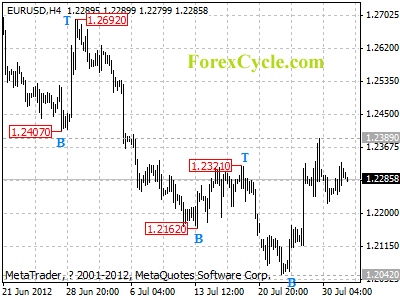
EURUSD is in correction of the uptrend from 1.2042

EURUSD is in correction of the uptrend from 1.2042. Pullback to 1.2170 area to complete the correction is expected. Resistance is at 1.2389, a break above this level could signal resumption of the uptrend, and the target would be at 1.2500-1.2600 area. Key support is at 1.2042, only break below this level could indicate that the longer term downtrend from 1.3486 (Feb 24 high) has resumed, then further decline towards 1.1500 could be seen.

eurusd

Forex Signals

Things Are About to Get Much Worse for Energy Firms in Argentina – Interview with Sam Logan

Things Are About to Get Much Worse for Energy Firms in Argentina – Interview with Sam Logan

By OilPrice.com

Angering Spain by seizing and nationalizing a majority of Repsol’s shares in YPF and ramping up the rhetoric over the Falkland Islands as exploration deals promise to make the territory a major oil player overnight, Argentina is making few friends in the fossil fuels industry these days. Sam Logan, owner of the Latin America-focused private intelligence boutique, Southern Pulse, speaks to Oilprice.com about the politics of populism behind Argentina’s energy aggression.

Samuel Logan is the founding partner of Southern Pulse, a private human intelligence organization focused on investigating security, politics, energy, and black market economics in Latin America. Southern Pulse investigators operate from hubs in Mexico, El Salvador, Colombia, Brazil, and Chile to leverage Southern Pulse’s HUMINT network, unique access, and deep understanding of the region to mitigate risk for public and private sector clients with exposure to political, security, financial, or legal risk in Latin America.

 In the interview Sam Talks about:

  • Why Carlos Slim bought shares in YPF
  • Why Argentina won’t take any definitive action in the Falklands
  • Why things will get worse for energy firms in Argentina
  • Argentina’s brewing political crisis
  • Argentina’s future relationship with Spain


Interview conducted by Jen Alic of Oilprice.com

Oilprice.com: In April, Argentina nationalized Spanish Repsol’s shares in YPF and now shareholders have approved a move that could see a sharp cut in dividend payouts and a redirection of profits to investment. This is in line with President Cristina Fernandez de Kirchner’s justification for nationalizing Repsol’s shares in YPF. She had accused Repsol of fleecing YPF by using too much of its profits for shareholder benefits rather than investing in exploration and turning Argentina into an importer of fuel. Will this essentially political and economic populism help or harm Argentina?

Sam Logan: While there are certainly short-term gains to be realized, the long-term effects of the Argentina-Spain relationship and Argentina’s relationship with other oil majors will result in significant setbacks in investment confidence and overall appetite for working with the Argentine government.

Oilprice.com: What we would like to know is what is missing from this story and what role certain vested interests, such as the Eskenazi family (minority YPF shareholders brought on by the Kirchners who later defaulted on their Repsol loans) and Carlos Slim, have played in the YPF saga.

Sam Logan: The Eskenazi family really took a hit from this action. When brought on board by the Kirchners, they took out loans to buy their stakeholder position in YPF. The payback on those loans was based partially on dividend payments. So the Kirchner nationalization and subsequent decision on dividends has left them in default. Carlos Slim, who got 8% of YPF when Eskenazi defaulted, was simply making a personal investment, not a political statement. When you’re the world’s richest man, it’s not particularly risky to make low-value purchases and hold them long term to see if they pan out.

Oilprice.com: Populism is also at play in Argentina’s renewed push over the Falkland Islands. Last week, Premier signed a $1 billion deal develop Rockhopper Exploration’s Sea Lion field in the Falkland Islands and Argentina is threatening to sue Premier for illegal activity. How will this play out for Argentina, and for big oil? What can we expect in the near- medium-term?

Sam Logan: The Argentine lawsuit will move forward and the UK firms will ignore the action, but BP could get caught in the crossfire as a UK firm with holdings in Argentina. Already we’ve seen Kirchner’s administration apply pressure to BP.

Oilprice.com: How are oil and the Falklands used as symbols of national sovereignty in Argentina?

Sam Logan: The Falklands have long been used as symbols in Argentina, and this is an issue that crosses party lines so there is more political currency available for the Falklands issue across the Argentine political spectrum. There could be more saber rattling, but at this point I don’t see the Argentine government taking definitive action.

Oilprice.com: Would you agree that at the heart of the matter is Argentina’s misguided energy policy, in place since 2003?

Sam Logan: It’s not just energy. This is more about Argentina’s overall economic policies and the steadily increasing economic pressures the Kirchner government is facing. Inflation, currency controls and price controls on gasoline all play a huge role in this market, which extends well beyond the recent actions with YPF. Let’s not forget that until recently Argentina was a natural gas exporter. Due to a long-term political negligence and mismanagement of infrastructure, Argentina is dependent on multinational energy firms to develop deposits and other known reserves – not to mention the potential for hydraulic fracturing. Ultimately, the irrational behavior Argentina has shown against multinational energy firms underscores a brewing political crisis that shows little to no sign of abatement in the near-term. It’s likely to get worse for energy firms in Argentina before it gets better.

Source: http://oilprice.com/Interviews/The-Energy-Showdown-in-Argentina-Interview-with-Sam-Logan.html

Interview by. Jen Alic of Oilprice.com


Rescued banks engaged in riskier lending – BIS paper

By Central Bank News

    Banks that received public funds during the 2008 financial crises were involved in riskier lending than banks that did not need a government bailout, according to a working paper published by the Bank for International Settlements (BIS).
    The paper, by economists Michael Brei and Blaise Gadanecz, examined the loan risk of 87 banks – 40 of which received public funds – and found that before the crisis, the rescued institutions had a significantly higher share of leveraged, and thus riskier, loans  in their portfolios of syndicated loan signings than their non-rescued peers.
     While the finding is hardly surprising, the authors found evidence that those banks that were rescued took on the risk mainly in their home markets,  “possibly reflecting their expectation that rescues are more likely to occur at home, where they may count as more systemic or wield more market power than abroad,” the paper said.

    The authors also tried to ascertain whether the public rescue operations, such as the 2008 Troubled Asset Relief Program (TARP) in the US, made the rescued banks shy away from risky lending toward safer loans.
    “Although risk started diminishing across the board in 2009, we fail to find significant consistent evidence that with the onset of the crisis in 2008, rescued banks have reduced their risk relatively more than non rescued banks,” the paper said.
    The authors said their findings were consistent with current literature that says rescued banks take on higher risks because they expect to be rescued, a concept often referred to as moral hazard.
    “Rescued banks may either be erring in risk management or consciously taking advantage of the implicit bailout guarantee,” the paper said.

    www.CentralBankNews.info


Understanding the Basic Language of Option Trading

JW Jones – www.OptionsTradingSignals.com

“Anticipate the difficult by managing the easy.”
~ Lao Tzu ~

The peculiar vocabulary and concepts inhabiting an options trader’s thoughts are often the source of confusion to visitors to my world. I have often pondered that learning to understand options is a lot like learning a foreign language. When you arrive in the country whose language you seek to learn, you need a functional vocabulary immediately.

In order to be able to understand my world, I thought it would be helpful to discuss a bit of my language since it is helpful to grasp a few basics. I want to touch on some of the basic concepts necessary to form the basis for a functional language we can use to communicate concepts underlying a rational (hopefully) thought process leading to trade design and management.

In ruminations to come we will return to these fundamental concepts and begin to understand their function in the dynamic world of an options trader. The nuances of their specific structures are beyond the scope of this blog. We will return to consider these factors in virtually every trade because they re-appear each and every day in my world. For today, just shake their hands and remember their names.

One point not often discussed is the way in which options are priced. The quoted option price is in reality the sum of two separate components. These are referred to as the intrinsic and the extrinsic portions of the premium. I think of these as steak and sizzle respectively.

As I type, AAPL has closed at around $395. The January 390 call has 41 days to expiration and could have been bought for $18.90. Of this sum, $5 represents intrinsic premium and $13.90 represents extrinsic or time premium.

This is an important distinction because it is the extrinsic premium which is subject to time decay and change due to variations in implied volatility. We will get to a discussion of implied volatility in next week’s missive.

The intrinsic premium is subject to change solely due to changes in the price of the underlying security. There is no sizzle in the intrinsic premium; you can buy the option today, exercise it to buy stock, sell the stock, and pocket the $5. Of course, your trading career will not last long with that sort of trade, but my point is that the intrinsic premium has an easily calculable true value.

The situation with the extrinsic premium is quite different. The value changes not only with time to expiration but also with the constantly changing implied volatility. It is for this reason that an option trader must be very careful with this extrinsic component. Depending on the specific option under consideration, extrinsic premium may represent all, a portion, or a trivial amount of the entirety of the option premium.

Another important concept is that of the “moneyness” of an option. An individual option can be classified in one of three categories of “moneyness:”

  • At-the-money
  • In-the-money
  • Out-of-the money

At-the-money options by definition consist of a single strike price. Both in-the-money and out-of-the-money strikes usually contain several individual strikes within their groups.

In our example of AAPL, the at-the-moneystrike is the 395 strike. The in-the-money strikes consist of all calls with strike prices below 395 and all puts with strike prices above 395. The out-of –the-moneystrikes consist of all calls above the 395 strike and all puts below the 395 strike.

Obviously since the price of the underlying defines the category into which an option is classified, the category into which an individual option fits is fluid and changes dynamically with the price of the underlying asset.

The reason for taking the time to discuss in some detail this classification of “moneyness” is that there are important reliable characteristics of each type of option.

At-the-money options characteristically contain the absolute greatest dollar amount of extrinsic premium. In-the-money options have the least amount of extrinsic premium. Out-of-the-money options consist entirely of extrinsic premium, and therefore only contain sizzle . . . no steak can be found there.


Because the functional characteristics of these three categories of options differ, it is a basic strategy to combine options of different “moneyness” to achieve trades with the best probability of success and the highest risk/reward scenarios.

For example, buying an in-the-moneycall and selling an at-the-money call gives birth to a call debit spread, a high probability trade structure for the trader who is bullish in the underlying.

Next week we will cover the stealth concept of option trading, implied volatility. Failure to understand the impact of this variable is the most common cause of beginning options traders’ failure to succeed.

Join My Premium Options Writing Trading Service to Start Earning Monthly Income: JW Jones – www.OptionsTradingSignals.com

This material should not be considered investment advice. J.W. Jones is not a registered investment advisor. Under no circumstances should any content from this article or the OptionsTradingSignals.com website be used or interpreted as a recommendation to buy or sell any type of security or commodity contract. This material is not a solicitation for a trading approach to financial markets. Any investment decisions must in all cases be made by the reader or by his or her registered investment advisor. This information is for educational purposes only.