Market Review 9.8.12

Source: ForexYard

printprofile

The euro took moderate losses against the US dollar last night, but remained bullish overall as investor anticipation regarding potential ECB action to lower Spanish and Italian borrowing costs kept risk sentiment high. Additionally, better than expected Australian employment data caused investors to shift their funds to higher yielding assets, including the aussie. The AUD/USD advanced close to 60 pips during Asian trading to reach a fresh 4 ½ month high at 1.0612. The pair is currently trading at 1.0590.

Main News for Today

ECB Monthly Bulletin- 08:00 GMT
• The bulletin outlines the ECB’s economic forecast for the euro-zone
• A positive outlook could lead to more risk taking in the marketplace, which may help the euro against the US dollar and yen

US Unemployment Claims- 12:30 GMT
• Analysts are forecasting today’s figure to come in slightly higher than last week’s
• If the news comes in higher than 371K, the dollar could see additional losses against the JPY in afternoon trading

US Trade Balance- 12:30 GMT
• The trade balance figure is forecasted to come in at -47.4B, slightly better than last month’s -48.7B
• Any better than expected data could help the dollar recoup some of its recent losses against the EUR and AUD

Read more forex news on our forex blog

Forex Market Analysis provided by ForexYard.

© 2006 by FxYard Ltd

Disclaimer: Trading Foreign Exchange carries a high level of risk and may not be suitable for all investors. There is a possibility that you could sustain a loss of all of your investment and therefore you should not invest money that you cannot afford to lose. You should be aware of all the risks associated with Foreign Exchange trading.

Korea holds rate, sees ‘very moderate’ global growth

By Central Bank News
    The Bank of Korea (BOK) held its base rate unchanged at 3.0 percent, as most economists had expected, saying the country’s growth was slowing due to lackluster exports and domestic demand.

    “The Committee expects the pace of global economic recovery to be very moderate going forward as well, with the uncertainties surrounding the euro area fiscal crisis and the international financial markets persisting,” the BOK said in a statement following a meeting of its Monetary Policy Committee.
     Reflecting the global slowdown and its impact on South Korean exports, the BOK cut its base rate last month, its first cut in interest rates since February 2009.
     The day after the BOK’s surprising interest rate cut, the bank reduced its 2012 growth forecast to 3.0 percent from its April forecast of 3.5 percent, and its 2013 forecast to 3.8 percent from a previous 4.2 percent. In 2011 South Korea’s GDP expanded by 3.6 percent.

    The bank also trimmed its consumer price inflation forecast due to lower commodity prices to 2.7 percent in 2012, down from a previous forecast of 3.2 percent. In 2011 inflation was 4.0 percent and in 2013 inflation was seen ticking up to 2.9 percent.  The BOK targets inflation of 2-4 percent.
    The BOK noted that consumer prices rose by 1.5 percent yar-on-year in July, down from 2.2 percent  in June, mainly due to stable international oil prices and favorable weather.
    “The Committee forecasts that inflation will remain at a low level for the time being, despite for instance pressures to hike public utility fees and the instability of international grain prices,” the BOK said.
   The central bank’s BOK Economic Sentiment Index, which reflects business and consumer sentiment, fell four points to 92 for July. Any reading below 100 means that economic sentiment in the private sector is below past averages.
    The drop in the sentiment index had lead some economists to expect the BOK to cut rates further.

    www.CentralBankNews.info


How to Invest Outside the Government-Controlled System

By MoneyMorning.com.au

Ha, ha, ha.

We knew it would happen.

Ho, ho, ho.

And we’re sure you knew it would happen too.

Hee, hee, hee.

Of course, it’s not really a laughing matter…unless you like paying $5,653.85 for your laughs.


But that won’t be the last of it. The latest government bungle shows that by the time this huge taxpayer-funded folly is finished, the real cost to you will be many times that amount.

It’s time to protect your wealth and savings before the Aussie Welfare State and Australia’s biggest trading partner get completely out of control. Here’s how…

As far as the government and the public sector is concerned, private citizens are second class citizens. They see the private sector (especially individuals) as nothing more than tax fodder.

The role of the State isn’t to protect individuals from each other and abuses from the State. The role of the State is to protect itself from individuals.

A report in today’s Age highlights this view:

‘[Prosecutor] Mr Young said jail was the only appropriate sentence while [Magistrate] Mr Rozencwajg described the conduct as a serious example of the offence made more serious by the subjects being public officials.’

The case involves a man who pointed two fingers at Attorney-General Nicola Roxon and said ‘I’m spewing I don’t have a gun with me…’

In other words, according to the magistrate (himself a public employee), the life of a private citizen (you) is worth less than the life of a public servant. That’s nice to know isn’t it?

But it’s a perfect example of the attitude taken by authorities towards the private sector and individuals. What’s yours is only yours as long as the government allows you to keep it.

Whatever you own is at any point in time subject to confiscation at the whim of jumped-up governments that decide they can better spend your money than you can.

Take the National Broadband Network (NBN)…

The Cost of Fast Internet

Yesterday, communications minister, Senator Stephen Conroy revealed the NBN would – surprise, surprise – cost more than originally thought.

That doesn’t surprise us. We warned long ago that the real end cost will probably be at least three-times the original forecast.

As The Australian reported:

‘The funding required to roll out the super-fast National Broadband Network has blown out by $3.2 billion, with the vast majority of the extra money to come from taxpayer funds.’

The government says the NBN will now cost $44.1 billion. Based on the last Census which showed Australia has 7.8 million households, the NBN will cost $5,653.85 per household.

We’re sure that given the choice, you would happily spend $5,653.85 on an Internet connection too. What’s that? You wouldn’t…we thought as much.

As it happens, when we arrived home last night we saw a letter from our Internet provider, iPrimus. They had written to say that due to an upgrade in the Frankston area we could now use the iPrimus network to get faster speeds.

How much do we have to pay for this upgrade? $5,000? More perhaps? No. It won’t cost us a bean for the upgrade. In fact our monthly bill will be $20 cheaper.

Got that? The private sector can provide us with a better service at a lower cost. While the government has to charge each household $5,653.85 for a service we can’t be sure will be any better than the one we’ve already got.

But as usual, the government thinks it knows how to better spend your money than you. So it forces you to spend thousands on health insurance that you don’t need, and now it’s spending $5,653.85 of your tax dollars on an Internet connection you probably pay about $60 a month for.

The point is, instances such as this prove that you can’t rely on the government to take care of you in retirement. Governments are more interested in squandering your money to build their own legacy.

The Rudd Government’s school-building program wasn’t about improving schools, it was about them saying, ‘Look, we did that.’

The same goes for the Future Fund and the NBN. They’re about using taxpayer dollars to build memorials to boost their ego.

That’s why it’s important to remove as much of your wealth from the system as possible…out of the reach of government meddling…

Investing Outside the System

As we wrote last week, at the flick of a switch the government can freeze any electronic assets within seconds. There’s no way to access your assets once they’re frozen.

That includes cash and shares. Even property isn’t safe. You can’t hide a house from the government, and you can’t sell it if the government won’t process the title transfer.

The one asset you can keep away from the government is gold. It’s portable. It’s transferable between willing buyers and sellers without needing the permission or involvement of a third party (such as a broker or bureaucrat). And you can conceal it from tyrannical governments.

Make no mistake, the State is closing in on free individuals. As we said at the After America conference earlier this year, ‘it’s not that China is becoming more free market, it’s that the West is becoming more authoritarian.’

Western governments look to China for inspiration of how to suppress freedom and grow the central government.

As former Aussie PM, Paul Keating recently said at a book launch:

‘The seemingly perpetual invocation of this human rights mantra attributes no moral value to the size and quality of the Chinese achievement.’

This is a view taken by many central planners. The individual is subservient to the State.

The thing is, central planning is a flawed economic model. China’s economy is no different. Its destiny is to collapse, which while positive in the long term, will have a devastating impact to the world economy in the short term.

So much, that our old chum, Sound Money.Sound Investments editor, Greg Canavan says it ‘could end the retirement dreams of millions of Australians…’

To avoid that fate it’s important to do all you can to protect your wealth against a Chinese economic collapse and the actions of the State.

The best way to do that is to invest in the one asset the government can’t easily take…gold. To see what Greg has to say on this subject, click here…

Cheers,
Kris

Related Articles

Market Pullback Exposes Five Stocks to Buy

Olympic Badminton Farce Shows How Capitalism Beats Socialism

Compulsory Voting for a Violent State


How to Invest Outside the Government-Controlled System

There is No Safe Haven – But You Should Still Own Gold

By MoneyMorning.com.au

‘Sell gold‘.

That’s the message from FT columnist Peter Tasker, a Tokyo-based analyst with Arcus Research. As far as he’s concerned, gold’s bull market is over.

I’m a fan of Tasker’s writing. He often talks a lot of sense. And I normally agree with him.

I even agree with many of the points he makes about gold.

But not quite all of them…

Why Hasn’t Gold Soared During the Eurozone Crisis?

If gold is such a ‘safe haven’ asset, then why hasn’t it rocketed during the euro crisis?

This has become one of the key arguments of gold bears. And it’s one that Peter Tasker makes in his latest column for the FT. ‘Where is the haven that offers protection against the turbulence of markets? Guess what: there isn’t one.’

He’s absolutely right. The term “safe haven” is lazy shorthand used to describe any asset that people pile into when they are feeling scared. But there is no such thing as a consistently “safe” haven.

For example, UK gilts, US Treasuries, and German bunds have all variously been described as “safe havens”. But they are among the most overvalued assets on the planet. And their prices fluctuate on a daily basis, so they don’t offer any sort of guaranteed protection against capital loss.

And let’s be very clear – gold isn’t a “safe haven” either. Try telling anyone who bought it in 1980 that gold protects the value of your money, and you’ll probably be greeted with a sardonic laugh. It might do so over the very long-term, but a 20-year bear market is enough to test the patience of even the most ardent goldbug.

What most people outside the financial world understand by the word “safe”, is that an asset provides a guaranteed safeguard against a nominal loss of capital (ie ignoring inflation).

The only asset that does that is cash. And unless you keep it under a mattress, even that guarantee is only as good as the government-backed deposit insurance scheme that stands behind your bank account. More to the point, it will do nothing to protect you against currency devaluation, debasement, or general inflation.

The Real Question: Why Has Gold Held Up So Well?

So why hasn’t gold performed spectacularly during the eurozone crisis? Here’s why. If the eurozone collapses, the outcome that people fear most is deflation. That explains partly why so much money has piled into bonds that yield very little.

During deflation, cash becomes more valuable. If prices are falling, a fixed amount of cash will buy more. So as long as you’re holding on to the right currency, you can do very well. Even a minimal yield on a bond issued by a reliable government, will be a big improvement on the complete absence of yield offered by gold.

In fact, I’d argue that the real wonder is that gold has held up so well during the eurozone crisis, particularly when you compare it to most other commodities.

The answer to why gold has held up so well? Well, if deflation is allowed to have its way with the eurozone, then you can expect mass defaults across the globe. That would be very bad news for the global financial system. In turn, that would increase physical gold’s appeal, because it’s one of the few assets that isn’t anyone else’s liability. Its value may rise and fall, but it will never go to zero.

The alternative – and I’d say more likely – scenario is that whatever lies directly ahead, the end game of this crisis involves central banks printing a lot more money. Again, that scenario is good news for gold.

The biggest threat to gold, as far as I can see, is if central banks start to hike interest rates. That time may not come for quite some time. And when it does, it’ll probably be in response to rising inflation, which tends to be good news for gold in the early stages in any case.

Gold Is Not The Only Investment – But You Should Hold Some

That doesn’t mean that gold is the only thing that should be sitting in your portfolio. It would be stupid to have 100% of your money in gold, just as it would be stupid to have all of your money in any single asset class.

And gold is certainly not as cheap as it was 10 or 11 years ago, when it was self-evidently undervalued. As Tasker puts it, ‘some assets offer more value than others’. He cites stocks in Japan and Europe, both of which I’d happily add to my portfolio just now.

Tasker also notes that US house prices are very low relative to the price of gold. Again, if you’re going to consider buying property somewhere in the world, I’d agree that the US looks more promising than most.

But I’d also hang on to gold. My view is that 5-10% is about right, but your exact allocation would come down to your own circumstances. It’s there to protect you against extreme financial risks, and there’s still a good chance that we’ll see more of those in the near future.

Also, I’d keep a close eye on the gold price over the coming months. As my colleague Dominic Frisby has pointed out on several occasions, gold’s bull market has followed a fairly reliable pattern of hitting new highs, then consolidating for periods of around 18 months.

The last peak came in late summer of 2011. So we’re not far off the 18-month mark now. If the pattern holds, 2013 could be a very profitable year for investors in gold.

John Stepek
Contributing Editor, Money Morning

Publisher’s Note: This article originally appeared in MoneyWeek (UK)

From the Archives…

Revealed: Government to Get Hands on More Retirement Savings
03-08-2012 – Kris Sayce

Olympic Badminton Farce Shows How Capitalism Beats Socialism
02-08-2012 – Kris Sayce

How Low Natural Gas Prices Are Causing Energy Havoc
01-08-2012 – Dr. Alex Cowie

Silver Bounces Off Key Level, Where’s it Going Next?
31-07-2012 – Dr. Alex Cowie

How No ‘Plan B’ For The Australian Economy Could Boost Aussie Stocks
30-07-2012 – Kris Sayce


There is No Safe Haven – But You Should Still Own Gold

Bank of Japan keeps rate steady, sees moderate recovery

By Central Bank News
    The Bank of Japan (BOJ) held its policy rate unchanged, as widely forecast, repeating last month’s statement that its domestic economy was expected to recover moderately on the back of firm domestic demand and overseas economies that are emerging from a phase of deceleration.
    However, the BOJ, which held its overnight call rate steady at zero to 0.1 percent, acknowledged that there was a high degree of uncertainty about the global economy and Japan faces the challenge of overcoming deflation and returning to sustainable growth with price stability.
    The BOJ still expects the inflation rate to remain around zero percent for the time being and it would continue its policy of monetary easing by steadily increasing the amount outstanding in its Asset Purchase Program.
    “Regarding risks to the price outlook, careful attention should be paid to future developments in international commodity prices and in medium- to long-term inflation expectations,” the BOJ said.

    The BOJ has a target of 70 trillion yen for its asset purchase program but economists worry that it may not be able to meet its target. 
    Japan continues to combat deflation, with consumer prices down 0.20 percent in June from the same month last year. But the economy is continuing to expand faster than other advanced economies and in the first quarter the GDP rose 1.2 percent from the previous quarter for an annual rate of 2.7 percent.
    www.CentralBankNews.info


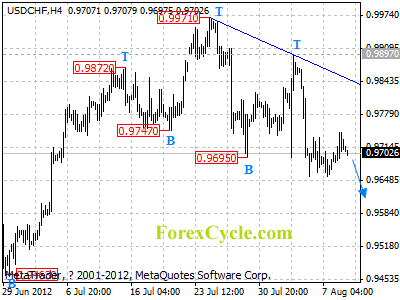
USDCHF remains in downtrend from 0.9971

USDCHF remains in downtrend from 0.9971. Another fall could be expected after a minor consolidation, and next target would be at 0.9500 area. Resistance is at 0.9770, followed by the downward trend line on 4-hour chart, only a clear break above the trend line could indicate that the longer term uptrend from 0.8931 (Feb 24 low) has resumed, then the following upward move could bring price to 1.0200 area.

usdchf

Daily Forex Analysis

GOLD close to confirming breakout to all-time highs

David Banister- www.markettrendforecast.com

Back in the fall of 2011 I was warning my subscribers and the public via articles to prepare for a large correction in the price of GOLD.  The metal had experienced a primary wave 3 rally from $681 per ounce in the fall of 2008 to the upper $1800’s at the time of my warnings in the fall of 2011. A 34 Fibonacci month rally was sure to be followed by an 8-13 month consolidation period, or what I would term a Primary wave 4 correction pattern.

We have seen GOLD drop at low as the $1520’s during this expected 8-13 month window, but at this time it looks to me like a break over $1630 on a closing basis will put the nail in the wave 4 coffin. I expect GOLD to rally for about 8-13 months into at least June of 2013 and our longstanding target has been in the $2300 per ounce arena in US Dollar terms. Some pundits have much higher targets in the $3,500 per ounce or higher area but I am using my low end targets for reasonable accuracy.

This 5th wave up can be difficult to project because 5th waves in stock or metals markets can be what are called “Extension” waves. This means they can have a potentially much larger percentage movement relative to the prior waves 1 and 3 of the primary bull market since 2001.  You can end up with a parabolic move at the end of wave 5, where those $3000 plus targets are possible.  I expect the 5th wave to be about 61% of the amplitude of wave 3, which ran from 681 to 1923, or about $1242 per ounce. If we were to apply that math, we come up with $767 per ounce of rally off the wave 4 lows.  $1520 plus $767 puts us at $2287 per ounce, or roughly $2300 an ounce low end target.

In summary, crowd behavior is crucial to the next coming movement in GOLD and it could be a sharp rally that catches many off guard, much like the downdraft last fall did the same to the Bulls. Be prepared to go long GOLD once over $1630 per ounce and buy dips along the way up to $2300 into the summer of 2013.

Receive our free weekly reports at www.markettrendforecast.com or sign up for a discounted subscription and get our reports daily on the SP 500 and GOLD.


David Banister- www.markettrendforecast.com


Is a Gold Price Rally on Its Way? [Video]

Article by Investment U

View the Investment U Video Archive

In focus this week: the return of mega-cap stocks, indicators say gold prices are set to rally again and the fattest slap-in-the-face award (SITFA) ever.

The Return of Mega-Cap Stocks

While the market has been taking its lumps this year, one sector of the stock market that has been out of favor for years has been lighting it up; ultra-large caps, $50 billion and bigger.

CNBC reported this past week that despite the EU, China and the fiscal cliff hanging over the U.S., the largest of the large, the Russell Top 50 Index, climbed 14% since last year. The darlings of the market since the early 90s, the small caps have gained only 1%.

When you add dividends, these behemoths returned a total of 18%.

In July alone they are up 2% and some analysts are saying this is a sign of a gradual shift back to the more stable U.S. big caps, even away from international stocks.

Jack Albin, CIO of Harris Private Bank, said in the CNBC piece that one of the factors driving the increased attraction of these monsters is stability, and of course dividends. The flight from the EU has also added to the big uptick as investors look for less troubled waters.

The 50 mega caps have a yield of about 2.2%, which blows away anything small caps have.

“One of the big surprises in this sector,” said Keith Trauner of the GoodHaven Fund (GOODX), “is that big companies have been much more adept at cutting expenses, adjusting their cost structure and adapting since the collapse in ’08, more than anyone thought they could.”

And, mega-caps currently have a PE of about 13 compared to small-caps at 20.

Mega-caps may finally be having their day in the sun…

Gold Price Rally on its Way?

A little over a week ago it was up 2.2%, which got gold bugs just a little excited.

The Hulbert Gold Newsletter Indicator (HGNI) gained 12.5 points last Friday, and Le Metropole Café reported that the HGNI has been under 20% for the last 100 days, a record for the index. The last time it did this was in 2002, which was followed by a 10.9% run-up over two months.

The bullion dealer Standard Bank reported that there is a large short position in Comex gold and there have only been five times since 2004 that Comex short positions have stood out like this.

Three of these spikes were followed by 25%, 23% and 36% run-ups.

HSBC said this past week that based on short positions gold has room to rally from here.

Last year the U.S. debt ceiling crisis was blamed for a 12.3% run-up in gold prices. This year we have our pick: Iran/Israel, the EU saga and the U.S. QE possibilities and looming fiscal cliff.

While it’s never a sure thing, right now there are lots of reasons to watch gold, and that’s coming from a committed non-gold bug…

Lastly, As Promised, the Fattest SITFA Ever!

Donuts are going big time! Tres Leche, Foie Gras, chili mango, apricot cardamom are some of the new flavors for donuts that cost as much as $11, for one donut.

I’m not kidding!

This saturated fat craziness is popping up everywhere. San Francisco has a shop that features a strip of bacon on a maple long john, yuck!

According to a Smart Money article, you used to be able to count on two things from donuts: they were cheap and guaranteed to kill you. Now you can only count on the later.

It seems when times are tough folks look for comfort food and what is more comforting than a donut? But 11 bucks? That’s a lot of comfort.

You can now get donuts made from locally grown ingredients, trans fat free… what’s the point of a trans-fat free donut, gluten free and organic? As the article said, you’re not pigging out on these, you’re doing the world a favor.

The amazing part, Megan Brown of Glazed and Confused, a super donut shop, said even at $3 a donut the margins are lower than the $6 a dozen at Dunkin Donuts (Nasdaq: DNKN).

A chocolate covered $.79 donut is fine with me.

Foie Gras on a donut, how awful!

See you all next week.

Article by Investment U

Foreign Currency Investing: Is the Almighty Dollar Going Down?

Article by Investment U

Since WWII, the U.S. dollar has been the world’s reserve currency.

However, since the economic collapse of 2008, the greenback seems to be getting less and less respect.

In fact, just as the U.S. Federal Reserve and the European Central Bank (ECB) decide on how to move their currencies forward in the coming weeks, other central banks around the world have quietly hedged themselves against the dollar and the euro, and have started loading up on another currency altogether.

I’m talking about the Chinese yuan. And what’s going on today hopefully will be a wake-up call for America.

A Growing Global Trend

Just look at what’s happened in the last few months…

On June 22, Forbes reported Brazil and China signed a currency exchange pact that’s part of a larger move with other BRIC nations, Russia and India, and even South Africa.

They have agreed that if there’s another financial meltdown and global credit dries up, each country’s central bank will have money set aside to help the other and keep their economies running smoothly.

Now let’s go back to March. Australia signed a $31-billion currency exchange deal directly with China to promote trade and investment between the two nations.

In December 2011, Japan announced a currency pact with China that topped headlines. Japan and China are the third and second largest economies in the world.

Also in December was another agreement with Thailand.

Every one of these deals limits the power of the U.S. dollar a little bit more in these countries and gives more value to the yuan.

However, all this being said, the yuan isn’t ready for the world stage, either.

Still Problems in China

Despite the yuan’s growing acceptance around the globe, its value is still managed by the state. In fact, while China will be the first to deny it, it has kept its currency artificially low for years.

What’s more, the yuan isn’t convertible or allowed to trade freely outside the country yet.

And on top of all of this, China really doesn’t want its currency appreciating right now. Over the past five years, the yuan has climbed 18% against the U.S. dollar.

That has made profit margins tight in China. With its economy continuing to slow down in recent months, Chinese exporters could get crushed if the yuan is left to trade freely in the markets.

Point is, the future of the yuan is as much about how China’s government manages its currency problems as it is how the United States and Europe get their deficits in order.

Moving Forward

Unfortunately, there’s no predicting the future. But one thing is certain: China knows it has to change the way it controls the yuan.

The People’s Bank of China, the central bank, proposed a series of currency reforms earlier this year that suggested internationalizing the yuan in stages.

As Time magazine reports, the plan would allow the markets to freely trade the yuan in the next three to five years. In the long term, between five and 10 years, foreign investors would be given more access to Chinese stocks, bonds and property.

China has repeatedly expressed how the U.S. dollar should no longer be considered the world’s reserve currency. But at the same time, it can’t exactly afford to see the dollar go bust against the yuan.

So how could anyone play this trend?

Our very own Senior Analyst Carl Delfeld recently suggested diversifying your global portfolio into other currencies altogether such as the Swiss franc, through the CurrencyShares Swiss Franc Trust (NYSE: FXF), or the Australian dollar, through the CurrencyShares Australian Dollar Trust (NYSE: FXA). And Jason Jenkins recently wrote about the relative strength of the Swedish krona, here.

However, as Carl warned, just don’t go overboard. You could be crushed by a snapback in the U.S. dollar.

Good Investing,

Mike

Article by Investment U

Another Reason to Stay Bullish: A Bottom in Home Prices

Article by Investment U

Over the past couple of weeks, I’ve encouraged readers to look beyond the negative headlines – and heated political rhetoric from both major political parties – and remain optimistic on the outlook for high-quality stocks.

You’ve already heard the national media report all the negatives ad nauseam: weak economic growth, high unemployment, runaway deficit spending and continuing troubles in the Eurozone.

But few seem to recognize the many positives that also exist: low inflation and interest rates, declining energy prices, expanding opportunities in emerging markets, low valuations and record corporate profits.

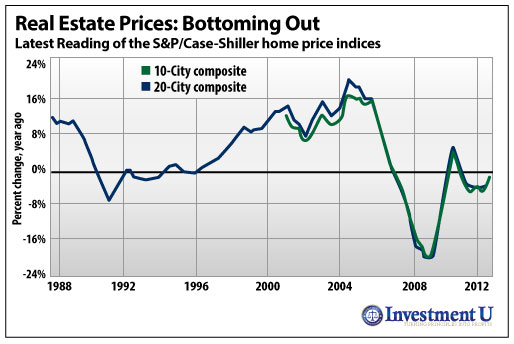
To this list, it’s also time to add another positive. According to S&P/Case-Shiller and the real estate website Zillow, U.S. home prices are at or near a bottom. That’s a very good thing. Here’s why…

Declining home prices have been a dark cloud over the economy and the stock market for roughly six years now. Having temporarily taken leave of their senses, home buyers bought into the mantra that “real estate always goes up” and drove prices up to the cirrus clouds.

It was bound to end badly and the ensuing adjustment has been painful. A home is most consumers’ biggest purchase. And the drop in prices didn’t just reduce or eliminate their home equity for millions. In many cases, it demolished household net worth. That, in turn, crushes consumer confidence.

So a bottom in home prices is a huge plus. And that appears to be what we’re seeing now. As Zillow Chief Economist Stan Humphries said last week, “After four months with rising home values and increasingly positive forecast data, it seems clear that the country has hit a bottom in home values. The housing recovery is holding together despite lower-than-expected job growth.”

Indeed, many homebuyers feel like they can’t hold off any longer, either because prices are so low or because their personal need for new housing is so high.

In the second quarter, values rose in 53 of the 167 markets covered in Zillow’s Real Estate Market Reports. And some gains were substantial. Home prices rose 12.1% in Phoenix, for example.

Similarly, the S&P/Case-Shiller 20-city composite index rose in the month of April, with 19 out of 20 cities posting gains during the month. Then, last Tuesday we learned the index rose 2.2% in May, marking two consecutive months of gains.

Another Reason to Stay Bullish: A Bottom in Home Prices

This doesn’t mean that home prices are set to rocket higher, of course. There are still millions of foreclosures looming – and these fire sales will keep a lid on prices. Yet Zillow reported this week that only 5.8 out of every 10,000 homes were lost to foreclosure in June, down from 7.9 of every 10,000 homes in January.

With the economy soft and many foreclosures still working their way through the system, it will be quite a while before we see robust growth in home prices again.

But a housing bottom is a necessary first step. And another reason to remain bullish on both the U.S. economy and U.S. share prices.

Good Investing,

Alex

Article by Investment U