Take Advantage of the High Australian Dollar While You Can

By MoneyMorning.com.au

In this post-2008 crisis world, global capital flows violently from asset class to asset class and country to country, seeking opportunity and safety in equal turns.

In doing so, capital flows through currencies and into assets denominated in that currency, whether they be bonds, land, property, shares or bank deposits.

Do you remember back in the late 1990s when international shares were all the rage? Back then, Aussie investors benefitted from rising stock markets AND a falling Australian dollar.

The combination produced years of double-digit returns and made international shares the favoured asset class.

But in the past decade, the tide has turned. Thanks to a secular resources boom, the Australian dollar has gone from one of the weakest to one of the strongest major currencies in the world. The strong domestic currency, combined with weak global markets since the dot com crash, has led to international shares being the worst performing asset class over the past decade.

How Strong is the Australian Dollar?

How strong has the Australian dollar been? As you can see in the chart below, the Trade Weighted Index (TWI), also known as a country’s ‘effective exchange rate’, illustrates the Aussie dollar’s decade long strength.

The TWI is a measure of a currency’s purchasing power relative to its trading partners. The terms of trade (the value of exports relative to imports) are a major driver of the nominal TWI.

A nations’ productivity also plays a role in determining relative currency strength. The real TWI adjusts the nominal value by taking into account the differences in consumer price inflation between Australia and its trading partners.

So what is the chart telling you? Well, in simple terms its saying the purchasing power of the Australian dollar hasn’t been as strong (in nominal terms) since the early 1980s. And back then the currency was on its way down following the float of the dollar in 1983.

In real terms, the Australian dollar hasn’t seen such strength since the mid-1970s. This coincided with Australia’s last great commodity boom, which fed Japan’s industrialisation. This time, it’s China’s industrialisation that’s behind the surging TWI.

There’s also another way to interpret the chart.

Cheap Overseas Holidays, Cheap Overseas Assets

The steep rise from 2002 reflects the flow of global capital into Australian dollar denominated assets. Put yourself in the shoes of a US fund manager in the early 2000s.

You see the rise of China in the decade ahead and view Australia as ideally placed to benefit. At the time, $US1 dollar buys nearly $2 Aussie dollars. In US dollar terms then, Aussie assets are dirt cheap.

So it makes sense to invest capital here. Over the past decade, all asset classes have increased in value…property, shares and bonds have all appreciated. And if you’re a foreign investor, you can add a significant currency benefit to that return.

In short, the past decade has been very good for foreigners investing in Australia. They’ve had the benefit of rising asset prices plus a currency tailwind…the best of both worlds.

But that was last decade. What do you think the next decade holds?

Investing is all about probabilities and foresight. So ask yourself, what is the probability of the Australian dollar continuing to move higher from here? Australia’s terms of trade are declining, and our productivity performance is terrible.

The fundamentals for further gains just aren’t there. That doesn’t mean panicked capital flows won’t continue to support the Aussie in the short term.

But I think we’re very close to a secular change in currency values which would lead to particular investment consequences. If I’m right the trade weighted index will turn down and revert to ‘more normal’ levels.

That being the case, wouldn’t it make sense to use the current strong purchasing power of the Aussie to diversify into investments where asset prices are weak but could recover soon? I think it would.

Greg Canavan
Editor, Sound Money. Sound Investments.

From the Archives…

Read This Gold Price Warning Before You Buy Another Stock
24-08-2012 – Kris Sayce

Stocks Are Up – Is it a Good Time to Buy?
23-08-2012 – Kris Sayce

It’s About Freedom of Speech: What if We Couldn’t Write to You Anymore?
22-08-2012 – Kris Sayce

Things Are Looking Up for Gold
21-08-2012 – Bengt Saelensminde

The Good News About Europe’s Missing Pre-nup
20-08-2012 – Nick Hubble

Take Advantage of the High Australian Dollar While You Can

Why Platinum is a Screaming Buy

By MoneyMorning.com.au

You won’t read about it in the mainstream news, but the South African mining industry is in the fight of its life. That makes one investment a screaming buy.

You see, violent strikes have paralyzed several South African mines this year, including most recently the giant Lonmin platinum mine.

This isn’t a short-term problem, either, and it’s not related to conditions in the mining industry.

There’s a deep political agenda at play, which means the disputes are likely to be a severe ongoing problem.

But it’s the story behind the story that has my eye. Because for investors who can grasp what this crisis really means, the seeds of opportunity are about to take root.

Let me explain…

South Africa’s Mining Industry is a Political Football

In this case it has to do with politics, or more accurately, radical left-wing politics.

Even though it is a democracy, South Africa is effectively a one-party state. Since the opposition Democratic Alliance attracts voters primarily from the minority white and mixed-race communities, it has no real chance of dislodging the African National Congress from power.

What’s more, the country is very unequal, with one of the highest Gini (inequality) coefficients in the world.

These days however, it’s not just the whites who are rich. The ruling ANC bosses now have primarily business interests and are among the nation’s richest people. Meanwhile the economy grows only sluggishly and unemployment is a towering 25%.

As you might surmise, in this situation there’s a lot of unrest.

Caught in the middle is South Africa’s mining industry, which has been a political football for two years now.

But now a radical wing of the ANC is attempting to replace the current president, Jacob Zuma, in the next election.

That’s important because, in 2010 Julius Malema, then leader of the ANC Youth League and a leading radical, launched a political campaign to nationalize the mines.

Zuma opposes this, as does the official National Union of Mineworkers. And even though Malema was expelled from the ANC in February, a discussion document advocating mine nationalization was only narrowly defeated at the ANC Policy Congress in June.

Since then, Malema has taken his campaign to the streets, and has stirred up radical groups among the mineworkers to demand improved pay and conditions outside of the official union structure.

This mix of radical union leaders combining with extremist political agitators in a society of extreme inequality, where the majority population has memories of oppression, has an analogue in history…

And it’s not in Africa.

It’s reminiscent of Czarist Russia before the 1917 Revolution that let in the Bolsheviks. Malema is essentially Lenin or Trotsky (at least he’d like to be) and the miners’ union is the equivalent of the Petrograd Workers Soviet.

That suggests that these troubles won’t disappear anytime soon.

Whether or not Malema succeeds in overthrowing South Africa’s power structure (and the odds must still be against him), mine nationalization is very much a live issue, and industrial action by militant miners is a key tool for Malema’s supporters in their efforts to achieve radical change.

Here’s where the payoff is for investors…

Political Unrest Means a Steep Rise in Platinum Prices

It’s highly likely South African mine output will be heavily disrupted for several years to come – even if Malema’s objective of mine nationalization fails (and my bet would be that’s the one place where he will eventually succeed, as the current power structure adopts elements of his program to defuse opposition.)

Like a disruption of oil supplies through the Straits of Hormuz, disruption of South Africa’s output will raise prices of the commodities where it is an important producer.

Traditionally, this would have meant gold, but today South Africa is only a medium-scale gold producer, accounting for about 12% of world output.

However in platinum, South Africa accounts for 70% of world output, so even a halving of production over a prolonged period would bring a steep price rise.

Platinum is a key ingredient in automobile catalytic converters; it is also, along with gold, palladium and silver, one of the four precious metals for which a substantial investment demand exists.

Traditionally, it trades at a premium to gold, but in early August, before the latest outbreak of mine violence, platinum had been trading at a 17% discount to gold – the lowest relative level for 27 years.

Analysts see platinum primarily an industrial metal, citing the substantial inventories of the metal in existence, especially in Russia. But what they don’t realize is that those “inventories” are in many cases investment holdings, similar to those of gold or silver.

Regarded as a precious metal, platinum is now in imminent danger of shortage.

Like gold, it will benefit from the ultra-easy monetary policies of the Fed and the European Central Bank, both of which are expected to provide more fuel to the monetary fire next month.

However, it also has the potential to soar in price, even beyond gold, as supplies are restricted by South Africa’s politically-inspired industrial action.

For investors, that leaves one clear economic winner. Platinum is a screaming buy right here.

Martin Hutchinson
Contributing Editor, Money Morning

Publisher’s Note: This article originally appeared in Money Morning (USA)

From the Archives…

Read This Gold Price Warning Before You Buy Another Stock
24-08-2012 – Kris Sayce

Stocks Are Up – Is it a Good Time to Buy?
23-08-2012 – Kris Sayce

It’s About Freedom of Speech: What if We Couldn’t Write to You Anymore?
22-08-2012 – Kris Sayce

Things Are Looking Up for Gold
21-08-2012 – Bengt Saelensminde

The Good News About Europe’s Missing Pre-nup
20-08-2012 – Nick Hubble


Why Platinum is a Screaming Buy

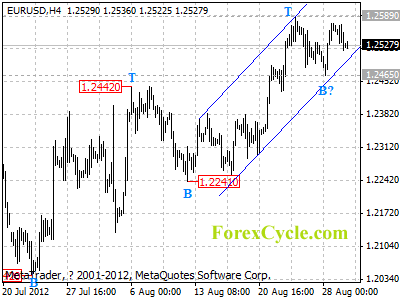
EURUSD trades in a range between 1.2465 and 1.2589

EURUSD trades in a range between 1.2465 and 1.2589. The price action in the range is likely consolidation of the uptrend from 1.2241. Initial support is at the lower line of the price channel on 4-hour chart, followed by 1.2465, as long as this level holds, the uptrend could be expected to resume, and another rise towards 1.2700 is still possible. On the other side, a breakdown below 1.2465 will suggest that lengthier consolidation of the uptrend from 1.2042 is underway, then deeper decline to 1.2400 area could be seen.

eurusd

Daily Forex Analysis

Vanguard Funds: Proof That Smart Investors Are Getting Smarter

Article by Investment U

A recent article in the Wall Street Journal reports that “Many investors, rightly or wrongly, are simply fed up with stocks and are piling into bonds despite record-low interest rates.”

Let’s face it.  Savvy investors – the ones who understand how badly you can get burned in bonds when rates tick up – are not plowing their hard-earned capital into ultra-low-yielding bonds right now.  Stocks, offering higher income and far superior long-term prospects, are a much more attractive alternative right now.   Intelligent investors – the ones who are thinking rationally and not emotionally – know this.  How can we be sure?

By looking at where the smart money is flowing right now.  According to Morningstar, investors pulled a net $200 billion out of American Funds from January 2008 through June 2012.  That fund company, which has both high costs and sub-par performance, has seen 36 consecutive months of outflows.

Yet over the same period, investors pumped a net $452 billion into the Vanguard Group.  Why is this smart?  Because Vanguard has a unique structure among mutual fund companies, one that is highly favorable to investors like you and me.

Providing The Best Service at the Lowest Possible Cost

Vanguard is the nation’s largest mutual fund group with more than $1.7 trillion in assets under management.   Yet this is a not-for-profit corporation.  The funds themselves – and by extension the fund shareholders – own all of the common stock of the Vanguard Group. That means there is never any incentive to do anything other than provide the best service at the lowest possible cost.

The company’s huge asset base allows it to enjoy enormous economies of scale.  Vanguard’s costs are the lowest in the mutual fund industry.  And not by a little. The average mutual fund charges fees six times higher than Vanguard’s.  Six times!

These costs have drastic effects on performance.  Without fees, a $100,000 portfolio earning 10% a year grows to $1.08 million after 25 years.  With a 1% annual fee, the final value shrinks to $842,000.  If total fees reach 3%–as they do with some funds—the final value is only $505,000.

In short, fees matter.  Especially in a low-return environment.  If the stock market returns 5%, for instance, a 1% fee is equal to 20% of your return.

And what is true of stock funds is doubly true of fixed-income funds.  A stock manager can potentially earn high enough returns to justify his fees.  (Although few do over the long haul.)  But that’s rarely possible with bond funds – and the reason Vanguard bond funds are regularly found in the top performance quartile of fixed-income funds.

If you’ve ever wondered why The Oxford Club’s Gone Fishin’ Portfolio – a long-term asset allocation strategy that has beaten the market by a wide margin and with low risk for over a decade now – is made up entirely of low-cost Vanguard funds,  now you know.

Vanguard wasn’t built through clever advertising or ruthless business practices.  Instead, several key innovations simply make it the best choice for the majority of individual investors.  Word of mouth from happy customers – and satisfactory performance –  built this company.

In short, the interests of Vanguard and its fund shareholders are completely aligned.  That’s something you simply can’t say about any other fund company.

Good Investing,

Alex

Editor’s Note: The New York Times recently caught up with Vanguard-founder John C. (Jack) Bogle. To view the article in its entirety, click here. Bogle’s advice to investors should sound very familiar to Investment U readers…

Article by Investment U

Platinum, Homebuilders, and Regional Banks: Markets You Can’t Miss

Article by Investment U

View the Investment U Video Archive

In focus this week: you have to be in the homebuilders and platinum, a little bank with a big punch and the SITFA.

Jack Bouroudjian, the CEO of Bull and Bear Partners, said in a recent interview that he sees us in a directional change market right now, meaning a move from bonds to stocks, and not being invested is very dangerous.

Adding fuel to this argument are the increasing prices of gold, oil and grains. He sees a real price move being driven by all of the stimulus actions of the central banks. This, he said, is not an environment in which to be out of the market.

Crude’s recent move toward 100, gold’s sudden activity driving it to above 1,600 again, and grains being driven by emerging market demand, and the drought in the U.S. are all early signs that inflation is real and moving up.

But maybe the most interesting part of the discussion was Bouroudjian’s idea that gold, with the huge emotional component of its supporters, is not the buy right now. Platinum, he says, has all the price potential of gold and none of the crazy emotion that’s tied to gold.

He also said that the best sign of firming in the U.S. economy, and the improving stock market, is homebuilders. Virtually all of them are showing better numbers and improving stock prices, and Bouroudjian said this is an early sign of a better market.

He’s also hot on small regional banks. This is where he sees a lot of the returns in the financials going forward….

And speaking of small banks, an article in Barron’s this past week touted a bank called Investors Bancorp, symbol ISBC. I mention this because, to me, when I read it, it had all the earmarks of a very solid play.

Barron’s called it well run, well capitalized and growing, all at a discounted price, with a misunderstood ownership structure that will be resolved in the next few months. When it is resolved, the stock could move up 25%.

This bank sold 44% of itself to the public in 2005. Until then it was wholly owned by its depositors. Not unusual for a thrift back then. The bank is expected to sell the rest of its shares to the public later this year and when it does, it will free up lots of excess capital and significant value for its shareholders.

Book value, according to Matthew Kelley, who covers the bank for Sterne Agee, could jump to $16 to $17 from its current $9, and management says they will initiate a dividend around that time.

ISBC currently trades at just 94% of its expected book value while its peers are trading at 127%. There’s lots of room for movement here.

The CEO said in a recent announcement that the dividend will precede the sale of the remaining stock and could happen in the next six to nine months.

Increased capital, increased value to stockholders, below book value, and a dividend? This looks like a solid bet to me.

One Last Thing Before the SITFA

In mid July, I did a segment here calling AAPL the only safe play in technologies and to watch it as the momentum builds before the announcement this fall of the new iPhone. It had just crossed the $600 level at that time.

Well, it’s up 20% since then and if the strength of this market holds, we could see a significant move above its record price of last week. As I said then, this thing is a monster when the emotion of its followers and the momentum in its stock starts to build. It’s something to watch when it gets moving.

My advice then and now: Buy before the new iPhone is unveiled, sell on the news.

Finally, the SITFA

This goes out to all the guys I worked with in the brokerage business, who are still in the business.

A recent Journal article talked about a new way of evaluating the possibility of recidivism for those who have been paroled from prison. It’s called COMPAS. It has proven to be more accurate at predicting who will end up back in jail than all previous systems.

That’s a good thing.

Here’s the funny part.

The article featured a 60-year-old man who had been in jail numerous times since the 90s. With the use of the compass program he has recently competed his three-year probation with no problems, which means he didn’t go back to jail on a violation of some sort, and is now studying for his GED and he wants to be, are you ready, a stock broker.

I guess his multiple stints in jail did prepare him for something.

That’s it.

Good Investing,

Steve

Article by Investment U

OPK: Why an Insider is plowing $17 Million into This Stock

Article by Investment U

Investors take note…

Tracking the moves of corporate insiders is one of the most powerful signals that a stock is set to head higher.

For instance, our very own Chief Investment Strategist Alexander Green runs a research service within The Oxford Club that recommends stocks based partially on the moves of corporate insiders.

And already this year, his service has booked gains of 40%, 87%, and even 90%, to name a few. One of his open positions is even over 100% as I write.

While an insider may sell shares of their company for a multitude of reasons (i.e. buying a new home, sending kids to college, divorce) there’s typically just one reason they ever buy shares…

They think the stock is about to soar higher.

Insiders have access to information not available to outside investors. They may know the direction of sales since the last quarterly report… whether there are any new products in development… if the company has gained or lost any major customers… whether there is any takeover interest in the company.

In short, they have a huge advantage over average investors when they trade their shares on the market.

But here’s why the “less-fortunate” of us should be happy about this and not envious.

Each transaction requires a Form 4 filing with the U.S. Securities and Exchange Commission (SEC).

These forms show exactly how many shares they are trading. And they give us insight to which companies we should be keeping an eye on.

One of my favorite websites to scour for these insider transactions is InsiderMonkey.com.

The website has a tab specifically called “Insider Trading” that lets you see who’s buying what from any company that trades on the NYSE.

For instance, just a couple of days ago, the website posted that the CEO of OPKO Health Inc. (NYSE: OPK) purchased 35,000 shares of his company for an estimated $153,388.

And after digging a bit deeper, it turns out this same CEO has bought over $17 million worth of his company’s stock over the past 6 months.

Think he expects OPKO’s share price to skyrocket?

You bet he does.

In fact, Reuters reports, OPKO CEO, Dr. Phillip Frost, “is holding 128,490,000 of the firm, which makes up about 43% of the company.”

OPKO has a couple of promising developments right now that could make it worth a closer look.

  1. It has a drug called Rolapitant that is in Phase III trials to treat nausea and vomiting brought on from chemotherapy. Considering the annual cost of cancer treatments in the U.S. cost roughly $115 billion, this could be a blockbuster for the company if all goes well through its trial completion in June 2013.
  2. The company is also developing an Alzheimer diagnostic test that is currently scheduled to launch in 2013. It could be another major contributor to the company’s bottom line for several years to come.

Analysts have pinned the stock to hit $8.25 per share over the next 12 months.

Considering the stock is trading at roughly $4.50 per share now, this could be the perfect time to ride Dr. Frost’s coattail all the way to the bank.

Good Investing,

Mike

Article by Investment U

Brazil cuts key rate to 7.50%, cautious about next move

By Central Bank News

    The central bank of Brazil cut its benchmark Selic rate by 50 basis points to a record low 7.50 percent, as widely expected, but said it would be extremely cautious with further rate cuts.
    “Considering the cumulative and lagged effects of policy actions implemented so far, which partly reflected the ongoing recovery in economic activity, the Committee believes that, if the prospective scenario were to include a further adjustment in monetary conditions, this movement should be conducted with maximum parsimony,” Banco Central do Brasil said in a statement in Portuguese following a meeting of its Copom monetary policy committee.
    The bank added that the decision to reduce the benchmark rate was unanimous and it did not include a bias toward future policy decisions.
    Brazil’s central bank has been cutting rates since August 2011 when the bank started its campaign of easing rates from a recent high of 12.50 percent to revive growth.

    Financial markets had recently become confident that the central bank would cut rates, but that further rate cuts would be unlikely as the economy gradually starts to improve following government stimulus measures.
    Brazil’s GDP rose 0.2 percent in the first quarter from the fourth quarter for an annual rate of 0.8 percent. But this is sharply down from 2011’s 2.7 percent growth and 2010’s 7.5 percent growth.
    The inflation rate rose to 5.2 percent in July, up from 4.9 percent in June. The central bank targets inflation of 4.5 percent.
    www.CentralBankNews.info
  

GOLD: Bias To The Upside Above The 1,1640 Level.

GOLD: Although hesitating, our outlook on GOLD remains higher as long as it continues to hold above the 1,640.45 level. However, it will have to break and hold above the 1,676.65 level to resume its corrective recovery towards the 1,700.00 level. Price hesitation is expected at this level but if taken out, expect the commodity to strengthen further towards the 1,714 level. The alternative scenario will be for the commodity to return to the 1,640.45 level where a reversal of roles as support is expected to occur. However, if this fails, further declines will shape up towards the 1,584 level and then the 1,544.35. Below here will call for a move lower towards the 1,527.05 level. All in all, GOLD continues to hold above the 1,640.45 level taken out the past week suggesting more upside.

Norway keeps rate on hold, says economy faring well

By Central Bank News
     The central bank of Norway kept its key policy rate unchanged at 1.5 percent, as widely expected, saying the country’s economy was doing well but inflation was on the low side.
    “The Norwegian economy is still faring well, but inflation is low. External growth is sluggish and interest rates abroad are very low. Against this background, the key policy rate is kept unchanged at 1.5 per cent,” Norges Bank said in a statement, quoting Deputy Governor Jan F. Qvigstad.
    Norway’s GDP expanded by 1.0 percent in the second quarter from the first, for an annual growth rate of  5 percent, up from 4.6 percent in the first quarter.
    Inflation rose by a mere 0.2 percent in July from July 2011, down from an annual rate of 0.5 percent in June. Norges Bank targets annual inflation of 2.5 percent.
    The central bank last cut its policy rate by 25 basis points in March. In August 2011 the rate was 2.25 percent.
    Norges Bank said developments in Norway and among its trading partners was broadly in line with expectations though inflation was slightly lower than forecast and the krone had recently apprecated somewhat.
    “In June, the key policy rate was projected to remain at today’s level in the period to the turn of the year. New information does not warrant a change to this assessment,” Qvigstad said.
    The bank said the U.S. economy was continuing to expand at a moderate pace but growth was slowing in several emerging Asian economies and economic activity was declining in both the euro area and the U.K.
    “Central bank key rates are close to zero in many countries and there are prospects that they will remain low longer than previously anticipated. In the US, the Federal Reserve has reaffirmed that it will keep interest rates near zero until end-2014, and in the euro area market prices indicate that the short-term money market rate (EONIA) will be close to zero until end-2013,” the bank said.
    www.CentralBankNews.info
    

USDCAD: Focus Turn Lower With Trend Resumption Looming

USDCAD: Focus Turn Lower With Trend Resumption Looming.
USDCAD: With USDCAD continuing its weakness and testing the 0.9841 level to close lower on Tuesday, the threat is for an eventual break and hold below the 0.9841 level, its Aug’2012 low. If this occurs, the pair will resume its medium term weakness towards the 0.9800 level. A violation of there will allow for a move lower towards the 0.9700 level, its psycho level and possibly towards the 0.9600 level. Conversely, the only way to prevent these bear threat is for it to decisively break and hold above the 0.9945 level. This if seen could propel it further towards the 1.0000/83 levels. A breach will aim at the 1.0105 level and then the 1.0165 level. All in all, the pair remains biased to the downside in the medium term.