US Non-Farm Payrolls Set to Create Heavy Market Volatility

Source: ForexYard

printprofile

At FOREXYARD, we believe in keeping our clients prepared for potentially significant news events. As such, traders will want to pay careful attention to the US Non-Farm Employment Change, set to be released today, September 7th at 12:30 GMT. The Non-Farm indicator is widely considered to be the most significant event on the forex calendar and consistently leads to market volatility. As can be seen in the chart below, last month’s better than expected figure led to major gains for the EUR/USD.

EURUSD6.9

Don’t miss out on another opportunity to capitalize on market volatility!

Today’s news is forecasted to come in at 121K, well below last month’s 163K. If the predictions turn out to be true, speculations that the Fed will soon take steps to boost the US economic recovery could increase, which may lead to dollar losses before markets close for the weekend. This is an excellent opportunity for forex traders to take advantage of potentially significant news, so don’t miss out!

Read more forex news on our forex blog

Forex Market Analysis provided by ForexYard.

© 2006 by FxYard Ltd

Disclaimer: Trading Foreign Exchange carries a high level of risk and may not be suitable for all investors. There is a possibility that you could sustain a loss of all of your investment and therefore you should not invest money that you cannot afford to lose. You should be aware of all the risks associated with Foreign Exchange trading.

Market Review 7.9.12

Source: ForexYard

printprofile

The euro hovered near a two-month high against the USD for much of last night, following the announcement of the ECB’s new bond buying program, designed to lower borrowing costs in Spain and Italy. Also, the USD was able to maintain its gains against the JPY after the ECB news, combined with a better than expected US ADP Non-Farm Employment Change led to risk taking in the marketplace. The higher demand for the dollar resulted in downward movement for gold. The precious metal fell close to $12 an ounce last night and is currently trading at the $1692 level.

Main News for Today

US Non-Farm Payrolls/Unemployment Rate- 12:30 GMT
• The news is considered the most important event on the forex calendar and its impact is generally felt throughout the marketplace
• If the Non-Farm figure comes in above the expected 123K, the dollar may see gains against its main currency rivals including the euro, yen, Swiss franc and British pound
• If the dollar turns bullish following the news, crude oil may also see gains while gold could extend its downward trend

Read more forex news on our forex blog

Forex Market Analysis provided by ForexYard.

© 2006 by FxYard Ltd

Disclaimer: Trading Foreign Exchange carries a high level of risk and may not be suitable for all investors. There is a possibility that you could sustain a loss of all of your investment and therefore you should not invest money that you cannot afford to lose. You should be aware of all the risks associated with Foreign Exchange trading.

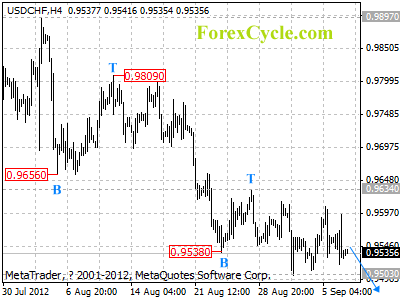
USDCHF stays in a trading range

USDCHF stays in a trading range between 0.9503 and 0.9634, the price action in the range is treated as consolidation of the downtrend from 0.9809. Another fall could be expected after consolidation, and next target would be at 0.9400 area. Initial support is at 0.9503, a breakdown below this level could signal resumption of the downtrend. Key resistance is at 0.9634, only break above this level will indicate that the downtrend has completed at 0.9503 already, then the following upward movement could bring price to 0.9800 zone.

usdchf

Daily Forex Analysis

Outright Money Transactions – Why ‘Free’ Money Costs You More

By MoneyMorning.com.au

The OMT will replace the SMP.

But to get an OMT, you first need to apply for an EFSF or ESM.

Or, if you’ve already been to see the EU or IMF, you qualify for an OMT anyway. So, well done.

What does all that nonsense have to do with financial markets?

Well, the creation of the OMT caused the FTSE 100 to rise 2.1%. The DAX added 2.9%. The Spanish and Italian indices gained 4.9% and 4.3% respectively. And the US market gained 2%.

Of course GOLD climbed too, trading above USD$1,700 this morning.

As for Aussie stocks, we expect the ‘good news’ to flow here too. But beware. Like prior false rallies, you shouldn’t think this one will last long either…

If you haven’t read today’s news you may wonder why overseas markets went berserk overnight.

The answer is due to Europe’s grand new plan, the Outright Money Transactions (OMT) programme. The Financial Times sums it up this way:

‘[European Central Bank president,] Mr Draghi said the bank could potentially buy an unlimited amount of Eurozone sovereign debt with maturities of between one and three years.

So there you have it. In effect, the ECB will print money to buy bonds from debt-laden Eurozone countries.

More free money.

Of course, some will claim it’s not free money because the Spanish and Italian governments will pay interest on the loans.

While that’s true, the point is it’s free money because the ECB will create the money from thin air. The money used to buy the Spanish and Italian bonds won’t be the proceeds from productive labour or capitalism.

The money printing is pure monetary inflation. And monetary inflation is always bad for consumers because it competes with money earned from productive labour and capitalism.

And because it’s unearned money, it naturally devalues the earned money. So while markets tend to cheer central bank money printing, and stock markets rise as investors bank on the new free cash going into stocks, what’s unseen is the negative impact the free money has on your wealth.

Why Free Money is Irrationally Exciting

Among all the stories on the Bloomberg News website covering the ECB’s latest plan was a story titled, ‘Why Free Stuff Is So Irrationally Exciting’.

The article reviews a book called Predictably Irrational: The Hidden Forces That Shape Our Decisions, by Dan Ariely.

The article reflects on the history of giveaways used in marketing products. For instance, a toy in the cereal box (we remember the tiny plastic submarine in the Corn Flakes box that was powered using baking powder), or the McDonald’s Happy Meals.

As the article notes:

‘From a business perspective, incentives have been a smart strategy from the start. They have a way of persuading us to buy goods we otherwise might not have, to buy them in greater quantities than we had intended, or to waste valuable time standing in line for a free item we have no use for…

‘It overrides the rational part of our brain that would calculate how much something offered for free might actually cost us.’

This irrational behaviour is exactly what you’ve seen in the financial markets for the past four years.

The prospect of free money printed by the world’s central banks tends to excite investors. But they don’t always think about the long-term effect of the money printing.

So just as a consumer irrationally buys a box of corn flakes to get the free plastic ship, investors irrationally buy stocks to get the effect of the free money. Their brain switches off and they follow the crowd.

However, as exciting as it may be for the first couple of times to watch that ship buzzing around the bath, the joy soon wears off…just as the joy of money printing has worn off for stock investors.

Free Money Fun Won’t Last

The red dots on the chart below show the approximate periods when the US Treasury or Federal Reserve implemented stimulus programmes (including money printing):


Click here to enlarge

Source: Google Finance

The last red dot on the right denotes where talk began in earnest of the next round of money printing. The market has gotten a boost even though it hasn’t started yet.

But for all the previous stimulus packages (TARP, QEI, QEII, Operation Twist), it’s had an impact, but not a lasting impact.

As the effects wear off, investors decide they want more free stuff, so markets begin to fall. That leads the central bankers’ to act again, fearing the economy will collapse.

Meanwhile in Europe there have been so many crises and bailouts that the following chart looks as though it’s got a bout of the measles:


Click here to enlarge

Source: Yahoo! Finance

As we pointed out yesterday, money printing and stimulus creates more, not less uncertainty for markets and businesses.

The market gets excited, but as soon as the effects start to wear off, the market is looking for the next buzz.

So now the ECB has told the world that it will buy an unlimited amount of bonds, the attention will turn back to the US to see what Dr. Ben S. Bernanke can come up with.

Buy Stocks, but Buy This Too…

In the short term, this all looks great. It’s why we’ve encouraged you to have some exposure to the stock market so you can benefit from the idiocy of central bankers.

But in the long term, we also know that getting something for free doesn’t always represent value for money. So go ahead, buy some stocks and get excited by 2% daily stock market gains.

But also remember to take note of the warning signs that show the market isn’t as sound as the mainstream would have you believe. Gold has quietly gained ground over the past month.

And as the central bankers keep doing what they’ve been doing, we’d expect it to gain more ground over the coming months.

Buy stocks. But most of all…buy gold.

Cheers,
Kris.

Related Articles

What You Must Do to Survive the Coming China Crash

The Unlikely Benefit from the Currency War on the Australian Dollar

Spanish Banks are in BIG Trouble


Outright Money Transactions – Why ‘Free’ Money Costs You More

What the Latest European Central Bank Scheme Means for Europe

By MoneyMorning.com.au

Mario Draghi has spoken.

And the markets haven’t collapsed, at least, which will no doubt be a relief to the European Central Bank (ECB) head.

The ECB kept interest rates on hold, but this was a sideshow. The big news was always going to come from the press conference afterwards. As was widely expected, Draghi confirmed that the ECB would buy an “unlimited” amount of government bonds via Outright Monetary Transactions (OMT) – but this depends on the ‘fiscal pact’ and the European Stability Mechanism (ESM – the big eurozone bail-out fund) being agreed.

As I’ve already noted, that puts the ball firmly in Germany’s court (literally) next week.

Draghi also stated that in return for any bond-buying assistance from the ECB, countries would have to agree to carry out economic reforms and to keep to fiscal targets.

To make the threat credible, the ECB will stop buying the bonds of any country that doesn’t deliver. He also emphasised that the debt purchases would focus on short-term debt, and would not include an explicit cap on yields.

Finally, any bond-buying will be sterilised, so the ECB will fund it through selling debt to the markets. The point of doing this is to avoid expanding the money supply, and therefore ease concerns about the bond-buying creating inflation.

The ECB Paves the Way to Print Money

The euro slid, then clawed its way back, as markets digested the news. However, Italian and Spanish stocks rose strongly. In part this is a reflection of the ambiguity.

On the one hand, “unlimited” support implies that the ECB’s purchases could be large. However, by refusing to put a clear cap on yields, the ECB action could just as easily end up being very small.

There are also concerns that the need for countries to agree to fiscal and policy conditions will delay bond purchases.

Certainly, if the ECB keeps to the letter of its promises, it will be very hard for it to take the action needed to keep the euro together. The need for the ESM to be approved, for a start, means that any action may be delayed for a month or two at the earliest.

The fact that the German member of the ECB also opposes the action taken suggests that Draghi will have to proceed with caution. Indeed, the German economic ministry immediately stated that bond-buying by the ECB can’t be a substitute for reforms.

However, the fact that bond-buying has been agreed at all is an important step. Once started, it is hard to see how it can now be stopped. Either the ECB prints a large amount of money, or the euro breaks up – in which case, the national banks will almost certainly step into the breach.

Indeed, the only downside fear is the ‘Hotel California’ scenario. In this case, the ECB would buy enough bonds to keep the euro together, but not enough to deliver a major economic boost. However, as we’ve said, the decision by the German Constitutional Court on the constitutionality of the ESM, expected next week, may force the ECB to become even more aggressive.

Stick with European Shares

It’s worth at least drip-feeding money into Europe. Stocks are cheap, and Draghi has shown a commitment to avoid letting Italy or Spain go bust.

Another way to take advantage of the coming money-printing is to buy gold. As we’ve said before, in the past it has proven to be among the best hedges against the inflation that is likely to result from bond purchases.

And it’s always useful to have in your portfolio in case all this experimental policy by central banks goes horribly wrong at some point in the future.

Matthew Partridge
Contributing Editor, Money Morning

Publisher’s Note: This article originally appeared in MoneyWeek

From the Archives…

Why There’s No Such Thing as a Floor Price Just the Market Price
31-08-2012 – Kris Sayce

Take Advantage of the High Australian Dollar While You Can
30-08-2012 – Greg Canavan

Smartphone, Dumb Patents
29-08-2012 – Jeffrey Tucker

Find Out if You’re a Speculator, Value Investor or Stock Trader
28-08-2012 – Nick Hubble

Why Green Energy Will Struggle Against a 790,000 Year Habit
27-08-2012 – Kris Sayce


What the Latest European Central Bank Scheme Means for Europe

They Don’t Eat iPhones in Namibia

By MoneyMorning.com.au

Every time I hear one of these western central bankers or politicians talk about how there’s no inflation, it just makes me want to vomit. This is one of the most arrogant, disingenuous, intellectually dishonest statements one can make.

And if these guys ever got off their butts and traveled somewhere, they’d see for themselves.


Case in point – here in Namibia, the country is between a rock and a hard place. Big time. Namibia’s economy is stalling. GDP growth is a mere 0.7% year over year, and unemployment has been estimated at anywhere between 28.4% to 51.2%. They just haven’t figured out which math to use yet.

Meanwhile, inflation in Namibia is becoming uncomfortably high. The official rate that the government acknowledges is at least 7%, but the street rate is well into double digits.

In the wealthy part of the world, they pretend that inflation doesn’t exist because Wal Mart cut the price of the iPhone 4S from $188 to $148. Of course, that doesn’t mean much in Namibia. These aren’t exactly the folks lining up at the Apple store.

Fact is, inflation does exist. I see it everywhere I travel. As Bernanke and Draghi print money without limit or regard for sanity, central bankers in the developing world are feverishly inflating their own currencies to keep up… and importing dollars and euros from abroad to help keep their exchange rates low.

Real World Problems Thanks to Those Out of Touch With Reality
 

The net result is cheap iPhones in America, but catastrophically higher prices for staple items like food and medicine in Namibia… and most of the developing world.

What a truly bizarre system. One guy in Washington has screwed entire nations of people, including, eventually, his own. One guy can do this. Just one. It seems so strange to have awarded such Herculean powers to a single individual… let alone one who is demonstrably out of touch with reality.

The world may indeed become a better place if Mr. Bernanke would get on a plane and go see, first hand, the deep strain caused by his policies around the world.

Fortunately for Namibia, the country is going to be just fine in the long-term. Despite the monetary misgivings of central bankers from faraway lands, this is still a country that’s twice the size of California with a sparse population of just 1.8 million. And it’s loaded with resources.

Whenever you have a huge country with massive resource deposits and a tiny population to divide it all up, this is a good sign.

Nambia’s Natural Resources Are Real Wealth
 

Namibia is in a similar category… and this bodes well for the long-term. Deep down beyond its impoverished veneer, Namibia has great wealth potential.

The country already has one of the richest commercial fishing grounds in the world thanks to its cold, clean Atlantic waters. Moreover, Namibia has vast deposits of diamonds, gold, uranium, and several other valuable resources. Many of these have been exploited for years, others are just getting started.

Uranium is particularly interesting; Namibia itself is the world’s 4th largest producer of the funky metal, and output is growing every year. The Husab project alone is presently the third largest deposit in the world. As nuclear power becomes favorable once again, Namibia will benefit substantially.

Simon Black
Contributing Writer, Money Morning

Publisher’s Note: This article originally appeared in Sovereign Man: Notes From the Field.

From the Archives…

Why There’s No Such Thing as a Floor Price Just the Market Price
31-08-2012 – Kris Sayce

Take Advantage of the High Australian Dollar While You Can
30-08-2012 – Greg Canavan

Smartphone, Dumb Patents
29-08-2012 – Jeffrey Tucker

Find Out if You’re a Speculator, Value Investor or Stock Trader
28-08-2012 – Nick Hubble

Why Green Energy Will Struggle Against a 790,000 Year Habit
27-08-2012 – Kris Sayce


They Don’t Eat iPhones in Namibia

Peru keeps rate steady, expects inflation to ease

By Central Bank News
    The central bank of Peru kept its monetary policy reference rate unchanged at 4.25 percent, as expected, saying inflation that is above its target reflected temporary supply factors in an economy that is operating at close to full potential.
    The Central Reserve Bank of Peru said the decision to maintain the interest rate, unchanged since April 2011, was taken in the context of uncertain financial markets, lower terms of trade and the “prospect of lower growth in both developed and emerging countries.”
    Peru’s central bank, which has been fighting to restrain the rise in the sol currency, said it still expected inflation to gradually converge to its target range of 1-3 percent in the rest of the year.
    Peru’s annual inflation rate rose to 3.5 percent in August from July’s 3.3 percent, but the bank said this was mainly due to higher prices of perishable food, which was affected by an adverse domestic climate. Excluding food and energy, the inflation rate was 2.4 percent.
    Peru’s economy is among the world’s fastest growing, forecast to expand by around 6 percent this year. Gross domestic product grew by 6.0 percent in the first quarter from the 2011 first quarter.
    www.CentralBankNews.info


Egypt keeps rates steady, possible upside inflation risk

By Central Bank News
    The Central Bank of Egypt held its benchmark overnight deposit rate unchanged at 9.25 percent along with its other interest rates.
    The bank issued the following statement:

In its meeting held on September 6, 2012, the Monetary Policy Committee (MPC) decided to keep the overnight deposit rate and overnight lending rate unchanged at 9.25 percent and 10.25 percent, respectively, and the 7‐day repo at 9.75 percent. The discount rate was also kept unchanged at 9.5 percent.


While headline CPI inched up by 0.38 percent (m/m) in July, the annual rate continued on a downward trend reaching 6.39 percent from 7.26 percent recorded in the previous month. Similarly, annual core CPI con

The Pitfalls of Nontraditional ETFs

By The Sizemore Letter

The following are notes from comments I recently gave on the pitfalls of investing in nontraditional ETFs.

The regulators would be wise to keep an eye on non-traditional ETFs. The original ETF structure was something that should be celebrated. It added a new level of liquidity and tax efficiency and lowered trading costs for investors who would have normally used mutual funds as their default investment vehicle. There is little not to like.

Unfortunately, the same cannot be said for some of the more exotic issues of late. I was just discussing Master Limited Partnership (MLP) ETFs and ETNs and the drawbacks of both. In the case of the ETN, JP Morgan runs a very popular option that trades under the ticker symbol $AMJ. Unlike ETFs, which hold the underlying shares of the companies they track in trust, an ETN is not much more than a bond. JP Morgan promises to pay investors a return equal to the return of the MLP index.

This is not a deal breaker, and I myself hold shares of AMJ for clients. But many of the people buying this security are completely unaware that it is not really backed by anything other than the full faith and credit of JPMorgan. And after the 2008 meltdown, that means less than it used to.  (As a secondary issue, the distributions from AMJ are taxed at a much higher rate than on the MLPs its tracks.  This isn’t an issue in an IRA account, but it is a major irritant for a taxable investor.)

The popular Alerian MLP ETF, which trades under the ticker $AMLP, is a true ETF in the sense that it holds shares of its underlying positions like a traditional ETF. But because of the accounting issues with MLPs, AMLP has an enormous hidden fee in the form of a “deferred tax liability.” I’ll spare you the details of what that actually means, but suffice it to say, the much-heralded tax benefits of traditional ETFs do not apply here.

Commodity ETFs and ETNs are also particularly problematic because, with few exceptions, they tend to use futures rather than physical commodities. (The popular $GLD is an exception; it holds physical gold in a vault.) There is nothing inherently wrong with futures for investors and traders that understand them. But most people buying, say, the oil ETF $USO, have no idea that they value of the fund erodes every month due to contango (i.e. negative roll yield). Contango is an issue that could warrant an entirely separate article, but I’ll summarize it like this: due to excessive passive investor (i.e. ETFs, mutual funds, etc.) interest in the front month contract, the price of the contract gets pushed up above the spot price. As the contract approaches maturity, its value falls to match the spot price.

Think of it like this: rather than buying low and selling high, the ETFs are perpetually buying high and selling low. This is why so many of them have underperformed the commodities they are supposed to be tracking. Frankly, it borders on criminal negligence.

A good manager knows how to mitigate or avoid these risks. This is one of those times where paying a professional manager with expertise in the area you are looking to invest in will generally make more sense than going the passive index/ETF route.


Related posts:

How the Mobile Industry’s “Most-Hated Business” is Set to Grow Five-Fold By 2016

Article by Investment U

Ever since Apple (Nasdaq: AAPL) invented the smartphone, the cellphone has never been the same.

Today, smartphones allow us to not only make calls, but surf the web, watch video, email, text, download apps, and even pay for items at select locations.

And more and more, consumers are getting on the smartphone bandwagon…

According to Juniper Research, it’s estimated that by 2016, one billion smartphones will be sold every year. That’s double the number sold now.

However, just as smartphones will be bought up in droves around the globe over the coming years, not everything about them is loved by all.

In fact, if there’s one thing people hate about them, it’s mobile advertising.

Yet, like it or not, this despised mobile business is growing even faster than the annual sales of smartphones themselves.

Perhaps the Only Good Thing About Mobile Ads

I don’t know many people who actually enjoy getting ads – especially on their phones.

But publishers and broadcasters need to pay their bills. (How do you think we’re able to make Investment U free, after all?)

Ads are just a necessary part of the business. And like it or not, the mobile ad business is booming as smartphone sales continue to soar higher.

IT research firm, Gartner (NYSE: IT), predicts that revenue from mobile advertising is set to reach $20.6 billion worldwide by 2016. That’s a 522% increase from the total revenue brought in just last year.

But that’s not all.

The best part about mobile advertising is that private investors are loving its growth prospects, too.

In 2011, venture capitalist investments in mobile marketing and advertising increased five-fold from 2010 to $592 million.

So who exactly is making money from this?

The two main players in the mobile ad market are Google (Nasdaq: GOOG) and Apple. Together they account for 57% of the mobile advertising market.

However, there’s a little-known company that’s the independent leader in mobile advertising and data, a company that’s also set to benefit as the mobile ad market continues its surge upwards.

That company is Millennial Media (NYSE: MM).

A Pure Play on Mobile Advertising

Millennial Media has been the subject of a number of recent research reports.

For example, ThinkEquity initiated coverage on shares of the company in late July.

Shortly before then, analysts at Canaccord Genuity initiated coverage on shares of MM in a research note to investors in June.

Also, Goldman Sachs (NYSE: GS) gave the company a “Buy” rating in May, predicting shares will reach $19, up from the $11.53 per share as I write.

That’s a potential gain of 64%.

All in all, Millennial Media is a company that’s set to rise should all of the predictions about mobile advertising become truth.

And if you’re a believer, why not pick up a few shares of the company that’s the purest, and biggest, play on mobile advertising around?

Good Investing,

Mike

Article by Investment U