Pound Advances on Trade Deficit Data

By TraderVox.com

Tradervox.com (Dublin) – The sterling pound has advanced to its highest level in four months against the dollar after a report in the UK signaled economic growth in the Kingdom as trade deficit contracted in July. This is the fourth time the UK currency has advanced against the dollar in the last five days. The advance is supported by sentiments that the unemployment has remained at its lowest since a year ago, a report is expected to show tomorrow. In addition, comments by policy makers in the UK that the economy is stronger than the data showed dampened speculations of expanding stimulus.

According to Jeremy Stretch, a London-based Forex Strategist at the Canadian Imperial Bank of Commerce indicated that the figures from the UK are encouraging and has fundamental implications to economic growth. He predicted that the sterling pound may strengthen more against the dollar and the euro. The figures indicate that the economy may be coming out of a double-dip recession which had worsened due to debt crisis in the euro region. Ian McCafferty, who is a Bank of England Monetaru Policy Committee member, suggested that the data is signaling some momentum in the economy in a statement he gave to lawmakers yesterday. George Osborne, the Chancellor of the Exchequer, indicated in his speech in the House of Commons yesterday said that the government will publish its Autumn Statement on December 5.

The pound is facing resistance at $1.6081 according Axel Rudolph who is a technical analyst in London at Commerzbank. The strength of the pound is seen in its performance last month, when it increased by 0.6 percent. It increased by 0.5 percent against the dollar yesterday in London to exchange at $1.6067, after it advanced to 1.6079, its strongest level since May 15. The pound fell against the euro by 0.2 percent to trade at 79.97 pence per euro.

Disclaimer
Tradervox.com is not giving advice nor is qualified or licensed to provide financial advice. You must seek guidance from your personal advisors before acting on this information. While we try to ensure that all of the information provided on this website is kept up-to-date and accurate we accept no responsibility for any use made of the information provided. Opinions expressed at Tradervox.com are those of the individual authors and do not necessarily represent the opinion of Tradervox.com or its management. 

Article provided by TraderVox.com
Tradervox.com is a Forex News Portal that provides real-time news and analysis relating to the Currency Markets.
News and analysis are produced throughout the day by our in-house staff.
Follow us on twitter: www.twitter.com/tradervox

South Pacific Currencies Strengthen on Risk Appetite

By TraderVox.com

Tradervox.com (Dublin) – As the Federal Open Market Committee meets today, speculation of an announcement to commence bond buying program have mounted, boosting risk appetite in the market. South pacific dollars have, in turn, advanced against most of their peers. The New Zealand dollar and its Australian counterpart advanced against the US dollar as Moody’s Investor Services warned that it would review the US rating to AA1 if there were no policies passed to ensure economic growth in the country. The kiwi strengthened as Fitch Ratings indicated that the AA status for the country is under no risk as the country has a strong governance and business environment.

According to Camilla Sutton, who is the Chief Currency Strategist in Toronto at Bank of Nova Scotia, indicated in a emailed statement to clients that risk aversion is limiting the Australian dollar’s advance while the advance by the New Zealand dollar is as a result of affirmation of the country’s AA status by Fitch Ratings and the declining risk sentiments. Kiran Kowshik and Steven Saywell who are renowned currency strategists in London at BNP Paribas SA, indicated that the firm has increased bets the greenback will weaken against the New Zealand dollar, predicting that it will drop to 84.70 cents against the New Zealand dollar.

The kiwi appreciated by one percent against the dollar to trade at $1.0434 yesterday in New York after it advanced by 1.1 percent to its strongest level since August 23 of $1.0449. The currency rose by 0.3 percent against the yen to trade at 81.15 yen. Kiwi gained by 1.1 percent to exchange at 81.74 US cents after reaching its August 7 strongest of 81.95 cents; it advanced by 0.4 percent against the yen to exchange at 63.56.

Steven and Kiran advised that the NZD/USD pair will catch-up with the equity performance in the markets as the kiwi stands out in the positioning perspective.

Disclaimer
Tradervox.com is not giving advice nor is qualified or licensed to provide financial advice. You must seek guidance from your personal advisors before acting on this information. While we try to ensure that all of the information provided on this website is kept up-to-date and accurate we accept no responsibility for any use made of the information provided. Opinions expressed at Tradervox.com are those of the individual authors and do not necessarily represent the opinion of Tradervox.com or its management. 

Article provided by TraderVox.com
Tradervox.com is a Forex News Portal that provides real-time news and analysis relating to the Currency Markets.
News and analysis are produced throughout the day by our in-house staff.
Follow us on twitter: www.twitter.com/tradervox
Market Review 12.9.12

Source: ForexYard

printprofile

The euro hit a fresh four-month high against the US dollar yesterday, amid speculations that a German court will rule in favor of the ECB bailout fund today. Other higher yielding assets, including crude oil and gold, extended their upward trend last night amid an increase in risk taking among investors. Meanwhile, the dollar continued to fall against its other main rivals, including the yen and Swiss franc, in Asian trading, as investors eagerly await a FOMC Statement tomorrow regarding a possible new round of quantitative easing in the US.

Main News for Today

German Constitutional Court Ruling- 08:00 GMT
• Expectations that the German court will rule in favor of the ECB bailout fund have supported riskier currencies and commodities in recent days
• If the ruling does support the ECB’s plans to combat the euro-zone debt crisis, the euro could see additional gains throughout the day

US Crude Oil Inventories- 14:30 GMT
• Analysts are forecasting the figure to come in at -1.8B
• If true, it may be taken as a sign of high demand in the US and could result in oil extending its recent bullish trend

Read more forex news on our forex blog

Forex Market Analysis provided by ForexYard.

© 2006 by FxYard Ltd

Disclaimer: Trading Foreign Exchange carries a high level of risk and may not be suitable for all investors. There is a possibility that you could sustain a loss of all of your investment and therefore you should not invest money that you cannot afford to lose. You should be aware of all the risks associated with Foreign Exchange trading.

2009′s Hot Commodity Making a Comeback

By MoneyMorning.com.au

For some reason, the resource sector likes to run with one new ‘hot commodity’ each year.

Back in 2009, lithium was the big new thing. Then in 2010, the rare earths bandwagon stole the spotlight.

In 2011 it was potash, and this year it has been graphite.

But a few years on, the lithium story has matured and is back in the spotlight for serious investors…

For one thing, lithium prices are on the march back up again. The world’s biggest producers, who all but control the market, have just increased their prices for lithium carbonate by around 20%.

The reason is that demand is rising strongly again. Lithium is an essential component of lithium ion batteries, which is what runs your mobile phone, iPad or laptop computer. Electric vehicles are a huge potential source of demand too.

The electric car revolution that got the market excited about lithium in 2009 is yet to take off in earnest. However, hybrid cars, whose batteries require a huge amount of lithium, are taking off in a huge way now.

That nerdy looking hybrid, the Toyota Prius, is now the world’s third best-selling car.

The lithium demand from batteries is growing at 20% annually, and is expected to keep at this rate for the next 10 years. This is the main reason the lithium producers are raising prices.

So I tipped an ASX listed lithium stock a few months ago. I’d watched it for years, but with the lithium sector warming up again it was a good time to take the shot. In just over 2 months readers are sitting on a 26.8% gain.

Sector Running Hot

Most of this gain has come in the last few weeks. The rally started around the time that some real fireworks went off in the sector, including a C$724 million takeover announced in the lithium sector.

Talison Lithium (TSE:TLH), which is listed in Canada but based in WA, received a C$6.50 per share cash takeover offer from Rockwood (NYSE:ROC). That price was 53% above that day’s closing price. Click here to see the chart. Shareholders have done very well!

I sent an update to Diggers and Drillers readers after news of this takeover, saying that:

‘Rockwood’s bid for Talison reminds me of BHP’s bid for Potash Corp (TSE:POT). Rockwood is a large-cap, multi-commodity company bidding for the dominant producer of a relatively obscure, but profitable commodity.

‘BHP’s bid put potash in the spotlight and the whole sector then rallied for months. However, there’s been surprisingly little Australian media on this lithium deal yet. But I think as word of this bid spreads, the takeover should focus market attention on lithium, and our lithium stock tip as the best in show. ‘

This isn’t the only takeover in the lithium space this year. Back in March, Galaxy (ASX:GXY) bought Lithium One (TSX:LI). The lithium sector isn’t very big, and these takeovers make the list of potential future targets very small.

In fact, the lithium stock I tipped will be the only new lithium brine producer to join the sector in the next few years, so is one of the few ways to play this move.

Even Rio Tinto (ASX:RIO) is getting in on the act. A few months ago, CEO, Tom Albanese said:

‘Lithium is going to be so critical to that future world of electric cars and hybrids … we’ve got a lot of interest from Japanese and Korean companies that want to be in the forefront of hybrid and lithium technologies, so I’m pretty excited about the project.’

With corporate activity taking place in the lithium sector, major resources firms showing an interest, and lithium prices rising — this sector is running hot at a time that most of the resource market is on its knees.

That’s the good thing about the resource sector; it’s a diverse place and even when things look bleak, there are normally a few hidden parts which are still working. Lithium is one of them.

2013: A Good Year for Resource Stocks?

This year I’ve focused squarely on gold, oil, and strategic minerals like lithium and graphite.

The lithium story is running hot right now, and the lithium stock I tipped a few months ago is riding the renewed interest in the sector. But more than that, it’s due to receive funding any week now.

Not many companies can secure funding in this market, so this puts it well ahead of the pack. With funding in the bank, it will immediately start building. All being well, production could be just a year away.

It looks like the lithium story has much further to run yet, but beside this there are more opportunities in the resource sector. So I’ll keep looking for more of these hidden opportunities for Diggers and Drillers readers over the coming year.

Dr. Alex Cowie
Editor, Diggers and Drillers

Related Articles

What You Must Do to Survive the Coming China Crash

Gold Up, but Gold Stocks Up More

Why Graphite is the High Tech Commodity of the Future


2009′s Hot Commodity Making a Comeback

Why the Latest Euro ‘Fix’ Could be Bad News for the US

By MoneyMorning.com.au

Investors are finally convinced that the eurozone can be saved.

European Central Bank boss Mario Draghi has made it clear that he’ll do ‘what it takes’ to stop the likes of Spain or Italy from going bust, as long as they ask for help.

The Germans might throw a spanner in the works later this week. But even if their constitutional court rejects or delays the existing big bail-out fund, chances are another fudge would be hastily pulled together.

So the ‘Armageddon’ discount is fading from European assets, which have rallied hard in recent months.

That sounds like good news. The trouble is, once investors stop fretting quite so much about Europe, they’ll wake up to the fact that the rest of the world is in a bit of a mess too.

And that could be bad news for overpriced shares in the US in particular…

European Money Printing Won’t Stop a Recession

The promise of money printing from the European Central Bank (ECB) has boosted both bond prices and share prices in the most troubled parts of Europe.

That makes sense. As we saw in both the UK and the US, a bit of money-printing (or QE – ‘quantitative easing’) can work wonders for droopy asset prices.

However, if there’s another thing we should have learned about QE by now, it’s that it doesn’t have any obviously helpful impact on the wider economy.

So while I’d be happy to keep buying European shares, I don’t expect Europe itself to make a miraculous recovery from recession in the near future.

For European stocks, this doesn’t matter too much. Overall, they’ve been pricing in complete collapse. So a mere recession comes as something of a relief.

But it’s a much bigger worry for more highly priced companies. The US is a classic example. As the FT points out, US companies are more downbeat about their prospects than at any time “since the start of the financial crisis.”

Indeed, one pundit tells the paper that: “Historically, we have only seen numbers like this during times of recession.” Yet the US stock market remains near a four-year high.

US corporate profit margins are also at record levels. That’s bad news, because it means that the only way to grow profits is to grow sales too. There aren’t any more gains to be had from ‘efficiencies’.

But if China is slowing, and Europe is in recession, the opportunities for blockbuster sales growth seem thin on the ground. In short, the US market looks vulnerable.

You’d expect investors to have taken all of this on board by now. After all, markets are meant to be forward-looking and efficient. So why haven’t they?

There are probably two main reasons. Firstly, with all the fear over Europe, just about anywhere else in the developed world has acquired a sort of ‘safe-haven’ status. US stocks have probably benefited from that.

Secondly, there’s the prospect of more QE in the US. The weak ‘non-farm payrolls’ figures on Friday cheered investors no end. They now believe that the Federal Reserve has all the excuse it needs to launch more QE this week.

But will it?

It Doesn’t Matter Whether QE3 Launches or Not

The short answer is: I don’t know, and nor does anyone else. My gut feeling is that QE3 is far from being a certainty. The timing is politically awkward, and Fed chief Ben Bernanke doesn’t command the same consensus among his troops as his predecessor Alan Greenspan did.

The market is far from being in the full-blown panic mode that we saw on previous occasions when Bernanke printed. Now that the ECB is making an effort in Europe, it seems harder for Bernanke to justify more printing in the States.

On top of that, how much good would QE3 do? If investors have any sense at all, there should be a bit of scepticism creeping in about QE’s ability to do anything helpful about the non-farm payroll figures.

But as I’ve said before, it doesn’t matter one way or the other. If the US prints more money, it’ll be good for cheap assets as well as pricey US stocks. So European shares will be buoyed too. It would also be good for gold, which you should be hanging on to as portfolio insurance.

And if it doesn’t – well, better to be invested in cheap eurozone stocks than expensive US ones at that point. In the absence of QE, disappointed US investors might start to wake up to the fact that their market is looking a little pricey, particularly if Apple’s latest iPhone doesn’t impress sufficiently.

As John Dizard notes in his FT column, as fear of a euro-disaster recedes, investment strategies will change. “The relative weakness of European assets compared to those in the US will reverse over the next couple of months.” That adjustment could just as easily come through US markets falling, as through European ones rising.

John Stepek
Contributing Editor, Money Morning

Publisher’s Note: This article originally appeared in MoneyWeek

From the Archives…

Outright Money Transactions – Why ‘Free’ Money Costs You More
07-09-2012 – Kris Sayce

Spanish Banks are in BIG Trouble
06-09-2012 – Bengt Saelensminde

With Iron Ore Prices Falling Will Fortescue ‘Break the Buck’?
05-09-2012 – Kris Sayce

Brace Your Portfolio for a Hard Landing in China
04-09-2012 – John Stepek

Australian Resources Boom Curse…or Industrial Renaissance?
03-09-2012 – Nick Hubble


Why the Latest Euro ‘Fix’ Could be Bad News for the US

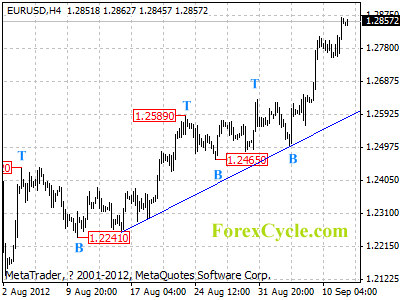
EURUSD continues its upward movement from 1.2241

EURUSD continues its upward movement from 1.2241 and reaches as high as 1.2871. Further rise could be expected after a minor consolidation, and next target would be at 1.3000. Initial support is at 1.2750, and the key support remains at the upward trend line on 4-hour chart, only a clear break below the trend line could signal completion of the uptrend.

eurusd

Daily Forex Forecast

South Pacific Dollars Decline on China Imports Data

By TraderVox.com

Tradervox.com (Dublin) – Report from China showing a drop in imports and an Australian report showing a drop in domestic home-loan approvals signaled to a worsening economic growth outlook, dampening the demand for the Australian and New Zealand dollars. The Australian dollar dropped from a two week high against the dollar for the first time in three days. Another report from China indicated that the country’s industrial output rose by least in three years indicating a decline in global economy. The New Zealand currency held its gains against the dollar as speculation of QE3 mounted as the fed prepares to meet tomorrow.

Discussing the Chinese Data, Jonathan Cavenagh, a Westpac Banking Corp strategist based in Singapore agreed that the Chinese data were very weak and south pacific currencies may experience further drops. The drop may be limited as the FOMC meets tomorrow. Government bonds in Australia declined, with ten-year yields falling 0.08 percent to 3.12 percent, as Australian home-loan approvals declined by one percent in July after increasing by the same margin in June according to a Bureau of Statics  report released yesterday. The market was expecting the report to show stagnation. Further, a report from National Bureau of statics in China showed yesterday that China’s imports declined by 2.6 percent last month from a year earlier where they rose by 2.7 percent. The report showed that production in China increased by only 8.9 percent, giving significance to President Hu Jintao’s comment that China economic growth is facing significant downward pressure. Takuya Kawabata, of Research Institute Ltd, predicted that China’s slowdown will be a major drag on the Aussie.

The Australian dollar declined by 0.3 percent against the dollar to trade at $1.0358 from last week close of $1.0385. It reached a high of $1.0401 on Sept 7, the highest it has been since August 27. The Aussie declined by 0.3 percent against the yen to trade at 81.04. The Kiwi dropped to 81.15 US cents from 81.25 after it had advanced by 2.3 percent last week. The currency dropped by 0.1 percent against the yen to exchange at 63.49.


Disclaimer
Tradervox.com is not giving advice nor is qualified or licensed to provide financial advice. You must seek guidance from your personal advisors before acting on this information. While we try to ensure that all of the information provided on this website is kept up-to-date and accurate we accept no responsibility for any use made of the information provided. Opinions expressed at Tradervox.com are those of the individual authors and do not necessarily represent the opinion of Tradervox.com or its management. 

Article provided by TraderVox.com
Tradervox.com is a Forex News Portal that provides real-time news and analysis relating to the Currency Markets.
News and analysis are produced throughout the day by our in-house staff.
Follow us on twitter: www.twitter.com/tradervox

Turkcell: Iranian Espionage, South African Corruption, and U.S. Election Politics

By The Sizemore Letter

There is never a dull moment when owning Turkish telecom provider Turkcell Iletisim Hizmetleri ($TKC).  As I’ve highlighted in recent articles, the company is still embroiled in a multi-year, intercontinental boardroom struggle that would rival a daytime soap opera for melodrama and intrigue.

Two rival shareholder factions are fighting for control, and after bouncing around courtrooms in Turkey and the Caribbean, the case is now being reviewed by Britain’s Privy Council.

Yes, the Privy Council of the Queen of England…for a Turkish mobile phone company.  I couldn’t make this up if I wanted to.

And now, Turkcell is involved in another international scandal that involves Iranian espionage, United Nations vote rigging and Republican presidential hopeful Mitt Romney.

Turkcell is suing South African mobile giant MTN for $4.2 billion over allegations the company won contracts by bribing Iranian officials with promises of weapons and South African support for Iran at the United Nations (see article).  MTN also allegedly helped the Iranian regime spy on its own citizens.

No, this isn’t a movie script. It’s business as usual in this part of the world, though the dispute has managed to spill over into U.S. politics.  One of President Obama’s chief advisors took $100,000 from MTN to deliver speeches, leading Republicans to allege that the President has an Iranian fifth columnist in his ranks. Meanwhile, Mitt Romney is a shareholder in Turkcell, meaning that he has a vested interest in the outcome of the lawsuit against MTN.

In spite of all of this drama, Turkcell’s management has done a fine job of running the company. And as investor risk appetites have returned, Turkcell has seen a monster rally in its shares.

Since hitting a bottom in late May, Turkcell is up nearly 40%. And barring a relapse into crisis by the Eurozone, I believe the stock has much further to run. It is priced at only 11 times expected 2013 earnings, and once the boardroom fiasco is put to rest—and at the risk of sounding like a broken record, it soon will be—investors will likely enjoy a large cash bonus from past years’ unpaid dividends and a regular dividend in the ballpark of 3-4%.

I chose Turkcell as my entry in InvestorPlace’s 10 stocks for 2012 contest because I considered it a conservative way to play the emergence of Turkey and its up-and-coming middle class. Thus far, the pick has performed even better than expected, up 26% year to date. With one quarter remaining, Turkcell is in second place, trailing only Capital One ($COF).

SUBSCRIBE to Sizemore Insights via e-mail today.

Related posts:

Pound Advances against the Euro on Debt Crisis Concerns

By TraderVox.com

Tradervox.com (Dublin) – The sterling pound advanced against the euro as concerns on worsening debt crisis rose. The pound increased as signs of recovery started to show following positive UK data last week. It emerged from a near two-month low against the euro as coalition government in Greece failed to agree on austerity measures. The pound has also gained against the US dollar, reaching a four-month high last week as UK services expanded in August and manufacturing recovered. These positive data from the UK are indicative of a recovering economy and speculations of quantitative easing measures are receding.

According to Peter Kinsella, a London-based Senior Foreign Exchange Strategist at Commerzbank AG said that the UK data is on the stronger side, hence boosting the sterling against the euro. He projected that the solutions in Europe will not be enough to push the euro above 80 pence. The pound has been among the best performers last month, increasing by 0.7 percent where the US dollar fell by 1.5 percent and the euro climbed by 2.9 percent. Economists expect the strong performance by the pound to continue today, when the UK trade deficit report is released. The market is expecting the deficit to shrink to 9 billion pounds. Another report on September 12 is expected to show that UK unemployment rate is at 8 percent according to market estimates.

The effects of Greece crisis on the euro was larger than the effect of a report released yesterday showing that the UK business confidence dropped to a new low in August. The sentiment gauge dropped to 89.1 in August from 93 in July according to a report by BDO LLP yesterday, this is the lowest it has been since the gauge was introduced in 1992. However, this did bar the pound from increasing against the euro by 0.2 percent to 79.87 pence per euro. The pound was trading at $1.5996 against the dollar, after it had closed the week at $1.6034.

Disclaimer
Tradervox.com is not giving advice nor is qualified or licensed to provide financial advice. You must seek guidance from your personal advisors before acting on this information. While we try to ensure that all of the information provided on this website is kept up-to-date and accurate we accept no responsibility for any use made of the information provided. Opinions expressed at Tradervox.com are those of the individual authors and do not necessarily represent the opinion of Tradervox.com or its management. 

Article provided by TraderVox.com
Tradervox.com is a Forex News Portal that provides real-time news and analysis relating to the Currency Markets.
News and analysis are produced throughout the day by our in-house staff.
Follow us on twitter: www.twitter.com/tradervox

Renewable Energy Sources Could be the Key to Reaching Through to Iran

By OilPrice.com

Why are we even talking about Iran’s nuclear program when renewable energy offers a clear way out of this conundrum? If we can remove bad politics from the equation for a moment and get back to business as usual, energy diplomacy with Iran could render the nuclear question irrelevant altogether.

The West is not alone in the pursuit of renewable energy capacity. Middle Eastern countries are on the same path, and that includes Iran. Iran’s nuclear energy efforts were initially a reflection of the reality that oil and gas resources will not last forever. The answer to this reality was to fall back on nuclear energy, which has in turn become the focal point of a bitter conflict between Iran and the West.

But even nuclear energy is becoming yesterday’s news, both because of the push to harness renewable energy sources and also as a result of nuclear disasters, most recently that in Fukushima-which very clearly demonstrated the inability to protect nuclear facilities from Mother Nature.

Helping Iran to shift to the development of renewable energy resources would gradually remove all justification and necessity for a nuclear energy program, not the least because nuclear energy is the purview of states rather than private corporations, so there is money to be made.

That Iran is keen to pursue renewable energy efforts is clear enough. In May this year, Iranian President Mahmoud Ahmadinejad approved the allocation of €500 million from the €35 billion National Development Fund for renewable energy projects. The money is earmarked for loans for smaller developers. This purpose of the National Development Fund is to ensure that oil and gas revenues are reinvested in social development projects, with renewable energy playing a growing role.

Also supporting the solar industry is the state-sponsored Renewable Energy Organization of Iran (SUNA), which is attached to the Energy Ministry and enjoys a budget of around $60 million.

In 2010, the Iranian government announced plans to build 2,000MW of renewable energy capacity over the next five years. As of that same year, Iran had 8,500MW of hydroelectric capacity and 130MW of wind energy capacity. Iranian officials also said at the time that private companies had signed contracts to build more than 600MW of biomass systems and 500MW of new wind energy projects.

Iran is also working to make renewable energy commercially viable and the Ministry of Energy is required to buy privately produced renewable energy at world market prices. A feed-in-tariff (FiT) for wind and biomass energy of around 13 cents/kWh also helps.

Renewable energy is essential to Iran as it will curb massive pollution and increase the country’s ability to export oil and gas. Currently, the cost of fuel for producing electricity for domestic consumption and for exporting oil and gas is unsustainable in the long term.
Iran has vast untapped solar, wind, geothermal and hydroelectric sources that hold the potential to meet domestic needs and boost export capacity, and in the process make nuclear energy irrelevant. To do this, it will require massive investments.

Sanctions are not only costly to Iran, they are devastating to much of the world, and particularly to the European Union, whose decision to slap its own new sanctions on Iran in July was a political response to Israel-a response intended to steady the Israeli trigger finger poised to attack Iran. Europe cannot afford these sanctions. Investment in renewable energy technology and development would benefit all financially, geopolitically and in terms of energy independence.

The one potentially productive aspect of sanctions against Iran is that they may boost Iran’s renewable energy efforts. Earlier this year, Iranian officials hinted at just that, with the country’s energy minister calling for increased investment in renewable energy as a path forward in the face of less-than finite fossil fuels supplies and the sanctions regime.

“Gradual reduction of oil consumption on the one hand and a revolutionary and swift move toward using renewable energies on the other hand are the only appropriate mechanisms which can help the country,” Iranian news agencies quoted the minister as saying in a statement delivered to the National Energy Conference in southern Iran.

For those who ask why we should do business with the “enemy”, consider this: We did business with the Soviet Union for four decades of Cold War, and with Iran during its war with Iraq.


Source: http://oilprice.com/Alternative-Energy/Renewable-Energy/Deal-with-the-Devil-Invest-in-Iranian-Renewable-Energy.html

By. Jen Alic of Oilprice.com