Technical Report For Major Pairs This Week

By TraderVox.com

Tradervox.com (Dublin) – The dollar has continued with declines against major peers in the market as Bernanke announce the QE3. The euro gained as the German Court ruled in favor of the European Stability Mechanism increasing the demand for risk in the market. Last week was dominated by fundamentals as the market reacted to economic reports. Here is a quick analysis of what happened and what to expect this week.

EUR/USD: the cross went beyond the 1.30 level, after the court ruled in favor of the ESM and as the dollar weakened on Bernanke’s announcement of QE3. This week, there are sentiments that the European issues are improving and the dollar has been debased in the previous week. Spain and Greece are the major concerns this week and this might keep the cross just above the 1.30 level. However, there is a possibility of correction after a strong euro rally hence it is wise to proceed with caution this week.

GBP/USD: the pair started the week at 1.5991 and climbed to 1.6256 as it broke resistance at 1.6247. The pair reclined to 1.6210 at the end of the week. With strong UK reports expected this week, the pound is will continue with its upward trend this week. US data this week are expected to fuel the upward trend of the cross as the market digest the quantitative easing announcement.

USD/JPY: the pair opened the week above the support line at 78 and fell deeper into 77 levels as the yen strengthened. However the dollar strengthened at the close of the week as speculation of BOJ intervention emerged. The pair closed the week at 78.38. As the pair is influenced by the US yields, it is expected that more investors will be investing in the dollar as fears of intervention from BOJ continues. The market will be looking at the Bank of Japan as it meets this week.

USD/CHF: the pair started at 0.9454 and went up to 0.9483. The pair then dropped sharply, reaching the level of 0.9239. It closed the week above the support line at 0.9250 at 0.9262. The sentiments on this pair give a bearish outlook on the pair.

Disclaimer
Tradervox.com is not giving advice nor is qualified or licensed to provide financial advice. You must seek guidance from your personal advisors before acting on this information. While we try to ensure that all of the information provided on this website is kept up-to-date and accurate we accept no responsibility for any use made of the information provided. Opinions expressed at Tradervox.com are those of the individual authors and do not necessarily represent the opinion of Tradervox.com or its management. 

Article provided by TraderVox.com
Tradervox.com is a Forex News Portal that provides real-time news and analysis relating to the Currency Markets.
News and analysis are produced throughout the day by our in-house staff.
Follow us on twitter: www.twitter.com/tradervox

Market Review 18.9.12

Source: ForexYard

printprofile

The euro was able to hold steady at the 1.3100 level against the US dollar last night, just below a four-month high. After an unexpected drop yesterday, the price of crude oil, gold and silver stabilized during the Asian trading, and remain near recent multi-month highs. Analysts attributed yesterday’s bearish movement, which saw the price of crude fall more than $3 a barrel in a matter of minutes, to low volatility in the marketplace, which can sometimes result in erratic price shifts.

Main News for Today

German ZEW Economic Sentiment- 09:00 GMT
• As the euro-zone’s biggest economy, indicators out of Germany tend to have a significant impact on the euro
• Today’s news is forecasted to come in at -19.2, significantly better than last month’s -25.2
• Any better than expected news could help the euro extend its recent gains against the US dollar and Japanese yen

Read more forex news on our forex blog

Forex Market Analysis provided by ForexYard.

© 2006 by FxYard Ltd

Disclaimer: Trading Foreign Exchange carries a high level of risk and may not be suitable for all investors. There is a possibility that you could sustain a loss of all of your investment and therefore you should not invest money that you cannot afford to lose. You should be aware of all the risks associated with Foreign Exchange trading.

Weekly Fundamental Outlook: Major Events

By TraderVox.com

Tradervox.com (Dublin) – Last week the dollar dropped against all its peers as Federal Reserve Chairman Ben S. Bernanke announced the third round of quantitative easing. Further, positive reports from Europe boosted the euro and risk related currencies. Here are some of the major events this week expected to shape the market this week.

Tuesday 18

The UK inflation data will be released on this day at 0830hrs. The consumer prices in July advanced to 2.6 percent after a 2.4 percent reading in the previous month. The advance was related to high transportation cost, footwear, and clothing. However, economists are expecting a decline in this report to 2.5 percent. The other major event on this day will be the euro-zone German ZEW Economic Sentiment, which will be released at 0900hrs GMT. This reading declined in August by 5.9 points to its lowest level in 2012 of minus 25.5 points. Economists are expecting an improvement to minus 19.7.

Wednesday 19

There are four major events on this day, the first one being the Japanese Rate Decision. The market expects the bank to give warnings about currency intervention but no change is expected in the BOJ’s monetary policy. US Building Permits and the Existing Home Sales are the other two major events on this day. The US Building Permits at 1230hrs is expected to register a slight decline to 790,000 from the 812,000 registered in July. The US Existing Home Sales report will be released at 1400hrs and is expected to show an improvement to 4.59 million from the 4.47 million realized in July. The New Zealand GDP report will be released at 2245hrs GMT, where a growth rate of 0.4 percent is expected.

Thursday 20

There are two major events from the US on this day –the US Unemployment Claims and US Philly Fed Manufacturing Index. At 1230hrs GMT, the US Unemployment Claims report will be released. Last week’s data showed the highest number of Americans asking for unemployment claims in two months, where it reached a high of 382k. The market is expecting a drop to 370,000 this week. The US Philly Fed Manufacturing Index will be released at 1400hrs GMT where a slight improvement to -4.1 is expected this time. Mario Draghi’s Speech at the European Systemic Risk Board Meeting will be the last major event of the week and it will take place at 1600hrs GMT. The speech is expected to create volatility in the market and economists and investors will be evaluating it for any clues of the next ECB move.

Disclaimer
Tradervox.com is not giving advice nor is qualified or licensed to provide financial advice. You must seek guidance from your personal advisors before acting on this information. While we try to ensure that all of the information provided on this website is kept up-to-date and accurate we accept no responsibility for any use made of the information provided. Opinions expressed at Tradervox.com are those of the individual authors and do not necessarily represent the opinion of Tradervox.com or its management. 

Article provided by TraderVox.com
Tradervox.com is a Forex News Portal that provides real-time news and analysis relating to the Currency Markets.
News and analysis are produced throughout the day by our in-house staff.
Follow us on twitter: www.twitter.com/tradervox

Banging the Tin Drum

By MoneyMorning.com.au

You should have seen the excitement in the eyes of my colleagues yesterday when I told them I was going to a tin market seminar!

I had to beat them off with a stick just to keep my ticket. It was fierce!

OK. It wasn’t quite like that. But I think tin is interesting anyway.

And more importantly, I think it’s on overlooked investing opportunity that could make investors a good return

I’ve been ‘banging the tin drum’ for a few years now, and looking to play the market through small-cap tin stocks. This worked well, with the two stocks I tipped reaching gains of 82% and 54% at their peak.

Since then the tin price has pulled back, the mining sector has been belted, and both stocks are back to where we started.

Although it’s better if the share price goes up, this price action is actually great news if you’re new to the tin story. Why? Because tin looks primed for another big rally, like the first time I tipped tin stocks. In other words, it’s time for a second bite of the apple.

But why the excitement over tin? And what’s it used for?

Big Demand Brewing for Tin

Tin’s main use is in the electronics industry. Apparently after a slow year or two there are signs of life coming back to this sector, generating a rise in tin demand. Yesterday’s tin seminar gave me a chance to get an update on the market, and give me a few surprises to boot.

For example, I had no idea that tin is now used significantly in lithium ion batteries.

Thanks to use in mobile phones, tablet computers and laptops, and now that the hybrid car industry is taking off, the lithium ion battery market is really exploding. Even the conservative analysts at broking firm Citi reckon it will triple in size within a decade.

This means that (until recently unknown to me) the Diggers and Drillers buy list has an exposure to three of the main ingredients of lithium ion batteries.

We’re already sitting on good returns of 27% and 128% in the last few months from tipping lithium and graphite stocks (also used in lithium ion batteries). So it was music to my ears that tin is now a major input to the new generation lithium ion batteries made by Sony and 3M.

Peter Kettle, the Manager of Markets for the International Tin Research Institute (ITRI), gave the talk at yesterday’s presentation. This is the peak body for the tin market, which is now worth around $10 billion annually.

When I asked him how much demand for tin lithium ion batteries is generating, he estimated it’s already adding 1-2% of total demand. This may not sound like much, but it’s big enough to be a swing factor in a market that’s as tight as tin’s.

The reason things are so tight is that the main supplier of tin, Indonesia, is struggling to maintain production. A lot of supply was coming from small inefficient operations, dredging ‘alluvial tin’ from rivers. But most of the ‘easy stuff’ is gone now, and besides, the government has clamped down on such an environmentally destructive method of mining.

So there is now a vacuum for a few years until new projects come on line. And that means prices should only go one way until then.

Tin Stocks Set to Fly?

Another reason to expect tin prices to keep rising now is the Quantitative Easing (money printing) I wrote to you about yesterday. The last few times the Fed embarked on this madness, commodity prices soared. As tin makes up one of the smallest commodity markets of all, the tin price soared more than any of its peers in response to the newfound liquidity sloshing around in the markets.

For example, during QE2 the tin price increased more than 100%. And when the European Central Bank carried out their Long Term Refinancing Options (LTRO1/2) at the start of this year, tin rallied over 30%.

Now we have open-ended QE from the Fed, AND talk of unlimited bond purchases by the European Central Bank.

This is a double whammy of money printing from the world’s two largest central banks — at the same time.

Commodity indices like the CRB index have already rallied over 15% in the last few months in anticipation of this. Likewise, tin has had a head start too.

Quantitative Easing to Send the Tin Price Soaring — Like Last Time?

Source: London Metals Exchange

Commodity analysts, CRU, updated their commodity forecasts recently. The only commodity they are more bullish about than tin is palladium.

It’s hardly a fair competition though, as palladium is at the mercy of the chaotic and fatal mining protests in South Africa, the world’s key source of the metal. Though, this comparison puts the bullish set-up in tin in some sort of context.

Everything is now in place for tin to have a big run up. Demand is rising and new uses are emerging, supply is struggling, and the market is about to see a massive rush of liquidity looking for a home.

Peter Kettle from ITRI didn’t want to be held to an official forecast, but thinks $35,000 per tonne is possible. That would mean a 62% price jump from current levels which may sound bullish, but seems quite likely to me given that tin increased 100% during QE2.

And besides, tin has already reached those seemingly lofty levels before.

I’d be tempted to go one better, and say that if tin doubles as it did last time, it could punch through $40,000 by the end of this rally.

If it does — expect tin stocks to come back to life again very soon.

Dr. Alex Cowie
Editor, Diggers and Drillers

Related Articles

What You Must Do to Survive the Coming China Crash

Why Does the World Still Trust This Man?

Gold Up, but Gold Stocks Up More


Banging the Tin Drum

A Bear Market Where You Least Expect

By MoneyMorning.com.au

While events in the US and Europe impact the Aussie market, events in China are far more important as they will affect our economy.

There are now two competing China narratives. One is that the decade long China led resources boom is over.

The other is that China is undergoing a managed slowdown and demand for Australia’s raw materials will soon pick back up. This being the case, the recent collapse in iron ore and coal prices will soon reverse.

But it’s not quite as simple as that.

There are two parts to the commodity story. Two very different parts.

What if I told you that many of the commodities Australia produces have been in a long bear market? You probably wouldn’t believe me.

Check out the following chart…

Aussie Dollar Commodity Prices in a Long Term Bear Market

Source: Stockcharts

It shows the Reuters/Jefferies CRB index (a US dollar index) priced in Aussie dollars. The index includes all commodities including base metals, agriculture, energy and precious metals. It excludes bulk commodities like iron ore and coal.

The Downside of the High Aussie Dollar

It’s a pretty shocking chart. While the China boom has obviously done wonders for export volumes over the decade, it has done nothing for prices when adjusting for Aussie dollar strength. Just a few months ago, commodities priced in Aussie dollars were BELOW 1999 levels! That was back when the Tech Bubble was in full swing…

There are a few points to note about this chart…

For many Aussie based commodity producers (who denominate revenues and costs in Aussie dollars) there has been no price boom. Making things worse, cost inflation over the decade, coupled with a price collapse since 2009, means profitability for many producers must be near all-time lows.

The other obvious conclusion to draw is that if other commodities are in the doldrums, the bulk commodities — coal and iron ore — must have been doing all the heavy lifting. In other words, the commodity boom, especially over the past few years, has been dangerously narrow.

That’s not a particularly huge revelation. But if the commodity and terms of trade boom are all about Chinese steel production and the coal and iron ore that feeds it, then you have to wonder about the fundamentals of the Aussie dollar.

In my view the iron ore and coal bubble is in the process of going bust. A bubble bust is a process where prices ALWAYS overshoot on their mean reversion journey.

Those hoping that bulk commodity prices will rebound strongly or that further Chinese stimulus will come to the rescue are unwittingly churning out that well-worn phrase…this time is different.

My conclusion? The Aussie dollar is way overvalued. It must fall to restore competitiveness and profitability to our ‘other’ commodity industries, not to mention to the benefit of other non-commodity sectors.

Greg Canavan
Editor, Sound Money. Sound Investments.

From the Archives…

What the Central Banks Are Doing to Your Money
14-09-2012 – Kris Sayce

Luxury Firm Burberry Highlights the Chinese Slowdown
13-09-2012 – John Stepek

Gold Up, but Gold Stocks Up More
12-09-2012 – Dr. Alex Cowie

The ECB is Only Fooling the Gullible
11-09-2012 – Dan Denning

Why This ‘Ludicrous’ Investment Keeps Going Up
10-09-2012 – Kris Sayce


A Bear Market Where You Least Expect

Investments to Avoid as China Crash Lands

By MoneyMorning.com.au

The key to making money in investment is to buy assets when they are cheaper than they should be, then sell them when they are more expensive than they should be.

In other words, even the dodgiest-looking market may have its price, if it falls far enough. We’ve been promoting the virtues of beaten-down European markets for the last few months, for example.

So far, that’s paid off. So are there any other markets that look ripe for a turnaround?

Well, if you’re looking for beaten-down markets, China certainly qualifies. The Chinese Shanghai Composite Index has endured a vicious bear market since it peaked in 2007 at more than 6,000. The market is down by nearly 70%.

With the Federal Reserve launching the third batch of quantitative easing (QE) last week, could things be looking up for China?

I don’t think so. Here’s why.

China’s Landing Could be Very Hard

If it was ever contrarian to bet on a hard landing for China, those days are gone. I don’t think anyone can really argue with the view that China has some problems to sort out.

So it might seem to make sense to buy Chinese stocks now. After all, they’re not far off the lows seen in 2008. And they’re around 70% off the peak. Surely the worst is priced in?

This is where I’d disagree. I’d say that Europe has just about priced in the worst-case scenario. There, the chances of an unexpected, cataclysmic implosion of the financial sector have receded sharply. Investors have gone from expecting the euro to shatter, to anticipating a painful, drawn-out recession instead. Believe it or not, that’s an improvement.

With China, on the other hand, investors are really only just coming to terms with the ‘hard landing’ scenario. Most of them aren’t especially sure what a ‘hard landing’ even means.

If something nastier happens – like a system-wide banking crisis that the authorities have difficulty sweeping under the carpet – then stocks could fall yet further.

And that’s what I’d be worried about. Writing in The Diplomat, Minxin Pei reminds us of an ‘iron law of financial calamity.’ While financial busts have ‘different immediate triggers’, they all share a single underlying cause: ‘an explosion in credit.’

He goes on to list a whole range of statistics on just how much bad debt Chinese banks could be sitting on. To cut a long story short, the Chinese stimulus package of 2008/09 was funnelled through the banks. As a result, they loaned money for lots of ‘prestige projects or economically wasteful investments.’

On top of that, there’s all the money in China’s “shadow” banking system. These are effectively “off-balance-sheet” loans, similar to the loans that brought down Western banks. Minxin reckons that ‘Chinese banks are trying to hide the mother of all debt bombs.’

I don’t think anyone would argue with this. The difference between the bulls and the bears is that the bulls reckon that China’s canny leaders can fix the banking system at any time they want.

But that faith doesn’t seem to be shared by those at the sharp end – the Chinese themselves. The Financial Times ran an interesting piece from the World Economic Forum in eastern China last week. Apparently, it was characterised by bullishness from Western investors, and deep pessimism from the Chinese.

One Chinese economist told the paper: ‘I believe China is going to experience a very serious economic downturn and I think it has already started… If [the government] can’t turn things around then I expect huge and widespread social unrest.’

It doesn’t help that the US election has thrown another variable into the mix. The only thing that makes me feel better about British politics is looking across the Atlantic and seeing just how much worse things could be.

Conveniently timed ahead of a visit to what the FT describes as ‘the manufacturing-heavy state of Ohio’, Barack Obama’s team has attacked China over its export subsidies for cars and car parts. The US government is taking China to the World Trade Organisation, complaining that the subsidies have disadvantaged US manufacturers.

Given that the US has just deliberately tried to weaken its own currency through QE3, you might see this as a tad cheeky. But with both countries undergoing leadership contests, protectionist sentiment is likely to be ramped up further to appeal to nationalistic voters.

Buy Europe, not China

In short, Europe is cheap, and the risks are known. I feel comfortable that the level of potential reward is worth taking the risk for.

China, on the other hand, might be cheap, but it’s fraught with unknown risks. I don’t know just how difficult the leadership transition might turn out to be. All I know is that it seems a lot less smooth than the China bulls would have predicted at the start of this year.

I don’t know just how bad its banks’ balance sheets are. All I know is that credit bubbles throughout history end badly. No one has convinced me yet that China has come up with a debt hangover cure that actually works.

And I don’t know how serious the current territorial dispute with Japan is. All I know is that history suggests that nationalist sabre-rattling is a sure sign of internal political strife.

That’s why I won’t be investing in China. There are still too many other more attractive opportunities out there.

It’s also why I’d keep avoiding industrial metals miners, and other commodity-dependent economies, such as Australia. QE3 might be able to prop up a lot of asset prices, but it’ll have difficulty keeping industrial commodity prices up if a steady swathe of bad news keeps emerging from China.

Of course, there’s one group of miners that could do rather well out of QE3 – that’s gold miners.

John Stepek
Contributing Editor, Money Morning

Publisher’s Note: This article originally appeared in MoneyWeek

From the Archives…

What the Central Banks Are Doing to Your Money
14-09-2012 – Kris Sayce

Luxury Firm Burberry Highlights the Chinese Slowdown
13-09-2012 – John Stepek

Gold Up, but Gold Stocks Up More
12-09-2012 – Dr. Alex Cowie

The ECB is Only Fooling the Gullible
11-09-2012 – Dan Denning

Why This ‘Ludicrous’ Investment Keeps Going Up
10-09-2012 – Kris Sayce


Investments to Avoid as China Crash Lands

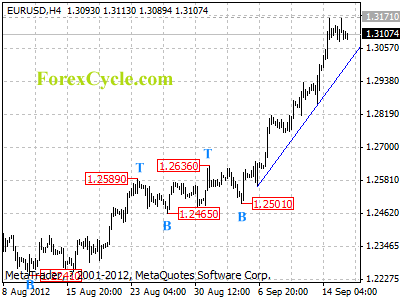
EURUSD’s upward movement extends to 1.3171

EURUSD’s upward movement from 1.2501 extends to as high as 1.3171. Support remains at the trend line on 4-hour chart, as long as the trend line support holds, uptrend could be expected to continue, and next target would be at 1.3300 area. On the other side, a clear break below the trend line support will indicate that a cycle top has been formed at 1.3171, and consolidation of the uptrend is underway, then further decline to 1.2900 area could be seen.

eurusd

Daily Forex Forecast

Sri Lanka keeps rate steady, says past efforts paying off

By Central Bank News
    The Central Bank of Sri Lanka kept its benchmark repurchase rate unchanged at 7.75 percent, as expected, saying past efforts to curb high demand for imports and credit are starting to pay off.
    “Reflecting the impact of the policy measures taken, credit obtained by the private sector has decelerated since the second quarter of 2012, and the policy measures in place are expected to help ensure that the growth of credit will be within the desired level at year end,” the central bank said in a statement.
    Average monthly credit expansion decelerated to some 27 billion rupees in the second quarter, down from an average expansion of about 52 billion, the central bank said, adding that the amount of credit was still sufficient to ensure reasonably robust economic activity.
    Sri Lanka’s economy expanded by 6.4 percent in the second quarter, down from 7.9 percent in the first quarter. Inflation rose to 9.5 percent in August, down from a 3-1/2 year high of 9.8 percent in July, but the central bank said policies adopted by authorities are expected to help contain inflation to single digits.
    The bank has raised interest rates twice this year, by a total of 75 basis points.

    Sri Lanka’s central bank said the growth of imports had decelerated considerably since April, outpacing the decline in export growth, resulting an improve trade balance.
    In addition, growing positive investor sentiment has resulted in net inflows of $229 million to the Colombo stock exchange while proceeds of a bond issue in July helped boost gross official reserves to over $7 billion by end-July.
    www.CentralBankNews.info
   

Gen Z: The Money Won’t Fall In Your Lap

By The Sizemore Letter

The following article by Michael Tarsala was originally published by Covestor.

Gen Z: Many people age 22 or younger have a laissez-faire attitude toward money. They expect to inherit it.

But experts say most of their parents’ assets will dwindle before it falls into the laps of the youngest adult generation. A recent TD Ameritrade survey suggest that just 16 percent of parents plan on leaving anything for their GenZ kids.

That points back to a recurring problem shared among the past three generations, says Charles Sizemore, manager of Dividend Growth and three other investment models offered by Covestor: Not socking away enough money in prime earning years.

The same can be said of the Baby Boomers and, for that matter, every generation that has followed. All were chronic under savers for most of their working lives, accrding to Sizemore.

“And most cannot expect to have their retirements funded by an inheritance,” he says.

In most cases, it’s a problem of division. Most Boomers have multiple siblings, and any inheritance would likely be split among heirs. So a nest egg that supported one couple in retirement will now be split into two or more pieces for each of the children.

“Unless the parents were extremely wealthy or their children’s spending habits very modest, it is hard to see much of a windfall effect,” Sizemore says.

It doesn’t help that most portfolios have seen little growth in the last decade and that end-of-life expenses (i.e. large medical bills) often have a devastating effect.


No related posts.