EUR/USD Hits 1-Week Low amid Poor French, Chinese Data

Source: ForexYard

Risk aversion returned to the marketplace yesterday after disappointing economic indicators out of China and the euro-zone resulted in higher-yielding currencies and commodities turning bearish throughout the day. In addition to the EUR/USD, which hit a one-week low, the AUD and crude oil also saw downward movement. As markets get ready to close for the week, traders should note that a lack of significant news events today may result in a low liquidity trading environment. That being said, any talk of a euro-zone bailout of Spain, which is widely expected to occur in the near future, may lead to volatility.

Economic News

USD – Dollar Benefits from Risk Aversion

The US dollar was able to take advantage of risk aversion in the marketplace following a series of disappointing indicators out of China and the euro-zone, which led to gains against several of its main currency rivals. The AUD/USD tumbled close to 100 pips during Asian trading, eventually reaching as low as 1.0366. Despite a slight upward correction later in the day, the pair was once again bearish by the evening session. Against the Swiss franc, the greenback gained more than 90 pips during the first half of the day, and by the end of the European session was trading at the 0.9350 level.

Turning to today, traders will want to pay attention to announcements out of the euro-zone, particularly with regards to the current situation in Spain. It is widely expected that the Spanish government will soon request a bailout from the ECB. Any signs today that the request may come soon could lead to significant volatility before markets close for the weekend. If the situation in Spain turns out to be worse than originally thought, the dollar could extend its upward trend vs. its riskier currency rivals.

EUR – Disappointing French News Turns EUR Bearish

The euro fell against most of its main currency rivals yesterday, after several worse than expected French economic indicators led to risk aversion in the marketplace. In addition, a disappointing Chinese manufacturing figure led to fears regarding the pace of the global economic recovery. Against the US dollar, the euro slipped more than 80 pips during European trading to reach as low as 1.2917, a one-week low. Meanwhile, the EUR/JPY dropped some 78 pips to trade as low as 100.92, its lowest level since last Friday.

As markets get ready to close for the week, traders will want to pay attention to announcements out of Spain regarding its debt issues and whether the Spanish government will seek a bailout package. Despite the fact that a bond auction yesterday signaled increased demand for Spanish debt, most investors remain convinced that a bailout request is likely to happen in the near future. Any signs that the situation in Spain is worse than previously thought could result in the euro extending yesterday’s losses.

Gold – Gold Turns Bearish after Disappointing Global News

Gold spent most of yesterday’s trading session in a bearish trend, as a series of disappointing economic indicators out of China and the euro-zone weakened demand for commodities and precious metals. The price of gold fell by more than $15 an ounce over the course of the day, eventually reaching as low as $1755.60 before staging a mild upward correction during the afternoon session.

Today, gold traders will want to pay attention to the EUR/USD. If the euro continues to fall against the greenback, gold may extend yesterday’s bearish trend. A weakened euro typically means that gold becomes more expensive for international buyers, which can lead to a drop in prices.

Crude Oil – Crude Oil Sees Minor Gains in European Trading

The price of crude oil saw minor gains during European trading yesterday, following its drop to a six-week low during the Asian session. After reaching as low as $90.94 during early morning trading, crude was able to stage a brief recovery which brought it above the $92 a barrel level by the afternoon.

Today, crude traders will want to note that if risk aversion continues to dominate market sentiment, the price of crude may extend yesterday’s losses. Attention should be given to higher yielding currencies, including the EUR and AUD. If they see additional bearish movement today, so might oil.

Technical News

EUR/USD

The Slow Stochastic on the weekly chart appears close to forming a bearish cross, signaling that a downward correction could occur in the coming days. This theory is supported by the daily chart’s Williams Percent Range and Relative Strength Index, both of which have crossed into overbought territory. Going short may be the best choice for this pair.

GBP/USD

The daily chart’s Relative Strength Index is currently in overbought territory, indicating that this pair could see downward movement in the near future. This theory is supported by the Slow Stochastic on the weekly chart which has formed a bearish cross. Opening short positions may be the preferred strategy today.

USD/JPY

The Bollinger Bands on the weekly chart are narrowing, indicating that this pair could see a price shift in the coming days. That being said, most other long-term technical indicators are currently range trading, making the direction of the price shift difficult to predict. Taking a wait and see approach for this pair may be the best choice.

USD/CHF

The Slow Stochastic on the daily chart appears close to forming a bullish cross, signaling that this pair could see upward movement in the near future. Furthermore, the Relative Strength Index on the same chart has dropped below the 30 level. Traders may want to open long positions for this pair.

The Wild Card

USD/SEK

A bullish cross on the daily chart’s Slow Stochastic indicates that this pair could see upward movement in the near future. This theory is supported by the Williams Percent Range, which has crossed into oversold territory. Going long may be the smart choice for forex traders today.

Forex Market Analysis provided by ForexYard.

© 2006 by FxYard Ltd

Disclaimer: Trading Foreign Exchange carries a high level of risk and may not be suitable for all investors. There is a possibility that you could sustain a loss of all of your investment and therefore you should not invest money that you cannot afford to lose. You should be aware of all the risks associated with Foreign Exchange trading.


Australian Dollar Advances of Signs Central Banks are Supporting Growth

By TraderVox.com

Tradervox.com (Dublin) – Aussie advanced against most of its peers as signs Federal Reserve is supporting growth and Europe is heading closer to solving the debt crisis emerged, spurring demand for higher yielding currencies. The Australian dollar advanced against the yen and the US dollar after the Minneapolis Federal Reserve Bank President Narayana Kocherlakota indicated that the Federal Reserve should continue with its near zero interest rates until the unemployment drops from above 8 percent to below 5.5 percent. The Australian currency also gained after a report in Financial Times indicated that European Union leaders are in talks about a new rescue plan for Spain. The south pacific currency is set for a weekly decline after the International Monetary Fund member indicated that the organization is considering lowering global economic forecast.

According to Jonathan Cavenagh, a Currency Strategist in Singapore at Westpac Banking Corp, the Spain seems to be closer to bailout, which will reduce the tail risks related to the European economic outlook. Further, he pointed out that Kocherlakota’s comments have boosted growth sentiments, which will be positive for the Aussie in the short term. Despite today’s ascent, the Australian dollar is set to register a weekly decline against the US dollar. The New Zealand dollar is set to make a weekly gain against the US dollar.

The Australian dollar is set to decrease by 0.8 percent this week against the US dollar while the New Dollar will increase by 0.1 percent after increasing by 2 percent in the previous week. This comes at a time when the Fed is seen supporting low interest rates as long as inflation remains below 2.25 percent. This week has also witnessed the start of talks among EU leaders and Spanish authorities on ways to start the ECB bond purchasing program according to a report by Financial Times. The results of the discussions are expected to be announced on September 27.

The Australian dollar rose by 0.3 percent yesterday to exchange at $1.0468. The currency was higher by 0.3 percent against the yen, trading at 81.89. The New Zealand currency has added 0.1 percent against the US dollar to exchange at 83 US cents.


Disclaimer
Tradervox.com is not giving advice nor is qualified or licensed to provide financial advice. You must seek guidance from your personal advisors before acting on this information. While we try to ensure that all of the information provided on this website is kept up-to-date and accurate we accept no responsibility for any use made of the information provided. Opinions expressed at Tradervox.com are those of the individual authors and do not necessarily represent the opinion of Tradervox.com or its management. 

Article provided by TraderVox.com
Tradervox.com is a Forex News Portal that provides real-time news and analysis relating to the Currency Markets.
News and analysis are produced throughout the day by our in-house staff.
Follow us on twitter: www.twitter.com/tradervox

Technical Analysis USD/CAD: Loonie Falls to 8-Week Low

By TraderVox.com

Tradervox.com (Dublin)- The Canadian dollar has declined to its lowest in eight weeks against the US dollar as global reports indicate global manufacturing is slowing. The loonie fell for the second day as manufacturing and services report from euro zone showed a decline to its lowest in more than three years. Another report showing a decline in China’s manufacturing is expected to be released while US leading economic indicator index fell in August and the manufacturing dropped in September. These reports are indicating global slowdown in manufacturing, leading to a decline in risk related currencies such as the loonie.
The Canadian currency declined by 0.4 percent against the US dollar yesterday to trade at 97.79 cents per dollar after declining by as much as 0.7 percent during the day to its July 23 low. According to technical Analyst Shaun Osborne, the USD/CAD cross is approaching short-term resistance in the range between 98.40 and 98.60 where the 200 SMA resides. He also added that a push back from this resistance range would push the cross down to support at 97.

Shaun Osborne, who is the Chief Currency Strategist in Toronto at TD Securities, noted that the Loonie has continued to decline to the higher end of 97 cents per dollar, where it has sustained the move which exposes it to further loss to 99.02 cents. He also added that the general flow of news suggests that the dollar-loonie will move higher. The pair is seen consolidating after breaking above the September Channel, which it has extended after breakout during the Sept. 20 session. The 14-day Relative Strength is moving close to 70 showing that there is a bullish momentum according to the chart.

Some of the factors affecting the pair include the risk-off tone in the market and the prices of crude oil which have declined for four days now.

Disclaimer
Tradervox.com is not giving advice nor is qualified or licensed to provide financial advice. You must seek guidance from your personal advisors before acting on this information. While we try to ensure that all of the information provided on this website is kept up-to-date and accurate we accept no responsibility for any use made of the information provided. Opinions expressed at Tradervox.com are those of the individual authors and do not necessarily represent the opinion of Tradervox.com or its management. 

Article provided by TraderVox.com
Tradervox.com is a Forex News Portal that provides real-time news and analysis relating to the Currency Markets.
News and analysis are produced throughout the day by our in-house staff.
Follow us on twitter: www.twitter.com/tradervox

In Defence and Praise of ‘Cranks and Crazies’

By MoneyMorning.com.au

What makes someone a ‘crank’ or a ‘crazy’?

Is it that they’re a fool? Maybe they’re a clown.

No, those are fools and clowns.

They’re different from cranks and crazies.

Cranks and crazies are people on the fringe of debates. They tend to have views and opinions that are different to most people.

And — brace yourself for this — as a reader of Money Morning, that probably makes you a crank and crazy too.

But before you panic, delete this email and rush off for a shower, read on. In today’s Money Morning we’ll show you that the cranks and crazies like you have more knowledge, insight and understanding of economics and financial markets than any of the goons running the global economy today.

Including Australia’s own Treasurer, Wayne Swan

At a speech in Sydney today, Wayne Swan said:

‘Let’s be blunt and acknowledge the biggest threat to the world’s biggest economy are the cranks and crazies that have taken over the Republican Party.’

He also said:

‘Despite President Obama’s goodwill and strong efforts, the national interest was held hostage by the rise of the extreme right Tea Party wing of the Republican Party. The consequences were grave.’

We’ll admit we have sympathy with some of the original ideals of the Tea Party — limited government, sound money, the right to self-determination, and low taxes.

Of course, we’d take things a step further and say ‘no taxes’. Simply because taxation is just a cute and cuddly word governments use to disguise what taxation really is — the theft by government of private property.

But, as with all organised political movements, it doesn’t take long before someone infiltrates it. And it doesn’t take long before even the purest of activists abandon their principles as they strive for power and higher office.

That’s why democracy can never preserve individual freedoms. There is always the temptation for elected officials to steal from one group of people in order to win favour with another group of people…especially when taxation is a coercive rather than voluntary action.

Try Managing a Corner Store Before Tackling a National Economy

In a true private business (as opposed to the rent seeking businesses that profit by working with government to force you to deal with them, for example private healthcare) you can’t force consumers to deal with you. Consumers have choices. They can either do business with you or go to a competitor.

For instance, we can’t force you to read this email, or buy our paid newsletters. All we can do is show you the benefit of both. If you agree with us, then you may buy.

Because of that, real private businesses have to give the consumer what they want. If they don’t, they’re in danger of losing the business to a firm that can meet the consumer’s needs.

We know what our customers want: ideas on how to achieve financial wealth and independence.

Running a private business takes a certain type of person. We call them market entrepreneurs. These people think of new ideas. They’re also not afraid of risks and failure, because they believe the reward outweighs the risk.

Compare that to the type of people who get to the top in the public sector. These people aren’t entrepreneurial. And although they may give some consumers what they want, they only get it because the government has taken money from others to pay for it. (It would be the equivalent of forcing someone else to pay for your Australian Small-Cap Investigator subscription.)

The driving force for success in the public service or in politics isn’t about meeting consumer demands. It’s about convincing half the population that they can get what they want if they take it from the other half.

You only have to look at the employment history of the main players who are supposedly trying to solve the current economic mess.

Based on our five-minutes of research, we couldn’t find a single instance of private sector employment by Aussie Treasurer Wayne Swan, Reserve Bank of Australia governor Glenn Stevens, US Treasury Secretary Tim Geithner, US Federal Reserve chairman Dr Ben S. Bernanke, UK Chancellor of the Exchequer George Osborne, and Bank of England Governor Mervyn King.

Instead you’ve got a list of academics, career politicians and career central bankers.

Apparently, that makes these people qualified to micro-manage the economies of entire nations. That’s despite the fact that they’ve never so much as managed the economy of a corner store.

Wealth Destroying Criminals

So you can perhaps understand why we’re not convinced when the supposedly sane central bankers and politicians tell us that the path to prosperity lies in the government spending more than it can steal from taxpayers.

And then when it can’t steal any more, it boosts its coffers by going further into debt. And when no-one will buy the debt it just prints more money so that it can buy its own debt.

That’s while in the cranks and crazies corner, there are people like you who think that going further into debt probably isn’t the best solution for a debt problem.

And we certainly don’t believe the solution is to print money from thin air.

So as far as working out who’s sane and who’s crazy, it’s pretty easy. You can choose between the psycho money printers who are out of ideas apart from the belief that destroying wealth is the answer to prosperity.

Or you can choose the sound money advocates who want central bankers to stop destroying wealth.

We’re 100% certain we know who are the real cranks and crazies.

But if all that just sounds like thinly analysed rubbish, perhaps we can best show how the supposed sane brains trusts are destroying wealth.

Consider this quote from the UK Daily Mail:

‘QE [money printing] has the effect of lowering annuity rates, which dictate how much a newly-retired person receives from their pension, to an all-time low.

‘Some 20 years ago, a £100,000 pension pot bought in £15,650 a year for life — today it’s just £5,800.’

Thanks to central bank money printing (the Bank of England has printed more than the EU and the US as a percentage of GDP) newly retired UK pensioners get 62.9% less in annuity payments than someone who retired 20 years ago.

That’s even though the cost of living has risen 69% over the same time.

In our view, the actions of central banks are nothing short of criminal.

In short, if it’s a choice between the ‘sanity’ of central bankers and politicians or the ‘cranks and crazies’ like you who understand the value of money and the virtue of working, investing and creating to build wealth…

…then you can give us the cranks and crazies any day of the week.

Cheers,
Kris

PS. There’s no doubt that central bank money printing destroys wealth. That’s proven by the lower returns faced by retirees. That means whether you like it or not, the central bankers are forcing you to take more risks with your money. The key is to make sure you only take calculated risks and weigh those risks against the reward. To find out how we investors can make big rewards without taking unnecessary risks, click here…

Related Articles

What You Must Do to Survive the Coming China Crash

Why Does the World Still Trust This Man?

Gold Up, but Gold Stocks Up More


In Defence and Praise of ‘Cranks and Crazies’

The Bank of Japan Joins the Money Printing Party

By MoneyMorning.com.au

If Ben Bernanke was hoping that he could demolish the US dollar with never-ending money-printing, he might need to rethink his plans.

Because he’s got competition.

The Bank of Japan joined the party, throwing another ¥10trn at the market. The move took analysts by surprise – they’d expected action next month instead.

As you’d expect, Japanese stocks jumped, and the yen fell.

‘Whether central banks intend it or not, there is a competition for loosening monetary policy around the world,’ as one analyst told Bloomberg.

So what does it all mean for your money?

Japan’s Goal: to Keep the Yen from Getting Stronger

The Japanese government has been nagging the Bank of Japan (BoJ) in an unsubtle manner to copy the rest of the world and print money more enthusiastically.

The central bank is meant to be independent – like the rest of them. But as we all know, stray too far from the party line and central bankers soon find out just how independent they really are.

Finance minister Jun Azumi said that [the] move by the BoJ was ‘very much welcomed.’ Japan’s economy is struggling like most of the rest of the world. There are plenty of challenges, from the shutdown of its nuclear plants to fears over growing tension with China.

But the biggest problem is pretty simple – it’s the yen. The currency is one of the strongest in the world, and has been for some time. It has risen by nearly 50% against the dollar in the past five years. That’s not great for exporters, and it also means throwing off deflation is difficult.

From a personal point of view, I can see the advantages to having a currency whose value stays broadly stable or even improves over time (cheap holidays for one). But that’s not the way today’s economies work.

So now the BoJ has expanded its own quantitative easing programme to ¥55trn, from ¥45trn before. And the government has made little secret of the fact that it doesn’t want the yen any stronger than it is now.

Who’s going to win this battle? Lots of investors believe that the US dollar is doomed. The trouble is, you have to look at what the competition are doing.

The UK is even more indebted than the US. While Mervyn King looks more reluctant than Bernanke does when he hits the money-printing button, he’s actually been pretty aggressive with quantitative easing. So there’s no reason to expect sterling to rebound strongly.

Europe has now started to embrace the printing press. For now, the euro has recovered because people no longer think it will break up. That means money is flowing back into the region. But if proper QE starts there, then I can’t see how that would be good for the euro in the longer run.

And now we’ve got the BoJ becoming more determined to keep the yen from ruining the economy. So far, betting that the yen will weaken has been a very dangerous trade.

But look at it this way: the yen is at near-record highs; the US dollar, despite some recent strength, is still near historical lows. If both central banks are equally determined to undermine their currencies, which is most likely to succeed?

The caretaker of the expensive currency, or the guardian of the one that’s already cheap? I’d argue that the Japanese have the easiest job.

How to Bet on a Weaker Yen – Buy Japanese Stocks

This is just one reason why we’re still keen on Japanese stocks. It’s one of the easiest ways to profit from a weaker yen. If the yen does weaken, we’d expect the boost this gives share prices to outweigh any losses on the currency side.

On a broader point, if everyone’s printing money, what does that mean for the economy? We got an interesting report in from Deutsche Bank. They point out that central bankers’ actions are turning the natural order of investing on its head.

‘Loss-makers are compensated by a system that remains unable to tolerate the consequences of failure. Moral hazard continues to be encouraged,’ say the report’s authors, Daniel Brebner and Xiao Fu. People who have made bad investments or taken on too much debt are being bailed out, while more prudent investors and savers are being punished.

Like it or not, this is likely to continue, because it’s the path of least political resistance. ‘When one has accumulated too much debt, while the right thing to do is pay it back, the easiest thing to do is default and hope your creditor has a short memory. We believe the Western economies in general are biased towards the latter, whether they admit it or not.’

What does that mean? ‘We expect a soft default will likely be the preferable course of action; a managed form of currency depreciation through various stages of quantitative easing or successive bailouts by central banks of the banking system.’

There’s one asset class that all of this is definitely good for, of course. That’s gold. If everyone is trying to destroy the value of their paper currencies, then the value of a ‘real’ currency can only go up.

John Stepek
Contributing Editor, Money Morning

Publisher’s Note: This is an edited version of an article that first appeared in MoneyWeek

From the Archives…

What the Central Banks Are Doing to Your Money
14-09-2012 – Kris Sayce

Luxury Firm Burberry Highlights the Chinese Slowdown
13-09-2012 – John Stepek

Gold Up, but Gold Stocks Up More
12-09-2012 – Dr. Alex Cowie

The ECB is Only Fooling the Gullible
11-09-2012 – Dan Denning

Why This ‘Ludicrous’ Investment Keeps Going Up
10-09-2012 – Kris Sayce


The Bank of Japan Joins the Money Printing Party

Forget the Punch Bowl, Ben’s Party is Open Bar

By MoneyMorning.com.au

Everything changed on September 13. It’s the day Ben Bernanke promised not to take away the punch bowl.

Last Thursday, Helicopter Ben announced that the Fed would start buying $40 billion in mortgage-backed securities – for as long as it takes. He also announced the Fed will keep rates between 0-0.25%, until mid-2015.

The goal is to keep supporting the mortgage bond market until the employment level improves ‘sufficiently.’

But given that the last several rounds of multi-hundred billion dollar stimulus didn’t accomplish that goal, it’s hard to see why they’d expect this time to be any different.

Maybe it’s just because Paul Krugman was right: They didn’t spend enough the first two times (sarcasm intended). Or then again, maybe that’s not really their goal…

Consider this: At Jackson Hole just a few weeks ago Bernanke said that, historically, there has only been limited experience with quantitative easing. Therefore central banks, including the Fed, ‘have been in the process of learning by doing.’

Excuse me, but are you freaking kidding me?

Did Ben skip all his history classes? Has he ever heard of the demise of Rome or Weimar Germany?

More recently, even Argentina and Zimbabwe have had plenty of experience with quantitative easing. Their zealous over-printing led to major devaluation and/or outright currency collapse.

Couldn’t Bernanke have checked in with Cristina Kirchner or Robert Mugabe?

The only real difference, and I’ll admit it’s a substantial one, is that the U.S. dollar is the reserve currency for the world’s central banks. But that won’t change the outcome.

Instead it may just delay the day of reckoning. In the meantime, it’s very likely going to make the situation much, much worse.

So What’s the Fed Really Up To?

Well, here’s what I think…

Keeping interest rates way below market rates has the following effects:

  • It discourages savings and encourages consumption. Actually it’s a slap in the face for anyone holding onto cash, especially retirees who depend on fixed returns for income.
  • Investors will also be “forced out” of bonds, because they provide a negative yield after you factor in true inflation (which is certainly in the neighborhood of 6%-8% annually, no matter what the Fed says). The 10-year bond has been trending lower for the past five years, currently yielding near record lows at 1.8%.
  • That in turn encourages investors to pursue higher-risk investments, effectively supporting and pushing stocks higher.

Printing massive amounts of new dollars has the following effects:

  • It debases the currency, meaning holders of U.S. dollars have continually decreasing purchasing power.
  • It seriously annoys other nations who suddenly find their exports to the U.S. shrinking (as they become more costly to Americans), leading to “me too” policies from them, otherwise known as “currency wars.” (Europe confirmed this a couple of weeks ago, and Japan announced new easing measures).
  • This, too, supports and pushes stocks higher.
  • Asset bubbles develop in areas that are especially inflation-sensitive, like precious metals and commodities of all sorts, and even select real estate.
  • This in turn causes inflation to increase for all kinds of basic goods, like food, raw materials, and energy (sound familiar?).

And so the vicious cycle of higher input costs, leading to still higher prices, becomes entrenched.

The risk is that once serious inflation, or even the fear of it, takes hold, it will probably already be too late for the Fed to address in any substantial way.

So if there’s so much risk, and so little to show for the recent bailout/stimulus campaigns and extended low rates, why pursue more?

For the answer, we need to look at who the Fed really serves: the [US] federal government and the large banks.

Bank of America just last week said it expects the Fed to almost double its balance sheet, running it up from its current $2.8 trillion to $5 trillion in the next two years alone.

Extended artificially low rates are good for debtors. So it will help mortgage holders and homebuyers somewhat, but the federal government is by far the largest debtor. And low rates are a disincentive for the government to actually rein in spending to get its fiscal house in order, as they make the debt burden relatively more manageable.

The [US] national debt will likely rise to $20 trillion by 2016 from $16 trillion today. Even at a reasonable 5% interest rate, debt servicing alone will cost $1 trillion per year, eating up a whopping 40% of government tax revenues.

When rates do return to “normal” market levels and probably much higher – à la the levels of the late 70s to early 80s – look out, as it could get really ugly. If rates went to 12%, all tax revenues would go to service the national debt!

Keep in mind that the effect of higher stock prices also makes both the Fed and government “look good” in the eyes of the populace.

As for the large banks, incessant money printing adds to their cash balance. And since they’re barely lending, much of that cash earns a risk-free return on deposit at the Fed. Not a bad deal, for the banks.

The new cash repairs their balance sheets and improves their capital asset ratios. The banks slowly return to relative health and profitability, and the taxpayer foots the bill through higher taxes and inflation.

But let’s face it, it’s a lousy deal for Joe Main Street.

How to Game the Fed

While QE1 and QE2 clearly did little to help the unemployed, their effects on the markets were undeniable.

Commodities soared.

Since March 2009, gold is up 97%, silver is up 162%, oil is up 122%, and the Continuous Commodity Index (CCI) is up 55%. The S&P 500 is up 114%, and is at spitting distance from its 2007 all-time highs.

Those who didn’t participate, typically lower income earners and most of the middle class, are certainly the poorer for it.

In the four weeks preceding Bernanke’s September 13 QE-Infinity announcement, inflation-sensitive hard assets sensed that something was afoot.

Over that one month alone, gold gained 10.8%, silver gained 26.5%, oil was up 5.4%, copper gained 13.4%, and the CCI was up 8.2%.

Meanwhile the U.S. Dollar Index lost almost 7%, a huge amount for any major currency, in the six weeks leading up to the recent QE announcement.

So what’s an investor to do? Well, what works, of course.

My advice is simple. Thanks to the Fed, this trend has just been rebooted. Maintain exposure to inflation-sensitive assets, like precious metals and commodities. They will continue to do as well or better than they did during QE1 and QE2.

Look, the only difference with this round of QE is that it’s going to be much bigger and go on much, much longer.

So the effects of the first two rounds of QE are really just being extended, and the gains will multiply from here.

So while posterity may not be kind to Bernanke’s legacy, you have the knowledge to protect yours.

Peter Krauth
Contributing Editor, Money Morning

Publisher’s Note: This is an edited version of an article that originally appeared in Money Morning (USA)

From the Archives…

What the Central Banks Are Doing to Your Money
14-09-2012 – Kris Sayce

Luxury Firm Burberry Highlights the Chinese Slowdown
13-09-2012 – John Stepek

Gold Up, but Gold Stocks Up More
12-09-2012 – Dr. Alex Cowie

The ECB is Only Fooling the Gullible
11-09-2012 – Dan Denning

Why This ‘Ludicrous’ Investment Keeps Going Up
10-09-2012 – Kris Sayce


Forget the Punch Bowl, Ben’s Party is Open Bar

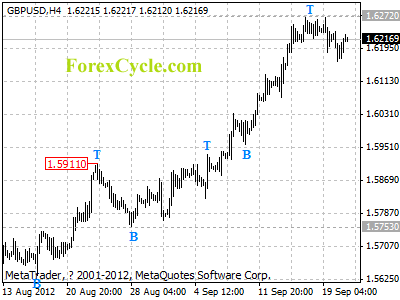
GBPUSD remains in uptrend from 1.5753

GBPUSD remains in uptrend from 1.5753, the fall from 1.6272 is treated as consolidation of the uptrend. Range trading between 1.6100 and 1.6272 would likely be seen in a couple of days. Support is at 1.6100, as long as this level holds, we’d expect uptrend to resume, and another rise towards 1.6500 is still possible after consolidation. Resistance is at 1.6272, a break above this level could signal resumption of the uptrend.

gbpusd

Forex Signals

Unsuspecting Bond Fund Investors Are Set Up for a Shock

Why risk in the rebalanced portfolio is ramping higher
September 20, 2012

By Elliott Wave International

During market pullbacks, financial advisors use a boilerplate response: “Let’s rebalance the portfolio.” Investors have heard that one for years.

The recommended allocation varies depending on a client’s age and risk tolerance, but it typically involves shifting funds from stocks to bond holdings.

The evidence shows that many investors did just that in response to the 2007-2009 financial crisis – at the fastest rate in decades. Bond fund assets have risen eight-fold over the past 22 years.

Investors now hold more than $800 billion in bond funds. Just take a look at this chart from a June 6, Elliott Wave Theorist Special Report.

Investors who increased their bond allocation probably feel financially safer.

After all, bond funds have been more stable than stock funds, and they provided higher returns than money market funds.

Yet extrapolating the past into the future is often a major mistake.

During the coming collapse in the value of debt, investors’ interest in diversified funds of all stripes-debt, equity and commodity-will fall precipitously. The drop will come as a shock, especially to those who “rebalanced” from stocks and commodities to bonds after the markets panicked in 2008.

The Elliott Wave Theorist, Special Report, June 2012

What should safety-conscious investors do?

The Theorist Special Report offers a clear answer, one that’s just as relevant now as when it was published in June.

You will also learn about a striking parallel between the bond market of 1929-1932 and today and what to expect next.


Free 10-Page Report: Major Top in the Bond Market on the Way Prechter’s message to bondholders today: Beware.Prechter warned investors about looming destruction in tech stocks, real estate, blue chips and commodities — all at a time when conventional wisdom considered them “safe.”

Here’s what he’s saying now: Whether you have your money directly in bonds or your mutual fund does, your savings could be at risk.

You’re just one click away. Follow this link for instant access to the first four pages of Prechter’s free report.

Read the first 4 pages now, zero obligation, no email address required >>

This article was syndicated by Elliott Wave International and was originally published under the headline Unsuspecting Bond Fund Investors Are Set Up for a Shock. EWI is the world’s largest market forecasting firm. Its staff of full-time analysts led by Chartered Market Technician Robert Prechter provides 24-hour-a-day market analysis to institutional and private investors around the world.


Learn How an Objective Method Can Improve Your Trading

Dear Reader,

One of the most difficult aspects of trading is emotional control — the ability to keep yourself from sabotaging your trading plan. Unfortunately, there is so much information available to you that your decision-making can be easily swayed.

But, what if you had a method that allowed you to remain objective? … One that included a set of rules and guidelines to follow to keep you from guessing or making rash decisions? … One that let you know when your outlook is wrong and it’s time to cut your losses?

Elliott Wave International has released a report that will help you learn about a method that allows you to manage your positions objectively — plus control your emotions — so you make the most of each high-confidence trade setup.

Learn more and download your free report.

There’s even a bonus lesson included on “Protective Stops,” so you can learn critical exit strategies.

If you’re a trader or considering trading, this report is a must-read. Rid yourself of emotional trading and learn to objectively identify high-confidence trade setups in the markets you trade.

Download your free report today.


About the Publisher, Elliott Wave International
Founded in 1979 by Robert R. Prechter Jr., Elliott Wave International (EWI) is the world’s largest market forecasting firm. Its staff of full-time analysts provides 24-hour-a-day market analysis to institutional and private investors around the world.


Banks progress, but still short of capital under Basel III

By Central Bank News
    Major banks have made major progress in thickening their capital cushion to prepare for the new tougher Basel III rules but they were still short of up to 374 billion euros by the end of 2011.
    In order for all the 102 largest banks to reach a 4.5 percent minimum level of capital to risk-weighted assets, an additional 11.9 billion euros is needed, the Basel Committee on Banking Supervision said in its latest study of the impact of the new, more stringent rules.
    To reach Basel III’s target of a 7.0 percent capital ratio, which includes a surcharge for globally systemic important banks and a capital conservation buffer, the largest banks have to put aside an additional 374.1 billion euros, more than their combined 2011 net profits of 356 billion euros.
    In comparison to the previous study from April, the Basel Committee of global bank regulators found that largest banks had reduced the total shortfall by 111.5 billion euros.

    A total of 209 banks participated in the impact study, which assumes full implementation as of December 31, 2011, and doesn’t take account of how each country is phasing in Basel III.
    For the 102 largest banks, the so-called Group 1 banks that are either internationally active or have capital  over 3 billion euros, the study found an average Tier 1 capital ratio of 7.7 percent, well above the minimum.
    For Group 2 banks, which includes all other major banks, the average Tier 1 ratio was 8.8 percent. For all the Group 2 banks to meet the 7.0 percent target, an additional capital of 21.7 billion euros is required, below their combined profits of 24 billion euros, the Basel Committee said in a statement.
    The Basel Committee also estimated the impact of the new liquidity standards, which European Central Bank President Mario Draghi has criticized for penalizing interbank lending.
    The liquidity standard was introduced in the Basel III rules to ensure that banks had enough assets that could be sold easily so they could survive a freezing up of credit markets, as happened in 2008.
    Assuming that banks made no changes to their liquidity risk profile or funding structure as of December 2011, the Basel Committee said the weighted average Liquidity Coverage Ratio (LCR) for Group 1 banks would have been 91 percent, up from 90 percent in the previous study that was based on data as of June 30, 2011.
    For Group 2 banks, the average LCR was 98 percent. The Committee did not provide a comparison figure, not actual estimates of what the shortfall was in euros.
    The Committee repeated that it is considering modifying some aspects of LCR, but it “will not materially change the framework’s underlying approach.
    The ECB has asked the Basel Committee to expand the type of assets that banks can use to meet the liquidity requirements.
    The liquidity rules were published in December 2010 but the Basel Committee is taking a very careful approach to make sure there are no unintended consequences.
    But Stefan Ingves, chairman of the Basel Committee,  last week acknowledged that some banks had said this careful approach had triggered uncertainty and hindered work toward meeting the standards.
    The Basel Committee plans to finalize its recommendations for the liquidity rules around the end of this year, but Ingves not the goal of the rules was to raise the bar for banks.
    “It is designed to have an impact on banks and markets: that is not unintended,” he said.
 
    www.CentralBankNews.info