Technical Analysis For Major Pairs This Week

By TraderVox.com

Tradervox.com (Dublin) – The US dollar advanced last week, making gains against both commodity-related currencies and safe haven currencies. The lack of promising solution to the eurozone crisis and the strong economic data from the US made the dollar more appealing to investors. As the month closes this week, here is a brief analysis of major currencies performances last week and the expected trend this week.

EUR/USD: the pair slid in range last week, losing the 1.30 line in the process. The lack of progress in Euro zone and Germany’s opposition to Greece restructuring proposal has exacerbated the situation in Europe. The euro-dollar pair started the week with a move up, but failed to break the resistance line at 1.3075. The pair then dropped to below 1.30 line and went further below the 1.29 line. With Draghi expected to speak this week and the German Retail sales expected at the start of November, there is a high chance the that euro will appreciate marginally against the dollar. However, the weekly outlook remains neutral and slightly bullish for the pair.

GBP/USD: the pair enjoyed a good week last week, climbing by almost one cent at the close of the week. The pair started the week at 1.5997 and dropped to touch a low of 1.5913 as the support line at 1.5930 weakened. The pair then made a strong break above the 1.61 level to touch a high of 1.6141 before retreating to close the week at 1.6091. The manufacturing and Construction PMIs are the major reports this week and the pair is expected to trade within range this week.

USD/JPY: improvements in the US resulted to the pair moving upwards during the week. The pair started the week with a slow climb to the resistance line at 80. With critical support at 79.70, the pair moved up above the 80 line to touch a high of 80.37 before sliding to close the week at 79.64. The outlook for the pair this week remains bullish and we might see the pair move above the 80 line again.

Disclaimer
Tradervox.com is not giving advice nor is qualified or licensed to provide financial advice. You must seek guidance from your personal advisors before acting on this information. While we try to ensure that all of the information provided on this website is kept up-to-date and accurate we accept no responsibility for any use made of the information provided. Opinions expressed at Tradervox.com are those of the individual authors and do not necessarily represent the opinion of Tradervox.com or its management. 

Article provided by TraderVox.com
Tradervox.com is a Forex News Portal that provides real-time news and analysis relating to the Currency Markets.
News and analysis are produced throughout the day by our in-house staff.
Follow us on twitter: www.twitter.com/tradervox

Central Bank News Link List – Oct. 30, 2012: China money rates fall after record PBOC cash injection

By Central Bank News
Here’s today’s Central Bank News link list, click through if you missed the previous link list. The list comprises news about central banks that is not covered by Central Bank News. The list is updated during the day with the latest developments so readers don’t miss any important news.

Central Bank News Link List – Oct. 30, 2012: Spain’s bad bank lures investors with steep discounts

By Central Bank News
Here’s today’s Central Bank News link list, click through if you missed the previous link list. The list comprises news about central banks that is not covered by Central Bank News. The list is updated during the day with the latest developments so readers don’t miss any important news.

India holds rate, cuts CCR by 25 bps, sees further easing

By Central Bank News
    India’s central bank held its benchmark repurchase rate steady at 8.0 percent but cut its Cash Reserve Ratio (CCR) by 25 basis points to 4.25 percent, and held out the promise of further policy easing in the fourth quarter of the 2012/13 year.
   The Reserve Bank of India (RBI), which also cut its CCR by 25 basis points last month, said in a statement that the reduction in CCR would inject some 175 billion rupees into the banking system, and was “intended to pre-empt a prospective tightening of liquidity conditions, thereby keeping liquidity comfortable to support growth.”
    The RBI said it expects inflation to rise further and then ease in the last quarter.
    “While risks to this trajectory remain, the baseline scenario suggests a reasonable likelihood of further policy easing in the fourth quarter of 2012-13,” it said, adding that further easing would also be “conditioned by the evolving growth-inflation dynamic.”
     The cut in the CCR – the percentage of deposits that banks keep with the central bank – was expected by many economists while some had also been looking to the RBI to cut its repo rate.

    The RBI said risks to global growth had risen and could well overwhelm to positive effects of enhanced liquidity by central banks in advanced economies.

    And with commodity prices still at elevated levels, the risks of liquidity-driven prices increases remain significant, the RBI warned.
    “Even as this process moves forward, the months ahead will be a period of heightened uncertainty for the global economy,” it said.
    Amidst this slowdown and uncertainty, the RBI said the Indian economy remained sluggish, held down by stalled investment, weakening consumption and declining exports, though recent government measures had improved sentiment.
    India’s economy expanded by 0.8 percent in the second quarter from the first quarter, for an annual growth rate of 5.5 percent, up from 5.3 percent in the first quarter.
    But inflation sped up to an annual 7.8 percent from 7.6 percent in August. The bank is comfortable with inflation around 5 percent.
    Despite a moderation in growth, the RBI said inflationary pressures continued and India is an exception to the global trend of low inflation, underscoring the role of domestic structural factors.
    “Consequently, managing inflation and inflation expectations must remain the primary focus of monetary policy,” the RBI said.
    www.CentralBankNews.info

The New Threat to the Eurozone – Disintegrating Nations

By MoneyMorning.com.au

Could Europe’s regions bring down the Eurozone?

Up until now, the biggest threats to the continued existence of the Eurozone have come from individual countries.

In June, Greece nearly elected the anti-austerity Syriza. A few weeks ago, some people thought that Germany might be prevented, by the courts, from taking part in the fund designed to bail out Spain and Italy.

These threats haven’t gone away, of course. Recent protests in Athens and Madrid show that both the Greeks and the Spanish are sick of austerity. Meanwhile, there are rumours that Berlin might take a much harder line on bail-outs once the US presidential election is out of the way.

But now an even greater fiscal threat is emerging – the danger that individual countries themselves may splinter as regions call for independence.

How much of a threat is this to the eurozone? And can you take advantage of it?

Why Breakaway Regions Matter to the Eurozone

There have always been regional tensions within several European countries. Many people in Catalonia don’t consider themselves Spanish. Similarly, the Lega Nord wants northern Italy to split from the poorer south.

The differences are partly cultural. However, the fact that many of these regions pay more in taxes than they get back in spending is a major factor.

During the good times, governments were able to hide this through deficit spending. This kept taxes low and spending high for everybody. However, austerity has thrown these processes into reverse.

Now taxes are going up and spending is going down. That makes the extent of fiscal transfers between regions much clearer.

Separatist movements have also been emboldened by the general unpopularity of incumbent parties. In Spain, the Catalan president has said that if he wins regional elections, he will demand a vote on independence.

In Italy, there have been pro-secession demonstrations in the northern city of Venice. Polls show that between 70% and 80% of Venetians want the region to break away.

In Belgium, local elections in Flanders resulted in a victory for a pro-independence party.

How Secession Could Ruin National Finances

Each of the three regions pays more in taxes than it receives in spending. An exit by Flanders would have the biggest impact, with its transfers equal to nearly a tenth of total Belgian government revenue. Venice and Catalonia transfer 3% and 4% respectively.

If these net contributors went their own ways, it would be harder for those who remained to meet budget targets. Capital Economics thinks that Spain, Italy and Belgium’s budgets would ‘suffer greatly’. In the worst case, it would even ‘increase the risk of further bail-outs of disorderly defaults’.

Of course, the chances of this happening are still relatively low. Talking about secession is not the same as doing it. As well as the legal and political hurdles, there is the practical issue as to whether any new country would automatically become an EU member, or would have to apply from scratch.

For example, the Madrid government has said that it would strongly oppose letting an independent Scotland into the Eurozone as a matter of course. That might be a warning to a potential independent Catalonia (or Venice, or Flanders), all of which would depend on good access to European markets.

Even a Halfway House Could Damage the Eurozone

So what may be more likely is that Brussels, Madrid and Rome will concede more powers to the regions, and allow them to keep a greater proportion of their revenue. Indeed, some experts think that this is what the separatist movements expect to happen.

But while this may reduce short-term political pressures, it will have a similar fiscal effect to secession, increasing the amount that has to be cut in the rest of the country.

Indeed, the fact that the partial break up of three countries is even being talked about may be enough to do significant damage. For one, it could shake confidence in the markets.

More importantly, it may also raise further doubts about the viability of fiscal burden sharing that is part of the attempt to keep the Eurozone together. Northern Europeans may feel that there is no point in subsiding nations that are splitting up on their own.

As Capital Economics puts it, ‘if Catalans, Fleming and Venetians are unwilling to support the poorer parts of their own countries, there is very little hope that German taxpayers will bear the burden’.

What this Means for Investors

We’re still happy to buy cheap stocks in the Eurozone. At current levels historically speaking, you can expect good returns from here, if you hold for the long run.

However, we can easily see the euro weakening – particularly against the [US] dollar. Why? Because the only way the Eurozone can stay together is through the euro becoming less of a ‘hard’ currency. And if the European Central Bank (ECB) ends up printing money, that’s just what will happen.

From the point of view of investors in Eurozone shares, if the ECB does print money, we’d expect the resultant boost to stocks to outweigh the impact of a falling currency. So we’re not overly concerned about the threat of a falling Euro when it comes to buying stocks.

Matthew Partridge
Contributing Editor, Money Morning

Publisher’s Note: This article originally appeared in MoneyWeek

From the Archives…

Does Excessive Government Spending Make You the World’s Best Treasurer?
26-10-2012 – Kris Sayce

Why a Return to the Gold Standard Could Actually Be Bad
25-10-2012 – Kris Sayce

A Safer Than Super Investment?
24-10-2012 – Nick Hubble

Agricultural Commodities – The Best Way to Play Rising Food Prices
23-10-2012 – Merryn Somerset Webb

Stock Market ‘Barometer’ Speaks: The Bulls Won’t Like it…
22-10-2012 – Kris Sayce


The New Threat to the Eurozone – Disintegrating Nations

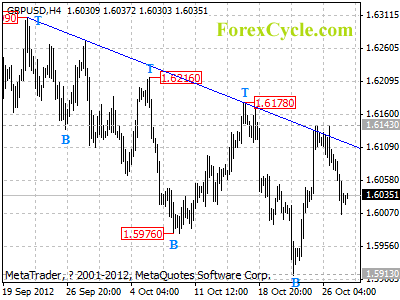
GBPUSD failed to break above trend line resistance

GBPUSD failed to break above the resistance of the downward trend line from 1.6309 to 1.6178 and pulled back from 1.6143. However, one more rise to re-test the trend line resistance would likely be seen, a break above the trend line resistance will indicate that the fall from 1.6309 had completed at 1.5913 already, then further rise towards 1.6309 previous high could be seen. On the downside, the fall from 1.6143 would possibly be resumption of the downtrend from 1.6309, a breakdown below 1.5913 support could trigger another fall to 1.5800 area.

gbpusd

Forex Forecast

Task force issues 7 disclosure principles for banks

By Central Bank News

    A task force comprised of bankers, investors, analysts, auditors and credit ratings’ officers has issued seven principles that should make it easier for shareholders to grasp the risks posed by banks and help restore their trust in the financial industry.
    The principles from the Enhanced Disclosure Task Force (EDTF), which was formed in May at the initiative of the Financial Stability Board (FSB), is different from recommendations by banking regulators because they arise from discussions between users and prepares of financial reports.
    “These principles provide a firm foundation for developing high-quality, transparent disclosures that clearly communicate banks’ business models and the key risks that arise from them,” said the report, co-chaired by Hugo Baenziger, supervisory board chairman of Eurex, Russell Picot, group general manager of HSBC, and Christian Stracke, managing director of Pimco.
    The principles are mainly aimed at improving risk disclosure by large international banks, but should also be applicable to all banks that access equity and debt markets.

    The task force will present its recommendations to the major regulatory bodies, such as the Basel Committee on Banking Supervision, the International Organisation of Securities Commissions and the International Association of Insurance.
    EDTF hopes that many of its principles will be adopted this year or next.
    The seven fundamental principles for enhanced risk disclosures are:
•   Disclosures should be clear, balanced and understandable.
•   Disclosures should be comprehensive and include all of the bank’s key activities and risks.
•   Disclosures should present relevant information.
•   Disclosures should reflect how the bank manages its risks.
•   Disclosures should be consistent over time.
•   Disclosures should be comparable among banks.
•   Disclosures should be provided on a timely basis. 
    The EDTF report is available at the FSB’s website: http://www.financialstabilityboard.org

Israel cuts rate 25 bps to 2.0% to bolster growth

By Central Bank News
    The central bank of Israel cut its policy interest rate by 25 basis points to 2.0 percent, its third rate cut this year, to bolster economic growth while inflation has eased to the midpoint of the bank’s target.
    But to restrain the growth in housing credit, the Bank of Israel (BoI) limited the loan-to-value ratios to keep home prices from raising too fast.
    The BoI, which has cut rates by a total of 75 basis points this year, said Europe’s debt crises continues to be the main risk to the global economy and recent data showed that growth in Israel’s economy had moderated to a rate of around 3 percent, in line with the bank’s forecast from last month of Gross Domestic Product growth of 3.3 percent this year and 3.0 percent in 2013.
   Against the background of the debt crisis in Europe, the level of economic risk from around the world remains high, and with it the concerns over negative effects on the local economy,” the BoI said in a statement.
    In the second quarter, Israel’s economy expanded by 3.10 percent annual rate while the September annual inflation rate rose to 2.1 percent from 1.9 percent. The BoI targets inflation of 1-3 percent.
    www.CentralBankNews.info

Angola keeps rate on hold, fx and interest rates stable

By Central Bank News
    The central bank of Angola kept its base rate unchanged at 10.25 percent, saying the exchange rate and interest rates have been stable in the last month.
    Angola’s annual inflation rate eased to 9.65 percent in September, the lowest level so far this year, from 9.87 percent in August.  The decline of inflation to a single-digit level has been an aim of Banco Nacional de Angola for many years.
    The central bank last cut its interest rate by 25 basis points in January, but earlier this month the bank’s governor said in a speech that a sudden cut in the bank rate would not improve credit to the economy, nor help contain inflation.

    The bank said credit extended to the economy increased by 2.6 percent in September for an increase of 17.19 percent since the beginning of this year. Interest rates were also stable last month with overnight LUIBOR at 5.40 percent annually, the bank said.

    The average exchange rate of the kwanza currency against the U.S. dollar was 95.42 at the end of September “reflecting the stability observed since the beginning of the year,” the bank added.
    www.CentralBankNews.info
   

Euro Drops Amidst Weak Economic Outlook

By TraderVox.com

Tradervov.com (Dublin) – The 17-nation currency has declined to near three-week low against the US dollar as Mariano Rajoy, the Spanish Prime Minister and the Mario Monti the Italian Premier prepare to meet as euro-zone economic outlook worsens. The US currency and the Japanese yen rose against the euro as data from euro region boosted the demand for safety in the market. The euro declined as a report from Spain showed that retail sales fell by 11 percent last month from a year earlier. Yen increased to two weeks high after German Finance Minister Wolfgang Schaeuble opposed Greece’s debt restructuring proposal.

According to Sebastien Galy, a senior strategist in New York at Societe General SA, the market is on a risk-off mood and most traders are bidding the dollar across the market. He added that this is an effect of market paring down, suggesting that it might continue like this as the market assesses the real impact of Hurricane Sandy. The euro dropped against most major currencies after the German Finance Minister’s speech. He was talking at an interview before European policy makers receives a report about Greece progress in achieving the agreed targets. The report was compiled by the European Commission, European Central Bank, and International Monetary Fund.

The 17-nation currency has fallen by 1.7 percent in the last six months, making it the second worst performer after the Swiss franc. The Japanese currency has against by 2.3 percent while the US dollar has added 1.4 percent. The euro has gained 0.3 percent against the dollar this month. After the retail report from Spain and Wolfgang comments, the euro dropped by 0.3 percent against the dollar to trade at $1.2899 at the start of trading in New York. It had earlier touched $1.2887; the currency had dropped to its lowest since October 11 of $1.2883 on October 26. The common currency fell by 0.3 percent against the yen to exchange at 102.70 yen. It had earlier dropped to 102.52, the least it has been since October 16.

Disclaimer
Tradervox.com is not giving advice nor is qualified or licensed to provide financial advice. You must seek guidance from your personal advisors before acting on this information. While we try to ensure that all of the information provided on this website is kept up-to-date and accurate we accept no responsibility for any use made of the information provided. Opinions expressed at Tradervox.com are those of the individual authors and do not necessarily represent the opinion of Tradervox.com or its management. 

Article provided by TraderVox.com
Tradervox.com is a Forex News Portal that provides real-time news and analysis relating to the Currency Markets.
News and analysis are produced throughout the day by our in-house staff.
Follow us on twitter: www.twitter.com/tradervox