Forex Technical Analysis 01.04.2014 (EUR/USD, GBP/USD, USD/CHF, USD/JPY, AUD/USD, USD/RUB, GOLD)

Article By RoboForex.com

Analysis for April 1st, 2014

EUR USD, “Euro vs US Dollar”

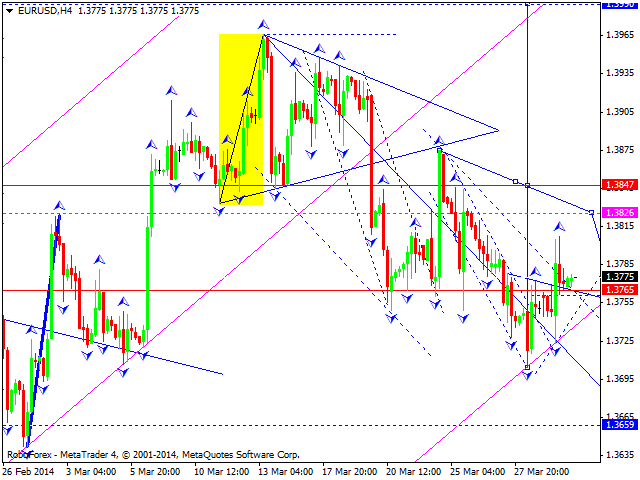
Euro completed the third ascending impulse. We think, today price may form the fifth structure of this wave with target at 1.3826 and then start falling down towards level of 1.3765. Later, in our opinion, instrument may start new ascending wave towards level of 1.3990.

GBP USD, “Great Britain Pound vs US Dollar”

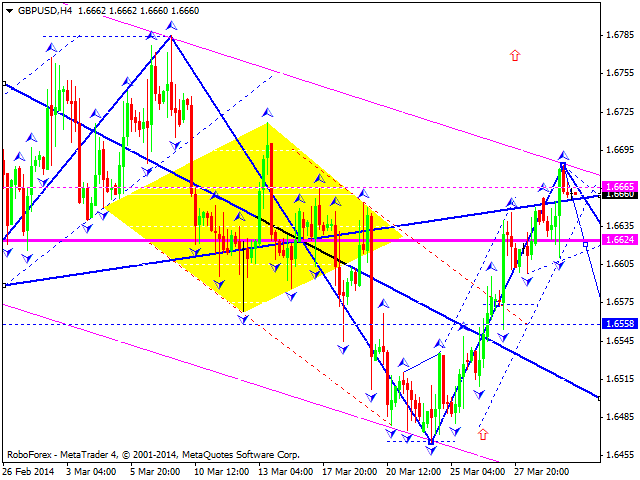
Pound reached new maximum and is still moving upwards. We think, today price may form consolidation channel and reversal pattern to start new descending wave with target at level of 1.6558.

USD CHF, “US Dollar vs Swiss Franc”

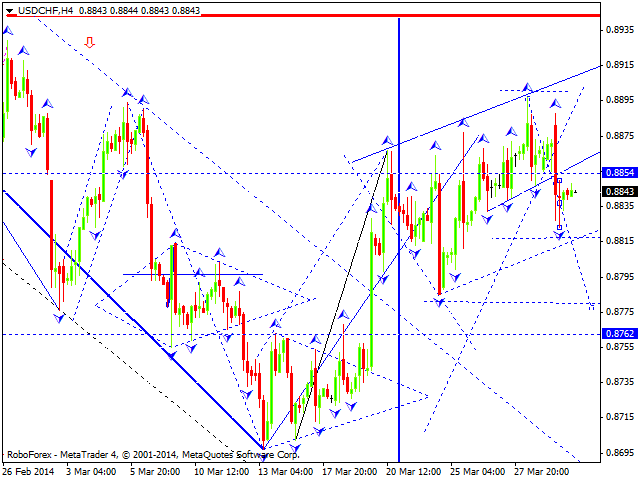
Franc completed another descending impulse and right now is consolidating near its minimum; this consolidation may be considered as the third wave. We think, today price may continue moving downwards to reach target at level of 0.8780.

USD JPY, “US Dollar vs Japanese Yen”

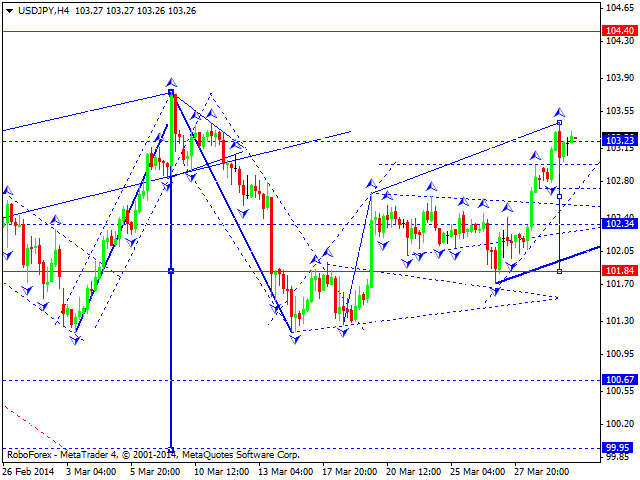
Yen rebounded from the upper border of its consolidation channel and may renew maximum of current wave. We think, today price may form reversal pattern to start new descending movement towards level of 100.00.

AUD USD, “Australian Dollar vs US Dollar”

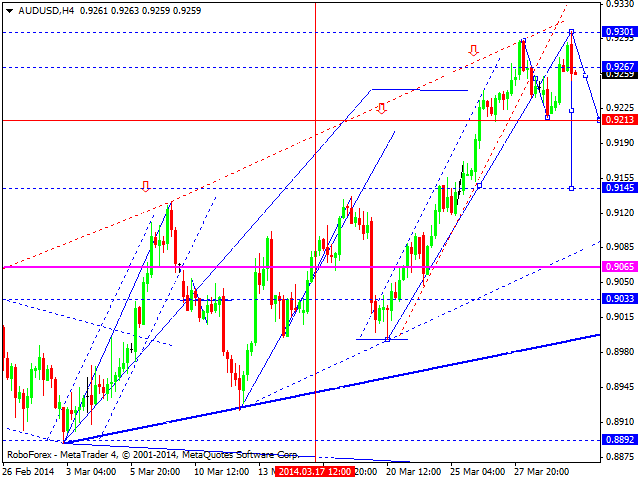
Australian Dollar formed another descending impulse. We think, today price may consolidate for a while and then form reversal pattern to start new descending movement towards level of 0.9200. Later, in our opinion, instrument may continue falling down to reach level of 0.9150.

USD RUB, “US Dollar vs Russian Ruble”

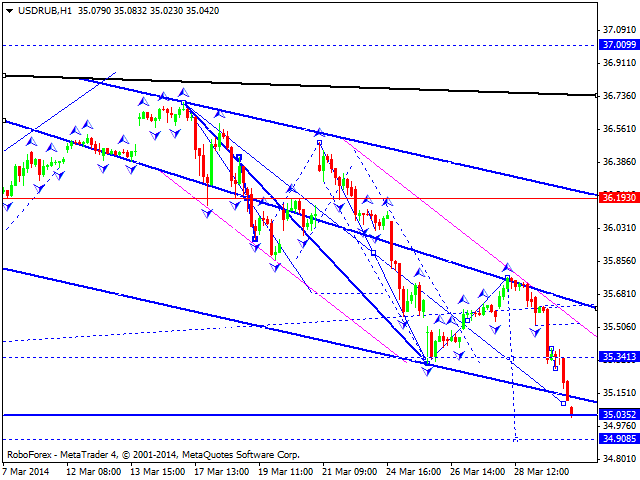
Ruble is still forming descending structure. We think, today price may reach level of 34.90 and then return to 36.20. Later, in our opinion, instrument may start new descending wave.

XAU USD, “Gold vs US Dollar”

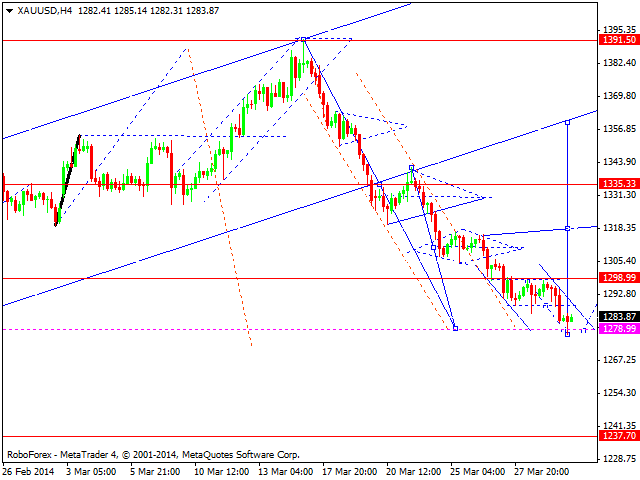
Gold reached target of its descending movement. We think, today price may consolidate for a while, form reversal pattern, and start forming new ascending wave. Target is at level of 1435.

RoboForex Analytical Department

Article By RoboForex.com

Attention!
Forecasts presented in this section only reflect the author’s private opinion and should not be considered as guidance for trading. RoboForex LP bears no responsibility for trading results based on trading recommendations described in these analytical reviews.


Wave Analysis 01.04.2014 (DJIA Index, Crude Oil)

Article By RoboForex.com

Analysis for April 1st, 2014

DJIA Index

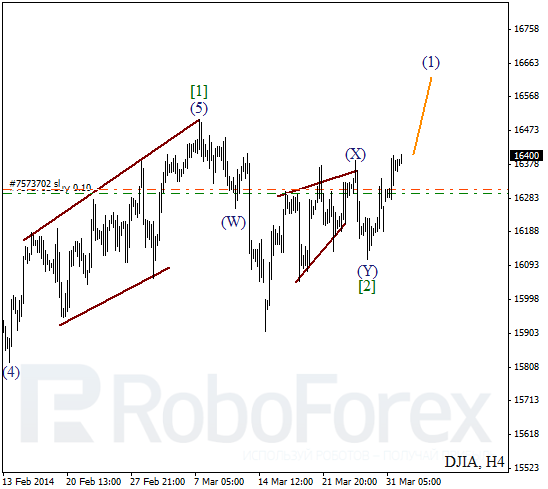
Index is starting new ascending movement. Possibly, wave [2] took the form of double three pattern. Probably, right now price is forming initial ascending impulses inside the third wave. Stop is already in the black. Later instrument is expected to break local maximum.

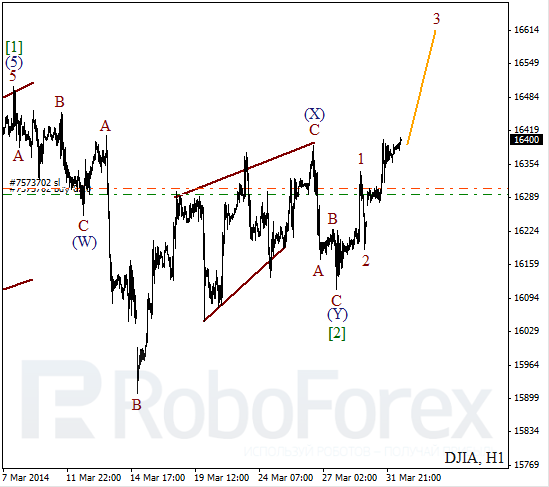
More detailed wave structure is shown on H1 chart. After completing zigzag pattern inside wave (Y), price formed ascending impulse. Most likely, after slight correction, instrument will continue growing up.

Crude Oil

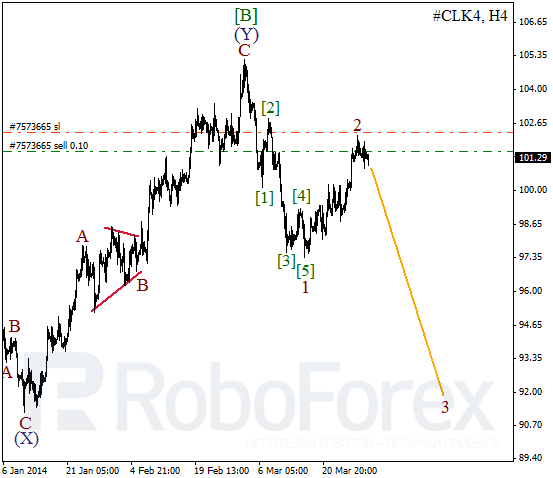
After completing initial impulse inside wave 1, Oil started new correction. Most likely, the second wave has been already completed and right now market is falling down inside the third one. I’ll move stop into the black right after instrument starts moving downwards.

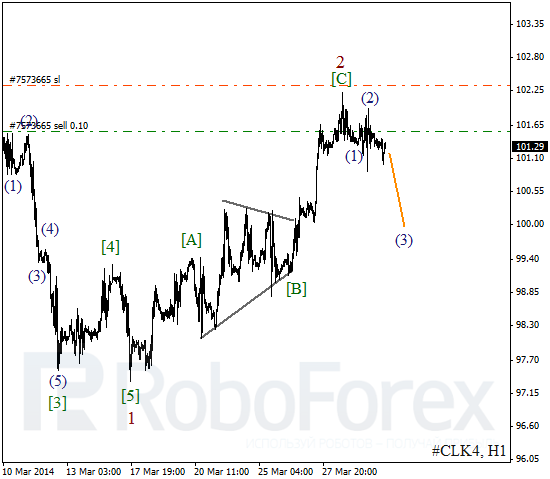
As we can see at the H1 chart, Oil formed zigzag pattern inside wave 2. On minor wave level, price completed bearish impulse inside wave (1). Probably, during the day instrument may start moving downwards inside the third wave.

RoboForex Analytical Department

Article By RoboForex.com

Attention!
Forecasts presented in this section only reflect the author’s private opinion and should not be considered as guidance for trading. RoboForex LP bears no responsibility for trading results based on trading recommendations described in these analytical reviews.


EUR/USD Price Action For April 1st

Article by Investazor.com

EUR/USD Price Action For April 1st

The price made a false breakout below 1.3745, yesterday, and rallied very fast all the way to 1.3800. It did not close, on a 60 minutes chart, above this round level so it dropped back to 1.3761. A close below this local support could mean that the US dollar could get back to 1.3747. A close above the 200 EMA would be a positive signal which would confirm the Falling Wedge. Upside target is 1.3815.

Economic Releases

Even though Technical analysis is important and can help us trade profitable, it is very important to keep our eyes open for important economic releases which could move the market in an unexpected direction.

For today the most important indicators programed to be released are:

EU – Spanish Manufacturing PMI (08:15). In January and February, 2014, the Spanish manufacturing PMI was above estimation. In March it has been published under analysts’ forecasts. Today it is expected to be around 52.9. A release above this number would help the Euro gain, while a lower number could mean a drop for the European single currency.

The post EUR/USD Price Action For April 1st appeared first on investazor.com.

Strong Consumer Spending Pushes up US Stocks

By HY Markets Forex Blog

Stock options traders can use a wide array of information to attempt to predict market volatility, and something that should be on their radar in the coming months is consumer spending.

According to the U.S. Department of Commerce, household purchases increased the most in three months during February, which pushed U.S. stocks higher as shares rebounded. Experts told Bloomberg consumer spending growth won’t stop, which could be good news for stocks in the next couple of months.

“If consumers go back in and are confident enough to start spending again, that supports earnings and will certainly support  the equity market,” Chris Gaffney, senior market strategist at EverBank Financial, told the news source. “I feel like we’re forming a base that we can move high now.”

With the potential for consumer spending to continue to rise, stock options traders may want to use this information to their advantage. Consumer shares were some of the strongest following the Commerce Department’s announcement, as H&R Block Inc and GameStop Corp climbed at least 6.2 percent, which means these types of stocks could be good ones to bet on in the next few months.

One sign that spending could remain strong in the near future is the fact that consumer confidence surged from a 78.3 reading in February to 82.3 in March, according to the Conference Board.

“Consumer confidence improved in March, as expectations for the short-term outlook bounced back from February’s decline,” said Lynn Franco, director of economic indicators at The Conference Board.

Markets are difficult to predict, but information is available to help make educated estimates. Stock options traders can use consumer spending and confidence data to help predict market volatility, and all signs currently point to future increases.

The post Strong Consumer Spending Pushes up US Stocks appeared first on | HY Markets Official blog.

Article provided by HY Markets Forex Blog

Russia, US Talks Critical for Oil Prices

By HY Markets Forex Blog

Tensions have been high between Russia and the U.S. ever since President Vladimir Putin made his first move on the Crimea region in Ukraine. This situation has had an impact on numerous markets, including crude oil.

With the potential for significant sanctions placed on Russia, oil prices have been volatile, as these could cut much of the world off from the Russia oil and gas sector. Investors who take part in crude oil trading will want to keep a close eye on talks between Russia and the U.S.

According to The Associated Press, U.S. Secretary of State John Kerry and Russian Foreign Minister Sergei Lavrov met and agreed that there needs to be a diplomatic resolution. However, nothing is etched in stone, and if talks break off, oil prices could rise, which is something traders need to keep a close eye on.

“The plentiful supply, particularly from Saudi Arabia and Iraq, is offset by the ongoing production outages in Libya and the – albeit fairly remote – prospect of the West imposing sanctions on the Russian oil and gas sector,” said a report from Commerzbank in Frankfurt.

One sign that tensions could be de-escalating is the fact that President Putin told German Chancellor Angela Merkel he would pull some Russian troops from near the border with Ukraine, according to NPR. In response, oil prices may decline, as the threat of the rest of the globe of being cut off from Russia’s supply decreases. This is valuable information for crude traders, as it could allow them to get out ahead of market fluctuations.

The post Russia, US Talks Critical for Oil Prices appeared first on | HY Markets Official blog.

Article provided by HY Markets Forex Blog

Australia holds rate, repeats steady rates for a period

By CentralBankNews.info
    Australia’s central bank held its benchmark cash rate steady at 2.50 percent, as expected, and reiterated that “the most prudent course is likely to be a period of stability in interest rates.”
    The Reserve Bank of Australia (RBA), which has maintained its rate since August 2013, said continued accommodative monetary policy should support demand and help economic growth strengthen over time while inflation is expected to remain in line with the bank’s 2 -3 percent target.
    The RBA’s guidance that rates are likely to remain unchanged for some time was the same as it gave in February and earlier this month and its statement today also largely mirrored last month’s view of the prospects for Australia’s economy.
    The exchange rate of the Australian dollar – known as the Aussie – is still considered “high by historical standards,” and the RBA voiced concern over the recent rise in the exchange rate following a drop over in the last year.
    “The decline in the exchange rate from its highs a year ago will assist in achieving balanced growth in the economy, but less so than previously as a result of the rise over the past few months,” the RBA quoted its governor, Glenn Stevens as saying.
    The Aussie weakened sharply from May through August last year, falling from around 1.05 to the U.S. dollar to 0.89 by August 30.  It then gained strength through October before again falling to a low of below 0.87 to the dollar in late January this year.
   But  in the last two months it has started appreciating again, trading at 0.92 to the dollar earlier today.
    Australia’s economy has been hit by lower demand for its resources from China and reduced investments in its mining sector and the RBA said investment spending is still set to decline significantly and there are only tentative signs of improved investments in other sectors as firms wait for more evidence of improving conditions for committing to expansion plans.
    Demand for labour remains weak and the RBA expects the unemployment rate, which was unchanged at 6.0 percent in February, to probably rise a little further and wage growth has declined noticeably, helping keep inflation consistent with the target, even with a lower exchange rate.
    The headline inflation rate rose to 2.7 percent in the fourth quarter of 2013 while core inflation rose to 2.64 percent from 2.36 percent in the third quarter. In its latest quarterly report, the RBA forecast core inflation of 3 percent in the fiscal year ending in June and at 2.25-3.25 percent through December this year.
    Australia’s Gross Domestic Product expanded by only 0.8 percent in the fourth quarter from the third for annual growth of 2.8 percent, up from 2.3 percent in the third but sharply down from rates of 3 percent and more in 2012.
    But there are signs that consumer demand is picking up and housing construction is solid, with the RBA saying some indicators of business conditions and confidence have improved and exports are rising.
    The RBA has forecast GDP to rise by 2.75 percent in the year to June and by 2.25-3.25 percent through December, helped by a lower exchange rate that is aiding exports.
    The RBA said there were reasonable prospects for the global economy to improve this year as the U.S. economy continues to expand, the euro area has begun to recover from recession and Japan has recorded a significant pickup in growth. China’s growth is largely in line with policymakers objectives, though it may have slowed a little in early 2014.
    Since embarking on its easing cycle in November 2011, the RBA has cut rates by 225 basis points, including 50 points in 2013.

    http://ift.tt/1iP0FNb


EURUSD is facing trend line resistance

EURUSD is facing the resistance of the downward trend line on 4-hour chart. A clear break above the trend line resistance will indicate that the downtrend from 1.3966 had completed at 1.3705 already, then the following upward movement could bring price to 1.4000 area. On the downside, as long as the trend line resistance holds, the rise from 1.3705 would possibly be consolidation of the downtrend, another fall towards 1.3550 is still possible after consolidation.

eurusd

Provided by ForexCycle.com

Don’t Get Distracted When Investing In Emerging Markets

By MoneyMorning.com.au

Whether he likes to admit it or not, the crowd love to hear Kris Sayce talk.

Monday afternoon, he entered the stage at the World War D conference to a loud applause.

Kris loves to be controversial. And that’s what he delivered yesterday…

He started his event with a story called the Gift of the Magi. A story of a woman who sold her hair, her most precious possession, to buy her husband a chain for his watch. However, as she sold her hair, her husband was out selling his watch, his most prized possession, to buy combs for her hair.

The point of the story? Nothing. In Kris words, ‘…it was a red herring.’

In fact, so was the title of his presentation.

All Kris was doing was diverting the crowd’s attention. But they couldn’t work out why.

And this is exactly the point he was trying to make.

Over the past six years, you’ve faced tens or hundreds of investment red herrings. All this has done is distract you, or stop you from making money.

As Kris told the crowd, by all means, don’t ignore the crises as they come and go, but don’t let it consume you. Which is, in Kris’s words, ‘the message I want you to take from here today’.

The current crisis, Crimea, is just another distraction you face.

After demonstrating to the crowd how easy it is to get distracted by macro events, he declared war…on contrarians! At this point, I thought the crowd was getting ready to boo Kris.

However, the reason why he was attacking contrarians is because he reckons they simply don’t know what it means to be one anymore.

Being a contrarian investor isn’t doing the opposite of everyone else. That view is wrong. Because if you think that’s what contrarian investing is all about, then you’re a seller in a rising market, and a buyer in a falling market. Investing this way will just mean you blow your capital quicker than other investors.

But the real art to contrarian investing, as Kris explained, is getting behind an idea before the rest of the market does.

He went on to add that too many so-called contrarian investors get caught up in the little things.

Economic data detailing a half a percentage point drop in China’s economic growth…or one nation state fighting with another nation state.  Yes these events are important, Kris reasoned. But they should not be the sole analysis behind your investments:

‘Investors spend too long focusing on charts and meaningless statistics,’ Kris told the audience.  ‘Paralysis by macro-analysis.’

‘Contrarians have lost the plot in searching for the charts.’ Kris told the crowd. Adding that it’s made worse by the mainstream media constantly discussing what could be the next crisis or ‘black swan’ event.

‘Had you heard of SHIBOR, before it threatened to take the market down?’ Kris asked the audience. No one answered. Yet, we all knew the answer. No, we hadn’t heard of it. And no one has heard of it since.

In fact, Kris said there had been over 20 ‘crises’ since 2008, and each one has seen the market rally. Not crash like the mainstream try to predict.

Instead stocks keep going up.

The audience were transfixed at this point, taking it all in. Kris continued:

The trouble is when you’re constantly trying to pick bubbles and crashes you’ll inevitably pick a whole bunch of stuff that will only have a minor impact on the broader market.

Contrarian investors and advisors are partly to blame for this. Contrarians have allowed themselves to become crash predictors rather than investing opportunists.

After his attack on fake contrarians, Kris moved on to what he thought was the biggest threat to your wealth today.

Two types of criminals. Cyber criminals and government criminals. The crowd laughed and nodded in agreement about the government being crooks.

Cyber criminals cost Australians $4.8 billion in 2011. Whereas the government managed to take $329 billion from Australians in either direct or indirect taxes in 2012. As Kris said, ‘Even the smartest private sector criminals haven’t yet found a way to take your money before you’ve taken possession of it.’

After making sure the crowd was on side, Kris then offered some investing tips.

Emerging markets are presenting a great investment opportunity, Kris reckons.  China’s economy, still classed as one, still has potential. The Chinese government aims to lodge two million patents by 2015. This could be the catalyst to shift them from a manufacturing hub into an innovation hub.

As Kris said:

‘[China] hasn’t innovated in one damn way over the last 1,000 years. China’s most recent innovations are paper and gunpowder. That tells you something about the lack of innovation. But that’s about to change.

The problem is there are red herrings all over the place when it comes to emerging markets.

But don’t let this put you off, because there’s big future for this speculative but growing sector.

Shae Smith+
Roving Reporter for Money Morning Australia at World War D

Join Money Morning on Google+


By MoneyMorning.com.au
Why the US Government Needs More Debt

By MoneyMorning.com.au

Capitalism is Dead

That was the controversial theme of Richard Duncan’s World War D presentation. In place of capitalism, Duncan argued, we now have creditism: a form of credit-fuelled economic growth directed by the US government.

But, he warned, that system is in danger of imminent collapse.

Duncan pinpoints the beginning of this new system – or the death of capitalism-as the First World War. To pay for US weaponry and technology, the Europeans gave the US gold. This fuelled a massive credit boom and the period known as the roaring 20s.

It couldn’t be repaid, and triggered the Great Depression. When war returned, the government took over every aspect of the economy and increased spending by 900%.

That changed the global economy forever, and then a bigger change came along…

Up until 1968 the US Federal Reserve had to have at least 25% gold for every dollar printed. By 1968 the US was running out of gold, so they changed the law. Money was no longer linked to gold, and the US could create as much credit as it wished.

Debt exploded from $1 trillion in 1964 to $50 trillion in 2007, and the world enjoyed close to four decades of growth.

While common thinking is that debt is unequivocally bad, Duncan makes the obvious point: Credit growth equals economic growth.

He sees the dangers. Asset prices inflate in an upward spiral, creating more collateral for consumers to borrow against but, as he says, the ‘day always comes when credit can’t grow any further‘. In 2007 the private sector couldn’t repay its debt and the government had to jump in.

And now, he says, ‘Creditism has created unprecedented prosperity around the world, but it’s on the verge of collapse because the private sector cannot bear any more debt.’

That diagnosis doesn’t stray too far from mainstream opinion – it’s his solution however that had audience members shaking their heads in disagreement.

He made the case for increasing, rather than cutting debt. Duncan pointed out that there have only been nine times since 1952 where credit has grown at less than 2% per annum. Each of those periods created a recession.

Duncan calls this 2% debt level the recession threshold. In order to reach that threshold, the US needs US$2.4 trillion dollars in credit growth to reach this threshold, but that looks unlikely according to Duncan. ‘Judging by history we’re not going to have any economic growth,‘ Duncan said. ‘If this half-century long credit bubble pops, civilisation wouldn’t survive.‘ Unemployment would rise, globalisation would come to an end, welfare would cease, the US would lose its military dominance, China’s economy would implode, and there would be widespread starvation, chaos and war.

For Duncan, it’s imperative the US maintains its stake in creditism. ‘[the global economy] is like a big rubber raft. Instead of being inflated with air, it’s inflated with credit‘. The problem he says is that the raft is defective, full of holes, and keeps leaking credit. ‘Policy makers are absolutely terrified that if it sinks it will be like it was in the 1930s and 40s,‘ he said. Bump in more credit, asset prices go up, people are kept dry and happy, and the raft stays afloat.

So much credit has been created globally that the earth’s seven billion people can’t service it. The private sector can’t bear more debt either…but the US government can, according to Duncan. Japan’s debt is 250% of GDP, but US debts stands at 100%. America could borrow and spend another US$17 trillion and only reach 200% debt to GDP.

At this point the audience looked rather sceptical, especially given the Japanese response isn’t known for its success.

But Duncan pushed his case. The economy must ‘inflate or die‘, because the capitalist economic system died 100 years ago. The world requires further credit expansion or it will face utter collapse.

How about we learn from Japan’s mistakes?‘ asked Duncan.  The Japanese wasted government money on building bridges to nowhere, and paving the Japanese countryside. Instead, he wants the US Government to invest in new technology – US$1  trillion in solar, biotech, GM and other new technologies.

He envisages the US government sparking a debt-fuelled, technological revolution that would create profitable industries. ‘This is not only a once in a lifetime opportunity, it’s a once in a history opportunity,‘ he said, that could cure disease and bring people out of poverty. 

That sounds like optimistic vision. The reality is less rosy for Duncan.

Politicians, he says, don’t get it. Neither the Democrats or Republicans will increase debt, and the world will plunge into depression.

Money Morning readers don’t usually read defences of government spending and debt, and the audience definitely looked challenged at times.

But on that final point – the deficiencies of politicians – there were many heads nodding in agreement.

Callum Denness,
Roving Reporter for Money Morning Australia at World War D

Join Money Morning on Google+


By MoneyMorning.com.au