Gold, Silver Down Ahead of Jobs Data, Gold in India Hits One-Month Low

London Gold Market Report
from Ben Traynor
BullionVault
Friday 2 November 2012, 07:15 EDT

SPOT MARKET prices to buy gold in Dollars dropped to below $1710 an ounce Friday morning, reversing gains from earlier in the week, while stocks and commodities fell and the US Dollar rallied ahead of the release of key US jobs data.

The Bureau of Labor Statistics is due to publish its monthly ‘Employment Situation’ report at 08.30 EDT, which will include the official nonfarm payrolls estimate for the number of private sector jobs added in October. Consensus forecast among analysts is for 125,000 jobs added, while the unemployment rate is expected to tick higher to 7.9%, up from 7.8% in September.

Silver prices meantime fell below $32 an ounce this morning, extending losses from the day before.

“[Silver] bulls tried for a breakout [on Thursday] but were met with selling pressure,” said a technical analysis note from bullion-dealing Scotiabank.

“Despite the disappointing close, downside momentum appears to have waned somewhat.”

Like gold, silver traded lower Thursday following the release of a better-than-expected ADP Employment Report, a release that is widely regarded as an indicator for the official nonfarms release.

Over in India meantime, traditionally the world’s biggest gold buying nation, Rupee prices to buy gold fell to their lowest in nearly a month, following gains this week for the Rupee against the Dollar.

“We are hoping for good Diwali sales,” one jeweler told newswire Reuters, although trader noted that demand could dry up ahead of the November 13 festival should gold prices climb higher.

Heading into the weekend, gold and silver were little changed on the week by Friday lunchtime in London, although analysts say they expect the nonfarm payrolls release could impact on prices.

“If the nonfarm payrolls data is very good, it will be bearish for gold, as it will cut expectations for any additional quantitative easing, and it will be fairly positive for the Dollar as well,” says Nick Trevethan, Singapore-based senior strategist at ANZ.

“If the payroll data is much above the 125,000 [jobs] consensus the Dollar is likely to go down,” disagrees Standard Bank analyst Steve Barrow.

“The Fed is not going to respond to stronger-than-expected data with tighter policy and, more importantly, the interest rate markets are not going to expect the Fed to change course…instead, the focus clearly seems to be on the fact that firm data lifts stocks, lowers risk aversion and so tends to lift ‘riskier’ currencies against the ‘safe-haven’ Dollar.”

A note from Swiss bank UBS this morning said funds tracking the DJ-UBS Commodity Index will need to buy gold and silver, since the precious metals are due to form a bigger part of the index when it is reweighted at the start of next year.

“In gold’s case, its weight will be raised to 10.82% from 9.79% and silver will increase to 3.90% from 2.77%,” UBS said.

“The settlement prices on the fourth business day of January will determine the final amounts to be bought.”

Here in Europe, Eurozone manufacturing activity continued to contract last month, with the pace of contraction accelerating from September, according to purchasing managers index data published Friday. The single currency areas four biggest economies – Germany, France, Italy and Spain – all published PMIs below 50.

The Bank of England meantime said it welcomes three independent reviews into its operations, forecasting ability and handling of the financial crisis that were published Friday.

One review, that looked at the Bank’s framework for providing liquidity to the banking system, concluded the Bank is “centralized and hierarchical…with a large decision-making burden  residing with the Governor and senior management.”

The review of the Bank’s forecasting capability meantime said that “recent forecast performance has been noticeably worse than prior to the crisis, and marginally worse than that of outside forecasters.”

In South Africa, AngloGold Ashanti, the world’s third-largest gold mining producer, has suspended operations at the TauTona mine, with 300 protesting workers conducting a sit-in.

Earlier this week two striking coal miners were shot dead by security guards at South Africa’s Magdalena mine, with reports saying the two men tried to break into the mine’s armory.

Ben Traynor
BullionVault

Gold value calculator   |   Buy gold online at live prices

Editor of Gold News, the analysis and investment research site from world-leading gold ownership service BullionVault, Ben Traynor was formerly editor of the Fleet Street Letter, the UK’s longest-running investment letter. A Cambridge economics graduate, he is a professional writer and editor with a specialist interest in monetary economics. Ben writes and presents BullionVault’s weekly gold market summary on YouTube and can be found on Google+

(c) BullionVault 2012

Please Note: This article is to inform your thinking, not lead it. Only you can decide the best place for your money, and any decision you make will put your money at risk. Information or data included here may have already been overtaken by events – and must be verified elsewhere – should you choose to act on it.


Romania holds policy rate steady at 5.25%

By Central Bank News
    The central bank of Romania held its policy rate steady at 5.25 percent, as expected, saying that it would continue to ensure “firm liquidity management in the banking system,” and retained the current levels of minimum reserve requirements on both leu and foreign currency deposits.
    The National Bank of Romania (NBR), which has cut its policy rate by a total of 75 basis points in the first three months of the year, also said it would release the quarterly inflation report on Nov. 7.
    Inflation in Romania rose to 5.3 percent in September, the highest in 15 months, up from 3.4 percent in August. The NBR targets inflation of 3.0 percent in 2012 and 2.5 percent in 2013, with a one percentage point variation band.
    Its current forecast calls for inflation of 3.2 percent at the end of the fourth quarter of 2012, and in 2013 inflation is forecast to range from 2.6 percent end-first quarter to 3.0 percent at the end of the fourth quarter.
    Romania’s Gross Domestic Product rose 0.5 percent in the second quarter from the first, for an annual growth of 1.7 percent.

    www.CentralBankNews.info
   

After Sandy: Now What?

By The Sizemore Letter

In the first day of trading after Hurricane Sandy pounded New York, the S&P 500 had its best trading day in seven weeks.

I’m not one to assign a lot of significance to a single day’s trading, but I did find it encouraging.  It suggests that the damage left behind was less severe than the Street feared.  Life is already returning to normal in Manhattan, and power and transport are being restored bit by bit.  The damage tally will not be small, and the disruption will likely take a bite out of 4th quarter GDP.  But the rebuilding efforts should create a nice jolt in economic activity leading into the new year.

Stocks have been stuck in a sideways pattern for the better part of the past two months, as a string of disappointing earnings releases and economic data kept a lid on investor enthusiasm.  But with the bad news now mostly digested—and with the Fed, the ECB and the rest of the world’s major central banks still maintaining the loosest collective monetary policy in history—I expect the animal spirits to return for the last two months of the year.

Sizemore Capital has been pleased with the performance of our Dividend Growth and Sizemore Investment Letter models at Covestor.  Both are beating the S&P 500 for the year without taking significantly more risk.  In a year like 2012, when so much is determined by macro and political risks outside of the control of company managements, an income-focused strategy is the only strategy that makes sense.

Within the Dividend Growth portfolio, we are focusing most heavily on mid-stream oil and gas partnerships and conservative triple-net retail REITS.  In our view, these sectors are attractively priced and throw off healthy amounts of cash.  These are investments we would be happy to hold for the next 1-5 years, come bull or bear market. Given the current pricing of bonds and other mainstream income investments, we expect these investments to outperform by a wide margin with very little risk of principal loss.  In many cases, dividend yields are well in excess of 5%—not a bad income return in a low-yield environment.

The Sizemore Investment Letter portfolio is slightly more speculative and is not limited to a pure income focus (strong dividend growth is one of many investment criteria covered).  In this portfolio, we see the greatest opportunities in European blue chips with substantial operations in emerging markets.  As the European Union slowly congeals into a more “American” style federal system, we see investor risk appetites for European stocks returning.  And in the meantime, we get access to high emerging-market growth rates and a steady stream of dividends.

You can view our Covestor profile here.

The post After Sandy: Now What? appeared first on Sizemore Insights.

Related posts:

Market Review 2.11.12

Source: ForexYard

printprofile

The Japanese yen slipped to a fresh four-month low against the US dollar last night, following better than expected US employment data yesterday which boosted investor confidence in the US economic recovery. The USD/JPY, currently trading at 80.32, has gained close to 40 pips in the last 24 hours.

Concerns regarding Greece’s willingness to institute new austerity measures, required to secure a new round of bailout funds, caused the euro to fall against several of its main rivals in Asian trading. The EUR/USD fell more than 50 pips last night, and is currently trading below the 1.2900 level.

Both crude oil and gold saw minor downward corrections last night, as concerns about Greece also weighed down on higher-yielding commodities. Still, analysts were quick to warn that investors are likely to hold off on opening big positions for commodities until after key US employment data today.

Main News for Today

US Non-Farm Payrolls – 12:30 GMT
• The Non-Farm figure is widely considered the most important indicator on the forex calendar
• Following yesterday’s better than expected ADP Non-Farm Employment Change, analysts are forecasting today’s news to show growth in the US employment sector
• Any better than expected data could help the USD/JPY extend its recent bullish trend

US Unemployment Rate- 12:30 GMT
• After last month’s surprising drop in the US Unemployment Rate, the dollar received a boost against the yen
• Any better than expected news could help the dollar once again today

Read more forex news on our forex blog

Forex Market Analysis provided by ForexYard.

© 2006 by FxYard Ltd

Disclaimer: Trading Foreign Exchange carries a high level of risk and may not be suitable for all investors. There is a possibility that you could sustain a loss of all of your investment and therefore you should not invest money that you cannot afford to lose. You should be aware of all the risks associated with Foreign Exchange trading.

Dollar Remains Strong Against Peers Prior to US Jobs Data

By TraderVox.com

Tradervox.com (Dublin) – The greenback advanced against most of its peers after US data increased expectations that the employment figures from the world’s largest economy will indicate that the economy is recovering. The euro continued with poor performance for the second day before the European data that is expected to show that the manufacturing sector in the region is dwindling. If the projections of contraction are confirmed, this would be the 15th month the sector would contract. The yen continued with weekly declines against the dollar as signs of economic weaknesses started to show and as investors evaluate the effects of the Bank of Japan move to add 11-trillion yen as additional stimulus to bond-buying kitty.

According to Lee Sue Ann, who is a treasury economist in Singapore at United Overseas Bank ltd, if the employment data from the US are impressive, there might be a large number of people buying the dollar on relative basis as the dollar remains the better option for safe haven seekers. Sue added that if the data is too bad, the dollar might remain supported as it is a safe haven currency. The yen has dropped by 0.8 percent against the dollar since October 26 and is poised to register another weekly decline against the dollar. If the yen closes lower against the dollar, this will be the longest stretch of weekly declines since March 16. The yen has dropped by 0.5 percent against the euro in the past week while the US dollar has gained by 0.3 against the common currency in the same period.

The increased speculation of good employment data from the US lead to a 0.3 percent increase of the dollar against the euro to trade at $1.2901 at the start of trading in London today. The euro declined by 0.1 percent against the yen to exchange at 103.59 yen. The greenback advanced by 0.2 percent against the yen to trade at 80.28.

Disclaimer
Tradervox.com is not giving advice nor is qualified or licensed to provide financial advice. You must seek guidance from your personal advisors before acting on this information. While we try to ensure that all of the information provided on this website is kept up-to-date and accurate we accept no responsibility for any use made of the information provided. Opinions expressed at Tradervox.com are those of the individual authors and do not necessarily represent the opinion of Tradervox.com or its management. 

Article provided by TraderVox.com
Tradervox.com is a Forex News Portal that provides real-time news and analysis relating to the Currency Markets.
News and analysis are produced throughout the day by our in-house staff.
Follow us on twitter: www.twitter.com/tradervox

US Non-Farm Payrolls Set to Create Major Market Volatility

Source: ForexYard

The USD/JPY was able to extend its bullish run throughout the day yesterday, following a batch of positive US economic news which boosted faith in the American economic recovery. The better than expected news also resulted in moderate gains for the euro, as investors decided to shift their funds to higher yielding assets. Today, US news is once again forecasted to generate major volatility in the marketplace. Specifically, the all-important US Non-Farm Payrolls figure, set to be released at 12:30 GMT, could boost the dollar further if it comes in above its forecasted level.

Economic News

USD – Positive US News Boosts USD/JPY

A batch of better than expected US news yesterday, specifically the ADP Non-Farm Employment Change and ISM Manufacturing PMI, resulted in the US dollar extending its gains against the Japanese yen. The USD/JPY spent most of the day trading at around the 80.10 level, just below a recent four-month high. The greenback did not have as much luck against some of its higher-yielding currency rivals. The positive news resulted in investors shifting their funds to riskier assets, causing the dollar to fall against the Swiss franc. The USD/CHF fell close to 40 pips during mid-day trading, eventually 0.9298.

Today, US dollar traders will want to pay close attention to the US Non-Farm Payrolls and Unemployment Rate, both scheduled to be released at 12:30 GMT. The employment data is widely considered the most important indicator on the forex calendar and consistently leads to volatility in the marketplace. Today’s news is expected to show that 123K new US jobs were added in October, slightly better than the 114K added in September. Should today’s news come in above 123K, the dollar could see additional gains against the yen.

EUR – Risk Taking Boosts Euro

Better than expected US economic indicators yesterday led to risk taking among investors, which helped boost higher yielding currencies, like the euro, throughout the day. Against the US dollar, the euro was able to advance more than 40 pips during mid-day trading, eventually trading as high as 1.2980 at the beginning of the US session. The EUR/JPY moved up over 50 pips throughout the European session to trade as high as 104.00. A minor downward correction brought the pair to 103.89 during afternoon trading.

Today, the euro is virtually guaranteed to see volatility following the release of the US Non-Farm Payrolls figure. Following yesterday’s better than expected ADP Non-Farm Employment Change figure, many investors are feeling confident that today’s news will show additional growth in the US labor sector. If true, riskier assets like the euro could see additional gains before markets close for the weekend. That being said, traders will want to remember that Non-Farms figure is notoriously difficult to predict. Should today’s news disappoint, the euro could turn bearish.

Gold – Global Economic Fears Cause Gold to Slide

The price of gold fell more than $10 an ounce during mid-day trading yesterday, as fears regarding the pace of global economic growth caused the precious metal to reverse some of its recent gains. Prices fell as low as $1716.48 by the afternoon session. That being said, losses were limited due to better than expected US economic data and the overall trend remained bullish.

Turning to today, gold traders will want to pay attention to highly important US employment data set to be released at 12:30 GMT. Any better than expected news could help relieve fears about the pace of the global economic recovery, which may help boost higher yielding assets, like gold, before markets close for the weekend.

Crude Oil – Drop in US Inventories Boosts Price of Oil

A significantly lower than expected US Crude Oil Inventories report yesterday resulted in the price of oil spiking by more than $1 a barrel during afternoon trading. The US data, which came in at -2.0M, signaled to investors that demand has gone up in the world’s leading oil consuming country. As a result, oil was able to trade as high as $87.30.

Today, oil trades will want to continue monitoring news out of the US, particularly the Non-Farm Payrolls figure. Any better than expected news may signal to investors that demand for oil will continue to increase, which may help crude extend yesterday’s bullish trend.

Technical News

EUR/USD

A bearish cross on the daily chart’s MACD/OsMA is indicating that this pair could see a downward correction in the near future. This theory is supported by the weekly chart’s Williams Percent Range, which has crossed into overbought territory. Traders may want to open short positions for this pair.

GBP/USD

In a sign that this pair could see a downward correction, the Relative Strength Index on the weekly chart is approaching the overbought zone. Furthermore, the MACD/OsMA on the same chart appears close to forming a bearish cross. Traders will want to keep an eye on these two indicators, as they may soon point to impending bearish movement.

USD/JPY

While the Williams Percent Range on the weekly chart has crossed over into overbought territory, most other long term technical indicators place this pair in neutral territory. Traders may want to take a wait and see approach for the time being, as a clearer picture is likely to present itself in the near future.

USD/CHF

A bullish cross on the weekly chart’s Slow Stochastic indicates that this pair could see an upward correction in the coming days. Additionally, the Williams Percent Range on the same chart is currently in oversold territory. Traders may want to open long positions for this pair.

The Wild Card

Silver

The Bollinger Bands on the daily chart are narrowing, indicating that a price shift could occur in the near future. Furthermore, the MACD/OsMA on the same chart has formed a bullish cross, indicating that this price shift could be upward. This may be a good time for forex traders to open long positions ahead of a possible upward correction.

Forex Market Analysis provided by ForexYard.

© 2006 by FxYard Ltd

Disclaimer: Trading Foreign Exchange carries a high level of risk and may not be suitable for all investors. There is a possibility that you could sustain a loss of all of your investment and therefore you should not invest money that you cannot afford to lose. You should be aware of all the risks associated with Foreign Exchange trading.


Euro Strengthens Against the Yen as EU Leaders Urge Greece on Austerity Measures

By TraderVox.com

Tradervox.com (Dublin) – The 17-nation currency strengthened against the Japanese currency as European governments pushed Greece to make deeper spending cuts. Eurozone leaders want Greece to adhere to these spending cuts in order to keep aid flowing and as they discuss measures to resolve the region’s debt crisis that has lasted for the last three years. The euro dropped against the dollar earlier as traders avoided riskier assets due to Hurricane Sandy. However, the euro strengthened against most of its major counterparts as Portuguese lawmakers prepare to vote on 2013 budget proposal.
Brain Kim has noted that the risk-off mood in the market is partly due to the discussions going on about Greece. Kim, who is a currency strategist at Royal bank of Scotland Group Plc, in Stamford Connecticut, added that the support from Euro zone leaders discussing Greece bailout was expected as there is general consensus that everything should be done to keep Greece in the monetary union. The euro rose against the yen as Standard & Poor’s 500 Index remained high, increasing by 0.5 percent.  

According to Sireen Harajli, who is a foreign currency strategist at Credit Agricole in New York, EU leaders discussing the Greece issue are showing flexibility but without giving up the ultimate goal of positive development in the country and the region as a whole. The euro has dropped against the dollar as the region tries to resolve debt crisis issues. On November 27, Portuguese Parliament will hold a final budget vote while the Greek government is presenting the budget to the parliament today.

The 17-nation currency strengthened against the Japanese currency by 0.2 percent to close the day at 103.38. It had gained to 104.59 on October 23, the strongest it has been since May 4. The euro remained unchanged against the dollar at $1.2960 after it appreciated by 0.5 percent.

Disclaimer
Tradervox.com is not giving advice nor is qualified or licensed to provide financial advice. You must seek guidance from your personal advisors before acting on this information. While we try to ensure that all of the information provided on this website is kept up-to-date and accurate we accept no responsibility for any use made of the information provided. Opinions expressed at Tradervox.com are those of the individual authors and do not necessarily represent the opinion of Tradervox.com or its management. 

Article provided by TraderVox.com
Tradervox.com is a Forex News Portal that provides real-time news and analysis relating to the Currency Markets.
News and analysis are produced throughout the day by our in-house staff.
Follow us on twitter: www.twitter.com/tradervox

Microsoft the Better Long-Term Bet, But Apple and Big Tech a Short-Term Buy

By The Sizemore Letter

Last week, I suggested that Microsoft ($MSFT) would be the ultimate winner in the long war for dominance of the smartphone and tablet markets.

Though Apple ($AAPL) dominates today, it has no real defensible “moats” that would prevent an aggressive competitor from muscling in on its turf.  Consumers are notoriously fickle, and there is little to lock them into the Apple ecosystem.  You can access your key services—such as Facebook ($FB), Twitter, Skype and even Apple’s iTunes—from just about any device, after all.  And if Microsoft is able to leverage its dominance of the desktop market by familiarizing users with its Windows 8 operating system—which looks and feels more or less the same on desktops, tablets and smartphones—Microsoft may well dig the elusive moat that Apple has thus far been unable to dig.

Moreover, Apple’s “idea man,” the late Steve Jobs, is not something that can be replicated, and going forward Apple will find it increasingly harder to stay ahead of its competition.

As Apple discovered to its dismay during the PC era of the 1980s through the mid-2000s, computers are ultimately commodity products for which it is difficult to charge a premium (and yes, I lump smartphones, tablets and PCs together as “computers”).  The iPhone’s popularity has been bankrolled by generous subsidies by service providers like AT&T ($T), Verizon ($VZ) and Sprint ($S).  But as these carriers start to push back against subsidies, Apple will find it harder to maintain its margins without lowering its prices—something the company will be reluctant to do.  In a very short period of time, Apple may again see itself fall from the position of industry leader to that of a niche provider.

None of this suggests Apple’s imminent demise, of course.  I’m talking about a long war of attrition.

But none of this matters in the short term.  For the remainder of 2012, I see investor risk appetites returning, and I see Apple and its competitors Microsoft and Google ($GOOG) leading a rally in technology shares.

I recommend investors pick up shares of the Technology Select SPDR ($XLK) and plan on holding for the remainder of 2012.

With the bad earnings releases of the third quarter mostly digested, I expect to see a broad-based market rally, and I expect more cyclical sectors such as technology to lead.

Disclosure: Charles Sizemore is long XLK through his Tactical ETF Model. This article first appeared on TraderPlanet.

The post Microsoft the Better Long-Term Bet, But Apple and Big Tech a Short-Term Buy appeared first on Sizemore Insights.

Related posts:

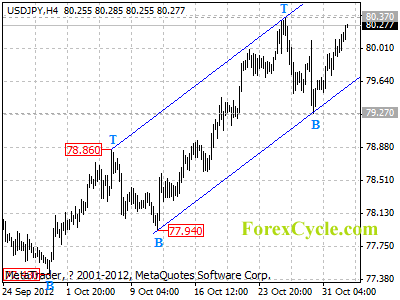
USDJPY is facing 80.37 resistance

USDJPY is facing 80.37 previous high resistance, a break above this level will indicate that the uptrend from 77.43 has resumed, then further rise towards 82.00 could be expected. Support remains at the lower line of the price channel on 4-hour chart, only a clear break below the channel support will suggest that lengthier consolidation of the uptrend from 77.43 is underway, then range trading between 79.27 and 80.37 could be seen.

usdjpy

Forex Signals

More Bad News for the Asian Century

By MoneyMorning.com.au

‘Climate change adviser Ross Garnaut has lambasted Australian executives for destroying shareholder funds in the blind belief China’s demand for Australia’s big three mining exports would continue to climb.’ – The Age

Perhaps Mr Garnaut should ask why company executives are blowing up shareholder funds.

Maybe it’s because for 30 years, Australian governments have spouted off about the Asian economic boom.

And now the Aussie government has just released the Asian Century white paper. The gist of the white paper is that Asia will undergo an economic boom for another 100 years.

But before you trust everything the government says, just remember that they can’t even correctly forecast their budgets six months in advance. So we find it hard to take a 100-year forecast with anything more than a pinch of salt.

Our advice? Ignore the long-range forecast and look at history instead. That’s because history tends to offer useful lessons for the future…including a lesson Australia could learn from previous Asian booms and busts…

Take this report from the New York Times in 1996:

‘Are East Asia’s fiercely competitive tiger economies starting to lose their fangs?

‘Things probably have not gotten quite that bad. But if the teeth are still intact, they have lost some of their sharpness of late. Export growth for many countries in the region – including the original “Four Tigers” of Singapore, Taiwan, Hong Kong and South Korea, as well as a half-dozen other countries that are following the same fast-growth path – has slowed sharply this year. And China’s exports have actually declined.

‘The deceleration in part reflects a healthy cooling off of economies that were running the risk of overheating. But it also raises questions about the staying power of East Asia’s export-driven economic boom. In particular, it translates into a deterioration of the region’s trade balance.’

One year later, the Asian Economic Crisis was in full flow. The Asian Tiger economies collapsed and their currencies were devalued. To rub the salt in, the International Monetary Fund (IMF) handed out bailout money.

In simple terms, the cause of the Asian Economic Crisis was over-investment, over-borrowing, and over-enthusiasm…

Asian Tiger Slaughtered

It was a classic bubble. An investment or economy begins growing on its own fundamentals. This attracts attention. So more people invest. Things get even better…imagine if growth continued at this rate.

Then the snake-oil salesmen arrive. In this case they called it the ‘Asian Tiger’. Businesses expanded and new businesses appeared. But because they hadn’t saved enough, they had to borrow money.

The banks cautiously loaned money at first. But when they started seeing the returns, they imagined what they could have made if they had loaned twice or three-times as much.

You get the picture. In the end, like every investment bubble in the history of mankind, the world runs out of fools who are prepared to buy into the bubble.

The euphoria that sucked everyone in disappears. Replacing it is fright as everyone rushes for the exit.

They sell the investment at a loss. Businesses can’t sell enough goods to repay the loans. That means loans go unpaid. The currency falls as investors abandon it for safe haven currencies…and finally, the whole economy collapses in a heap.

That’s the (abridged) story of the Asian Financial Crisis. And it’s the story of every other asset or economic bubble…and it’s the story of the Chinese economic bubble.

‘Oh, but Kris, China is different, it doesn’t have a bunch of external debt. It owns other nations debts, so it will be fine.’

We often hear that excuse.

But, it’s worth paying attention to an article in Forbes earlier this year:

‘Here’s some terrific news about China’s economy: at the end of last year, the debt-to-GDP ratio of the Chinese government, the key measure of its fiscal sustainability, stood at 16.3%. That’s an improvement from the already impressive 17% at year-end 2010.

‘Based in large part on Beijing’s low debt load, the Economist’s “wiggle-room index,” which ranks economies on their ability to afford stimulative measures, assigns a great rating to China. Of 27 emerging nations, only petroleum-blessed Saudi Arabia and Indonesia look stronger…

‘All this sounds wonderful, but none of it correlates with the facts. The 16.3% calculation excludes Beijing’s “hidden liabilities.” Once you add them in, China’s debt-to-GDP ratio increases to somewhere between 90% and 160%. And if you believe Beijing has been overstating its GDP recently – it has, at least starting from the last quarter of last year – China’s ratio approximates Greece’s 164%.’

Greece is Nothing Compared to China

Wow! The European Union is on the verge of collapse, and asset markets have crashed due to Greece’s debt problems. Given the relative size of the Greek economy to the Chinese economy

…can you imagine what will happen to asset prices when the Chinese economy implodes? It almost doesn’t bear thinking about. Only you have to think about it because the Australian economy is handcuffed to the Chinese economy.

Now, we’re not saying that China won’t be an economic force…to a large degree it already is. But what we are saying is something we’ve said for the past couple of years.

That is, regardless of a country’s strength, economic growth doesn’t go up non-stop forever. Booming economies will always have periods of bust.

If an economy sees excessive credit growth and an economic boom, as sure as night follows day, that economy will see credit contraction and an economic bust.

Bottom line: 100 years is a long time, and anything can happen. But don’t fall for the spin that Australia’s future wealth is safe.

The Chinese economy is following the same path as every other economic boom…and it will soon follow the same path as every other economic bust.

History will show that the Asian Financial Crisis was nothing compared to the coming fallout from the Chinese Financial Crisis.

Cheers,
Kris

From the Port Phillip Publishing Library

Special Report: After the Bust

Daily Reckoning:
It Won’t Be Long Before the Problems in Greece Resurface

Money Morning:
Is the Asian Century Already Kaput?

Pursuit of Happiness:
Tax = Theft

Australian Small-Cap Investigator:
The Power of Small Cap Stocks


More Bad News for the Asian Century