So Much for the Obama Bounce

By MoneyMorning.com.au

Nothing changed yesterday.

Barack Obama is still the president of the US. The Republicans are still in charge of the House of Representatives, which means there’s still lots of potential for squabbling and inaction.

Elsewhere, Europe is still in a mess. As for China, no one really knows what’s going on there, but there’s certainly a lot of potential for trouble.

Like I said, nothing changed yesterday.

So why did the Dow collapse in its worst plunge of the year?

The Market is Neurotic

One of the best characterisations of the stock market is still Benjamin Graham’s description of ‘Mr Market’. He’s always there to buy or sell you shares. But he’s a moody fellow. Some days he’ll pay whatever it takes; other days he’ll be desperate to offload whatever he’s got.

Lately, Mr Market seems to have an incredibly short attention span, too. He only seems able to focus on one thing at a time.

Prior to the US election, Mr Market was fretting over who would win. Mitt Romney would arguably have been more friendly to businesses in terms of tax policies.

But there was also a fear that he’d have been a ‘hard money’ kind of guy. For a market hooked on quantitative easing (QE), that was a worrying prospect.

Now Obama’s back in, the market doesn’t have to worry about QE suddenly being withdrawn. But nothing else has changed. So now the focus has shifted to all the other things left to worry about.

Hence the huge plunge in the US stock market yesterday. The Dow Jones index fell by more than 300 points. And – perhaps more worryingly, as it’s such a key stock – Apple has now entered a bear market. Its share price is down more than 20% from its peak.

So what exactly are investors fretting about now?

For starters, there’s that ‘fiscal cliff‘ problem everyone keeps talking about. In case you weren’t already aware, a package of tax hikes and spending cuts is due to take effect at the start of next year.

If the full package is put in place, it’ll suck a load of money out of the US economy. Chances are that would hit the economy hard.

Given that almost nothing has changed in the make-up of the American leadership, attempts to reach a compromise will boil down to how co-operative the two sides of the government feel.

I suspect some sort of deal will be reached. The Republicans can hardly accuse Obama of being a mad ‘tax and spend’ socialist at the next election if the changes are allowed to go ahead. And if the economy takes the hit now, chances are the pain will be in the past by the time 2016 comes around.

So at this stage, they’ve every incentive to reach a compromise. The closer to the next election they can push tough decisions on spending and tax-raising, the better it’ll look for them.

Of course, it’s anyone’s guess how it will all turn out. However, history suggests that ‘big scary events’ that everyone already knows about usually end up being less big and less scary than imagined.

Expect Europe to Return to the Headlines


Europe is more of a concern. If you think negotiating the fiscal cliff is a challenge, try doing the same thing across 17 different countries, all with different electoral cycles.

And yesterday European Central Bank head Mario Draghi warned that even Germany is starting to suffer as recession spreads across the region. In fact, the disappointing German economic data probably rattled investors more than anything to do with the US election.

We still believe the ECB will end up having to print money. It’s only a matter of time. But expect more ‘crisis’ headlines and summits before then.

As for China – it’s anyone’s guess what will happen when the handover of power is finished there. But with shadows hanging over both the US and European economies, it’s hard to believe that China can reignite economic growth easily when demand in the rest of the globe is so weak.

What can you do?

Well, as we’ve said on numerous occasions, the best way to deal with all this uncertainty is to try to ignore it. There’s always some potential disaster waiting in the wings. Hard as it may seem to believe sometimes, the world has endured far harder times and come through.

Ultimately, that was Ben Graham’s point when he talked about Mr Market. He’ll come to your door every day in one frame of mind or other. But you don’t have to trade with him unless you think it’s worth doing so.

Don’t let his mood swings affect your judgement. You don’t need to worry about his frame of mind – just look at the deals he’s offering you. If they’re good value, take them. If not, he’ll be back tomorrow with a different offer.

For investors, all that really matters is buying what’s cheap. Valuation is the key to successful investing.

John Stepek
Contributing Editor, Money Morning

Publisher’s Note: This article originally appeared in MoneyWeek

From the Archives…

More Bad News for the Asian Century
2-11-2012 – Kris Sayce

Is the Asian Century Already Kaput?
1-11-2012 – Kris Sayce

Has the Australian Dollar’s Luck Just Run Out?
31-10-2012 – Murray Dawes

How the Aussie Dollar is Caught Up in Big Bankers’ Games
30-10-2012 – Callum Newman

Does Excessive Government Spending Make You the World’s Best Treasurer?
29-10-2012 – Kris Sayce


So Much for the Obama Bounce

Korea holds rate, sees exports emerging from downtrend

By Central Bank News
    The central bank of South Korea held its base rate steady at 2.75 percent, saying it expects global economic growth to be “very modest” going forward and the downside risks to growth are large due to the U.S. fiscal consolidation issues and Europe’s fiscal crises.

    But the Bank of Korea (BOK) also said that Korea’s exports appeared to be emerging from their downtrend and consumption and investment had turned around and was starting to pick up while the number of employed had risen in the the service and even more in the manufacturing sector.
    Nevertheless, the BOK, which has cut its base rate twice this year for a total cut of 50 basis points, “anticipates that the negative output gap in the domestic economy will persist for a considerable time, due mostly to the prolongation of the euro area fiscal crises and to the delay in recovery of the global economy.”
    South Korea’s export-driven economy has been hit hard by slow global growth, with Gross Domestic Product only expanding by 0.2 percent in the third quarter from the second, for a year-on-year growth rate of 1.6 percent, the weakest in 12 quarters.
     Last month the BOK cut its economic growth forecast for 2012 to 2.4 percent and for 2013 it expects growth of 3.2 percent. In 2011 the economy grew by 3.6 percent.
     Weak demand has restrained inflation, with consumer prices rising by an annual 2.1 percent in October, slightly up from 2.0 percent in September.
     “The Committee forecasts that inflation will not deviate substantially from its current level for the time being, owning primarily to the easing of demand-side pressures and despite the influence for example of international grain price instability,” the BOK said after a meeting of its Monetary Policy Committee.
    In October the BOK cut its forecast for inflation to 2.3 percent in 2012 and 2.7 percent in 2013. 
    The BOK has a 2-4 percent inflation target range for 2012 and for 2013-2015 it targets a 2.5-3.5 percent increase in consumer prices.
    

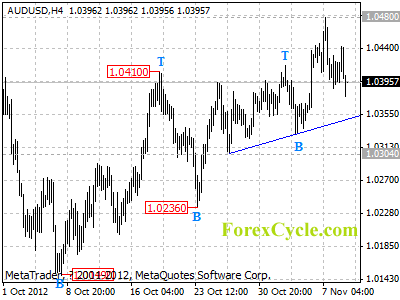
AUDUSD remains in uptrend from 1.0236

AUDUSD remains in uptrend from 1.0236, the fall from 1.0480 could be treated as consolidation of the uptrend. Support is at the upward trend line on 4-hour chart, as long as the trend line support holds, the uptrend could be expected to resume, and another rise towards 1.0500 is still possible after consolidation. On the downside, a clear break below the trend line will indicate that the uptrend from 1.0236 has completed at 1.0480 already, then the following downward movement could bring price back to 1.0200 zone.

audusd

Forex Signals

Investing Lessons: Avoiding the Peter Lynch Bias

By The Sizemore Letter

The single most important lesson I’ve learned about being a successful investor is the need to maintain emotional detachment.  Any feelings you may have towards a stock are unrequited.  If you love a stock, it will not love you back.  And if you hate a stock, it will not give you the satisfaction of responding in kind.  (As tragic as unanswered love may be, unanswered hate is often more damaging to your pride.)

A stock is like that unattainable cheerleader you had a crush on in high school.  She neither loved you nor hated you; she was completely unaware you existed.

No matter how much you love a stock (and write favorably about it in MarketWatch) it will not reward your loyalty by rising in price. And heaven help you if you allow your emotions to cloud your judgment in a short position.  I know of no surer way of losing your investment nest egg than to short a stock or other investment you hate.  Alas, I know from experience; I shorted the Nasdaq 100 in the fall of 2003.  In an outbreak of moral high-horsing that has (thankfully) now been purged out of me, I decided that tech stocks were overpriced and needed to fall further.  The Nasdaq had very different ideas, and I was forced to cover that short at a 20% loss with my tail tucked between my legs.

A closely-related investment mistake is succumbing to what I call the “Peter Lynch bias.”

Peter Lynch ran the Fidelity Magellan fund from 1977 to 1990 and had one of the best performance records in history for a mutual fund manager—an annualized return of over 29% per year.

Unfortunately, he also offered some of the worst advice in history when he recommended that investors “invest in what they know.”

On the surface, it seems like decent enough advice.  If you stumble across a product you like—say, a particular brand of mobile phone or a new restaurant chain—then it might be reasonable to assume that others will feel the same way.  If the stock is reasonably priced, it might make a good investment opportunity.

Unfortunately, “investing in what you know” tends to create muddled, emotionally baggaged thinking.  The fact that you like Chipotle (NYSE:$CMG) burritos and are intimately aware of every ingredient used in the red salsa does not automatically make Chipotle a good investment any more than your liking of Frappuccino makes Starbucks (Nasdaq:$SBUX) a good investment.   Rather than give you an insightful edge, liking the product causes you to lose perspective and see only what you want to see in the stock.

How do we mitigate our emotional impulses?

In a prior article, I noted that “brain damage can create superior investment results.”  But short of physically re-wiring our brains, what can we actually do?

I try to follow these basic guidelines and recommend them:

  • If you like a company’s products, try using one of their competitors before seriously considering purchasing the stock.  If I had really taken the time to learn how to use an Apple (Nasdaq:$AAPL) iPhone or Google (Nasdaq:$GOOG) Android device, I probably wouldn’t have gotten sucked into the Research in Motion (Nasdaq:$RIMM) value trap. Yes, RIMM was one of the cheapest stock in the world when I recommended it last year.  But I cannot deny that my decision to recommend it was biased by my ownership of a BlackBerry phone.  Likewise, many iPhone owners are probably buying Apple for similar reasons today.
  • To the best extent you can, try to follow trading rules and use stop losses.  What works for one investor will be very different than what works for another.  Perhaps you use a hard stop loss of, say, 10% below your purchase price.  Or perhaps you use a trailing stop or 20-25%.  If you are a value investor, perhaps you base your sell decision on valuation or fundamentals rather than market price.  But in any event, my point stands.  Lay out the conditions under which you intend to sell and stick to them.  Stock ownership is a marriage of convenience with quick, no-fault divorce if your situation changes.  Don’t make the mistake of falling in love.
  • Unleash your inner Spock.  For readers who are not Star Trek fans, Spock is an alien from the planet Vulcan who is incapable of feeling emotions.  When talking about a stock or watching its price fluctuate gets your heart racing, take a step back and try to look at the investment through Spock’s eyes.  Is it logical?  Do the numbers make sense?  Are the growth projections based on reasonable facts or on optimistic hope?  Would you buy a different company if it were trading at the same price multiple?

Admittedly, these are not precise guidelines.  But then, another lesson I learned is that it is a mistake to try to be too precise in this business.  Follow the lead of great value investors like Benjamin Graham and Warren Buffett by making sure you have a wide margin of safety in your assumptions.

Disclosures: Charles Sizemore has no positions in any securities mentioned. This article first appeared on MarketWatch.

The post Investing Lessons: Avoiding the Peter Lynch Bias appeared first on Sizemore Insights.

Related posts:

(VIDEO) GBP/USD: How Elliott Wave Patterns Predicted Recent Drop Under 1.60

A great 6-minute video lesson in Elliott wave analysis of forex markets
November, 2012

By Elliott Wave International

Every Friday, the editor of EWI’s forex-focused Currency Specialty Service, Jim Martens, records a video update for his subscribers. Each video delivers a real-life lesson on Elliott wave application to forex markets.

Watch this 6-minute video Jim recorded on October 12. Jim called for cable (GBP/USD) to drop below 1.60 in wave 5 of the developing Elliott wave sequence.

Ten days later, on October 23, GBP/USD fell as low as 1.5925.

Download Your Free 14-page eBook: “Trading Forex: How the Elliott Wave Principle Can Boost Your Forex Success”Here’s some of what you’ll learn:

  1. Which Elliott waves to trade
  2. Which Elliott waves set up your forex trade
  3. When your analysis is wrong
  4. Guidelines for projecting price targets
  5. How to evaluate an Elliott wave structure
  6. How to use the bigger picture to give you perspective on the market’s next major move

Jim also takes you through two real-world trading examples to reinforce what you’ve learned and apply it to your own trading.

All you need is a free Club EWI profile to download this FREE 14-page eBook now >>


This article was syndicated by Elliott Wave International and was originally published under the headline (VIDEO) GBP/USD: How Elliott Wave Patterns Predicted Recent Drop Under 1.60. EWI is the world’s largest market forecasting firm. Its staff of full-time analysts led by Chartered Market Technician Robert Prechter provides 24-hour-a-day market analysis to institutional and private investors around the world.


Peru holds rate steady, sees further decline in inflation

By Central Bank News
    The central bank of Peru held its benchmark interest steady at 4.25 percent, as expected, saying the deviation in inflation from its target range was due to temporary supply side factors in a domestic environment where growth is close to potential and an external environment that is “highly uncertain.”
    The Central Reserve Bank of Peru (BCRP), which has held interest rates steady since April 2001,  also said inflation, which again fell in October due to a reversal of earlier supply shocks, will gradually trend toward 2 percent.
    Peru’s inflation rate fell to 3.25 percent in October, the lowest this year, from 3.74 percent in September. Inflation has exceeded the central bank’s upper tolerance range since June 2011.
    The central bank targets inflation of 2.0 percent, within a one percentage point tolerance band.
    BCRP said indicators show that Peru’s economy has stabilized around its long-run sustainable level although sectors linked to exports show a weak performance and there is uncertainty about the global economic growth rate.
    Peru’s economy, the fastest growing in South America this year, expanded by an annual 6.1 percent in the first and second quarters of this year and the finance minister said recently that Gross Domestic Product expanded about 6.4 percent in the third quarter.
    Third quarter data are first scheduled for release later this month.
    Peru’s economy is forecast to expand by 6 percent, or slightly more, this year,  down from 6.9 percent in 2011.

    www.CentralBankNews.info

Google Earnings Trading Idea

By JW Jones, OptionsTradingSignals.com

We recently discussed the impending release of third quarter earnings for Google (GOOG), analyzed the expected move in light of then-current options pricing, discussed the expected behavior of the implied volatility of the options, and finally constructed an option trade structure we thought had a high probability of success. I thought it would be helpful to discuss how our prognostications fared and finally to consider “lessons learned” in this exercise.

This column is essentially a trade journal entry. I would encourage all traders to make such entries routinely; each trade, whether it is economically successful or not, has an embedded lesson. No trader ever reaches the point at which he executes perfectly. The lesson has been paid for. It is foolish not to capture its message.

Google was scheduled to report earnings after the closing market bell on Thursday, October 18.  It is worth noting that most options players wait until an hour or less prior to earnings release to enter earnings trades. These last minute players were completely shut out because of an unexpected early earnings release mid-day on Wednesday.

Prior to this unforeseen early release of information the stock was trading around $755. The stock immediately sold off and traded wrapped around $680 / share for the next few days. This 10% sell off was the largest move on earnings for the prior four quarters. The recent range of price moves on earnings had been between 2% and 8%.

The second portion of our prospective analysis was to calculate the anticipated move that was reflected in the options pricing. We calculated the impending move at $34.60; roughly 50% of the actual move that occurred. This means that the move on earnings was a 2 standard deviation move, a very unusual event.

Our statistics tell us that the 1 standard deviation calculated move of +/- $34.60 / share would have contained 68% of the occurrences of the move. The actual 2 standard deviation event would have contained 95% of the movement events.

We discussed the fact that playing earnings directionally is difficult.  Obviously those sufficiently prescient to predict this massive sell off and structure appropriate options positions did well. In this particular case, simply buying puts would have been a profitable strategy since the move was so much larger than anticipated.

However, it is critical to realize that a trading strategy that can survive over the long haul cannot be based on statistically improbable events.  Traders who simply buy options ahead of earnings release are engaging in low probability strategies that will not be successful when used over a sufficient number of events that the probabilities are realized.

We considered the example of a high probability trade, a triple calendar. This trade was designed to deliver profit over a wide range of prices and profit from the anticipated volatility collapse on the front month contracts.

To recap, the original P&L curve is presented below:

Google - GOOG Option Trading

This trade was designed to be short term and was planned to conclude on the Friday following earnings. The original break even points for the trade were around $670 and $840 and were outside double the expected move. The trade had approximately a 90% chance of profitability.

At expiration on Friday, the planned duration of the trade, the price of GOOG was $682, within the initially projected zone of profitability.  So how did the trade do?

It was a scratch, losing $8. The reason for the loss was that the collapse in implied volatility extended to the December series options we were long to a greater degree than anticipated.

While a negative economic outcome is never welcome, I feel quite good about the result in light of the magnitude of the price move. I feel this is an example of how a well constructed trade exposes the trader to minimal loss even when price movements occur well outside the predicted range.

Happy Trading!

Simple ONE Trade Per Week Trading Strategy?
Join www.OptionsTradingSignals.com today with our 14 Day Trial

JW Jones

This material should not be considered investment advice. J.W. Jones is not a registered investment advisor. Under no circumstances should any content from this article or the OptionsTradingSignals.com website be used or interpreted as a recommendation to buy or sell any type of security or commodity contract. This material is not a solicitation for a trading approach to financial markets. Any investment decisions must in all cases be made by the reader or by his or her registered investment advisor. This information is for educational purposes only.


Euro zone economy to remain weak in 2013 – ECB

By Central Bank News
    The economy of the 17 nations that share the single euro currency is weak and the European Central Bank (ECB) expects growth to remain weak next year.
    The ECB, which earlier held its benchmark refinancing rate unchanged at 0.75 percent, said inflation is expected to remain above 2.0 percent for the rest of 2012, due to high energy prices and taxes, but then fall below that level next year and remain in line with the bank’s price stability target.
    ECB President Mario Draghi said economic activity continues to be supported by the bank’s policy stance and confidence in financial markets has “visibly improved” since the announcement of the Outright Monetary Transactions (OMT) programme, which he said the bank is ready to undertake to avoid extreme scenarios and avoid worries over the impact of destructive forces.
    But the economy remains weak and Draghi said data continued to signal weak activity in the second half of this year.
    “While industrial production data showed some resilience in July/August, most recent survey evidence for the economy as a whole, extending into the fourth quarter, does not signal improvements towards the end of the year,” Draghi told a press conference.

     The euro zone economy contracted by 0.2 percent in the third quarter from the second quarter for an annual decline in Gross Domestic Product of 0.4 percent.
    “Looking ahead to next year, the growth momentum is expected to remain weak,” he said, adding that the risks surrounding the outlook remain on the downside.
    Annual inflation in the euro zone was 2.5 percent in October, above the ECB’s target of inflation below but close to 2.0 percent, but Draghi said underlying price pressures should remain moderate given modest growth and well-anchored expectations.
    Current levels of inflation should thus remain transitory,” Draghi said.
   
    www.CentralBankNews.info


Central Bank News Link List – Nov 8, 2012: China economy improving, policy flexible: central bank

By Central Bank News

Here’s today’s Central Bank News link list, click through if you missed the previous link list. The list comprises news about central banks that is not covered by Central Bank News. The list is updated during the day with the latest developments so readers don’t miss any important news.

Aussie Increases as RBA Holds Interest Rates

By TraderVox.com

Tradervox.com (Dublin) – The Reserve Bank of Australia held its benchmark interest rate at the highest among the developed nations as global economy seems to stabilize and inflation in the country starts to pick. The Aussie has improved to five week-high against the dollar as risk appetite boosted commodity related currencies.

According to a statement released yesterday, the RBA governor Glenn Stevens left the overnight lending cash rate at 3.25 percent. Most economists were expecting the RBA to cut interest rate to 3 percent. According to Stevens’ statement, the prices data is slightly higher than bank expectation and the global economy is showing signs of improvement. He added that the board considered these figures to come up with the monetary policy.

The decision to keep current interest rates is seen as a move to shield the economy against inflation risks. The nation’s economy relies on China as a trading partner, where it exports most of its products. Aussie remains above parity against the greenback despite acceleration in US economic growth.

According to Daniel Martin, a Singapore-based economist at Capital Economics Ltd, the RBA will not act unless the global economy takes a turn to the worst. Martin predicts that the Australian central bank will keep the rates unchanged till late 2013 as it seeks to boost non-mining sectors before the mining sector peaks.

The Australian dollar climbed to $1.0438 against the greenback after the decision was announced. This is the highest it has been since September 28. The Australian economy depends on exports to China with more than five percent of the GDP coming from the Iron ore exports to China. Chinese data have showed a rebound in the non-manufacturing sector which has been on a slowdown for the last 19 months.

The Australian dollar has increased by 57 percent in the last four years. This has lead to a loss of 37,000 manufacturing jobs in the last two years. The construction sector is reported to have lost 70,000 jobs in the past year. A report today is expected to show an increase of 600 jobs in the country, while the unemployment rate is expected to rise by 0.1 percent.

Disclaimer
Tradervox.com is not giving advice nor is qualified or licensed to provide financial advice. You must seek guidance from your personal advisors before acting on this information. While we try to ensure that all of the information provided on this website is kept up-to-date and accurate we accept no responsibility for any use made of the information provided. Opinions expressed at Tradervox.com are those of the individual authors and do not necessarily represent the opinion of Tradervox.com or its management. 

Article provided by TraderVox.com
Tradervox.com is a Forex News Portal that provides real-time news and analysis relating to the Currency Markets.
News and analysis are produced throughout the day by our in-house staff.
Follow us on twitter: www.twitter.com/tradervox