USDCAD: Vulnerable But Holds Above The 1.0000/1

USDCAD: With USDCAD continuing to hold above the 1.0000/1 levels, we look for it to trigger a recovery higher following its recent weakness. Support comes in at the 1.1000/1 levels where bulls may come in and push it higher but if violated further weakness could occur towards the 1.0950 level. Further down, support is located at the 1.0909 level. On the other, we expect a recovery higher to occur following its ability to hold above the 1.0000/1 levels. If this occurs expect the pair to strengthen further towards the 1.1100 level where a break will aim at the 1.1168 level and then the 1.1200 level. Further out, resistance resides at the 1.1277 level where a break will resume its broader uptrend. This if seen will pave the way for a run at the 1.1300 level. All in all, USDCAD faces further downside pressure but correction may occur.

Article by www.fxtechstrategy.com


Uganda holds rate, sees lower short-term inflation

By CentralBankNews.info
   Uganda’s central bank maintained its Central Bank Rate (CBR) at 11.5 percent, saying its neutral policy stance is warranted given its current projections for inflation and economic growth.
    The Bank of Uganda (BOU), which last cut its rate by 50 basis points in December for a net 50 point reduction in 2013, revised downward its forecast for core inflation to 4-5 percent over the next few months from February’s forecast of 5-6 percent in the first half of the year after headline and core inflation eased in February due to a strengthening of the exchange rate.
    But over the next 12 months, the BOU still sees core inflation rising to between 5.5 and 6.5 percent and cited potential risks of stronger inflation from a deprecation of the exchange rate, stronger domestic demand from the fiscal sector and higher food prices due to drought and regional food shortfalls.
    “The magnitude and timing of possible declines in foreign aid are also a source of uncertainty for the balance of payments and the economy,” the BOU said.
    In its monetary policy statement, the BOU referred to a decline in February headline inflation to 6.7 percent from 6.9 percent in January while core inflation fell to 3.7 percent from 4.6 percent.
   But on Monday the bank said, citing Uganda’s statistics bureau, headline inflation rose to 7.1 percent in March from a revised 6.8 percent in February while core inflation fell to 3.7 percent in March from a revised 3.9 percent in February.

    The BOU targets core inflation of 5.0 percent.
    Uganda’s shilling appreciated by 6.2 percent in 2013 but since late February it has declined, trading at 2,545 to the U.S. dollar today compared with 2,525 at the end of 2013.
    The bank said economic growth in the current 2013/14 fiscal year, which ends on June 30, is still projected to be relatively buoyant, supported by fiscal stimulus, a stronger global environment, strong inflows of foreign direct investment and household consumption. However, it said weak bank credit growth posed a risk to this outlook.
    The BOU has forecast growth of 6.0-6.5 percent in the current fiscal year.
    Uganda’s Gross Domestic Product contracted by 0.6 percent in the third calendar quarter from the second quarter for annual growth of 2.2 percent, down from 5.8 percent in the second quarter.

    http://ift.tt/1iP0FNb

Things That Make You Go Hmmm: Fight Club

By Grant Williams  |  April 1, 2014

Sometimes the sand shifts beneath your feet without your realizing it. Other times you can see it happening.

In November 1975, at a summit meeting in the picturesque Château de Rambouillet near Paris, leaders of the six richest industrial powers gathered to form a rather exclusive, though completely informal, little club.

The article Things That Make You Go Hmmm: Fight Club was originally published at mauldineconomics.com.

How The Situation In Eastern Europe Has Affected The EURUSD

By MXT Global

In February 2014, the president of Ukraine, Viktor Yanukovich, was impeached by the country’s interim government after countless protests caused a revolution. The former president had made several well-known deals with the Russian Federation, and the people of Ukraine clearly indicated that they have a strong desire to ally the country with Europe and to join the European Union.

The volatility has proved both profitable and nightmarish for traders willing to take the risks, with MXT Global’s Forex analysts providing their technical analysis.

Sources: Bloomberg, Emirates NBD Research

Sources: Bloomberg, Emirates NBD Research

Three days after the temporary government had been established, Russian soldiers invaded the Republic of Crimea, which is a small peninsula that is located in the southern part of Ukraine.

The Revolution

The initial protests began in early February. In the first 15 days of February, the value of the euro increased substantially.

The main protests against the government of Ukraine took place in Kiev and other major cities between February 18, 2014 and February 23, 2014. During this time period, the EUR/USD remained stable, and only small fluctuations in the currency pair’s value occurred.

The Invasion 

The international worth of the EUR/USD fell swiftly on February 26, 2014 as news first reached investors that Russia had sent troops into the Republic of Crimea.

However, banks began to purchase euros again on February 28, and investors started to rapidly liquidate dollars. On this day, the exchange rate of euros to dollars increased by almost one percent.

In early March, the European Union and the United States officially issued statements that condemned Russia’s actions; however, Vladimir Putin announced that Russia would not recognize Ukraine’s new government.

After these announcements, the value of the EUR/USD increased rapidly again.

The Input Of The People 

A referendum was scheduled for the middle of March, and during the 10 days that preceded the vote, the international value of the euro continued to rise steadily. When the result was announced, the government of Russia proudly proclaimed that the 2.5 million people who live in the area had opted to make the Republic of Crimea a new province of Russia.

As a result, the value of the euro fell swiftly during the next several days.

In spite of a substantial gain on March 24, 2014, the exchange rate of euros to dollars has been dropping steadily since the announcement because of the European Union’s inability to stop the Russian annexation of the peninsula.

The estimated worth of the euro increased slightly after 100 members of the United Nations created a non-binding resolution that indicated that the results of the referendum were invalid.


About the Author:

This article was provided by the analysts at MXT Global.  MXT specialises in Forex and Binary Options trading with MetaTrader.


NZD/USD corrects lower after touching 0.8700

Since going up to the resistance from March 2013, NZD/USD failed to put in a daily close above it for four consecutive business days. The pair has been dropping since yesterday’s last bullish push, an attempt that went as high as 0.8700. ANZ Commodity Price Index dropped 0.1% from February, down to 337, marking the first decline in four months.

Technical Analysis

NZDUSD 2ndApril

Yesterday’s drop formed a bearish engulfing pattern on the daily timeframe, conveying the market’s intentions for a correction from this point onward.

The first supports have already been broken, with price already closing below the trendline that defined this bullish rally since early February. Next in line is the 0.8565-0.8570 area, where the 100 Simple Moving Average on 4H timeframe, 61.8% Fibonacci retracement from 0.8500 to 0.8700 and a small pivot point from late February might provide temporary support.

A close below 0.8565 will extend the correction towards 0.8500 price pivot zone. Later it can drop to 0.8466, where the 200 Simple Moving Average on 4H and 38.2% Fibonacci retracement between 0.8050-0.8700 should provide sellers with a more meaningful challenge.

Until the bullish trend configuration of higher swing highs and higher swing lows isn’t completely invalidated, all rejections starting from the afore mentioned levels should be treated with caution, since they can mark the end of the correction and continuation of the main trend.

*********
Prepared by Alexandru Z., Chief Currency Strategist at Capital Trust Markets


Wave Analysis 02.04.2014 (DJIA Index, Crude Oil)

Article By RoboForex.com

Analysis for April 2nd, 2014

DJIA Index

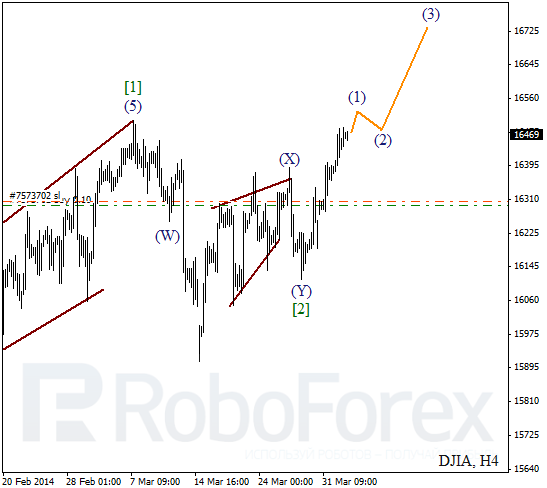
Index is moving towards new maximums. Probably, after completing double three pattern inside wave [2], price started forming bullish impulse inside wave (1). Instrument may yet continue growing up for a while, but later market is expected to start new correction.

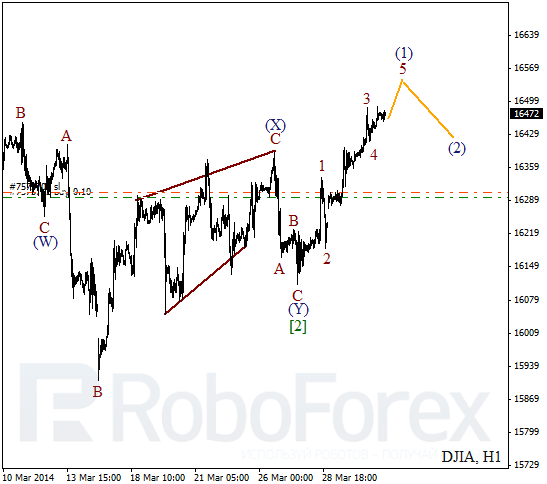
More detailed wave structure is shown on H1 chart. It looks like price is finishing the fifth wave inside wave (1). In the future, after wave (2), I’m planning to increase my long position with target in the end of the third wave.

Crude Oil

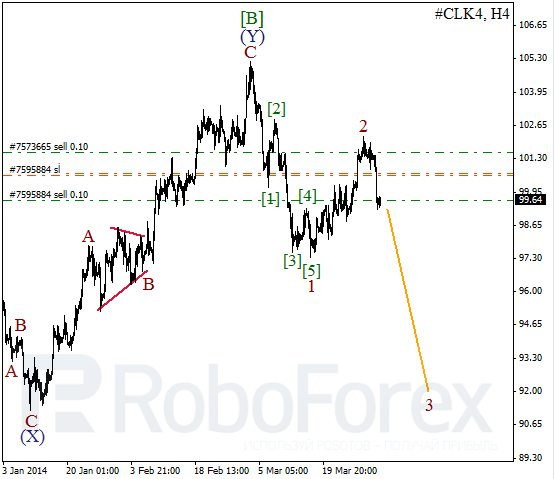
Oil started forming wave 3. Earlier price completed the second wave, during which I opened my first sell order. During local correction, I opened the second order and later plan to add several more.

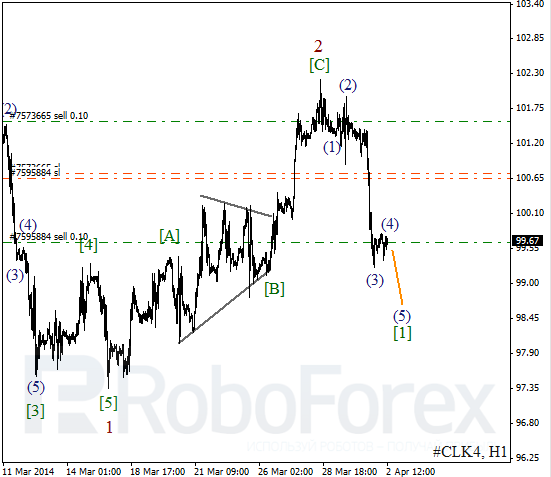
As we can see at the H1 chart, wave 2 took the form of zigzag pattern with triangle pattern inside wave [B]. On minor wave level, price is completing the fourth wave inside wave [1]. Probably, during the day instrument may break local minimum.

RoboForex Analytical Department

Article By RoboForex.com

Attention!
Forecasts presented in this section only reflect the author’s private opinion and should not be considered as guidance for trading. RoboForex LP bears no responsibility for trading results based on trading recommendations described in these analytical reviews.


Fibonacci Retracements Analysis 02.04.2014 (EUR/USD, USD/CHF)

Article By RoboForex.com

Analysis for April 2nd, 2014

EUR USD, “Euro vs US Dollar”

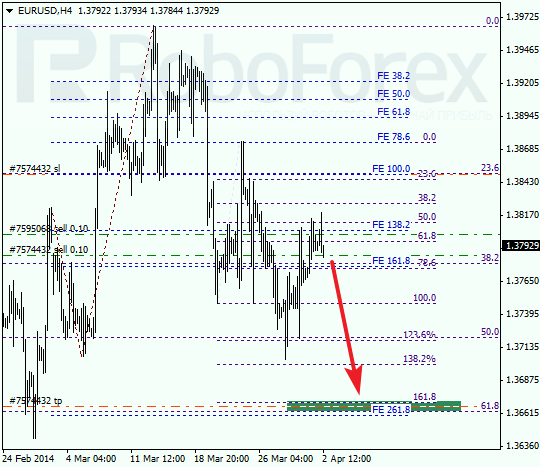
It looks like Eurodollar completed its correction and right now is starting new descending movement towards the group of lower fibo levels at 1.3665. If later pair rebounds from it, price may start new and deeper correction.

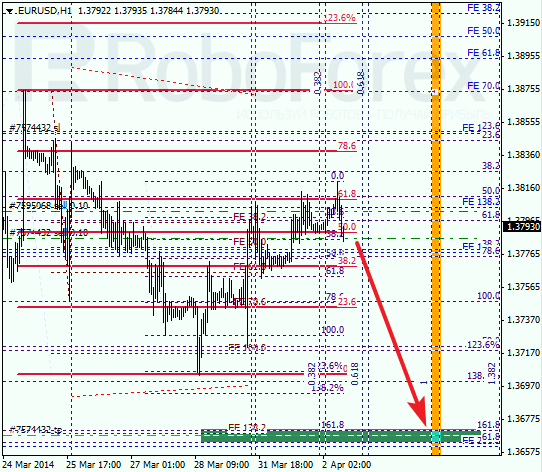
As we can see at H1 chart, pair rebounded from local correctional level of 61.8% one again. I’ve got two sell orders, and if price continues falling down, I’ll move stop into the black. According to analysis of temporary fibo-zones, lower target levels may be reached until the end of the week.

USD CHF, “US Dollar vs Swiss Franc”

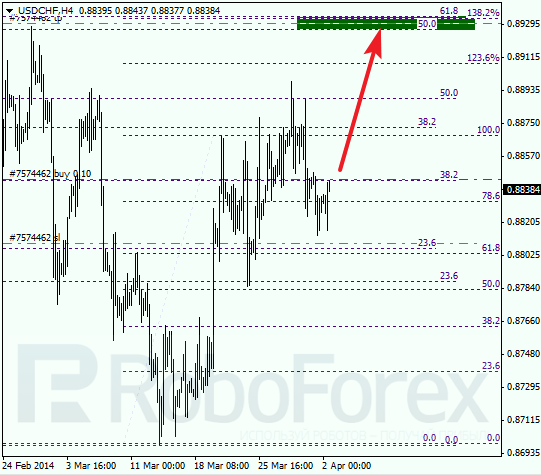
At H4 chart, bulls are returning to the market. Probably, price is starting new ascending movement and may break maximum quite soon. Target is still near the group of upper fibo levels at 0.8930.

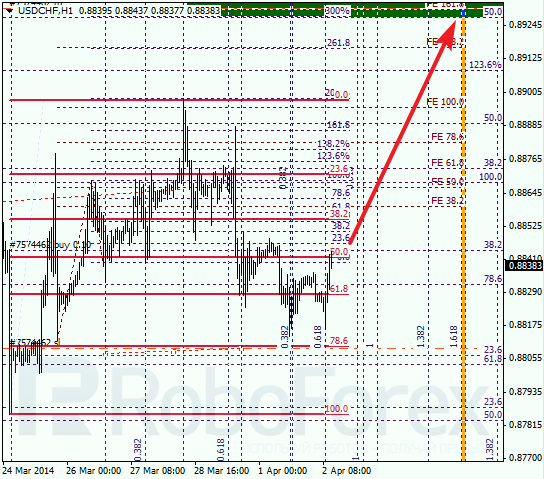
As we can see at H1 chart, pair is moving above local level of 61.8% again. I’ll increase my long position as soon as market breaks level of 38.2 upwards. According to analysis of temporary fibo-zones, predicted targets may be reached during the next couple of days.

RoboForex Analytical Department

Article By RoboForex.com

Attention!
Forecasts presented in this section only reflect the author’s private opinion and should not be considered as guidance for trading. RoboForex LP bears no responsibility for trading results based on trading recommendations described in these analytical reviews.


EUR/USD Forecast And Price Action For April 2nd

Article by Investazor.com

Yesterday economic indicators published for the Euro Area were mixed.  The Spanish Manufacturing PMI was published in line with the estimates, 52.8 and the Italian Manufacturing PMI was also in line with analysts’ estimates. These two happened to equilibrate very well the other two positive indicators published. German Unemployment Change was better than official estimates, just like I was anticipating, and the Unemployment Rate for the Euro Zone was 0.1% lower.

My expectations were of in line with this drop. Even though the good news helped a bit the Euro to maintain its position, the actual rally came only at the publication of ISM Manufacturing PMI for the US, which was lower than expected. Overall the price was contain between 1.3745 and 1.3815 at the end of the day.

See yesterday analysis: EUR/USD Forecast And Price Action for April 1st;

Today the Euro was pushed higher before the London opening and the publishing of the Spanish Unemployment Change. Even though this indicator dropped 16.6K, very good news for the Spanish labor market, the price started to drop right at the opening of the Exchange. Continue this article to see what to expect for today and the price action analysis for the EURUSD currency pair.

The following are expected next:

Second day for the ECOFIN Meetings. These are usually held in Brussels and attended by Finance Ministers from EU members states. They discuss a range of financial issues, such as euro support mechanisms and government finances.

The post EUR/USD Forecast And Price Action For April 2nd appeared first on investazor.com.

Faber, Rickards, Robb and Duncan Go Head-to-Head at World War D

By MoneyMorning.com.au

After a long first day of presentations at World War D, the international keynote speakers, Marc Faber, Jim Rickards, Richard Duncan and John Robb got up on the stage to answer questions on topics ranging from Bitcoin, to China’s economy and liberty.

You can read a summary of the discussion below, or go here to find out how to see video of the full discussion.

Kicking off the discussion: Bitcoin and Gold

Bitcoin feels like currency at this point. I don’t recommend it to investors but I’m not anti-bitcoin,‘ said Jim Rickards.  His concern however, was that many bitcoin users are tax evaders. He argued that the US Internal Revenue Service (IRS) has been used for political purposes before – pursuing the Tea Party over tax matters, for example – and that creates a risk for people who use Bitcoin. Bitcoin has been in an upcycle since 2009, he said, and no one knew what it would be like in a down cycle.
He affirmed the importance of gold in every portfolio.

Joining the discussion, Mark Faber said: ‘The question should be how could you NOT own gold.‘ His concern about Bitcoin was how reliant it is on internet and electricity networks functioning properly, something that can’t be taken for granted in the age of digital warfare.

Gold, however, is a physical asset that performed superbly until September 2011, Faber said, and has been in a correction since then, which isn’t unusual in a money printing environment.  ’The fact is that gold down is a present from God and I wish it would go lower so I could buy more,‘ he said. The big proviso Faber added was that he had to physically own it, and said people would be ‘mad’ to own any asset in the US.

That prompted the question: does the medium of exchange matter to you in the future? Does money have to be backed by a hard asset?

John Robb answered by turning to a theme that had dominated his presentation: trust. ‘What we’re seeing in terms of how people interact is the importance of online reputation.‘ He sees a fundamental shift afoot. This will be where the online sharing economy gives primacy to permanent, online reputations maintained by buyers and sellers (think AirBnB).

Mark Faber didn’t agree, noting that the terrible reputation of bankers hasn’t harmed them. ‘A lousy whore will still have customers,‘ he added to raucous laughter.

Richard Duncan jumped in, moving the discussion back to bitcoin. ‘I don’t understand the point of bitcoin. If you want paper money or paper currency you have several to choose from. If you want a physical asset you have gold.

Discussion moved to a theme that had dominated day one:

China’s Economy. Is a collapse imminent?

Chinese banks are less connected to the global system than USA and Europe so there is less risk of contagion,‘ said Jim Rickards. The risk may be lower but is still there – he pointed out that when the mortgage meltdown happened in the US in 2007 the Tokyo Stock Exchange dropped precipitously. Why? ‘When you’re in financial distress you don’t sell what you want, you dump what you can sell, which is why they dropped Japanese stocks and gold,‘ he said.

Mark Faber introduced another element – how the Chinese government would respond to a weak economy or falling asset prices. In that case, he said, the Chinese could easily print more money. That would make the currency decline, and Faber isn’t sure what consequences that would have. It’s not the involvement of Chinese Banks in the global system that could cause contagion but investors who have a strong exposure in China, he said.

Richard Duncan sees China differently. ‘China’s economic model is in absolute crisis,‘ he said. ‘With the US in crisis, and Japan and Europe, there’s no one else left for China to keep exporting to. So if exports aren’t growing why would they keep investing in factories? What’s going to drive China’s economy?‘ He argued that bank loans have been driving the Chinese economy and to survive the impending crisis, China will have to do what Japan has been doing: run up massive government debt.

That may avert a depression but in his view, China won’t grow anywhere near 7% a year.

John Robb’s view: China, like other emerging economies, is in an arms race with technology for middle class jobs. Technology, he believes, will win, which will deny billions of people entry to the middle class.

Liberty – are we effectively living in a police state?

The problem is we’re in a zero trust or low trust world. We’ve seen more and more states climbing into this police state overwatch,‘ answered John Robb.

The thing about liberty, observed Jim Rickards, is that once you notice it slipping away, those that have taken it won’t give it back. ‘If you pass enough laws everyone is a criminal. This is modern neo-Fascism, and it’s coming your way,‘ he added, to applause from the audience.

Mark Faber ended by noting that those who benefit most from regulation are established corporate players, at the expense of small business and individuals. Large corporations can afford to keep teams of expensive lawyers on staff, allowing them to minimise their own taxes and twist regulation in their favour in ways that their start-up rivals can’t. ‘The corporate establishment love regulation because it keeps the opposition away‘ he said.

And that ended day one. You can catch the events from days one and two here.

Callum Denness
Roving Reporter for Money Morning at World War D

From the Port Phillip Publishing Library

Special Report: ASX: 15,000

Join Money Morning on Google+


By MoneyMorning.com.au

Faber, Rickards, and Duncan on Deflation, Inflation and Interest Rates

By MoneyMorning.com.au

After discussion Bitcoin, China and even liberty at World War D, the international keynote speakers, Marc Faber, Jim Rickards, and Richard Duncan continued answering questions on delfation, inflation and interest rates.

You can read a summary of the discussion below, or go here to find out how to see video of the full discussion.

Deflation, inflation and stagflation

If the energy boom, technology boom, and globalisation is deflationary, asked Jim Rickards, how can the US pay its debts?  ’Remember deflation increases the real burden of debt, so if you can’t pay them off today when can you?‘ The forces of deflation are powerful, the necessity for inflation is powerful, but what will happen is a near instantaneous collapse in confidence in paper money and a flight to hard assets, he said.

Faber’s diagnosis was much the same. ‘Inflation and deflation can co-exist, especially in a money printing environment.‘ For example, he argued that gold and precious metals have been in a deflationary phase, as have real wages, for the past 20 years or so. Asset prices however have been in an inflationary phase. Faber’s warning: every inflation phase will sooner or later come to an end. The question for investors is when it will happen. ‘We have a global festival of money printing,‘ he said to much laughter. ‘It’s going to end badly, we just don’t know when.

You can see and hear Dr Faber’s comments on video. Click here to find out how.

Richard Duncan agreed the outlook is uncertain. ‘This is being managed by the government. We don’t know who the government will be five years from now,‘ said Duncan, which means it’s difficult to predict what will happen.

To manage this risk, the panel agreed on the need for a diversified portfolio of cash, quality stocks, and gold. Richard Duncan added:  ’I would borrow money at fixed interest rates to buy property. The property I would buy is land with lots of houses on them.‘ Like gold, land is scarce and as long as owners aren’t too leveraged they will always make money from rents, even in a depression.

Mark Faber also added: ‘I would choose the stock part of my portfolio very carefully. If you look hard there is always something somewhere that is depressed, and always something somewhere that is in fantasy land.

Jim Rickards also thinks buying up currencies is a good idea, naming the euro, Canadian dollar, Korean yuan and Singapore dollar. He has been a defender of the euro because it’s a de facto German currency. ‘The euro is the deutschmark in drag so to speak,‘ he said.

Interest rates

On the question of locking in fixed mortgage rates, Mark Faber argued that interest rates move in long cycles of 45-60 years – and with effective rates in the US at zero for last five years we have to assume we’re nearing the end of the interest rate downturn. Any interest rate rise will affect the value of assets. ‘I’m convinced in my life I will see the day when my asset values drops 50%,‘ he said.

Speaking on the uncertainty of data that underpins interest rate decision, John Robb argued economic conditions are much worse than central banks and governments are reporting. ‘What we’re seeing on the ground in the US is a lot more dire. Jobs are evaporating faster than they’re being replaced. That’s why so many [people] end up at retirement without any savings at all, and it’s going to get worse and worse.

I don’t find any discussion of IR [interest rates] useful unless you’re talking about real and nominal. The way I look at it IR are at an all-time high,‘ added Jim Rickards.

And that ended day one. You can catch the events from days one and two here.

Callum Denness
Roving Reporter for Money Morning at World War D

From the Port Phillip Publishing Library

Special Report: ASX: 15,000

Join Money Morning on Google+


By MoneyMorning.com.au