Is This Proof That Commodity Prices are Set to Fall?

By MoneyMorning.com.au

Since I took over writing Money Morning every Wednesday I have focused on giving you an insight into my technical approach to trading markets.

But today I’d like to start by having a squiz at some interesting developments in the commodity markets.


I’ve noticed a distinct rise in articles referring to speculative commodity stockpiling in China and elsewhere.

An ANZ commodity research report from this week focused on something called ‘contango financing’ in the aluminium market. In a moment I’ll explain why you should take notice of this obscure term, and what it means for commodity markets…

According to the report:


‘The aluminium market is facing a supply shock in 2014 when prices could drop by 20% or more in a very short period. We expect around 70% of on-warrant and off-warrant stocks, or about 8 million tonnes of metal tied up in financing deals, to come to the market around the middle of 2014. The trigger will be rising interest rates, which will make contango financing unprofitable.

‘Contango financing – buying cash metal at a discount, selling forward at a premium, then using the difference to cover the cost of storage, interest and make a profit – has increased significantly since the global financial crisis. Low interest rates have caused investors to seek yields in alternative investment structures and financing metal remains a relatively low risk opportunity. However, margins can rapidly shrink as costs, primarily interest and warehouse rents, go up.

‘The metal locked away in these deals could amount to around 8 million tonnes or 15%-20% of global supply.’

This is scary stuff.

Then I read a Bloomberg article on Mike Shedlock’s economic blog, Mish’s Global Economic Trend Analysis. The article notes:


‘cotton stockpiles in China, the world’s biggest importer, are set to climb to about 9 million metric tons this season, enough to cover the country’s deficit for the next six years, according to Allenderg Cotton Co.

‘Inventories are rising as the government boosts purchases to support domestic prices and lift farmer incomes, Joe Nicosia, chief executive officer of the worlds largest cotton trader, said at a conference in Hong Kong today.’

A China Daily article from the same website focuses on the problems ahead for the Steel industry:


‘China’s steel industry is a big cause for concern in the fourth quarter due to shrinking demand and heavy losses, according to an industry official. The fears were outlined by Huang Libin, an official from the Ministry of Industry and Information Technology, in an interview with China National Radio.

‘The steel sector’s performance has been bad since the beginning of the year,” Huang said. “Their revenues are falling and demand remains weak.” The entire steel sector is now operating at a loss and struggling with problems of oversupply and a broader economic slowdown, he said. MIIT data show that 45 percent of the country’s steel companies suffered losses in the first nine months of 2012.’

It seems quite clear to me that we’re seeing distortions in many hard and soft commodity markets. Some are due to central bank meddling in interest rates, which is forcing investors to look for ingenious ways to make a buck (contango financing) and some are due to government interference (Chinese subsidies for cotton).

But the end result is the same: inventories going through the roof while growth comes off the boil.

A Leg Down Coming in Commodities

I find it hard to believe that we’re not close to another serious leg down in commodities.

I think the catalyst for such a fall will be any signs that Chinese macroeconomic data is shifting back to the downside.

So economic data such as this Thursday’s release of the HSBC flash PMI will be worth keeping a close eye on.

Murray Dawes
Slipstream Trader

From the Port Phillip Publishing Library

Special Report:
Retire Rich, Happy and Free From Money Worries

Daily Reckoning:
Facing Fiscal Reality: You Can’t Tax Your Way Out of a Spending Problem

Money Morning:
Buy Quality Gold Stocks That Have the ‘Right Stuff’

Pursuit of Happiness:
The Biggest Threat to Peace: A State of Warfare or Welfare?

Diggers and Drillers:
The High-Tech Commodity Driving an Investing Revolution


Is This Proof That Commodity Prices are Set to Fall?

Two Reasons to Steer Clear of the Chinese Stock Market

By MoneyMorning.com.au

Here are some things that we know. We know that long-term stock market returns are utterly unrelated to economic growth; instead, they are related to the price at which you buy your stake.

Buy a market when it is cheap, and history tells us you will make good long term returns; buy a market when it is expensive, and history tells us you will not.

We also know that when a market is cheap, sentiment will be such that everyone will have a reason why it will stay cheap forever, and must be avoided at all cost. The clever investor is the one who ignores the noise and looks at the price.

Beware the Bear Market Trap

This brings me to the Chinese stock market – people keep telling me how cheap it is. Brian Dennehy of fundexpert.co.uk sent me a chart this week showing how the major markets have performed since October 2007. The S&P 500 is down 10% and the FTSE 100 is down about 11%.

But the Shanghai Composite index is down a nasty 62%. The Chinese stock market doesn’t look that good over a 20-year period either: the MSCI China Index started at 100 on December 31 1992; it is now at 59.

It is a story borne out if you look at short-term fund performance too. The best performers in the US stock market are up between 18 and 20% over the past year, while even the very best performer in the Chinese stock market – First State Greater China Growth – is up only just over 4%. Its runner-up, Baillie Gifford Greater China, is down 2%.

Dennehy points out that the Chinese stock market bears many of the hallmarks of a bear market hitting bottom. There is a consensus growing against it among foreigners – note Barron’s ‘Falling Star’ cover from July this year, explaining why low Chinese growth is bad news for stocks – and among locals.

The number of new trading accounts being opened has fallen to 2008 levels, and trading volumes on both main markets (Shanghai and Shenzhen) dropped by 30% in the first half of this year.

Next up is the fact that its price/earnings ratio, “depending on who you believe”, is either at or near a record low, somewhere between ten and 12 times and much where it was in 1995. Chinese stocks used to trade at a massive premium to those in the rest of Asia; now they trade on a discount.

Dennehy isn’t alone in his enthusiasm. The idea that Chinese equities are historically cheap is gaining momentum: even Asia-based stock guru and über bear Marc Faber told me a few weeks ago that at these prices, China is due a major bounce.

Given that I am usually keen to push you into cheap equities (it is the only way to survive this kind of very low interest rate environment) you might now expect me to suggest that you start buying shares. But while I wouldn’t be at all surprised to see China’s stock market rally nicely from these levels, it just doesn’t make sense as a long-term hold. Why? Two reasons.

Why You Should Avoid the Chinese Stock Market

First, it isn’t cheap enough. Very few valuation methods have ever shown themselves to be of any use in predicting where stock markets might go. The cyclically adjusted p/e ratio (Cape), however, does. And on Cape, China still looks expensive: cheap would be under 11 times, and China is on more like 16 times.

But the real argument against anyone but stock traders investing in the Chinese stock market isn’t really anything to do with the current price or with the various theories about how equities should or could be valued, or about the noise surrounding the political changes and economic slowdown.

Instead, as CLSA’s Russell Napier pointed out to me this week, it is about something more fundamental – the usual measures don’t hold good because the things listed on Chinese stock exchanges aren’t proper equities.

An equity is a real share in an asset that you hope represents growth in the productive part of an economy – and a share that entitles you to all the rights that come with owning that asset.

But if you buy into a market such as China’s where the vast majority of shares are state-owned (about 80% of the market), that is not really what you are getting.

As one long-term China bear noted this week, ‘what is a Chinese bank but a branch of the Ministry of Finance which makes non-performing loans to state-owned companies, some of which are funded with equity sold to foreigners?’ Quite.

Own Chinese stocks and you just don’t have the same kind of effective ownership as the word ‘equity’ suggests you should, something that surely makes most of our theories on valuation more or less irrelevant.

It is also worth noting that state control matters more than usual at the moment. Why? Inequality, the corruption that causes inequality, and the new focus on both in China.

In the West, if governments want corporates to distribute more of their profits to labour (which they surely do) they have to beg, legislate or take the money in taxes and redistribute it themselves.

In China, the government (old and probably new too) can work to smooth things a little with a firm endorsement of fast-rising wages, something it can directly deliver via its ownership of the corporate sector regardless of whether the small pool of private shareholders agree with the policy or not.

That – obviously – suggests a state-sponsored squeeze on profit margins, says Napier. The other obvious risk to bear in mind is that the Chinese government probably doesn’t want to own most of the market forever, so we can surely expect it to sell parts of the various stakes it holds whenever prices rise.

As I’ve written before, in turbulent times you need to invest as far away from anything controlled by government as you can. Stocks owned by the state and listed in a command economy are too close to government for comfort.

Merryn Somerset Webb
Contributing Editor, Money Morning

Publisher’s Note: This article originally appeared in MoneyWeek

From the Archives…

Retirees and the Fed Face Off
16-11-2012 – Kris Sayce

Attention Investors: This Market is Worse Than it Looks
15-11-2012 – Kris Sayce

Avoid the Slaughter: Watch This Key Stock Market Pointer
14-11-2012 – Murray Dawes

Why Lithium is Another ‘Rare’ Element on China’s Radar
13-11-2012 – Dr. Alex Cowie

Who Says Gold Doesn’t Pay ‘Interest’?
12-11-2012 – Dr. Alex Cowie


Two Reasons to Steer Clear of the Chinese Stock Market

USDCAD is facing channel support

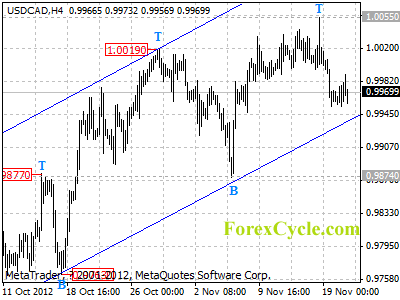
USDCAD is facing the support of the lower line of the price channel on 4-hour chart, a clear break below the channel support will suggest that the trend from 0.9632 (Sep 14 low) has completed at 1.0055 already, then deeper decline to test 0.9874 key support could be seen. On the upside, as long as the channel support holds, the fall from 1.0055 could be treated as consolidation of the uptrend, and another rise towards 1.0100 is still possible after consolidation.

usdcad

Daily Forex Forecast

Trade Interceptor wins the Best Mobile Platform Award

Trade Interceptor received the Best Mobile Platform award at the Forex Magnates Summit in London, reaching an important milestone in the company’s mission, which is to offer the best forex trading platform for retail traders.

Sofia, 20 November 2012.  Trade Interceptor received the “Best Mobile Platform” Award at the Forex Magnates summit in London, a prestigious forex event where the biggest names in the industry shared their views about the market with over 500 forex professionals. Trade Interceptor was elected by a jury of fifteen industry experts among thirteen nominees.

“This is an important award for us, as it shows that Trade Interceptor is not only recognized as the best mobile trading platform among private currency traders but also by the industry professionals” says Rodolfo Festa Bianchet, CEO of Riflexo, the company which develops Trade Interceptor. He adds :“Our mission is very simple: to offer the best forex trading platform, and this award shows that we are on the right track”.

Trade Interceptor is currently the most downloaded forex mobile trading application on both the Apple App Store and the Android Google Play market, and counts over 255.000 registered users in 254 countries. As reported in the recent “Active Trader Market Report” from Aite Group, the most interesting aspect about Trade Interceptor is the unusually high level of trader satisfaction, evidenced by its numerous high ratings and trader praise on the iTunes Store and Android Google Play market.

The key features that Trade Interceptor users most enjoy are the possibility to trade trading accounts from different broker firms, the advanced charting and trading capabilities on all mobile and desktop applications, the possibility to trade from the charts, the robust array of order types, the trade execution performance, and a very responsive customer support and development team.
Trade Interceptor is powered by Riflexo, a software development company, which has been developing real-time trading solutions for financial institutions and professional traders for the last twelve years.

About Riflexo

Riflexo Jsc is in the business of providing real-time trading solutions, systems and services to professional traders, financial organizations, and private investors worldwide. The company has a strong track record in the development of real-time trading applications, technical analysis systems, and mobile solutions. Clients include top tier banks, leading financial information providers, and brokers. Riflexo has signed alliances with fully regulated trading firms to provide private traders with an advanced, stable, and secure real-time desktop and mobile trading platform.

Media contact: E.Girodet

359 2 980 14 34

[email protected]

What I’m Thankful For…

Article by Investment U

Tomorrow, most of us in the United States will be with friends and family, sitting around festive tables filled with way more food than we need, sharing all of the things that we’re thankful for.

Yes, I’m thankful for my family, the abundant meal, puppies, rainbows and all of the heartwarming stuff like everyone else. But this is an investment e-letter, so here’s what I’m thankful for when it comes to the financial markets…

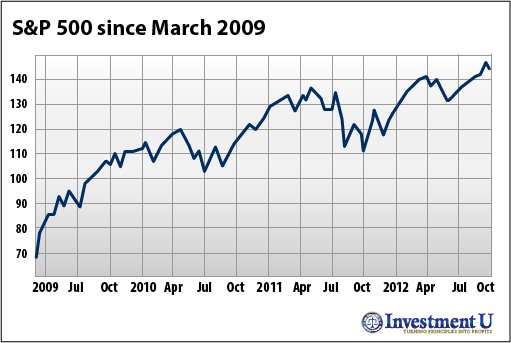
I’m thankful for this bull market that has been in effect since the lows of March 2009. Since then, the S&P 500 is up 108%.

Even better – as Alexander Green says, this is the most disrespected bull market in history. Despite the fact that the market has doubled in just three and a half years, there’s still a very high degree of skepticism.

According to the Spectrem Group, 48.6% of affluent investors (those with $500,000 or more of investable assets) are sitting on the sidelines. That’s a lot of firepower that can return to the market and push stocks higher once these investors decide they’re missing the party.

Low Interest, Low Inflation and Housing Recovering

I’m thankful for low interest and low inflation. While low interest rates make it tough for savers, it’s a great environment for investors. The low rates have driven stocks upward, and if you can get a loan, the banks are giving away money. Thirty-year fixed mortgages are available in the low threes. I recently obtained a loan at 3.25%. For someone who wants to pick up some investment real estate, you can’t ask for much better than that.

I’m thankful that housing is recovering. The National Association of Home Builders Index, a measure of sentiment, is at its highest level in six years. The eight-point jump in present sales was the largest since 2002.

When housing prices rise, people feel more confident. Even if they have no plans to sell, they feel wealthier and will be more comfortable spending more money, which sparks the economy.

Harnessing the Power of Dividends

The low rates also have awakened many investors to the power of dividend investing, particularly investing in dividend growth stocks. By investing in stocks with growing dividends, investors not only tend to own higher-quality companies, but the investment outpaces the ravages of inflation. That last statement is a critical point in my book, Get Rich with Dividends, which shows investors how to earn double-digit yields and/or returns over the long term.

By the way, that’s something else I’m thankful for – the fact that Get Rich with Dividends was so well received it became an Amazon.com bestseller, hitting No. 1 in “Investing.” So if you already read it – thank you very much.

If not, or you know someone who could benefit from learning how to conservatively create wealth and income for the long term, there are only 33 shopping days left before Christmas. Thank you in advance for filling loved ones’ stockings with copies of the book.

Cheers to All the Fearful Investors…

I’m also thankful for panicky investors. I love when people dump stocks because the market is falling, or because of an election, or because taxes may rise. Yes, those things can be scary, but in the long run, stocks go up. They always have and this time is not different.

There have always been troubles – the Depression, World War II, the Cuban Missile Crisis, double-digit inflation, terrorism, etc. But through it all, the market has continued to climb higher. When scared investors sell stocks, I go in and scoop them up. That’s how you make real money in the stock market.

I’m especially thankful for all of you who read this column. Without you, I wouldn’t be able to jump out of bed every morning, excited to go to work. It is truly a blessing to love what I do and to be able to write about whatever market topics I find interesting, It’s a dream job that, quite frankly, I never would have even imagined having 16 years ago, when I was first breaking into the industry as an assistant on a trading desk, having chairs flung over my head into a bank of monitors when the computer regularly locked up.

I’m thankful that, today, no one throws chairs over my head. I’m very thankful for that.

Lastly, as rancorous and difficult as the past few years have been, I’m thankful I live somewhere that has free elections and markets. Much of the world does not have that luxury. While the government, the economy and our markets have problems – serious problems – that need to be addressed, I would still rather contend with these issues than live in a place where my life and prosperity are determined by autocrats and dictators.

As has been said about both capitalism and democracy – they’re the worst systems, except for all of the others.

I hope you have a wonderful Thanksgiving holiday filled with good times, laughter and some good stocks in your portfolio.

Good Investing,

Marc

Article by Investment U

Warren Buffett is Rotating into Riskier Sectors; Should You?

By The Sizemore Letter

If Warren Buffett is doing it, it must be good, right?

That’s actually horrendously bad advice. Warren Buffett is one of the greatest investors in history, but you should never blindly follow any investor–not even the Sage of Omaha. You don’t know what their rationale for buying was or what their sell criteria is, and you certainly lack the clout and control over management that Warren Buffett brings to a deal.

That said, if Buffett is buying it, it might at least make sense to do a little research. We may or may not end up buying what he’s buying, but it can’t hurt to pick his brain a little.

So, what is Buffett buying? A lot of gritty industrials.

RECENT REPORT SHOWS

Berkshire Hathaway (NYSE:$BRK-A) recently released its holdings for the third quarter, and three of the company’s four new buys were industrials: Deere & Co (NYSE:$DE), the producer of tractors and others heavy-duty equipment, Precision Castparts Corp (NYSE:$PCP), which is essentially a metal shop with a worldwide presence, Wabco Holdings Inc (NYSE: $WBC), a world leader brake and control systems for large commercial vehicles.

WHAT DID HE DUMP?

Interestingly, Buffett sold out or reduced his holdings in several consumer-oriented stocks. Most of Buffett’s most famous investments involve consumer product names–a Coke anyone–while his single greatest failure was an old-line industrial stock: the textile company Berkshire Hathaway itself.

BIG PICTURE

In any event, Buffett is clearly bullish on the global economy. He’s not playing it safe by buying defensive consumer names (though he does maintain large legacy positions in Wal-Mart, Procter & Gamble & Coca-Cola). He is buying companies that very much live or die with cyclical economic activity.

There are different ways to skin this cat, and Buffett’s industrial picks would not be my first choice. But, if you want to follow Buffett, buying the Industrial Select SPDR ETF (NYSE:$XLI) isn’t a bad option.

But if you’re going to play the “risk on” game, I would be more inclined to buy an emerging market ETF. Once good choice might be the MSCI Turkey ETF (NYSE:$TUR). Turkey is an attractive market right now for several reasons. It’s the most politically and monetarily stable it’s been in years, and it stands to be one of the prime beneficiaries of the eventual rebuilding of Syria. It’s also a dominant economy in the Eastern European and Middle Eastern markets, and its stocks are very reasonably priced at just 9 times earnings.

With fiscal cliff worries likely to keep the market choppy for a while, you may want to ease into this position over the course of the next few weeks. As always, general common sense rules apply. If global stocks look to be starting a new bear market, you do not want to own volatile Turkish stocks. I recommend using a 15% trailing stop to guard against that possibility.

Disclosures: Sizemore Capital is long TUR. This article first appeared on TraderPlanet.

SUBSCRIBE to Sizemore Insights via e-mail today.


The post Warren Buffett is Rotating into Riskier Sectors; Should You? appeared first on Sizemore Insights.

Related posts:

Nigeria holds rate, says tightening cycle still not over

By Central Bank News
    Nigeria’s central bank held its Monetary Policy Rate (MPR) steady at 12.0 percent, despite expectations of a cut, saying there were still inflationary pressures and a rate cut now to support moderating growth would send the wrong signal to markets that the policy tightening cycle was over.
    Despite a further easing in core inflation for the fourth month, the Central Bank of Nigeria said the “risk of food inflation remained hawkish” with a rise in headline inflation likely connected to floods on farmlands which poses an upside risk to near-term inflation along with imported food inflation.
    Nigeria’s inflation rate rose to 11.7 percent in October from 11.3 percent in September while core inflation eased to 12.4 percent from 13.1 percent, well above the bank’s 10 percent inflation target.
    The conflicting price signals from the latest inflation number has created uncertainty as to the appropriate policy stance, the bank said, adding the factors underpinning inflationary pressures were structural so a monetary response would not be appropriate.
   “The Committee observed that while there were compelling arguments for monetary easing at this time based on the continuous moderation of core inflation, slowdown in GDP growth and evidence of fiscal prudence, the short-term gains may not be sufficiently adequate to overturn the long term implications of sending a wrong signal that the tightening cycle was permanently over,” it said.

    The central bank said the global economy was still characterized by uncertainty along with decelerating growth and this would have implications for the domestic economy.
    “Overall, the Committee believes that the fiscal gridlock in the US, the lingering euro zone financial and economic crisis, as well as the softening output growth in the key emerging Asian economies, could have serious implications for the domestic economy in the near-to-medium term 

    Nigeria’s statistics office has revised down the economy’s growth in fiscal 2012 to 6.61 percent from earlier projections of 6.85 percent, “indicating the economy is encountering growth challenges not previously anticipated.”
    In the third quarter, Nigeria’s Gross Domestic Product expanded by an annual 6.5 percent, up from a rate of 6.4 percent in the second, but below the 7.4 percent in the third quarter of 2011.
    The central bank said it had “noted with concern the continuing decline in the contribution of the oil sector to growth, in an area of strong oil price performance, which became apparent in the last half of 2011 and also the decline in the contribution of agriculture to growth since Q3, 2011.”
    Nigeria’s central bank has held its policy rate unchanged since October 2011, but tightened its policy stance in July when its raised the Cash Reserve Ratio (CRR) to 12.0 percent from 8.0 percent.

    www.CentralBankNews.info

For a Year-End Rally, Look to Spanish Banks

By The Sizemore Letter

The world is a funny little place.  For all the talk of Greece (or Spain…or Italy…or Portugal…) getting kicked out of the Eurozone, it is the United Kingdom—which doesn’t even use the euro as its currency—that may be the first political casualty of the euro crisis.

By this time next year, the UK might well have been kicked out of the European Union in all but name.   A disagreement over the European Union’s budget—Britain wants spending capped at 2011 levels—may mark the unceremonious end to Perfidious Albion’s European experiment.  (I can imagine the break-up speech now; “It’s not you, it’s me.  We’ve just grown so far apart these last few years…we’re just so different…it was never going to work, you and me.”

With or without Britain, 2013 promises to be an eventful year in Europe.  I expect it to be volatile, but I also expect it to be wildly profitable for investors willing to stomach it.

For the best shot at 50-100% total returns, I recommend take a look at Spanish banks, and particularly at Spain two premier global powerhouses: Banco Santander (NYSE: $SAN) and Banco Bilbao (NYSE: $BBVA).

Let’s take a look at the numbers.  Santander trades for just 8 times expected 2013 earnings and at just 0.69 times book value.  It also yields a fat 9.3% in dividends.  BBVA trades for a comparable 8 times earnings and 0.71 times book and yields 6.8 %.

Both banks are cheap…but both banks are domiciled in Spain.  Shouldn’t they be cheap?

Not exactly.  Santander and BBVA get the vast majority of their profits overseas, and particularly from their growing Latin American subsidiaries.  Both banks offer great “back door” access to one of the few areas of the globe still growing.

Yes, there is macro risk in buying a Spanish bank.  Spain is at the center of the European sovereign debt crisis, and banks are at the mercy of their home country’s sovereign credit rating.  So if Spain “blows up,” it will take its banks down with it.

I don’t see this happening.  Spain will fight it as long as it can—perhaps another quarter—but it will eventually have to ask the EU and ECB for a bailout.  And when that happens, I expect it to be a mundane, administrative detail, not a catastrophic market event.

Even outside of these two banking blue chips, there will be plenty of other opportunities to make money on Spanish banks in the year ahead.  Wilbur Ross, the famous “vulture investor,” has been circling around Spain for months.  According to  Bloomberg, Ross is looking to make investments in smaller Spanish banks once they start shedding their bad debts.  The United States, Ireland, and Britain have already gone through this process…and now it’s Spain’s turn.  The Spanish government is in the process of setting up a “bad bank” to be a dumping ground for the country’s non-performing real estate debt. It’s expected to be up and running in early 2013.

Ross will probably focus on smaller Spanish banks, some of which don’t trade in the U.S. market with any volume to speak of.  I intend to keep an eye on Ross’s moves (you can follow his moves too at Guru Focus) and may follow his lead when the time comes, but for now, Santander and BBVA remain the best bets for most investors.

Disclosures: Sizemore Capital is long BBVA and SAN.

The post For a Year-End Rally, Look to Spanish Banks appeared first on Sizemore Insights.

Related posts:

Shale Gas Will be the Next Bubble to Pop – An Interview with Arthur Berman

By OilPrice.com

The “shale revolution” has been grabbing a great deal of headlines for some time now. A favourite topic of investors, sector commentators and analysts – many of whom claim we are about to enter a new energy era with cheap and abundant shale gas leading the charge. But on closer examination the incredible claims and figures behind many of the plays just don’t add up. To help us to look past the hype and take a critical look at whether shale really is the golden goose many believe it to be or just another over-hyped bubble that is about to pop, we were fortunate to speak with energy expert Arthur Berman.

Arthur is a geological consultant with thirty-four years of experience in petroleum exploration and production. He is currently consulting for several E&P companies and capital groups in the energy sector. He frequently gives keynote addresses for investment conferences and is interviewed about energy topics on television, radio, and national print and web publications including CNBC, CNN, Platt’s Energy Week, BNN, Bloomberg, Platt’s, Financial Times, and New York Times. You can find out more about Arthur by visiting his website: http://petroleumtruthreport.blogspot.com/

In the interview Arthur talks about:

· Why shale gas will be the next bubble to pop

· Why Japan can’t afford to abandon nuclear power

· Why the United States shouldn’t turn its back on Canada’s tar sands

· Why renewables won’t make a meaningful impact for many years

· Why the shale boom will not have a big impact on foreign policy

· Why Romney and Obama know next to nothing about fossil fuel energy

Interview conducted by James Stafford of Oilprice.com

James Stafford: How do you see the shale boom impacting U.S. foreign policy?

Arthur Berman: Well, not very much is my simple answer.

A lot of investors from other parts of the world, particularly the oil-rich parts have been making somewhat high-risk investments in the United States for many years and, for a long time, those investments were in real estate.

Now these people have shifted their focus and are putting cash into shale. There are two important things going on here, one is that the capital isn’t going to last forever, especially since shale gas is a commercial failure. Shale gas has lost hundreds of billions of dollars and investors will not keep on pumping money into something that doesn’t generate a return.

The second thing that nobody thinks very much about is the decline rates shale reservoirs experience. Well, I’ve looked at this. The decline rates are incredibly high. In the Eagleford shale, which is supposed to be the mother of all shale oil plays, the annual decline rate is higher than 42%.

They’re going to have to drill hundreds, almost 1000 wells in the Eagleford shale, every year, to keep production flat. Just for one play, we’re talking about $10 or $12 billion a year just to replace supply. I add all these things up and it starts to approach the amount of money needed to bail out the banking industry. Where is that money going to come from? Do you see what I’m saying?

James Stafford: You’ve been noted suggesting that shale gas will be the next bubble to collapse. How do you think this will occur and what will the effects be?

Arthur Berman: Well, it depends, as with all collapses, on how quickly the collapse occurs. I guess the worst-case scenario would be that several large companies find themselves in financial distress.

Chesapeake Energy recently had a very close call. They had to sell, I don’t know how many, billions of dollars worth of assets just to maintain paying their obligations, and that’s the kind of scenario I’m talking about. You may have a couple of big bankruptcies or takeovers and everybody pulls back, all the money evaporates, all the capital goes away. That’s the worst-case scenario.


James Stafford: Energy became a big part of the election race, but what did you make of the energy policies and promises that were being made by both candidates?

Arthur Berman: Mitt Romney, particularly, talked about how the United States would be able to achieve energy independence in five years. Well, that’s garbage.

Anybody who knows anything about oil, gas and coal, knows that that’s absurd. We were producing a little over 6 million barrels a day thanks to an all-out effort in the shale oil play. We consume 15 million barrels of oil a day and that leaves the gap of 9 million barrels per day. At the peak of U.S. production, in 1970, the U.S. produced 10.6 million barrels per day. Like I said, either the guy doesn’t know what he’s talking about, or is making a big joke of it.

Obama didn’t talk so much . . . He’s a hugely green agenda kind of president and I’m not opposed to that, but he’s certainly not for the oil and gas business. It wasn’t until he got serious about thinking about his re-election that he decided to take credit for what really happened.

James Stafford: Japan recently announced that they are going to be phasing out nuclear power. What are your views on nuclear? Are we in a position to abandon this energy source?

Arthur Berman: No. Japan is a special case. The disaster at Fukushima, the nuclear reactor, was right on top of a major fault. So, that was a dumb place to put it.

To wholesale abandon nuclear power because one reactor was incredibly stupidly planned, to me seems like a bit of a . . . well, I can’t tell people how they should react, but if I were a Japanese citizen, and the truth was that we have no oil, we have no coal, we have no natural gas, the next question is, “Well, if we get rid of nuclear, what are we going to do?”

It’s a really good question to ask. If you don’t have anything of your own, how are you going to get what you need? The answer is that they have to import LNG and that’s very expensive.

Right now, natural gas is selling in Japan for $17 per million BTUs. You can buy the same BTUs in Europe for $9 today, or in the US for $3.25

James Stafford: What about Germany’s decision to also phase out nuclear power?

Arthur Berman: For Germany to abandon nuclear… that decision is truly delusional because they haven’t had any problems over there. Nor is Germany particularly earthquake prone or tsunami prone. They have forced themselves into a love relationship with Russia.

James Stafford: What are your views on Canada’s tar sands? Are they a rich source of oil that the U.S. needs to exploit? Or do you think they’re a carbon bomb, which could do irreparable damage to the climate?

Arthur Berman: Well, that’s a very good question. I suppose they’re both, as are virtually all things that burn. Right? They’re a very rich source of oil. And they’re dirty. It requires a lot of natural gas heating to convert them into some usable form, a lot of processing, but here’s the thing, if the United States doesn’t buy that oil from Canada, do you think Canada’s just going to say, “Oh. Okay. Nevermind. We’ll forget about all this.”

No. They’re going to sell it somewhere else. They’ll probably sell it to Asia. So, the issue of the carbon bomb doesn’t get resolved by the United States not taking the oil.

So, to me, that’s off the table. Yes. I think it’s an incredibly sensible play to get your oil from a neighbour, and a neighbour who you trust, and it doesn’t require overseas transport and probably getting involved in periodic revolutions and civil uprisings.

James Stafford: Is there any technology, any development you see coming in the future that can help us get where we need to be? Is conservation really the only answer or do you have any hopes for some of the alternative energy technologies, such as solar or, even, some of these more advanced technologies such as Andrea Rossi’s E-cat machine?

Arthur Berman: Oh. I have all the enthusiasm for technology that you could ask for. I’m a scientist and I love technology but I heard a very good presentation several years ago on your exact question and the man who gave a talk said, “I’m going to give you a rule to live by. If it’s not on the shelf today, then a solution is no sooner than ten years in the future.” So, when you talk about E-cat and you talk about algae and all this kind of stuff, it’s not on the shelf today. So, that means it’s in some sort of pilot stage of testing.

Work harder guys. Work harder and faster because you’ve got a lot of work to do. So, yes, I’m enthusiastic. I think there are some great ideas out there but I don’t see any of them helping us in the coming five to ten-year period.

James Stafford: Environmentalists talk about the evil of fossil fuels, but have they really done their research to see how vital it is to pretty much everything that we base our modern lives upon?

Arthur Berman: Well, that’s exactly right. My oldest son and his family until recently lived in California, and in California people think electricity comes from the wall. They don’t have any idea that most of their electricity comes from horrible coal-fired power plants in New Mexico and Arizona. As long as they don’t have to see it, they don’t have a problem.

But, in this world, and in this life, we’re all connected and if you see something you don’t like, there’s a good possibility that whatever they’re doing there has something to do with something you’re using. So, this is an issue.

Source: http://oilprice.com/Interviews/Shale-Gas-Will-be-the-Next-Bubble-to-Pop-An-Interview-with-Arthur-Berman.html

By. James Stafford of

Oilprice.com