Euro May Strengthen Further Against the Yen

By TraderVox.com

Tradervox.com (Dublin) – The recent developments in Greece crisis fighting measures have yielded positive results for the euro. With most investors anticipating a favorable outcome in the November 26 euro zone Finance Ministers meetings, the single currency has continued to strengthen against major currencies after dropping to critical supports earlier. According to Credit Suisse Group AG, the euro may continue to strengthen against the yen.

The single currency is poised to strengthen to 107.74 against the yen, which is the 78.6 retracement of its decline from March through to July. Such sentiments are also held by analysts David Sneddon, who heads the technical analysis research at CSG in London. However, the euro may first weaken to 104.62 yen per euro, before hitting the 107.74.

According to David Sneddon note to clients, the acceleration through to 104.83 yen will pave the way for further strengthening through to 107.74 yen. He also added that pivotal support lies at the 104.62 which has been a high previously. The market is expects a brief correction to this level before advancing to new high of 107.74. With this analysis and the projected Greece aid, the euro will strengthen against the safe haven currencies as risk appetite grips the market. The commodity related currencies are expected to strengthen as stocks rallies.

The 17-nation currency has strengthened by 0.6 percent against the dollar to trade at 106.50 at mid-day trading in London yesterday. It had earlier increased to a high of 106.58, the strongest it has been since April 30. The currency last hit 107.74 yen on April 23. The technical analysis of the Fibonacci is based on the theory that prices increase or decline after reaching a certain high or low.

The euro has increased against the yen despite reports showing that the euro region has entered into another recession. Manufacturing data from the region showed that the contraction in the sector was more than the market was expecting.

Disclaimer
Tradervox.com is not giving advice nor is qualified or licensed to provide financial advice. You must seek guidance from your personal advisors before acting on this information. While we try to ensure that all of the information provided on this website is kept up-to-date and accurate we accept no responsibility for any use made of the information provided. Opinions expressed at Tradervox.com are those of the individual authors and do not necessarily represent the opinion of Tradervox.com or its management. 

Article provided by TraderVox.com
Tradervox.com is a Forex News Portal that provides real-time news and analysis relating to the Currency Markets.
News and analysis are produced throughout the day by our in-house staff.
Follow us on twitter: www.twitter.com/tradervox

Market Trends 23.11.12

Source: ForexYard

printprofile

Hey Everyone,

Below are some market trends for today.

Good luck!

-Dan

Gold- May see upward movement today
Support- 1745.99
Resistance- 1711.11

Silver- May see upward movement today
Support- 34.06
Resistance- 33.88

Crude Oil- May see upward movement today
Support- 85.84
Resistance- 88.53

Dax 30- May see downward movement today
Support- 7126.68
Resistance- 7363.74

EUR/USD May see upward movement today
Support- 1.3002
Resistance- 1.2762

Forex Market Analysis provided by ForexYard.

© 2006 by FxYard Ltd

Disclaimer: Trading Foreign Exchange carries a high level of risk and may not be suitable for all investors. There is a possibility that you could sustain a loss of all of your investment and therefore you should not invest money that you cannot afford to lose. You should be aware of all the risks associated with Foreign Exchange trading.

Market Review 23.11.12

Source: ForexYard

printprofile

The euro extended its bullish trend during the overnight session, as hopes that a deal can be reached to provide Greece with a new round of bailout funds can be reached next week boosted riskier assets. The EUR/USD advanced close to 30 pips last night, eventually trading above the 1.2900 level.

The US dollar saw minor downward movement last night against the Japanese yen, but analysts were quick to warn that rumors of additional monetary easing next month in Japan could turn the greenback bullish in the coming days. The USD/JPY is currently trading at 82.18, down slightly more than 20 pips from the beginning of Asian trading.

Main News for Today

German Ifo Business Climate- 09:00 GMT
• The indicator is forecasted to come in at 99.6, slightly lower than last month’s 100.0
• Any worse than expected news may cause the euro to give up some of its recent gains

Forex Market Analysis provided by ForexYard.

© 2006 by FxYard Ltd

Disclaimer: Trading Foreign Exchange carries a high level of risk and may not be suitable for all investors. There is a possibility that you could sustain a loss of all of your investment and therefore you should not invest money that you cannot afford to lose. You should be aware of all the risks associated with Foreign Exchange trading.

Why You Should Always Be Looking to Buy Small Cap Stocks

By MoneyMorning.com.au

For most of this week we’ve worked on the November issue of Australian Small-Cap Investigator. We put the final touches to it yesterday morning, and sent the report to subscribers yesterday evening.

Part of the job of researching, analysing and writing about small companies is that you have to look on the positive side of things. You have to think about what could happen if all the company’s amazing ideas come to fruition.

Of course, you also have to understand the risk of investing in small-cap stocks. There’s a chance you could lose all the money you invest.


However, if you fully pay for your shares rather than using borrowed money, you can never lose more than the amount you invest.

The thing with investing in small-caps is that the odds are always against you. It’s never a 50/50 proposition. But, although you could lose your entire investment, there’s a chance you could earn many times the amount you invest.

That’s what makes the risk-taking worth it.

But not all analysis works that way. There are some analysts and investors who have a neutral attitude to the stock market. They aren’t looking to double their money in a trade, and they don’t expect to lose their entire stake.

Rather, they bet on short-term market moves, and they don’t care whether the stock market goes up or down…

In this month’s Australian Small-Cap Investigator we wrote:


‘But with revenues and profits falling, neither of this month’s stock picks can afford to do nothing.

‘The issue is whether other, more nimble firms can innovate better than either of these two companies.

‘If either company gets the next step wrong, either by not innovating or by innovating in the wrong direction, then it could be curtains for them.

‘To sum thing up, this is a speculative turn-around situation. I’m better that these two […] companies have enough resources and new ideas to reinvigorate their businesses and return to profitability.

‘If they do then gains of 294% and 230% are entirely possible.’

Most of the time when you buy a small-cap stock you’re punting on a company that either has big ideas to become a much bigger company…or used to be a bigger company and needs to come up with a new plan to get back to the top.

This month’s Australian Small-Cap Investigator stock tips fall into the latter category.

But as we said, not all investing is the same.

Some investors aren’t looking for big game-changing events that could change a company’s fortunes. Some investors just look for shorter-term price trends.

The best example of that is the technical analysis approach taken by our old pal, Murray Dawes…

This is Why We Buy Stocks in a Falling Market

If you don’t subscribe to his trading service, you’ll know Murray from his feature articles every Wednesday in Money Morning.

Although Murray admits to having a bearish outlook on the markets, the reality is he doesn’t care which way the stock market goes.

That’s because he’s typically looking for the same risk reward on bought and short-sold trades.

For example, if he wanted to trade a stock like BHP (current price $33.58), he might look for a short-term $3-$4 move. Depending on whether his charts tell him a rise or fall of that amount is more likely, Murray will place the trade accordingly.

When you’re trading blue-chip stocks you’re typically not weighing up the odds of the stock going to zero against it going up 200% or 300%. Blue-chip technical traders are looking for smaller gains in a shorter period of time (that’s why they also tend to use leverage to magnify their returns).

How does that fit in with the current market? Is the stock market more likely to rise or fall?

Well, as a speculator in small-caps stocks we’re always looking to buy. We see small-cap investing as a gold mine of optimism, innovation and entrepreneurialism (and because it’s harder and riskier to short-sell small-cap stocks).

And because we only recommend investors allocate a small part of their portfolio to small-caps, if things don’t go to plan investors aren’t exposed to big losses.

But as we say, Murray has a more neutral approach to investing. If he thinks the stock market is going higher, he’ll buy. If he thinks it’s heading lower he’ll short sell.

So, just where is the stock market headed…?

The Stock Market Could Fall 29% in Weeks

Murray isn’t a big fan of making long term forecasts. He knows that events can make the stock market turn on a sixpence. So he prefers to look at short term movements and trade accordingly.

Even so, Murray’s analysis takes into account historical price action and how it relates to potential future market moves.

It’s when Murray looks at the historical price data that he sees some troubling signs.

One of those signs is the recent market action. The stock market hit a one-year high just a week ago. The problem is, after hitting that high point the market fell below a key level, what Murray calls the ‘top of the distribution’.

In layman’s terms, it means there wasn’t enough buying strength to keep the stock market at the higher level. As the buying dried up, the short sellers gained strength and pushed the stock market lower.

This fits into Murray’s longer term view that buyers will fail to prop up the stock market. And the longer this continues, the more likely it is to exhaust buyers, and it will be harder for the stock market to sustain rallies.

That will put short sellers in an even stronger position. That’s why Murray has another key level in his sights – the low of 2009…and it could happen sooner than you think.

If Murray is right and the stock market does head south, you’re looking at a fall of 29% from the current level. That will mean some big falls for Aussie blue-chip stocks.

Small-Cap Stocks Will Be the First to Gain When the Market Rebounds

Of course, a lot of things can happen. Even in a bear market you get periods of rising share prices. But if you’ve got a lot of money tied up in shares, it’s important to know the long term trend and the impact it could have on your wealth.

Anyway, we’ve asked Murray to share his thoughts with you, including the key dates when he believes the biggest move could occur. He’ll be in touch with you shortly.

Until then, we’ve already seen big falls in the small-cap market. So in a way we’re looking ahead of a stock market collapse and adding as many dirt-cheap small-cap stocks as we can to the recommended buy list.

That doesn’t mean small-caps will escape damage when the stock market falls. But when it recovers it can happen so quickly that many investors miss out on some of the biggest small-cap gains.

Cheers,
Kris

From the Port Phillip Publishing Library

Special Report:
Retire Rich, Happy and Free From Money Worries

Daily Reckoning: Currency Devaluation: While Europe Gets Sinned, Australia Sins

Money Morning:
Don’t be Fooled by Australian Housing’s Death Fart

Pursuit of Happiness:
The Right to Protect Yourself: Why the State Disarmed You

Australian Small-Cap Investigator:
Five Simple Steps to Picking Winning Small-Cap Stocks


Why You Should Always Be Looking to Buy Small Cap Stocks

This “X Factor” Controls the Price of Gold Stocks

By MoneyMorning.com.au

‘I spent 40 years in the gold market. That’s all I’ve done with my life,’ Pierre Lassonde told the assembled audience at Grant’s Fall Investment Conference. ‘I think I know a thing or two about gold.’ Our host Jim Grant introduced him as one of the few moneymakers in the gold sector. Lassonde is a co-founder of Franco-Nevada Mining, and he sits on the board of New Gold (NGD.)

Much of what he had to say was what you’d expect a gold bull to say. But there were a few things that I thought were particularly interesting and perhaps things you haven’t considered.

For example, analyst forecasts on gold have been wrong for years. And they’ve been wrong always in the same direction – too low!

Mainstream Missing the Mark on Gold for Years


On that score, Lassonde shared the chart below. The way to read this chart is to start on the far left. That first line, the lowest line, is a plot of the 2007 forecasts. You can see analysts projected a gold price of less than $600 an ounce by 2012.

The next line up, which begins in 2008, is a plot of the 2008 predictions. Same thing. You can see the predicted gold price was under $800 an ounce. In each set of predictions, analysts not only forecast gold prices too low, but they forecast gold prices to decline a few years out.

And so on through the years. The top line plots the forecasts made today in 2012. What’s most interesting about this is the steep dive the price of gold takes after 2013. Basically, the market consensus is that gold prices are going to fall beginning in 2014.

So if the consensus is wrong – as it consistently has been – then you stand to make a lot of money taking the opposite view.

A consensus like this is more important than you might think. All these same analysts derive the valuations on the gold stocks they cover by referencing some “price deck” (as they say in the trade).

The market often takes its cues from these analysts. Hence, those big moves up and down on a day some analyst upgrades or downgrades a stock. So if the analysts are using gold prices that are too low to value gold stocks, then the market values of those gold stocks will prove way too low.

The Gold Story is Not About Ben Bernanke

Another nugget from Lassonde came on the heels of a prior speaker’s comment – it was Bruce Kovner of Caxton, one of the best hedge fund managers around – that the gold price could tank if the Fed backed off its QE stimulus plans. Lassonde cut right to heart of why this was so much weak beer.

‘What I find interesting in coming to the U.S. is the views of gold are very U.S.-centric,’ Lassonde said. ‘I spend three months per year in Europe. I’ve lived in Canada and tour the world on a regular basis. I want to give you a more worldly view of the gold market.’

What he gave us was a pretty imposing fact: China and India account for 47% of the demand for gold. The rest of the world, excluding the U.S. and Middle East, account for 41% of the demand for gold.

This is in sharp contrast to the state of affairs that existed as recently as 2002, when the U.S. and Middle East represented 25% of demand. China and India then made up only 23% of demand.

So the great bulk of new gold buying is coming out of the two Asian giants. That puts Kovner’s remark in the shade. As Lassonde said, ‘Don’t think that the fiscal and economic policies of the U.S. will have everything to do with the gold market. China and India will have a heck of a lot more to do with what happens in the gold market than Washington.’

Another great chart from Lassonde shows how the world’s central banks are now buyers, instead of sellers, of gold. Take a look:

Just think: In 2006, central banks sold 600 tonnes of gold. In 2011, they bought 400 tonnes of gold. This is a big change.

I think these are some compelling points in favor of gold. If you are bullish on gold, then you might think, naturally, that you ought to buy gold stocks.

So What about Gold Stocks?

‘If you’ve been in gold equities the last seven or eight years, you’ve probably not had a great ride,’ Lassonde said. ‘You’ve either marked time or lost money altogether. You would’ve made more money buying the gold ETF.’

Why have gold stocks proven such a lousy place to put money? There are lots of reasons, most having to do with the deteriorating economics of mining the stuff.

New finds are proving increasingly elusive. New gold mines are smaller and have lower grades – meaning you have to chew through more rock to produce a given ounce of gold. New mines are more expensive to mine and take longer to bring into production.

In essence, gold assets are of lower quality – and getting lower. The technology hasn’t changed much in 30 years. Nothing like what has happened to oil and gas has happened in the gold sector. Lastly, governments are more rapacious, taking more in taxes.

All of these things translate into less economic assets and poor stockholder returns. I don’t think this is widely appreciated by those who speculate in gold stocks. You’re really better off just buying the metal. At least that’s been the way it has been for the last seven years or so.

Having said that, I know you may well enjoy speculating on gold stocks for a big return with full knowledge of the risks involved. And not every deposit is an economic disaster area. Lassonde himself has made a lot of money investing in gold stocks. Just know that the odds are stacked against you even as the price of gold moves higher.

How much higher? It’s anybody’s guess. Lassonde guesses gold will hit $13,000 an ounce over the 10 years before the party ends. There is a lot of space between today’s $1,700 an ounce price and Lassonde’s guess.

Let’s hope Lassonde is wrong if only because a world where gold is $13,000 an ounce is apt to be unpleasant in many other respects. But better own some of the shiny metal just in case.

Chris Mayer
Contributing Editor, Money Morning

Publisher’s Note: This article originally appeared in Daily Resource Hunter

From the Archives…

Retirees and the Fed Face Off
16-11-2012 – Kris Sayce

Attention Investors: This Market is Worse Than it Looks
15-11-2012 – Kris Sayce

Avoid the Slaughter: Watch This Key Stock Market Pointer
14-11-2012 – Murray Dawes

Why Lithium is Another ‘Rare’ Element on China’s Radar
13-11-2012 – Dr. Alex Cowie

Who Says Gold Doesn’t Pay ‘Interest’?
12-11-2012 – Dr. Alex Cowie


This “X Factor” Controls the Price of Gold Stocks

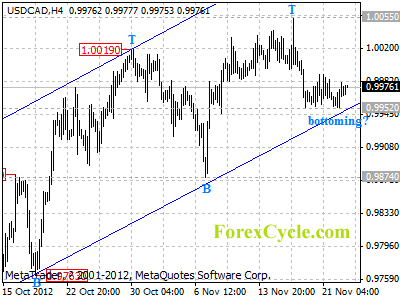
USDCAD rebounds from 0.9952

Being contained by the support of the the lower line of the price channel on 4-hour chart, USDCAD rebounds from 0.9952, suggesting that a cycle bottom is being formed. Resistance is at 0.9995, a break above this level will indicate that the uptrend from 0.9632 (Sep 14 low) has resumed, then further rise towards 1.0100 could be expected. However, as long as 0.9995 resistance holds, another fall to re-test the channel support is still possible, a clear break below the channel support will indicate that the uptrend from 0.9632 has completed at 1.0055 already, then deeper decline to test 0.9874 key support could be seen.

usdcad

Forex Signals

Three Retailers That Should Be Thankful They Are Still in Business This Thanksgiving

By The Sizemore Letter

This is the time of year for giving thanks, and we all have quite a bit to be thankful for.  Though we complain about having a divided country, we live in a place where power changes hands without violence.  And for all the angst about rising taxes, at least we live in a country where work is still rewarded with the possibility for great wealth.  The economy isn’t the healthiest right now, but it’s still a fine time to be an American.

That said, there plenty of companies who aren’t doing particularly well and who should be thankful that they are still in business at all.  And by next Thanksgiving…they may not be.

I’ll start with electronics chain Best Buy (NYSE:$BBY). Best Buy posted earnings this week that were wide off the mark of expectations, sending the share price down a quick 8%.

Big deal; companies miss earnings all the time, right?  Yes, but Best Buy’s problems run far deeper than a single earnings release.

The company has become the unofficial (and unpaid) showroom for the entire electronics industry.  Want to check out the new Samsung Galaxy phone…or Microsoft (Nasdaq: $MSFT) tablet?  Then you drive to Best Buy.  But do you whip out the credit card and buy it there?  No, probably not.  Not when you can go to your smartphone and order it on Amazon.com (Nasdaq:$AMZN) or another discount online retailer for far cheaper…and get free shipping.   The Washington Post reported that fully 20% of shoppers plan to “showroom” their Christmas shopping this year.  And this number should only continue to grow.

There is no easy way out of this problem.  Best Buy can improve its web presence and try to attack Amazon head on, as Wal-Mart (NYSE:$WMT) is attempting to do.  But they are still going to be at an enormous cost disadvantage for having to maintain an expense network of stores and employees.

Perhaps Best Buy should accept its role as Samsung, Sony (NYSE: $SNE) and Apple’s (Nasdaq: $AAPL) showroom and ask that these manufactures pay them for the publicity.  I don’t see that approach working, mind you, but their current approach isn’t working either.

Next on the list is JC Penney (NYSE: $JCP).  There comes a point in a retailer’s life when it is simply no longer relevant.  Best Buy still gets foot traffic, and some of those visitors do actually buy while in the store (after checking the prices of competitors on their phone, of course).

But JC Penney?  Not so much.

As I wrote in a recent post, JC Penney is toast.  The company is a “tweener,” squeezed between Wal-Mart and Target (NYSE:$TGT) on the low end and Dillard’s (NYSE:$DDS) and Macy’s (NYSE:$M) at the mid-range price point.  And I’ve said nothing yet about deep discounters such as Ross Stores (Nasdaq:$ROST) or, again, online retailers such as Amazon.

There is no compelling reason to go to a JC Penney store, and it shows in the company’s results.  Revenues have been stagnant for years…actually fell by 26% last quarter.   Earnings are firmly in the red and have been for the past four consecutive quarters.

In a weak overall economy, I do not see a future for a marginal retailer like JC Penny.  Outright bankruptcy might still be a few years away…but I see no recovery for a store that has already fallen so far in relevance to shoppers.  I challenge you to name a single friend or family member who has shopped there in the past 12 months.

And finally, we come to RadioShack Corp (Nasdaq:$RSH).   I do not see RadioShack surviving to see another Thanksgiving, at least not in its current form, and from the looks of things, neither does the market.  The stock has lost 84% of its value over the past year and over 90% since 2011.

If Best Buy’s business model is under threat, then how much worse off must RadioShack be?  The company’s niche market of specialty electronic parts and components has been absolutely killed by internet competition.  An on those days you need a particular part or cable immediately and can’t afford to wait for shipping, you’re going to get a better selection at Fry’s Electronics or even Best Buy or Wal-Mart.

RadioShack has tried multiple times to reinvent itself by selling things such as mobile phones and service and mainstream consumer electronics.  But by doing this, they are competing head to head with big-box retailers and the mobile phone providers themselves.  It’s hard to see how RadioShack can compete here, and frankly, the numbers speak for themselves.  The company has had three consecutive losing quarters…and this losses have gotten bigger with each release.

RadioShack is also saddled with $750 million in debt…$375 million of which is due in 2013…and a market cap of only $193 million.

Investors might get bailed out by an acquisition here.  At the right place, Best Buy or some other electronics retailer might the chain to be worth buying.  But barring this, I expect RadioShack to bleed to death in the very near future.

Disclosures: Sizemore Capital is long WMT and MSFT.

SUBSCRIBE to Sizemore Insights via e-mail today.

The post Three Retailers That Should Be Thankful They Are Still in Business This Thanksgiving appeared first on Sizemore Insights.

Related posts:

Central Bank News Link List – Nov 22, 2012: Brazil central bank’s Tombini: Activity intensifying in fourth quarter

By Central Bank News
Here’s today’s Central Bank News link list, click through if you missed the previous link list. The list comprises news about central banks that is not covered by Central Bank News. The list is updated during the day with the latest developments so readers don’t miss any important news.)

South Africa holds rate, growth worsens and inflation rises

By Central Bank News

    South Africa’s central bank held its benchmark repurchase rate steady at 5.0 percent, as expected, balancing upward pressure on inflation against downside risks to economic growth. The bank cut its growth forecasts and raised inflation forecasts.

    The South African Reserve Bank (SARB), which has cut rates by 50 basis points this year, struck a somber tone in its statement and said there had been a marked change in the domestic landscape that have affected the country’s economic outlook and confidence.

    Labour unrest and and a sharp fall in mining output has aggravated the domestic impact of the global economic slowdown, threatening to “derail the progress made to date whereby South Africa has been able to withstand the worst contagion effects of the ongoing global crisis,” the bank said after a meeting of its Monetary Policy Committee.

    The central bank appealed to employers and workers to improve their “fraught “relations and stressed its “concern about the conduct of some of the parties involved in the recent labour market instability and, in particular, the unacceptable levels of violence that have accompanied the strikes.”

    “While many of the strikes appear to have been resolved, long term resolution of the underlying causes requires ongoing, concerted action on the part of all the parties involved.  We need cohesion and certainty of policy, as well as unity of purpose to build an inclusive, longer-term vision.”

    The SARB trimmed its forecast for 2012 Gross Domestic Product growth to 2.5 percent from a previous 2.6 percent, but cut the 2013 forecast to 2.9 percent from 3.4 percent. Forecasts for 2014 GDP growth were cut to 3.6 percent from 3.8 percent.

    Noting that risks remain to the downside, the central bank also said data indicated that third quarter growth was well below the second quarter’s 3.2 percent, with mining output down 3.2 percent in the quarter and should contract further in the fourth quarter.

    South Africa’s GDP rose by 3.2 percent in the second quarter from the first quarter, for an annual rate of 3.0 percent.

    The outlook for inflation has also deteriorated, the bank said, due to continued upward pressure on food prices, a depreciation in the rand currency and a reweighting and rebasing of the consumer price index.

    “Furthermore, the possible impact of higher wage increases could exert further upward pressure on inflation notwithstanding the concerns that recent developments in the labour market could impact negatively on employment. The MPC considers that the demand pressures on inflation at this stage remain relatively benign, as evidenced in the contained trend of underlying inflation,” the SARB said.

    South Africa’s inflation rate ticked up further in October to 5.6 percent, the fourth consecutive monthly rise, approaching the upper end of the central bank’s 3-6 percent target range.

    The bank now expects inflation to average 5.6 percent in 2012, 5.5 percent in 2013, up from a previous forecast of 5.2 percent, and 5.0 percent in 2014, unchanged, with a peak of 5.7 percent in the first quarter of 2013.

    These forecasts, however, do not reflect the new CPI weights and rebasing, and the central bank said this could shift its central inflation projection upward by 0.2 percentage points in 2013.

     Another reason for the higher inflation forecasts is the decline in the rand, which has has depreciated by about 6.7 per cent against the US dollar, by 5.8 per cent against the euro, and by 5.8 per cent on a trade-weighted basis since the bank’s September meeting.

    “The MPC considers that the demand pressures on inflation at this stage remain relatively benign, as evidenced in the contained trend of underlying inflation. There are also signs of moderation of consumption expenditure against the backdrop of a weak supply side of the economy. The negative output gap is expected to persist for some time, and the balance of risks to the growth outlook remains on the downside.”

    www.CentralBankNews.info

Sterling Drops against Euro Prior to UK Manufacturing Data

By TraderVox.com

Tradervox.com (Dublin) – The sterling pound dropped against the 17-nation currency after advancing for the last two days. The drop came prior to a gauge of UK manufacturing orders which is expected to show a drop in November. The UK currency has advanced to a two-week high against the dollar prior to the report which is expected to show that the Confederation of British Industry’s factory orders index rose from negative 23 to negative 20 in the previous month.

The drop against the euro came as the Bank of England Policy Makers including the Governor and the Deputy Governor testified to the Parliamentary Commission on Banking Standards. The country’s gilts remained little changed as the Debt Management Office prepares to sell index-linked bonds. According to Ian Stannard, a currency strategist at Morgan Stanley in London, despite the support the sterling is getting from the situation in euro zone, there are fundamental economic challenges that are preventing the currency from rebounding. He suggested that the market will be watching closely indicators such as CBI industrial trends.

The sterling has been among the gainers this year, advancing by 1.4 percent over the year. The euro has declined by 2.4 percent while the dollar has dropped by 1.5 percent. The yen has dropped by 7 percent over the same period.

The country’s ten-year benchmark yield rose by less than one basis point to 1.75 percent prior to the DMO sale of index-linked gilts due in 2044 through financial institutions in the country.

The sterling weakened against the euro by 0.3 to exchange at 80.65 pence at the start of trading in London today. The currency had earlier appreciated to its strongest level since November 14 of 80.06 pence. The pound remained little changed against the dollar, trading at $1.5950. It had rose to its November 9 level of $1.5978 yesterday.

Disclaimer
Tradervox.com is not giving advice nor is qualified or licensed to provide financial advice. You must seek guidance from your personal advisors before acting on this information. While we try to ensure that all of the information provided on this website is kept up-to-date and accurate we accept no responsibility for any use made of the information provided. Opinions expressed at Tradervox.com are those of the individual authors and do not necessarily represent the opinion of Tradervox.com or its management. 

Article provided by TraderVox.com
Tradervox.com is a Forex News Portal that provides real-time news and analysis relating to the Currency Markets.
News and analysis are produced throughout the day by our in-house staff.
Follow us on twitter: www.twitter.com/tradervox