South Pacific Currencies Up on Greek Bailout Agreement Optimism

By TraderVox.com

Tradervox.com (Dublin) – The New Zealand and Australian dollars advanced to their strongest levels in two weeks as speculation Euro zone finance ministers will reach an agreement increased the demand for commodity related currencies. The kiwi and Aussie were supported by the strong performance of Asian shares after US shares registered their biggest advance in five months as holiday shopping season started to grip the market. The Australian dollar advanced to 0.1 percent from a two-week high against the kiwi as the investors and market analysts speculated that the Reserve Bank of Australia will cut its borrowing costs when they meet next month.

According to Joseph Capurso, a currency strategist in Sydney at Commonwealth Bank of Australia, the euro zone finance ministers will be positive for the kiwi and Aussie if they give positive news. He projected that the currencies are already reaping from the increased optimism and the news of an agreement will boost their demand for the short-term. The Australian benchmark yields declined by 0.03 percentage point, to 3.27 percent from its close on November 23 of 3.30 percent, this was the highest level since October 26. The New Zealand two-year swap rate fell by two basis points to 2.64 percent.

The south pacific currencies advanced as MSCI Asia Pacific Index of shares gained by 0.5 percent. The S&P 500 Index of US stocks rose by 3.6 percent last week, registering its biggest weekly advance since the week ending June 8. The Aussie was trading at $1.0458 at the close of trading in Sydney where it traded at 86.09 yen per Australian dollar. The New Zealand dollar exchanged at 82.39 US Cents and 67.83 yen.

The strong performance of south pacific currencies have come as Finance official meet in Brussels today after an all-night meeting and a European Union summit failed to reach an agreement on the necessary measures to be taken to secure Greece bailout.

Disclaimer
Tradervox.com is not giving advice nor is qualified or licensed to provide financial advice. You must seek guidance from your personal advisors before acting on this information. While we try to ensure that all of the information provided on this website is kept up-to-date and accurate we accept no responsibility for any use made of the information provided. Opinions expressed at Tradervox.com are those of the individual authors and do not necessarily represent the opinion of Tradervox.com or its management. 

Article provided by TraderVox.com
Tradervox.com is a Forex News Portal that provides real-time news and analysis relating to the Currency Markets.
News and analysis are produced throughout the day by our in-house staff.
Follow us on twitter: www.twitter.com/tradervox

Market Review 26.11.12

Source: ForexYard

printprofile

The euro took moderate losses during overnight trading, following an election in Catalonia, Spain’s wealthiest region, in which pro-separatist political parties scored some victories. The news led to speculations that Spain will continue to delay requesting a euro-zone bailout. The EUR/USD fell close to 25 pips during the Asian session, while the EUR/JPY dropped more than 70 pips.

The price of crude oil fell around $0.30 during the first half of the night, eventually trading as low as $87.85, before staging an upward recovery and bouncing back to its current level of $88.15.

After shooting up close to $20 an ounce on Friday, gold was able to largely hold onto its recent gains during the Asian session as hopes that a deal to unlock a new round of Greek bailout funds will soon be reached. The precious metal is currently trading at the $1750 level.

Main News for Today

Eurogroup Meetings- All Day
• The Eurogroup consists of finance ministers from throughout the euro-zone
• The main topic of discussion for today is how to provide Greece with a new round of bailout funds
• If a deal is reached to provide Greece with the funds, the euro could see gains throughout the day

Read more forex news on our forex blog

Forex Market Analysis provided by ForexYard.

© 2006 by FxYard Ltd

Disclaimer: Trading Foreign Exchange carries a high level of risk and may not be suitable for all investors. There is a possibility that you could sustain a loss of all of your investment and therefore you should not invest money that you cannot afford to lose. You should be aware of all the risks associated with Foreign Exchange trading.

Euro Declines amid Uncertainty in Spain

By TraderVox.com

Tradervox.com (Dublin) – The 17-nation currency dropped against its peers after pro-independent parties in Catalonia won a regional vote in Spain. The vote has strengthened calls for secession in defiance of Mariano Rajoy, the Spanish Prime Minister. The euro dropped against its most traded counterparts as the market speculated that Spain will derail in asking for bailout as political uncertainty mounts. The currency has dropped as Finance Ministers prepare to meet to discuss the Greek issue where they are expected to come up with a solution. The Japanese yen has surged from a seven-month low as technical indicators showed that the currency might have been oversold. The strengthening was limited by minutes of the last Bank of Japan meeting which showed that members were calling for more easing.

According to Masafumi Yamamoto, the Chief Foreign-Exchange Strategist in Tokyo at Barclays Plc, Spain is most likely to continue delaying for the financial assistance. He noted that the election results were not positive for the euro as the market will most likely shift its focus on Spain. The poor economic fundamentals in Europe will also be determined by Spain after the Finance Ministers meeting today. Artur Mas, the Catalan President, called an early election to establish a debate on independence, and he has won 50 seats of the 135 in the regional assembly. Separatist party, Catalan Republican Left, double its seats to 21 from ten it held previously.

The euro also dropped as Finance Ministers in the region returns to Brussels to discuss issue bailout woes. The meeting has been held twice with no results as creditors differ on the way to handle the Greek crisis. According to French Finance Minister Pierre Moscovici, the Finance chiefs are committed to achieving an accord as failing to do so would be irresponsible considering all the efforts that have been put to it from all sides.

The 17-nation currency dropped by 0.1 percent against the dollar to trade at $1.2961 from its mid-day trading in Tokyo on Friday Nov 23, after it had advanced by 1.8 percent over the week. The currency advanced to its strongest level against the euro since April 27 of 107.14 yen, before dropping to 106.69 which is 0.2 percent from its November 23 close in New York.

Disclaimer
Tradervox.com is not giving advice nor is qualified or licensed to provide financial advice. You must seek guidance from your personal advisors before acting on this information. While we try to ensure that all of the information provided on this website is kept up-to-date and accurate we accept no responsibility for any use made of the information provided. Opinions expressed at Tradervox.com are those of the individual authors and do not necessarily represent the opinion of Tradervox.com or its management. 

Article provided by TraderVox.com
Tradervox.com is a Forex News Portal that provides real-time news and analysis relating to the Currency Markets.
News and analysis are produced throughout the day by our in-house staff.
Follow us on twitter: www.twitter.com/tradervox

Will Australian Banking Scandals Rock the Economy in 2013?

By MoneyMorning.com.au

2012 has seen an impressive list of global banking scandals.

The problem is that even as they get more outrageous, the market becomes more desensitised.

Apathy reigns.

The real bombshell this year was the LIBOR scandal.


Some of the world’s biggest banks got caught with their pants down, manipulating the LIBOR rate. If you think that sounds boring, then know that it underpins derivatives worth over $300 TRILLION. Tweaking LIBOR a few basis points here and there can pay for more than lunch.

This was a scandal so huge that it involved some of the biggest names in the banking game: Barclays, HSBC, Deutsche Bank, UBS, Credit Suisse, Soc Gen, Citibank, JP Morgan, and Bank of America, amongst many others.

So global banking titans formed a cartel to deceive the world?

This is the kind of thing that should spark a revolution!

But sadly, no one seems that surprised or that fussed. Maybe investors are just too battle weary after four long hard years down in the trenches.

It seems the forgotten headlines about LIBOR are already today’s fish and chips wrapper.

Now the current ‘scandal-du-jour’ served up by the media is the ‘The London Whale’ which is now going through the courts.

Somehow, within six years of leaving Uni, this Ghana-born lad was in charge of multi-billion dollar bets in UBS’ London office.

Didn’t anyone ever question the wisdom of this?

Or just perhaps…keep a bit of an eye on him?

But no! The trading culture and poor oversight let ‘The Whale’ singlehandedly rack up a loss of nearly $12 billion.

It’s not too hard to draw the dots from this loss, to the recent announcement that UBS is cutting 10,000 jobs (16% of its workforce) over the next few years.

Obviously HQ in Switzerland isn’t too chuffed at what’s been going on at the London branch, as the job cuts kicked off with a swift axing of 100 traders in London.

But this is happening everywhere.

The Australian Banking and Finance Industry Under Attack from a ‘Meat Cleaver’

The financial services industry blossomed for decades on an irrigation channel of cheap credit. Now that the channel is drying up, the sector is being ruthlessly rationalised.

We saw big cuts last year and they continue unabated. Nancy Bush, a famous bank analyst puts it bluntly. ‘The whole structure of the financial services industry has got to change. We are in the meat cleaver stage right now.’

Just recently, I heard a broker in the Aussie market, Marcus Padley, saying that two hundred Aussie brokers are now leaving the industry each week.

I’ve also heard rumours that one of the big four Australian banks is facing a major ‘restructuring’, which is a nice way of saying mass redundancies.

It took years for the Libor scandal and the London Whale scandals to surface.

So you have to wonder what is unfolding behind the scenes a bit closer to home at the big-4. Regular Editor of Money Morning, Kris Sayce, has already uncovered a few stinkers like the secret loans NAB and Westpac took from the US Federal Reserve.

And looking ahead, my pal Greg Canavan of Sound Money. Sound Investments sees more trouble unfolding for Australian banks. He thinks 2013 could be the year the polished facade collapses.

Australian banks would have you think they are amongst the most secure banks in the world, but Greg reckons they’re just houses of cards built on quicksand. For example, he calculates that if Commonwealth Bank (ASX: CBA) suffered a 5.8% fall in the value of its assets, all shareholder equity would disappear. In other words, Australia’s biggest bank would be bankrupt.

Greg’s not saying this this will happen. He’s just pointing out the inherent leverage and riskiness of bank balance sheets. This leverage works a treat in the good years, but it has the opposite effect when things slow down. And Greg reckons Australia’s looking at a major slowdown in 2013.

Be Worried About Australian Banks in 2013

Let me say that Greg is very good at making big-picture calls that start out as unpopular but turn out to be correct.

For example when China was still flying along, he was calling it to slow down during 2012, several years before anyone else. Listening to his reasoning back then was part of the reason I avoided iron ore and coal stocks for almost two years. And thank god too.

So if he’s pointing the finger at Australian banks today, it’s worth listening to why. Part of the issue is with property prices. As national income falls off the back of China slowing down, he expects property prices to correct in a major way.

In fact, he reckons a $1.3m home in Paddington, Sydney could be worth $880,000 two years from now. And this would simply kill the Australian banks, whose balance sheets are dominated by residential property loans.

The Aussie dollar has defied gravity so far, but at some point this has to reverse. Iron ore prices have taken a hit on falling Chinese property construction, and coal has dropped as the US moves to cheap gas.

By rights, the Australian dollar should have fallen by now. However, Aussie bonds are the best yielding AAA rated bonds globally. So investors are buying in, which keeps the price up. Once rates fall, which they will, then this tide of buyers will reverse – and spectacularly so.

Goldman Sachs certainly reckons the Aussie is primed to collapse, and are selling it. They think it’s 20% overpriced, so worth closer to 85c. A slowing economy and falling commodity prices will see it tumble. In fact they’re going as far as to call ‘Short Aussie, Long Euro‘ the ‘trade of the century’.

Taking Goldman’s advice on anything can be dangerous of course. They’re not famous for respecting their clients, and have recently been dragged over the coals for endemically referring to clients as ‘muppets‘.

Neither are they famous for giving out advice for free, so perhaps take the ‘trade of the century’ call with a pinch of salt.

However I put more weight on Greg’s calls in this area. For one thing he’s not an investment bank taking the other side of the same trade! He’s far too nice a bloke for that. And most importantly, he’s been calling the big picture correctly for a few years straight now.

So when he’s saying a tough year for Australia in 2012 was the warm up for the main course in 2013, it’s worth taking the time to listen why.

Dr Alex Cowie
Editor, Diggers & Drillers

From the Port Phillip Publishing Library

Special Report:
Retire Rich, Happy and Free From Money Worries

Daily Reckoning:
Why the Worst is Not Over For China’s Economy

Money Morning:
What Japan’s Energy Supply Crunch Means for Uranium Stocks

Pursuit of Happiness:
The Right to Protect Yourself: Why the State Disarmed You

Diggers and Drillers:
Why You Should Invest in Junior Mining Stocks


Will Australian Banking Scandals Rock the Economy in 2013?

China’s Economy Suffering a $3.8 Trillion Haemorrhage

By MoneyMorning.com.au

China’s economy is starting to haemorrhage money.

How much?

Over the past decade, about $3.8 trillion has left China illicitly. The trend is accelerating. Somewhere around $50 billion per month is flooding out of China.

Today I want to cover the final ramifications of this monetary haemorrhage, and why it matters to your investments and your wealth…

A Shockingly Huge Amount of Money Leaving China’s Economy

At the individual level, what’s a Chinese saver to do? Over the past decade, the Chinese have sought wealth preservation, if not investment returns, in China’s stock market, as well as in Chinese property markets.

These ideas worked out well for some Chinese investors, but not for others. Plus the Chinese buy gold – lots of it. In addition to investing in Chinese assets – stocks, property, gold, etc – there’s long been anecdotal evidence of Chinese moving funds offshore in shady ways.

There’s an old saying in the field of statistics that ‘The plural form of the word anecdote is data.’ And recently, a number of investigators have gained access to much more hard data about how much Chinese money has moved overseas. The amount of money is huge, to the point of shocking.

When it comes to funds that have moved away from China – and the fate of the individual owners is something else entirely – we’re dealing with what The Economist magazine recently called a form of ‘voluntary exile’.

The bottom line is that large numbers of Chinese are moving money offshore, by hook or by crook. According to Hurun Report – a Shanghai-based service that caters to a very upscale clientele – the average wealthy Chinese (defined as having a net worth over 10 million yuan, or about $1.6 million) holds 19% of his assets overseas.

Meanwhile, per Hurun, 85% of wealthy Chinese plan to send their children to school outside China, while 44% have plans to emigrate at some point in their life. In and of itself, that’s hardly a ringing endorsement for the future livability of China.

Also, according to a report issued Oct. 25, 2012, by the Washington, D.C.-based Global Financial Integrity (GFI) group, almost $3.8 trillion (yes, trillion!) illegally exited the Chinese economy between 2000 and the end of 2011. About $602 billion left China in just 2011, so the trend is accelerating.

Indeed, if about $50 billion per month ($602 billion divided by 12 months) left China in 2011, it’s no wonder that, for the past year, we’ve seen market-moving reports that China’s economy is slowing down. Perhaps China’s economy isn’t so much ‘slowing down’, in many respects, as it’s decapitalizing due to illicit outflows.

Naked Officials and Hot Money

What’s the source of these illicit funds? According to GFI, some of the proceeds are outright ill-gotten lucre from bribes to officials, or raw government corruption. Chinese Internet bloggers have coined a term for modestly paid officials who move their families, and/or large piles of assets, abroad: ‘naked officials’.

Other capital that flees China may be money that was earned initially through legitimate business means. However, these funds then moved out of China in defiance of law, regulation and other capital controls, usually hand in hand with evasion of applicable taxes. It’s often called ‘hot money’, a term that originated in Hong Kong.

Right away, this hot money puts other entities at a competitive disadvantage, especially Western companies that must go to extreme lengths to obey tax and banking laws on an international scale.

Now consider the difficulty a Western business might have in competing with a Chinese business. The Western business has to conduct itself transparently, while obeying a long list of home-country laws and regulations.

Meanwhile, the Chinese business has access to cheap and hot money and operates under a business plan that’s based on nominal underpricing of goods and services, made up with accounting shenanigans.

Evading ‘Normal’ Export Channels

Let’s look at some examples. Consider the rare-earth (RE) business, which concerns a set of exotic elements crucial to modern industry – electronics, magnetics, optics, the auto sector and more. The RE biz is about 95% controlled by China at the source.

Over the years, I’ve heard stories from reputable Western buyers about procuring raw RE supplies – of Chinese origin – in places like Thailand and Myanmar. The RE materials come in poorly labeled bags of product (I’ve actually seen examples!) and are hauled in rickety trucks through uncontrolled mountain passes down from China. It’s hardly a ‘normal’ export channel.

I’ve also heard reports of Chinese sellers mislabeling RE elements as, say, a low grade of steel scrap. The scrap gets exported to, say, Japan or Korea, using bills of lading that dramatically understate the value of material.

Then the ‘scrap’ buyer pays a second bill for the RE elements using a wire transfer to a numbered bank account somewhere far from China. Again, it’s hardly a ‘normal’ export channel.

The GFI report highlights other shady export practices – far beyond what happens with RE elements – that serve to hide the true cost and/or price of products moving through otherwise legitimate export channels. That is, GFI identified chronic levels of ‘mis-invoicing’ of Chinese exports to the U.S., ranging from $49 billion in 2000 to $59 billion in 2011.

Specifically, Chinese companies are known to cook the books in a way that understates export value out of China versus income from sales at the destination. The ‘missing’ funds pass through any number of tax havens, where there’s no physical value added but where business secrecy is sufficient for markups and profit skimming.

According to GFI, Chinese products most susceptible to trade mis-invoicing include power equipment (even nuclear reactors), boilers, machinery, electrical and electronic equipment and electronic circuits – think of all those ‘Made in China’ products that fill the shelves of Wal-Mart, Target, Best Buy and other stores. GFI identified $84 billion of such mis-invoicing in just 2007-2011.

Chinese Hot Money Resting Offshore

Along the way, GFI located almost $596 billion of cash deposits and/or financial assets (such as stocks, bonds, mutual funds and derivatives) that landed in tax haven jurisdictions from 2005-2011.

According to GFI, just the British Virgin Islands – with a population of 28,000 – accounted for over $213 billion in officially reported investment in China in 2010. One might say that the British Virgin Islands glow at night from all that Chinese hot money.

The situation with the British Virgin Islands illustrates another point. Some of that hot money actually goes back into China disguised as ‘foreign’ investment, despite being owned by Chinese nationals, with the value-added originally generated in China.

Thus, this hot money isn’t really ‘new’ investment. Instead, we’re just looking at a very roundabout, economically inefficient way for Chinese business owners to recover a return on their original investments. It’s a strange way to grow an economy.

Meanwhile, rampant capital outflow from China greases wheels within a shadow global financial system. Not to paint with too broad of a brush, but it’s accurate to say that illicit funds have been found in proximity with all manner of improper and illegal activities.

These include crimes like drug running, human trafficking, arms smuggling, trade in contraband (such as ‘blood diamonds’) or stolen goods (high-end cars, for example), environmentally damaging land use and much else.

China’s Economy is a Ticking Time Bomb

In the GFI report, the authors state that there are ‘serious questions about the stability of the Chinese economy’. Furthermore, per the report, ‘If outflows continue to ratchet upward, adverse repercussions on social and political stability cannot be ruled out.’

In other words, the massive, illicit capital outflows from China contribute to a growing sense of economic inequality, as well as pervasive corruption.

The principal author of the GFI report, Dev Kar, formerly of the International Monetary Fund (IMF), opined that ‘The Chinese economy is a ticking time bomb. The social, political and economic order is not sustainable in the long run given such massive illicit outflows.’

The Chinese system is ‘not sustainable’? Now, that’s a problem.

Byron King
Contributing Editor, Money Morning

Publisher’s Note: This article originally appeared in Daily Resource Hunter

From the Archives…

Why You Should Always Be Looking to Buy Small Cap Stocks
23-11-2012 – Kris Sayce

China is Now the World’s Biggest Gold Producer – and Consumer
22-11-2012 – Dominic Frisby

The Stock Market Gets Squeezed
21-11-2012 – Murray Dawes

Buy Quality Gold Stocks That Have the ‘Right Stuff’
20-11-2012 – Dr. Alex Cowie

Picking the Hot Commodity Stocks of 2013
19-11-2012 – Dr. Alex Cowie


China’s Economy Suffering a $3.8 Trillion Haemorrhage

Microsoft Will Crush Google

By The Sizemore Letter

In recent weeks, I’ve written that Microsoft ($MSFT) will ultimately muscle-out Apple ($AAPL) as the leader in smartphones and tablets.  It will be a long war of attrition, but Apple has no durable long-term advantages—what Warren Buffett calls “moats”—to keep most of its customers loyal.  And Apple’s insistence on controlling every aspect of both its software and hardware puts it at a disadvantage to a more flexible Microsoft.  With Nokia ($NOK), Samsung, and other major manufacturers lining up to produce Windows phones, we will likely see a very different smartphone market a year from now. (To read the whole story, click here.  And to see what caused Nokia’s share price to jump 30% last week, see Nokia Lumia sells out in Germany.)

But what about Google’s ($GOOG) Android?

It may seem odd that Google gets barely a mention from me, given that the Android operating system dwarfs both Apple and Microsoft in market share.  By some estimates (it depends on what your threshold for “smartphone “ is), Android has over 75% of the market.  And I myself carry an Android phone.

If you want to know why I don’t take Google seriously as a long-term competitor, consider my recent experience with Google Play Music, which is Google’s (shoddy) attempt to compete with Apple’s iTunes. 

Google Play Music sounds great, in theory.  It offers you the ability to upload your entire music collection into the cloud and sync all of your mobile devices to one library and one set of playlists.  You can stream the songs over the internet or keep copies locally on your phone…or so I thought.

This is where I start to curse Google under my breath.  Google Play is incapable of syncing music to an SD card; it can only save your music to your phone’s internal memory.  That’s a problem when you have 32 gigs available on your SD card and less than 2 gigs in the phone’s internal storage.

This has been a “known issue” for over a year, and one that Google should seemingly be able to fix in a matter of hours.  Yet in order to get Google Play Music to use my SD card, I had to hack my phone with a jury-rigged scripting file.

Seriously?

You simply don’t have these sorts of problems with Apple or Microsoft.  Why?  Because they are real companies with real business models.  With a few exceptions, they actually charge for their products and offer some degree of support.

Given that Google gives most of its products away for free, you have to question how seriously they take them.  And given my experience with Play Music, the answer is “not very.”

I should be clear that I am not forecasting an immediate collapse in Google’s share price.  I simply have no way to gauge the sustainability of their advertising model, so I find it more prudent to invest elsewhere.

Disclosures: Sizemore Capital is long MSFT. This post first appeared on TraderPlanet

SUBSCRIBE to Sizemore Insights via e-mail today.

The post Microsoft Will Crush Google appeared first on Sizemore Insights.

Related posts:

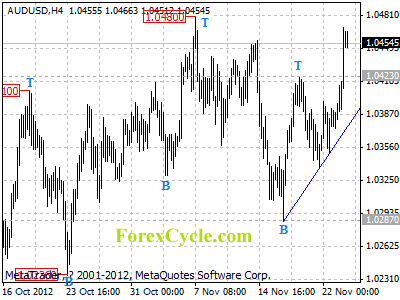
AUDUSD is facing 1.0480 resistance

AUDUSD is facing 1.0480 resistance, a break above this level will confirm that the uptrend from 1.0149 (Oct 8 low) has resumed, then further rise towards 1.0550 could be seen. Support is at the upward trend line on 4-hour chart, only a clear break below the trend line will suggest that lengthier consolidation of the uptrend is underway, then sideways movement in a rang between 1.0287 and 1.0480 could be seen.

audusd

Daily Forex Forecast

USD Index and weekly fundamental overview 25-11-12

USDIndex moving as it expected to move. Currently closed near support
level, It may retrace a bit but it has a good chance to break the
support and get close to 79 level.

201213 USD Index and weekly fundamental overview 25 11 12

USD INDEX


Most USD news forecast suggest mix move on price next week. Most
importantly USD unemployment claim cross 2012 high so far, It will not
stay there long so we can assume next week  it will be more neutral this
would effect market movement.

Uptrend likely to continue on EURUSD,GOLD, AUDUSD at the beginning of
the week. Later however some news may affect price movement.

Next week important news.

Nov 26 -Eurogroup Meetings

Nov 27 -GBP-Revised GDP q/q

Nov 27 -USD-Core Durable Goods Orders m/m (Forecast – negative)

Nov 27 -USD-CB Consumer Confidence (Forecast – positive)

Nov 28 -USD-New Home Sales (Forecast – negative)

Nov 29 -Italian 10-y Bond Auction

Nov 29 -USD-Prelim GDP q/q (Forecast – positive)

Nov 29 -USD-Unemployment Claims (Forecast – positive)

Nov 29 -USD-Pending Home Sales m/m (Forecast – positive)

Nov 30 -CAD-GDP m/m (Forecast – positive)


Monetary Policy Week in Review – Nov. 24, 2012: Three of six central banks ease as global uncertainty continues

By Central Bank News

    Last week six central banks took monetary policy decisions, with two cutting policy interest rates (Colombia and Georgia) and the remaining four (Japan, Turkey, Nigeria and South Africa) keeping rates unchanged.
     Although Turkey kept is benchmark rate unchanged, it placed itself in the easing camp by reducing the short-term lending rate, further narrowing its interest rate corridor to 4.0 percentage points.
    So far this year, policy rates have been cut four times more often than they have been raised by the 88 central banks followed by Central Bank News. Year-to-date, rates have been reduced 113 times while they have been increased 28 times, demonstrating central banks’ concern over growth prospects and the lack of an inflationary threat on a global scale.
     The recurrent theme in central banks’ statements last week was uncertainty about the global economy, primarily due to the lack of political decisions to resolve the threat of the U.S. “fiscal cliff” and the euro area’s debt crises, which is dragging down economic growth.
    The two central banks that cut rates, Georgia and Colombia, cited lower inflation that allowed them to help stimulate economic activity. Nigeria, which held rates despite expectations for a cut, cited high inflation as the reason for its decision.
    South Africa’s central bank was very downbeat, saying recent labor unrest had negatively affected the country’s economic outlook and confidence, aggravating the impact of slow global growth. The bank was now in the tough spot of trying to strike the right balance between inflationary pressures and slowing growth.
LAST WEEK’S (WEEK 47) MONETARY POLICY DECISIONS:

COUNTRYMSCI    NEW RATE     OLD RATE        1 YEAR AGO
JAPANDM0.10%0.10%0.10%
TURKEYEM5.75%5.75%5.75%
NIGERIAFM12.00%12.00%12.00%
GEORGIA5.50%5.75%7.00%
SOUTH AFRICAEM5.00%5.00%5.50%
COLOMBIAEM4.50%4.75%4.75%
NEXT WEEK (WEEK 48) monetary policy committees at eight central banks are scheduled to meet, including Angola, Israel, Hungary, Albania, Thailand, Brazil, Fiji and Mexico.

COUNTRYMSCI      DECISION          RATE        1 YEAR AGO
ANGOLA26-Nov10.25%10.50%
ISRAELDM26-Nov2.00%2.75%
HUNGARYEM27-Nov6.25%6.50%
ALBANIA27-Nov4.00%5.00%
THAILANDEM28-Nov2.75%3.25%
BRAZILEM28-Nov7.25%11.00%
FIJI29-Nov0.50%0.50%
MEXICOEM30-Nov4.50%4.50%

Implied Volatility Crush in AAPL Can Lead to Profits

By JW Jones – www.OptionsTradingSignals.com

The recent massive sell off in AAPL stock has presented some interesting opportunities for low risk trades. For long time readers of this column, you may recognize that my portfolio usually contains an AAPL position.

Why? I cannot overemphasize the importance of trading liquid instruments, and in the current world, very few underlying issues have options with the degree of liquidity routinely available in a wide spectrum of strike prices and expiration dates.

What is the big deal about liquidity? When markets trade in an orderly fashion it is usually possible to negotiate a reasonable price for all but the most illiquid underlying. However, when blood is running in the street, market makers will routinely widen bid / ask spreads and attempt to extract well more than a pound of flesh. It is only in the most liquid series that any hope of a reasonable exit in these times can be found.

Ok, sermon is over; I like AAPL! For those who have not looked at the option chain for AAPL since last Thursday, I want to call attention to another new aspect of the tremendous flexibility that exists in this name. Entirely new sets of weekly options are now trading, not just those for the next upcoming Friday expiration.

This means as I type on Tuesday morning, I can trade liquid options for calendar year 2012 that expire in 3, 10, 17, 24, or 31 days. That is a lot of choices and will allow us to exploit a never before level of granularity in constructing our trades.

The trade I would like to discuss is a high probability of success trade that is based on the expansion of implied volatility in AAPL as a result of the brutal sell off that has brought the stock from its recent highs a bit over $700 to its current price of $565 despite yesterday’s neck snapping $30 / share rally.

As regular readers know, the first characteristic I evaluate in seeking a high probability trade is that of the current status of implied volatility.  AAPL is one of a handful of stocks that have listed values for implied volatility.

As an aside, the history and current status of implied volatility is discernible for all stocks having listed options, but may require access to a broker database or one of several fee based sites.

The current status of implied volatility for AAPL, symbol VXAPL, is shown below:

AAPL Chart

As is obvious, the value has “come in” recently but still remains in the upper half of its recent range, particularly when excluding the characteristic spike in volatility preceding the recent release of third quarter earnings in October. Since currently elevated levels of implied volatility indicate that options are rich on an historic basis, it seems logical to consider a trade that benefits from selling these rich assets.

The purest way to sell option premium in a non directional based trade is to sell a naked strangle. A naked strangle is a position established by selling both a naked put and a naked call. The trade is typically constructed in far out-of-the-money strikes, typically with a delta valued at an absolute value of 5 to 10, and having duration of 25 to 35 days.

I have illustrated below the P&L curve for a 10 lot naked strangle for December monthly options. The put and call are sold at the $475 Put and the $630 Call strikes. The trade has an 87% probability of profitability and yields 9% for a 32 day holding period.

AAPL Volatility Crush - Options

A word of explanation of the manner in which the probabilities are derived is in order. One of the helpful practical characteristics of the options “Greeks” is the fact that the delta of an option is closely correlated to its probability of being in-the-money at expiration.

In the case of the options we are selling, the puts have a delta of -6 and the calls have a delta of 10. This means the puts have a probability of 94% of being out-of–the-money at expiration and the calls have a probability of 90%.

The probability of both contracts being out of the money is therefore 0.9*0.94= .84 or 84%. The credit we initially received serves to broaden the profitability zone a bit, resulting in the stated 87% probability of profit.

This is a very capital intensive trade with unlimited risk. In the illustrated size of a 10 lot trade, the buying power reduction required in a regulation T account is around $56,000. On this basis, the trade yields 9% at expiration.

For those with risk based margin, more commonly known as Portfolio Margin, the margin is a bit less than half that amount. This dramatic reduction in margin requirements results in a yield in excess of 18%.

These trade constructions illustrate the pure return and probabilities of success for a premium selling approach and illustrate the logical thought process of pursuing such a strategy. An important caveat is that these unlimited risk trades such as illustrated must be taken in small size relative to the total portfolio to reduce risk and allow for adjustments when price does not behave.

While these structures are not common and require a certain degree of capital and professional understanding, the probabilities and potential returns are such that small positions can result in large profitability outcomes on a monthly basis.

Right now we are offering a special trial offer for traders interested in trying out OptionsTradingSignals.com! The recent track record has been almost too good to be true. Check out this special offer by click here.

Options Trading Performance

Happy Trading & Happy Thanksgiving!

Simple ONE Trade Per Week Trading Strategy?
Join www.OptionsTradingSignals.com today with our 14 Day Trial


JW Jones

This material should not be considered investment advice. J.W. Jones is not a registered investment advisor. Under no circumstances should any content from this article or the OptionsTradingSignals.com website be used or interpreted as a recommendation to buy or sell any type of security or commodity contract. This material is not a solicitation for a trading approach to financial markets. Any investment decisions must in all cases be made by the reader or by his or her registered investment advisor. This information is for educational purposes only.