Time to Give the Feds the Heave Ho

Control things… then things get out of control.

Centralize… and then watch what you put together break apart.

Yes, dear reader, we are tapping into the deepest currents of nature. There the tides rush back and forth, in and out… and there ain’t nuthin’ you can do to stop it.

America succeeded largely because it was a single, centralized nation… one of the largest, richest landmasses in the world… populated by one people.

No trade barriers kept the Indianans from selling to the Texans. No immigration police kept the Vermonters from moving to Florida. And no language barrier kept the Californians from sharing their latest fashions with the New Yorkers.

But centralization is only a benefit some of the time, not all of the time. Now the big ship of state is loaded to the gunwales with debt, financial obligations and delusions of imperial grandeur.

Chainsaw Cuts!

The weight of all that debt was elucidated for us in the pages of yesterday’s Wall Street Journal.

Unfortunately, we threw away the paper before boarding the plane for Florida. But we remember the story. And if we’re off by a trillion or two…so what? It won’t make any difference.

You may remember, for example, the deficit for this year is said to be $1.1 trillion. That’s the number reported in the press. But the real number is much higher. The real deficit – including the deferred expenses inherent in Medicaid and Social Security and so forth – is over $7 trillion.

And the real debt is usually misreported too. It’s not $16 trillion – roughly equal to GDP. It’s more like $70 trillion… or five times GDP. And even if you took 100% of all the income earned by America’s taxpayers… it still wouldn’t be enough to pay these debts and obligations.

Nobody talks about it. Nobody wants to think about it. Because the nation is going broke… and the only way to avoid it is to prune those spending programs heavily. We’re not talking about paltry “fiscal cliff” cutbacks… or sequesters. We’re talking real chainsaw cuts!

Secession Fever

But what politician wants to mention that? And what clever state wants to stay on this sinking ship?

Cometh the problem… cometh the solution. Everybody’s talking secession. The Scots and the Catalans are already voting on it. Many of them want out. And here comes the Great State of Texas… formerly the Republic of Texas… getting the itch too. From The New York Times:

In the weeks since President Obama’s re-election, Republicans around the country have been wondering how to proceed. Some conservatives in Texas have been asking a far more pointed question: how to secede.

Secession fever has struck parts of Texas, which Mitt Romney won by nearly 1.3 million votes.

Sales of bumper stickers reading “Secede” – one for $2, or three for $5 – have increased at TexasSecede.com. In East Texas, a Republican official sent out an e-mail newsletter saying it was time for Texas and Vermont to each “go her own way in peace” and sign a free-trade agreement among the states.

A petition calling for secession that was filed by a Texas man on a White House Web site has received tens of thousands of signatures, and the Obama administration must now issue a response. And Larry Scott Kilgore, a perennial Republican candidate from Arlington, a Dallas suburb, announced that he was running for governor in 2014 and would legally change his name to Larry Secede Kilgore, with Secede in capital letters. As his Web page, secedekilgore.com, puts it: “Secession! All other issues can be dealt with later.”

“Our economy is about 30 percent larger than that of Australia,” said Mr. Kilgore, 48, a telecommunications contractor. “Australia can survive on their own, and I don’t think we’ll have any problem at all surviving on our own in Texas.”

Few of the public calls for secession have addressed the messy details, like what would happen to the state’s many federal courthouses, prisons, military bases and parklands. No one has said what would become of Kevin Patteson, the director of the state’s Office of State-Federal Relations, and no one has asked the Texas residents who received tens of millions of dollars in federal aid after destructive wildfires last year for their thoughts on the subject.

But all the secession talk has intrigued liberals as well. Caleb M. of Austin started his own petition on the White House Web site. He asked the federal government to allow Austin to withdraw from Texas and remain part of the United States, “in the event that Texas is successful in the current bid to secede.” It had more than 8,000 signatures as of Friday.

A Fragile World

In the new phraseology of our friend Nicholas Taleb, central governments have become “fragile.” Even a small storm could sink Greece… France… or the U.S.

And why should Texas go down with the ship?

Who owes the debt? The central government. Who made the promises and borrowed the money? The feds. Whose government is run by the zombies, for the zombies and of the zombies? That’s right: Washington’s government.

So, it makes sense to give the feds the heave-ho. Texas would be better off on its own.

We’re planning on starting our own secession movement in Maryland. The Old Line State failed to secede in the War Between the States. Taking a middle road of neutrality. This time, we’re hoping Maryland will correct its error.

Free Maryland!


Disclaimer

Article brought to you by Inside Investing Daily. Republish without charge. Required: Author attribution, links back to original content or www.insideinvestingdaily.com. Any investment contains risk. Please see our disclaimer.

Market Trends 30.11.12

Source: ForexYard

printprofile

Hey Everyone,

Below are some market trends for today.

Good luck!

-Dan

Gold- May see upward movement today
Support- 1718.79
Resistance- 1739.87

Silver- May see upward movement today
Support- 33.58
Resistance- 35.09

Crude Oil- May see upward movement today
Support- 86.88
Resistance- 88.63

Dax 30- May see downward movement today
Support- 7286.43
Resistance- 7448.25

EUR/USD May see upward movement today
Support- 1.3070
Resistance- 1.2939

Read more forex news on our forex blog

Forex Market Analysis provided by ForexYard.

© 2006 by FxYard Ltd

Disclaimer: Trading Foreign Exchange carries a high level of risk and may not be suitable for all investors. There is a possibility that you could sustain a loss of all of your investment and therefore you should not invest money that you cannot afford to lose. You should be aware of all the risks associated with Foreign Exchange trading.

Market Review 30.11.12

Source: ForexYard

printprofile

The euro hit a five-week high against the US dollar during morning trading today, as confidence that US Congressional leaders will soon reach a deal to avoid the upcoming “fiscal cliff” encouraged risk taking in the marketplace.

Speculations that the Bank of Japan will initiate a new round of monetary easing next month caused the yen to fall against several of its main rivals during the Asian session. The EUR/JPY shot up to a seven-month high while the USD/JPY hit its highest point in one-week.

Main News for Today

Canadian GDP- 13:30 GMT
• Analysts are forecasting the GDP figure to come in at 0.1%, which would represent increased economic activity in Canada
• Any better than expected data could result in gains for the Canadian dollar

Read more forex news on our forex blog

Forex Market Analysis provided by ForexYard.

© 2006 by FxYard Ltd

Disclaimer: Trading Foreign Exchange carries a high level of risk and may not be suitable for all investors. There is a possibility that you could sustain a loss of all of your investment and therefore you should not invest money that you cannot afford to lose. You should be aware of all the risks associated with Foreign Exchange trading.

Dollar Declines on Lawmakers Optimism

By TraderVox.com

Tradervox.com (Dublin) – US Treasury Secretary Timothy F. Geithner is due to meet congressional leaders in a meeting set to discuss the fiscal cliff. This has caused the dollar to decline to 0.4 percent from its weakest level this month. According to Kengo Suzuki, a Tokyo-based currency strategist at Mizuho Securities Co, the fiscal cliff will lead to a dollar off while the US GDP figures will boost risk appetite which will spur yen selling.
Lawmakers have boosted the optimism of a possible of a solution to the fiscal cliff issue which has lead to the Dollar Index declining for the second day. The fiscal cliff, which will take effect in January, has boosted safety demand in the market. The yen has dropped against most of its major trading peers as Asian Stocks gained prior to a report expected to show US Gross Domestic Product expanded more than the market had previously estimated.

The Dollar Index used by the Intercontinental Exchange Inc to measure the US Dollar against other six major trading peers, dropped by 0.1 percent to 80.277 yesterday. The MSCI Asia Pacific Index of shares increased by 0.9 percent boosting demand for higher yielding assets.

Mitul Kotecha, the global head of Foreign Exchange strategy in Hong Kong at Credit Agricole Corporate and Investment Bank, said that investors are being driven by the headlines, with risk appetite increasing as positive news on the fiscal cliff are released. Mitul also added that currencies will continue to track the improvements in risk but they are likely to remain within range. The developments in the fiscal cliff issue came after the US House Speaker John Boehner indicated that he is optimistic that the lawmakers will avert the situation.

The US Dollar traded at $1.2954 against the 17-nation currency during the midday trading in Tokyo yesterday from its close of $1.2953 in New York the previous day. The greenback had touched its lowest on this month Nov 27 of $1.3009, which was last reached on Oct 31. The Japanese currency was little changed against the euro at 106.45 and 82.18 against the greenback.

Disclaimer
Tradervox.com is not giving advice nor is qualified or licensed to provide financial advice. You must seek guidance from your personal advisors before acting on this information. While we try to ensure that all of the information provided on this website is kept up-to-date and accurate we accept no responsibility for any use made of the information provided. Opinions expressed at Tradervox.com are those of the individual authors and do not necessarily represent the opinion of Tradervox.com or its management. 

Article provided by TraderVox.com
Tradervox.com is a Forex News Portal that provides real-time news and analysis relating to the Currency Markets.
News and analysis are produced throughout the day by our in-house staff.
Follow us on twitter: www.twitter.com/tradervox

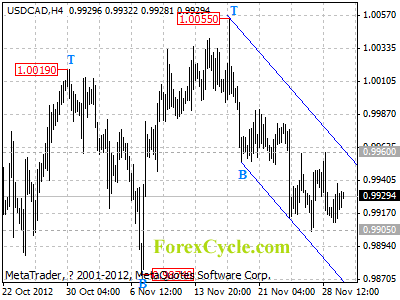
USDCAD moves sideways in a narrow range between 0.9905 and 0.9960

USDCAD moves sideways in a narrow range between 0.9905 and 0.9960. The price action in the range is likely consolidation of the downtrend from 1.0055. Resistance is located at the upper line of the price channel on 4-hour chart, as long as the channel resistance holds, the downtrend could be expected to resume, and another fall to test 0.9874 support is possible after consolidation. On the upside, a clear break above the channel resistance will suggest that the downtrend from 1.0055 has completed at 0.9905 already, then the following upward movement could bring price to 1.0100 area.

Daily Forex Forecast

William Knox D’Arcy: The Greatest Australian You’ve Never Heard Of

By MoneyMorning.com.au

The story of the man who built one of Australia’s greatest ever small-cap mining fortunes and changed the course of history should be an unforgotten legend of risk, adventure and unimaginable riches.

But today practically nobody knows his name.

Today’s Money Morning will resurrect this amazing tale – and remind us all of the potential profits than come from calculated punts and a healthy dose of vision.

‘The most influential Aussie who ever lived’

The greatest Australian you’ve never heard of is William Knox D’Arcy.

In August this year the Queensland State Government inducted D’Arcy into its Business Leaders Hall of Fame. He was one of six inductees. The award was recognition for ‘his major contribution to the success of the Mount Morgan gold mine and the international significance of his role in the discovery of oil in Persia.’

You could forgive D’Arcy for feeling a little peeved that it took 95 years for him to get some official recognition. Then again, it was a government award – but it still seems like a shocker even by that standard.

If you love geography and history you’ll know Persia is largely today’s modern Iran. Persia is also the location of the Middle East’s first oil find – thanks to our man D’Arcy’s money and appetite for risk.

This is the reason that historian Geoffrey Blainey recently said, ‘William Knox D’Arcy is, almost by definition, the most influential Australian who has ever lived. He is a giant figure on the world stage.’

That probably seems like a pretty big call. But you’ll soon see why. D’Arcy didn’t start with a lot of money. In fact, he had no significant wealth to speak of.

But we’re getting ahead of ourselves here. We need to backtrack, because D’Arcy didn’t make his first big money – and it was BIG – in oil. It was in gold.

When You Take a Risk…and Win

Born in England, D’Arcy’s father had brought out the family to Australia when D’Arcy was 17. In time, D’Arcy became a small time lawyer in the Queensland town of Rockhampton.

D’Arcy loved to punt on the horses and play cricket.

We don’t know what his luck was like at the track but he sure got lucky – almost unbelievably lucky – the day two gold prospectors walked into his office and slapped a bag of stone on his desk.

The two men were the Morgan brothers.

The Morgan brothers chose D’Arcy for no other reason than they had been told by their banker they needed a lawyer. D’Arcy didn’t have any expertise in mining or metals. The sample had come from about twenty miles out of Rockhampton at a place called Ironstone Mountain.

A sample was sent off and showed a high level of gold.

Recognising the chance to ride what could be a great thing, D’Arcy bought into the project with a single £500 stake. In fact, D’Arcy was essentially gambling with borrowed money, probably from his wife’s family.

Less than two years after the gold started to flow the Morgan brothers – who had renamed Ironstone Mountain Mount Morgan – decided to sell out. They thought the ore was rich at the surface but sparse at depth. So, the Morgan brothers cashed out.

But by this time D’Arcy must have thought he knew better. He kept buying until he owned around 36% of the shares.

It turns out the Morgans had made a terrible mistake. Not only was Mount Morgan rich with gold at the surface, but it was rich with gold at depth too. It was just that the initial digging at depth had missed it. After further exploration, the miners found the rich gold vein and the mine and Rockhampton boomed.

Geoffrey Blainey wrote about this in his book The Rush that Never Ended:


‘Ten years after the finding of Mount Morgan the return on the actual capital invested was over 200,000 per cent and dividends had exceeded £3 million.’

The shares rocketed over 1,600% at the peak of the mania surrounding the mine. But not everyone got rich from Ironstone Mountain. The original freeholder who owned the land didn’t get fabulously rich. The Morgan brothers made money, but missed out on a fortune. But the speculators did get rich.

Over the next 100 years the mine would produce nearly 8.8 million ounces of gold, 1.3 million ounces of silver and 387,000 tonnes of copper. At today’s prices, the gold alone would be worth nearly $15 billion.

This would prove to be one of the richest gold mines in Australian history and turn its investors into millionaires. The phenomenal gush of dividends would finance D’Arcy’s luxury living on the scale of European aristocrats and royalty. And, of course, his discovery of oil in the Middle East.

And best of all for D’Arcy, he didn’t have to lift a finger, let alone swing a pick axe.

He soon became one of the richest men in Australia. We don’t know what Rockhampton was like in the 1880′s. But there clearly wasn’t enough of interest to make him stick around. He sold his law firm, and left for England in 1887.

And as any millionaire is bound to do, he bought a mansion and two country estates. He had his own private box at the Epsom racecourse (King Edward of England had the only other one). D’Arcy never worked again. He and his wife became a fixture of London ‘society’, famous for their lavish parties.

D’Arcy had turned a small, speculative investment into a life-changing fortune. But he didn’t lose the speculative streak in his nature. After striking it lucky and making a fortune…he decided to do it again. This time it would reshape the history of the world for the next century…

From Aussie Gold…to Persian Oil…to the Hall of Fame

D’Arcy was smart enough to see a big change happening in the world when many were missing it. He saw a bright future for oil, especially thanks to the latest invention: the motor car.

And if there was going to be an industry based on an internal combustion engine, there needed to be more oil. And that would mean a bigger oil industry. Also, if the British could find a strategic source of oil it would give them a huge advantage.

By 1900, years of high living had taken its toll on D’Arcy’s finances. The company manager of Mount Morgan told him the mine’s best days were gone and his shares were overvalued. The dividend cheques began to shrink.

Looking for other opportunities, in 1901 D’Arcy was approached to invest in oil exploration in Persia. The gambler in him came out. If this opportunity was even half as good as Ironstone Mountain he could make a second fortune. So he took his chance. He bought a concession that covered 480,000 square miles of the country and was good for sixty years.

D’Arcy employed and sent out what would prove to be his key man, a tenacious geologist and engineer called George Reynolds. He would labour away for seven long years and find practically nothing. The project would nearly send D’Arcy bankrupt.

It seemed a reasonable bet that there would be oil in Persia because oil was known to seep to the surface. But finding a commercial field in the heat and the desert with little to no infrastructure and hostile locals was another thing altogether.

Persia had crushed many other hopeful schemes and enterprises before. From Daniel Yergin’s The Prize:


‘It was not a reasonable business proposition. Even the estimate for expenditures was to be grossly understated. At the outset, D’Arcy had been advised that it would cost ten thousand pounds to drill two wells. Within four years, he was to be out of pocket in excess of two hundred thousand pounds.’

D’Arcy was eventually forced to go to his London bankers and take out a huge overdraft, putting up his shares in Mount Morgan as collateral. That created a problem. The shares were falling as investors caught on to the fact the mine was no longer as rich in gold.

But it was still rich in copper, which had been ignored in the hunt for more and more gold. Luckily for D’Arcy, copper would save the mine. The copper would keep the dividend money flowing so that, along with the loans from London, D’Arcy could keep his men drilling in Persia.

But by 1905, D’Arcy wanted out. False starts, endless overruns, dry wells and trouble plagued his Persian oil play. He resolved to sell his concession. He turned to the French Rothschilds.

But around that time the British government was considering switching its Navy fuel from coal to oil. At the time Britain only had a limited source of oil within the Empire.

Seeing the opportunity, the British Government arranged to buy into D’Arcy’s concession via Scottish company Burmah Oil. This happened with days to spare. It was much needed capital. When you consider D’Arcy didn’t have a proven oilwell, let alone anything like an operating company, it was a lifesaver. But that wasn’t the end of the drama.

Three years later Burmah Oil had lost a lot of money for little return in Persia just like D’Arcy had before them.

The directors of Burmah Oil eventually caved in and cabled George Reynolds in May 1908 to cease drilling. But Reynolds must have known he was closer than ever before. He ignored the order and kept drilling. Six days later they struck oil. It was a gusher, drenching the drillers. A few days later, a second well hit oil. There was oil in Persia and D’Arcy’s team had found it.

D’Arcy’s fortune soon rocketed back up to its previous stratospheric level. Britain had a secure supply of oil that would influence the direction of both World Wars. Not only that, but the discovery of Persian oil formed the ‘Anglo-Persian’ oil company, which later became British Petroleum (BP), currently one of the world’s largest integrated oil companies.

Bottom line: the quest to find, secure, and produce this oil fundamentally altered the 20th century…and it all began with a gold mine in Queensland and a speculator named William Knox D’Arcy.

As one biographer, Margaret Carnegie, wrote, it was ‘a fitting monument to an achiever who took big risks and stood fast.’

And that’s what this story is really all about.

Great fortunes can be achieved no matter who you are. You just need to be willing to recognise a good opportunity when you see one…and be willing to take a risk.

Kris Sayce has just finished a presentation on this very idea. It will be in your inbox tomorrow. He says there are great opportunities to back in 2013. Stay tuned.

Callum Newman

Contributing Editor, Money Morning

From the Port Phillip Publishing Library

Special Report:
Retire Rich, Happy and Free From Money Worries

Daily Reckoning:
Secession Fever in the USA

Money Morning:
Why I’m Bullish on These Beaten-Down Stocks

Pursuit of Happiness:
The End of 797 Years of Legal Precedent

Diggers and Drillers:
Why You Should Invest in Junior Mining Stocks

Australian Small-Cap Investigator:
Why Speculating On Small-Cap Stocks is Your Best Bet in a Rigged Market


William Knox D’Arcy: The Greatest Australian You’ve Never Heard Of

Why It’s Possible to Buy AND Sell This Market

By MoneyMorning.com.au

Yesterday, a lot of stocks on the Aussie market went up…

…but a lot of stocks on the Aussie market went down too.

And many others did, well, nothing much. They went up a bit, then down a bit (or vice versa), but ended the day where they had started.

For some investors and analysts (including your editor) this action says ‘buy’. For others (including Murray Dawes) it says ‘sell’.

What’s an investor to do?


In fact this seemingly contrary advice often leads to us getting questions like this from readers, ‘How come you’re telling me to buy stocks when Murray says the market is about to crash? I’m confused.’

It’s a fair question, and we’ll answer it today…

Many investors make a common mistake.

They look at the market as though it’s black or white…it’s up or down…it’s a bull market or a bear market.

But you shouldn’t look at the market like that.

The ‘market’ isn’t just one big lump. It’s not like a school of fish that switches directions at the same time.

You’ve got the stock market, bond market, foreign exchange (FX) market, commodity market, derivatives market, property market…and hundreds of other markets.

And within those broad markets there are different sectors or sub-markets, such as utilities, finance, and resources in the stock market; government, semi-government and corporate in the bond market…

In the FX market there are major and minor currency pairs; base metals, precious metals and agricultural commodities in the commodity market; CFDs, options and futures in the derivatives market; and residential and commercial property in the property market.

You get the point.

And then within these sub-markets there are further sub-markets and then individual tradeable assets.

The point is, just because BHP Billiton [ASX: BHP] goes up in the stock market, doesn’t necessarily mean the silver price goes up in the commodity market.

Heck, just because BHP goes up, doesn’t mean other stocks have to go up.

However, that’s only a third of the story. The other two-thirds involve risk and asset allocation…

Do This Before You Even THINK About Buying a Stock

We won’t cover this in fine detail because we’ve gone through each of these in detail before. Just go to the Money Morning website and search for ‘punting money’ or ‘asset allocation’ and you’ll find the relevant articles.

But to put it simply, before you even look at the various markets you need to look at your finances.

You need to total up your savings and work out how much money you want to put in each investment. This is the ‘safe money’ and ‘punting money’ that we’ve written to you about in the past.

This is where you allocate 70-80% of your savings in cash, term deposits, dividend stocks, and gold and silver. This is money you can’t afford to lose…money you’re investing for the long term.

This is how we manage our family wealth. We’ve got money in cash and term deposits, and money in dividend stocks. We don’t ever plan on selling out of any of those investments – although that’s not to say we don’t review them.

You should plan to keep hold of these investments regardless of whether the economy is going up, down or sideways.

Aside from this you should have your ‘punting money’. How much you allocate to your punting fund comes down to your attitude to risk. That’s why we look at risk and asset allocation together.

If you’re happy with a lot of risk then you’ll allocate less to your ‘safe money’. If you’re risk averse then you’ll allocate more to your ‘safe money’.

And it’s here where you may think there’s confusion between your editor’s message to buy stocks against Murray’s message to short sell stocks.

The fact is, as odd as it may seem, the two strategies aren’t mutually exclusive. Murray looks at the market for big macro-economic moves. He’s looking at what the central bankers are up to, the latest economic releases, and what policy makers are doing in Canberra or Washington DC.

He then looks to place big leveraged bets to take advantage of short-term moves.

Why You Should Speculate to Build Wealth

To a large extent, when we’re researching stocks for Australian Small-Cap Investigator we don’t care much for central bankers, economic data, or dumb policy decisions.

We tend to focus on longer-term trends. We look at some of the most speculative stock positions available on any market – small-caps. We’re not looking for small short-term gains.

We’re looking for huge gains. We’re looking at companies that are developing a breakthrough technology, exploiting a market trend, or exploring for an undiscovered resource.

We look back at history to some of the wealthiest people, most of them got where they did by taking risks…by speculating. Many probably risked more than they should. People like John Templeton and William Knox D’Arcy.

Yet we’re not saying people should go ‘all in’ on small-cap stocks. We believe investors should understand the risks and then take a meaningful but calculated punt. That’s why we suggest allocating 5-15% of your savings in this end of the market.

If you punt on the right stocks at the right time it’s possible to make a fortune. In short, these are the kind of stocks that could either go belly up…or could make you a 300%, 400% or 500% gain.

And that’s the thing, because you can make such big gains, you only need to use a small amount of capital. And because small-cap stocks can take longer to reach their full potential, you also have to sit through some of the shorter-term broad market moves.

Right now, we’re looking at hundreds of small-cap stocks trading at bargain-basement prices. Yet only a handful of them will make the kind of explosive gains we’re looking for. It’s our job to try and find those stocks.

Yes, You Can Short-Sell and Buy Stocks at the Same Time

So, we get it. We know it can sometimes appear confusing when one editor says buy when another says sell, the key point is to look at the advice in context with your overall wealth.

To our way of thinking there’s no contradiction with the advice to use some of your cash to short-sell lumbering blue-chip stocks today, while at the same time trawling the bottom of the market for beaten-down small-cap gems.

We hope that helps.

Cheers,
Kris

PS. By the way, as Callum said in his story on William Knox D’Arcy, there are a number of things D’Arcy did to build his fortune. But in a report we’re due to release tomorrow, we’ll reveal the single most important wealth-building strategy that turned D’Arcy from a provincial lawyer to one of the world’s richest men.

From the Archives…

Why You Should Always Be Looking to Buy Small Cap Stocks
23-11-2012 – Kris Sayce

China is Now the World’s Biggest Gold Producer – and Consumer
22-11-2012 – Dominic Frisby

The Stock Market Gets Squeezed
21-11-2012 – Murray Dawes

Buy Quality Gold Stocks That Have the ‘Right Stuff’
20-11-2012 – Dr. Alex Cowie

Picking the Hot Commodity Stocks of 2013
19-11-2012 – Dr. Alex Cowie

Australian Small-Cap Investigator:
Why Invest in Small Cap Stocks and Why Now?


Why It’s Possible to Buy AND Sell This Market

With the Economy Recovering, Are Higher Rates Imminent?

By The Sizemore Letter

Quietly, under the radar, all signs are pointing to a strong recovery in the housing market.  Sales of both previously occupied homes and new homes rose sharply last month, as did building permits.   Building permits are up a whopping 22% over the past year.

Mortgage applications are rising. And prices are rising in most markets. We’ve even seen improvement in billings from architects.

You wouldn’t know it from watching the news or from talking to the average American—who remains deeply pessimistic about housing and the economy in general—but we have the makings of a mini-boom in housing that should go a long ways towards stabilizing the U.S. economy.

Remember, in addition to the jobs in construction and finance that a strong housing market creates, there are the spillover effects.  A strong housing market makes it easier for Americans to sell their homes and move for a better job opportunity.  It’s impossible to calculate with any accuracy, but some portion of our 7.9% unemployment rate is “frictional” unemployment, which means that would-be workers are not able to take available jobs because they are not mobile enough to take them.

What does all of this mean for interest rates—and for a resumption in the bull market in equities?

So much of the recent recover y in home prices has been due to low mortgage rates.  Housing is affected by rates the same way that bonds are.  Lower interest rates mean higher home prices for a given monthly payment.  So, if mortgage rates rise too quickly, they can nip this would-be recovery in the bud.

This is something that bears watching, but for now it doesn’t concern me.  I do expect rates to rise from their current lows, but I do not expect them to return to pre-crisis levels any time soon.  As Japan has proven, inflation and interest rates can remain subdued for years following a major asset bubble.

It is a simple case of supply and demand.  When there is a large supply of money but comparatively little demand for it in the form of loans, the price of money—in this case the interest rate—falls.  This was the case for Japan during its two lost decades, and it is the case in America and Europe today.  A deleveraging private sector is more than compensating for a spendthrift government to reduce the total amount of debt.  Add to this Bernanke’s insistence on keeping quantitative easing measure in effect until we see a real fall in the unemployment rate, and you have a recipe for continued low rates, housing recovery or not.

Where does this leave the stock market?

Worries about higher taxes have hit dividend-paying stocks in the weeks following the election, and I expect tax loss selling by high-net-worth investors to keep a lid on prices for the remainder of 2012.

But in a world of low yields, dividend paying stocks are still going to be the best option for most investors.  My favorite dividend-focused ETF is the Vanguard Dividend Appreciation ETF ($VIG), which yields a modest 2.11% in dividends.  But unlike bond coupon payments, VIG’s payout will rise over time.  The ETF’s holdings consist of stocks that have raised their dividend for a minimum of 10 consecutive years—which means they raised them throughout the chaotic years of 2008 to the present.   The ETF’s cash payout is up 13% year over year, and I expect continued strong boosts in the years ahead.

Disclosures: Sizemore Capital is long VIG. This article first appeared on MarketWatch.

SUBSCRIBE to Sizemore Insights via e-mail today.

The post With the Economy Recovering, Are Higher Rates Imminent? appeared first on Sizemore Insights.

Related posts:

Tunisia holds rate, economy recovers, inflation may rise

By Central Bank News
    Tunisia’s central bank held its benchmark interest rate steady at 3.75 percent as the economy continues to improve gradually but inflation could rise in coming months.
    Banque Centrale de Tunisie, which raised its rate in August by 25 basis points, said the pressure on prices and the balance of payments warrants watching and financial balances must be preserved.
    Tunisia’s consumer prices rose 0.8 percent in October from the previous month for an annual rise of 5.3 percent, down from September’s 5.7 percent due to lower food prices, the bank said, adding:
    “It is worth noting that certain provisional indicators augur for the return of a rise in inflation in coming months.”
    Tunisia’s central bank does not have a specific target for inflation, but the governor said last month that the bank would tolerate inflation of up to 5 percent.
    Tunisia’s economy has been gradually improving this year after contracting by 2.2 percent last year following political unrest that triggered the Arab Spring across North Africa.
    The central bank said the economy expanded by an annual 2.6 percent in the third quarter for a 3 percent expansion in the first nine months, with agriculture, services, mining and energy improving.
    “By contrast, pressure from lethargic external demand keeps on affecting production in  manufacturing industries and exports because of the persistence of economic and financial difficulties in Tunisia’s main partner countries in the European Union,” the bank said.
    Tunisia’s trade deficit rose in the first 10 months of the year with the current account deficit widening to 6.9 percent of Gross Domestic Product, up from 5.8 percent in the same 2011 period. Foreign reserves also declined to the equivalent of 94 days of imports as of Nov. 26 compared with 113 days at the end of 2011, the bank said.
    The outstanding balance of deposits in Tunisia’s banking sector rose by 5.4 percent in the first 10 months from the same period last year, the central bank said.
    In its statement, Tunisia’s central bank made no mention of consumer credit, which has concerned the bank. Since October, the central bank has required commercial banks to hold reserves equal to the amount of new consumer credit issued to contain inflation.

    www.CentralBankNews.info