Market Review 6.12.12

Source: ForexYard

printprofile

The markets saw relatively little movement during overnight trading last night, as investors were hesitant to open large positions ahead of tomorrow’s all-important US Non-Farm Payrolls report. The EUR/USD fell just over 20 pips, but was quickly able to recoup its losses. The pair is currently trading at 1.3067.

A better than expected Australian Employment Change figure resulted in the AUD/USD gaining more than 30 pips to eventually trade as high as 1.0479. The price of gold fell just over $4 an ounce before finding support at the $1690 level. Crude oil prices held steady around the $87.75 level throughout the night.

Main News for Today

Euro-Zone Minimum Bid Rate and ECB Press Conference- 12:30 and 13:15 GMT
• The euro-zone interest rate decision followed by the ECB press conference tend to have a significant impact on the marketplace, as they signal to investors what the current state of the EU economy is
• Any signs that the euro-zone economic recovery is slowing down could result in euro losses during afternoon trading today

US Unemployment Claims- 13:30 GMT
• The unemployment claims figure will provide investors with another indicator regarding the state of the US labor sector ahead of tomorrow’s Non-Farm Payrolls report
• Should the figure come in below the forecasted 378K, the dollar could receive a boost against the Japanese yen

Read more forex news on our forex blog

Forex Market Analysis provided by ForexYard.

© 2006 by FxYard Ltd

Disclaimer: Trading Foreign Exchange carries a high level of risk and may not be suitable for all investors. There is a possibility that you could sustain a loss of all of your investment and therefore you should not invest money that you cannot afford to lose. You should be aware of all the risks associated with Foreign Exchange trading.

Central Bank News Link List – Dec. 6, 2012: ECB seen refraining from rate cuts as yields sink on bond plan

By Central Bank News

Here’s today’s Central Bank News link list, click through if you missed the previous link list. The list comprises news about central banks that is not covered by Central Bank News. The list is updated during the day with the latest developments so readers don’t miss any important news.)

How to Make Cash-Like Returns Using Shares

By MoneyMorning.com.au

Today your editor is looking at the 7 November edition of the Australian Financial Review (AFR).

It still sits, (not quite) pride of place on our desk.

In big, bold black letters the headline screams, ‘Upgrade to shares, RBA tells savers’.

We wrote to you about that headline at the time. The Reserve Bank of Australia (RBA) wasn’t kidding. And we guess we can’t say they didn’t warn everyone about its intentions.

This week – as you doubtless already know – the RBA cut interest rates to 3%. That means the benchmark interest rate is back down to the so-called emergency low of 2009.

How come? Isn’t the Aussie central bank supposed to be so much cleverer than other central bank goons? Clearly not. When faced with a crisis the RBA has proven it’s no more capable than any other central bank.

And that spells bad news for Aussie savers

But it’s not just the RBA kicking savers in the teeth by cutting rates. In yesterday’s AFR, columnist Philip Baker writes:


‘There’s a host of decent alternatives to term deposits that investors have flocked to in the wake of the global financial crisis.

‘They include infrastructure, shares with attractive and sustainable dividends, property, real estate investment trusts, corporate and emerging market debt and even high-yield debt, or junk bonds. It all just depends on how courageous investors are.’

We almost spat out our afternoon cup of tea after reading that ‘junk bonds’ are an alternative to cash.

And as for ‘courageous’, we’ve always taken a different view on what ‘courageous’ means ever since Sir Humphrey Appleby’s definition on Yes, Prime Minister:


‘Controversial only means this’ll lose you votes, courageous means this’ll lose you the election.’

Mr Baker does concede that the assets he names are riskier than cash:


‘Shares and hybrids and any other investment all have risks attached. It’s about understanding the risk so if anything untoward happens, no one can say they weren’t warned.’

But even so, any suggestion that a term deposit is comparable with shares, property and junk bonds is ridiculous. If you invest in a term deposit, you do so because you’re after something safe.

Remember, this isn’t about asset allocation. This isn’t about putting 50% in cash, 25% in shares and 25% in gold. Based on Mr Baker’s reasoning, a saver should just take that 50% cash exposure and buy shares or junk bonds.

There isn’t a genuine investment advisor alive who will say a 50% cash exposure is the same as a 50% junk bond exposure.

Cash and junk bonds are at the opposite end of the risk spectrum. Dumping cash and buying junk bonds isn’t just a controversial move, it’s a ‘courageous’ move.

It Will Only Get Worse for Savers

Artificially low interest rates will have a big impact on the latest investment vehicle of choice among the finance industry and central planners – annuities.

Here’s how the Australian newspaper reported a recent speech by former Prime Minister, Paul Keating:


‘He also hinted that he believed that there should be some requirement for people to put some of their superannuation savings into an annuity that would provide a stable source of income for their retirement.

‘Mr Keating, who was the architect of Australia’s $1.4 trillion compulsory superannuation system, said the additional money raised by increasing compulsory guarantee from 12 to 15 per cent should be paid into a government “longevity insurance fund” which would be used to help fund the retirements of people over 80.’

An annuity may be a great idea if you bought one when interest rates were high, but what about today?

If the experience in the UK is anything to go by, the age of good annuity returns may already be over. As interest rates head lower and stay low, annuity rates are likely to fall.

As the UK Telegraph noted in September:


‘At the start of the Nineties, a £100,000 pension fund would have guaranteed an income of £15,640 a year for life. Twenty years on, a 65-year-old man will secure just £5,140 a year.’

Got that? Anyone who starts an annuity in the UK today gets only one-third the amount that an annuity investor got 20 years ago. Yet living expenses haven’t dropped two-thirds in that time.

And now Mr Keating wants to force Aussies to take out an annuity in retirement…even though it may be the worst possible time to buy such an investment. But that’s politicians and bureaucrats for you.

So, with interest rates going down, living costs going up, and investment risks increasing, what’s an investor to do?

How You Can Use Shares to Beat the Central Bankers

We won’t claim it’s easy. All we can do is repeat a message we’ve spouted for more than a year. You’ve got to weigh up your own attitude to risk and then make your investment choices accordingly.

Above we mentioned that buying high-risk investments isn’t a genuine alternative to cash investments. If you’re not getting a big enough return on your term deposit, the solution isn’t to put all your money in a junk bond or property trusts.

In fact, arguably, given the increasing investment risks it’s more important than ever that you stick to your game and don’t let the mainstream and central bankers force you to take bigger risks than you should.

So, how can you do that?

The best way is to follow our ‘safe money’ and ‘punting money’ strategy.

First up, you need to figure out the kind of annual return you’re after. If you need a 6% annual return on your assets, you won’t get that from term deposits, but according to Mr Baker you can get around 4.2%.

That means you need to find a way of making up another 1.8%. So, should you ditch all your term deposits and buy shares that pay a 6% dividend yield?

No, because even dividend stocks are riskier than cash…certainly too risky to invest all your ‘safe money’.

So rather than taking a big risk by putting all your cash money into shares, look at the alternative.

Let’s say you have $100,000 and you want a 6% annual return ($6,000). Rather than take a big risk by investing all your money in shares, an alternative is to invest – say – $80,000 in a term deposit. That should give you a 4.2% return ($4,200). Then put $13,000 in share investments that yield 6%. That will earn you about $780 a year.

And then invest your final $7,000 in higher risk investments.

To reach your $6,000 annual income target you’ll need to make about 15% ($1,020) a year from the $7,000 high-risk investments.

We’ll be honest, that’s not easy in this market. But at least you’re isolating your risk. You’ve still got 80% of your money in a very ‘safe’ investment, 13% in a moderately safe investment, and only 7% of your assets in high-risk investments.

Why We Like These High-Risk Investments

As we say, this isn’t fool-proof. It would be better if central bankers, politicians and bureaucrats didn’t make investing so hard by fiddling with interest rates and markets.

But that’s the world you live in and you need to make your best stab at achieving your desired returns without taking unnecessary risks.

So, where do you get that high-risk growth from? Our preference is small-cap stocks. Small-caps are the riskiest of the risky investments, but they can be the most profitable too.

You could use other methods too, such as trading stocks for short-term gains. That’s something favoured by our old pal Murray Dawes.

But we like small-caps because you know your maximum loss if things don’t go to plan (and remember, you’re only risking a small part of your portfolio), and you can make big returns if things do go to plan.

But whatever you decide, you’ve got to make sure you don’t chase higher yields without taking into account the potential higher risks. A 6% yield on a property trust isn’t the same risk as a 6% yield on the term deposit you took out two years ago.

Cheers,
Kris

From the Port Phillip Publishing Library

Special Report: The Big Money Secret of Ironstone Mountain

Daily Reckoning:
Why You Should Take Interest in the Current Account Deficit

Money Morning:
How Long Can the Market Ignore These ‘Warning Signs’?

Pursuit of Happiness:
What Can Stop Europe’s New Social Cleansing?

Australian Small-Cap Investigator:
Five Simple Steps to Picking Winning Small-Cap Stocks


How to Make Cash-Like Returns Using Shares

The Golden Age Redux

By MoneyMorning.com.au

In Germany, gold is now available from vending machines in airports and railway stations – Gold to Go. Shoppers can buy a 1 gram wafer of gold or a larger 10g bar. Seeking safety for their savings, individuals have purchased 150 tonnes of gold, mainly in the form of coins.

Investors poured money into special funds (known as exchange traded funds (ETFs) which pool investor monies to buy over 1,000 tonnes of gold. Having earlier sold off their holding, some central banks are now re-building their gold reserves.

Refiners are unable to keep up with demand for gold bars and coins. New gold vaults are being built to accommodate demands for secure storage.

As the Global Financial Crisis continues and the cure of easy money proves as dangerous as the disease, the gold price has increased from around $250 per troy ounce in 2001 to a peak of over $1,900 in 2011. It now trades at around $1,750 per ounce.

As poet John Milton wrote, ‘Time will run back and fetch the age of gold.’

Monetary Status…


In the 19th and early 20th centuries gold played a key role in the international monetary system, being used to back currencies. The international value of each nation’s currency was determined by its fixed relationship to gold, with the precious metal being used to settle international accounts.

The problems of gold as a currency dominate Ian Fleming’s 1959 work Goldfinger. James Bond, Agent 007, is sent to investigate Auric Goldfinger, a mysterious Swiss financier who is smuggling gold. Goldfinger’s real plot is to boost the value of his gold through an audacious attack on the Fort Knox gold depositary.

In the film version, the attack features lethal nerve gas to be sprayed from a squadron of crop duster aircraft. The pilots are a bevy of buxom lesbian beauties led by a female villain, the unlikely titled Pussy Galore, played by Honor Blackman.

Goldfinger’s plan entailed contaminating the gold by exploding a nuclear device – a dirty bomb in the age of terror. Goldfinger’s own stock of uncontaminated gold would increase in value astronomically in the process. Bond discerns the plot through dazzling mental arithmetic – Fort Knox’s $15 billion dollars of gold equated to over 400 million ounces which would weigh around 12,000 imperial tonnes, making it difficult to carry off.

In Goldfinger, Colonel Smithers explained the monetary role of gold succinctly: ‘Gold and currencies backed by gold are the foundation of international credit…We can only tell what the true strength of the pound is… by knowing the amount of [gold] we have behind our currency.’

The system operated more or less continuously until the early 1970s, when progressively the world moved to the era of floating currencies with no explicit link to gold.

The Return of Gold…


Since the replacement of the gold standard with the dollar standard, the gold price has fluctuated widely. In January 1980, the gold price reached a high of $850/ ounce, reflecting high rates of inflation and economic uncertainty. Subsequently, the recovery of the global economy saw the gold price fall for nearly 20 years, reaching a low of $253/oz ($8,131/kg) in June, 1999.

From 2001, the gold price began to rise due to a number of factors. One was increased demand, especially from emerging nations such as India and China. In 2007/2008, gold received an additional boost from the onset of the global financial crisis. Concern about a banking system collapse drove gold prices higher with gold prices finally passing the 1980 high, reaching $865/ ounce in January 2008.

In late 2009 the gold price renewed its rise, passing $1,200 in December 2009 on its way to over $1,913/ ounce in August 2011. The 500% increase in the gold price since April 2001 prompted gold bugs to speculate about a new age of gold.

In reality, the rise was driven by fear. The depth of the financial crisis, concern about the security of other assets, including once risk-free governments bonds and a fragile banking system prompted a flight to gold as a safe haven. The monetary policies of governments and central banks, emphasising low interest rates and printing money to restart the global economy, also underpinned the gold price.

Germans wanted the return of their Deutschemark, now replaced by the Euro, pining for when ‘Mark gelich Mark – paper or gold, a mark is a mark’. The nightmare of Weimar, the erosion of the value of money, hovered in background. As governments borrowed ever larger sums, ordinary citizens feared that even gilt-edged government securities would become worthless.

A weak US dollar and the questionable prospects of other major currencies, such as the Euro and Yen, also drove demand for gold as de facto currency.

David Einhorn of Greenlight Capital, a hedge fund, summarised the demand for gold:


‘Gold does well when monetary and fiscal policies are poor and does poorly when they appear sensible. … When I watch Chairman Bernanke, Secretary Geithner and Mr. Summers on TV, read speeches written by the Fed Governors, observe the “stimulus” black hole, and think about our short-termism and lack of fiscal discipline and political will, my instinct is to want to short the dollar. But then I look at the other major currencies. The Euro, the Yen, and the British Pound might be worse. So, I conclude that picking one these currencies is like choosing my favourite dental procedure. And I decide holding gold is better than holding cash, especially now, where both earn no yield.’

Like other investors, central banks, especially in emerging nations such as China and India, increased holdings of gold. With a large portion of their reserves invested in currencies of developed nations which were losing value, the central banks sought to switch to gold as well as other real assets.

In 2009, China announced that over the preceding 7 years, it had acquired 454 tons of gold. It seemed that central banks had remembered J.P. Morgan’s words to Congress in 1912: ‘Gold is money. Everything else is credit.’

This fear of reduction in the value of paper money has haunted the system of fiat or paper money from inception. Keynes recognised the risk of governments and politicians determining the value of money: ‘By a continuing process of inflation, government can confiscate, secretly and unobserved, an important part of the wealth of their citizens.’

Former U.S. Federal Reserve Chairman Alan Greenspan once flirted with this problem:


‘Under the gold standard, a free banking system stands as the protector of an economy’s stability and balanced growth…The abandonment of the gold standard made it possible for the welfare statists to use the banking system as a means to an unlimited expansion of credit… In the absence of the gold standard, there is no way to protect savings from confiscation through inflation.’

Ironically, during his tenure in charge of the U.S. Federal Reserve system, Greenspan would use the banking system to expand credit in an unsustainable way that was to lay the foundation for the global financial crisis of 2007.

In his study of the human unconscious, Sigmund Freud noticed a striking association between money and excrement: ‘I read one day that the gold which the devil gave his victims regularly turned into excrement.’ Many people now find the prospect of governments pursuing policies that would turn money into excrement a disturbing, real risk, forcing them to turn back to gold.

Means to a Golden End…


For investors, investing in gold is not without problems. Shares in gold mining companies may not provide the sought after exposure to gold prices.

The value of mining companies behaves more like shares than the gold price. This reflects the company’s operation which may include exploration. The gold mining company may have investments in other commodity operations, which dilutes the exposure to gold.

Decisions to hedge the gold price may affect the sensitivity of the company’s earnings to the gold price. There are problems of mergers and acquisitions, purchase and sale of operations, borrowing and sundry issues like mismanagement and fraud.

Most investors prefer direct investment in the precious, yellow metal. This takes the form of trading in instruments like gold futures contract, or direct purchases of gold.

Gold futures and similar contracts require knowledge of derivatives trading. Physical gold is expensive and also difficult to store and insure. Popular forms of physical gold investment like coins reflect a premium to the actual gold content, adding to the cost.

To overcome the problems of physical investment in gold, some banks offer gold ‘passbook’ accounts especially for smaller investor. Operating like a normal bank account, the facility allows investors to buy and sell modest amounts of gold. The bank pools investors’ money and buys and sells gold to match the amounts owed to investors.

Increasingly, investors use gold ETFs, which are an extension of the gold account. The ETF is structured as a mutual fund or unit trust which is listed and tradeable on a stock exchange.

Investor purchase fractional shares in the ETF which then invests the money raised in gold. Some ETFs invest in the metal itself. Others synthesise the exposure to gold using instruments linked to the gold price, such as gold futures and derivatives. Some ETF’s allow leverage, borrowing funds to augment the investor’s contribution to increase sensitivity to fluctuations in the gold price.

Gold ETFs create new risks. Where the ETF uses derivatives and other financial instruments to obtain exposure to the gold, it is exposed to the risk of default by the financial institutions with which it contracts. Even where the funds are invested in physical gold, the metal is held via custodians, often financial institutions, exposing them to the failure of these entities.

This is ironic given the fact that the investment in gold is specifically motivated by fear of the failure of the financial system.

In 2011, President Hugo Chavez ordered the Venezuelan central bank to repatriate 211 tons of its 365 tons of gold reserves (worth around $11 billion) from US, European, Canadian and Swiss banks, including the Bank of England. Part of the reason was concern about the developed economies and their banking systems. More recently, the Bundesbank, Germany’s central bank, has requested an audit of its gold holdings.

Investors also worry about the risk of confiscation of gold holdings. In reality, a government can confiscate anything – gold, savings, property – they want to in times of economic emergency.

In 1933 President Roosevelt issued Executive Order 6102, prohibiting the private holding of gold and requiring U.S. citizens to turn over their gold bullion or face a $10,000 fine (equivalent around $170,000 today) or 10 years imprisonment.

In response, opportunistic coin dealers encourage investors to buy expensive ‘numismatic’ or ‘collectible’ coins, taking advantage of an exemption in the 1933 order which protected these assets from government seizure.

Seeking to reassure investors, some ETFs have installed fibre optic cable linked cameras in their gold vaults. Investors can monitor their holdings via the Internet. Of course, this clever marketing gimmick does not protect the investor from the failure of a custodian or financial counterparty, or from confiscation risk.

Golden Brown Bottoms…


The investment case for gold is mixed. Gold’s tactical value over specific periods is significant.

The period from 1999 to 2001 is referred to the ‘Brown Bottom’ of a 20-year bear market during which gold prices declined. The reference is to the ill-fated decision by Gordon Brown, then UK Chancellor of the Exchequer and subsequent Prime Minister, to sell half of the UK’s gold reserves via auction over 1999 and 2002.

At the time, the UK’s gold reserves were worth US $6.5 billion, constituting around half of the UK’s foreign currency reserves.

The decision to sell around 400 tonnes of gold at the low point in the price cycle cost the UK tax payer up to £10 billion, or around £600 per UK family (depending on the gold price used).

Commentators have compared it to the cost of £3.3 billion to UK taxpayers on Black Wednesday 1992 when the UK was forced to withdraw from the European Exchange Rate Mechanism after a failed attempt by the Treasury and Bank of England to defend the Pound.

Any investor who purchased the gold sold by the financially astute UK Chancellor would have made a substantial profit. But gold is not itself a great store of value, at least over long time periods.

Gold bugs excitedly speculate about gold prices reaching $2,300. But even at that price gold would merely match its January 1980 peak price after adjusting for inflation; in other words, the holder had earned nothing on the investment over almost 30 years!

The gold price adjusted for inflation is the same as the price in the middle ages. Dylan Grice of Société Générale summed up the case for gold as a store of value in the following terms:


‘A 15th century gold bug who’d stored all his wealth in bullion, bequeathed it to his children and required them to do the same would be more than a little miffed when gazing down from his celestial place of rest to see the real wealth of his lineage decline by nearly 90 per cent over the next 500 years.’

The gold price can also be very volatile. In late 2011, after reaching record levels, the gold price fell nearly 20% very quickly.

Warren Buffet observed that if stock investors are driven by optimism about prospects then ‘what motivates most gold purchasers is their belief that the ranks of the fearful will grow.’

Harry ‘Rabbit’ Angstrom, the central character in John Updike’s 1970s novels about American suburban life, spends $11,000 on the purchase of 30 gold Kruggerrands (a South African minted gold coin). Rabbit explains the purchase to his wife: ‘The beauty of gold is, it loves bad news.’

In economic chaos, war or collapse, gold reappears, reasserting it grip on humanity.

Back to the Future…


The revival of interest in gold is also underpinned by debate of a return to the gold standard. Advocates as varied as Libertarian US Presidential candidate Ron Paul and the Islamic Liberation Party (Hizb ut-Tahrir) have argued that the gold standard is a solution to the deep problems of the global economy.

The gold standard, it is argued, would foster economic stability and prosperity, primarily by creating price stability, fixed exchange rates and placing limits on government deficit spending as well as trade imbalances. It will also limit credit driven boom bust cycles through constraints on the supply of money.

The gold standard, opponents argue, would limit the flexibility of governments and central banks in managing economies, restricting the ability to adjust money supply, government budgets and exchange rates. Opponents also point to the inflexibility of the gold standard, which may have contributed to the severity and length of the Great Depression.

A return to the gold standard would also confer a natural financial advantage to countries that produce gold, such as the US, China, Russia, Australia and South Africa. Geo-political considerations and global competition make this unlikely.

There are also limits to supply. In all human history, only about 160,000 to 170,000 metric tonnes of gold have ever being extracted. Annual production is somewhere around 2,400-2,800 tonnes of gold.

The world’s existing stock of gold is equivalent to about two Olympic standard swimming pools. The value of this amount of gold is over US$ 6 trillion, roughly 10% of everything that the world produces in a single year and a tiny fraction of global wealth and assets.

Limited central bank holdings of gold constrain a return to the gold standard. The US, German and French central banks have gold stockpiles valued at 250% to 300% of their reserves of foreign currencies. China, India, Russia, Brazil and South Korea hold between 0.5% and 10% of their foreign reserves in gold.

If the central banks of China, India, Russia, Brazil and South Korea sought to increase their gold holdings to a mere 15% of foreign reserves, these countries would need to purchase more than 10,000 tons of gold. The US, the world’s largest gold holder, holds a little over 8,000 tons.

Max Weber, the father of social science, defined the state as the agency that successfully monopolises the legitimate use of force. The state, through its monopoly over the printing presses, has almost total control of money and the economy.

Money is now a matter of pure trust. American dollars still bears the words, ‘In God We Trust’. But God is not directly responsible for control of money, it is governments and central banks. Politicians and policy makers are unlikely to willingly cede the power that a paper money system provides.

Golden Deaths…

In 1998, gold sceptic Warren Buffett pointed to the absurdity of the precious metal as an investment:


‘Gold gets dug out of the ground in Africa, or someplace. Then we melt it down, dig another hole, bury it again, and pay people to stand around guarding it. It has no utility. Anyone watching from Mars would be scratching their head.’

But gold’s mythological power has fuelled the imagination of mankind for much of its history. As Peter Bernstein, the financial historian and author of The Power of Gold wrote, ‘Gold has…this kind of magic. But it’s never been clear if we have gold – or gold has us.’

As the metal’s price rose, a Tuscan spa offered wealthy clients a treatment which entails the entire body being covered in 24-carat gold. Costing Euro 420, the treatment, proponents claim, provides unverified benefits such as delaying the visible effects of age, skin hydration and skin elasticity.

Having switched from traditional financial investments to gold to preserve their wealth, investors will be hoping for the health benefits of the gold treatment rather than another possible ending. In the film Goldfinger, the character Jill Masterson, played by Jill Eaton, is murdered by being painted head-to-toe in gold paint – one of movie history’s iconic scenes.

Satyajit Das
Contributing Writer, Money Morning

© 2012 Satyajit Das All Rights Reserved.

Earlier versions of the content have been published previously at Market Watch, ABC.net.au and in The Economic Times of India.

Satyajit Das is a former banker and author of Extreme Money and Traders Guns & Money

From the Archives…

Now it’s the Turn of These Small-Cap Stocks to Rally…
31-11-2012 – Callum Newman

Why It’s Possible to Buy AND Sell This Market
30-11-2012 – Kris Sayce

William Knox D’Arcy: The Greatest Australian You’ve Never Heard Of
30-11-2012 – Callum Newman

Why I’m Bullish on These Beaten-Down Stocks
28-11-2012 – Kris Sayce

Natural Gas to Rule the World
27-11-2012 – Dr. Alex Cowie

Diggers and Drillers:
Five Reasons Why Gold Stocks Are Set to Rebound


The Golden Age Redux

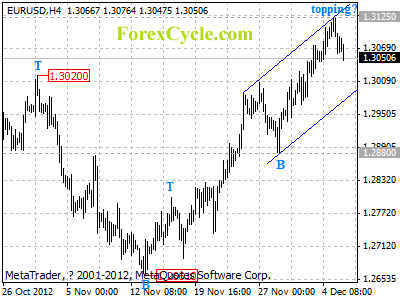
EURUSD may be forming a cycle top at 1.3125

EURUSD may be forming a cycle top at 1.3125 on 4-hour chart. Range trading between 1.3000 and 1.3125 would likely be seen in a couple of days. Support is now located at the lower line of the price channel, as long as the channel support holds, the fall from 1.3125 could be treated as consolidation of the uptrend from 1.2661, one more rise towards 1.3500 is still possible after consolidation, only a clear break below the channel support could signal completion of the uptrend.

eurusd

Daily Forex Analysis

Gold Should Be Nearing A Major Bottom

David A Banister- www.MarketTrendForecast.com

The recent rally in Gold took the metal from the 1620’s to roughly 1800 per ounce before the ensuing corrective action began.  Back around October 20th we warned our readers about a likely “ wave 2” correction in Gold and we had several reasons for that warnings.  One of the biggest concerns we had was that the sentiment surveys were  running  very hot at the time. The percentage of professional advisors polled that were bullish on GOLD was 88%, with 7% neutral and only 7% bearish.  Elliott Wave Theory is the foundation of our work, though we are sure to mix in other clues and elements to “fact check” our reads.  When you see sentiment readings that high, coupled with a $180 rally leading up to those readings, you can begin to look for clues of a top.

The other warning signal we noted was the MACD signal which had crossed south and was a topping warning signal to get out of GOLD for intermediate traders.  At the time, we surmised that a “wave 2” correction in sentiment, and therefore price was required to work off the overbought conditions.  The first level attacked the 1681 areas roughly and then a “B” wave rally to 1751 roughly ensued. Wave 2’s are made up of a 3 wave pattern, A down- B up- and C down to finish.  It appears that GOLD is now in the final C wave down in sentiment to complete the correction pattern.

Clues for the “C” wave include the Goldman Sachs quasi-bearish 2013 GOLD forecast that came out today.  In addition, the media attempting to explain the drop in GOLD as being related to stronger than expected economic indicators or fiscal cliff negotiations, neither of which make any sense at all.

We expect GOLD therefore to complete the C wave correction at 1631 or 1681 specifically. There are Fibonacci fractal relationships to the first leg down (The A wave) at those levels, and they tend to repeat themselves in terms of crowd behavior.  At the 1681 level we have the C wave equal to 61.8% of the A wave amplitude.  At 1631 we have a more traditional C wave equal to the A wave.  In either event, look for a washout low in GOLD occurring at anytime near term, and for traders to start scaling in long.

Below is the GLD ETF chart showing the two most likely bottoms for the precious metal, one of which already qualifies as of today’s trading:

Gold Market Forecast

Consider signing up for our free weekly report at www.MarketTrendForecast.com or take advantage of our 33% coupon by signing up today for SP 500 and GOLD forecasts updated on a daily basis.


This is What Polarized People DO to Each Other

By Robert Folsom |  2012

Plenty of news stories in recent years have noted that American politics have become “deeply polarized.”

Nearly all of them define and gauge what polarization means in broad terms — by a breakdown of “red state/blue state,” an analysis of “attack ads,” or via the endless examples of the “dysfunctional” legislative process in Washington.

But if polarization truly does run deep in society, the fact is that it will show up in what everyday people actually do. That’s why I was fascinated by a story I heard over the weekend, which was not the latest repeat of the same big-picture tale of polarized politics…

…But instead reported on how polarized individuals behave.

The most recent episode of the award-winning radio broadcast This American Life did the shoe-leather work, via interviews in many communities and households to discover how individuals are acting and reacting to political differences they have with people they know and in some cases love.

The short version: Time and again, this episode of This American Life learned of broken friendships and divided families to an extent no one could recall.

I’ll mention two of the many examples (one Democrat, one Republican) from the broadcast, which can only be described as open meanness to a friend.

A lady learned of an opening in a friend’s hiking group — only to be told by her friend in front of the group — that she would not be permitted to join because she was a Republican.

A man and his friend are married to sisters — but the man warned the friend not to vote Democrat or he wouldn’t serve the friend any barbeque at dinner. Further, the friend would need to bring his own food if he visits.

Mind you, these are not hearsay accounts. The radio broadcast played audio clips from the interviews of these people, describing their own behavior.

The broadcast also played many clips to tell how friends/family on opposite political sides each express the same sentiment about the other — often in the nearly the same language, including:

1) I can’t believe they really think THAT

2) People in my party are so much more open minded

3) People on the other side just don’t consider my point of view

4) They’re acting like the Nazis did [yes, I heard quote after quote saying that].

Now please allow me to zoom out to the big picture regarding the presidential election and the nation’s polarized politics, but from a source you haven’t heard before. Sage Open is a peer-reviewed journal of the social and behavioral sciences. It has just published the “Elections Paper” I’ve frequently mentioned on this page. This is an important advancement in the study of social mood’s influence on politics. The paper remains available as a free download on SSRN. This is seminal research — SSRN has posted over 350,000 papers on its website, yet in just 10 months the elections paper has become one of its most-downloaded ever.

Andrea Dibben contributes research.

If you would like to receive the best of Social Mood Watch and other free socionomics content each week, sign up here.

New Zealand holds rate, sees stronger domestic demand

By Central Bank News
     New Zealand’s central bank held its Official Cash Rate (OCR) steady at 2.50 percent, as widely expected, saying it expects stronger domestic demand to eliminate the economy’s excess capacity by the end of next year, pushing up the inflation rate towards the bank’s target.
    The Reserve Bank of New Zealand (RBNZ), which has held its rate steady since March 2011, also said the “global outlook remains soft but appears less threatening than was the case earlier in the year,” adding the risk of severe deterioration in the euro area has decreased and Chinese economic indicators are more positive. But uncertainty around the U.S. fiscal position is constraining U.S. growth.
    Despite this guarded optimism, the bank’s governor, Graeme Wheeler, said he was mindful of recent downside surprises to employment and inflation and was keeping a close eye out for any further signs of moderation.
    “With the reconstruction-driven pick-up in investment now clearly underway, the Bank will also continue to watch for a greater degree of inflation pressure than is assumed,” Wheeler said.
    Although economic growth has slowed in recent months, Wheeler said in a statement that over the next two years economic growth is “expected to accelerate to between 2.5 and 3 percent per annum.”
    Reconstruction following the Canterbury earthquake is gathering pace and the housing market is strengthening while mortgage rates have declined due to lower funding costs for New Zealand’s banks and increased competition.

    Dampening factors include the government’s fiscal consolidation, continued caution by households and the “high New Zealand dollar continues to be a significant headwind, restricting export earnings and encouraging demand for imports,” Wheeler said.
    New Zealand’s Gross Domestic Product expanded by 0.6 percent in the second quarter from the first for an annual growth rate of 2.6 percent, and the headline inflation rate eased to 0.8 percent in the third quarter, down from 1.0 percent.
    The RBNZ targets annual inflation of 1-3 percent.

    www.CentralBankNews.info

Poland to cut rates again if economy weak, inflation low

By Central Bank News
    The central bank of Poland, which earlier today cut its benchmark interest rate, said it would cut rates further if the economic slowdown is protracted and inflationary pressures remained limited.
    The National Bank of Poland (NBP) said it cut its reference rate earlier today by 25 basis points to 4.25 percent to support economic activity and reduce the risk that inflation falls below the bank’s target due to lower economic growth that will tend to restrain wages and inflationary pressures.
    The Polish central bank, which in November also said it would cut rates if it was clear the economic slowdown was protracted and inflation low, said data had confirmed the slowdown.
    “At the same time, the Council assesses that GDP growth will remain moderate in the coming years, which poses a risk of inflation declining below the NBP’s inflation target in the medium term,” the central bank said after a meeting of its Monetary Policy Council.
    Last month the bank cut its 2012 growth forecast to 2-2.6 percent and forecasts 2013 growth of 0.5-2.5 percent, sharply down from 2011’s 4.3 percent Gross Domestic Product growth.
    The NBP, which targets inflation of 2.5 percent plus/minus one percentage points, has cut rates by 50 basis points this year and said it may cut further.

    “Should the incoming information confirm a protracted economic slowdown, and should the risk of an increase in inflationary pressure remain limited, the Council will further ease monetary policy,” it said, repeating its statement from November.
    Poland’s GDP rose by only 0.4 percent in the third quarter from the second for annual growth of 1.4 percent, down from a 2.5 percent growth rate in the second quarter, with a decline in domestic demand deepening on the back of lower investment and consumption growth.
    The bank added that new data, such as industrial production, retail sales and a fall in construction output, “indicate that at the beginning of 2012 Q4 activity remained low.”
    It added the unemployment rate had risen – to 12.5 percent in October from 12.4 percent in September – which contributes to wage growth deceleration.
     Poland’s inflation rate eased to 3.4 percent in October from 3.9 percent in September and most of the core inflation measures also declined, “which confirms weakening of demand and cost pressures in the economy,” the bank said.

    www.CentralBankNews.info
     

Poland cuts key rate by 25 bps to 4.25%

By Central Bank News
    Poland’s central bank cut its reference interest rate by 25 basis points to 4.25 percent, as widely expected, along with other key bank rates. The bank’s Monetary Policy Council will explain its decision at a news conference later today.
    The National Bank of Poland (NBP) has now cut its benchmark rate by a net 50 basis point this year. In February the NBP cut its rate but then raised it in May in response to inflationary pressure. But then the bank cut rates in November in response to the economic fallout from the euro zone debt crises.
    The rate cut had been widely flagged by Polish central bankers and some economists had expected the bank may even cut rates by more than 25 basis points.
    Last month the central bank said it would cut rates further if “incoming information confirm a protracted economic slowdown, and should the risk of increase in inflationary pressure remain limited.”
    Poland’s economy, which expanded by 4.3 percent in 2011, has been deeply affected by Europe’s economic crises and its Gross Domestic Product rose by only 0.4 percent in the third quarter from the second for annual growth of 1.4 percent, down from 2.5 percent in the second quarter.
    The NBP last month cut its 2012 growth forecast to 2-2.6 percent, down from July’s forecast of 2.2-3.6 percent. It forecasts 2013 growth of 0.5-2.5 percent.

    Poland’s inflation rate has also been falling from 4.2 percent in 2011. The headline inflation rate eased to 3.4 percent in October, down from 3.9 percent in September and the central bank said last week that its survey of household inflation expectations fell for the third month in November.
    The average inflation rate expected by Polish consumers over the next year fell to 3.6 percent, down from 3.8 percent in October,  4.1 percent in September and 4.4 percent in August.
    The NBP targets annual inflation of 2.5 percent, plus/minus one percentage point.
    In addition to its reference rate, the central bank cut its Lombard rate by 25 basis points to 5.75 percent, the deposit rate to 2.75 percent and the rediscount rate to 4.50 percent.
    www.CentralBankNews.info