By www.CentralBankNews.info Sweden’s central bank cut its benchmark repo rate by 25 basis points for the third time this year due a weakening economy and said it expects to keep the rate at 1.0 percent for the coming year.
The Riksbank, which has now cut rates by a total of 75 basis points this year, said the rate cut should help support the economy so inflation starts to rise towards the bank’s 2.0 percent target.
“The risks entailed in household’s high level of indebtedness remain, but given the weaker economic activity and lower inflation, the Executive Board of the Riksbank assesses that it is appropriate to cut the repo rate,” the bank said in a statement.
The Riksbank also revised further downwards it growth and inflation forecasts, expecting 1.2 percent growth in Gross Domestic Product in 2013, down from its October forecast of 1.8 percent, but kept its forecast for 2.7 percent growth in 2014 and raised its 2015 forecast to 3.2 percent from 2.9 percent.
The bank retained its 2012 GDP forecast of 0.9 percent, down from 3.7 percent in 2011.
The repo rate is expected to average 1.0 percent in 2013, down from its previous forecast of 1.2 percent, 1.5 percent in 2014, down from 1.7 percent, and 2.2 percent in 2015, down from 2.3 percent.
The rate cut was widely expected due to the weakening economy but the Riksbank is clearly concerned about rising household debt, an important reason for holding rates steady in October. At that meeting, it also said a rate cut was more likely this year than a rate hike.
Sweden’s GDP expanded by 0.5 percent in the third quarter from the second for annual growth of 0.7 percent, down from a rate of 1.3 percent in the second
“The weak developments in the euro area are having a clear effect on the Swedish economy,” the bank said, adding that international trade has been weak for some time, the outlook by households and companies is more gloomy and consumption and investments are weak.
The labor market has also deteriorated and wage increases are expected to be lower, which will contribute to low inflationary pressures.
Consumer prices fell by an annual rate of 0.1 percent in November and the Riksbank maintained its forecasts for average inflation of 0.9 percent for the year, down from 3.0 percent in 2011. It cut its 2013 inflation forecast to 0.3 percent from 0.7 percent. But by 2014 inflation is expected to return to 2.3 percent, down from its previous forecast of 2.4 percent and rise by 2.6 percent in 2015, down from 2.7 percent.
One of the Riksbank’s board members, Deputy Governor Lars Svensson, wanted to cut the repo rate by 50 basis points to 0.75 percent now and then push the rate down to 0.5 percent from the second quarter of 2013 through the first quarter of 2014.
Monti Resignation may Delay Euro Agreement
 Tradervox.com (Dublin) – Mario Monti’s pending resignation risks delaying the efforts of fighting the debt crisis in the region that has lasted for three years. The Italian prime minister who is expected to resign this week after parliament passes the budget. Euro region and business leaders have urged Monti to enter the Italian election campaign but the PM seems adamant and wants to quit after the budget is passed. Silvio Berlusconi, the Former Prime Minister, have withdrawn his support for the government. The upper house started the budget debate yesterday and it will be passed to the lower house later.
The European leaders have closed the year with some breathing room as the European Union summit held last week agreed to bolster the euro with fiscal rules aimed at helping the indebted nations. The EU summit passed rules on permanent bailout fund, European Central Bank bond buying program and issued a clear road map for tighter banking and fiscal union. The EU summit efforts were overshadowed this month by Berlusconi’s announcement that he was withdrawing support for the Monti’s government, pledging to return to power for the fourth time.
According to Erik Nielsen, the Chief global economist in London at UniCredit SPA, the outcome of the Italian election, which might be held in February 2013, will not derail last year’s reform process. However, he indicated that the process requires close monitoring for any signs of derailment.
The 17-nation currency climbed to the highest level since May against the greenback while the Spanish government bonds advanced for the third week as bets the situation is being contained increased. The agreement by the EU leaders last week to create a central bank supervisory body and the signing of the next aid tranche for Greece have led to the improved optimism. The challenges next year are expected to revolve around dealing with the Franco-German differences on how to develop closer fiscal ties.
Disclaimer
Tradervox.com is not giving advice nor is qualified or licensed to provide financial advice. You must seek guidance from your personal advisors before acting on this information. While we try to ensure that all of the information provided on this website is kept up-to-date and accurate we accept no responsibility for any use made of the information provided. Opinions expressed at Tradervox.com are those of the individual authors and do not necessarily represent the opinion of Tradervox.com or its management.
Article provided by TraderVox.com Tradervox.com is a Forex News Portal that provides real-time news and analysis relating to the Currency Markets. News and analysis are produced throughout the day by our in-house staff. Follow us on twitter: www.twitter.com/tradervox
India holds rate steady, affirms intention to ease next year
By www.CentralBankNews.info India’s central bank held its policy repo rate unchanged at 8.0 percent, as expected, along with its Cash Reserve Ratio (CRR), but said it was still expecting to ease policy in the first quarter of next year due to lower inflationary pressures.
The Reserve Bank of India (RBI), which has held rates steady since a 50 basis point cut in April, said lower inflation would allow it to respond to growth threats and liquidity conditions would now be managed in a way that supports growth, “thereby preparing the ground for further shifting the policy stance to support growth.”
“Overall, recent inflation patterns and projections provide a basis for reinforcing our October guidance about policy easing in the fourth quarter,” the RBI said in a statement, adding that there were still risks to inflation and the policy stance would remain sensitive to these risks even if the emphasis starts to shift toward supporting growth.
India’s inflation rate eased to 7.24 percent in November from October’s 7.45 percent, but this remains above the 4-5 percent that the RBI is comfortable with.
The RBI said headline inflation had been below its projected level for the past two months and the decline in core inflation was comforting, reinforcing the likelihood of a steady moderation in 2013-14 though inflation may edge higher over the next two months.
“In view of inflation pressures ebbing, monetary policy has to increasingly shift focus and respond to the threats to growth from this point onwards,” the bank said.
India’s Gross Domestic Product expanded by 0.6 percent in the third quarter from the second for annual growth of 5.3 percent, slightly lower than the second quarter’s growth rate of 5.5 percent.
The RBI said there were some incipient signs of a pickup, but growth remains significantly below its recent trend and with food and manufacturing prices expected to edge down further, inflationary pressures may ease somewhat in coming months.
The momentum in global growth is expected to firm over the rest of 2012 and 2013, but the biggest risk to the outlook is from political economy decisions in the U.S. and the euro area.
While the RBI has held its policy rate steady since April, it has cut the CRR twice by a total of 50 basis points to 4.25 percent. The CRR is the percentage of deposits that banks have to keep with the central bank.
In its October statement, the RBI said there was a “reasonable likelihood” of a policy easing in the January-March quarter and in early November the central bank governor said this easing may come as early as in January due to lower inflationary pressures.
Why You Should Watch the Japanese Yen
With the year quickly drawing to a close I thought it was a good idea to look at the big picture in a few key markets.
One of the most interesting recent developments has been the large move in the Japanese yen. The LDP (Liberal Democratic Party) just won the election last Sunday, and the market expects to see far more money printing under the LDP.
A recent Reuters article pointed out that:
‘Even before Japanese voters returned Shinzo Abe’s party to power, he had already won over financial markets with an economic revival plan as seductively simple as economists say it is risky: print money and spend it. Lots of it.‘The Liberal Democratic Party’s landslide on Sunday is likely to sustain a market rally fuelled by economic stimulus hopes, but Abe’s economic legacy will probably be defined by how he tackles chronic ills that easy money alone cannot fix and that were largely ignored during the campaign.’
So after two decades of printing money and spending it without successfully reviving the Japanese economy, they’ve decided to give it another go.
Japan really is the poster child for failed Keynesian stimulus policies. Their debt to GDP is approaching 240% and their interest rates have been near zero for longer than anyone else and they’re still stuck in a deflationary depression.
As Albert Einstein said, the definition of insanity is ‘doing the same thing over and over again and expecting a different result’. It looks like we’re about to witness more of the same from Japan…
Watch the Japanese Yen
The reason this is interesting is that the yen is finally cracking after rallying for six years. The government has intervened in the currency markets over the past couple of years in an attempt to weaken what was a very strong yen.
It looks like the recent LDP victory and their promise of firing up the printing presses has finally convinced the market to start selling the yen.
Equity markets were driven for years by the yen carry trade which involved financial players borrowing in the Yen and investing offshore. That’s why the euro/yen cross rate was always used as a ‘risk proxy’. It gives a hint about large capital flows.
Euro/Yen Daily Chart vs ASX 200

Source: Slipstream Trader
You can see from the above chart that the euro/yen has shot higher in the last month and we have had a corresponding move in our equity market. The correlation has actually been quite high between the two over the last few years.
So is the yen carry trade coming back into fashion? If they’re going to attempt printing their way to prosperity again does that give market players the confidence that the yen will continue to depreciate and therefore reduce risk in placing yen carry trades?
If this is the case then we may see stock markets continue higher on the back of this phenomenon. The race to the bottom in the world’s major currencies is having a profound effect on markets worldwide and I have been caught off guard by the continuing resilience of equity markets in the face of deteriorating fundamentals.
Our equity market in particular is now flirting with some very important technical levels. For the last three years the 4600-4700 area in the ASX 200 has been an important dividing line for our market. I would expect to see some very stiff resistance in that zone.
ASX 200 Daily Chart

Source: Slipstream Trader
If we manage to bust up through the Point of Control at 4700 then I will certainly scratch my head, but also accept that I was wrong to be so bearish.
We need to see the ASX 200 close below 4450 in the near term for me to reinitiate my strongly bearish view. Until that happens I have to maintain a wait and see approach. It looks like we are having the Santa rally that happens so often.
There will be plenty of fund managers wanting to window dress their results into the end of the year, so I accept that there isn’t much chance of a big sell-off over the next few weeks unless there is a complete breakdown in negotiations over the fiscal cliff.
The Bear in Hibernation For Now
The Aussie dollar continues to hold up incredibly well in the face of falling commodity prices.
Australian Dollar vs CRB Index

Source: Slipstream Trader
You can see quite clearly that the high correlation between the Australian dollar and the CRB index, which is a basket of commodities, has broken down quite dramatically over the last few months.
The Aussie/yen is also powering higher due to the strength of the Aussie dollar and the weakness of the yen combined. The Aussie/yen is another cross rate that people use as a risk proxy.
It appears that there are some large offshore capital flows currently driving the direction of our markets. The lack of yield worldwide is of course the ultimate reason for these flows, and this state of affairs could continue to the foreseeable future.
The bears have gone back into hibernation once again.
But I think 2013 could see this reverse once the economic slowdown becomes impossible to ignore.
Murray Dawes
Slipstream Trader
From the Port Phillip Publishing Library
Special Report: The Fuse is Lit
Daily Reckoning:
Why Shale Gas is the Biggest Story in the Energy Markets
Money Morning:
Message to Investors: Here’s Why Gold Could Boom in 2013
Pursuit of Happiness:
Are You Brave Enough to Break From Technology?
How Central Banks Are Letting Inflation Get Out of Control
There’s a revolution going on in the central banking world.
When the cult of independent central bankers took hold, their main enemy was inflation. They all had to keep inflation rising at a gentle pace of around 2% a year.
They didn’t care about asset price inflation. The price of a house could rocket as much as it liked. And they were quite relaxed about the soaring price of energy as long as this was offset by a drop in the price of music players, for example.
All in all, they managed to stick to the inflation target pretty well. Meanwhile the economy still overheated massively, then collapsed in on itself under the weight of all the debt everyone had taken on.
That approach clearly didn’t work. So what’s the new recipe for success?
The Federal Reserve in America has thrown caution over inflation to the winds. It is now emphasising employment over price changes. The Fed has become even more aggressive in its monetary policy, even as the US economy seems to be healthier than it has been in a long time.
In the UK, the Bank of England governor-in-waiting, Mark Carney, says he’s a fan of NGDP targeting.
In short, it means you target a certain level of nominal economic growth. If that means tolerating inflation at 5%, while ‘real’ growth is at 0%, then so be it. In other words, it’s a way to go soft on inflation without breaking your rules.
And in Japan, the new party in power has sworn to stop deflation. The Bank of Japan may end up with a new inflation target of 2%, double its current target.
In short, central banks have decided that inflation doesn’t matter anymore. Fretting about this target is holding them back from taking the decisive action needed to resuscitate our ailing economies. 2013 is going to be all about taking monetary policy to the max.
We sense disaster looming.
Why Trust Central Banks?
Central banking might just work, if it was genuinely independent. If you had central bankers who were willing to do the whole ‘counter-cyclical’ thing, we might have a more stable economy.
In other words, if central banks were willing to raise interest rates to temper booms, rather than just slash them to alleviate busts, then they might do some good.
But this is never going to happen. Central banks argue that it’s impossible to see asset bubbles inflating. This is nonsense. The fact is that they don’t care about bubbles.
All that matters to them is that the economy keeps chugging forwards. It doesn’t matter whether it’s chugging towards the promised land or towards a cliff edge – all growth is good growth. So they will never act to rein in a boom, regardless of whether it’s ‘healthy’ or not.
This is because central banks are political institutions. They are not independent. And as long as you understand this, then it’s easy to see why we’re trapped in this self-destructive cycle of bubble-blowing.
Politicians will always pursue ‘boom and bust’ policies because they always think they’ll get out on time. Voters love a boom. Taking the punch bowl away during the boom time is not the way to win votes. And by the time the bust arrives, it’ll be someone else’s problem, with any luck.
This central bank bias in favour of ‘easy’ money lies at the heart of all the bubbles we’ve seen in recent decades. The tech bubble inflated, then burst. Interest rates were slashed. The property bubble inflated, then burst. Interest rates were cut to near-zero, and central banks started buying government bonds. So we now have a bubble in government debt.
At Least Be Prepared For Anything
There is one thing that is more toxic for bond prices than anything else – inflation. And right on cue, across the world, central banks are falling over themselves to abandon inflation targeting.
Is there a method in their madness? Or are they just pursuing growth at any cost? Past performance is no guide to the future, we’re always told. But I think anyone who believes that central bankers are going to get it right this time is being almost deliberately naïve.
So what can you do about it? A bond market blow-up would be nothing short of disastrous for most asset classes. We can’t know when it’s going to happen. But it’s one good reason to make sure you have a well-diversified portfolio.
John Stepek
Contributing Editor, Money Morning
Publisher’s Note: This article originally appeared in MoneyWeek
From the Archives…
Why Small-Cap Stocks Could Be Your Best Investment in 2013
14-12-2012 – Kris Sayce
How the Global Oil Grab Affects You…
13-12-2012 – Byron King
The Price of Risk in the Stock Market
12-12-2012 – Murray Dawes
Why Silver Could Be the Best Investment in 2013
11-12-2012 – Dr. Alex Cowie
The Long, Drawn Out Retreat in Australian House Prices
10-12-2012 – Dr. Alex Cowie
Russian Ruble Advances from Gains in Crude Oil
Source: ForexYard

A sudden surge in crude oil values yesterday brought about resurgence in a recently-weakened Russian ruble (RUS). The value of the RUS was brought down by strong dips in global stocks last week as traders sought the safety of more stable currencies. The US dollar (USD) was making strides against the RUS, but this week has seen the pair turning back in favor of the ruble.
Crude oil is the leading export earner for Russia, which makes its rise in price help lift the value of the ruble. The RUS, in turn, helps return investment interest to the Russian economy at a time when it needs to prove it can weather the financial storm of another global downturn.
With the price of oil holding steady above $86 a barrel, the RUS also climbed significantly against its primary basket of currencies. The RUS moved up over 0.2% against the USD and EUR towards 29.03 per dollar and 41.76 per euro. Talk of another round of quantitative easing by the US Federal Reserve has also caused many investors to bet on a sudden spike in oil values should the greenback become weakened. That predicted spike is also feeding into the ruble’s recent ascent.
Forex Market Analysis provided by ForexYard.
© 2006 by FxYard Ltd
Disclaimer: Trading Foreign Exchange carries a high level of risk and may not be suitable for all investors. There is a possibility that you could sustain a loss of all of your investment and therefore you should not invest money that you cannot afford to lose. You should be aware of all the risks associated with Foreign Exchange trading.
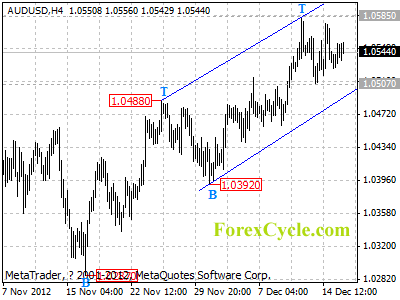
AUDUSD moves sideways in a range between 1.0507 and 1.0585
AUDUSD moves sideways in a range between 1.0507 and 1.0585. Support remains at the lower line of the price channel on 4-hour chart, as long as the channel support holds, the sideways move could be treated as consolidation of the uptrend from 1.0287, and another rise to test 1.0624 (Sep 14 high) is still possible after consolidation, only a clear break below the channel support could signal completion of the uptrend.
South Pacific Currencies Up against Yen on Abe’s Victory
 Tradervox.com (Dublin) – The Aussie climbed against the yen to its strongest level in 19 months after Japan’s opposition leader Shinzo Abe won the lower parliament election held yesterday. The party leadership has expressed its desire to adopt further easing measures. The New Zealand dollar increased to its highest in four years as pressure mounted on the Bank of Japan to expand its asset-purchases program. The central bank policymakers are meeting this week to discuss the issue. The Australian dollar, however, declined against the US dollar prior to Reserve Bank of Australia releasing the meeting minutes. Australian yields rose to the highest in three months as Abe was announced the victor.
According to Joseph Capurso, a currency strategist in Sydney at Commonwealth Bank of Australia, there was a large lift between the dollar-yen and other yen crosses after the announcement of the results. He predicted that the meeting minutes will add downward pressure on the Australian dollar as they are expected to show the RBA is open to further easing. Australian 10-year yields climbed by 0.03 percentage points to 3.14 percent, which is the highest it has been since Sept 17, they later dropped to 3.34 percent.
Hans Kunnen, the chief economist in Sydney at St. George Ltd said in a report to clients that the new government’s commitment to lift economic growth through further easing, has resulted to the yen’s decline in the recent weeks as well as the rise in bond yields. The Australian dollar gained by 0.5 percent against the yen to trade at 88.67 yen at the close of trading in Sydney on Monday, from its close on Friday 14. It had earlier touched its highest since May 2, 2011 of 89.13 yen. The currency dropped by 0.3 percent against the dollar to trade at $1.0540. The New Zealand was at 71.51 yen, the strongest it has been since October 2008, it later dropped to 71.00, which is 0.5 percent stronger than its close in the New Session on Friday. Kiwi was down 0.3 percent against the dollar to 84.39 US cents.
Disclaimer
Tradervox.com is not giving advice nor is qualified or licensed to provide financial advice. You must seek guidance from your personal advisors before acting on this information. While we try to ensure that all of the information provided on this website is kept up-to-date and accurate we accept no responsibility for any use made of the information provided. Opinions expressed at Tradervox.com are those of the individual authors and do not necessarily represent the opinion of Tradervox.com or its management.
Article provided by TraderVox.com Tradervox.com is a Forex News Portal that provides real-time news and analysis relating to the Currency Markets. News and analysis are produced throughout the day by our in-house staff. Follow us on twitter: www.twitter.com/tradervox
Getting Coal in Your Stocking May Be Exactly What You Want
CountingPips.com Email Newsletter December 17, 2012
Getting Coal in Your Stocking May Be Exactly What You Want
We all want new and exciting electronic gizmos and gadgets for the holiday season. Unfortunately they have the tendency to lose almost all their value within weeks because of newer versions etc… but what if you just got a lump of dirty old coal in your stocking, how would you feel?

Prechter: “This is Not a Picture of a Bull Market”
What a comeback for the Dow Industrials! From a March 9, 2009, close of 6,547, the senior index climbed to 13,610 on Oct. 5, 2012. Moreover, the Dow achieved this feat in the face of a weak-kneed economy, and it has grinded forward now for three and a half years…

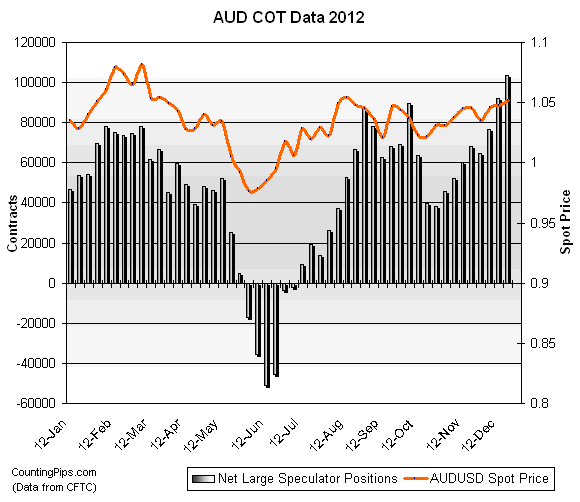
Currency Speculators go short on US Dollar for first time since October. Aussie bets reach 2012 high
December 16, 2012 – Non-commercial large futures traders, including hedge funds and large speculators, registered a US dollar short position total of 1.03 billion on December 11th and down from a total long position of $920.79 million on December 4th…
Ukraine Crushed in $1.1bn Fake Gas Deal
Certainly the folks at Gazprom are having a good snicker, reveling in the mockery that has been made of what should have been a landmark Ukraine-Spain gas deal that would have loosened Russia’s gas grip on Kiev.
Everyone wondered how Russia would respond to Ukraine’s attempt at gas independence. But this is what happens when you mess with Gazprom…

TODAY’S FOREX HEADLINES:
- The Senior Strategist: Stocks ignore ‘fiscal cliff’ December 17, 2012
- Central Bank News Link List – Dec. 17, 2012: China central bank facing no pressure for aggressive easing December 17, 2012
- Japan “Will Now Print and Spend” Following LDP Election Win, “Low Trader Participation” Leaves Gold “Weak” December 17, 2012
- “Fiscal Cliff” Talks, German Data Set to Drive Markets This Week December 17, 2012
- Market Trends 17.12.12 December 17, 2012
- Market Review 17.12.12 December 17, 2012
- Message to Investors: Here’s Why Gold Could Boom in 2013 December 17, 2012
- The Federal Reserve’s Magic Act is Destroying America December 17, 2012
FREE RESOURCE:
In July 2008, when crude oil prices were at $148 a barrel and “peak oil” bulls were forecasting a rise to $200, even $300 a barrel, contrarian technical analyst Robert Prechter took the opposite stance: “One of the greatest commodity tops of all time is due very soon,”…

Charles Sizemore on Planning for Prosperity
Listen to Charles Sizemore discuss the Fed’s latest moves, the risk of inflation (of lack thereof), the shale gas boom and the situation in Europe with Dean Barber and Bud Kasper.
If you cannot view the embedded player, please follow this link.
The post Charles Sizemore on Planning for Prosperity appeared first on Sizemore Insights.
