By www.CentralBankNews.info The Czech central bank held interest rates unchanged, as expected, and the board will release details of its decision later today.
Last month the Czech National Bank cut its benchmark two-week repo rate to a record low of 0.50 percent and said it would keep rates at this level “over a longer horizon until inflation pressures increase significantly.”
The central bank also maintained its discount rate at 0.05 percent and the Lombard rate at 0.25 percent.
Inflation in the Czech Republic eased to 2.7 percent in November, the lowest rate this year. The central bank targets inflation of 2 percent.
The Czech economy is stuck in recession, with Gross Domestic Product shrinking by 0.3 percent in the third quarter from the second, the fifth consecutive quarterly contraction. On an annual basis, the economy shrank by 1.3 percent.
Last month the central bank revised downwards its growth forecast for this year, expecting the economy to shrink by 0.9 percent this year, down from 1.7 percent growth in 2011. In 2013 the Czech GDP is forecast to rise 0.2 percent and then by 1.9 percent in 2014.
Market Volatility Expected Following German, US Data
Source: ForexYard
Signs of progress in budget negotiations between US Congressional leaders and President Obama led to moderate risk taking yesterday, which gave a boost to the euro. That being said, a lack of significant international news resulted in little movement elsewhere in the marketplace. Today, traders can anticipate significantly more volatility when the German Ifo Business Climate and US Building Permits figures are released. The indicators, scheduled to be announced at 09:00 and 13:30 GMT, could boost higher-yielding assets, like the euro, if they come in above their expected levels.
Economic News
USD – Building Permits Data Set to Impact Dollar
The safe-haven US dollar took moderate losses against some of its higher-yielding currency rivals yesterday, following an increase in risk taking due to signs of progress in US budget negotiations. The USD/CHF fell some 25 pips during the European session to trade as low as 0.9155, while the GBP/USD gained 21 pips during the mid-day session to trade as high as 1.6225. Against the Japanese yen, the greenback remained within reach of a recent 20-month high, as speculations that the Bank of Japan will soon begin an aggressive policy of monetary easing weighed down on the yen.
Today, trades will want to continue monitoring any developments in the ongoing US budget negotiations, which need to be resolved to prevent the implementation of a set of automatic tax increases and budget cuts, known as the “fiscal cliff”, at the beginning of the year. Additionally, the US Building Permits figure, set to be released at 13:30 GMT, could generate volatility for dollar pairs. If the indicator comes in above the forecasted 0.87M, risk taking in the marketplace could result in losses for the safe-haven greenback.
EUR – Euro May Extend Gains Following German News Today
Signs of progress in US budget negotiations encouraged risk taking among investors yesterday, which led to moderate bullish movement for the EUR/USD during the mid-day session. The pair, which earlier in the week hit its highest point in almost eight-months at 1.3192, advanced close to 30 pips to trade as high as 1.3185. Against the Japanese yen, the common currency spent the day range trading between 110.70 and 110.45.
Today, euro traders will want to pay attention to the German Ifo Business Climate, set to be released at 09:00 GMT. Analysts are predicting that the indicator will come in at 101.9, which would represent a slight improvement over last month for the euro-zone’s biggest economy. A better than expected business climate result today is likely to generate risk taking, which could give the euro an additional boost during the morning session.
Gold – Gold Fails to Stay Above $1700 Level
After briefly advancing past the psychologically significant $1700 an ounce level during early morning trading, largely due to optimism that a US budget deal will soon be reached, gold prices once again began falling. The precious metal dropped close to $7 an ounce, eventually trading as low as $1695 by the evening session.
Today, gold traders will want to pay attention to the German Ifo Business Climate figure. Should the figure come in above the forecasted 101.9, investor risk taking could help gold prices reverse yesterday’s bearish trend.
Crude Oil – US Inventories Figure May Help Crude Reverse Downward Trend
After advancing close to $0.50 a barrel during Asian trading yesterday, largely due to signs that the US budget crisis was closer to being resolved, crude oil began falling during afternoon trading. The commodity traded as low as $87.65 by the end of the European session, down some $0.70.
Today, oil traders will want to pay close attention to the US Crude Oil Inventories figure, set to be released at 15:30 GMT. Analysts are forecasting that US inventories fell by some 0.9 million barrels last week, which if true, would be a sign of increased demand and could turn the price of crude bullish.
Technical News
EUR/USD
The Bollinger Bands on the weekly chart are beginning to narrow, indicating that this pair could see a price shift in the coming days. Furthermore, the Williams Percent Range on the same chart has crossed over into overbought territory, signaling that the price shift could be bearish. Traders may want to open short positions for this pair.
GBP/USD
A bearish cross on the weekly chart’s MACD/OsMA indicates that a downward correction could take place in the near future. Furthermore, the Relative Strength Index on the same chart appears close to crossing into the overbought zone. Opening short positions may be the best long-term choice for this pair.
USD/JPY
The Slow Stochastic on the weekly chart has formed a bearish cross, indicating that a downward correction could occur in the near future. Additionally, the Williams Percent Range on the same chart has crossed into overbought territory. Opening short positions may be the wise choice for this pair.
USD/CHF
The weekly chart’s Williams Percent Range has crossed into oversold territory, indicating that an upward correction could occur in the near future. Furthermore, the Slow Stochastic on the same chart appears close to forming a bullish cross. Traders may want to open long positions for this pair.
The Wild Card
CAD/CHF
The Slow Stochastic on the daily chart appears close to forming a bullish cross, indicating a possible upward correction in the near future. Furthermore, the Williams Percent Range on the same chart has crossed into oversold territory. Opening long positions may be the best choice for forex traders for this pair.
Forex Market Analysis provided by ForexYard.
© 2006 by FxYard Ltd
Disclaimer: Trading Foreign Exchange carries a high level of risk and may not be suitable for all investors. There is a possibility that you could sustain a loss of all of your investment and therefore you should not invest money that you cannot afford to lose. You should be aware of all the risks associated with Foreign Exchange trading.
Central Bank News Link List – Dec. 19, 2012: Taiwan’s dollar gains before interest-rate review
Here’s today’s Central Bank News link list, click through if you missed the previous link list. The list comprises news about central banks that is not covered by Central Bank News. The list is updated during the day with the latest developments so readers don’t miss any important news
Why Uranium Stocks Could be Worth Another Look
In the last five years, the uranium sector has had more false starts than a frog race.
And uranium stocks have left a long list of burnt shareholders in their wake.
But now it looks like investors are gearing up to roll the dice one more time.
Beaten up uranium stocks have soared in the last few days.
For example, Australia’s leading uranium stock, Paladin (ASX: PDN), once trading at $10, was down as low as just 76 cents last month. But in the space of a week, Paladin has jumped 37.1%
It’s a similar tale from Energy Resources of Australia (ASX: ERA). After spending the last three years falling 96% from $26 to just $1.10, it has just jumped 20.3% in the space of a week.
This week’s Japanese election win for the nuclear-friendly LDP has been the trigger to set off this rally. The idea being that under the new mob, there is more chance of seeing most of Japan’s 50 or so reactors come back online, creating renewed uranium demand.
But there is more to the rally than meets the eye.
There is something else in the wind.
And just perhaps…we really are looking at the start of the next rally in uranium stocks…
At any rate, the spot price for uranium certainly wouldn’t give you any clues that the sector was about to turn up. After holding its ground around the $52 / lb level for most of the first half of this year, it had then crashed down to $42 / lb by October.
Such a low price is a pretty tragic state of affairs for the sector. Marginal projects become unviable, and such a low price makes it hard to justify building any new uranium mines.
Uranium Price on its Knees Again

Source: Cameco
The only glimmer of hope is that the uranium price has unexpectedly picked up slightly in the last few weeks. By last week, it had climbed a few bucks to hit $45.50.
But what’s interesting to note is that the last rally in the uranium price started from the low 40′s. So it’ll be worth keeping tabs on the uranium price in coming months, in case we’re about to see a rerun of that.
What really got me thinking about uranium stocks ahead of the rally was the big increase in corporate deals in the sector. In last week’s December Issue of Diggers and Drillers, I made a few comments on this:
‘Deals for uranium stocks also picked up, which is interesting. Uranium has been in the dog house for so long that at some point it has to become the ultimate contrarian play. The uranium spot price recently fell as low as $41 / lb, so I wouldn’t hold your breath. But with more corporate deals picking up, uranium should be on your radar at least.’
Uranium really is the ultimate contrarian play.
There is a sound investment case behind it. Yet I can’t think of a tougher commodity to get investors interested in. It’s the ‘pariah’ of the resource community.
Everyone hates it.
But there are two blunt forces in play that could make that irrelevant.
Firstly, 2013 will see the global supply of uranium chopped off at the knees.
This is because the ‘Megatons to Megawatts’ program, which has been converting Russian warheads into nuclear fuel, expires in 2013.
For years, this has met a big chunk of global demand, and without it there will be a gaping hole in the market.
Secondly, even after Fukushima, the world is still building a huge fleet of nuclear reactors.
China is the elephant in the room here, and may have been quiet on the subject, but is still full steam ahead with its nuclear plans. In a recent report from Resource Capital Research, the analysts said:
‘Strong growth in nuclear reactor construction is expected to continue globally with 484 planned and proposed nuclear reactors (Nov ’12) up 2 from 482 pre-Fukushima (Mar ’11). Growth is expected to remain particularly strong in Asia, with Chinese expansion continuing to lead the pack. China’s official installed nuclear capacity projections are 70-80 GWe by 2020, 200 GWe by 2030 and 400-500 GWe by 2050. This compares with a 12 GWe capacity today (15 reactors). China has 26 reactors currently under construction.‘Support and demand for new nuclear power reactors is expected not only from China and India, but also South Korea, USA, UK, the Middle East, Russia and Ukraine.
‘Demand for uranium is expected to increase from around 164mlbspa U3O8 in 2011 to 226mlbspa by 2020 and 280mlbspa by 2030. Current primary supply of uranium (139mlbs U3O8 2011) is only around 50% of expected uranium demand in 2020.’
This is a very bullish scenario. And as my colleague Callum Newman wrote to you recently, ‘Uranium is shaping up to be a classic resource scenario […] a supply/demand imbalance in a market everybody hates.’
Cal is right. It’s hard to find a more contrarian commodity investment proposition. I mean, the market REALLY hates uranium.
But…just maybe…it’s time to give this ‘pariah’ another go.
Uranium looks like being a resource to watch in 2013.
Dr. Alex Cowie
Editor, Diggers & Drillers
From the Port Phillip Publishing Library
Special Report: The Fuse is Lit
Daily Reckoning:
A North Korean Investment Opportunity
Money Morning:
How Central Banks Are Letting Inflation Get Out of Control
Pursuit of Happiness:
Are You Brave Enough to Break From Technology?
Diggers and Drillers:
Three Simple Steps to Manage Your Risk with Aussie Small-cap Mining Stocks
Why the Landslide Election in Japan Signals a Change to Investors
Japan has a reputation as an orderly, well-behaved society.
While this reputation is deserved, it’s actually quite odd when you consider how tumultuous the country’s politics are.
Japan has gone through six prime ministers in as many years. It’s about to get its seventh. And anyone living outside the country would be hard-pushed to name any one of them.
So you might be tempted to dismiss all the excitement over the latest Japanese election.
But you’d be wrong. This is one occasion in which politics could actually make a real difference…
Why is the Market Excited About Abe’s Return?
Shinzo Abe has already had a crack at being prime minister of Japan. Between 2006 and 2007, he was the top man before stepping down due to ill health. Now he’s back at the head of the Liberal Democratic party (LDP).
In between times, the country has experienced the global financial crisis, the Fukushima disaster, and an ongoing wrestling match with deflation.
The population is clearly getting fed up. In 2009, the Japanese voted for change. They ditched the LDP, which had been in power almost constantly since 1955, in favour of the Democratic Party of Japan (DPJ).
Now they’ve got tired of the lack of progress under the DPJ. They’ve brought Abe back in a landslide victory, which should make it easier for him to push through the various changes he wants to make.
So why are the markets getting so excited? The Nikkei 225 has risen by 8% in the past month alone.
It mostly comes down to Abe’s plans for the Bank of Japan (BoJ). Even although Japan is often seen as the birthplace of quantitative easing (QE), the country has in fact been far less aggressive with money printing than the US or the UK.
Abe wants that to change. He wants the BoJ to target inflation of 2% rather than 1%. And yesterday he was piling on the pressure ahead of the BoJ’s next meeting, which happens this week.
‘It is very unusual for monetary policy to be a focus of attention in an election. But there was strong public support for our calls to beat deflation. I hope the Bank of Japan takes that into account,’ he said.
A higher inflation target means more money printing. And more money printing means a weaker currency. In anticipation, the yen has already weakened sharply against the dollar, falling to a near-two-year low. And that should be good news for Japan’s embattled but vital export sector. This in turn, is what has helped the Nikkei to surge back towards the 10,000 mark.
There’s More to Japan than Just Weakening the Yen
But while the assault on the yen is the biggest headline-grabber, it’s hardly the only reason to like Japan.
There’s its banking sector. Having been through the sort of crisis that everyone else’s banks are still recovering from, Japan’s banks are in much better shape than almost any other developed world banking sector.
Japanese banks no longer need to focus on fixing their balance sheets. As a result, lending by the banks could expand greatly if they just have the incentive to do so.
Meanwhile, there are already signs of life in the stock market, which have little to do with the weak yen. According to Australian financial group Macquarie, more money is set to be raised this year from new companies floating, than from already-listed companies issuing new shares. That’s the first time this has happened since 1999.
Why is that good news? Because, says Macquarie, a recovery in the number of new listings could ‘spur greater participation by Japan’s retail investors’. In other words, it’d get the punters on the street back into the stock market.
As for the downsides: the nation’s poor demographics are constantly cited as one big reason to be sceptical of Japan. But demographics don’t have to be a problem if the culture is willing to change a little.
We’re not even talking about increasing the birth rate here, or taking a more relaxed view of immigration. Japan is already sitting on a lot of untapped potential: its potential female workforce.
The International Monetary Fund reckons that Japan could lift GDP by as much as 8% a head if the number of women in the workplace rose to northern European levels, reports Mure Dickie in the FT.
The main point to take away from the election result is that the Japanese people are clearly getting fed up with the condition of the Japanese economy.
As Abe pointed out, you don’t normally get voters excited about intricate details of monetary policy, but that’s not the case here. If the people want change, they’ll get it – and in this particular case, that’s exactly what Japan’s economy needs.
John Stepek
Contributing Editor, Money Morning
Publisher’s Note: This article originally appeared in MoneyWeek
From the Archives…
Why Small-Cap Stocks Could Be Your Best Investment in 2013
14-12-2012 – Kris Sayce
How the Global Oil Grab Affects You…
13-12-2012 – Byron King
The Price of Risk in the Stock Market
12-12-2012 – Murray Dawes
Why Silver Could Be the Best Investment in 2013
11-12-2012 – Dr. Alex Cowie
The Long, Drawn Out Retreat in Australian House Prices
10-12-2012 – Dr. Alex Cowie
Why We Should Abolish the Fed
The Federal Reserve System is a government-sanctioned private enterprise that functions as a socialist tool.
It was conceived in 1910 and constructed for the benefit of the private bankers who control it. Congress blessed the scheme in 1913 with passage of the Federal Reserve Act.
These days the Fed doesn’t just backstop America’s too-big-to-fail banks. It has expanded its doctrine of socializing banking losses globally.
The Fed helped bail out private businesses, foreign big banks and central banks in Europe and Japan in the credit crisis of 2008 and is the model for the European Central Bank, as well as the ECB’s primary backstop.
To understand how the Fed gets taxpayers around the world to pay the losses its member banks routinely incur, let’s pull back the curtain on the Fed and explain how it operates.
Here’s What the Fed Really Does
Banks lend money and sometimes they don’t get paid back. That’s not a problem if it doesn’t happen too often and if profits from other loans and investments cover the loan losses.
But since banks have gotten really big and have to make big loans (due to economies of scale and return on capital expectations) they need big borrowers. There are no bigger borrowers on the planet than governments, and that’s where a lot of banks are lending.
Of course, governments aren’t immune to over-borrowing and insolvency.
All the big banks that lent to banks in countries now in financial straits continue to lend to them because if they don’t they won’t get paid back what they are owed. Banks would fail from a cascade of losses and would either have to be bailed out or shut down.
That’s where the Federal Reserve comes in.
They don’t let their constituent members go under. If they have to, they will print money and give it to them, no matter how much they need.
That includes foreign banks and foreign governments. The Fed’s member banks lend all the time to both foreign banks and foreign governments. It only follows that our banks are not immune to what goes on anywhere they have lent money. They are directly in the line of fire.
If there was no Fed or no ECB, there wouldn’t be a backstop for banks that have lent to borrowers in Europe who can’t pay them back. Countries would fail.
But they don’t fail because central banks print money to give to banks so they can extend the loans they made, reschedule them, or in some way keep them going so they don’t have to write them off as losses.
What’s Wrong With Bankers Helping Bankers?…Plenty
The Federal Reserve System was designed to ensure that bankers always get paid. Congress blessed this scheme because Congress can be bought, was bought in 1913, again in 1977 when the Fed was given its ‘dual mandate’, and is still being bought and paid for by bankers today.
Essentially, the Fed operates on a socialist model. It’s not capitalism because banks would be ‘allowed’ to fail under the rules of capitalism.
But they are protected from failing by virtue of taxpayers being called upon, in one way or another (mostly by future inflation and currency debasement, in other words, less purchasing power) to ‘socialize’ banks’ losses.
There is no going backwards. Globally we couldn’t endure the hardships that would befall us if a cascade of big banks failed. So don’t worry, that won’t happen. But you should be worried about the creeping socialism.
The elitist class of bankers and money brokers, whose incredible wealth is protected by taxpayers, is going to have to increase the size of loans they make since they have more capital to disperse and earn income on, and will end up needing more taxpayers under their thumbs to keep their game a win-win for themselves.
Not that there isn’t a way out for us taxpayers, those of us who would like to earn more than half a percent on our fixed income investments. There is a way out…
We have to end the Fed. It’s just that simple.
End the Fed and all the big banks would have to be either shrunk or broken up, because there would be no more backstopping them with taxpayer money. The truth is they should all be made small enough to be allowed to fail without encumbering the national economy, or unfortunately today, the global economy.
Think about it. Banks that should have failed in 2008 are bigger than ever.
They’ve paid off what they borrowed to stay alive. They are paying dividends again. They are buying back billions and billions of dollars of their stocks again.
They are paying big fat bonuses again. But they still complain that tougher capital standards and reserve ratios will ruin their profitability and they won’t be able to lend to the people who need them.
Seriously, this is what the Federal Reserve does, has done, and will continue to allow to happen – unless we end the Fed and their game for good.
Shah Gilani
Contributing Editor, Money Morning
Publisher’s Note: This article originally appeared in Money Morning (USA)
From the Archives…
Why Small-Cap Stocks Could Be Your Best Investment in 2013
14-12-2012 – Kris Sayce
How the Global Oil Grab Affects You…
13-12-2012 – Byron King
The Price of Risk in the Stock Market
12-12-2012 – Murray Dawes
Why Silver Could Be the Best Investment in 2013
11-12-2012 – Dr. Alex Cowie
The Long, Drawn Out Retreat in Australian House Prices
10-12-2012 – Dr. Alex Cowie
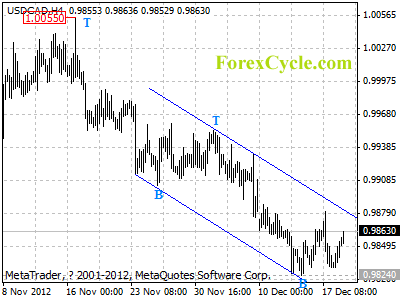
USDCAD remains in downtrend from 1.0055
USDCAD remains in downtrend from 1.0055, the price action from 0.9824 is likely consolidation of the downtrend. Resistance is at the upper line of the price channel on 4-hour chart, as long as the channel resistance holds, the downtrend could be expected to resume, and another fall towards 0.9700 is still possible. On the upside, a clear break above the channel resistance will suggest that lengthier consolidation of the downtrend is underway, then further rally to 0.9920 area could be seen.
Will Regulators Damn Keystone XL?
By OilPrice.com
Starting Tuesday, U.S. regulators will hold regular meetings on oil and natural gas pipeline safety standards. A series of pipeline issues, ranging from a deadly gas pipeline explosion in California, to a massive oil spill in Michigan, have brought pipeline safety to the forefront of the American energy debate. The safety meetings, scheduled in Virginia, come days after environmental regulators in Nebraska end a public comment period for Keystone XL, one of the most contentious U.S. pipeline issues.
The U.S. Pipeline and Hazardous Materials Safety Administration scheduled hearings beginning Dec. 11 in Virginia. During those meetings, safety committees are expected to review proposed rules related to pipeline damage prevention. PHMSA described the committees as ” statutorily mandated advisory committees that advise PHMSA on proposed safety standards, risks assessments, and safety policies for natural gas pipelines and for hazardous liquid pipelines.”
In October, the Nebraska Department of Environmental Quality announced it was finished with its draft evaluation report for the proposed reroute of the Keystone XL pipeline through the state. In its 600-page draft, the NDEQ found that TransCanada’s new proposal “avoids the region that was identified as the Sandhills by NDEQ, which is based on extensive research conducted by various state and federal agencies several years ago.”
NDEQ closed the period for written testimony on the reroute Friday. Bold Nebraska, an advocacy group opposing the pipeline, said this week that TransCanada’s route remains problematic, however.
“TransCanada (NYSE:TRP) is still risking our aquifer and still risking the fragile sandy soils of our state,” said Bold Nebraska’s Executive Director Jane Kleeb in a statement. “When TransCanada first submitted their route to the U.S. State Department, their designation of the Sandhills was much larger and much more accurate to the reality of the Sandhills region.”
Nebraskans get about 85 percent of their drinking water from regional aquifers, a November report published in the journal Environmental Science and Technology states. The study found few published groundwater case studies on the fate of tar sands oil, the type of crude designated for Keystone XL, but noted there may be a residual impact. The report recommended for the pipeline a “risk-managed route.” That route targets a section of the state that was “intensely spray-irrigated, row-cropped (and) underlain by contaminated groundwater.” This route, the report finds, would provide easier access should any emergency response be needed for Keystone XL.
Supporters of Keystone XL say the project is needed to ensure U.S. energy security and support jobs. U.S. Rep Fred Upton, R-Mich., chairman of the House Energy and Commerce Committee, said the pipeline could “create an estimated 100,000 or more direct and indirect jobs” for American workers. Detractors, like Bold Nebraska, however, said any potential benefits far outweigh the risks.
The journal report finds that pipeline spills have declined considerably during the past 10 years. While it’s unclear what action the PHMSA may consider in its safety review, it’s clear that, despite high-profile concerns like the so-called fiscal cliff, regulators are taking pipeline issues seriously as the North American energy boom gains steam.
Source: http://oilprice.com/Energy/Crude-Oil/Will-Regulators-Damn-Keystone-XL.html
By. Daniel J. Graeber of Oil Price
Investing Outlook for 2013
There are still a few weeks left in 2012, but focus has already shifted to 2013. The next year will be a “make or break” one for some of the investment themes we’ve been tracking, but in others it will be more of the status quo.
I’ll start with Europe. I spent much of 2012 attempting to buy the dips in the markets most affected by the ongoing sovereign debt crisis. In my Covestor Tactical ETF Model, my primary trading vehicle was the iShares MSCI Spain ETF (NYSE:$EWP), and my record on this trade was very much a mixed bag. I underestimated how truly terrified investors were of a Eurozone breakup, and I entered the trade far too early. The losses I took earlier in the year on EWP are a big reason for the Tactical ETF Portfolio’s underperformance vs. the S&P 500.
In the Covestor Sizemore Investment Letter Model, I took positions in Spanish banking giants Banco Santander (NYSE: $SAN) and BBVA (NYSE:$BBVA), and my timing on these trades was better. Both positions have thus far worked out nicely in 2012.
I continue to be a bull on European stocks in general and Spanish stocks in particular. At current prices, I consider European blue chips to be very attractive, and I like several as ways to get “back door” exposure to emerging markets. For European blue chips to be a profitable investment over the next 1-5 years, the Eurozone simply needs to avoid blowing up.
Unfortunately, that may be asking a lot. Political forces are quickly pushing the UK to the exit door, and the return of Silvio Berlusconi puts Italy’s reform agenda at serious risk. And Spain may be facing a bona fide secession crisis from Catalonia, which would likely mean a meltdown in the Spanish sovereign debt market.
So, while I remain bullish on Europe, I acknowledge that 2013 will be a “make or break” year. If Europe survives 2013 intact, then chances are good it will muddle through. But this is by no means certain.
Dividend-paying stocks were a major investment theme for Sizemore Capital in 2012. In addition to comprising a large allocation of both the Tactical ETF Portfolio and the Sizemore Investment Letter Portfolio, we created a new model to focus specifically on dividends and dividend growth: the Covestor Sizemore Capital Dividend Growth Model. The Dividend Growth model is currently concentrated in dividend paying stocks, master limited partnerships, and conservative real estate investment trusts.
Investors have been concerned that higher taxes on dividend income will be coming down the pipeline if President Obama gets his way on tax hikes for high-income Americans. This is a legitimate worry, but I don’t see higher taxes having much of an effect on the long-term shift in investor preferences for income.
There are multiple, overlapping trends at work. First, with rates on bonds and traditional savings instruments crawling along near record lows, investors have little incentive to dump dividend-paying stocks. Yes, they will likely be paying more in taxes on the dividend income. But what is their alternative for income? Bond interest will likely be taxed at an even higher rate.
Demographics also play a role here. As the Boomers approach retirement, they are developing a strong preference for income-producing securities. And as the largest and wealthiest generation in history, the Boomers tend to get their way. Dividend tax hike or no dividend tax hike, the demographic-driven demand for income is not likely to change.
Furthermore, current income is only one reason to buy dividend-paying stocks. Companies that pay a reliable dividend are rightly viewed as being more stable and conservatively managed. They are also less likely to be engaged in accounting shenanigans. All of this matters more today than in years past to investors who have gotten burned by scandal after scandal over the past decade.
With all of this in mind, Sizemore Capital intends to continue its focus on income-producing securities such as dividend-paying stocks.
Finally, I expect a good year for emerging markets. On this count, I was flat-out wrong in 2012 (as a value investor, I prefer to say “early”). I underestimated how badly the markets would react to slowing in China and Brazil. But after spending much of the past year in a correction, I expect to see emerging markets have a break out year in 2013.
Disclaimer: Sizemore Capital is long EWP, SAN and BBVA. This article first appeared on MarketWatch.
SUBSCRIBE to Sizemore Insights via e-mail today.
The post Investing Outlook for 2013 appeared first on Sizemore Insights.
Bank regulators propose new securitisation framework
By www.CentralBankNews.info Global banking regulators have proposed a new framework for banks to calculate potential losses on asset-back securities that aims to reduce their automatic reliance on credit ratings agencies whose assumptions proved far too optimistic and contributed to the severity of the global financial crises.
The Basel Committee on Banking Supervision said the proposal – “Revisions to the Basel Securitisation Framework – did not include a specific text but was a revision to the framework. The Committee is now asking for industry feedback and will carry out an impact study of the proposals before deciding on the “definite way forward.”
The popularity of securitised debt, such as mortgage-backed securities, exploded in the last decade but the financial crises revealed that banks and ratings agencies severely underestimated the expected loss in underlying exposures and the concentration of systemic risk. They were also far too optimistic in their view of the benefits to banks of such diversification.
As the crises started to unfold in 2007, it became clear that capital requirements assigned to both highly-rated and low-rated securitised products were too low. So when ratings agencies downgraded the products as credit quality deteriorated, banks suddenly had to come up with additional regulatory capital and often sought to get rid of their securitisation exposure, further depressing their value.
The Basel Committee didn’t put all the blame on credit ratings agencies, saying some banks’ internal risk assessment models “performed equally poorly or even worse.”
The new securitisation framework seeks to address what regulators have identified as the four main shortcomings of the current method: Mechanistic reliance on external ratings, too low risk weights for highly-rated securitisation exposures, too high risk weights for low-rated securitisation exposures and cliff-effects in capital requirements following deterioration in credit quality of the underlying pool.
The Basel Committee, which represents banking supervisors from the world’s main financial centers, is proposing two approaches with different hierarchies, depending on whether the banks use a standardised approach to risk measurement or an internal ratings based approach.
“The two alternative hierarchies would basically use the same approach for assigning capital requirements; however, the application of these approaches would vary, depending on the specific exposure characteristics and other factors,” the Basel Committee said.
Comments on the revised framework should be submitted by mid-March 2013.
The new proposed framework is the result of a fundamental review by the Basel Committee of the way banks measure their exposure to securitised products. In July 2009 the committee introduced improvements to the Basel II rules – known as Basel 2.5 – but these mainly addressed immediate shortcomings that became clear during the financial crises.
At that point, the Basel Committee launched a more thorough review of the securitisation framework alongside the publication of the Basel III rules in December 2010.
