- BOJ chief: Reviewing goal unlinked to policy accord (MNI)
- Bank of Canada should raise rates in late 2013-IMF (Reuters)
- Central bankers rethink their devotion to slaying inflation (Reuters)
- Brazil central bank says lower rates won’t affect inflation (Bloomberg)
- IntercontinentalExchange takes aim at CME with NYSE deal (Reuters)
- Vietnam says has enough room to cut interest rates (Reuters)
- HKMA says investigating UBS over interbank interest rates (Reuters)
- Turkey yields jump most in 3 months on interest-rate corridor (Bloomberg)
- Chile central bank sees no big short-term capital inflow (Reuters)
- www.CentralBankNews.info
The U.S. Dollar Has Finally Corrected. Will the Correction Continue?
EURUSD
Yesterday, bulls in the EUR/USD continued to amaze by its tenacity and optimism, pushing the pair higher and higher. The single currency did not even try to test the broken-through resistance near 1.3170 and finding its support at 1.3229 its growth was resumed. The pair immediately passed the resistance at 1.3255 and continued to increase until it reached the level of 1.3308. There, market participants decided to take profits, having led the pair decrease to 1.3236, but during the Asian session on Thursday, the pair dropped to 1.3189. There, the pair rolled back from the level of 1.3228, which acted as the resistance again. Consequently, the pair left the overbought state on the 4-hour chart, due to its correction to 1.3189, and it is wise to assume that its growth will be resumed towards the current high, because yesterday’s drop is corrective and while quotes are holding above the broken-through level of 1.3170, the euro prospects remain constructive. In anticipation of the holidays and in the absence of news, the pair could well remain in the range of 1.3170 — 1.3308. In case of the loss of the support near 1.3170, the euro will drop to the level of 1.3126, which can be considered as the key one for the bulls in the pair. By and large, the EUR/USD could well be corrected to this level too.
GBPUSD
The GBP/USD pair also demonstrated a positive mood. The pound continued increasing to the level of 1.6262 and reached the 1.6306 resistance without any pullbacks, rising above the upper line of the ascending tunnel. Both on the 4-hr and daily charts, the RSI was in the overbought zone, the pair hit the highs of September, from which it dropped to 1.5828, thus profit-taking was surprisings. As a result, the GBP/USD ended the day with its drop to 1.6238, having returned to the bottom line of the ascending tunnel. There, on the 4-hr chart, the RSI left the overbought zone, thus if the pound can consolidate at the current support, it will be wise not to exclude another attempt to increase to the 63rd figure. The loss of 1.6238 would decrease the rate to the 1.6180/70 proximity, which can be considered as the key one for the British pound bulls.
USDCHF
Yesterday, bears in the USD/CHF pair completed their minimum program. They brought the dollar to 0.9088, due to their sales from 0.9133. When this level was reached, the pair was undergone an upward correction, which allowed the dollar to recover to 0.9153. There, on the 4-hr chart, the RSI out of the oversold zone that promotes re-testing of the 91st figure. Nevertheless, the upward correction could well last up to the 0.9200 — 0.9240 proximity. Its rise above the latter resistance, would weaken the bearish pressure in the pair. In the absence of fresh incentives, breakdown of the current highs seems unlikely.
USDJPY
The dollar continued to push the Japanese yen higher. After reaching the level of 84.61, there’s something happened to the bulls that did not allow the dollar to increase higher. Having felt the bulls’ weakness, bears decided to take advantage of the situation and made the pair’s rate decrease to 83.86. Even the fact that the Bank of Japan expanded its Asset Purchase Program did not encourage the bulls to increase above 84.40. Despite the increased chance of the dollar’s decrease towards 83.20 — 81.80, it is premature to talk about changes in the speculators’ attitude towards the Japanese currency. Nevertheless, the probability of the USD/JPY pair’s growth above the 84.40/60 proximity looks pretty low.
Washington Debate “Holding Investors Hostage”, But Gold “Sees Downward Momentum Slowing”
London Gold Market Report
from Ben Traynor
BullionVault
Thursday 20 December 2012, 07:30 EST
U.S. DOLLAR gold prices climbed back above $1670 an ounce Thursday lunchtime in London, following two days of losses that saw gold in Dollars fall to its lowest level since August, while stocks and commodities were little changed on the day and US Treasuries gained.
“The downward momentum [in precious metals] does appear to be slowing, with gold [on Wednesday] holding above the previous day’s low of $1660 an ounce,” says today’s commodities note from Standard Bank.
Silver also ticked higher after spending most of this morning hovering just above $31 an ounce.
“A break below this key technical and psychological level could spell a swift move lower given the excessive length in the futures market,” says Ground.
In Washington, the Republican-controlled House of Representatives is expected to hold a vote later today on the so-called ‘Plan B’ for dealing with deficit. The bill, advocated by Republican House speaker John Boehner, would extend tax cuts currently due to expire at the end of the month for anyone earning less than $1 million.
President Obama has argued the threshold should be lower – initially calling for it to be $250,000 before raising that to $400,000.
The White House has said it would veto ‘Plan B’ if it were passed by Congress, with Obama telling Republicans yesterday they should “peel off the partisan war paint”.
“It seems investors are being held hostage by Washington politics and what is making things more difficult to figure out, is the fact that we have not been in such a predicament before,” says INTL FCStone analyst Ed Meir, adding that optimism earlier this week that a deal might be done to avoid the so-called fiscal cliff as been replaced by “a distinct tone of acrimony and pessimism”.
“Unfortunately for the gold bugs,” says Meir, “neither scenario seems to be helping their cause much.”
Greece meantime “still face[s] the possibility of bankruptcy” in 2013 despite the success of its recent bond buyback program and the release of €34.3 billion in bailout funding, the country’s finance minister Yannis Stournaras told the Financial Times Wednesday.
“What we have done so far is necessary but not sufficient to achieve a permanent solution for Greece,” Stournaras said.
Yields on 10-Year Greek government bonds have fallen sharply in recent weeks, dropping to 22-month lows below 12% Thursday after the European Central Bank yesterday announced that it will again accept Greek debt as collateral.
The ECB’s announcement followed the decision by ratings agency Standard & Poor’s Tuesday to upgrade Greece’s debt from ‘selective default’ to ‘junk’ status.
The Euro touched $1.33 yesterday for the first time since early April, while the Euro gold price looks set to record its biggest quarterly loss since the single currency launched in 1999.
The Bank of Japan extended its asset purchase and loan program for the third time in four months Thursday, adding a further ¥10 trillion to take the total to ¥101 trillion, while leaving its main policy interest rate at 0.1%.
His campaign leading up to last Sunday’s election, Japan’s next prime minister Shinzo Abe talked of the need for an “unlimited Yen” policy from the central bank as a way of fighting deflation.
“I take it as that the BoJ is carrying out what we sought during the election step-by-step,” Abe said following the monetary policy announcement.
“The next step is [higher] inflation targeting,” reckons Masamichi Adachi, senior economist at JPMorgan Securities in Tokyo.
“Abe is not even prime minister yet. If you look at how the BoJ is behaving, you could argue this is a loss of independence.”
Following his victory on Sunday, Abe said that after he has formed his government it will issue a joint statement with the BoJ increasing the inflation target from 1% to 2%.
“The ultra-loose monetary policy of major central banks is an important cornerstone of the increase we expect to see in the price of gold next year,” say precious metals analysts at Commerzbank in a note this morning.
“We do not therefore believe that today’s low gold prices are sustainable. Long-term ETF investors, for instance, remain loyal to gold and are not selling their holdings. What is more, the fact that the gold price in Indian rupees is also lower should help boost physical demand for gold during the ongoing wedding season in India.”
“We saw very, very good demand on the physical front [on Thursday], mainly from the two centers in India and China, ” Afshin Nabavi, senior vice president at precious metals refiner MKS, told news agency Bloomberg this morning.
Gold value calculator | Buy gold online at live prices
Editor of Gold News, the analysis and investment research site from world-leading gold ownership service BullionVault, Ben Traynor was formerly editor of the Fleet Street Letter, the UK’s longest-running investment letter. A Cambridge economics graduate, he is a professional writer and editor with a specialist interest in monetary economics. Ben writes and presents BullionVault’s weekly gold market summary on YouTube and can be found on Google+
(c) BullionVault 2012
Please Note: This article is to inform your thinking, not lead it. Only you can decide the best place for your money, and any decision you make will put your money at risk. Information or data included here may have already been overtaken by events – and must be verified elsewhere – should you choose to act on it.
Euro Extends Gains Following Positive German Data
Source: ForexYard
A better than expected German Ifo Business Climate figure yesterday, helped the euro extend its recent bullish trend during the European session. Higher-yielding commodities, including crude oil, were also able to benefit from risk taking after the German indicator was released. Today, US news is likely to market sentiment, with the Unemployment Claims, Existing Home Sales and Philly Fed Manufacturing Index set to have the greatest impact. Should any of the indicators come in above expectations, the dollar may be able to reverse some of its recent losses.
Economic News
USD – US Data Set to Impact Dollar Today
The safe-haven US dollar took losses yesterday, following the release of a better than expected German business climate figure which encouraged investors to shift their funds to higher-yielding assets. The GBP/USD advanced more than 30 pips during morning trading to reach as high as 1.6297, before a downward correction brought the pair to 1.6280 during the afternoon session. Against the Swiss franc, the dollar fell some 35 pips to trade as low as 0.9086. By the end of the European session, the USD/CHF was steady at 0.9099.
Today, US news is likely to have a significant impact on dollar pairs. Traders will want to pay close attention to the Unemployment Claims at 13:30 GMT, followed by the Existing Home Sales and Philly Fed Manufacturing Index at 15:00. While the number of people filing for first time unemployment insurance last week is forecasted to have gone up, both the home sales and manufacturing figures are expected to show improvements in the US economy. Any better than expected news may help the greenback reverse some of its recent losses.
EUR – Strong German Indicator Helps Euro
The euro saw across the board gains yesterday, following the release of a better than forecasted German Ifo Business Climate during the morning session. Against the US dollar, the common currency was able to reach a more than eight-month high at 1.3299 before a slight downward correction brought the pair to 1.3277. The EUR/JPY saw gains of 80 pips to peak at 112.43, its highest level since August of 2011. By the end of European trading, the pair was trading slightly higher than 112.00.
Turning to today, euro traders will want to monitor any developments in the ongoing US budget negotiations between Congressional leaders and President Obama. Any signs that the US will avoid the automatic tax increases and spending cuts set to take place at the beginning of the year, known as the “fiscal cliff”, could lead to risk taking which may help the euro extend its recent gains. That being said, if any of the US economic indicators today, specifically the Philly Fed Manufacturing Index and Existing Home Sales, come in above expectations, the euro could give back some of its recent gains against the USD.
Gold – Gold Extends Losses amid Hopes for “Fiscal Cliff” Deal
The price of gold took losses for a second day straight yesterday, amid speculations that a deal is closer to being reached to avoid the so called “fiscal cliff” of automatic spending cuts and tax increases in the US. The precious metal fell as low as $1665 an ounce, down over $10, to reach a more than three-month low. By the end of European trading, prices rebounded slightly to $1671.
Today, developments in the ongoing US budget negotiations are likely to have the biggest impact on gold prices. Any indication that a deal is closer to being reached may result in gold extending its bearish trend.
Crude Oil – Signs of Increased US Demand Boost Oil Prices
The price of crude oil saw bullish movement yesterday, amid signs that demand in the US, the world’s leading oil consuming country, has gone up. The commodity gained more than $0.70 a barrel during the morning session, eventually reaching above $89. By the end of European trading, crude was stable at the $88.80 level.
Turning to today, crude oil prices are likely to be impacted by a batch of US news set to be released during afternoon trading. Should the Unemployment Claims, Philly Fed Manufacturing Index or Existing Home Sales come in better than their forecasted levels, oil prices could see additional gains during the second half of the day.
Technical News
EUR/USD
The Williams Percent Range on the weekly chart has crossed over into overbought territory, indicating that a downward correction could take place in the coming days. This theory is supported by the Slow Stochastic on the daily chart, which has formed a bearish cross. Opening short positions may be the wise choice for this pair.
GBP/USD
While the Relative Strength Index on the weekly chart is approaching the overbought zone, most other long-term technical indicators place this pair in neutral territory, making a defined trend difficult to predict. Traders may want to take a wait and see approach, as a clearer picture is likely to present itself in the near future.
USD/JPY
The Relative Strength Index on the weekly chart is in overbought territory, indicating that a downward correction could take place in the near future. This theory is supported by the Slow Stochastic on the same chart, which has formed a bearish cross. Opening short positions may be the wise choice for this pair.
USD/CHF
The Bollinger Bands on the weekly chart are narrowing, indicating that a price shift could occur in the coming days. Furthermore, the Williams Percent Range on the same chart is in oversold territory, indicating that the price shift could be bullish. Opening long positions may be the best choice for this pair.
The Wild Card
USD/HUF
A bullish cross on the daily chart’s MACD/OsMA indicates that an upward correction could take place in the near future. This theory is supported by the Williams Percent Range on the same chart, which has crossed into oversold territory. Opening long positions for this pair may be the best choice for forex traders today.
Forex Market Analysis provided by ForexYard.
© 2006 by FxYard Ltd
Disclaimer: Trading Foreign Exchange carries a high level of risk and may not be suitable for all investors. There is a possibility that you could sustain a loss of all of your investment and therefore you should not invest money that you cannot afford to lose. You should be aware of all the risks associated with Foreign Exchange trading.
Bank of Japan to inject 50 trillion yen over next year
By www.CentralBankNews.info Japan’s central bank will inject more than 50 trillion yen in new funds over the next 12 months aimed at boosting economic growth and will review its monetary policy goals next month, fueling speculation that it will raise its target for inflation.
The Bank of Japan (BOJ), which launched its asset purchase program in October 2010, said it would increase the size of the program by a further 10 trillion yen to about 101 trillion, buying 5 trillion yen of Treasury discount bills and 5 trillion worth of Japanese government bonds.
The additional purchases over the next 12 months, inclusive of those already decided, will amount to about 36 trillion. In addition, the BOJ regularly buys bonds at the pace of 21.6 trillion annually.
Under the Stimulating Bank Facility, which was launched in late October, the bank expects lending to reach more than 15 trillion yen. The new facility aims to provide long-term funds at a low interest rate, without any limit, to financial institutions at their request.
Combining these two programs, the BOJ said the amount outstanding would exceed 120 trillion yen.
The BOJ also continued to hold its overnight call rate steady at zero to 0.1 percent, the level it has been at since December 2008.
The BOJ’s expansion of its quantitative easing program was largely expected with Japan’s economy feeling the full effects of Europe’s crises and its economy expected to remain weak for a while. Inflation is also expected to remain very low.
Japan’s Gross Domestic Product contracted by 0.9 percent in the third quarter from the second quarter for annual shrinkage of 3.5 percent. Consumer prices fell by 0.4 percent in October, the fifth month in a row of deflation.
“Based on these economic and price developments, the Bank of Japan judged it appropriate to undertake further aggressive monetary easing in order to prevent Japan’s economy from deviating from the path of returning to a sustainable growth path with price stability,” the BOJ said.
www.CentralBankNews.info
Australian Stocks: Still the Best Wealth Builder in Town
If you stand too close to a beautiful painting, you don’t get a true appreciation of its beauty.
So maybe we should be thankful that the Mona Lisa is sectioned off…that you have to stand behind a velvet rope about five metres from the painting.
Stand close to a Jackson Pollock and it just looks like a bunch of squiggly lines, but stand further away and…OK, bad example.
Anyway, the point I’m making is that when you look at something close up, you don’t necessarily see the same thing as when you stand further away.
Right now, that’s the dilemma facing Australian stock market investors, because the ‘close view’ and the ‘far view’ give investors a mixed message. We’ll explain how below…
If you look at the S&P/ASX 200 up close you get this picture:

The market has gained 16% since the June low. That’s a pretty good return by anyone’s standards.
If you’re a trend stock trader, you could make a pretty good argument to say the trend is up…follow the trend.
On the other hand, 16% is a big move. Maybe this is the top of the market and it’s time to sell.
Hmmm. Maybe we’ll look at a longer term chart to get a better idea:

Double hmmm. We’re not sure that helped.
Australian stocks are close to the mid-point of the five-year high and low (it’s right at the mid-point of the three-year high and low). Our technical trading guru, Murray Dawes, calls that the Point of Control (PoC).
What’s an investor to do?
Make or Break for Greece? Not Again…
That’s the thing. Look at the above chart again. Investors have been in this spot since the end of 2009. The stock market looks as though it’s about to take off and it’s time to pile in, then you get headlines such as this from the Financial Times: ‘Greece faces “make or break” year’.
Then what happens? That’s right, the stock market spirals down again.
As we’ve said for some time, it makes it tough for investors to plan. Most investors are too scared to buy when the stock market is low. Yet when they finally pluck up the courage to buy stocks, the bad news hits and stocks fall again.
The thing is it’s easy to look at the broad market, assume it’s too scary and just give up.
For instance, in the past few weeks we’ve read a bunch of stories about the Australian liquefied natural gas (LNG) market, such as this from the Australian:
‘Chevron’s Gorgon liquefied natural gas venture, the nation’s biggest resources project, has unveiled a $9 billion blowout, with labour costs and shortages and bad weather blamed for boosting estimated development costs to $52bn.’
Reading that, an investor could think that the LNG sector is a bad bet. Yet the LNG stock we backed in Australian Small-Cap Investigator has just revealed that:
‘…the estimated total cost of the XXXXXXXX XXXXXXXXX XXXXXX Project remains at US$1.1 billion. This capital cost includes the engineering, procurement and construction (EPC) for the First LNG train of 1.9 million tonnes per annum (mtpa) LNG production capacity…’
Not only that, but while other LNG projects see costs soaring, with some projects even under threat, this same company has just announced a deal to propose building a new LNG project in Louisiana, USA.
Or take the Aussie mainstream media. We’ve written here and in Australian Small-Cap Investigator that mainstream media has to come up with something new or die.
Clearly we weren’t alone thinking that way. Most Australian media stocks have slumped over the past five years. Some of them are down more than 90%.
That’s a reason to stay away from them right? Maybe. But at a certain point a stock price becomes so cheap that it’s worth taking a punt on.
We certainly wouldn’t suggest putting your life savings into them, but as a punt…if you’re after a big bang for your buck (and you’re not afraid to lose if things don’t turn out right) then this is a sector that could give investors some of the best returns over the next year.
Aussie Bounceback Belters
That’s the message we’d like you to take on board today. The up-and-down market you’ve seen since late 2009 isn’t going anywhere. At the end of last year we said the stock market would go up and down but that by the end of the year we wouldn’t be surprised if it was back where it started.
With two weeks to go until the end of the year, it looks as though we’ve got that wrong. But it will only take a 10% drop from this level (like in 2010, 2011, and 2012) for us to be right about the level…albeit wrong about the timing.
Naturally, we hope that doesn’t happen. The stock market is one of the best places to build wealth. But due to the volatility it has put off a lot of investors in recent years.
In short, as we’ve said all year, don’t abandon the stock market, because there are few better places to grow your wealth. And right now, despite the recent good run for Australian stocks, we still see a lot of good, beaten-down Aussie stocks that are set to bounce back if investors gain more confidence.
Cheers,
Kris
From the Port Phillip Publishing Library
Special Report: The Fuse is Lit
Daily Reckoning:
Why Uranium Stocks Could be Worth Another Look
Money Morning:
Why We Should Abolish the Fed
Pursuit of Happiness:
Gun Control: Did Obama Shed Tears for These Kids?
Australian Small-Cap Investigator:
Why Invest In Small-Cap Stocks? And Why Now?
Is China’s Rebound for Real? Don’t Bet on It
China’s economy is bouncing back. Apparently.
The stock market has rebounded from its recent low. Economic data is looking more positive. It has a nice shiny new group of leaders to take it on to its next stage of development.
Suddenly all those people who briefly turned bearish earlier in the year are now declaring that there will be no ‘hard landing’ for China.
We’re not convinced. The business model that got China to where it is today is irretrievably broken.
And as yet, it’s not clear what will replace it…
China’s Economic Advantages Are All Used Up
There’s a great piece on China’s problems by Andy Xie in the South China Morning Post. It’s well worth a read.
Xie argues that China’s growth has been based on two major ‘dividends’. One was its becoming a member of the World Trade Organisation (WTO), which boosted its share of global trade.
The other was its demographics. It had plenty of young agricultural workers who could be moved to work in cities, producing cheap goods for export.
The trouble is, both of these dividends have now been used up. The export boom was based on having a Western consumer hungry to buy at the other end. That no longer exists.
Why not? The average Western worker – ironically enough – saw their wages stagnate as global competition kept labour costs down. Meanwhile, central banks suppressed interest rates, meaning that living costs were higher than they otherwise would have been.
So credit was the only way to maintain a rising standard of living. When the credit bubble burst, that source of demand was cut off. The only manufacturers benefiting from loose monetary conditions these days are the ones servicing billionaires, not the ordinary consumer.
Meanwhile, China’s supply of cheap labour is drying up. As Xie notes, ‘the shortage of blue-collar labour, as reflected in wages increasing faster than exports, points to the end of the demographic dividend.’ This trend won’t turn around.
On the one hand, workers are increasingly being replaced by robots as automation becomes ever more attractive. On the other, the US has a new source of extremely cheap energy in the form of shale gas.
Labour costs are becoming more competitive too, but if you’re going to be using fewer workers anyway, then power becomes a key cost to consider. Better yet, the US – and Mexico – are much closer to the end consumer. So after you account for transport costs, the benefits of shipping production out to China just don’t add up.
As the Chinese Export Boom Collapses, So has the Property Bubble
Perhaps the biggest problem is what China has been doing in the meantime with the money earned from the export boom. Xie argues that this money went on inflating China’s property bubble, as individuals and companies speculated on ever-increasing land prices.
In turn, income from land sales and tax on property sales – ‘over half the proceeds from property sales end up in the government’s pocket’ – helped fund China’s wasteful approach to infrastructure investments.
When most of us invest our money, we expect to get a return on it. Say you buy a property as an investment. Unless you are buying during a bubble, you expect to be able to rent it out to generate a return almost right away. You don’t expect to have to subsidise it for several years in the hope that it’ll all eventually come good.
That’s not how China invests. It builds ‘ghost’ towns and too many motorways, in the expectation that the capacity will one day be needed. But we all know how hard it is to forecast anything accurately. In some cases, this way of doing things will work out. In many others though, you’ll end up wasting the money.
This doesn’t matter too much as long as there’s a constant stream of fresh money to fund these projects. But with exports drying up, and the property bubble bursting, that’s no longer the case. ‘Like all other East Asian economic booms before, China’s asset bubbles deflate when the export boom ends.’
What’s the solution? Xie basically argues that China’s economy needs to become more capitalist. The size of the public sector needs to be cut back, and the government needs to stop interfering in the market. ‘Bad companies don’t die, because they get government support.’
Funnily enough, these are the same solutions that ‘developed’ economies like our own could do with pursuing. And this is the problem. Because I suspect there’s as much chance of China coming over all ‘pro-market’ as there is of our own government deciding it’s time to pull the plug on the zombie sectors of our economy.
Don’t Buy into a China Rebound
As Sean Corrigan of Diapason points out, it’ll take a lot more than words to help China make the shift from being investment-led to being consumer-led. And even if China does bounce back, don’t bet on the most obvious accompanying trade – a rebound in commodities – being successful.
Rebalancing is as much about giving consumers more rights, and going easier on the ‘financial repression’ (whereby savings rates are well below the inflation rate), as it is about moving even more people to the cities.
It’s hard to see the next phase of China’s development being anywhere near as commodity-intensive as the last phase. In short, unless you’re a short-term trader, I wouldn’t buy into any China rebound.
John Stepek
Contributing Editor, Money Morning
Publisher’s Note: This article originally appeared in MoneyWeek
From the Archives…
Why Small-Cap Stocks Could Be Your Best Investment in 2013
14-12-2012 – Kris Sayce
How the Global Oil Grab Affects You…
13-12-2012 – Byron King
The Price of Risk in the Stock Market
12-12-2012 – Murray Dawes
Why Silver Could Be the Best Investment in 2013
11-12-2012 – Dr. Alex Cowie
The Long, Drawn Out Retreat in Australian House Prices
10-12-2012 – Dr. Alex Cowie
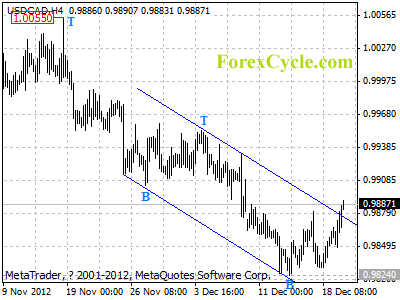
USDCAD breaks above channel resistance
USDCAD breaks above the upper line of the price channel on 4-hour chart, suggesting that lengthier consolidation of the downtrend from 1.0055 is underway. Range trading between 0.9824 and 0.9920 would likely be seen in a couple of days. Resistance is at 0.9920, as long as this level holds, the downtrend could be expected to resume, and another fall towards 0.9700 is still possible, and a breakdown below 0.9850 could signal resumption of the downtrend.

Review of Nassim Taleb’s Antifragile
We all know what “fragile” means. But what is the opposite of fragile?
If you are like me, your instinctive response would be “robust” or perhaps “durable.” But you would be wrong.
Something that is fragile is damaged by an unexpected shock, whereas something that is robust or durable is able to withstand it. To be robust is to be neutral to shocks.
But what do you call the true opposite of fragile—something that actually benefits from shocks?
As Nassim Taleb points out, there is no word in English (or in any other language, ancient or modern) that conveys this idea. So he invented one—antifragile—and wrote an entertaining and enlightening book around the concept.
Taleb is at times playful and even self-effacing in his writing and at other times insufferably arrogant and abrasive (“non-meek” in his words). But he is always—and I mean always—thought provoking.
Years ago, before Taleb become something of a celebrity, I picked up his original Fooled by Randomness and had something of a “eureka” moment. Taleb put into words (and numbers) many of the abstract ideas about risk and randomness that I instinctively felt yet couldn’t articulate (he had that effect on a lot of people, it would turn out). In particular, I had always mistrusted the Value-at-Risk metric and its offshoots that had been crammed down my throat as an undergraduate finance student. It registered on my “bulls_t detector”, to borrow one of Taleb’s earthy phrases, and history would vindicate this gut reflex with implosion of the financial system in 2008.
I still consider Fooled to be his best book, and if you have never read Taleb’s work that is where I would recommend you start. But Antifragile: Things That Gain From Disorder expands on the concepts in Fooled and its follow-up The Black Swan and goes far beyond financial markets into a more general theory of randomness and volatility and their importance in life and nature. “Living things are long volatility,” he emphasizes often.
Perhaps Taleb’s greatest gift as a writer is his ability to speak in metaphors, the best of which is his analogy of the Procrustean Bed (see my review of Taleb’s The Bed of Procrustes).
Procrustes was a nasty little fellow from Greek mythology who would invite guests into his home and then either stretch or amputate parts of their legs to make them fit just right in his guest bed. In Taleb’s analogy, much of the modern world is a Procrustean bed of sorts. People, markets, and economic systems are contorted to fit tidy theories.
But in Antifragile, Taleb goes beyond this “square peg in a round hole” argument to a larger critique of “soccer moms” (both figurative and literal) who naively attempt to make the world safer by “sucking randomness out to the last drop.” Doing this provides the illusion of safety while actually making us less resilient and more fragile. In other words, not only are scraped knees and bruises ok, they are an essential part of growth.
Many readers misunderstand Taleb’s core message. They assume that because Taleb writes about unseen and improperly calculated risks, his objective must be to reduce or eliminate risk. Nothing could be further from the truth.
If anything, Antifragile is a celebration of risk and randomness and a call to arms to recognize and embrace antifragility. Rather than reduce risk, organize your life, your business or your society in such a way that it benefits from randomness and the occasional Black Swan event.
Taleb’s own life is a case in point. He had the free time to write Fooled, The Black Swan and Antifragile because—in his own words—he made “F___ you money” during the greatest Black Swan event of our lifetimes, the 1987 stock market crash. And to demonstrate that Taleb’s trading style is antifragile, had the 1987 crash never happened, Taleb would not have been materially hurt. His trading style puts little at risk but allows for outsized returns.
In what may seem somewhat disturbing to some readers (and Taleb himself is disturbed by it as well), what makes a system antifragile is that its individual pieces are perishable. Natural selection—the survival of the fittest—requires that the unfit are allowed to fail.
Using the example of restaurants, the restaurant sector is robust because the failure of any one restaurant does not affect the others. And the restaurant sector is antifragile because the remaining players actually learn and grow from witnessing the mistakes made by the failed restaurant.
Now, compare this to the banking system. The world banking system is inherently fragile because the failure of one bank leads to contagion that can cause the failure of other banks and of the system itself.
The importance of failure to an antifragile system is a recurring theme to the book. As individuals and as a collective, we learn more from mistakes than from successes. In a capitalist system, you need a replenishable supply of entrepreneurs willing to take risks. For every failed business idea, our knowledge base expands.
Taleb goes so far as to advocate we treat ruined entrepreneurs in the same way we honor dead soldiers, “perhaps not with as much honor, but using the same logic.”
As Taleb explains, just as “there is no such thing as a failed soldier, dead or alive (unless he acted in a cowardly manner), likewise there is no such thing as a failed entrepreneur or failed scientific researcher.” Their sacrifice makes the system stronger.
I commend Taleb on another book well written, and I recommend Antifragile along with Fooled by Randomness and The Black Swan.
SUBSCRIBE to Sizemore Insights via e-mail today.
The post Review of Nassim Taleb’s Antifragile appeared first on Sizemore Insights.
Canada Set to Raise Interest Rates
Source: ForexYard

After yesterdays relatively calm trading session, today the economic calendar is filled with high impact data that threatens to sow large volatility into the market. Traders should pay special attention to the U.S Manufacturing PMI and Canadian Overnight Rate.
13:00 GMT: Canadian Overnight Rate
• Forecasts show that the Canadian Overnight Rate is expected to rise to 0.50%
• Market events like this one tend to create either big changes to current trends or push current trends even further.
• However, overall impact of the Interest Rate decision may in fact strengthen the Canadian currency in the longer run.
• Traders should focus their attention on this release, as it is expected to be the highlight of the week for Canadian markets.
14:00 GMT: U.S. Manufacturing PMI
• This indicator reflects the level of a diffusion index based on surveyed purchasing managers in the manufacturing industry.
• The indicator typically creates a volatile trading environment, affecting not only the USD crosses but also the value of Crude Oil and Gold.
• Disappointing results could send the EUR/USD pair above the 1.2400 resistance level.
Forex Market Analysis provided by ForexYard.
© 2006 by FxYard Ltd
Disclaimer: Trading Foreign Exchange carries a high level of risk and may not be suitable for all investors. There is a possibility that you could sustain a loss of all of your investment and therefore you should not invest money that you cannot afford to lose. You should be aware of all the risks associated with Foreign Exchange trading.