Euro-Zone News Boosts Riskier Assets

Source: ForexYard

Higher-yielding currencies and commodities saw significant gains yesterday, after the European Central Bank decided to leave euro-zone interest rates at 0.75% and ECB President Draghi predicted a gradual economic recovery in the region. As markets get ready to close for the weekend, the main pieces of economic news are likely to be the UK Manufacturing Production and US Trade Balance report, set to be released at 9:30 and 13:30 GMT, respectively. If either of the indicators comes in above their forecasted levels, risk taking could boost assets like crude oil, the euro and British pound.

Economic News

USD – US Trade Balance Report Set to Impact Markets Today

The safe-haven US dollar took losses against most of its higher-yielding currency rivals yesterday, as forecasts that the euro-zone is on its way to economic recovery led to risk taking in the marketplace. Against the Swiss franc, the greenback fell more than 90 pips during the European session to eventually reach as low 0.9169. A modest upward correction brought the dollar back to 0.9180 during the afternoon session. The GBP/USD advanced some 85 pips during mid-day trading before peaking at 1.6095.

Today, the main piece of US news is likely to be the Trade Balance figure, set to be released at 13:30 GMT. Analysts are predicting that the figure will come in at -41.1B, slightly higher than last month’s end result of -42.2B. Better than expected news may boost investor confidence in the US economic recovery, which would result in dollar gains before markets close for the weekend. At the same time, if UK manufacturing data signals growth in the British economy, the greenback could take additional losses against the GBP.

EUR – Risk Taking Leads to Significant Euro Gains

The euro saw significant upward movement yesterday, after EU officials issued a statement saying that they expect economic growth in the region to gradually progress and that euro-zone interest rates would remain at 0.75% for the foreseeable future. Against the US dollar, the euro climbed close to 150 pips during the mid-day session to eventually reach as high as 1.3202, its highest level in more than a week. Against the Japanese yen, the common currency gained some 130 pips to trade as high as 116.48.

Turning to today, euro traders will want to pay attention to the UK Manufacturing Production figure, set to be released at 9:30 GMT. The figure is forecasted to come in at 0.6%, which if true, would be a significant improvement over last month’s -1.3%. A higher than expected result would likely lead to additional risk taking in the marketplace, which is likely to give the euro an additional boost to finish out the week.

Gold – Bearish US dollar Sends Gold to One-Week High

Gold prices shot up to a one-week high during European trading yesterday, after investors shifted their funds to riskier assets which weakened the US dollar. Demand for gold often increases when the dollar is bearish because prices become more affordable for international buyers. The precious metal eventually peaked at $1688 an ounce, up more than $20 during European trading.

As markets get ready to close for the weekend, gold traders will want to pay attention to British manufacturing data and its impact on risk taking in the marketplace. If investors continue to shift their funds away from the US dollar to higher-yielding currencies like the GBP and EUR, gold could see additional bullish movement.

Crude Oil – Chinese Data Sends Oil to Three-Month High

Following a better than expected Chinese trade balance report yesterday, which led to speculations that demand for oil in China would increase, crude oil prices shot up to a three-month high. Overall, the commodity was able to gain around $1.60 a barrel to trade as high as $94.66, before a slight downward correction brought prices to the $94.00 level.

Today, oil traders will want to pay attention to the US Trade Balance report, set to be released at 13:30 GMT. If the figure comes in above the forecasted -41.1B, speculations that demand for oil in the US will go up may help the commodity extend its bullish momentum before markets close for the weekend.

Technical News

EUR/USD

The Bollinger Bands on the weekly chart are beginning to narrow, indicating that a price shift could occur in the coming days. That being said, most other technical indicators place this pair in neutral territory, meaning a definitive trend is difficult to predict at this time. Taking a wait and see approach may be the best strategy for this pair.

GBP/USD

The Bollinger Bands on the weekly chart are narrowing, indicating that this pair could see a price shift in the coming days. Furthermore, the MACD/OsMA on the same chart has formed a bearish cross, indicating that the shift could be downward. Opening short positions may be the best option for this pair.

USD/JPY

The Relative Strength Index on the weekly chart is currently in overbought territory, indicating that a downward correction could occur in the coming days. This theory is supported by the Slow Stochastic on the same chart, which has formed a bearish cross. Opening short positions may be the smart move for this pair.

USD/CHF

While the Williams Percent Range on the daily chart has crossed over into overbought territory, most other long-term technical indicators place this pair in neutral territory. Traders may want to take a wait and see approach, as a clearer picture is likely to present itself in the near future.

The Wild Card

EUR/GBP

The daily chart’s MACD/OsMA has formed a bearish cross, signaling a possible downward correction in the near future. Furthermore, the Williams Percent Range on the same chart has crossed over into overbought territory. This may be a good time for forex traders to open short positions, ahead of possible bearish movement.

Forex Market Analysis provided by ForexYard.

© 2006 by FxYard Ltd

Disclaimer: Trading Foreign Exchange carries a high level of risk and may not be suitable for all investors. There is a possibility that you could sustain a loss of all of your investment and therefore you should not invest money that you cannot afford to lose. You should be aware of all the risks associated with Foreign Exchange trading.

EUR/USD: Euro Soars as Draghi Delivers Upbeat Assessment

The Euro is foreseen to continue receiving a lift after European Central Bank President Mario Draghi dampened talk of further rate cuts yesterday by expressing confidence that Euro Zone economy is on the road to recovery. Meanwhile, a strong auction yesterday pushed Spanish yields to 10-month lows in a sign of improving investor confidence.

The ECB has dashed hopes of further stimulus to pull the Euro Zone out of recession and fight record unemployment, suggesting confidence that the economy is strong enough to heal itself. The central bank unanimously held interest rates at a record low of 0.75 percent yesterday, saying the Euro Zone economy will recover later in 2013 as encouraging signs of stabilization have already emerged. Speaking to reporters, Draghi expressed that Europe has turned a corner in the crisis, with borrowing costs across the region significantly lower, stock markets on a high, and volatility at a historical minimum. Likewise, Draghi boasted of strong capital inflows in the Euro area.

Just a month ago, Draghi revealed that the bank held a wide discussion on interest rates before opting to keep them on hold, suggesting some members favored a rate cut. Gross Domestic Product has failed to expand since the third quarter of 2011, and economists expect it to have dipped sharply in Q4. Nevertheless, Draghi said the improved health of the financial markets should work its way through to the economy and that global demand should strengthen, boosting export growth. According to analysts, Draghi made it clear that no further stimulus measures should be expected from them, providing a healthy boost to the single currency.

The central bank chief also stressed that the effects of its bond-purchase plan on the markets were more powerful than what rate cuts could have achieved. Reflecting this positive sentiment, Madrid kicked off its challenging 2013 funding program with a strongly-bid auction of mostly two-year debt yesterday. Spanish ten-year bond yields fell below 5 percent for the first time since March after the government sold nearly 6 Billion Euros of bonds, more than the 4 to 5 Billion Euros amount targeted. With no new economic data due today, buoyant sentiment from yesterday is deemed to carry over into today’s European trades. As such, a long position is advised for the EUR/USD.

For more news, analysis, technical charts and candlestick analysis, visit AlgosysFx Forex Trading Solutions

Why the Australian Stock Market Will Climb in 2013

By MoneyMorning.com.au


‘U.S. stocks advanced, sending the Standard & Poor’s 500 Index to the highest level in five years, amid better-than-estimated data on Chinese exports.’ – Bloomberg News

It’s not just the US stock market on the rise.

As we noted yesterday, the Japanese stock market is at the highest point since early 2011, and the Australian stock market is pretty good odds to head higher as the Reserve Bank of Australia (RBA) follows its overseas cousins and cuts interest rates.


Of course, the Aussie market’s future relies on China. And as you know from our old pal, Greg Canavan, the Chinese economy is set to bust.

But not so fast. A fight is brewing. And we’re not talking about trade wars or currency wars involving the US, China, Japan and Europe. We’re talking about a no-holds-barred scrap between two of our heavy-hitting editors…

In a weekly update to his readers last night, our other old pal Dr Alex Cowie wrote:


‘After seeing most mining stocks, big and small, fall for the last 18 months, this signal is a great way to start 2013. It suggests that the worst is behind us and that there should be some good opportunities this year.

‘And why shouldn’t there be? The resource story hangs off China, and China’s data is improving. I am the only China bull in the office (it gets a bit lonely at times)! But I look forward to writing to you in the next newsletter to spell out why I think China is about to drive the next leg up in the resource market.’

We’ve always seen the Doc as a contra-contrarian. That is taking the contrarian view to contrarians…but which isn’t necessarily the mainstream view. Confused? Don’t worry, we get confused ourselves sometimes.

But according to the Doc in his weekly update:


‘Even the mainstream media is beating up China these days. Who would have anticipated that being a China bull in 2013 would be a contrarian view?’

As we say, we don’t think a China rally is a contrarian view. We’d bet that most contrarians still have China hitting the skids and collapsing in an almighty heap. But we get the Doc’s point. Even the mainstream media is nowhere near as bullish on China as it used to be.

We Don’t Care Why the Stock Market Rallies

For what it’s worth, our take is that the Chinese economy will collapse. It’s only a case of when, not if. And when it does happen, it will take the Australian economy and stock market with it.

Trouble is, we’re not sure when that will happen. And because we understand the risks, we’re happy to keep playing the Australian stock market rally for as long as it lasts. If that sounds like we’re sitting on the fence with the macro-economic picture, we’ll cop that.

But the argument for the stock market rally to continue remains strong. Whether it’s due to China’s resource buying, US economic recovery, Japan’s money printing or Eurozone bailouts, we don’t know. And if we’re frank, we don’t care.

Yesterday we showed you the one year chart of the major indices. Here’s a chart covering the past five years:

chart covering the past five years of the major indices
Click here to enlarge

(Key: S&P 500 – green; FTSE 100 – yellow; S&P/ASX 200 – red; Nikkei 225 – blue)

Source: Google Finance

As the chart shows, the US and UK markets are back to the 2008 high, and close to the all-time high reached in 2007. On the other hand, the Aussie and Japanese stock markets are still down 21% and 25% respectively.

So much for the benefit of being close to the booming Chinese economy. It doesn’t seem to have helped the Aussie stock market much in the past four years.

That’s why there’s a reasonable argument to say that the Australian stock market has more to do with the performance of the Japanese market and yen, rather than China. As Japan prints money, the big investment institutions tend to take that money and look for higher yields.

Here’s Why Stocks Could Rise in 2013

Despite the record low interest rates in Australia, you can still get a good yield on Aussie government bonds. And as investors have searched for yields as interest rates have dropped, this has forced investors into buying stocks…pushing stock prices up…especially since last November.

It’s hard to see that trend disappearing anytime fast. The US Fed isn’t about to raise interest rates, and neither is the Eurozone. And given the recent actions of the Bank of Japan, neither is Japan.

Closer to home, the NAB today says the RBA will cut interest rates to 2.25% by the end of this year. Remember that ANZ has the cash rate at 2% by the end of 2013.

To our mind, as we look at the chart (and we’re not a technical analyst remember) we’re putting the balance of probabilities on the Australian stock market making a decent gain this year.

Earlier this week, Alex asked us for your year-end forecast for the Aussie index. We said 5,002 points – about 6% above the current level. We’re now starting to wonder if we’ve underplayed potential advance.

We haven’t changed our long-term view on China. It’s a Ponzi economy built on expanding credit. But look at how the markets rallied from 2003 to 2007. Wasn’t that on the back of a Ponzi economy rallying on expanding credit, too?

Cheers,
Kris

From the Port Phillip Publishing Library

Special Report: The Big Money Secret of Ironstone Mountain

Daily Reckoning: A North Korean Investment Opportunity

Money Morning: How Central Banks Are Letting Inflation Get Out of Control

Pursuit of Happiness: Are You Brave Enough to Break From Technology?

The Four Central Bank Lies to Look Out for in 2013…

By MoneyMorning.com.au

The world’s powerful central banks are playing a very dangerous game. Trying to manage inflation expectations while pursuing downright inflationary policies has caused, and is set to cause, a great deal of volatility in the market this year.

But as I said on Monday, there’s good money to be made for those who can stay a couple of steps ahead of the central planners.

Today I want to show you how central banks will try to pull the wool over your eyes this year. And what you can do to make sure you stay ahead of them.

How Central Banks are the Puppets of Politicians

Let’s get one thing straight from the start. Though most central banks claim to be independent, they are nothing of the sort.

When it comes down to it, the politicians call the shots. And the politicians generally favour what’s known as ‘dovish’ policy. That is low interest rates and all the easing-type stuff we’ve come to expect.

In Japan the politicians have made no bones about it. They’ve told the Bank of Japan to toe the line on money printing, or else the government will change the law and do it themselves.

And just look at how the composition of Europe’s central bank has changed over recent years. The strong currency hawks from northern Europe (especially Germany) have been completely driven out by the soft doves.

And let’s not forget the incoming governor of the Bank of England. George Osborne did everything he could to bag his man from Toronto – a former Goldman’s guy that’s already talking about the need for more accommodative measures.

So there we have it: a world where central bankers are puppets of the politicians and run policies that are now looking ever more like those you would see in a banana republic.

Why We haven’t Turned into Zimbabwe

Now, don’t get me wrong. I’m quite prepared to accept that these accommodative measures have been meted out with great aplomb. And though experiments like quantitative easing (QE) don’t solve the West’s underlying debt problem, there’s no doubt that it can delay the pain and shift the focus of the irritation.

But to get away with their actions, the central banks have had to box clever. They have to continually make it look as though they’re not doing what they actually are doing.

Because if they were honest about their intentions, we might have already seen inflation spiral out of all control.

Can they keep up this ruse? They’ll certainly try. Here are four central bank lies to look out for in 2013…

The Four Big Lies of Central Banks

The first lie you’ll hear this year from central bankers is that they intend to reverse their accommodative measures. For example, they will say that they intend to stop minting cash to buy government debt. Moreover (and more blatantly), they will announce their intention to start selling back to the market government bonds they’ve already bought. That’s impossible at this stage of the crisis…but a lie the markets need to be told nonetheless.

The second lie is that these asset purchases will be small and limited in scope. But from day one, the size and scope (i.e., the type of debt they’re buying) has ballooned. Actions that seemed unimaginable just a few years ago are now the norm. Market players have been hypnotised into thinking this is all very normal.

The third lie is that there’s a considered time scale to all of this. In fact, it was a release from the Fed that suggested the reversal is coming sooner than many think that sent the precious metals into a spin just after Christmas. Of course, there is no exit strategy and no timeline here. These guys are making up policy on the hoof. And to my mind it’s only going one way – and that is more of the same and for as long as they can get away with it.

The fourth lie they’ll tell is that they’re fighting deflation. But if that were really true, how can they also say that QE will be reversed? That would surely be to welcome deflation down the line.

No, these guys are pursuing inflationary policies, and they use the four lies to send the markets the wrong way.

They have to! I mean, if the inflation indicators – gold, silver and oil – took off, then the game would be up. Their precious bonds would get crushed under their own weight of debt.

So what happens is that whenever the inflation indicators turn up, the banks come up with some rhetoric to pull them down. And if the paper markets take a turn for the worse, they throw in some easing to pull them up.

This is what’s causing the big market swings. So…

What Should You Do?

For the main part, my stance has been to align my portfolio to profit from rising inflation indicators. Over the years it’s been a pretty successful investment strategy.

But increasingly, I’m learning to trade the swings too. As regular readers will know, I’ve used a simple trading strategy to trade in and out of the FTSE 100. Basically, buying the market dips on the assumption that the planners will come up with a wheeze to pull them back. It’s been a great play.

But I’m thinking I can do more. Specifically, trading in and out of the inflation indicators too. In my view, gold, silver and oil trade up only to get smashed down. I reckon it’s time to start making the most of what looks like inevitable volatility to provide some decent trading opportunities.

Bengt Saelensminde
Contributing Writer, Money Morning

Publisher’s Note: This article first appeared in MoneyWeek

From the Archives…

The Talisman of Fear: Why Gold Remains the Foundation of Wealth
4-1-2013 – Kris Sayce

We Got it Wrong With Dividend Stocks…And Investors Still Made Money
3-1-2013 – Kris Sayce

A Contrarian Investment Prediction for 2013
2-1-2013 – Greg Canavan

The Rockers and Shockers of 2012
31-12-2012 – Kris Sayce

Will 2013 Show Us Up?
29-12-2012 – Callum Newman

Central Bank News Link List – Jan. 10, 2013: Japan sets package to boost growth, hopes BOJ easing

By www.CentralBankNews.info Here’s today’s Central Bank News link list, click through if you missed the previous link list. The list comprises news about central banks that is not covered by Central Bank News. The list is updated during the day with the latest developments so readers don’t miss any important news.

Korea holds rate steady, U.S. and euro area still pose risks

By www.CentralBankNews.info     South Korea’s central bank kept its base rate steady at 2.75 percent, as expected by economists, saying uncertainties related to the fiscal issues in the euro area and the United States remain downside risks though the global economy is expected to continue to recover modestly.
    The Bank of Korea (BOK), which cut rates by 50 basis points in 2012, said it would continue to lower inflation expectations and keep inflation within the target range while ensuring that the country’s growth potential is not eroded due to the continuation of slow growth.
    The BOK said Korea’s economic growth remains weak with indicators of exports and domestic demand alternating between improving and worsening and the bank expects the negative output gap to persist for a considerable time, mainly due to the slow recovery of the global economy that is chiefly due to the sluggishness of economic activities in the euro area.

   South Korea’s Gross Domestic Product expanded by only 0.1 percent in the third quarter from the second for annual growth rate of 1.5 percent, down from a rate of 2.3 percent in the second quarter and 2.8 percent in the first quarter.
    Headline inflation fell to 1.4 percent in December from 1.6 percent in November and core inflation continued to be at a low level of 1.2 percent.
    “The Committee forecasts that inflation will remain low for the time being, owing primarily to the easing of demand-side pressures,” the BOK said after a meeting of its monetary policy committee.

    The central bank forecasts average 2.7 percent inflation in 2013 and targets inflation of 2.5-3.5 percent for the 2013-2015 period.


Listen to Charles Sizemore Discuss His Favorite Stocks for 2013 on Straight Talk Money Radio

By The Sizemore Letter

Listen to Charles discuss his favorite stocks and ETFs for 2013 with Mike Robertson on Straight Talk Money.

If you cannot view the embedded media player, please follow this link: Charles Sizemore on Straight Talk Money

SUBSCRIBE to Sizemore Insights via e-mail today.

The post Listen to Charles Sizemore Discuss His Favorite Stocks for 2013 on Straight Talk Money Radio appeared first on Sizemore Insights.

McDonalds is the Microsoft of Burger Joints

By The Sizemore Letter

If McDonalds (NYSE:$MCD) were a tech company, it wouldn’t be Apple (Nasdaq:$AAPL) or Google (Nasdaq:$GOOG).  It would distinctly be Microsoft (Nasdaq:$MSFT).

Yes, I realize that I’m talking about the world’s largest chain of burger joints, and it might seem odd to mention it in the same breath as America’s top tech titans.  But hear me out.

Microsoft doesn’t invent anything.  (I say this as a Microsoft bull, by the way.)  It takes ideas developed by others and institutionalizes them.

Think back in time.  Microsoft didn’t invent the personal computer platform, the GUI-based operating system, the spreadsheet, the word processor, the web browser, e-mail, web mail, voice-over-internet telephony, home video game consoles any of the other products and services it markets, yet it has a dominant position in all of them.

Microsoft isn’t an inventor.  It’s a very adept copier and institutionalizer of ideas invented by others. (On a side note, I expect that Windows Phone will eventually be another success that Microsoft snipes from Apple.  Time will tell; for now Windows Phone is off to a modest start.)

This brings me back to McDonalds.  McDonalds invented neither the hamburger nor the fast food concept.  (Their burgers are barely edible, in my opinion.)

But Ray Kroc & Co. built a scalable system that has come to define both in the minds of many.  And over the decades, McDonalds has had a rare talent for adapting its menu to changing consumer tastes.  The Happy Meal, Chicken McNuggets, and McRibs were only the beginning.  As Americans became more health conscious, McDonalds started selling salads for the parents to eat while the kids played on the playground.  And as Americans have gone upscale in the coffee drinking habits in recent years, McDonalds stole a few plays from the Starbucks (Nasdaq:$SBUX) playbook by launching its McCafe concept.

McDonalds

And let’s not forget, McDonalds was an early investor in Chipotle Mexican Grill (NYSE:$CMG)—a restaurant that I now cannot fathom living without.

Right now, Buffalo Wild Wings (Nasdaq:$BWLD) and Wingstop must be watching McDonalds very closely.  Micky D’s recently announced that it would be expanding a test of its Mighty Wings in some of its Chicago locations.  If successful, McDonalds could start selling hot wings nationwide, at least as a seasonal offering.

I’m not suggesting that McDonalds will put either of these companies out of business any more than I would suggest that McCafe is a serious competitive threat to Starbucks.  I do, however, see it as another example of McDonalds doing what it does best: taking a concept developed elsewhere and massively scaling it.

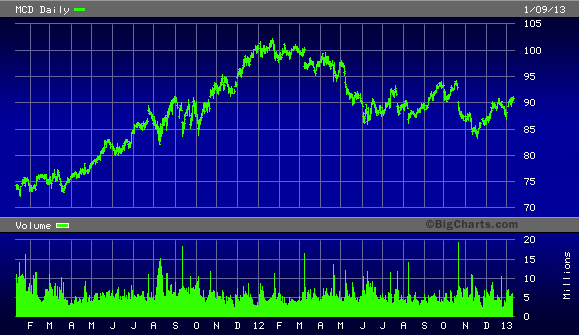
McDonalds share price has lagged over the last year, falling roughly 10% over a period in which the market was up by more than 10%.  At 15 times expected earnings, McDonalds shares are not “cheap,” but neither are they particularly expensive for a company of McDonald’s quality.  I would be comfortable buying McDonalds on any significant dips.

I should also add that McDonalds pays a respectable dividend of 3.4% and that it is a serial dividend raiser.  The stock’s dividend has more than doubled since 2008.  Not too shabby in a world starved for quality yield.

Disclosures: Sizemore Capital is long MSFT.

SUBSCRIBE to Sizemore Insights via e-mail today.

The post McDonalds is the Microsoft of Burger Joints appeared first on Sizemore Insights.

Kenya cuts rate 150 bps to 9.5% on positive outlook

By www.CentralBankNews.info     The Central Bank of Kenya (CBK) cut its Central Bank Rate by 150 basis points to 9.50 percent, slightly more than the 100 basis points expected by economists, with the bank saying this reduction should increase the uptake of credit by the private sector and help re-align commercial interest rates.
    The CBK said the economic outlook was positive with stable inflation and foreign exchange rates, and the main risk to macroeconomic stability was a full resolution of the euro zone’s problems along with its high current account deficit.
    Last month the central bank had said slow global growth, volatile oil prices and the high current account deficit were the main risks.
    Kenya’s economy is recovering from the CBK’s aggressive rate hike campaign to combat inflation from 2011 until mid-2012 when the bank reversed course and started cutting rates. Last year it cut by a total of 700 basis points but commercial lending rates still remain above 19 percent.
    In December, Kenya’s inflation rate eased for the 13th month in a row to 3.2 percent, down from 3.25 percent in November and a new low for the year.
    The bank said the drop reflected a continued fall in food prices and easing demand pressures with non-food and non-fuel inflation down to 4.81 percent from 4.83 percent so both inflation measures were now below the government’s 5 percent medium term target.

    “These developments, coupled with improved weather conditions and declining international oil prices continue to support a low and stable short-term outlook for inflation,” the CBK said in a statement following a meeting of its monetary policy committee.
    Kenya’s economy continued to strengthen in the third quarter and confidence remains high, the bank said, with Gross Domestic Product expanding by an annual rate of 4.7 percent, up from 3.3 percent in the second quarter.
    The bank’s survey in December showed that the private sector expects inflation and exchange rates to remain stable this year and “increased optimism for a strong recovery in growth in 2013.”
    The CBK’s monetary easing had improved liquidity and stability in the interbank market and the downward trend in private sector credit growth has reversed, the bank said, with growth up to 9.07 percent in November from 7.12 percent in October.
    It also said that commercial banks’ lending rates had come down slightly and the number of loan applications had risen by 32.5 percent in November from October.
   
     www.CentralBankNews.info  
   

Is Sears the Next Berkshire Hathaway?

By The Sizemore Letter

I originally penned this articled in December 2011.  Given Sears stock action in the year that has passed, it’s worth another read.

A well-respected value investor buys an old American company in decline, promising to restore its fortunes.  Alas, the recovery never comes.  The economics of the industry have changed, and the company cannot compete with younger, nimbler rivals.  The company ceases operations, but the value investor holds onto the shell to use as an investment vehicle.

Could this be the future of Sears Holdings (Nasdaq: $SHLD) under Eddie Lampert?  Maybe; maybe not.  But it was certainly the case for Warren Buffett’s Berkshire Hathaway (NYSE: $BRK-A).

Unless you’re a history buff or a dedicated Buffett disciple, you might not have known that Berkshire Hathaway was not always an insurance and investment conglomerate.  It was a textile mill, and not a particularly profitable one.  It was, however, a cash cow.  And after buying the company in 1964, Buffett used the cash that the declining textile business threw off to make many of the investments he is now famous for, starting with insurance company Geico.

So, when hedge fund superstar Eddie Lampert first brought Kmart out of bankruptcy in 2003, the parallels were obvious.  With its debts discharged, the retailer would throw off plenty of cash to fund Lampert’s future investments.  And even if the retail business continued to struggle, Lampert could—and did—sell off some of the company’s prime real estate to retailers in a better position to use it.  Lampert sold 18 stores to the Home Depot (NYSE: $HD) for a combined $271 million in the first year.

That Lampert would use Kmart’s pristine balance sheet to purchase Sears, Roebuck, & Co.—itself a struggling retailer—seemed somewhat odd, but his management decisions after the merger seemed to confirm that his strategy was cash cow milking.   Lampert continued to talk up the combined retailer’s prospects, of course.  But his emphasis was on relentless cost cutting, and he invested only the absolute bare minimum to keep the doors open.  Sears Holdings didn’t have to compete with the likes of Home Depot or Wal-Mart (NYSE: $WMT). It just had to stay in business long enough for Lampert to wring out every dollar he could before selling off the company’s assets.

The strategy might have played out just fine were it not for the bursting of the housing bubble—which killed demand for the company’s Kenmore appliances and Craftsman tools—and the onset of the worst recession in decades.  With retail sales in the toilet (and looking to stay there for a while), there was little demand among competing retailers for the company’s real estate assets.

It’s fair to blame Lampert for making what was, in effect, a major real estate investment near the peak of the biggest real estate bubble in American history.  But investors  frustrated by watching the share price fall by more than 80 percent from its 2007 highs have no one to blame but themselves.   Anyone who bought Sears when it traded for nearly $200 per share clearly didn’t do their homework.  They instead were hoping to ride Lampert’s coattails while somehow ignoring the value investor’s core principle of maintaining safety by not overpaying for assets.

Lampert is a great investor with a great long-term track record, and there is nothing wrong with paying a modest “Lampert premium” for shares of Sears Holdings.  If you like Lampert’s investment style but lack the means to invest in his hedge fund, Sears may be the closest you can get.  But at $200 per share—or even $100—the Lampert premium had been blown completely out of proportion.  The same is true of Buffett, of course, or of any great investor.  As the Sage of Omaha would no doubt agree, there is a price at which Berkshire Hathaway is no longer attractive either.

This brings us back to the title of this piece—is Sears the Next Berkshire Hathaway?

I would answer “yes,” but not necessarily for the reasons you think.

Everyone assumes that Buffett’s decision to buy Berkshire Hathaway was a typical Buffett stroke of genius.  Nothing could be further from the truth.  In fact, Buffett revealed in an interview last year that Berkshire Hathaway was the worst trade of his career.

If you cannot view the video above, please follow this link: “Buffett’s Worst Trade“ 

We like to think of Warren Buffett as the wise, elder statesman of the investment profession, but Buffett too was young once and prone to the rash behavior of youth.  He had been trading Berkshire Hathaway’s stock in his hedge fund; he noticed that when the company would sell off an underperforming mill, it would use the proceeds to buy back stock. Buffett intended to sell Berkshire Hathaway its own stock back for a small, tidy profit.

We’ve all been there, Warren.

But due to a tender offer that Buffett took as a personal insult, he essentially bought a controlling interest in the company so that he could have the pleasure of firing its CEO.  And though it might have given him satisfaction at the time, Buffett called the move a “200-billion-dollar mistake.”

Why?  Because Buffett wasted precious time and capital on a textile mill in terminal decline rather than allocate his funds in something more profitable—in his case, insurance.  Berkshire Hathaway will still go down in history as one of the greatest investment success stories in history.  But by Buffett’s own admission, he would have had far greater returns over his career had he never touched it.

So, in a word, “yes.”  Sears probably is the next Berkshire Hathaway.  And investors who buy Sears at a reasonable price will most likely enjoy enviable long-term returns as Lampert’s plans are eventually realized.   But Mr. Lampert himself will almost certainly come to regret buying the company—if he doesn’t already.

SUBSCRIBE to Sizemore Insights via e-mail today.

The post Is Sears the Next Berkshire Hathaway? appeared first on Sizemore Insights.