German Gold Story Distracts from Supply & Demand Data, $1900 Forecast by July

London Gold Market Report
from Adrian Ash
BullionVault
Thurs 17 Jan, 08:10 EST

DOLLAR gold prices were little changed in London on Thursday morning, holding above $1682 per ounce as world stock markets, commodities and bonds were little changed.

Silver also held in its tight 2-day range, trading just shy of $31.50 per ounce.

Priced in Euros, the gold price edged 0.5% lower as the single currency rose.

“Amazingly,” says Thursday’s note from the commodity team at Commerzbank in Frankfurt, “the German Bundesbank’s [statement on] the future storage of its gold reserves attracted more attention yesterday than the latest data from Thomson Reuters GFMS – the research institute, which specializes in analysing precious metals.”

“Criminal masterminds and Hollywood scriptwriters have been put on notice,” says the Financial Times today, calling Germany’s 7-year plan to move 674 tonnes of gold from New York and Paris to Frankfurt “one of the biggest publicly announced shipments of the precious metal on record.”

But “given that this is not a question of buying or selling, it has no direct impact on the gold price,” notes Commerzbank.

Full-year 2012 gold data from Thomson Reuters GFMS yesterday estimated gold demand from all central banks, as a group, at a half-century high of 536 tonnes, up 17% from 2011.

The Swiss National Bank today said it expects to report a full-year 2012 profit of US$6.4 billion thanks to a rise in both the gold price and the Euro –  which the SNB printed Swiss Francs to buy in a bid to depress its own currency in 2011.

Gold demand from Chinese jewelry manufacturers meantime showed the first drop in 9 years, according to GFMS, while household demand in India – the world’s #1 consumers – also fell.

Global gold mining supply hit a new annual record, albeit only 0.2% higher from 2011 and barely 8% above the level of 2001.

Since then, the gold price has risen by more than 515%.

“Although there is now growing speculation around the structure and longevity of the US Federal Reserve’s QE programme, policies of ultra-low interest rates across the Western economies will persist in 2013,” said Philip Klapwijk, global head of the consultancy, and one of London’s top 10 gold price forecasters eight times in the last decade.

“This will continue to support investor interest in gold in the absence of low risk investments that can offer acceptable yields,” Klapwijk believes, forecasting a rise in the gold price to $1900 per ounce by July, with investment demand surging by one fifth.

“The run-up to the debt ceiling crisis-point at the end of February,” agrees Credit Suisse analyst Tom Kendall, quoted by Reuters today, “is going to be supportive of gold.

“Talks of downgrades from the major rating agencies will be part of it. This focuses people’s attention on the longer-term stability of the US debt [and] the longer-term value of the US Dollar.

“[That] benefits gold.”

Pegging “resistance” in gold at $1694 short term, “Wednesday marked the 8th consecutive day of higher lows” for gold, notes the latest technical analysis from Scotia Mocatta.

“Gold in particular has been lifted by a stronger Euro this morning,” says Standard Bank in London.

“Physical gold demand is also strong, as it has been since last Friday. While Chinese buying has been relatively subdued, buying interest from South East Asia and India has more than taken up the slack.”

As earnings season got underway on the stock market, shares in London-listed gold miner Petropavlovsk Plc today gained 5% after it reported a 13% rise in full-year output.

African Barrick Gold – whose shares dropped by more than a fifth the day it said takeover talks with a Chinese-state owned gold miner had failed this month – ticked lower again after it reported a drop in full-year output.

Other corporate news saw Rio Tinto’s CEO Tom Albanese stood down as the mining giant booked $14 billion of write-downs from what analysts have called its “disastrous” takeover of aluminum business Alcan.

Goldman Sachs said its quarterly profit tripled to a 3-year record of $2.8 billion after it cut bankers’ pay by 11%, aided by job cuts.

Rival investment-bank J.P.Morgan netted $2.2bn in the last 3 months of 2012, but CEO Jamie Dimon saw his bonus halved to $10m after letting the “London Whale” run up trading losses of $6bn.

Adrian Ash
BullionVault

Gold price chart, no delay   |   Buy gold online

Adrian Ash is head of research at BullionVault, the secure, low-cost gold and silver market for private investors online, where you can buy gold and silver in Zurich, Switzerland for just 0.5% commission.

(c) BullionVault 2013

Please Note: This article is to inform your thinking, not lead it. Only you can decide the best place for your money, and any decision you make will put your money at risk. Information or data included here may have already been overtaken by events – and must be verified elsewhere – should you choose to act on it.


Central Bank News Link List – Jan. 17: Fed concerned about overheated markets amid record bond-buying

By www.CentralBankNews.info

Here’s today’s Central Bank News link list, click through if you missed the previous link list. The list comprises news about central banks that is not covered by Central Bank News. The list is updated during the day with the latest developments so readers don’t miss any important news.

Euro Takes Additional Losses Following Finance Minister Comments

Source: ForexYard

Comments from an EU finance minister earlier this week, in which he said that the euro’s recent bullish movement is threatening to hurt exports in the region, continued to weigh down on the EUR/USD yesterday. Meanwhile, speculations that future Japanese monetary easing will not be as aggressive as once thought, continued to boost the yen. Today, analysts are forecasting significantly higher amounts of volatility in the marketplace, as the US is scheduled to release building permits, unemployment claims and manufacturing data. Better than expected news may encourage risk taking, which would boost higher-yielding currencies like the euro.

Economic News

USD – Investors Closely Watching today’s US Manufacturing Data

The USD/JPY extended its bearish trend yesterday, as speculations that new monetary easing steps to be initiated by the Bank of Japan will not be as aggressive as once thought continued to boost the yen. The pair fell more than 100 pips during the first part of the day, eventually trading as low as 87.77, before staging a minor upward correction during mid-day trading to reach the 88.30 level. Against the Swiss franc, the greenback was relatively stable for most of the day. The USD/CHF lost some 30 pips during morning trading, to reach as low as 0.9285, before bouncing back to 0.9315 later in the day.

US news is expected to be the main focus of today’s trading session. Traders will want to pay particular attention to the Building Permits and Unemployment Claims figures, set to be released at 13:30 GMT, followed by the Philly Fed Manufacturing Index at 15:00. Should either of the indicators come in above their forecasted levels, higher-yielding currencies, including the Australian dollar, Swiss franc and British pound, may see bullish movement against the safe-haven greenback during afternoon trading.

EUR – EU Finance Minister Comments Sends EUR/USD Lower

After a brief bullish correction during early morning trading yesterday, the EUR/USD resumed its downward trend later in the day. Analysts attributed the bearish movement to recent comments from the EU finance minister, in which he said that the euro’s recent gains threaten to hurt the export industry in the region. The EUR/USD fell from a peak of 1.3323 to reach as low as 1.3255 during afternoon trading. The common-currency had more luck against the British pound. The EUR/GBP advanced more than 30 pips during European trading to reach as high as 0.8312.

Today, euro traders will want to pay attention to the ECB Monthly Bulletin, scheduled to be released at 9:00 GMT. The bulletin outlines the ECB’s forecasts of the future economic situation in the euro-zone. If the report forecasts economic growth in the region, risk taking among investors could help the euro against its main rivals. Later in the day, US news also has the potential to impact the common-currency, with better than expected data expected to boost riskier currencies.

Gold – Gold Sees Modest Downward Correction

Gold prices took moderate losses during European trading yesterday, but remained within reach of a recent two-week high, as concerns regarding US lawmaker’s ability to raise the debt ceiling helped keep demand for the precious metal high. Gold fell more than $10 an ounce during morning trading, eventually reaching as low as $1673.38 before bouncing back to the $1677 level.

Today, gold traders will want to monitor US news and its impact on currency pairs like the EUR/USD and GBP/USD. If the news leads to upward movement for either of the pairs, gold would become more affordable for international buyers, which could result in upward movement for the precious metal.

Crude Oil – Increased Demand for Oil in US Boosts Prices

An increase in American demand for crude oil, highlighted by a significantly lower than forecasted US Crude Oil Inventories figure, led to bullish movement for crude oil during afternoon trading. Overall, the commodity gained more than $0.80 a barrel during the European session to reach as high as $93.91.

Today, crude oil traders will want to pay attention to the US Building Permits and Philly Fed Manufacturing Index figures, scheduled to be released at 13:30 and 15:00 GMT, respectively. If either of the indicators comes in above their forecasted levels, risk taking could give oil prices an additional boost.

Technical News

EUR/USD

A bearish cross has recently formed on the weekly chart’s Slow Stochastic, indicating that a downward correction could occur in the coming days. This theory is supported by the Williams Percent Range on the same chart, which is currently in overbought territory. Opening short positions may be the smart choice for this pair.

GBP/USD

The Bollinger Bands on the weekly chart are narrowing, indicating that this pair could see a shift in price in the near future. Furthermore, a bearish cross has formed on the same chart’s MACD/OsMA, indicating that the shift could be bearish. Opening short positions may be the smart choice for this pair.

USD/JPY

The Relative Strength Index on the weekly chart is in overbought territory, indicating that a downward correction may occur in the coming days. Furthermore, a bearish cross has formed on the same chart’s Slow Stochastic. Traders may want to open short positions for this pair.

USD/CHF

The Bollinger Bands on the weekly chart are narrowing, indicating that a price shift is likely to occur in the near future. Additionally, the MACD/OsMA on the same chart appears close for forming a bullish cross, indicating that the price shift could be upward. Opening long positions may be the best choice for this pair.

The Wild Card

Platinum

Both the Relative Strength Index and Williams Percent Range on the daily chart have moved into overbought territory, indicating that a downward correction could occur in the near future. This may be a good time for forex traders to open short positions, ahead of a possible bearish correction.

Forex Market Analysis provided by ForexYard.

© 2006 by FxYard Ltd

Disclaimer: Trading Foreign Exchange carries a high level of risk and may not be suitable for all investors. There is a possibility that you could sustain a loss of all of your investment and therefore you should not invest money that you cannot afford to lose. You should be aware of all the risks associated with Foreign Exchange trading.


Serbia raises rate 25 bps to contain inflation expectations

By www.CentralBankNews.info     Serbia’s central bank raised its benchmark rate by another 25 basis points to 11.50 percent, its seventh rate rise since mid-2012, continuing its fight to contain inflationary expectations.
    The National Bank of Serbia, which raised rates by 175 basis points in 2012, said headline inflation in December was again above its target range and core inflation of 8.2 percent was “relatively high” and higher administered prices had already been announced.
    “The reaction of monetary policy is aimed at preventing transmission of the effects of growth of regulated prices to other prices through higher inflationary expectations,” the central bank said in a statement, adding:
    “The measures of the National Bank of Serbia will also prevent the increased dinar liquidity to affect the formation of inflationary pressures and the pressures on the foreign exchange market.”
      Serbia’s inflation rate has been volatile and rarely within the central bank’s target range in recent years.  In December the inflation rate ticked up to 12.2 percent from November’s 11.9 percent.
    The central bank targets annual inflation of 4.0 percent, plus/minus 1.5 percentage points and it has been tightening policy since June to stabilize medium-term inflation and stem expectations.


    In the months ahead, the central bank expects another rise in inflation due to higher administered and food prices, peaking in March of April, but inflationary pressures are then expected to subside due to low demand, the arrival of the new agricultural season that should have a positive impact on inflation, and the government’s fiscal consolidation program.
    The central bank expects the inflation rate to return to the “border of the target” by the end of 2013.
   In 2008 Serbia’s inflation rate fluctuated from a low of 8.6 percent to a high of 14.9 percent, in 2009 the range narrowed to 5.2-10.7 percent and in 2010 the range was 3.7-10.2 percent.
    But in 2011 the range widened to 7.0-14.7 percent and in 2012 the range was 2.7-12.9 percent, with the high reached in October, largely due to the effect of drought on food prices.
    Serbia’s third quarter Gross Domestic Product contracted by 0.8 percent from the previous quarter for an annual shrinkage of 2.5 percent, higher than the 0.8 percent decline in the second quarter.
    In 2013 GDP is projected to rise 2.5 percent, helped by exports after a projected contraction of 2.0 percent in 2012, mainly due to the”disastrous effect on this year’s agricultural production” according to the November inflation report.

    www.CentralBankNews.info

Market Review 17.01.2013

Source: ForexYard

printprofile

A worse than expected Australian jobs report caused the AUD to turn bearish during Asian trading last night, while crude oil gave up some of its recent gains following a lower than expected US Crude Oil Inventories figure yesterday.

The Australian dollar fell close to 70 pips against the USD during the overnight session to eventually trade as low as 1.0493. Currently, the AUD/USD appears stable at 1.0505. Against the JPY, the aussie lost more than 100 pips following the jobs report, while the EUR/AUD has gained more than 60 pips since last night.

After gaining well over $1 a barrel during afternoon trading yesterday, largely due to signs that demand for oil in the US has gone up, crude saw a minor downward correction last night. The commodity fell just over $0.40, eventually reaching as low as $93.78, before bouncing back to its current level of $94.00.

Main News for Today

US Building Permits- 13:30 GMT
• Forecasted to come in at 0.91M, slightly higher than last month
• Better than expected data today could boost riskier assets, including the EUR and GBP

US Unemployment Claims- 13:30 GMT
• Forecasted to come in at roughly the same level as last week
• A significantly higher than forecasted result today may lead to risk aversion which would boost the USD and JPY

US Philly Fed Manufacturing Index
• Forecasted to come in at 7.1, slightly below last month’s
• A better than expected figure may encourage risk taking, which would boost higher yielding assets like crude oil

Forex Market Analysis provided by ForexYard.

© 2006 by FxYard Ltd

Disclaimer: Trading Foreign Exchange carries a high level of risk and may not be suitable for all investors. There is a possibility that you could sustain a loss of all of your investment and therefore you should not invest money that you cannot afford to lose. You should be aware of all the risks associated with Foreign Exchange trading.

Sri Lanka holds rate steady, says inflation risks minimal

By www.CentralBankNews.info     Sri Lanka’s central bank held its benchmark repurchase rate steady at 7.50 percent, saying the current policy stance was appropriate for economic growth to reach 7.5 percent this year and the risks of higher inflation were minimal.
    The Central Bank of Sri Lanka, which raised rates by a net 50 basis points in 2012, said effective demand policies last year were likely to have moderated aggregate demand sufficiently and this had helped rein in future inflation and inflationary expectations.
    “As a result, inflation is projected to moderate from March 2013 and reach mid-single digit levels thereafter,” the bank said in a statement.
    In December, Sri Lanka’s inflation rate eased to 9.2 percent from 9.5 percent in November.
    Credit extended to the private sector by commercial banks – which has been declining steadily following policy tightening in early 2012 – is targeted to grow by around 18.5 percent this year and the central bank said it would closely monitor this to make sure this takes place.
    “At the same time, since such rate of credit expansion is considered adequate to deliver an economic growth of 7.5 percent in 2013 without giving rise to any unfavourable demand driven inflationary pressures, the risk of future inflation increasing is expected to be minimal,” the bank said.

    In November private sector credit growth eased to 20.7 percent from a peak of 35.2 percent in March 2012 and net credit obtained by the government also declined substantially in December as a result of government efforts to meet fiscal targets.
    Sri Lanka’s Gross Domestic Product expanded by an annual rate of 4.8 percent in the third quarter, down from a rate of 6.4 percent in the second quarter. In 2011 Sri Lanka’s economy grew by 8.3 percent and the economy is estimated to have expanded by 6.5 percent in 2012.
    The central bank said it was targeting a higher balance of payments surplus in 2013 based on a better trade balance, increased earnings from service exports, higher remittances and increased flow to the government and capital markets from direct foreign investments.
    “As a result of  the significant foreign inflows already being witnessed, the rupee, which appreciated by 5.3 percent against the US dollar during the second half of 2012, appreciated further by 0.6 percent by 15 January 2013,” the bank said.
   
     www.CentralBankNews.info


CBA Shares ‘Priced for Perfection’: Sell Now

By MoneyMorning.com.au

Investing is supposed to be risky. It’s the risk that enables the returns.

If you wait until an investment has no perceived risk, then you’re buying the investment at a premium…the investment is ‘priced for perfection’.

Trouble is (and this is the paradox of investing) when an investment reaches this point, where it appears nothing can possibly go wrong, that’s when things can go wrong. And when that happens, because it’s so unexpected, it can result in big price moves…

Why CBA Shareholders Should Heed This Lesson

That’s why we offer caution to investors in Commonwealth Bank [ASX: CBA]. Two weeks ago the newspapers went bonkers at the news CBA was now valued at $100 billion.

As the Sydney Morning Herald reported:

The bank’s shares rose to its highest-ever value $63.24 at the close of trading on Thursday, as the ASX200 reached a 19-month high and the market continued to rally following the US Congress’ temporary aversion of the “fiscal cliff” crisis.

That’s got to be good news. As the report continued:

“People are comfortable with the fact that these are safe haven banks,” Bell Potter Securities banking analyst TS Lim said.

You get consistent cash flows coming out and very good risk-adjusted returns. You’ve seen a lot of banks blow up overseas but over here, it’s been well run and well-regulated…

“CBA has always had a positive trajectory. If you look at CBA’s earnings in the last 10 years, it’s been going up, compared to the other local and international banks that have dips here and there,” he said.

What phrase springs to mind? That’s right, ‘priced for perfection’.

When an asset is priced for perfection, you know what happens. Just look back at the stock market in 1999 and 2000. Back then, financial analyst Martin Sass told the Independent, ‘There won’t be a cataclysmic decline but the market is priced for perfection.

Sass said that in May 1999. At that point the Dow Jones Industrial Average was at 11,000. That was close to the top. Four years later the market had fallen below 8,000 points.

Even Gold Can’t Avoid This Phenomenon

When something is priced for perfection, it comes as a big shock after it’s shown things weren’t perfect. Two recent examples of pricing for perfection and the fascination with the market reaching specific are the US Gold ETF [NYSE: GLD] and Apple [NASDAQ: AAPL].

In August 2011, the Wall Street Journal reported:

GLD, the SPDR Gold Trust ETF, is now bigger in terms of assets than SPY, the SPDR S&P 500 ETF. GLD has $77 billion in assets, compared with $75 billion for SPDR…

The GLD ETF hit USD$183 in September 2011. By the end of the year it was down to USD$151. In September 2011, gold was priced for perfection. Investors were betting on the collapse of the fiat monetary system and the prospect of a US debt default. So far, that hasn’t happened.

Apple Shares Were Priced for Perfection

Another example. In August last year, the Sydney Morning Herald reported:

Apple became the most valuable public company of all time after its market value climbed beyond $US620 billion to surpass a milestone set by Microsoft more than a decade ago.

‘Its shares were up 2.3 per cent at $US662.73 in overnight trade, after having gained more than 8 per cent this month as Wall Street bets on the September 12 rollout of the latest version of the iPhone, the device that revolutionised the mobile industry.

Apple was priced for perfection. Its shares hit USD$705 in September. Today the shares are USD$506.09, and the market cap has slipped to USD$476 billion.

What happened to the market in 2000 and 2007, and what happened to the Gold ETF and Apple is what eventually happens to all stocks. They go up and up and up, until they’re priced for perfection and no-one can see how the stock price can possibly fall…but then the stock price falls.

Traders like Murray Dawes thrive from finding stocks that are priced for perfection. Those are stocks that are usually trading at the top of what Murray calls the ‘distribution’.

Right now, today…17 January 2012, it looks to us that Commonwealth Bank [ASX: CBA] is priced for perfection. So if there’s a stock on the Aussie market ripe for traders to short-sell, CBA seems to fit the bill.

That’s got to be a real risk for CBA shareholders.

Cheers,
Kris

From the Port Phillip Publishing Library

Special Report: The Big Money Secret of Ironstone Mountain

Daily Reckoning: A North Korean Investment Opportunity

Money Morning: How Central Banks Are Letting Inflation Get Out of Control

Pursuit of Happiness: Are You Brave Enough to Break From Technology?

Australian Small-Cap Investigator:
Why Speculating On Small-Cap Stocks is Your Best Bet in a Rigged Market

The Destructive Hand of Government Regulators

By MoneyMorning.com.au

Picture it, you’re out shopping. You see a t-shirt in a shop window. You like it, but it’s $50. So you decide to shop around first.

Just in case it’s cheaper elsewhere.

You walk 30 metres down the street and you see an identical t-shirt in another shop window. Same brand, same style, same colour. To you, it’s the same t-shirt, only this one only costs $30.

It’s a no-brainer, you’ll buy that one. You make your way towards the shop door…only to find a government official standing there — ‘I’m sorry sir, this is a foreign shop, you’re not allowed to enter. If you want to buy that t-shirt you’ll need to buy the one in the shop down the street.’

Sounds ridiculous, right? It is. But it’s all part of a much bigger picture. The plan to restrict your rights to make your own decisions over what you do, what you buy, and how you invest

Today’s Australian reports:

Resource and infrastructure giants will be told to spend more heavily with local manufacturing companies in a Gillard government plan due within weeks to aid struggling industries amid fears of a wave of further job layoffs.

‘Big investors will have to prove they support Australian manufacturers in a new directive from Canberra that adds to existing rules aimed at increasing demand for local steel, building products and other materials.’

It’s clear the Australian government thinks it knows best. The government knows which widgets, light fittings, steel bars and window frames a company should buy. If that isn’t central planning, we don’t know what is.

We won’t even go into the detail about how this will force prices up and harm other businesses and consumers. And we won’t explain how this will harm the businesses that profit from importing goods (docks, warehouses, transport firms, services companies)…those same businesses that employ dockers, warehousemen, truck drivers and admin staff.

Of course the government wants to impose the same restrictions on consumers. It already does to some extent…limiting the type of goods you can import, and whacking you with tax if the value exceeds a certain amount.

And on Tuesday, the Australian Financial Review reported:

The stock exchange wants companies to make greater use of trading halts, in the way that David Jones did last year when it received a hoax takeover offer.

It’s all part of the trend to take the control from your hands and put it in the control of government regulators. Companies can’t run their business, consumers can’t buy what they want, and investors can’t make their own decisions without a regulator butting in.

Cheers,
Kris

From the Port Phillip Publishing Library

Special Report: The Big Money Secret of Ironstone Mountain

Daily Reckoning: A North Korean Investment Opportunity

Money Morning: How Central Banks Are Letting Inflation Get Out of Control

Pursuit of Happiness: Are You Brave Enough to Break From Technology?

Australian Small-Cap Investigator:
Why Speculating On Small-Cap Stocks is Your Best Bet in a Rigged Market

Every Gold Investor Should Watch These Numbers Like a Hawk

By MoneyMorning.com.au

This frustrating period of going nowhere continues for gold investors. 2013 continues in the vein of 2012.

In the past week we’ve had a nice move from below $1,630 an ounce to $1,680. But that only leaves us flat on the year. Gold is being left behind by other markets.

Can we expect more of the same for the rest of the year?

The Repeating Patterns in Gold’s Bull Market

Let’s start with a long-term chart of gold since 2001 (below), and a reminder of my big-picture theory.

I’ve drawn two red tram lines around gold’s fairly orderly run up. Within this, you can see that the gold price has displayed a repeating pattern. I have idealised this with the dotted blue lines.

Gold makes a move up, then enters a period of consolidation, during which it is essentially flat. The period of consolidation tends to reflect the previous run up in both duration and magnitude. In other words, if gold has a spike up, as it did in late 2003, April-May 2006, early 2008 and summer 2011, it will have a corresponding spike down.

Looking specifically at the period from 2009 to 2011, you could interpret this as one big run-up – as identified by the dotted green lines on the chart. If this is the case, then our consolidation phase has further to run.

Alternatively, you could split the period into two distinct run-ups. You could argue that we had one surge in late 2009, followed by a consolidation in early 2010. The next run up began in the latter part of the year. I have shown this with blue dotted lines. If this is the case, our period of consolidation should now be drawing to a close.

Welcome to the rather arbitrary nature of technical analysis!

What happens next?

I want to zoom in now and look at the last two years. I have marked the range of gold’s consolidation. The red line is resistance. The amber line is support.

I’m not going to pull any punches here. As long as that amber support zone is not breached, my theory that we’re in a consolidation phase remains valid. If the amber zone is broken to the downside, then it could very well be game over. I see that $1,500-1,520 support zone as that critical.

For now, we are in an intermediate-term downtrend. This began in October. I have defined this with the two blue tram lines on the chart above. The moving averages (MA) are pointed lower too, which adds further evidence to the bear case.

If you look at gold against sterling, as the chart below shows, the picture is the same: a range-bound market, with an intermediate term downtrend in place.

There is resistance at just over £1,100 an ounce and support in the £960 to £1,000 zone. A break below, say, £950 and it could very well be game over. It beats me how it could be game over for gold against sterling, but, hey, I’m just a bod. My opinion counts for nothing. It’s all about the ticker.

On the positive side, however, gold yesterday broke out to multi-decade highs against the Japanese yen. Unless you’ve been hiding in a bunker (perhaps the wisest place to be) you will have heard that the yen has been on a Bank-of-Japan-inspired plunge in recent weeks. Japanese bullion investors will be glad of their gold. It has and will continue to protect them against the profligacies of their central bank and other policy-makers. (That said the yen must be due a reversal, such has been the speed of the recent move).

Could Gold be About to See a Massive Break-out?

On another positive note, gold data-wrangler Nick Laird of www.sharelynx.com pinged me an email yesterday, which I’d like to share with you. Laird is bullish. He cites a chart pattern from Robert Edwards and John Magee’s classic Technical Analysis of Stock Trends – the consolidation, the break-out, the re-test and then the major run.

Below is the chart Nick sent me. It is of gold since 2007. Take a look at it – then I’ll try to explain the lines he has drawn on it.

Looking first at 2008, you can see the period of consolidation from early in the year as gold fell from just over $1,000 to $680. When gold broke above the two falling black diagonal lines, this was ‘the break-out’. The inverted red ‘V’ marks the re-test.

We then had that wonderful, two-year ‘major run’ all the way to $1,920 an ounce, as marked by the rising green diagonal line.

Now to the current situation. Laird feels we have had the ‘consolidation’. The move above the two falling black diagonal lines in September 2012 was the ‘break-out’. The inverted red ‘V’ marks the ‘re-test’ – which ended a few days ago.

Next comes the ‘major run’.

Here are Laird’s words: “Theoretically, this buy point is a big one. We did the consolidation wedge from 2011 through to Sept 2012 and then broke out. We have just seen the test of the breakout and, ideally, this now should be the beginning of a new major leg up similar (and bigger) than the one from 2009-2011.

“Last time we went from $700 up to $1,900. This move should be larger and over a shorter time period. This is classic technical analysis, especially over a two-year formation. A breakout will be followed by gasps of surprise.”

Now, as I say, technical analysis can be rather arbitrary. Two people can look at the same chart and offer completely opposing interpretations. To give you an example, here’s the same chart of gold with a blue trend line. Since gold broke this trend in spring 2012, it has gone back to it and failed to get through, signalling a market reversal.

You can see whatever you want to see and argue whatever it suits you to argue. So if you use technical analysis, you have to find a system that works for you.

If it’s so arbitrary, you ask, then what’s the point? Well, the beauty of technical analysis for me at least is that it quickly becomes apparent if your interpretation of the market is wrong. That makes is easier to manage your risk and your money. A move below $1,600 an ounce would invalidate Laird’s interpretation. A move beneath $1,520 invalidates mine and indicates we really are in bear market territory. But a move above $1,800 and the above chart is wrong.

I happen to find Laird’s case compelling. Perhaps that’s because it’s ‘what I want to hear’ – it ties in with my own theory that our ‘consolidation phase’ should soon be drawing to an end. On top of this, I am, after a long wait, getting a buy signal on junior mining stocks, which adds further fuel to the bullish fire – more on that next week, perhaps.

But, as we all know, events have a habit of getting in the way of plans. If they do, let’s hope I can divorce myself from my theories.

Dominic Frisby
Contributing Writer, Money Morning

Publisher’s Note: This article first appeared in MoneyWeek

From the Archives…

Why the Australian Stock Market Will Climb in 2013
11-1-2013 – Kris Sayce

What Lower Interest Rates Mean for Australian Stocks in 2013
10-1-2013 – Kris Sayce

Downside in the Yen: Shinzo Abe and the Three Bears
9-1-2013 – Murray Dawes

How the ‘China Money’ Could Push Silver 58% Higher in 2013
8-1-2013 – Dr Alex Cowie

Brightest Comet in 333 Years to Signal a Major Rally in Gold?
7-1-2013 – Dr Alex Cowie

USDJPY is in consolidation of uptrend

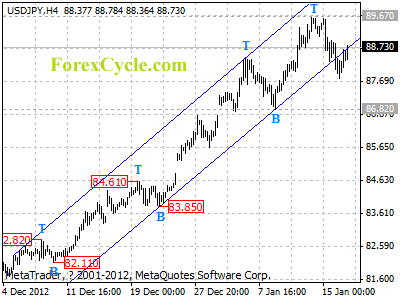
USDJPY broke below the lower line of the price channel on 4-hour chart, and is now in consolidation of the uptrend from 82.11. Range trading between 86.82 and 89.67 would likely be seen in a couple of days. Key support is at 86.82, as long as this level holds, the uptrend could be expected to resume, and another rise towards 95.00 is still possible. On the downside, a breakdown below 86.82 will indicate that the uptrend had completed at 89.67 already, then the following downward movement could bring price back to 84.00 zone.

usdjpy

Daily Forex Analysis