By www.CentralBankNews.info Angola’s central bank cut its BNA base rate by 25 basis points to 10.0 percent and said the country’s inflation rate in December continued to decline and hit the “lowest rate in Angola’s recent economic history.”
Angola’s annual inflation rate fell to 9.02 percent in December, the lowest that can be observed since January 2001, from 9.83 percent in November. The National Bank of Angola (BNA) has aimed to get inflation into single digits for many years and in August the rate fell below 10 percent for the first time ever and is continuing to decline.
The central bank, which also cut its base rate by 25 basis points last January but then kept rates steady the rest of the year, said the subindex for food and non-alcoholic beverages, miscellaneous goods and services and clothing and footwear recorded the biggest changes in December. It did not give further details.
Credit extended to the economy grew by 1.12 percent in December, for growth in 2012 of around 23 percent, continuing the trend seen in previous months, the BNA said.
The average exchange rate of the kwanza to the U.S. dollar was 95.826 at the end of December for a slight depreciation of 0.57 percent during 2012, “showing the stability of the national currency,” BNA said.
Safe Havens Assets “Under Pressure” as Gold, Silver Fall While Stock Markets Hit 5-Year Highs
London Gold Market Report
from Ben Traynor
BullionVault
Monday 28 January 2013, 07:00 EST
THE U.S. DOLLAR gold price extended its losses from last week Monday, dipping to a near-three-week low below $1655 per ounce during London’s morning trading, as stock markets ticked higher, with the FTSE 100 hitting its highest level since May 2008.
The S&P 500 meantime climbed above 1500 last week for the first time since December 2007.
Silver this morning dropped below $31 an ounce to hit a two-week low, while other commodities were broadly flat and US Treasuries gained.
Last week saw spot gold fall 1.5%, while silver was down 2.1%.
“It seems that a number of safe haven refuges like gold, the Japanese Yen, US Treasury bonds, and the Swiss Franc have all been under pressure lately,” says Ed Meir, metals analyst at brokerage INTL FCStone.
“Investors [are becoming] more comfortable parking their capital in riskier asset classes like the Euro and equity markets.”
The Swiss Franc is still “too strong”, Switzerland’s economy minister Johann Schneider-Ammann said Saturday, adding that he “hopes it will devalue further”.
“The Franc is still very strong,” Swiss finance minister Eveline Widmer-Schlumpf told reporters at the World Economic Forum in Davos the same day.
In September 2011, the Swiss National Bank announced a peg of SFr1.20 to the Euro in September 2011, following several years of Franc appreciation. The Swiss currency has weakened in recent weeks against the Euro, trading above SFr1.24 this morning, as the Euro has strengthened on the currency markets.
On Friday, SNB chairman Thomas Jordan told Davos he expects further weakening of the Franc.
A campaign to force a referendum on Switzerland repatriating all its foreign-vaulted gold bullion and increasing its gold reserves is nearing its target of 100,000 signatures.
Britain’s chancellor George Osborne would prefer to see the bank of England continue with its current inflation target policy framework rather than shift to targeting a nominal level of economic output, according to a report in the Financial Times Monday.
In a speech last month, Bank of Canada governor Mark Carney, who takes over at the Bank of England this summer, suggested a role for so-called nominal GDP targeting. When he spoke in Davos on Saturday however Carney “went out of his way not to mention nominal GDP”, the FT reports, but instead praised “flexible inflation targeting”.
Since the start of this month, Sterling has depreciated 4% against the Dollar and more than 5.5% against the Euro, which climbed to a 14-month high against the Pound this morning.
The gold price in Sterling meantime is up more than 2% from where it started January, while the Dollar gold price is flat on the month and gold in Euros is down 3%.
The so-called speculative net long position in Comex gold futures and options – calculated as the difference between ‘bullish’ long and ‘bearish’ short contracts held by noncommercial traders – ticked higher in the week ended last Tuesday, weekly data published Friday by the Commodity Futures Trading Commission show.
The world’s biggest gold exchange traded fund meantime continued to see outflows of bullion held to back its shares on Friday. The volume of gold held by SPDR Gold Trust (GLD) fell by nearly two tonnes from a day earlier to 1329.9 tonnes, its lowest level since the start of October.
The world’s largest silver ETF also continued to see outflows, with the volume of silver held by iShares Silver Trust (SLV) falling to 10,468.8 tonnes Friday – though this was still more than 300 tonnes above where it was 10 days previously following strong inflows.
“For the first time in eight weeks, ETFs’ commitment to silver has wavered,” says Standard Bank commodities strategist Marc Ground.
Kazakhstan and Russia both added to their gold reserves last month, International Monetary Fund figures show. Kazakhstan’s reserves rose 1.7% to 115.3 tonnes, the figures show, while Russia grew by 2.1% to 957.8 tonnes.
Russia’s central bank intends to continue buying gold, its first deputy chairman Alexei Ulyukayev said earlier this month, although he denied there is a target for gold to make up 10% of reserves.
Despite a flurry of new regulations to control “speculation” in Vietnam’s gold market, unlicensed trading of bullion continues, according to local press reports.
Some dealers and consumers have switched to trading rings and other jewelry pieces instead of gold bullion bars. This weekend, the State Bank said it will become the sole point for import and export of gold.
Gold value calculator | Buy gold online at live prices
Editor of Gold News, the analysis and investment research site from world-leading gold ownership service BullionVault, Ben Traynor was formerly editor of the Fleet Street Letter, the UK’s longest-running investment letter. A Cambridge economics graduate, he is a professional writer and editor with a specialist interest in monetary economics. Ben can be found on Google+
(c) BullionVault 2013
Please Note: This article is to inform your thinking, not lead it. Only you can decide the best place for your money, and any decision you make will put your money at risk. Information or data included here may have already been overtaken by events – and must be verified elsewhere – should you choose to act on it.
USD/CAD: USDCAD to Take on 1.0100 as BOC Remarks Continue to Weigh on Loonie
Treading a bullish channel in the second half of the month, the North American dollar pair has the US dollar advancing over its Canadian counterpart to commence this week’s currency exchanges. The USDCAD has appreciated after the Bank of Canada stated that the need for interest-rate increases was less urgent as it trimmed its economic-growth forecast.
Now moving above parity for the first time late last week since November, the Canadian currency is deemed to give up more gains to the Greenback today as there is not much lift expected from the Loonie. The currency pair is now poised to challenge the 1.0100 price level after gaining the most in eight months. Friday’s late exchanges flirted with the aforementioned price mark, and yet again earlier today.
In the recent monetary policy report from the Bank of Canada, BOC Governor Mark Carney said the need to raise interest rates is less urgent because the economy will take longer to reach full output, keeping inflation below target until the second half of next year. “The more muted inflation outlook and the beginnings of a more constructive evolution of imbalances in the household sector suggest that the timing of any such withdrawal is less imminent than previously anticipated,” Carney said at the press conference.
Further, Canadian inflation fell more than the median estimate of minus 0.2 percent, reaching a minus 0.6 percent in December. “We expected the numbers to be soft, but they fell even lower than expected,” said David Watt, chief economist at the Canadian unit in Toronto of HSBC Holdings Plc. “Canadian inflation is lingering near the lower part of the Bank of Canada target band and that provides more confirmation that Bank of Canada will not be raising interest rates anytime soon.”
Bearish remarks on the Loonie suggest a sell bias for the USDCAD to start the week’s exchanges. Nevertheless, it would be wise to keep watch for probable technical price corrections in the day’s trades.
For more news, analysis, technical charts and candlestick analysis, visit AlgosysFx Forex Trading Solutions.
Euro Bullish Ahead of Busy Trading Week
Source: ForexYard
The euro saw substantial bullish movement on Friday, amid signs that the euro-zone economic recovery is gaining momentum. Meanwhile, speculations that the Bank of Japan will take additional monetary easing steps in the near future caused the yen to extend its recent bearish trend. This week, traders can anticipate volatility in the marketplace as the US gets ready to release a batch of significant data. Today’s Pending Home Sales figure, a consumer confidence report tomorrow, the Advance GDP on Wednesday, and finally the Non-Farm Payrolls figure on Friday, can all help the US dollar if they signal improvements in the US economy.
Economic News
USD – All Eyes On US Employment Data This Week
The USD/JPY shot up to a fresh 2 ½ year high on Friday, as speculations that the Bank of Japan will ease monetary policy further continued to weigh down on the yen. The pair gained more than 70 pips during the first half of the day, eventually reaching as high as 91.18, before dropping back to 90.82, where it finished out the week.
Following a worse than expected US New Home Sales figure on Friday, investors shifted their funds to safe-haven assets, which helped the dollar reverse some of its recent losses against the Swiss franc. The USD/CHF gained more than 50 pips during afternoon trading, before closing out the week at 0.9268.
This week, traders can anticipate significant volatility in the marketplace, as attention shifts to the all-important US Non-Farm Payrolls figure, set to be released on Friday. In addition, traders will also want to pay attention to several other indicators out of the US throughout the week, including today’s Pending Home Sales figure and Wednesday’s ADP Non-Farm Employment Change and Advance GDP figures.
EUR – Signs of Improvements in EU Turns Euro Bullish
The euro saw gains against most of its main currency rivals on Friday, following the release of a better than expected German Ifo Business Climate figure and signs that the European banking sector is gaining strength. The EUR/USD gained more than 100 pips over the course of the day, eventually trading as high as 1.3475 before dropping back to 1.3458. Against the Japanese yen, the common-currency traded as high as 122.77, its highest level since April, 2011. The EUR/JPY finished out the week at 122.21.
In addition to the US news being released this week, euro traders will also want to pay attention to a batch of EU economic indicators. Specifically, tomorrow’s Gfk German Consumer Climate, Wednesday’s Spanish Flash GDP, German retail sales data on Thursday, and finally, manufacturing PMI’s for both Spain and Italy on Friday, could all boost the euro further if they indicate that the euro-zone economic recovery is gaining additional momentum.
Gold – Gold Takes Losses Following Positive EU News
Gold prices fell more than $16 an ounce on Friday, following positive German data which caused investors to shift their funds away from safe-haven assets. The precious metal traded as low as $1655.70 before bouncing back to $1658.44, where it finished out the week.
This week, gold traders will want to pay attention to a batch of US and euro-zone economic indicators, and their affect on the euro. Any signs that the global economic recovery gaining momentum is likely to boost the euro further, which could result in additional losses for gold prices.
Crude Oil – Crude Oil Remains Bullish
Crude oil prices remained within reach of their recent four-month high on Friday, as positive euro-zone news led to risk taking in the marketplace. The commodity traded as high as $96.53 a barrel during mid-day trading, before a slight downward correction to close out the week at $96.01.
This week, oil traders can anticipate heavy volatility in the marketplace as investors turn their attention to a batch of significant US data. If any of the news indicates growth in the US economy, speculations that American demand for oil will increase could help crude extend its bullish run.
Technical News
EUR/USD
A bearish cross is close to forming on the weekly chart’s Slow Stochastic, indicating that a downward correction could occur in the near future. This theory is supported by the Williams Percent Range on the same chart, which is currently in overbought territory. Opening short positions may be the best option for this pair.
GBP/USD
The Williams Percent Range on the weekly chart has fallen in into oversold territory, signaling that an upward correction could occur in the near future. This theory is supported by the Relative Strength Index on the daily chart, which is currently just below 30. Opening long positions may be the best choice for traders.
USD/JPY
The Relative Strength Index on the weekly chart is currently overbought territory, indicating that a downward correction could occur in the near future. Furthermore, the Slow Stochastic on the same chart has formed a bearish cross. Opening short positions may be the best choice for traders.
USD/CHF
Most long-term technical indicators show this pair trading in neutral territory, meaning a definitive trend is difficult to predict at this time. Traders may want to take a wait and see approach for this pair, as a clearer picture is likely to present itself in the near future.
The Wild Card
AUD/USD
The daily chart’s Slow Stochastic has formed a bullish cross, indicating that an upward correction could occur in the near future. Additionally, the Williams Percent Range on the same chart has fallen into oversold territory. This may be a good time for forex traders to open long positions, ahead of possible upward movement.
Forex Market Analysis provided by ForexYard.
© 2006 by FxYard Ltd
Disclaimer: Trading Foreign Exchange carries a high level of risk and may not be suitable for all investors. There is a possibility that you could sustain a loss of all of your investment and therefore you should not invest money that you cannot afford to lose. You should be aware of all the risks associated with Foreign Exchange trading.
Market Trends 28.01.2013
Source: ForexYard

Hey Everyone,
Below are some market trends for today.
Good luck!
-Dan
Gold- May see downward movement today
Support- 1642.42
Resistance- 1671.98
Silver- May see downward movement today
Support- 30.22
Resistance- 31.74
Crude Oil- May see downward movement today
Support- 94.93
Resistance-96.89
Dax 30- May see downward movement today
Support- 7744.91
Resistance- 7900.00
EUR/USD May see downward movement today
Support- 1.3358
Resistance- 1. 3478
Read more forex news on our forex blog
Forex Market Analysis provided by ForexYard.
© 2006 by FxYard Ltd
Disclaimer: Trading Foreign Exchange carries a high level of risk and may not be suitable for all investors. There is a possibility that you could sustain a loss of all of your investment and therefore you should not invest money that you cannot afford to lose. You should be aware of all the risks associated with Foreign Exchange trading.
Market Review 28.01.2013
Source: ForexYard
The euro saw a minor downward correction against the US dollar during overnight trading, but remained within reach of its recent 11-month high of 1.3477. The euro’s recent bullish run has been attributed to the strengthening European banking sector. Currently the EUR/USD is trading at 1.3445.
The USD/JPY also took slight losses during Asian trading, but remained close to a recent 2 ½ year high. Crude oil and gold prices have seen relatively little movement since markets opened for the week.
Main News for Today
US Core Durable Goods Orders- 13:30 GMT
• Forecasted to come in at 0.8%, well below last month’s 1.6%
• Worse than expected data could lead to dollar losses during mid-day trading
US Pending Home Sales- 15:00 GMT
• Forecasted to come in at 0.5%, well below last month’s 1.7%
• Worse than expected data could lead to dollar losses during afternoon trading
Read more forex news on our forex blog
Forex Market Analysis provided by ForexYard.
© 2006 by FxYard Ltd
Disclaimer: Trading Foreign Exchange carries a high level of risk and may not be suitable for all investors. There is a possibility that you could sustain a loss of all of your investment and therefore you should not invest money that you cannot afford to lose. You should be aware of all the risks associated with Foreign Exchange trading.
Central Bank News Link List – Jan. 28, 2013: Carney says flexible central banks not ‘maxed out’ on policy
By www.CentralBankNews.info Here’s today’s Central Bank News link list, click through if you missed the previous link list. The list comprises news about central banks that is not covered by Central Bank News. The list is updated during the day with the latest developments so readers don’t miss any important news.
- Carney says flexible central banks not ‘maxed out’ on policy (Bloomberg)
- Tilting towards a small (Indian) rate cut? (The Hindu)
- Japan defends stimulus, yen policy under fire (Reuters)
- China central bank sees 2013 GDP up 8%:report (MarketWatch)
- Reserve Bank (of New Zeland) tipped to leave interest rates on hold (radionz)
- Canada’s Flaherty expects April decision on central bank head (Reuters)
- FSA chairman calls for review of Bank inflation target (The Telegraph)
- Peru to buy back as much as $2 billion in bonds (Bloomberg)
- Chile finance minister would support central bank intervention on peso (Reuters)
- IMF says Yemen has room to cut interest rates (Reuters)
- www.CentralBankNews.info
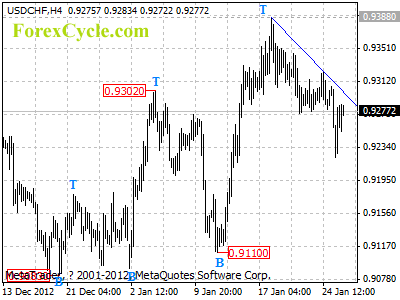
USDCHF stays below a downward trend line
USDCHF stays below a downward trend line on 4-hour chart, and remains in downtrend from 0.9388 and the fall extends to as low as 0.9222. Further decline is still possible after a minor consolidation and next target would be at 0.9150 area. Initial resistance is at the trend line, and the key resistance is located at 0.9325, only break above this level could signal completion of the downtrend.
Precious Metals & Miners Making Waves and New Trends
By Chris Vermeulen – TheGoldAndOilGuy.com
The precious metals sector has been dormant since both gold and silver topped in 2011. But the long term bull market remains intact. As long as we do not have the price of gold close below the lower yellow box on the monthly chart then technical speaking precious metals should continue much higher.
Large consolidation periods (yellow boxes) provide investors with great insight for investments looking forward 6-18 months upon a breakout in either direction (up or down). The issue with investing during these times is the passage of time. One can hold a position for months and sometimes years having their investments fluctuate adding extra stress to their life when they really do not need to.
Once a breakout takes place a powerful rally or decline will start putting an investors’ money to work within days of committing to that particular investment compared to money invested waiting months for the breakout and new capital gains to occur.
Gold Price Chart – Monthly

Gold Price Chart – Daily
The chart of gold continues to form a large bull flag pattern with a potential 3 or 5 wave correction. If price reverses this week and breaks above the upper resistance trend line then it will be a 3 (ABC) wave correction which is very bullish. But there is potential for a full 5 wave correction which is still bullish, but it just means we have another month or two before metals bottom.

Gold Miner Stocks – GDX ETF Chart – Daily
Gold miners do not have the sexiest looking chart. It was formed a strong looking bull flag but has continues to correct and is not nearing a key support level. This level could act as a triple bottom (bullish) or if price breaks below then it would be breaking then neckline of a massive head and shoulders pattern which points to 50% decline. I remain bullish with the longer term gold trend until proven wrong.

Silver Price Chart – Daily
Silver remains in a long term bull market much like the monthly chart of gold shown earlier in this report. Silver continues to work its way through a large bull flag pattern with a positive outlook at this time.

Silver Miner Stocks – SIL ETF – Daily Chart
Reviewing the precious metals sector it seems that silver miners have the sexiest looking chart. All price patterns are showing strength and are in proportion to one other. If this chart plays out to what technical analysis is pointing to then we could see the precious metals sector put in a bottom and rally within the next week or two. And if this is the case then silver miner stocks should provide the most opportunity going forward.

Precious Metals Trading Conclusion:
In short, what you need to focus on is the yellow consolidation box on the monthly gold chart. A breaking in either direction will trigger a massive move that should last 6-18 months. Until then long term investors can simply sit back and watch the sector while they put their money to work in other active sectors.
From a short term traders point of view, that f mine. I am looking for a signs of a bottom on the daily chart to get my money working earlier to play the bounce/rally that takes place and actively managing the position until a breakout occurs. The charts overall are not that clear as to when a breakout will take place. Metals could start to rally next week or in a few months and all we can do is wait for a reversal to the upside before we get active.
Knowing the big picture trends and patterns at play along with major support and resistance levels (breakout levels) is crucial for success and piece of mind.
Get my analysis, daily updates and trade alerts each day at www.TheGoldAndOilGuy.com
Chris Vermeulen
Monetary Policy Week in Review – Jan. 26, 2013: Pure inflation targeting crumbles further, 9 banks hold rates
The global trend toward flexible monetary policy and away from a singular focus on inflation accelerated this week as the Bank of Japan doubled its inflation target, the Bank of Canada delayed an rise in interest rates, the Bank of England governor said it was time to review the policy framework and a Riksbank board member called for a macroprudential framework that would help ensure financial stability.
Two forces are driving this change in monetary policy. Firstly, in the wake of the global financial crises, central bankers have become de facto responsible for financial stability along with price stability. Secondly, economic growth is inadequate in advanced economies despite central banks’ ultra-low interest rates and creative use of their balance sheets.
What we are now witnessing is a change to central banks’ operational framework that reflects the lessons of the global financial crises.
The 2007-2009 financial crises showed that low inflation does not prevent economic crises and may in fact contribute to the build-up of financial imbalances. If central bankers don’t pay close attention to credit and debt, which can accumulate without causing inflation, it poses a systemic risk that can destroy the livelihood of millions of people and wreck havoc on societies.
Central bankers no longer believe it makes sense to deal with the aftermath of financial crises – as former Federal Reserve Chairman Alan Greenspan suggested – because cleaning up after a crises is a complicated, costly and lengthy affair. Society is far better served if financial crises can be prevented.
Crises prevention has thus moved to the forefront of central bankers’ agenda. Financial regulation is increasingly focused on protecting the entire financial system, rather than just individual institutions, and the implementation of monetary policy must take financial stability into account, not just inflation.
Much was said in the press about the Japanese government’s pressure on the Bank of Japan to double its inflation target to 2 percent and its adoption of a Federal Reserve-style open-ended asset purchases, though first in 2014.
But little attention was paid to the fact that the BOJ never had an inflation target before – it was a goal – and the BOJ went to great lengths to stress that it was not adopting a rigid target, but rather a flexible UK-style target.
“Switching from a “goal” to a “target” reflects an increasing awareness regarding the importance of flexibility in the conduct of monetary policy in Japan,” the BOJ said, adding that monetary policy can’t just automatically react to price shocks in order to achieve a certain inflation target.
“It is not appropriate to run monetary policy mechanically aiming to achieve a certain inflation rate within a certain period of time in order to achieve sustainable growth with price stability,” the BOJ said, adding:
“Moreover, reflecting the recent experiences at home and abroad, many credit bubbles emerged under the recognition that prices were stable on a real-time basis, but they created large fluctuations in economic activity and prices after the bursting of the bubbles,” BOJ said, putting another nail in the coffin of strict inflation-targeters.
In Canada, where the Bank of Canada (BOC) two years ago first acknowledged that financial imbalances affect the inflationary target, the explicit reference to household debt in the same sentence as inflation was another reminder of the changes in the conduct of monetary policy.
In the U.K., Mervyn King, the outgoing governor of the Bank of England (BOE), said the UK’s focus on price stability remains essential but acknowledged there are times when inflation targets should be set aside due to concern over financial stability.
And with the U.K.’s inflation target almost 21 years old and coming of age, “it would be sensible to review the arrangements for setting monetary policy,” King said in Belfast.
In Sweden, Riksbank First Deputy Governor Kerstin af Jochnick said monetary policy was now taking household debt into account when setting interest rates because the financial crises had demonstrated that it poses a macro economic risk.
The reason for broadening the bank’s policy framework was simple: Sweden has no macroprudential framework to tackle household debt so by default the Riksbank has to take action.
The Riksbank’s position is symptomatic of the change in central banks.
Interest rates are a blunt instrument to manage household debt, a fact that Kerstin af Jochnick readily acknowledges. In the past, this argument was used by central banks to abdicate responsibility for pricking asset price booms.
Now, however, the Riksbank steps up to the plate and says it, just like the BOE, welcomes the added responsibility of overseeing financial stability.
“It is desirable that the Riksbank should be able to use the policy rate to an even greater extent to stabilise inflation and the real economy in the future, and that more appropriate tools than the repo rate can be used to reduce the risks of financial imbalances.
“A functioning framework for macroprudential policy can improve the conditions for ensuring that the Riksbank attains its two main objectives: price stability and financial stability,” Kerstin af Jochnick said in Stockholm.
Returning to this week’s policy decisions, 10 central banks met to decide on their policy stance with only the National Bank of Denmark adjusting rates upward in response to easing pressure on the krone from euro-zone investors seeking a safe haven.
Although Turkey held its benchmark rate steady, it continued to adjust its rate corridor, cutting both the floor and ceiling rates. As with other major central banks in advanced economies with rates effectively at the zero bound, the Bank of Japan should be counted in the easing camp due to further quantitative easing measures.
Through the first four weeks of 2013, 28 central banks have decided on monetary policy with 24, or 86 percent, keeping rates steady, two cutting rates and two raising rates.
LAST WEEK’S (WEEK 4) MONETARY POLICY DECISIONS:
| COUNTRY | MSCI | NEW RATE | OLD RATE | 1 YEAR AGO |
| JAPAN | DM | 0.10% | 0.10% | 0.10% |
| TURKEY | EM | 5.50% | 5.50% | 5.75% |
| NIGERIA | FM | 12.00% | 12.00% | 12.00% |
| MALAWI | 25.00% | 25.00% | 13.00% | |
| CANADA | DM | 1.00% | 1.00% | 1.00% |
| PHILIPPINES | EM | 3.50% | 3.50% | 4.25% |
| SOUTH AFRICA | EM | 5.00% | 5.00% | 5.50% |
| LATVIA | 2.50% | 2.50% | 3.50% | |
| DENMARK | DM | 0.30% | 0.20% | 0.70% |
| TRINIDAD & TOBAGO | 2.75% | 2.75% | 3.00% |
Next week (week 5) eight central banks will be deciding on monetary policy, including Israel, Colombia, India, Hungary, the United States, Malaysia and New Zealand. Angola’s central bank will issue its decision on Monday as the bank’s policy committee did not finish its deliberations last week.
| COUNTRY | MSCI | MEETING | RATE | 1 YEAR AGO |
| ANGOLA | 28-Jan | 10.25% | 10.25% | |
| ISRAEL | DM | 28-Jan | 1.75% | 2.75% |
| COLOMBIA | EM | 28-Jan | 4.25% | 5.00% |
| INDIA | EM | 29-Jan | 8.00% | 8.50% |
| HUNGARY | EM | 29-Jan | 5.75% | 7.00% |
| UNITED STATES | DM | 30-Jan | 0.25% | 0.25% |
| MALAYSIA | EM | 31-Jan | 3.00% | 3.00% |
| NEW ZEALAND | DM | 31-Jan | 2.50% | 2.50% |
