Forex Daily review brought to you by REAL FOREX | www.Real-forex.com
GBP/USD

Forex Daily review brought to you by REAL FOREX | www.Real-forex.com
GBP/USD

London Gold Market Report
from Ben Traynor
BullionVault
Wednesday 6 March 2013, 07:00 EST
U.S. DOLLAR prices to buy gold hovered around $1575 per ounce Wednesday morning in London, in line with last week’s close, as dealers in Asia reported an increase in demand for physical bullion, in contrast with exchange traded funds, which have continued to see selling, in what one analyst calls a “tug of war” between physical buying and ETF selling.
“Short-term, gold should drift lower to the short-term support line at $1569/65 or even to the previous low at $1555,” say technical analysts at Societe Generale.
“Initial support is at 1564.88,” adds UBS.
“A break below [that level] would expose $1556.50, the June 28 low and then $1533.70, the May 16, 2012 low.”
Gold in Sterling hovered just below £1045 an ounce for most of this morning, slightly down on the week, while gold in Euros stayed below €1210 an ounce.
Silver meantime hovered around $28.70 an ounce, very slightly up on the week, while other commodities were similarly flat. Stock markets extended yesterday’s gains, in contrast with major government bond prices which fell.
“We remain somewhat cautious on gold and silver,” says INTL FCStone analyst Ed Meir.
“They could be hit by a downward reversal if and when markets start to decouple from the surging equity markets.”
Stock markets in Europe extended yesterday’s gains this morning after several major indices closed at multi-year highs Tuesday.
In London, the FTSE 100 posted its highest close since January 2008 yesterday, while over in the US the Dow saw a new all-time record close and the S&P 500 closed at its highest level since October 31 2007, less than 2% off its all-time record close set earlier that month.
Yesterday saw the release of service sector purchasing managers’ index data for a number of economies, which indicated better-than-expected conditions in the US, UK and Eurozone.
“Looking forward,” says a note from Credit Agricole, “[stock market] sentiment could get further support from data this week as the {Federal Reserve’s] Beige Book today will probably show that employment continued to grow ahead of Friday’s jobs report.”
The latest US nonfarm payrolls figure and unemployment rate are due to be published this Friday. The consensus forecast among analysts is for an addition of 160,000 jobs last month, with the unemployment rate expected to stay at 7.9%.
Later today, the privately-produced ADP Employment report is due to be released at 08.15 EST.
Outflows from the world’s biggest gold exchange traded fund, the SPDR Gold Trust (ticker: GLD), continued yesterday for the eleventh day running, taking the total volume of gold held to back GLD shares to its lowest level since November 2011.
“It is really a tug of war between ETF selling and physical buying right now,” says Yuichi Ikemizu, head of commodity trading, Japan, at Standard Bank.
“We have seen quite good physical demand from China and Southeast Asia, but the ETF selling has put a lid on gold prices.”
In China, the most popular forward contract on the Shanghai Gold Exchange continued to trade a t a premium of around $20 an ounce compared to the international wholesale gold price Wednesday.
“We are seeing strong and growing support for gold from the physical market,” say Standard Bank commodity strategist Marc Ground, “as evidenced by our Standard Bank Gold Physical Flow Index, which places a floor at around $1560 an ounce.”
“If the buying from China, Indonesia and Thailand continues, it will not be very easy to get physical supply,” one dealer in Singapore told newswire Reuters this morning.
South Korea’s central bank bought 20 tonnes of gold last month, taking its total gold reserve to 104.4 tonnes, 1.5% of overall reserves, it said in a statement.
“As the gold purchase aims to diversify the foreign exchange portfolio over the long haul, gold prices’ short-term volatility have not been considered,” said Lee Jung, head of the Bank of Korea’s investment strategy team.
February also Russia and Kazakhstan continue to buy gold.
Gold value calculator | Buy gold online at live prices
Editor of Gold News, the analysis and investment research site from world-leading gold ownership service BullionVault, Ben Traynor was formerly editor of the Fleet Street Letter, the UK’s longest-running investment letter. A Cambridge economics graduate, he is a professional writer and editor with a specialist interest in monetary economics. Ben can be found on Google+
(c) BullionVault 2013
Please Note: This article is to inform your thinking, not lead it. Only you can decide the best place for your money, and any decision you make will put your money at risk. Information or data included here may have already been overtaken by events – and must be verified elsewhere – should you choose to act on it.
Over in the Blue corner of our office, we have China bear, Greg Canavan…
And here in the Red corner, you have yours truly: China bull, Alex Cowie.
If you’re worried things may get out of control, don’t. We’re good mates really, we just have different views on where China’s economy is heading.
In fact I take my hat off to Greg. Because it is hard work defending an unpopular stance – particularly when the data is going against you.
Already this year, we’ve seen a surge in China’s growth rate from 7.4% to 7.9%.
Then last week we had another round of positive monthly numbers from China’s business sector, in the form of the ‘Purchasing Managers Indices’ (PMI).
Now I’ll admit: taking pot shots across the office is good fun.
But in reality, this is a crucial debate.
The future for the Australian economy, your retirement savings, and your future quality of life all depends on which one of us is right…
Please tune into our free google plus page to give us your two cents worth.
Now here’s the problem with the China bear argument (including Greg’s), Chinese economic growth is already recovering.
And with China’s economy firing up again, the resources sector is putting a woeful 18 months behind it and is turning around right now. It’s happening in slow motion, like an iron ore vessel changing course – but the trend of resource stocks is finally pointing up once more.
So since the start of the year I’ve been tipping iron ore and copper stocks for Diggers and Drillers readers to profit from this move. I’ve also put coking coal on the radar.
The latest fly in the ointment for the China bears was the latest round of Purchasing Managers Index data. This includes both the official reading, and HSBC’s reading.
These data give an up-to-data reading on the pulse of Chinese business. And both were in positive territory (above 50) again.

So, what does this mean?
Well, here’s a recap: a reading of 50 suggests industry is stable, and therefore that economic growth is stable. Above 50, and China’s economic growth is accelerating. Below 50 suggests economic growth is decelerating. Easy, right?
Therefore the latest official reading of 50.1 means it was a positive reading, and therefore China’s economic growth is accelerating.
However, never in the history of statistics has the market misunderstood one indicator more.
Some were calling 50.1 a ‘bad reading’ – because it had dropped from 50.4 in January.
This simply isn’t true.
50.1 is still expansionary – it suggests China’s economy is still accelerating, just not at the same rate.
Now look again at the readings China put in last quarter: 50.2 in October, 50.6 in November, and then 50.6 in December. To put them in context, 55 would be a very strong result, and was what we used to see before the GFC.
Yet those readings of 50.2, 50.6, and then 50.6 were still enough to drive Chinese economic growth from 7.4%, to 7.9% last quarter.
My point here is that all we need is for the purchasing manager numbers to stay even just slightly above 50 this quarter, and we’re likely to see China’s growth creep above 7.9% at next count.
So China’s economy is well on track for this already. And don’t forget that China was closed for business for a week in February due to the Chinese New Year. Without this, the number would probably have been above 50.1.
But to avoid getting too bogged down in individual data points (government data, no less) it’s wise to step back, and look at the big picture.
To this end, in a few weeks I’ll be writing to you from Hong Kong.
I know, I know. Hong Kong isn’t quite the same thing as China. But it will give me a better view than you get from a desk in St Kilda.
You’ll be getting scoops from me on most days, as I attend, and speak at, the ‘Hong Kong Mines and Money’ conference.
Unleashed for four days, I’ll listen to, and get to meet with, a bevy of Chinese bankers, fund managers, analysts and companies.
And to test the ‘official line’ against reality, I’ll also meet with my on-the-ground contacts over there, to get their two cents. It’s will be a busy week. I can’t wait to get over there.
You can always get a good feel for the industry just by assessing the mood in the room at events like this. And I expect the mood to be buoyant. There looks set to be a record attendance, which is a good start.
But the real reason for the excitement is that Chinese lending figures have taken off. Here’s a snippet of what I wrote last week to Diggers and Drillers readers about this:
‘This is lending at a pace never seen before in China. China means business. Even China’s stimulus package in the depths of the GFC looks modest by comparison. That four trillion Renminbi injection China announced back in November 2008 marked the turning point for the Australian resource sector, and preceded a rally that saw the Metals and Mining index double in just over two years.‘So just contemplate that including the RMB2.5 trillion China lent out in January, China has now lent a total of RMB5.6 trillion over the last three months.
‘This flood of lending could go straight into infrastructure projects that could create massive demand for key commodities in both the months and years ahead. It reinforces my bullishness on the resource sector, and as resource stock prices are still just getting off their knees, this is a very exciting time to be looking at oversold resource juniors.
‘Of course, not all of this money will feed into infrastructure. It’s no coincidence that the Shanghai stock market has bounced 17.5% in the last three months. Chinese property prices are on the move too, with Beijing house prices up 5.4% over two months. The government is discussing property purchase restrictions to hold back these price hikes.
‘Some speculation is inevitable, however the majority of the capital should still feed into infrastructure spending. The reason I say this is that China Development Bank is the biggest conduit of lending into government approved projects, and it has seen a big jump in activity recently.
‘It has just announced recent loans totalling 1RMB billion on infrastructure projects.
‘These vary from coal-oil transport, water conservation, agriculture, forestry, telecommunications, power networks, public infrastructure, strategic technology, culture, environment, and energy-saving government-supported housing projects.
‘It is clear that CDB is driving this jump in loans. More are likely to follow, as the government uses CDB to finance further infrastructure projects.’
Make no mistake…
The colossal sum of lending in China is heading for major infrastructure projects – and it will have a big impact on commodity demand, and in turn, the resource sector.
After two long years of pain, the swing back up from oversold levels will make resource stocks a rewarding place to be in 2013.
Dr Alex Cowie
Editor, Diggers & Drillers
Join me on Google+
From the Port Phillip Publishing Library
Special Report: Just Discovered: The Pangaea Bond
Daily Reckoning: Politicians Are Clowning Around With Your Wealth
Money Morning: Buy Gold When They’re Crying…Sell Gold When They’re Yelling
Pursuit of Happiness: Freedom of Innovation is the Only Guarantee of Economic Growth
If you’ve ever suspected gold prices are being manipulated, you’re not alone – and you’re right, they are.
Against the backdrop of fiscal mismanagement, political incompetence, and failed austerity measures, the world’s biggest traders have all bet heavily on gold. Lately, they’ve been pulling out all the stops to get what they want while laughing all the way to bigger bonuses.
Today, I want to talk about who ‘they’ are and share a few tricks you can use to capitalize on their actions without being taken to the poorhouse.
Let’s begin with the concept of manipulation itself.
In order to understand the players, you have to understand their motivations. You’d think it’s all about profit, but that’s not entirely true…
The financial markets are like a football game in that there is a constant flow of energy between participants. Sometimes the game gets very aggressive, leading to smash and bash tactics intended to crush the opposing ‘team’.
Other times, the game is much more subtle, with all kinds of complicated feints and patterns being run to wear down the other side to the point where they make mistakes.
Neither changes the objective – which is, of course, to win.
Traders, especially the big ones acting on behalf of mega hedge funds, large-scale private funds, institutions, and various central banks, do the same thing. They attack the markets with all the ferocity of a top-tier coach orchestrating the most effective combination of plays and players in an all-out effort to win the game that literally starts each day when the opening bell goes off.
If they want to push prices higher, they can work to build momentum to the point where computerized arbitrage programs kick in with ‘buys’ of their own. If they’ve had enough, they can quietly begin selling into strength, hoping to slip out the back door as the new partygoers are enticed in the front.
If they want prices to move lower, they can simply walk away from the ‘bid’, a tactic used with amazing success and alarming regularity. Absent consistent buying, sellers have no choice but to lower their ‘ask’…until the buyers come back.
Or, perhaps they will even try to move the markets with a few well-placed comments in the cyber-ether.
Television host and former hedge fund manager Jim Cramer talked explicitly about how this is done on The Daily Show with Jon Stewart during a stunning March 12, 2009 interview, which referenced earlier footage from a December 22, 2006 interview he did with Daily Ticker host Aaron Task.
During this now-infamous appearance, Cramer noted that he’d encourage anyone who’s in the hedge fund business to do it because it’s ‘legal and it’s a very quick way to make money. And very satisfying.’
He also told Task that while it’s illegal to create an impression that a stock’s down all by yourself, ‘you do it anyway because the SEC doesn’t understand it.’ And you do it in such a way that you get the story-hungry media to do your dirty work for you, making prices move accordingly.
More commonly though, bigger firms like JPMorgan, Goldman Sachs, PIMCO or any of a dozen other behemoths will simply release a ‘research report’ that is interpreted as gospel by the mainstream media and swallowed hook, line, and sinker by millions of unsuspecting investors as a reason to buy or sell.
This allows mega-traders to engage a far wider audience – the retail investor. That, of course, is exactly what traders want to see, because it gives them the ability to buy or sell to the last incremental counterparty for maximum gains…right before they move the asset of choice completely in the other direction.
I think that’s the case with gold right now. Of course, it’s also the case with the S&P 500, which is moving higher despite overwhelming structural and fundamental economic problems – but that’s a related story for another time. ‘Manipulation’ works in both directions, especially when it’s being orchestrated by the Fed and other central banks in the name of political expediency.
Goldman Sachs, for example, recently released a report suggesting that gold’s 12-year bull market run is over and that prices as low as $1,450/oz. are ahead.
I’d bet dimes to dollars there’s at least one in-house Goldman trading desk that’s shorted the you-know-what out of gold. Goldman is well known for trading directly against the interests of its clients and has reportedly done so on everything from Greek debt swaps to the Facebook IPO to Chinese companies.
Bigger private traders like George Soros and Louis Bacon Moore are far more subtle, but that doesn’t mean they’re not playing the same game. What makes them different, though, is the scale of their actions.
With billions at their disposal, these guys have no need to engage retail investors directly; instead, they look to capitalise on the disarray created by other trading firms and their prey.
In other words, they’ve learned to ‘read’ the game.
Soros, who famously ‘broke the Bank of England’ in 1992 to the tune of more than a billion dollars in profit, is the ultimate example. He knows exactly what ‘plays’ to call based on a combination of personal knowledge, careful study, and gut feel built up over decades – not to mention billions of dollars’ worth of success.
If you’re about to give up hope – don’t.
Believe it or not, as a retail investor you’ve got several advantages the bigger players don’t:
And, finally, remember that you’ve got simple, effective tactics at your disposal that can counter seemingly overwhelming odds – market manipulation or not:
1) ‘Go with the flow’ by selling into strength and buying during periods of weakness. This is counter-intuitive, so it takes a lot of guts and discipline, but it’s worth it. Doing so not only helps minimize risk, but it aligns you, and more importantly your money, with the biggest traders rather than against them. Under the circumstances with gold prices now off its peak, I’d be buying.
2) Buy and sell over time, not all at once. One of the simplest ways to do this is simply to split your capital into chunks and invest on the first day of each month. It’s a little more work than just hitting the buy or sell button one time, but given what dollar cost averaging makes possible, I think it’s worth it, especially when you consider the big boys do the same thing for exactly the same reason.
3) Pay attention to the fundamentals. The most successful traders of our time are finely tuned to the world around us and they don’t get distracted by aberrations, even if they’re the ones creating them. Stick to the facts: Fiat currencies are failing, the world’s central banks are buying more gold than they ever have in history, and the world stands on the brink of a 1930s-style currency war. In the long run all three are incredibly bullish influences for gold prices.
4) Use trailing stops. You never want to be in a position where you are second guessing the markets or the big traders who move them. Instead, use trailing stops to pre-identify both profit targets and loss management – just about every online broker offers them these days so there’s no excuse for not using them. More sophisticated investors can use put options to accomplish the same thing.
And at the end of the day, remember, it doesn’t matter who is manipulating gold (or any other asset class for that matter) as long as you can profit from it.
Keith Fitz-Gerald
Contributing Editor, Money Morning
Publisher’s Note: This article originally appeared in Money Morning (USA)
From the Archives…
Gold’s Dark Hour Before Dawn
1-03-2013 – Dr. Alex Cowie
The Primary Colours of Investing
28-02-2013 – Kris Sayce
Revealed: Inside a Share Trader’s Den
27-02-2013 – Murray Dawes
Where to Find Value in this Rising Stock Market
26-02-2013 – Kris Sayce
China Bull Versus China Bear – There Can Only Be One Winner
25-02-2013 – Dr. Alex Cowie
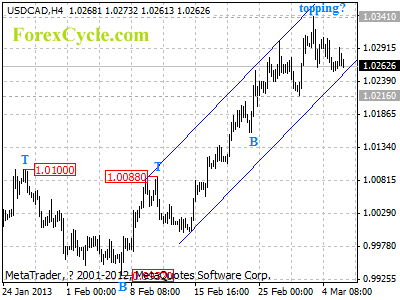
USDCAD is facing the support of the lower line of the price channel on 4-hour chart, as long as the channel support holds, the pair remains in uptrend from 0.9932, and the fall from 1.0341 could be treated as consolidation of the uptrend, another rise to 1.0400 is still possible after consolidation. On the other side, a clear break below the channel support will indicate that lengthier consolidation of the longer term uptrend from 0.9815 (Jan 11 low) is underway, then deeper decline to 1.0150 area could be seen.

Watch Charles Sizemore discuss the importance of social media in the modern investment advisory at Covestor’s Next Invest Conference.
If you cannot view the embedded video, please follow this link.
The post Charles Sizemore Talks Social Media at Covestor’s Next Invest appeared first on Sizemore Insights.
In the world of investing, so many things work better in theory than in practice.
Executive stock options? They are now reviled by investors as a way for management to quietly loot the companies they are paid to steward. When done in excess (which is the rule) they massively dilute shareholders over time. They also encourage short-termism and a fixation on raising the company’s stock price in the short term at the expense of planning for the company’s long-term future.
But before they became popular in the 1980s, they were touted as the solution to the age-old problem of aligning the interests of shareholders and management. Yes, even before the “decade of greed,” managers were seen as being self-serving and as managing the company for their own benefit rather than for the good of the shareholders. But if top executives were shareholders, then there would be no more conflicts of interests, right?
Well, it sounded good…in theory.
Along the same lines, share repurchases have become popular in recent decades as a tax-efficient alternative to cash dividends. Earnings paid out as dividends are taxed twice, at both the corporate and individual investor levels. But when a company uses that same cash to buy back its own shares in the open market, it can boost earnings per share without creating a taxable event.
And unlike dividends, which are generally paid regularly, stock buybacks can be done sporadically as their cash position allows. Management is often reluctant to raise the quarterly dividend because cutting that dividend if conditions took a turn for the worse sends a very bad signal to the investing public. But buybacks can be done quietly behind the scenes and can be stopped at any time without drawing attention.
Again, it sounded good…in theory. In practice, companies tend to have awful timing. They buy their stock when prices are high, but in a market panic when prices are low they are often unable to buy because a bad economic outlook causes them to hoard cash. In the worst cases, they actually have to issue new stock…at low prices that dilute shareholders. Buying high and selling low; this is not exactly a formula for maximizing shareholder value.
But the most insidious aspect of stock buybacks is that they often fail to reduce the number of shares outstanding.
How does that make sense? Simple. The company retires shares bought at full price on the open market to soak up new shares issued at a discount to fulfill employee and executive stock options. It’s highway robbery that is, sadly, perfectly legal.
How bad are the numbers here? Barron’s reported in January that the 500 largest U.S. companies repurchased about a quarter of their equity’s dollar value since 1998. But the number of shares outstanding actually grew more than 7%.
Don’t think that I am against stock buybacks, however. I’m a big fan of them, assuming that the stock is reasonably priced at the time and that the buybacks are actually used to reduce share count. But here, we have a mixed bag.
I recently highlighted three Dividend Achievers that were also reducing their share counts: Wal-Mart (NYSE:$WMT), Microsoft (Nasdaq:$MSFT) and Intel (Nasdaq:$INTC).
I love all three as long-term dividend payers to drop into your portfolio and forget. But of the three, Wal-Mart has been the friendliest to shareholders. Nearly all of its buybacks have gone to retiring shares, and the company has reduced its share count by a quarter over the past decade.
Microsoft and Intel have reduced their share counts too. Microsoft has shrunk its share count by 2.6 billion shares, or 23%, in the past decade. But its share repurchases are bigger than that by nearly half, with the rest being used for stock-based compensation. Intel’s performance on this count is also a mixed bag. But overall, I can’t complain too loudly. Despite some dilution from stock-based compensation, both have still managed to shrink their share count while simultaneously boosting cash dividends.
In any event, the key point to take away from this is that you should take the share buyback numbers you read about in press releases with a good-sized grain of salt. In a vacuum, a share repurchase plan means very little. They must actually reduce share count to be considered “shareholder friendly,” and they should only be implemented when market prices are favorable.
Disclosures: Sizemore Capital is long WMT, MSFT, and INTC
SUBSCRIBE to Sizemore Insights via e-mail today.
The post Don’t Be Fooled by Share Repurchases That Don’t Reduce Share Count appeared first on Sizemore Insights.
By www.CentralBankNews.info Uganda’s central bank kept its Central Bank Rate (CBR) steady at 12.0 percent for the fourth month in a row, saying upside inflationary risks had risen slightly but economic growth was below potential, credit growth was weak and the exchange rate stronger, factors that mitigate inflationary pressures.
The Bank of Uganda (BOU), which cut its CBR rate by 1100 basis points last year as inflation eased, said its forecast for “annual core inflation over the next 12-18 months remains largely unchanged at around 5 percent, though the upside risks have increased somewhat.”
Uganda’s headline inflation rate eased to 3.4 percent in February from January’s 4.9 percent due to lower food prices and annual core inflation was largely flat at 5.5 percent from January’s 5.6 percent.
“The monthly core inflation, however, accelerated, pointing to a buildup of core inflationary pressures that may need to be checked, if sustained,” the BOU said in a statement.
The central bank targets annual inflation of around 5 percent.
The BOU said growth in monetary aggregates continued to recover at a modest rate but shilling-denomined loans to the private sector remained stagnant due to high lending rates and the difficulties facing companies.
“Although real output is still below potential, real GDP growth is projected to gradually recover in 2013 and 2014; a projection which is supported by recent trends in the Composite Index of Economic Activity, that point to signs of increased buoyancy in the economy,” the bank added.
Uganda’s Gross Domestic Product expanded by 1.8 percent in the third quarter of 2012 from the second quarter for annual growth of 2.8 percent, down from 3.2 percent in the second quarter.
www.CentralBankNews.info